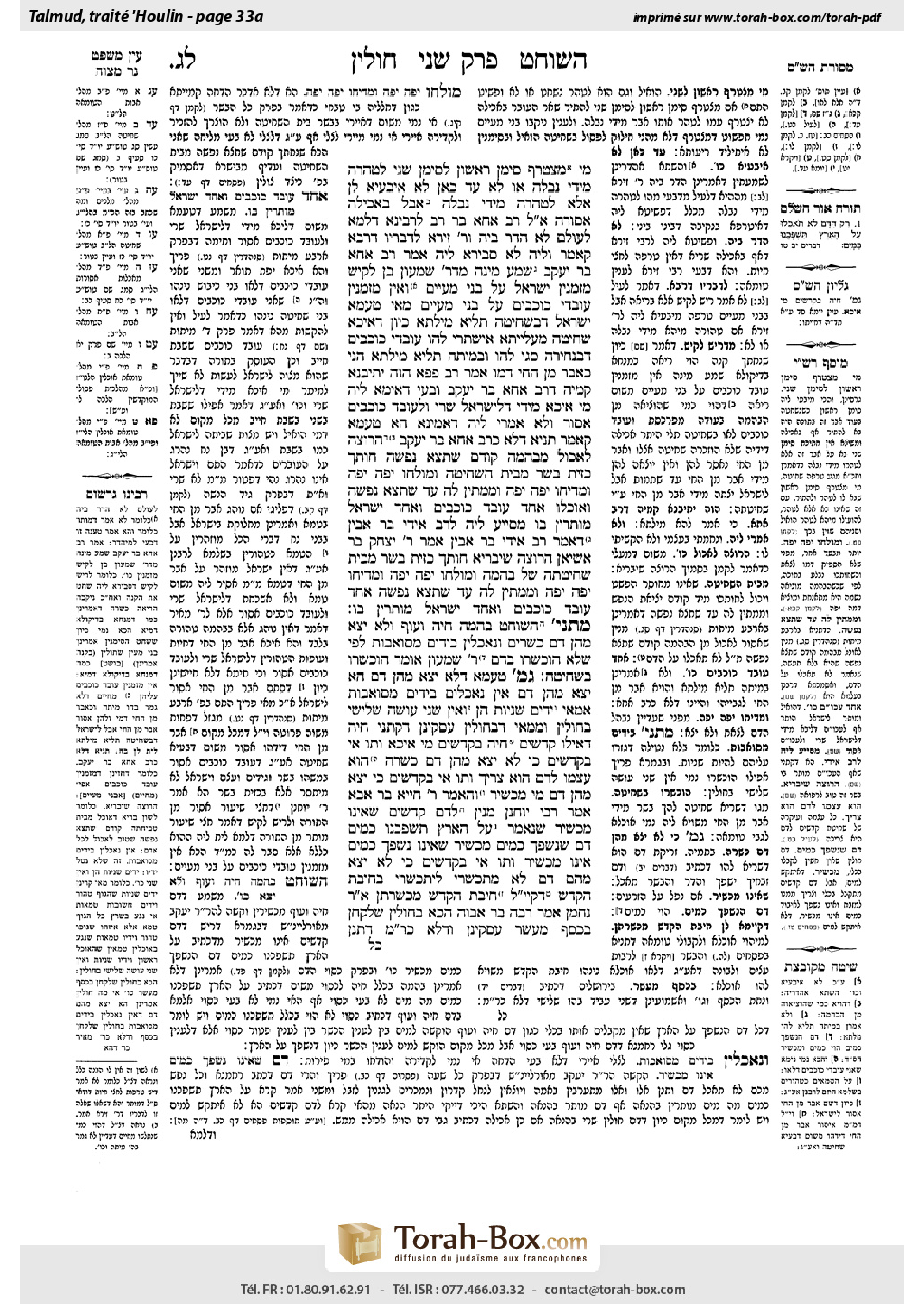
Chullin 33a: Talmud study for Daf Yomi
Study the Talmud for Daf Yomi with scanned pages, Hebrew text, English translations from Sefaria and AI-generated French translations.
Passage selection and English or AI-generated French translation are available where the scan has annotations. Daf Study is independent of Torah-Box and Sefaria.
Browse Chullin · חולין · All tractatesChullin 33a text and translations
This page of Chullin includes the Aramaic text, an English translation and an AI-generated French translation, alongside the scan above.
חולין ל״ג א · Aramaic and Hebrew text
מִי מִצְטָרֵף סִימָן רִאשׁוֹן לְסִימָן שֵׁנִי לְטַהֲרָהּ מִידֵי נְבֵלָה, אוֹ לָא?
עַד כָּאן לָא אִיבַּעְיָא לַן, אֶלָּא לְטַהֲרָהּ מִידֵי נְבֵלָה, אֲבָל בַּאֲכִילָה – אֲסוּרָה.
אֲמַר לֵיהּ רַב אַחָא בַּר רַב לְרָבִינָא: דִּלְמָא לְעוֹלָם לָא הֲדַר בֵּיהּ, וְרַבִּי זֵירָא לִדְבָרָיו דְּרָבָא קָאָמַר, וְלֵיהּ לָא סְבִירָא לֵיהּ.
אָמַר רַב אַחָא בַּר יַעֲקֹב: שְׁמַע מִינַּהּ מִדְּרַבִּי שִׁמְעוֹן בֶּן לָקִישׁ, מְזַמְּנִין יִשְׂרָאֵל עַל בְּנֵי מֵעַיִין, וְאֵין מְזַמְּנִין גּוֹי עַל בְּנֵי מֵעַיִין.
מַאי טַעְמָא? יִשְׂרָאֵל דְּבִשְׁחִיטָה תַּלְיָא מִילְּתָא, כֵּיוָן דְּאִיכָּא שְׁחִיטָה מְעַלַּיְיתָא – אִישְׁתְּרִי לְהוּ; גּוֹיִם דְּבִנְחִירָה סַגִּי לְהוּ וּבְמִיתָה תַּלְיָא מִילְּתָא, הָנֵי – כְּאֵבֶר מִן הַחַי דָּמוּ.
אָמַר רַב פָּפָּא: הֲוָה יָתֵיבְנָא קַמֵּיהּ דְּרַב אַחָא בַּר יַעֲקֹב, וּבְעַי דְּאֵימָא לֵיהּ, מִי אִיכָּא מִידֵּי דִּלְיִשְׂרָאֵל שְׁרֵי וּלְגוֹיִם אָסוּר? וְלָא אֲמַרִי לֵיהּ, דְּאָמֵינָא: הָא טַעְמָא קָאָמַר.
תַּנְיָא דְּלָא כְּרַב אַחָא בַּר יַעֲקֹב: הָרוֹצֶה לֶאֱכוֹל מִבְּהֵמָה קוֹדֶם שֶׁתֵּצֵא נַפְשָׁהּ – חוֹתֵךְ כְּזַיִת בָּשָׂר מִבֵּית הַשְּׁחִיטָה, וּמוֹלְחוֹ יָפֶה יָפֶה, וּמְדִיחוֹ יָפֶה יָפֶה, וּמַמְתִּין לָהּ עַד שֶׁתֵּצֵא נַפְשָׁהּ, וְאוֹכְלוֹ, אֶחָד גּוֹי וְאֶחָד יִשְׂרָאֵל מוּתָּרִין בּוֹ.
מְסַיַּיע לֵיהּ לְרַב אִידִי בַּר אָבִין, דְּאָמַר רַב אִידִי בַּר אָבִין אָמַר רַב יִצְחָק בַּר אַשְׁיָאן: הָרוֹצֶה שֶׁיַּבְרִיא, חוֹתֵךְ כְּזַיִת בָּשָׂר מִבֵּית שְׁחִיטָתָהּ שֶׁל בְּהֵמָה, וּמוֹלְחוֹ יָפֶה יָפֶה, וּמְדִיחוֹ יָפֶה יָפֶה, וּמַמְתִּין לָהּ עַד שֶׁתֵּצֵא נַפְשָׁהּ, אֶחָד גּוֹי וְאֶחָד יִשְׂרָאֵל מוּתָּרִין בּוֹ.
מַתְנִי׳ הַשּׁוֹחֵט בְּהֵמָה חַיָּה וָעוֹף וְלֹא יָצָא מֵהֶן דָּם – כְּשֵׁרִים, וְנֶאֱכָלִין בְּיָדַיִם מְסוֹאָבוֹת, לְפִי שֶׁלֹּא הוּכְשְׁרוּ בַּדָּם. רַבִּי שִׁמְעוֹן אוֹמֵר: הוּכְשְׁרוּ בַּשְּׁחִיטָה.
גְּמָ׳ טַעְמָא דְּלֹא יָצָא מֵהֶן דָּם, הָא יָצָא מֵהֶן דָּם – אֵין נֶאֱכָלִים בְּיָדַיִם מְסוֹאָבוֹת. אַמַּאי? יָדַיִם שְׁנִיּוֹת הֵן, וְאֵין שֵׁנִי עוֹשֶׂה שְׁלִישִׁי בְּחוּלִּין!
וּמִמַּאי דִּבְחוּלִּין עָסְקִינַן? דְּקָתָנֵי חַיָּה, דְּאִילּוּ קָדָשִׁים – חַיָּה בְּקָדָשִׁים מִי אִיכָּא? וְתוּ, אִי בְּקָדָשִׁים, כִּי לֹא יָצָא מֵהֶן דָּם – כְּשֵׁרָה? הוּא עַצְמוֹ לַדָּם הוּא צָרִיךְ!
וְתוּ, אִי בְּקָדָשִׁים, כִּי יָצָא מֵהֶן דָּם מִי מַכְשִׁיר? וְהָאָמַר רַבִּי חִיָּיא בַּר אַבָּא אָמַר רַבִּי יוֹחָנָן: מִנַּיִן לְדַם קָדָשִׁים שֶׁאֵינוֹ מַכְשִׁיר? שֶׁנֶּאֱמַר: ״עַל הָאָרֶץ תִּשְׁפְּכֶנּוּ כַּמָּיִם״, דָּם שֶׁנִּשְׁפָּךְ כַּמַּיִם מַכְשִׁיר, שֶׁאֵינוֹ נִשְׁפָּךְ כַּמַּיִם אֵינוֹ מַכְשִׁיר!
וְתוּ, אִי בְּקָדָשִׁים, כִּי לֹא יָצָא מֵהֶם דָּם לָא מִתַּכְשְׁרִי, (לִיתַּכְשְׁרִי) [לִיתַּכְשְׁרוּ] בְּחִיבַּת הַקֹּדֶשׁ! דְּקַיְימָא לַן חִיבַּת הַקֹּדֶשׁ מַכְשַׁרְתָּן.
אָמַר רַב נַחְמָן אָמַר רַבָּה בַּר אֲבוּהּ: הָכָא בְּחוּלִּין שֶׁלְּקָחָן בְּכֶסֶף מַעֲשֵׂר עָסְקִינַן, וּדְלָא כְּרַבִּי מֵאִיר, דִּתְנַן:
Chullin 33a · English translation
The Gemara clarifies this dilemma: Does the first siman join together with the second siman to purify the animal from the impurity of an unslaughtered carcass or not? In both cases the dilemma is: Does the cutting of the first siman, which serves the dual purpose of being a component of permitting consumption and preventing impurity of the animal, join together with the cutting of the second siman, which serves only the purpose of preventing impurity, in order to constitute a single act of slaughter and thereby prevent the animal from assuming the impurity of an unslaughtered carcass? Or perhaps because the cutting of each siman is performed for a different purpose they do not join together?
In any event, we raise the dilemma only in order to purify the foreleg from the impurity of an unslaughtered carcass. But with regard to eating the slaughtered animal, all agree that it is forbidden, as even Rabbi Zeira concedes that the animal is a tereifa and retracts his objection to the distinction that Rava proposed between the lungs and the innards.
Rav Aḥa bar Rav said to Ravina: Perhaps Rabbi Zeira actually did not retract his opinion, as even initially he held that there is no distinction between lungs and innards. If either is perforated after one siman was cut, the animal is a tereifa. And Rabbi Zeira stated his objection to the distinction of Rava in accordance with the statement of Rava, but he himself does not hold accordingly.
The Gemara continues its analysis of the statement of Reish Lakish, who said that after the windpipe is cut, the lung is considered as though it was placed in a basket, and if it is perforated before the slaughter is completed, the animal does not become a tereifa. Rav Aḥa bar Yaakov said: Learn from the statement of Rabbi Shimon ben Lakish that one may invite Jews to eat the innards of an animal that was slaughtered, but one may not invite gentiles to eat the innards of an animal that was slaughtered, because they are forbidden to gentiles.
What is the reason? For Jews the matter of rendering the meat of the animal fit for consumption is dependent upon the performance of a valid act of slaughter. Once there is full-fledged slaughter and both simanim are cut, the innards are permitted to them even if the animal is convulsing. But with regard to gentiles, for whom stabbing is sufficient and slaughter is not required, the innards are permitted only after the animal is completely dead, since the matter of rendering the meat of the animal fit for consumption is dependent upon its death. Therefore, if the animal is still convulsing, these innards, which are considered to be outside the body after the cutting of the two simanim, are considered like a limb from a living animal and it is forbidden for gentiles to eat them.
Rav Pappa said: I was sitting before Rav Aḥa bar Yaakov and I sought to say to him that his statement is difficult: Is there anything that is permitted for a Jew but prohibited for a gentile? But I did not say that to him, as I said to myself: Didn’t he say a reason for his ruling? Therefore, there is no reason to ask the question.
The Gemara notes: It is taught in a baraita not in accordance with the opinion of Rav Aḥa bar Yaakov: One who seeks to eat from the meat of an animal before its soul departs may cut an olive-bulk of meat from the area of the slaughter, the neck, and salt it very well, i.e., more than is normally required, and rinse it very well in water to remove the salt and the blood, and wait until the animal’s soul departs, and eat it. It is permitted for both a gentile and a Jew to eat it. Contrary to the statement of Rav Aḥa bar Yaakov, there is no distinction between Jew and gentile.
This baraita supports the statement of Rav Idi bar Avin, as Rav Idi bar Avin says that Rav Yitzḥak bar Ashyan says: One who seeks to recuperate from an illness should cut an olive-bulk of meat from the area of slaughter, i.e., the neck, of an animal, and salt it very well, and rinse it very well, and wait until the animal’s soul departs, and eat it. It is permitted for both a gentile and a Jew to eat it.
MISHNA: In the case of one who slaughters a domesticated animal, an undomesticated animal, or a bird, and blood did not emerge from them during the slaughter, all of these are permitted for consumption and do not require the ritual washing of the hands as they may be eaten with ritually impure [mesoavot] hands, because they were not rendered susceptible to ritual impurity through contact with blood, which is one of the seven liquids that render food susceptible to impurity. Rabbi Shimon says: They were rendered susceptible to ritual impurity by means of the slaughter itself.
GEMARA: The reason that they may be eaten with ritually impure hands is that blood did not emerge from the animals or birds during the slaughter; but if blood emerged from them during slaughter, they may not be eaten with ritually impure hands. The Gemara asks: Why not? Ordinary hands are impure with second-degree ritual impurity and an item of second-degree impurity cannot impart third-degree impurity to non-sacred items with which it comes into contact.
The Gemara clarifies: From where is it ascertained that we are dealing in the mishna with non-sacred food, and not with the slaughter of an offering? That is clear, as the tanna teaches in the list of those slaughtered: An undomesticated animal. As, if the tanna is referring to the slaughter of sacrificial animals and birds, is there any undomesticated animal included in the framework of sacrificial animals? And furthermore, if the tanna is referring to sacrificial animals, when no blood emerges from them are the offerings valid? The offering itself requires blood, as it is only through the presenting of the blood upon the altar that the offering is accepted.
And furthermore, if the tanna is referring to sacrificial animals, when blood emerges from them, does it render them susceptible to ritual impurity? But doesn’t Rabbi Ḥiyya bar Abba say that Rabbi Yoḥanan says: From where is it derived that the blood of sacrificial animals does not render food susceptible to ritual impurity? It is derived from a verse, as it is stated: “You shall not eat it; you shall pour it upon the earth like water” (Deuteronomy 12:24). Blood of a non-sacred animal, which is poured like water when it is slaughtered, renders food susceptible to ritual impurity. By contrast, blood of a sacrificial animal, which is not poured like water but is presented on the altar, does not render food susceptible to ritual impurity.
And furthermore, if the tanna is referring to sacrificial animals, when blood does not emerge from them are they not nevertheless rendered susceptible to ritual impurity? Let them be rendered susceptible to ritual impurity by means of regard for sanctity, as we maintain that regard for sanctity renders food suceptible to ritual impurity even in the absence of contact with any of the seven liquids.
Rav Naḥman said that Rabba bar Avuh said: Here we are dealing with non-sacred food that one purchased in Jerusalem with second-tithe money, which assumes the status of the second-tithe produce. This produce, in turn, assumes third-degree impurity through contact with hands that have second-degree impurity. And this mishna is not in accordance with the opinion of Rabbi Meir, as we learned in a mishna (Para 11:5):
Chullin 33a · Traduction française (IA)
La Guemara clarifie ce dilemme : Le premier siman se joint-il avec le deuxième siman pour purifier l'animal de l'impureté du cadavre non sacrifié ou non ? Dans les deux cas, le dilemme est : Le tranchage du premier siman, qui sert à la fois à permettre la consommation et à empêcher l'impureté de l'animal, se joint-il avec le tranchage du deuxième siman, qui sert uniquement à empêcher l'impureté, afin de constituer un seul acte de sacrifice et ainsi empêcher l'animal d'assumer l'impureté du cadavre non sacrifié ? Ou peut-être, puisque le tranchage de chaque siman est effectué pour un but différent, ils ne se joignent pas ensemble ?
En tout cas, nous soulevons ce dilemme uniquement afin de purifier la cuisse antérieure de l'impureté du cadavre non sacrifié. Mais concernant la consommation de l'animal sacrifié, tous s'accordent sur le fait qu'il est interdit, car même Rabbi Zéira admet que l'animal est un téréifah et retire son objection à la distinction que Rava avait proposée entre les poumons et les viscères.
Rav Acha bar Rav dit à Ravina : Peut-être que Rabbi Zéira n'a pas retiré son opinion, car même au départ il considérait qu'il n'y avait pas de distinction entre les poumons et les viscères. Si l'un est percé après que le premier siman ait été tranché, l'animal est un téréifah. Et Rabbi Zéira a exprimé son objection à la distinction de Rava conformément à l'affirmation de Rava, mais il ne l'applique pas lui-même.
La Guemara continue son analyse de l'affirmation de Réish Lakish, qui disait que, après que la trachée ait été tranchée, le poumon est considéré comme s'il était placé dans un panier, et si celui-ci est percé avant que le sacrifice ne soit achevé, l'animal ne devient pas un téréifah. Rav Acha bar Yaakov dit : Apprenez de l'affirmation de Rabbi Shimon ben Lakish que l'on peut inviter des Juifs à manger les viscères d'un animal sacrifié, mais on ne peut pas inviter des non-Juifs à manger les viscères d'un animal sacrifié, car ils sont interdits aux non-Juifs.
Quelle est la raison ? Pour les Juifs, la question de la pureté de la viande dépend de la performance d'un acte valide de sacrifice. Une fois qu'il y a un sacrifice complet et que les deux simanim sont tranchés, les viscères sont permis à eux même si l'animal convulse. Mais concernant les non-Juifs, pour lesquels le tranchage suffit et le sacrifice n'est pas requis, les viscères sont permis uniquement après que l'animal soit mort, car la question de la pureté de la viande dépend de sa mort. Ainsi, si l'animal est encore convulsif, ces viscères, qui sont considérés comme étant en dehors du corps après le tranchage des deux simanim, sont considérés comme un membre d'un animal vivant et sont interdits aux non-Juifs de les manger.
Rav Pappa dit : J'étais assis devant Rav Acha bar Yaakov et j'ai cherché à lui dire qu'il y a quelque chose qui est permis pour un Juif mais interdit pour un non-Juif. Mais je n'ai pas dit cela à lui, car j'ai pensé à moi-même : N'a-t-il pas dit une raison pour son jugement ? Donc, il n'y a pas de raison de poser cette question.
La Guemara note : Il est enseigné dans une baraïta, contrairement à l'opinion de Rav Aḥa bar Yaakov : Celui qui veut manger de la viande d'un animal avant que son âme ne s'élève peut trancher une quantité d'olive de viande dans la zone du sacrifice, le cou, et la saler très bien, c'est-à-dire plus que ce qui est normalement requis, et la rincer très bien dans l'eau pour enlever la saumure et le sang, et attendre que l'âme de l'animal s'élève, et manger. Cela est permis à la fois pour un non-Juif et un Juif. Contrairement à l'affirmation de Rav Aḥa bar Yaakov, il n'y a pas de distinction entre Juif et non-Juif.
Cette baraïta soutient l'affirmation de Rav Idi bar Avin, car Rav Idi bar Avin dit que Rav Yitzḥak bar Ashyan dit : Celui qui veut se rétablir d'une maladie doit trancher une quantité d'olive de viande dans la zone du sacrifice, c'est-à-dire le cou, d'un animal, et la saler très bien, et la rincer très bien, et attendre que l'âme de l'animal s'élève, et manger. Cela est permis à la fois pour un non-Juif et un Juif.
MICHNA : Dans le cas d'une personne qui sacrifie un animal domestique, un animal sauvage ou un oiseau, et que le sang n'est pas sorti pendant le sacrifice, tous ces animaux sont permis à la consommation et n'exigent pas le lavage rituel des mains, car ils peuvent être mangés avec des mains impures, car ils n'ont pas été rendus susceptibles d'impureté par contact avec le sang, qui est l'un des sept liquides qui rendent les aliments susceptibles d'impureté. Rabbi Shimon dit : Ils ont été rendus susceptibles d'impureté par le sacrifice lui-même.
GUEMARA : La raison pour laquelle ils peuvent être mangés avec des mains impures est que le sang n'est pas sorti des animaux ou des oiseaux pendant la bataille ; mais si le sang est sorti pendant la bataille, ils ne peuvent pas être mangés avec des mains impures. La Guemara pose la question : Pourquoi pas ? Les mains ordinaires sont impures à un degré d'impureté secondaire et un objet à un degré d'impureté secondaire ne peut pas transmettre un degré d'impureté troisième aux objets non sacrés avec lesquels il entre en contact.
La Guemara clarifie : D'où est-il établi que nous sommes en présence dans la mishna de nourriture non sacrée, et non du sacrifice d'un offrande ? Cela est clair, car le tanna enseigne dans la liste de ceux qui ont été sacrifiés : un animal sauvage. Car, si le tanna fait référence au sacrifice d'offrandes et d'oiseaux, y a-t-il un animal sauvage inclus dans le cadre des offrandes ? Et de plus, si le tanna fait référence aux offrandes, quand aucun sang n'émerge, les offrandes sont-elles valides ? L'offrande elle-même exige du sang, car c'est uniquement par la présentation du sang sur l'autel que l'offrande est acceptée.
Et de plus, si le tanna fait référence aux animaux sacrés, lorsque du sang en sort, cela rend-il ces animaux sujets à la souillure rituelle ? Mais ne dit pas Rabbi Ḥiyya bar Abba que Rabbi Yoḥanan dit : D'où est tiré le fait que le sang des animaux sacrés ne rend pas les aliments sujets à la souillure rituelle ? C'est tiré d'une parole, car il est dit : « Tu ne mangeras pas cela ; tu le verseras sur la terre comme de l'eau » (Deutéronome 12:24). Le sang d'un animal non sacré, qui est versé comme de l'eau lorsqu'il est tué, rend les aliments sujets à la souillure rituelle. En revanche, le sang d'un animal sacré, qui n'est pas versé comme de l'eau mais qui est présenté sur l'autel, ne rend pas les aliments sujets à la souillure rituelle.
Et de plus, si le tanna fait référence aux animaux sacrés, lorsque le sang ne sort pas d'eux, ne sont-ils pas tout de même rendus sujets à la souillure rituelle ? Laissons-les être rendus sujets à la souillure rituelle par le respect de la sanctité, car nous maintenons que le respect de la sanctité rend les aliments sujets à la souillure rituelle même en l'absence de contact avec l'un des sept liquides.
Rav Naḥman a dit que Rabba bar Avuh a dit : Ici, nous parlons d'aliments non sacrés achetés à Jérusalem avec l'argent de la deuxième part, qui acquiert le statut des produits de la deuxième part. Ce produit, à son tour, acquiert la souillure de troisième degré par contact avec des mains souillées à la deuxième degré. Et cette mitsva ne suit pas l'opinion de Rabbi Meir, car nous avons appris dans une mitsva (Para 11:5) :
Traduction française générée par IA à partir de l’édition anglaise de Sefaria. Vérifie toujours un passage avec le texte source.
Text from Sefaria: William Davidson Edition - Vocalized Aramaic (unknown); William Davidson Edition - English (CC BY NC).