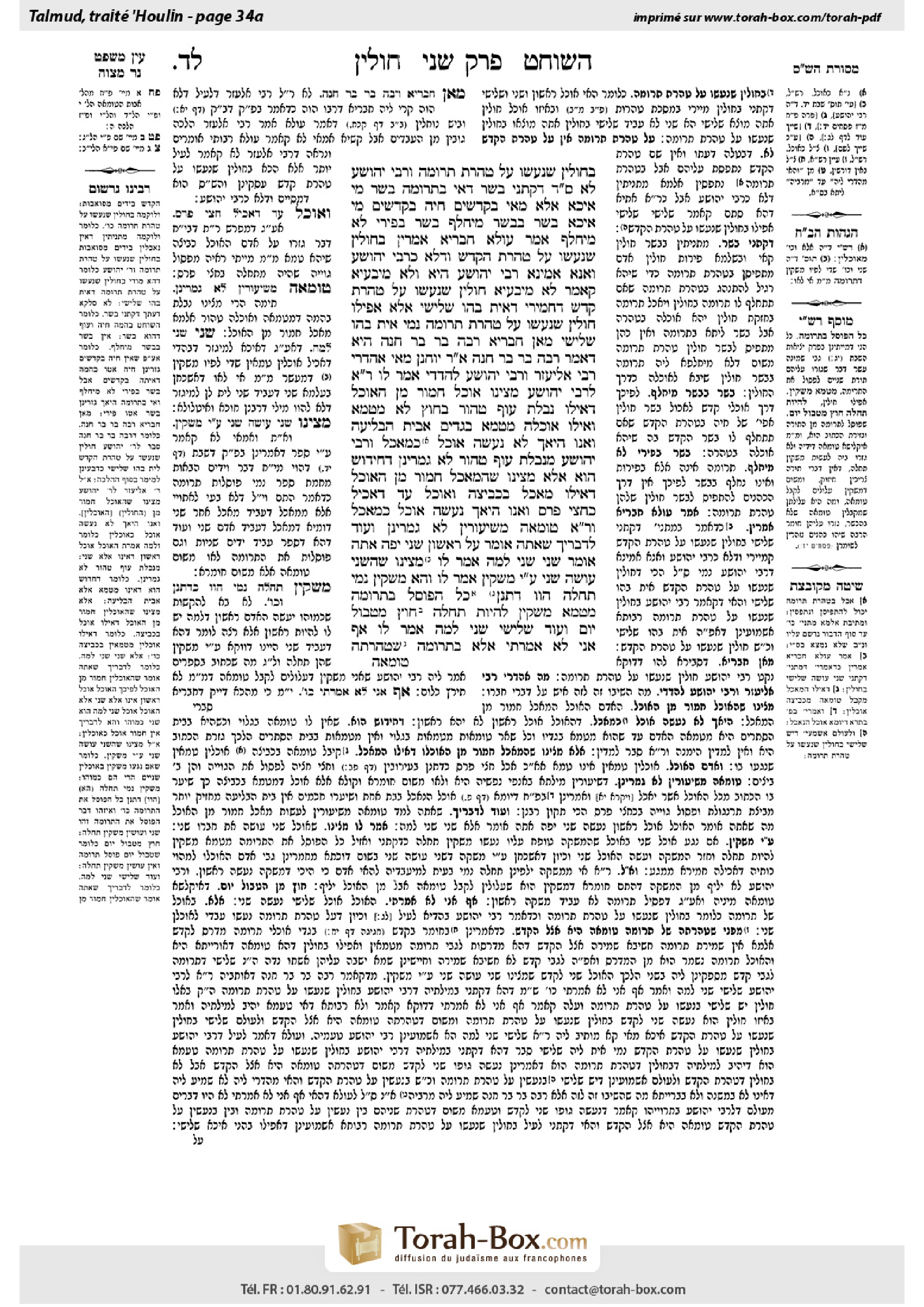
Chullin 34a: Talmud study for Daf Yomi
Study the Talmud for Daf Yomi with scanned pages, Hebrew text, English translations from Sefaria and AI-generated French translations.
Passage selection and English or AI-generated French translation are available where the scan has annotations. Daf Study is independent of Torah-Box and Sefaria.
Browse Chullin · חולין · All tractatesChullin 34a text and translations
This page of Chullin includes the Aramaic text, an English translation and an AI-generated French translation, alongside the scan above.
חולין ל״ד א · Aramaic and Hebrew text
בְּחוּלִּין שֶׁנַּעֲשׂוּ עַל טׇהֳרַת תְּרוּמָה, וְרַבִּי יְהוֹשֻׁעַ? לָא סָלְקָא דַּעְתָּךְ, דְּקָתָנֵי ״בָּשָׂר״, דְּאִי בִּתְרוּמָה – בָּשָׂר מִי אִיכָּא?
אֶלָּא מַאי, בְּקָדָשִׁים? חַיָּה בְּקָדָשִׁים מִי אִיכָּא? בָּשָׂר בְּבָשָׂר מִיחַלַּף, בָּשָׂר בְּפֵירֵי לָא מִיחַלַּף.
אָמַר עוּלָּא: חַבְרַיָּא אָמְרִין בְּחוּלִּין שֶׁנַּעֲשׂוּ עַל טׇהֳרַת הַקֹּדֶשׁ, וּדְלָא כְּרַבִּי יְהוֹשֻׁעַ.
וַאֲנָא אָמֵינָא רַבִּי יְהוֹשֻׁעַ הִיא, וְלָא מִיבַּעְיָא קָאָמַר: לָא מִיבַּעְיָא חוּלִּין שֶׁנַּעֲשׂוּ עַל טׇהֳרַת קֹדֶשׁ דַּחֲמִירִי דְּאִית בְּהוּ שְׁלִישִׁי, אֶלָּא אֲפִילּוּ חוּלִּין שֶׁנַּעֲשׂוּ עַל טׇהֳרַת תְּרוּמָה נָמֵי אִית בְּהוּ שְׁלִישִׁי.
מַאן חַבְרַיָּא? רַבָּה בַּר בַּר חָנָה הִיא, דְּאָמַר רַבָּה בַּר בַּר חָנָה אָמַר רַבִּי יוֹחָנָן: מַאי אַהְדַּרוּ רַבִּי אֱלִיעֶזֶר וְרַבִּי יְהוֹשֻׁעַ לַהֲדָדֵי?
אָמַר לוֹ רַבִּי אֱלִיעֶזֶר לְרַבִּי יְהוֹשֻׁעַ: מָצִינוּ אוֹכֵל חָמוּר מִן הָאוֹכֶל, דְּאִילּוּ נִבְלַת עוֹף טָהוֹר בַּחוּץ – לֹא מְטַמֵּא, וְאִילּוּ אוֹכְלָהּ מְטַמֵּא בְּגָדִים אַבֵּית הַבְּלִיעָה, וְאָנוּ הֵיאַךְ לֹא נַעֲשֶׂה אוֹכֵל כַּמַּאֲכָל?
וְרַבִּי יְהוֹשֻׁעַ: מִנִּבְלַת עוֹף טָהוֹר לָא גָּמְרִינַן, דְּחִידּוּשׁ הוּא. אֶלָּא מָצִינוּ שֶׁהַמַּאֲכָל חָמוּר מִן הָאוֹכֵל, דְּאִילּוּ מַאֲכָל בִּכְבֵיצָה, וְאוֹכֵל עַד דְּאָכֵיל כַּחֲצִי פְרָס, וְאָנוּ הֵיאַךְ נַעֲשֶׂה אוֹכֵל כַּמַּאֲכָל?
וְרַבִּי אֱלִיעֶזֶר: טוּמְאָה מִשִּׁיעוּרִין לָא גָּמְרִינַן, וְעוֹד – לִדְבָרֶיךָ שֶׁאַתָּה אוֹמֵר עַל רִאשׁוֹן שֵׁנִי – יָפֶה אַתָּה אוֹמֵר, שֵׁנִי שֵׁנִי לְמָה?
אָמַר לוֹ: מָצִינוּ שֶׁהַשֵּׁנִי עוֹשֶׂה שֵׁנִי עַל יְדֵי מַשְׁקִין.
אָמַר לוֹ: וְהָא מַשְׁקִין נָמֵי תְּחִלָּה הָווּ, דִּתְנַן: כׇּל הַפּוֹסֵל בִּתְרוּמָה מְטַמֵּא מַשְׁקִין לִהְיוֹת תְּחִלָּה, חוּץ מִטְּבוּל יוֹם.
וְעוֹד, שְׁלִישִׁי שֵׁנִי לָמָה?
אָמַר לוֹ: אַף אֲנִי לֹא אָמַרְתִּי אֶלָּא בִּתְרוּמָה, שֶׁטׇּהֳרָתָהּ
Chullin 34a · English translation
with regard to the case of non-sacred food items that were prepared on the level of purity of teruma and in accordance with the opinion of Rabbi Yehoshua. The Gemara responds: It should not enter your mind that the mishna is referring to a case of the level of purity of teruma, as the mishna teaches a case of the slaughter of animals and birds and consumption of their meat. And if the mishna is taught with regard to non-sacred food items that were prepared on the level of purity of teruma, is there meat eaten with the level of purity of teruma? The practice of preparing non-sacred food items on the level of purity of teruma is done only so that one will treat actual teruma in the correct manner, and teruma is separated only from produce that grows in the ground.
The Gemara asks: Rather, what is the case in the mishna? Is it a case of non-sacred food items that were prepared on the level of purity of sacrificial food? Is there an undomesticated animal that can be sacrificed as an offering and its meat is sacrificial food? The Gemara answers: Although undomesticated animals cannot be sacrificed as an offering, there are those who would undertake to eat their meat only when prepared on the level of purity of sacrificial food because meat of an undomesticated animal is sometimes interchanged with meat of a domesticated animal. No one would undertake to eat meat only when prepared on the level of purity of teruma, because meat would not be interchanged with produce.
Ulla said: My colleagues say that the mishna is referring to the case of non-sacred food items that were prepared on the level of purity of sacrificial food, and the mishna is not in accordance with the opinion of Rabbi Yehoshua, who says: Non-sacred food items that were prepared on the level of purity of teruma assume third-degree impurity, but non-sacred food items that were prepared on the level of purity of sacrificial food do not assume third-degree impurity.
Ulla continues: And I say that the mishna is in accordance with the opinion of Rabbi Yehoshua, and when he said that non-sacred food items that were prepared on the level of purity of teruma assume third-degree impurity, he is speaking utilizing the style of: It is not necessary. It is not necessary to say that in the case of non-sacred food items that were prepared on the level of purity of sacrificial food, which is stringent, that they have the capacity of assuming third-degree impurity. Rather, even non-sacred food items that were prepared on the level of purity of teruma also have the capacity of assuming third-degree impurity.
The Gemara asks: Who are the colleagues to whom Ulla referred? It is Rabba bar bar Ḥana, as Rabba bar bar Ḥana says that Rabbi Yoḥanan says: What did Rabbi Eliezer and Rabbi Yehoshua reply to each other? The differences between their opinions are twofold. First, Rabbi Eliezer holds that one who eats food with first-degree impurity assumes first-degree impurity, while according to Rabbi Yehoshua he assumes second-degree impurity. Second, Rabbi Eliezer holds that one who eats food with third-degree impurity assumes third-degree impurity, while according to Rabbi Yehoshua he assumes second-degree impurity vis-à-vis sacrificial food but not vis-à-vis teruma.
Rabbi Eliezer said to Rabbi Yehoshua: The basis for my opinion that one assumes the level of impurity of that which he ate is that we found a case where the halakha of the one who eats a food item is more stringent than the halakha of the food itself. As, the carcass of a kosher bird on the outside, i.e., when one comes into contact with it, does not impart ritual impurity, while one who eats the carcass of the kosher bird renders his garments impure when the food is in his throat. And we, in light of that, how will we not deem one who eats the impure item to be on a level of impurity at least like that of the food that he ate?
And Rabbi Yehoshua responded that we do not derive other cases from the case of the carcass of a kosher bird, because it is a novel ruling that cannot serve as a paradigm. Rather, we found that the halakha of food is more stringent than the halakha of the one who eats it, as food becomes impure if its measure is that of an egg-bulk, and one who eats impure food does not become impure until he eats half of a half-loaf. And we, in light of that, how will we deem one who eats the impure item to be on a level of impurity like that of the food that he ate?
And Rabbi Eliezer responded: We do not derive the relative stringency of ritual impurity from the relative size of halakhic measures, as measures are not indicative of stringency or leniency. And furthermore, according to your statement, that which you say with regard to one who eats food with first-degree ritual impurity, that he assumes second-degree impurity, what you say is well. But that which you say with regard to one who eats food with second-degree impurity, that he assumes second-degree impurity, why is that the case? It contradicts your reasoning.
Rabbi Yehoshua said to Rabbi Eliezer: We found that food with second-degree impurity renders other food impure with second-degree impurity by means of liquids. Liquids that come into contact with food with second-degree impurity render other food with which they come into contact impure with second-degree impurity.
Rabbi Eliezer said to him: But aren’t those liquids also impure with first-degree ritual impurity through contact with an item impure with second-degree impurity? As we learned in a mishna (Para 8:7): Any item with second-degree ritual impurity that disqualifies teruma renders liquids impure with first-degree ritual impurity. These liquids assume a degree of impurity greater than that of the item that rendered them impure. This rabbinic decree applies to all people and items with second-degree impurity except for one who was ritually impure who immersed that day and is waiting for nightfall for the purification process to be completed. Liquids with which he comes into contact follow the standard course of transmitted impurity and assume third-degree impurity, one level below his own impurity.
Rabbi Eliezer questioned the next segment in the ruling of Rabbi Yehoshua: And furthermore, that which you say with regard to one who eats food with third-degree impurity, that he assumes second-degree impurity vis-à-vis sacrificial food, why is that the halakha? It contradicts your reasoning.
Rabbi Yehoshua said to Rabbi Eliezer: I too stated that one who eats food with third-degree impurity assumes second-degree impurity vis-à-vis sacrificial food only with regard to one who eats non-sacred food items that were prepared on the level of purity of teruma, as its state of purity
Chullin 34a · Traduction française (IA)
en ce qui concerne le cas des aliments non sacrés préparés au niveau de pureté de la terouma et conformément à l'opinion du Rabbi Yéhoshua. La Guemara répond : Il ne faut pas que cela entre dans votre esprit que la Michna fait référence à un cas du niveau de pureté de la terouma, car la Michna enseigne un cas de sacrifice d'animaux et d'oiseaux et de consommation de leur viande. Et si la Michna est enseignée concernant des aliments non sacrés préparés au niveau de pureté de la terouma, y a-t-il de la viande mangée au niveau de pureté de la terouma ? La pratique de préparer des aliments non sacrés au niveau de pureté de la terouma est faite uniquement afin que l'on traite réellement la terouma de la manière correcte, et la terouma est séparée uniquement à partir de productions qui poussent sur la terre.
La Guemara demande : Plutôt, quel est le cas dans la Michna ? S'agit-il d'un cas d'aliments non sacrés préparés au niveau de pureté des aliments sacrés ? Y a-t-il un animal sauvage qui puisse être sacrifié en offrande et dont la viande est un aliment sacré ? La Guemara répond : Bien que les animaux sauvages ne puissent pas être sacrifiés en offrande, il y a ceux qui accepteraient de manger leur viande uniquement si elle est préparée au niveau de pureté des aliments sacrés, car la viande d'un animal sauvage est parfois échangée avec la viande d'un animal domestique. Personne ne voudrait accepter de manger de la viande uniquement si elle est préparée au niveau de pureté de la terouma, car la viande ne serait pas échangée avec les produits.
Ulla dit : Mes collègues disent que la Michna fait référence au cas d'aliments non sacrés préparés au niveau de pureté des aliments sacrés, et la Michna ne suit pas l'opinion du Rabbi Yéhoshua, qui dit : les aliments non sacrés préparés au niveau de pureté de la terouma acquièrent une impureté de troisième degré, mais les aliments non sacrés préparés au niveau de pureté des aliments sacrés n'acquièrent pas une impureté de troisième degré.
Ulla continue : Et je dis que la Michna suit l'opinion du Rabbi Yéhoshua, et lorsqu'il a dit que les aliments non sacrés préparés au niveau de pureté de la terouma acquièrent une impureté de troisième degré, il parlait en utilisant le style suivant : Il n'est pas nécessaire. Il n'est pas nécessaire de dire que dans le cas d'aliments non sacrés préparés au niveau de pureté des aliments sacrés, qui est plus exigeant, qu'ils peuvent acquérir une impureté de troisième degré. Plutôt, même les aliments non sacrés préparés au niveau de pureté de la terouma peuvent également acquérir une impureté de troisième degré.
La Guemara demande : Qui sont les collègues auxquels Ulla faisait référence ? C'est Rabba bar bar Ḥana, car Rabba bar bar Ḥana dit que Rabbi Yoḥanan dit : Qu'ont répondu Rabbi Eliezer et Rabbi Yéhoshua l'un à l'autre ? Les différences entre leurs opinions sont doubles. Premièrement, Rabbi Eliezer considère que celui qui mange un aliment avec une impureté de premier degré acquiert une impureté de premier degré, tandis que selon Rabbi Yéhoshua, il acquiert une impureté de deuxième degré. Deuxièmement, Rabbi Eliezer considère que celui qui mange un aliment avec une impureté de troisième degré acquiert une impureté de troisième degré, tandis que selon Rabbi Yéhoshua, il acquiert une impureté de deuxième degré concernant les aliments sacrés mais pas concernant la terouma.
Rabbi Eliezer dit à Rabbi Yéhoshua : La base de mon opinion selon laquelle l'on acquiert le niveau d'impureté de ce que l'on a mangé est que nous avons trouvé un cas où la halakha de celui qui mange un aliment est plus exigeante que la halakha de l'aliment lui-même. En effet, le cadavre d'un oiseau kasher à l'extérieur, c'est-à-dire lorsqu'on entre en contact avec lui, ne transmet pas une impureté rituelle, tandis que celui qui mange le cadavre de l'oiseau kasher rend ses vêtements impurs lorsque l'aliment est dans sa gorge. Et nous, en lumière de cela, comment ne pas considérer que celui qui mange un aliment impur est au moins au niveau d'impureté de l'aliment qu'il a mangé ?
Et Rabbi Yéhoshua répondit que nous ne déduisons pas d'autres cas à partir du cas du cadavre d'un oiseau kasher, car c'est une décision novatrice qui ne peut pas servir de modèle. Plutôt, nous avons trouvé que la halakha de l'aliment est plus exigeante que la halakha de celui qui le mange, car l'aliment devient impur si sa mesure est celle d'un œuf, et celui qui mange un aliment impur ne devient impur qu'après avoir mangé la moitié d'une demi-livre. Et nous, en lumière de cela, comment juger celui qui mange un aliment impur comme étant au niveau d'impureté de l'aliment qu'il a mangé ?
Et Rabbi Eliezer répondit : Nous ne déduisons pas la stricteur de l'impureté rituelle à partir de la taille des mesures halakhiques, car les mesures ne sont pas indicatives de stricteur ou de leniauté. Et de plus, selon votre déclaration, que vous dites concernant celui qui mange un aliment avec une impureté de premier degré, que celui-ci acquiert une impureté de deuxième degré, ce que vous dites est bien. Mais que vous dites concernant celui qui mange un aliment avec une impureté de deuxième degré, que celui-ci acquiert une impureté de deuxième degré, pourquoi est-ce le cas ? Cela contredit votre raisonnement.
Rabbi Yéhoshua dit à Rabbi Eliezer : Nous avons trouvé que l'aliment avec une impureté de deuxième degré rend d'autres aliments impurs avec une impureté de deuxième degré par le biais des liquides. Les liquides qui entrent en contact avec un aliment avec une impureté de deuxième degré rendent d'autres aliments avec lesquels ils entrent en contact impurs avec une impureté de deuxième degré.
Rabbi Eliezer dit à lui : Mais ne sont-ce pas ces liquides également impurs avec une impureté de premier degré par contact avec un objet impur avec une impureté de deuxième degré ? Comme nous avons appris dans une Michna (Para 8:7) : Tout objet avec une impureté de deuxième degré qui rend la terouma inacceptable rend les liquides impurs avec une impureté de premier degré. Ces liquides acquièrent un degré d'impureté supérieur à celui de l'objet qui les a rendus impurs. Ce décret rabbinique s'applique à tous les gens et objets avec une impureté de deuxième degré, sauf celui qui est impur rituellement et s'est immergé ce jour-là, attendant la nuit pour que le processus de purification soit achevé. Les liquides avec lesquels il entre en contact suivent le cours normal de l'impureté transmise et acquièrent une impureté de troisième degré, un niveau en dessous de sa propre impureté.
Le rabbin Eliezer a interrogé la suite du jugement du rabbin Yéhoshua : Et de plus, ce que vous dites concernant celui qui mange un aliment avec une impureté de troisième degré, qu'il assume une impureté de deuxième degré vis-à-vis des aliments sacrés, pourquoi est-ce la halakha ? Cela contredit votre raisonnement.
Le rabbin Yéhoshua a répondu au rabbin Eliezer : Je l'ai aussi dit que celui qui mange un aliment avec une impureté de troisième degré assume une impureté de deuxième degré vis-à-vis des aliments sacrés uniquement concernant celui qui mange des aliments non sacrés préparés au niveau de pureté de la terouma, car c'est son état de pureté.
Traduction française générée par IA à partir de l’édition anglaise de Sefaria. Vérifie toujours un passage avec le texte source.
Text from Sefaria: William Davidson Edition - Vocalized Aramaic (unknown); William Davidson Edition - English (CC BY NC).