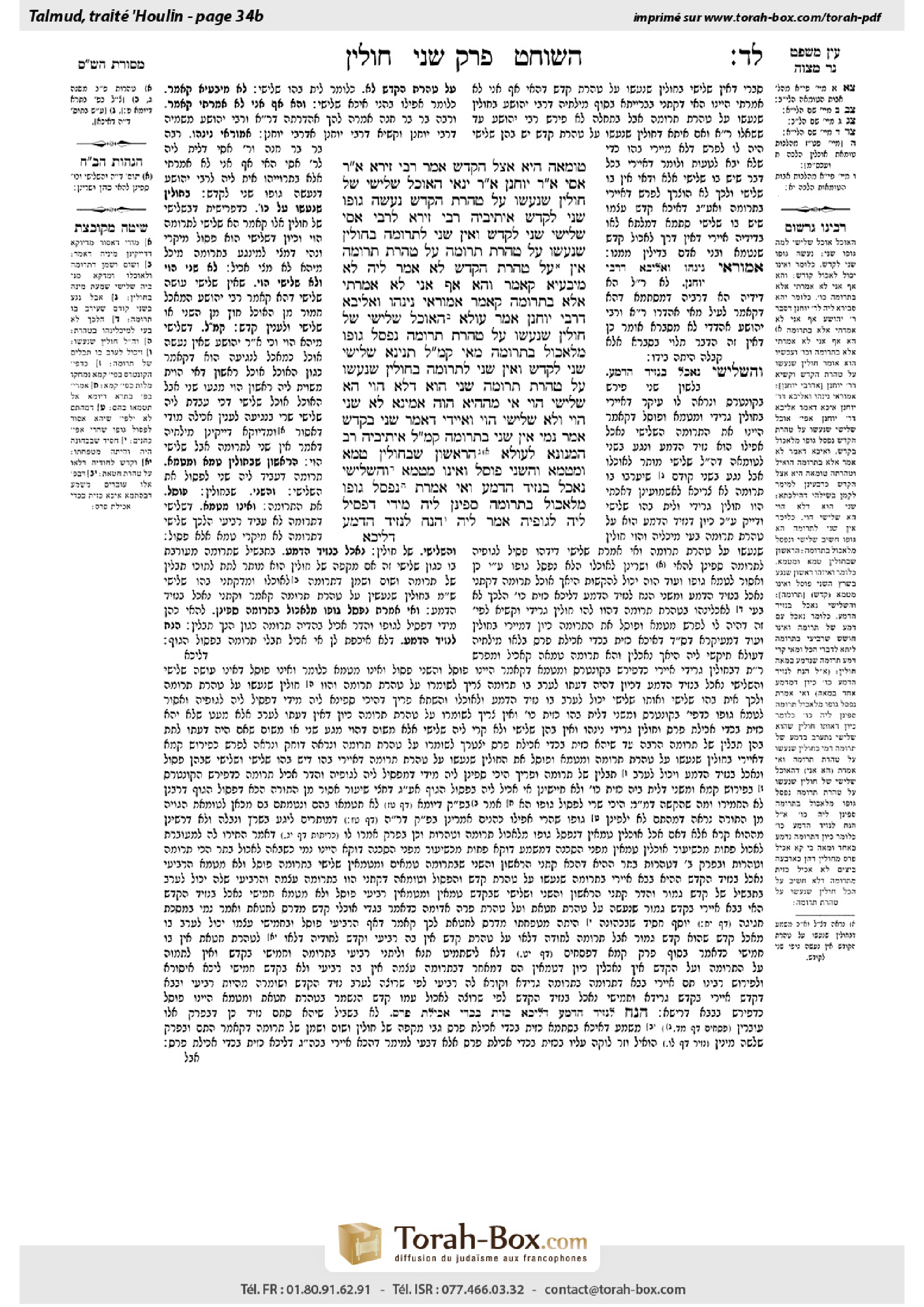
Chullin 34b: Talmud study for Daf Yomi
Study the Talmud for Daf Yomi with scanned pages, Hebrew text, English translations from Sefaria and AI-generated French translations.
Passage selection and English or AI-generated French translation are available where the scan has annotations. Daf Study is independent of Torah-Box and Sefaria.
Browse Chullin · חולין · All tractatesChullin 34b text and translations
This page of Chullin includes the Aramaic text, an English translation and an AI-generated French translation, alongside the scan above.
חולין ל״ד ב · Aramaic and Hebrew text
טוּמְאָה הִיא אֵצֶל הֶקְדֵּשׁ.
אָמַר רַבִּי זֵירָא אָמַר רַבִּי אַסִּי אָמַר רַבִּי יוֹחָנָן אָמַר רַבִּי יַנַּאי: הָאוֹכֵל שְׁלִישִׁי שֶׁל חוּלִּין שֶׁנַּעֲשׂוּ עַל טׇהֳרַת הַקֹּדֶשׁ – נַעֲשָׂה גּוּפוֹ שֵׁנִי לַקֹּדֶשׁ.
אֵיתִיבֵיהּ רַבִּי זֵירָא לְרַבִּי אַסִּי: שְׁלִישִׁי שֵׁנִי לַקֹּדֶשׁ, וְאֵין שֵׁנִי לַתְּרוּמָה, בְּחוּלִּין שֶׁנַּעֲשׂוּ עַל טׇהֳרַת תְּרוּמָה. עַל טׇהֳרַת תְּרוּמָה – אִין, עַל טׇהֳרַת הַקֹּדֶשׁ – לָא!
אֲמַר לֵיהּ: לָא מִיבַּעְיָא קָאָמַר.
וְהָא ״אַף אֲנִי לֹא אָמַרְתִּי אֶלָּא בִּתְרוּמָה״ קָאָמַר, אָמוֹרָאֵי נִינְהוּ, וְאַלִּיבָּא דְּרַבִּי יוֹחָנָן.
אָמַר עוּלָּא: הָאוֹכֵל שְׁלִישִׁי שֶׁל חוּלִּין שֶׁנַּעֲשׂוּ עַל טׇהֳרַת תְּרוּמָה – נִפְסַל גּוּפוֹ מִלֶּאֱכוֹל בִּתְרוּמָה.
מַאי קָא מַשְׁמַע לַן? תְּנֵינָא: שְׁלִישִׁי שֵׁנִי לַקֹּדֶשׁ, וְאֵין שֵׁנִי לַתְּרוּמָה, בְּחוּלִּין שֶׁנַּעֲשׂוּ עַל טׇהֳרַת תְּרוּמָה. שֵׁנִי הוּא דְּלָא הָוֵי, הָא שְׁלִישִׁי הָוֵי.
אִי מֵהַהִיא, הֲוָה אָמֵינָא: לָא שֵׁנִי הָוֵי וְלָא שְׁלִישִׁי הָוֵי, וְאַיְּידֵי דְּאָמַר ״שֵׁנִי בַּקֹּדֶשׁ״ – אָמַר נָמֵי ״אֵין שֵׁנִי בִּתְרוּמָה״, קָא מַשְׁמַע לַן.
אֵיתִיבֵיהּ רַב הַמְנוּנָא לְעוּלָּא: הָרִאשׁוֹן שֶׁבַּחוּלִּין טָמֵא וּמְטַמֵּא, וְהַשֵּׁנִי פּוֹסֵל וְאֵינוֹ מְטַמֵּא, וְהַשְּׁלִישִׁי נֶאֱכָל בִּנְזִיד הַדֶּמַע.
וְאִי אָמְרַתְּ נִפְסַל גּוּפוֹ מִלֶּאֱכוֹל בִּתְרוּמָה, סָפֵינַן לֵיהּ מִידֵּי דְּפָסֵיל לֵיהּ לְגוּפֵיהּ? אֲמַר לֵיהּ: הַנַּח לִנְזִיד הַדֶּמַע,
Chullin 34b · English translation
is impurity vis-à-vis sacrificial food. The Sages issued a decree that even one who is vigilant to partake of his teruma in a state of ritual purity is considered impure vis-à-vis one partaking of sacrificial food. Therefore, one who ate a food item that was prepared on the level of purity of teruma that had become impure with third-degree impurity assumes second-degree impurity, and he renders sacrificial food impure.
Rabbi Zeira says that Rabbi Asi says that Rabbi Yoḥanan says that Rabbi Yannai says: With regard to one who eats non-sacred food items that were prepared on the level of purity of sacrificial food, and these items had become impure with third-degree impurity, his body becomes impure with second-degree impurity vis-à-vis sacrificial food. He renders sacrificial food with which he comes into contact impure with third-degree impurity, and that food in turn disqualifies sacrificial food with which it comes into contact.
Rabbi Zeira raised an objection to the statement of Rabbi Asi from the statement of Rabbi Yehoshua: One who eats food with third-degree impurity assumes second-degree impurity vis-à-vis sacrificial food but does not assume second-degree impurity vis-à-vis teruma. This is stated in the case of non-sacred food items that were prepared on the level of purity of teruma. The Gemara infers: Yes, one is able to prepare items on the level of purity of teruma, but one is not able to prepare items on the level of purity of sacrificial food, as in the latter case the non-sacred food does not become impure at all.
Rabbi Asi said to Rabbi Zeira: That inference is incorrect, as Rabbi Yehoshua is speaking utilizing the style of: It is not necessary. It is not necessary to say that in the case of non-sacred food items that were prepared on the level of purity of sacrificial food, which is stringent, they have the capacity of assuming third-degree impurity. Rabbi Yehoshua teaches that non-sacred food items that were prepared on the level of purity of teruma also have the capacity of assuming third-degree impurity.
The Gemara objects: But didn’t Rabbi Yehoshua say to Rabbi Eliezer according to the explanation that Rabba bar bar Ḥana said that Rabbi Yoḥanan said: I too stated this only with regard to non-sacred food items that were prepared on the level of purity of teruma, indicating that he was not referring to non-sacred food items that were prepared on the level of purity of sacrificial food. The Gemara explains: Rabba bar bar Ḥana and Rabbi Asi are amora’im, and disagree with regard to the opinion of Rabbi Yoḥanan, and they disagree about whether the statement of Rabbi Yehoshua was stated specifically with regard to non-sacred food items that were prepared on the level of purity of teruma, or whether it includes even those prepared on the level of purity of sacrificial food.
§ Ulla says: One who eats non-sacred food items that were prepared on the level of purity of teruma and that are impure with third-degree impurity, his body is disqualified from the right to partake of teruma.
The Gemara asks: What is Ulla teaching us? We already learn in the mishna cited earlier (33b) from tractate Teharot: One who eats food with third-degree impurity assumes second-degree impurity vis-à-vis sacrificial food, but does not assume second-degree impurity vis-à-vis teruma. This is stated in the case of non-sacred food items that were prepared on the level of purity of teruma. The Gemara infers: It is second-degree impurity that he does not assume, but third-degree impurity he assumes, and he is therefore disqualified from partaking of teruma.
The Gemara answers: It was necessary for Ulla to teach this halakha, as if it was learned from that mishna, I would say that vis-à-vis teruma he assumes neither second-degree nor third-degree impurity, as there is no reason to deem the status of one who eats like that of the food that he ate. And perhaps it was only since Rabbi Yehoshua said that he assumes second-degree impurity vis-à-vis sacrificial food that he also said that he does not assume second-degree impurity vis-à-vis teruma. Therefore, Ulla teaches us that he assumes third-degree impurity and is disqualified from partaking of teruma.
Rav Hamnuna raised an objection to the statement of Ulla from a mishna (Teharot 2:3): Non-sacred food that is impure with first-degree impurity is impure and renders teruma impure in the sense that this teruma disqualifies other teruma with which it comes into contact. Non-sacred food that is impure with second-degree impurity disqualifies teruma, but it does not render teruma impure, meaning that it renders the teruma itself impure, but not to the extent that the teruma can render other teruma impure. And food that is impure with third-degree impurity may be eaten by a priest in a stew that is a mixture containing spices of teruma.
And if you say that by partaking of food that is impure with third-degree impurity his body is disqualified from the right to partake of teruma, do we feed him a matter that invalidates his body from the right to partake of teruma? According to this, when eating the stew that contains food that is impure with third-degree impurity, he is disqualified from partaking of the spices of teruma that the mishna permits him to add to the stew. Ulla said to him: Leave the matter of stew that is a mixture containing spices of teruma,
Chullin 34b · Traduction française (IA)
l'impureté vis-à-vis des aliments sacrés. Les Sages ont émis un décret selon lequel même celui qui est vigilant pour manger sa terouma dans un état de pureté rituelle est considéré comme impur vis-à-vis de celui qui mange des aliments sacrés. Ainsi, celui qui a mangé un aliment préparé au niveau de la pureté de la terouma devenu impur par l'impureté de troisième degré assume l'impureté de deuxième degré, et il rend les aliments sacrés impurs.
Rabbi Zeira dit que Rabbi Asi dit que Rabbi Yoḥanan dit que Rabbi Yannai dit : En ce qui concerne celui qui mange des aliments non sacrés préparés au niveau de la pureté des aliments sacrés, et ces aliments sont devenus impurs par l'impureté de troisième degré, son corps devient impur au deuxième degré vis-à-vis des aliments sacrés. Il rend les aliments sacrés avec lesquels il entre en contact impurs au troisième degré, et ce dernier aliment sacré à son tour rend impur celui avec lequel il entre en contact.
Rabbi Zeira a soulevé une objection contre l'affirmation de Rabbi Asi à partir de l'affirmation de Rabbi Yehoshua : Celui qui mange des aliments avec l'impureté de troisième degré assume l'impureté de deuxième degré vis-à-vis des aliments sacrés mais ne devient pas impur au deuxième degré vis-à-vis de la terouma. Cela est dit dans le cas d'aliments non sacrés préparés au niveau de la pureté de la terouma. La Guemara infère : Oui, on peut préparer des aliments au niveau de la pureté de la terouma, mais on ne peut pas préparer des aliments au niveau de la pureté des aliments sacrés, car dans ce dernier cas, les aliments non sacrés ne deviennent pas impurs du tout.
Rabbi Asi a dit à Rabbi Zeira : Cette inférence est incorrecte, car Rabbi Yehoshua parle en utilisant le style : Il n'est pas nécessaire. Il n'est pas nécessaire de dire que dans le cas d'aliments non sacrés préparés au niveau de la pureté des aliments sacrés, qui est strict, ils ont la capacité d'assumer l'impureté de troisième degré. Rabbi Yehoshua enseigne que les aliments non sacrés préparés au niveau de la pureté de la terouma ont aussi la capacité d'assumer l'impureté de troisième degré.
La Guemara s'oppose en disant : Mais n'a-t-il pas dit Rabbi Yehoshua à Rabbi Eliezer selon l'explication que Rabba bar bar Ḥana a dit que Rabbi Yoḥanan a dit : Je l'ai aussi dit uniquement en ce qui concerne les aliments non sacrés préparés au niveau de la pureté de la terouma, indiquant qu'il ne faisait pas référence aux aliments non sacrés préparés au niveau de la pureté des aliments sacrés. La Guemara explique : Rabba bar bar Ḥana et Rabbi Asi sont des amoraïm, et ils divergent sur l'opinion de Rabbi Yoḥanan, et ils divergent sur le fait que l'affirmation de Rabbi Yehoshua a été formulée spécifiquement en ce qui concerne les aliments non sacrés préparés au niveau de la pureté de la terouma, ou si elle inclut même ceux préparés au niveau de la pureté des aliments sacrés.
§ Ulla dit : Celui qui mange des aliments non sacrés préparés au niveau de la pureté de la terouma et devenus impurs par l'impureté de troisième degré, son corps est disqualifié du droit de manger la terouma.
La Guemara pose la question : Qu'enseigne Ulla ? Nous avons déjà appris dans la mitsva citée plus tôt (33b) du traité Téharot : Celui qui mange un aliment avec l'impureté de troisième degré assume l'impureté de deuxième degré vis-à-vis des aliments sacrés, mais ne devient pas impur au deuxième degré vis-à-vis de la terouma. Cela est dit dans le cas d'aliments non sacrés préparés au niveau de la pureté de la terouma. La Guemara infère : C'est l'impureté de deuxième degré qu'il ne devient pas impur, mais l'impureté de troisième degré qu'il assume, et il est donc disqualifié du droit de manger la terouma.
La Guemara répond : Il était nécessaire que Ulla enseigne cette halakha, car si elle était apprise à partir de cette mitsva, je dirais que vis-à-vis de la terouma il ne devient ni impur au deuxième ni au troisième degré, car il n'y a pas de raison de considérer le statut de celui qui mange comme celui de l'aliment qu'il a mangé. Et peut-être est-ce seulement depuis que Rabbi Yehoshua a dit qu'il assume l'impureté de deuxième degré vis-à-vis des aliments sacrés qu'il a dit qu'il ne devient pas impur au deuxième degré vis-à-vis de la terouma. Ainsi, Ulla nous enseigne qu'il assume l'impureté de troisième degré et est disqualifié du droit de manger la terouma.
Rav Hamnuna a soulevé une objection contre l'affirmation d'Ulla à partir d'une mitsva (Téharot 2:3) : L'aliment non sacré devenu impur par l'impureté de premier degré est impur et rend la terouma impure dans le sens où cette terouma disqualifie d'autres terouma avec lesquelles elle entre en contact. L'aliment non sacré devenu impur par l'impureté de deuxième degré disqualifie la terouma, mais ne la rend pas impure, c'est-à-dire qu'il rend la terouma elle-même impure, mais pas à tel point que la terouma puisse rendre d'autres terouma impure. Et l'aliment devenu impur par l'impureté de troisième degré peut être mangé par un prêtre dans une bouillie contenant des épices de terouma.
Et si vous dites que par la consommation d'aliments impurs à cause d'une impureté de troisième degré, son corps est disqualifié du droit de manger la terouma, est-ce que nous nourrissons une chose qui invalide son corps du droit de manger la terouma ? Selon cela, lorsqu'il mange la bouillie contenant des aliments impurs à cause d'une impureté de troisième degré, il est disqualifié du droit de manger les épices de terouma que la mitsva lui permet d'ajouter à la bouillie. Ulla a dit à lui : Laissez le sujet de la bouillie contenant des épices de terouma.
Traduction française générée par IA à partir de l’édition anglaise de Sefaria. Vérifie toujours un passage avec le texte source.
Text from Sefaria: William Davidson Edition - Vocalized Aramaic (unknown); William Davidson Edition - English (CC BY NC).