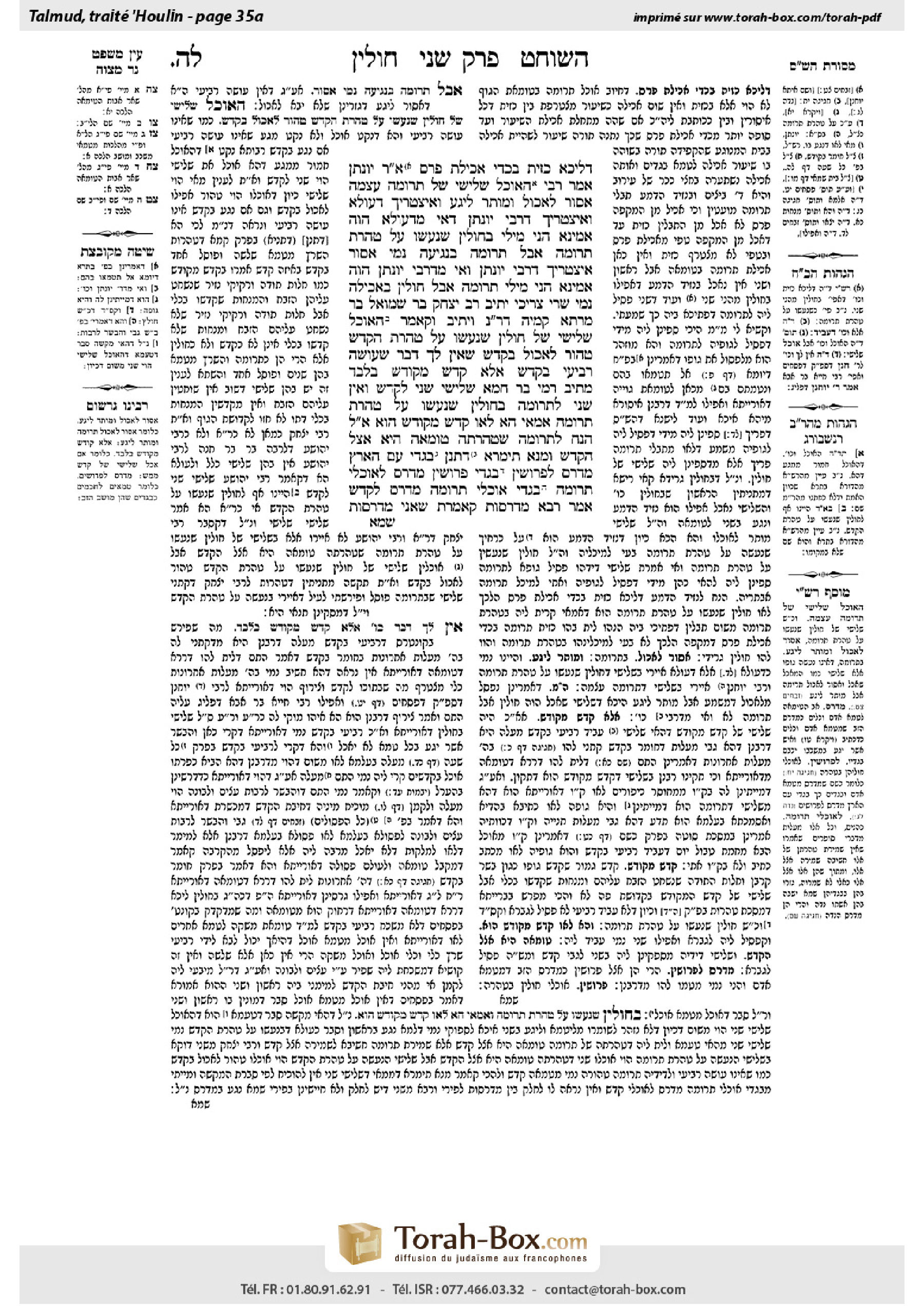
Chullin 35a: Talmud study for Daf Yomi
Study the Talmud for Daf Yomi with scanned pages, Hebrew text, English translations from Sefaria and AI-generated French translations.
Passage selection and English or AI-generated French translation are available where the scan has annotations. Daf Study is independent of Torah-Box and Sefaria.
Browse Chullin · חולין · All tractatesChullin 35a text and translations
This page of Chullin includes the Aramaic text, an English translation and an AI-generated French translation, alongside the scan above.
חולין ל״ה א · Aramaic and Hebrew text
דְּלֵיכָּא כְּזַיִת בִּכְדֵי אֲכִילַת פְּרָס.
אָמַר רַבִּי יוֹנָתָן אָמַר רַבִּי: הָאוֹכֵל שְׁלִישִׁי שֶׁל תְּרוּמָה עַצְמָהּ – אָסוּר לֶאֱכוֹל, וּמוּתָּר לִיגַּע.
וְאִיצְטְרִיךְ דְּעוּלָּא, וְאִיצְטְרִיךְ דְּרַבִּי יוֹנָתָן, דְּאִי מִדְּעוּלָּא הֲוָה אָמֵינָא: הָנֵי מִילֵּי בְּחוּלִּין שֶׁנַּעֲשׂוּ עַל טׇהֳרַת תְּרוּמָה, אֲבָל תְּרוּמָה – בִּנְגִיעָה נָמֵי אָסוּר, אִיצְטְרִיךְ דְּרַבִּי יוֹנָתָן. וְאִי מִדְּרַבִּי יוֹנָתָן הֲוָה אָמֵינָא: הָנֵי מִילֵּי תְּרוּמָה, אֲבָל חוּלִּין – בַּאֲכִילָה נָמֵי שְׁרֵי, צְרִיכִי.
יָתֵיב רַב יִצְחָק בַּר שְׁמוּאֵל בַּר מָרְתָּא קַמֵּיהּ דְּרַב נַחְמָן, וְיָתֵיב וְקָאָמַר: הָאוֹכֵל שְׁלִישִׁי שֶׁל חוּלִּין שֶׁנַּעֲשׂוּ עַל טׇהֳרַת הַקֹּדֶשׁ – טָהוֹר לֶאֱכוֹל בַּקֹּדֶשׁ, שֶׁאֵין לְךָ דָּבָר שֶׁעוֹשֶׂה רְבִיעִי בַּקֹּדֶשׁ אֶלָּא קֹדֶשׁ מִקּוֹדֶשׁ בִּלְבַד.
מֵתִיב רָמֵי בַּר חָמָא: שְׁלִישִׁי – שֵׁנִי לַקֹּדֶשׁ, וְאֵין שֵׁנִי לַתְּרוּמָה. בְּחוּלִּין שֶׁנַּעֲשׂוּ עַל טׇהֳרַת תְּרוּמָה. אַמַּאי? הָא לָאו קֹדֶשׁ מִקּוֹדֶשׁ הוּא!
אֲמַר לֵיהּ: הַנַּח לִתְרוּמָה, שֶׁטׇּהֳרָתָהּ טוּמְאָה הִיא אֵצֶל הַקֹּדֶשׁ.
וּמְנָא תֵּימְרַאּ? דִּתְנַן: בִּגְדֵי עַם הָאָרֶץ מִדְרָס לִפְרוּשִׁין, בִּגְדֵי פְרוּשִׁין מִדְרָס לְאוֹכְלֵי תְרוּמָה, בִּגְדֵי אוֹכְלֵי תְרוּמָה מִדְרָס לַקֹּדֶשׁ.
אָמַר רָבָא: מִדְרָסוֹת קָאָמְרַתְּ? שָׁאנֵי מִדְרָסוֹת,
Chullin 35a · English translation
as there is not an olive-bulk of teruma in the amount of stew that he eats in the time it takes to eat a half-loaf of bread. Therefore, one need not treat the mixture with the level of purity required of teruma.
Rabbi Yonatan says that Rabbi Yehuda HaNasi says: For one who partakes of actual teruma that is impure with third-degree impurity, it is prohibited to partake of other teruma, but it is permitted to come into contact with teruma.
The Gemara notes that the statement of Ulla was necessary and the statement of Rabbi Yonatan was necessary. As, if the halakha were learned exclusively from the statement of Ulla, I would say: This statement applies with regard to non-sacred food items that were prepared on the level of purity of teruma, but with regard to teruma itself perhaps contact is also prohibited. Therefore, the statement of Rabbi Yonatan was necessary. And if the halakha were learned exclusively from the statement of Rabbi Yonatan, I would say: This statement applies with regard to teruma, but with regard to non-sacred food that was prepared with purity of teruma, perhaps eating it is also permitted. Therefore, both statements are necessary.
§ Rav Yitzḥak bar Shmuel bar Marta was sitting before Rav Naḥman, and he was sitting and saying: With regard to one who eats non-sacred food items that were prepared on the level of purity of sacrificial food, and these items had become impure with third-degree impurity, he is ritually pure in terms of the right to partake of sacrificial food, as you have nothing that confers fourth-degree impurity in sacrificial food other than consecrated sacrificial food alone, but non-sacred food prepared with the purity of sacrificial food does not.
Rami bar Ḥama raises an objection from the mishna cited earlier (33b): One who eats food with third-degree impurity assumes second-degree impurity vis-à-vis sacrificial food, and he does not assume second-degree impurity vis-à-vis teruma. Eating an item with third-degree impurity is feasible only in the case of non-sacred items, as partaking of impure teruma is prohibited. It is only possible in the case of non-sacred food items that were prepared as if their level of purity were on the level of the purity of teruma. According to the statement of Rav Yitzḥak bar Shmuel bar Marta, why does this food assume second-degree impurity? It is not sacrificial food, which is sanctified.
Rav Yitzḥak bar Shmuel bar Marta said to him: Leave teruma alone; its state of purity is impurity vis-à-vis sacrificial food. Therefore, non-sacred food that was prepared with the purity of teruma renders sacrificial food impure.
The Gemara asks: And from where do you say that the purity of teruma is impurity vis-à-vis sacrificial food? It is from a mishna (Ḥagiga 18b), as we learned: The halakhic status of the garments of an am ha’aretz, who does not scrupulously observe the halakhot of ritual purity, is like that of items rendered impure by treading, e.g., items designated for sitting or lying upon which a zav or a menstruating woman sits or lies, which are rendered a primary source of ritual impurity for individuals who scrupulously observe the halakhot of ritual purity [perushin] and eat their non-sacred food in a state of purity. In other words, it is considered a primary level of impurity for them. The halakhic status of the garments of perushin is like that of items rendered impure by treading for priests who partake of teruma. In addition, the halakhic status of the garments of priests who partake of teruma is like that of items rendered impure by treading for those who eat sacrificial food.
Rava said: Are you saying that one can cite proof from the halakha of items rendered impure by treading that the state of purity of teruma is impurity vis-à-vis sacrificial food? No proof may be cited from there, as the decree that the halakhic status of the garments of priests who partake of teruma is like that of items rendered impure by treading for those who eat sacrificial food is different,
Chullin 35a · Traduction française (IA)
puisque il n'y a pas une quantité d'offrande de terouma égale à une olive dans la quantité de bouillon qu'il mange pendant le temps qu'il faut pour manger une demi-boule de pain. Ainsi, il n'est pas nécessaire de traiter ce mélange au niveau de pureté requis pour la terouma.
Rabbi Yonatan dit que Rabbi Yehuda HaNasi dit : Pour celui qui consomme de la terouma réellement impure avec un degré d'impureté de troisième degré, il est interdit de consommer d'autres teroumas, mais il est permis de venir en contact avec la terouma.
La Guemara note que l'avis d'Ulla était nécessaire et l'avis de Rabbi Yonatan également. Car, si la halakha était apprise uniquement à partir de l'avis d'Ulla, je dirais : cet avis s'applique aux aliments non sacrés préparés au niveau de pureté de la terouma, mais concernant la terouma elle-même, peut-être le contact est-il également interdit. Ainsi, l'avis de Rabbi Yonatan était nécessaire. Et si la halakha était apprise uniquement à partir de l'avis de Rabbi Yonatan, je dirais : cet avis s'applique à la terouma, mais concernant les aliments non sacrés préparés avec la pureté de la terouma, peut-être la consommation est-elle également permise. Ainsi, les deux avis sont nécessaires.
§ Rav Yitzḥak bar Shmuel bar Marta était assis devant Rav Naḥman, et il était assis et disait : Concernant celui qui mange des aliments non sacrés préparés au niveau de pureté des aliments sacrés, et ces aliments sont devenus impurs avec un degré d'impureté de troisième degré, il est rituellement pur en ce qui concerne le droit de consommer des aliments sacrés, car il n'y a pas de chose qui confère un degré d'impureté de quatrième degré aux aliments sacrés autre que les aliments sacrés eux-mêmes, mais les aliments non sacrés préparés avec la pureté des aliments sacrés ne le font pas.
Rami bar Ḥama éleve une objection à partir de la mitsna citée plus tôt (33b) : Celui qui mange un aliment avec un degré d'impureté de troisième degré assume un degré d'impureté de deuxième degré vis-à-vis des aliments sacrés, et il ne l'assume pas vis-à-vis de la terouma. La consommation d'un aliment avec un degré d'impureté de troisième degré est possible uniquement dans le cas d'aliments non sacrés, car la consommation d'une terouma impure est interdite. Elle est possible uniquement dans le cas d'aliments non sacrés préparés comme si leur niveau de pureté était celui de la pureté de la terouma. Selon l'avis de Rav Yitzḥak bar Shmuel bar Marta, pourquoi cet aliment assume-t-il un degré d'impureté de deuxième degré ? Il n'est pas un aliment sacré, qui est sanctifié.
Rav Yitzḥak bar Shmuel bar Marta dit à lui : Laisse la terouma de côté ; son état de pureté est une impureté vis-à-vis des aliments sacrés. Ainsi, un aliment non sacré préparé avec la pureté de la terouma rend les aliments sacrés impurs.
La Guemara pose la question : Et d'où dis-tu que la pureté de la terouma est une impureté vis-à-vis des aliments sacrés ? C'est d'une mitsva (Ḥagiga 18b), comme nous avons appris : Le statut halakhique des vêtements d'un am ha’aretz, qui ne suit pas rigoureusement les halakhot de pureté rituelle, est comme celui des objets rendus impurs par la marche, c'est-à-dire des objets désignés pour s'asseoir ou se reposer sur lesquels un zav ou une femme en état de ménstruation s'assoit ou se repose, qui sont considérés comme une source principale d'impureté pour ceux qui suivent rigoureusement les halakhot de pureté rituelle [perushin] et mangent leur aliment non sacré dans un état de pureté. En d'autres termes, il est considéré comme un niveau principal d'impureté pour eux. Le statut halakhique des vêtements des perushin est comme celui des objets rendus impurs par la marche pour les prêtres qui consomment la terouma. De plus, le statut halakhique des vêtements des prêtres qui consomment la terouma est comme celui des objets rendus impurs par la marche pour ceux qui mangent des aliments sacrés.
Rava dit : Tu dis que l'on peut citer une preuve à partir du statut halakhique des objets rendus impurs par la marche que la pureté de la terouma est une impureté vis-à-vis des aliments sacrés ? Non, on ne peut pas citer de preuve à partir de là, car le décret selon lequel le statut halakhique des vêtements des prêtres qui consomment la terouma est comme celui des objets rendus impurs par la marche pour ceux qui mangent des aliments sacrés est différent,
Traduction française générée par IA à partir de l’édition anglaise de Sefaria. Vérifie toujours un passage avec le texte source.
Text from Sefaria: William Davidson Edition - Vocalized Aramaic (unknown); William Davidson Edition - English (CC BY NC).