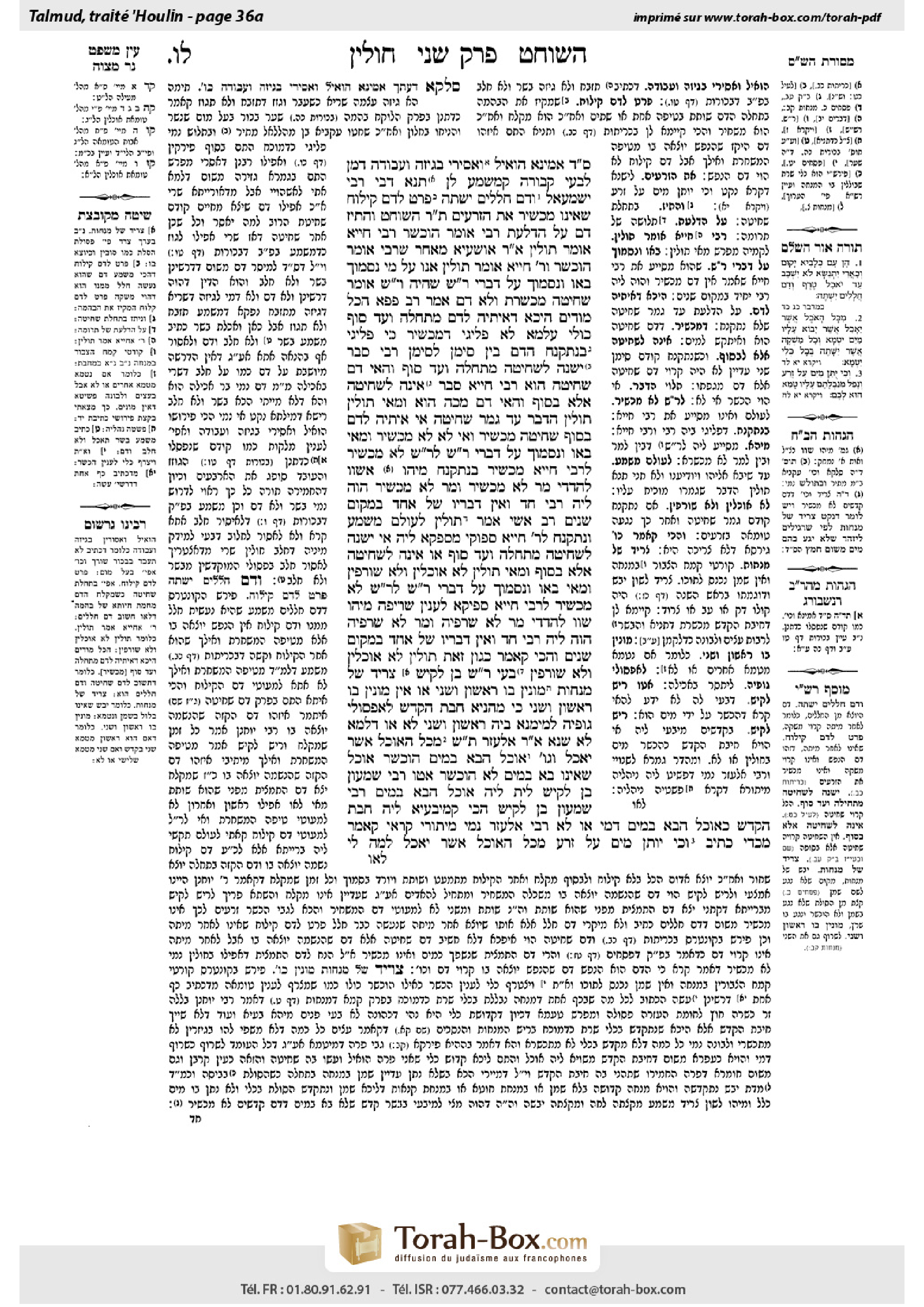
Chullin 36a: Talmud study for Daf Yomi
Study the Talmud for Daf Yomi with scanned pages, Hebrew text, English translations from Sefaria and AI-generated French translations.
Passage selection and English or AI-generated French translation are available where the scan has annotations. Daf Study is independent of Torah-Box and Sefaria.
Browse Chullin · חולין · All tractatesChullin 36a text and translations
This page of Chullin includes the Aramaic text, an English translation and an AI-generated French translation, alongside the scan above.
חולין ל״ו א · Aramaic and Hebrew text
סָלְקָא דַּעְתָּךְ אָמֵינָא: הוֹאִיל וַאֲסִירִי בְּגִיזָּה וַעֲבוֹדָה, דָּמָן לִבְעֵי קְבוּרָה, קָמַשְׁמַע לַן.
תָּנָא דְּבֵי רַבִּי יִשְׁמָעֵאל: ״וְדַם חֲלָלִים יִשְׁתֶּה״ – פְּרָט לְדַם קִילּוּחַ, שֶׁאֵינוֹ מַכְשִׁיר אֶת הַזְּרָעִים.
תָּנוּ רַבָּנַן: הַשּׁוֹחֵט וְהִתִּיז דָּם עַל הַדַּלַּעַת – רַבִּי אוֹמֵר: הוּכְשַׁר, רַבִּי חִיָּיא אוֹמֵר: תּוֹלִין.
אָמַר רַבִּי אוֹשַׁעְיָא: מֵאַחַר שֶׁרַבִּי אוֹמֵר הוּכְשַׁר, וְרַבִּי חִיָּיא אוֹמֵר תּוֹלִין, אָנוּ עַל מִי נִסְמוֹךְ? בֹּאוּ וְנִסְמוֹךְ עַל דִּבְרֵי רַבִּי שִׁמְעוֹן, שֶׁהָיָה רַבִּי שִׁמְעוֹן אוֹמֵר: שְׁחִיטָה מַכְשֶׁרֶת וְלֹא דָּם.
אָמַר רַב פָּפָּא: הַכֹּל מוֹדִים הֵיכָא דְּאִיתֵיהּ לְדָם מִתְּחִלָּה וְעַד סוֹף – כּוּלֵּי עָלְמָא לָא פְּלִיגִי דְּמַכְשַׁיר. כִּי פְּלִיגִי בְּנִתְקַנֵּחַ הַדָּם בֵּין סִימָן לְסִימָן, רַבִּי סָבַר: יֶשְׁנָהּ לִשְׁחִיטָה מִתְּחִלָּה וְעַד סוֹף, וְהַאי דַּם שְׁחִיטָה הוּא.
רַבִּי חִיָּיא סָבַר: אֵינָהּ לִשְׁחִיטָה אֶלָּא בַּסּוֹף, וְהַאי דַּם מַכָּה הוּא, וּמַאי ״תּוֹלִין״? תּוֹלִין הַדָּבָר עַד גְּמַר שְׁחִיטָה – אִי אִיתֵיהּ לְדָם בְּסוֹף שְׁחִיטָה מַכְשִׁיר, וְאִי לָא – לֹא מַכְשִׁיר.
וּמַאי ״בֹּאוּ וְנִסְמוֹךְ עַל דִּבְרֵי רַבִּי שִׁמְעוֹן״? לְרַבִּי שִׁמְעוֹן לֹא מַכְשִׁיר, לְרַבִּי חִיָּיא מַכְשִׁיר!
בְּנִתְקַנֵּחַ מִיהוּ אַשְׁווֹ לַהֲדָדֵי, מָר לָא מַכְשִׁיר, וּמָר לָא מַכְשִׁיר, הֲוָה לֵיהּ רַבִּי חַד, וְאֵין דְּבָרָיו שֶׁל אֶחָד בִּמְקוֹם שְׁנַיִם.
רַב אָשֵׁי אָמַר: ״תּוֹלִין״ לְעוֹלָם מַשְׁמַע, וְנִתְקַנֵּחַ לְרַבִּי חִיָּיא סַפּוֹקֵי מְסַפְּקָא לֵיהּ, אִי יֶשְׁנָהּ לִשְׁחִיטָה מִתְּחִלָּה וְעַד סוֹף, אוֹ אֵינָהּ לִשְׁחִיטָה אֶלָּא בַּסּוֹף, וּמַאי ״תּוֹלִין״? לֹא אוֹכְלִין וְלֹא שׂוֹרְפִין.
וּמַאי ״בֹּאוּ וְנִסְמוֹךְ עַל דִּבְרֵי רַבִּי שִׁמְעוֹן״? לְרַבִּי שִׁמְעוֹן לֹא מַכְשִׁיר, לְרַבִּי חִיָּיא סְפֵיקָא, לְעִנְיַן שְׂרֵיפָה מִיהוּ שָׁווּ לַהֲדָדֵי: (ומר) [וּלְמָר] לָא שָׂרְפִינַן, (ומר) [וּלְמָר] לָא שָׂרְפִינַן.
הָוֵה לֵיהּ רַבִּי חַד, וְאֵין דְּבָרָיו שֶׁל אֶחָד בִּמְקוֹם שְׁנַיִם, וְהָכִי קָאָמַר: כְּגוֹן זֹאת תּוֹלִין – לֹא אוֹכְלִין וְלֹא שׂוֹרְפִין.
בָּעֵי רַבִּי שִׁמְעוֹן בֶּן לָקִישׁ: צָרִיד שֶׁל מְנָחוֹת, מוֹנִין בּוֹ רִאשׁוֹן וְשֵׁנִי, אוֹ אֵין מוֹנִין בּוֹ רִאשׁוֹן וְשֵׁנִי? כִּי מַהְנְיָא חִבַּת הַקֹּדֶשׁ לְאִפְּסוֹלֵי גּוּפֵיהּ, לְמִימְנֵא בֵּיהּ רִאשׁוֹן וְשֵׁנִי – לָא, אוֹ דִלְמָא לָא שְׁנָא?
אָמַר רַבִּי אֶלְעָזָר: תָּא שְׁמַע, ״מִכׇּל הָאֹכֶל אֲשֶׁר יֵאָכֵל וְגוֹ׳״ – אוֹכֶל הַבָּא בְּמַיִם – הוּכְשַׁר, אוֹכֶל שֶׁאֵינוֹ בָּא בְּמַיִם – לֹא הוּכְשַׁר.
אַטּוּ רַבִּי שִׁמְעוֹן בֶּן לָקִישׁ לֵית לֵיהּ אוֹכֶל הַבָּא בְּמַיִם? רַבִּי שִׁמְעוֹן בֶּן לָקִישׁ הָכִי קָמִיבַּעְיָא לֵיהּ: חִבַּת הַקֹּדֶשׁ כְּאוֹכֶל הַבָּא בְּמַיִם דָּמֵי, אוֹ לָא?
רַבִּי אֶלְעָזָר נָמֵי מִיִּתּוּרֵי קְרָאֵי קָאָמַר, מִכְּדֵי כְּתִיב ״וְכִי יֻתַּן מַיִם עַל זֶרַע״, ״מִכׇּל הָאֹכֶל אֲשֶׁר יֵאָכֵל״ לְמָה לִּי?
Chullin 36a · English translation
It could enter your mind to say: Since benefit from disqualified consecrated animals is forbidden with regard to their fleece and labor, perhaps benefit from their blood is also forbidden, and let it require burial. Therefore, the verse teaches us that benefit from their blood is permitted.
The school of Rabbi Yishmael taught that the verse: “And drinks the blood of carcasses,” from which it is derived that the blood of an animal that was killed renders food items susceptible to ritual impurity, serves to exclude blood that emerges in a surge due to arterial pressure at the moment of slaughter while the animal is still alive that does not render seeds susceptible to ritual impurity.
§ The Sages taught in a baraita: With regard to one who slaughters an animal and splashed blood of the slaughter on a gourd of teruma, Rabbi Yehuda HaNasi says: The gourd is rendered susceptible to ritual impurity. Rabbi Ḥiyya says: If the gourd came into contact with a source of impurity, one places the matter in abeyance, as there is uncertainty whether the blood rendered it susceptible to impurity.
Rabbi Oshaya said: Since Rabbi Yehuda HaNasi says that the gourd is rendered susceptible to ritual impurity and Rabbi Ḥiyya says that one places the matter in abeyance, on whom shall we rely? Come and let us rely on the statement of Rabbi Shimon, as Rabbi Shimon would say: It is slaughter that renders the animal susceptible, and not blood.
Rav Pappa said in explanation: Everyone, Rabbi Yehuda HaNasi and Rabbi Ḥiyya, agrees that where there is blood on the gourd throughout the slaughter continuously from beginning to end, everyone, both Rabbi Shimon ben Lakish, who says: Slaughter is defined only as the conclusion of its performance, and Rabbi Yoḥanan, who says: Slaughter is defined from the beginning to the end of its performance, agrees that the blood renders the gourd susceptible to impurity, in accordance with the opinion of the Rabbis, who disagree with Rabbi Shimon. When they disagree is in a case where the blood is wiped off the gourd between the cutting of one siman and the other siman. Rabbi Yehuda HaNasi holds that slaughter is defined from the beginning to the end of its performance, and this blood that splashed on the gourd is blood of slaughter.
Rabbi Ḥiyya holds that slaughter is defined only as the conclusion of its performance, and this is blood of a wound, which does not render food items susceptible to ritual impurity. And what is the meaning of the ruling of Rabbi Ḥiyya that one places the matter in abeyance? It means that one places the matter in abeyance until the conclusion of the slaughter. If there is blood remaining on the gourd at the conclusion of the slaughter the blood renders the gourd susceptible to ritual impurity, and if not, the blood does not render the gourd susceptible to ritual impurity.
The Gemara asks: And what is the meaning of the statement of Rabbi Oshaya: Come and let us rely on the statement of Rabbi Shimon? According to Rabbi Shimon the blood of slaughter does not render food items susceptible to ritual impurity, while according to Rabbi Ḥiyya the blood of slaughter renders the gourd susceptible to ritual impurity.
The Gemara answers that in a case where the blood is wiped off the gourd prior to the conclusion of slaughter, in any event, the opinions of Rabbi Shimon and Rabbi Ḥiyya correspond to each other: One Sage holds that the blood of slaughter does not render the gourd susceptible to ritual impurity and the other Sage holds that the blood of slaughter does not render the gourd susceptible to ritual impurity. The result is that Rabbi Yehuda HaNasi, who holds that the blood of slaughter renders the gourd susceptible to ritual impurity, is one Sage stating an individual opinion, and the statement of one Sage has no standing in a place where it is disputed by two Sages.
Rav Ashi said that the term: One places the matter in abeyance, indicates that it remains in abeyance forever. It is a fundamental halakhic uncertainty for which there is no resolution. And in the case where the blood is wiped off the gourd prior to the conclusion of the slaughter, the halakha is unclear. This is because Rabbi Ḥiyya is uncertain whether slaughter is defined from the beginning to the end of its performance or whether slaughter is defined only as the conclusion of its performance. And what is the meaning of his ruling that one places the matter in abeyance? It means that if a source of impurity comes into contact with the gourd after the blood was wiped off the gourd, one may neither eat the gourd, as perhaps it is impure teruma, nor may one burn it, as perhaps it is pure.
The Gemara asks: And according to this explanation, what is the meaning of the statement of Rabbi Oshaya: Come and let us rely on the statement of Rabbi Shimon? According to Rabbi Shimon the blood of slaughter does not render food items susceptible to ritual impurity, while according to Rabbi Ḥiyya, there is uncertainty with regard to the status of the gourd. The Gemara answers that with regard to the matter of burning, in any event, the opinions of Rabbi Shimon and Rabbi Ḥiyya correspond to each other: One Sage, Rabbi Shimon, does not burn the gourd, because it was not rendered susceptible to impurity, and the other Sage, Rabbi Ḥiyya, does not burn the gourd, due to the uncertainty.
The result is that Rabbi Yehuda HaNasi, who holds that one burns the gourd since the blood of slaughter renders the gourd susceptible to ritual impurity and contact with a source of impurity renders it impure, is one Sage stating an individual opinion, and the statement of one Sage has no standing in a place where it is disputed by two Sages. And this is what Rabbi Ḥiyya is saying: In a case such as this, one places the matter in abeyance; one may neither eat the gourd nor burn it.
Rabbi Shimon ben Lakish raises a dilemma: With regard to a dry portion of consecrated flour that was not mixed with the oil of meal offerings, does one count the descending levels of impurity characteristic of other foods that come into contact with a primary source of impurity, i.e., that food assumes first-degree impurity, and food that comes into contact with that food assumes second-degree impurity; or does one not count the descending levels of first-degree impurity and second-degree impurity? The Gemara elaborates: When regard for sanctity is effective in rendering an item susceptible to impurity, is it effective only to disqualify that item itself, but to count the descending levels of first-degree and second-degree impurity it is not effective? Or perhaps once it is rendered susceptible to impurity there is no difference whether it is rendered susceptible by means of regard for sanctity or by means of contact with liquids.
Rabbi Elazar said: Come and hear proof from a baraita. It is written: “Of all food that may be eaten, on which water comes, it shall be impure; and all drink that may be drunk it shall be impure” (Leviticus 11:34). From that verse it is derived: Food that comes into contact with water is rendered susceptible to ritual impurity and to count the descending levels of impurity, but food that does not come into contact with water is not rendered susceptible to ritual impurity. Apparently, for the dry portion of flour that did not come into contact with a liquid but was rendered susceptible by regard for sanctity, one does not count the descending levels of impurity.
The Gemara asks: Is that to say that Rabbi Shimon ben Lakish does not have knowledge of the halakha that only food that comes into contact with water is susceptible to ritual impurity? The Gemara answers: This is the dilemma that Rabbi Shimon ben Lakish is raising: Is the halakhic status of consecrated food that is subject to regard for sanctity like that of food that comes into contact with water, and one does not count the descending levels of impurity for items that come into contact with it, or no, its halakhic status is unique?
The Gemara explains that Rabbi Elazar, who cited the verse to resolve the dilemma of Rabbi Shimon ben Lakish, is not merely citing a verse that Rabbi Shimon ben Lakish knows. Rather, he too is stating his proof from the extraneous formulation of the verses. Since it is written: “But when water is placed upon the seed, and any of their carcass falls upon it, it is impure for you” (Leviticus 11:38), why do I need the verse: “Of all food which may be eaten, on which water comes, shall be impure” (Leviticus 11:34)?
Chullin 36a · Traduction française (IA)
On pourrait penser que l'on pourrait dire : Puisque le bénéfice tiré des animaux consacrés non admissibles est interdit concernant leur laine et leur travail, peut-être le bénéfice tiré de leur sang est-il également interdit, et il faudrait les enterrer. Ainsi, la Sainte Écriture nous enseigne que le bénéfice tiré de leur sang est permis.
La maison de Rabbi Yishmael enseignait que la Sainte Écriture : « Et il boit le sang des bêtes mortes », d'après laquelle on déduit que le sang d'un animal tué rend les aliments sujets à la souillure rituelle, sert à exclure le sang qui jaillit en raison de la pression artérielle au moment de la mise à mort, alors que l'animal est encore vivant, qui ne rend pas les semences sujets à la souillure rituelle.
§ Les Sages enseignèrent dans une baraïta : Concernant celui qui tue un animal et qui projette le sang de la mise à mort sur un gourde de terouma, Rabbi Yehuda HaNasi dit : Le gourde est rendu sujet à la souillure rituelle. Rabbi Ḥiyya dit : Si le gourde a été en contact avec une source de souillure, on place la question en abeyance, car il y a une incertitude quant à savoir si le sang l'a rendu sujet à la souillure.
Rabbi Oshaya dit : Puisque Rabbi Yehuda HaNasi dit que le gourde est rendu sujet à la souillure rituelle et Rabbi Ḥiyya dit qu'on place la question en abeyance, sur qui devons-nous nous appuyer ? Viens, et appuyons-nous sur la déclaration de Rabbi Shimon, car Rabbi Shimon dirait : C'est la mise à mort qui rend l'animal sujet à la souillure, et non le sang.
Rav Pappa expliqua ainsi : Tout le monde, Rabbi Yehuda HaNasi et Rabbi Ḥiyya, est d'accord sur le fait que, lorsqu'il y a du sang sur le gourde tout au long de la mise à mort, du début à la fin, tout le monde, à la fois Rabbi Shimon ben Lakish, qui dit : La mise à mort est définie uniquement à la fin de son accomplissement, et Rabbi Yoḥanan, qui dit : La mise à mort est définie du début à la fin de son accomplissement, est d'accord sur le fait que le sang rend le gourde sujet à la souillure, conformément à l'opinion des Rabbins, qui s'opposent à Rabbi Shimon. Le point de divergence est dans le cas où le sang est essuyé du gourde entre la coupe d'un siman et celle d'un autre siman. Rabbi Yehuda HaNasi considère que la mise à mort est définie du début à la fin de son accomplissement, et ce sang qui a goutté sur le gourde est le sang de la mise à mort.
Rabbi Ḥiyya considère que la mise à mort est définie uniquement à la fin de son accomplissement, et ce sang est celui d'une plaie, qui ne rend pas les aliments sujets à la souillure rituelle. Et que signifie la décision de Rabbi Ḥiyya de placer la question en abeyance ? Cela signifie qu'on place la question en abeyance jusqu'à la fin de la mise à mort. Si du sang reste sur le gourde à la fin de la mise à mort, ce sang rend le gourde sujet à la souillure rituelle, et si non, le sang ne rend pas le gourde sujet à la souillure rituelle.
La Guemara demande : Et que signifie la déclaration de Rabbi Oshaya : Viens, et appuyons-nous sur la déclaration de Rabbi Shimon ? Selon Rabbi Shimon, le sang de la mise à mort ne rend pas les aliments sujets à la souillure rituelle, tandis que selon Rabbi Ḥiyya, le sang de la mise à mort rend le gourde sujet à la souillure rituelle.
La Guemara répond que dans le cas où le sang est essuyé du gourde avant la fin de la mise à mort, en tout cas, les opinions de Rabbi Shimon et Rabbi Ḥiyya correspondent l'une à l'autre : Un Sage considère que le sang de la mise à mort ne rend pas le gourde sujet à la souillure rituelle et l'autre Sage considère que le sang de la mise à mort ne rend pas le gourde sujet à la souillure rituelle. Le résultat est que Rabbi Yehuda HaNasi, qui considère que le sang de la mise à mort rend le gourde sujet à la souillure rituelle, est un Sage exprimant une opinion individuelle, et la déclaration d'un Sage n'a pas de valeur dans un lieu où elle est contestée par deux Sages.
Rav Ashi dit que le terme : On place la question en abeyance, indique qu'elle reste en abeyance à jamais. C'est une incertitude halakhique fondamentale dont il n'y a pas de résolution. Et dans le cas où le sang est essuyé du gourde avant la fin de la mise à mort, la halakha est incertaine. Cela est dû au fait que Rabbi Ḥiyya est incertain quant à la définition de la mise à mort, soit du début à la fin de son accomplissement, soit uniquement à la fin de son accomplissement. Et que signifie sa décision de placer la question en abeyance ? Cela signifie que si une source de souillure entre en contact avec le gourde après que le sang ait été essuyé du gourde, on ne peut ni manger le gourde, car il pourrait être impur terouma, ni le brûler, car il pourrait être pur.
La Guemara demande : Et selon cette explication, que signifie la déclaration de Rabbi Oshaya : Viens, et appuyons-nous sur la déclaration de Rabbi Shimon ? Selon Rabbi Shimon, le sang de la mise à mort ne rend pas les aliments sujets à la souillure rituelle, tandis que selon Rabbi Ḥiyya, il y a une incertitude concernant le statut du gourde. La Guemara répond que concernant la question du brûlement, en tout cas, les opinions de Rabbi Shimon et Rabbi Ḥiyya correspondent l'une à l'autre : Un Sage, Rabbi Shimon, ne brûle pas le gourde, car il n'a pas été rendu sujet à la souillure, et l'autre Sage, Rabbi Ḥiyya, ne brûle pas le gourde en raison de l'incertitude.
Le résultat est que Rabbi Yehuda HaNasi, qui considère qu'on brûle le gourde car le sang de la mise à mort rend le gourde sujet à la souillure rituelle et le contact avec une source de souillure le rend impur, est un Sage exprimant une opinion individuelle, et la déclaration d'un Sage n'a pas de valeur dans un lieu où elle est contestée par deux Sages. Et c'est ce que Rabbi Ḥiyya dit : Dans un cas tel que celui-ci, on place la question en abeyance ; on ne peut ni manger le gourde ni le brûler.
Rabbi Shimon ben Lakish pose un dilemme : concernant une portion sèche de farine consacrée qui n'a pas été mélangée avec l'huile des offrandes de farine, est-on tenu de compter les degrés descendants d'impureté caractéristiques des aliments qui entrent en contact avec une source principale d'impureté, c'est-à-dire que l'aliment devient d'abord impur, et l'aliment qui entre en contact avec cet aliment devient second degré d'impureté ; ou est-on tenu de ne pas compter les degrés descendants de première et de deuxième degré d'impureté ? La Guemara développe : Lorsque l'attention envers la sanctité est efficace pour rendre un objet susceptible d'impureté, est-elle efficace uniquement pour rendre cet objet lui-même inacceptable, mais pour compter les degrés descendants de première et de deuxième degré d'impureté, elle n'est pas efficace ? Ou peut-être, une fois que l'objet est rendu susceptible d'impureté, il n'y a pas de différence entre le fait qu'il le soit par l'attention envers la sanctité ou par le contact avec les liquides.
Rabbi Elazar dit : Viens écouter une preuve tirée d'une baraïta. Il est écrit : « De toute nourriture que l'on peut manger, sur laquelle vient l'eau, elle devient impure ; et toute boisson que l'on peut boire, elle devient impure » (Lévitique 11:34). À partir de cette versette, on déduit : la nourriture qui entre en contact avec l'eau est rendue susceptible d'impureté rituelle et l'on compte les degrés descendants d'impureté, mais la nourriture qui ne vient pas en contact avec l'eau n'est pas rendue susceptible d'impureté rituelle. Apparemment, pour la portion sèche de farine qui n'a pas été en contact avec un liquide mais a été rendue susceptible par l'attention envers la sanctité, on ne compte pas les degrés descendants d'impureté.
La Guemara demande : Est-ce que cela signifie que Rabbi Shimon ben Lakish ne connaît pas la halakha selon laquelle seule la nourriture qui entre en contact avec l'eau est susceptible d'impureté rituelle ? La Guemara répond : C'est ce dilemme que Rabbi Shimon ben Lakish soulève : est-ce que le statut halakhique de la nourriture consacrée soumise à l'attention envers la sanctité est semblable à celui de la nourriture qui entre en contact avec l'eau, et l'on ne compte pas les degrés descendants d'impureté pour les objets qui entrent en contact avec elle, ou non, son statut halakhique est unique ?
La Guemara explique que Rabbi Elazar, qui cite la versette pour résoudre le dilemme de Rabbi Shimon ben Lakish, ne cite pas simplement une versette que Rabbi Shimon ben Lakish connaît. Plutôt, il énonce également sa preuve à partir de la formulation extrinsèque des versettes. Puisque cela est écrit : « Mais quand l'eau est versée sur la semence, et que toute leur chair tombe dessus, cela est impur pour vous » (Lévitique 11:38), pourquoi ai-je besoin de la versette : « De toute nourriture que l'on peut manger, sur laquelle vient l'eau, elle devient impure » (Lévitique 11:34) ?
Traduction française générée par IA à partir de l’édition anglaise de Sefaria. Vérifie toujours un passage avec le texte source.
Text from Sefaria: William Davidson Edition - Vocalized Aramaic (unknown); William Davidson Edition - English (CC BY NC).