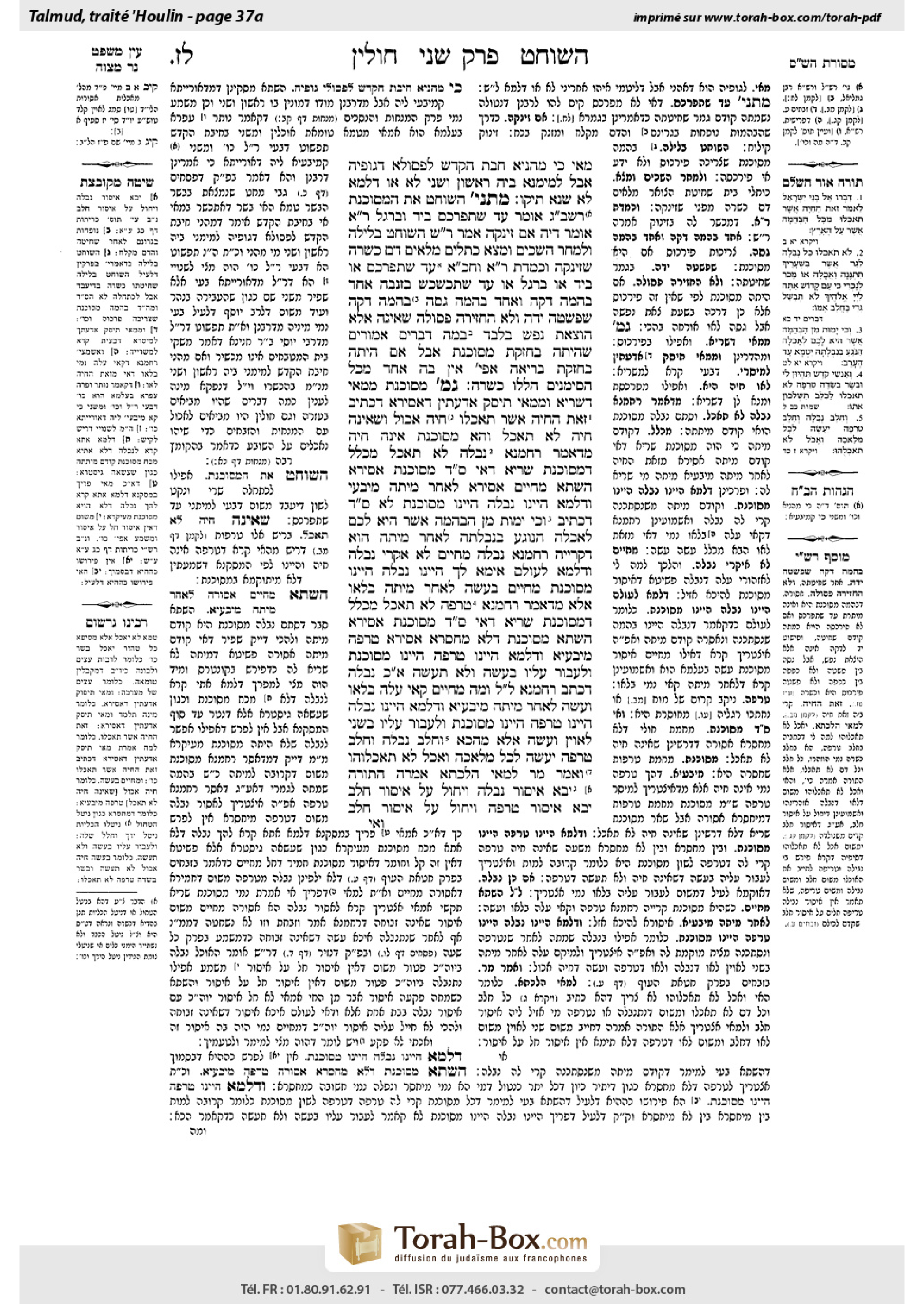
Chullin 37a: Talmud study for Daf Yomi
Study the Talmud for Daf Yomi with scanned pages, Hebrew text, English translations from Sefaria and AI-generated French translations.
Passage selection and English or AI-generated French translation are available where the scan has annotations. Daf Study is independent of Torah-Box and Sefaria.
Browse Chullin · חולין · All tractatesChullin 37a text and translations
This page of Chullin includes the Aramaic text, an English translation and an AI-generated French translation, alongside the scan above.
חולין ל״ז א · Aramaic and Hebrew text
מַאי? כִּי מַהְנְיָא חִבַּת הַקֹּדֶשׁ לִפְסוּלָא דְּגוּפֵיהּ, אֲבָל לְמִימְנֵא בֵּיהּ רִאשׁוֹן וְשֵׁנִי לָא, אוֹ דִּלְמָא לָא שְׁנָא? תֵּיקוּ.
מַתְנִי׳ הַשּׁוֹחֵט אֶת הַמְסוּכֶּנֶת, רַבָּן שִׁמְעוֹן בֶּן גַּמְלִיאֵל אוֹמֵר: עַד שֶׁתְּפַרְכֵּס בַּיָּד וּבָרֶגֶל. רַבִּי אֱלִיעֶזֶר אוֹמֵר: דַּיָּהּ אִם זִינְּקָה. אָמַר רַבִּי שִׁמְעוֹן: הַשּׁוֹחֵט בַּלַּיְלָה, וּלְמָחָר הִשְׁכִּים וּמָצָא כְּתָלִים מְלֵאִים דָּם – כְּשֵׁרָה, שֶׁזִּינְּקָה, וּכְמִדַּת רַבִּי אֱלִיעֶזֶר. וַחֲכָמִים אוֹמְרִים: עַד שֶׁתְּפַרְכֵּס אוֹ בַיָּד אוֹ בָרֶגֶל, אוֹ עַד שֶׁתְּכַשְׁכֵּשׁ בִּזְנָבָהּ.
אֶחָד בְּהֵמָה דַּקָּה וְאֶחָד בְּהֵמָה גַּסָּה, בְּהֵמָה דַּקָּה שֶׁפָּשְׁטָה יָדָהּ וְלֹא הֶחְזִירָה – פְּסוּלָה, שֶׁאֵינָהּ אֶלָּא הוֹצָאַת נֶפֶשׁ בִּלְבָד. בַּמֶּה דְּבָרִים אֲמוּרִים? שֶׁהָיְתָה בְּחֶזְקַת מְסוּכֶּנֶת, אֲבָל אִם הָיְתָה בְּחֶזְקַת בְּרִיאָה, אֲפִילּוּ אֵין בָּהּ אֶחָד מִכׇּל הַסִּימָנִים הַלָּלוּ – כְּשֵׁרָה.
גְּמָ׳ מְסוּכֶּנֶת מִמַּאי דְּשַׁרְיָא? וּמִמַּאי תִּיסַּק אַדַּעְתִּין דַּאֲסִירָא? דִּכְתִיב: ״זֹאת הַחַיָּה אֲשֶׁר תֹּאכְלוּ״, חַיָּה אֱכוֹל, וְשֶׁאֵינָהּ חַיָּה לֹא תֹּאכַל. וְהָא מְסוּכֶּנֶת אֵינָהּ חַיָּה?
מִדְּאָמַר רַחֲמָנָא נְבֵלָה לֹא תֹּאכֵל, מִכְּלָל דִּמְסוּכֶּנֶת שַׁרְיָא, דְּאִי סָלְקָא דַעְתָּךְ מְסוּכֶּנֶת אֲסִירָא – הַשְׁתָּא מֵחַיִּים אֲסִירָא, לְאַחַר מִיתָה מִיבְּעֵי?
וְדִלְמָא הַיְינוּ נְבֵלָה הַיְינוּ מְסוּכֶּנֶת? לָא סָלְקָא דַּעְתָּךְ, דִּכְתִיב: ״וְכִי יָמוּת מִן הַבְּהֵמָה אֲשֶׁר הִיא לָכֶם לְאׇכְלָה הַנֹּגֵעַ בְּנִבְלָתָהּ״, לְאַחַר מִיתָה הוּא דְּקַרְיַיהּ רַחֲמָנָא נְבֵלָה, מֵחַיִּים לָא אִקְּרַי נְבֵלָה.
וְדִלְמָא לְעוֹלָם אֵימָא לָךְ: הַיְינוּ נְבֵלָה הַיְינוּ מְסוּכֶּנֶת, מֵחַיִּים – בַּעֲשֵׂה, לְאַחַר מִיתָה – בְּלָאו.
אֶלָּא, מִדְּאָמַר רַחֲמָנָא טְרֵפָה לֹא תֹּאכַל – מִכְּלָל דִּמְסוּכֶּנֶת שַׁרְיָא, דְּאִי סָלְקָא דַעְתָּךְ מְסוּכֶּנֶת אֲסִירָא, הַשְׁתָּא מְסוּכֶּנֶת דְּלָא מְחַסְּרָא אֲסִירָא, טְרֵפָה מִיבַּעְיָא?
וְדִלְמָא הַיְינוּ טְרֵפָה הַיְינוּ מְסוּכֶּנֶת, וְלַעֲבוֹר עָלָיו בַּעֲשֵׂה וְלֹא תַעֲשֶׂה! אִם כֵּן, נְבֵלָה דִּכְתַב רַחֲמָנָא לְמָה לִי? וּמָה מֵחַיִּים קָאֵי עֲלַהּ בְּלָאו וַעֲשֵׂה, לְאַחַר מִיתָה מִיבַּעְיָא?
וְדִלְמָא הַיְינוּ נְבֵלָה, הַיְינוּ טְרֵפָה, הַיְינוּ מְסוּכֶּנֶת, וְלַעֲבוֹר עָלָיו בִּשְׁנֵי לָאוִין וַעֲשֵׂה!
אֶלָּא מֵהָכָא, ״וְחֵלֶב נְבֵלָה וְחֵלֶב טְרֵפָה יֵעָשֶׂה לְכׇל מְלָאכָה וְאָכֹל לֹא תֹאכְלֻהוּ״, וְאָמַר מָר: לְמַאי הִלְכְתָא אָמְרָה הַתּוֹרָה? יָבֹא אִיסּוּר נְבֵלָה וְיָחוּל עַל אִיסּוּר חֵלֶב, יָבֹא אִיסּוּר טְרֵפָה וְיָחוּל עַל אִיסּוּר חֵלֶב.
Chullin 37a · English translation
The Gemara asks: What is the resolution of the dilemma raised by Rabbi Shimon ben Lakish: When regard for sanctity is effective in rendering an item susceptible to impurity, is it only to disqualify that item itself, but to count the descending levels of first-degree impurity and second-degree impurity, it is not effective; or perhaps once it is rendered susceptible to impurity there is no difference whether it is rendered susceptible by means of regard for sanctity or by means of contact with liquids? The Gemara answers: The dilemma shall stand unresolved.
MISHNA: In the case of one who slaughters an animal that is in danger of imminent death, Rabban Shimon ben Gamliel says: The slaughter is valid only in a case where after the slaughter it convulses with its foreleg and with its hind leg. Rabbi Eliezer says: It is sufficient if blood spurted from the neck. Rabbi Shimon says: In the case of one who slaughters at night and the next day he awoke and found walls full of blood, the slaughter is valid, as it is clear that the blood spurted, and this is in accordance with the rule of Rabbi Eliezer. And the Rabbis say: It is valid only in a case where it convulses with its foreleg or with its hind leg, or in a case where it wags its tail.
This is the halakha with regard to both a small animal, e.g., a sheep, and a large animal, e.g., a cow, that is in danger of imminent death. The slaughter of a small animal that when being slaughtered extended its foreleg that was bent and did not restore it to the bent position is not valid, as extending the foreleg is only part of the natural course of removal of the animal’s soul from its body and not a convulsion indicating life. In what case is this statement said? It is in a case where the presumptive status of the animal was that it was in danger of imminent death. But if its presumptive status was that it was healthy, then even if there were none of these indicators, the slaughter is valid.
GEMARA: The Gemara asks: From where is it known that the flesh of an animal in danger of imminent death is permitted by means of slaughter? The Gemara responds with a question: And from where would it enter your mind that it is prohibited? The Gemara explains that one may have thought it is prohibited, as it is written: “These are the living beings [haḥayya] that you may eat among all the animals that are on the earth” (Leviticus 11:2). One might have thought that the verse is saying: Eat an animal that is fit to live [ḥayya], but do not eat an animal that is not fit to live. And this animal in danger of imminent death is not fit to live.
The fact that its meat is permitted is derived from the fact that the Merciful One states that you shall not eat an unslaughtered animal carcass, as it is written: “You shall not eat any unslaughtered carcass” (Deuteronomy 14:21); one learns by inference that eating the meat of an animal in danger of imminent death is permitted. As, if it enters your mind that eating the meat of an animal in danger of imminent death is prohibited, now if an animal is prohibited while alive, is it necessary to state that it is prohibited after death?
The Gemara rejects that proof. And that is not a legitimate inference, as perhaps the halakhic status of an unslaughtered carcass is the same as that of an animal in danger of imminent death, and the prohibition: “You shall not eat any unslaughtered carcass,” includes both. The Gemara answers: It would not enter your mind to say so, as it is written: “And if any animal of which you may eat dies, one who touches its carcass shall be impure until the evening” (Leviticus 11:39). This indicates that it is after death that the Merciful One calls the animal a carcass; while alive, the animal is not called a carcass.
The Gemara questions that understanding. And perhaps, actually I will say to you: The halakhic status of an unslaughtered carcass is the same as that of an animal in danger of imminent death, but if one slaughters the animal in danger of imminent death while alive, he would be in violation of a positive mitzva: “These are the living beings that you may eat” (Leviticus 11:2), whereas after its death, he would be in violation of a prohibition: “You shall not eat any unslaughtered carcass” (Deuteronomy 14:21).
Rather, the fact that its meat is permitted is derived from the fact that the Merciful One states you shall not eat an animal with a wound that will cause it to die within twelve months [tereifa], as it is written: “And you shall not eat any animal that was mauled in the field [tereifa]” (Exodus 22:30). From here, one learns by inference that eating the meat of an animal in danger of imminent death is permitted. As, if it enters your mind that eating the meat of an animal in danger of imminent death is prohibited, now that an animal in danger of imminent death that is not lacking any limb is prohibited, is it necessary to state that a tereifa, an animal that was mauled and lacking body parts, is prohibited?
The Gemara rejects that proof. And that is not a legitimate inference, as perhaps the halakhic status of a tereifa that is lacking body parts is the same as that of an animal in danger of imminent death that is not lacking body parts, and both are included in the category of tereifa. This would render one who slaughters either to be in violation of both a positive mitzva: “These are the living beings that you may eat,” and a prohibition: “And you shall not eat any animal that was mauled in the field [tereifa].” The Gemara questions that understanding: If so, why do I need the prohibition that the Merciful One writes with regard to an unslaughtered carcass? If while an animal is alive one stands in violation of a prohibition and a positive mitzva, is it necessary to state that it is prohibited after death?
The Gemara objects: And that is not a legitimate question, as perhaps the halakhic status of an unslaughtered carcass is the same as a tereifa that is lacking body parts, and is the same as that of an animal in danger of imminent death that is not lacking body parts. Therefore, when the Torah writes the word “carcass,” it is the same as though it had written tereifa and the same as though it had written an animal in danger of imminent death. The Torah prohibits each, and the result will be that he will violate two prohibitions and a positive mitzva.
Rather, the fact that the meat of an animal in danger of imminent death is permitted is derived from here: “And the fat of a carcass and the fat of a tereifa may be used for any purpose; but you shall not eat it” (Leviticus 7:24). And the Master says: In order to derive what halakha is this verse written? Would one imagine that because it is an unslaughtered carcass or a tereifa its fat would be permitted for consumption? The Torah states: Let the prohibition against eating an unslaughtered carcass come and take effect upon the prohibition against eating forbidden fat, which already exists. One who eats the forbidden fat of an unslaughtered carcass is liable for violation of both prohibitions. Likewise, the word “tereifa” in the verse teaches: Let the prohibition against eating a tereifa come and take effect upon the prohibition against eating forbidden fat, which already exists, so that one who eats the forbidden fat of a tereifa is liable for transgressing both prohibitions.
Chullin 37a · Traduction française (IA)
La Guemara pose la question : Quelle est la résolution du dilemme soulevé par Rabbi Shimon ben Lakish : Lorsque le respect de la sanctité rend un objet susceptible de souillure, est-ce qu'il n'entraîne la nullité que de cet objet lui-même, mais qu'il n'est pas efficace pour compter les degrés descendants de souillure première et de souillure deuxième, ou bien une fois que l'objet est rendu susceptible de souillure, il n'y a pas de différence entre le fait qu'il le soit par le respect de la sanctité ou par le contact avec les liquides ? La Guemara répond : Ce dilemme restera sans solution.
MICHNA : Dans le cas d'une personne qui sacrifie un animal en danger d'une mort imminente, Rabban Shimon ben Gamliel dit : La sacrifice est valide uniquement dans le cas où, après la sacrifice, l'animal convulse avec ses pattes avant et ses pattes arrière. Rabbi Eliezer dit : Il suffit que du sang jaillisse du cou. Rabbi Shimon dit : Dans le cas d'une personne qui sacrifie la nuit et le lendemain il se réveille et trouve des murs pleins de sang, la sacrifice est valide, car il est clair que du sang a jailli, et cela est conforme à la règle de Rabbi Eliezer. Et les Sages disent : La sacrifice est valide uniquement dans le cas où l'animal convulse avec ses pattes avant ou avec ses pattes arrière, ou dans le cas où il secoue sa queue.
C'est la halakha concernant à la fois un petit animal, par exemple un mouton, et un grand animal, par exemple un bovin, en danger d'une mort imminente. La sacrifice d'un petit animal qui, lors de la sacrifice, étendait sa patte avant qui était pliée et ne la repliait pas est invalide, car étendre la patte avant n'est qu'une partie naturelle du processus d'élimination de l'âme de l'animal de son corps et non une convulsion indiquant la vie. Dans quel cas cette déclaration est-elle faite ? C'est dans le cas où le statut présomptif de l'animal était qu'il était en danger d'une mort imminente. Mais si son statut présomptif était qu'il était sain, alors même s'il n'y avait aucun de ces indicateurs, la sacrifice est valide.
GUEMARA : La Guemara pose la question : D'où sait-on que la viande d'un animal en danger d'une mort imminente est permise par la mise à mort ? La Guemara répond avec une question : Et d'où pourrait-il entrer en votre esprit qu'il est interdit ? La Guemara explique que l'on pourrait avoir pensé qu'il est interdit, car il est écrit : « Ces sont les animaux vivants [haḥayya] que vous pouvez manger parmi tous les animaux qui sont sur la terre » (Lévitique 11:2). On pourrait avoir pensé que le verset signifie : Mangez un animal qui est apte à vivre [ḥayya], mais ne mangez pas un animal qui n'est pas apte à vivre. Et cet animal en danger d'une mort imminente n'est pas apte à vivre.
Le fait que sa viande est permise est tiré du fait que l'Éternel dit que vous ne devriez pas manger un cadavre non sacrifié, car il est écrit : « Vous ne devriez pas manger aucun cadavre non sacrifié » (Dn 14:21) ; on en déduit par analogie que manger la viande d'un animal en danger d'une mort imminente est permis. Car, si l'idée vous vient que manger la viande d'un animal en danger d'une mort imminente est interdit, alors si un animal est interdit pendant qu'il est vivant, est-il nécessaire de dire qu'il est interdit après sa mort ?
La Guemara rejette cette preuve. Et cela n'est pas une déduction valable, car peut-être le statut halakhique d'un cadavre non sacrifié est le même que celui d'un animal en danger d'une mort imminente, et l'interdiction : « Vous ne devriez pas manger aucun cadavre non sacrifié », inclut les deux. La Guemara répond : Il ne vous viendrait pas à l'esprit de dire cela, car il est écrit : « Et si un animal dont vous pouvez manger meurt, celui qui touche son cadavre devient souillé jusqu'au soir » (Lévitique 11:39). Cela indique que l'Éternel appelle l'animal un cadavre après sa mort ; pendant qu'il est vivant, l'animal n'est pas appelé un cadavre.
La Guemara questionne cette compréhension. Et peut-être, en réalité, je dirai à vous : Le statut halakhique d'un cadavre non sacrifié est le même que celui d'un animal en danger d'une mort imminente, mais si l'on sacrifie un animal en danger d'une mort imminente pendant qu'il est vivant, on viole une positive mitsva : « Ces sont les animaux vivants que vous pouvez manger » (Lévitique 11:2), tandis que après sa mort, on viole une interdiction : « Vous ne devriez pas manger aucun cadavre non sacrifié » (Dn 14:21).
Plutôt, le fait que sa viande est permise est tiré du fait que l'Éternel dit que vous ne devriez pas manger un animal qui a une blessure qui le fera mourir dans les douze mois [tereifa], car il est écrit : « Et vous ne devriez pas manger aucun animal qui a été mordu dans le champ [tereifa] » (Ex 22:30). D'où l'on déduit par analogie que manger la viande d'un animal en danger d'une mort imminente est permis. Car, si l'idée vous vient que manger la viande d'un animal en danger d'une mort imminente est interdit, alors que l'animal en danger d'une mort imminente qui n'a pas de membre manquant est interdit, est-il nécessaire de dire que le tereifa, l'animal qui a été mordu et manque de membres, est interdit ?
La Guemara rejette cette preuve. Et cela n'est pas une déduction valable, car peut-être le statut halakhique d'un tereifa manquant de membres est le même que celui d'un animal en danger d'une mort imminente qui ne manque pas de membres, et les deux sont inclus dans la catégorie des tereifim. Cela rendrait celui qui sacrifie l'un en violation à la fois d'une positive mitsva : « Ces sont les animaux vivants que vous pouvez manger », et d'une interdiction : « Et vous ne devriez pas manger aucun animal qui a été mordu dans le champ [tereifa]. » La Guemara questionne cette compréhension : Si c'est ainsi, pourquoi ai-je besoin de l'interdiction que l'Éternel écrit concernant un cadavre non sacrifié ? Si pendant que l'animal est vivant, l'on viole une interdiction et une positive mitsva, est-il nécessaire de dire qu'il est interdit après sa mort ?
La Guemara rétorque : Ce n'est pas une question légitime, car peut-être le statut halakhique d'un cadavre non sacrifié est le même que celui d'un téréifé manquant de membres, et le même que celui d'un animal en danger d'une mort imminente qui ne manque pas de membres. Ainsi, lorsque la Torah écrit le mot « cadavre », c'est comme si elle avait écrit « téréifé » et comme si elle avait écrit « animal en danger d'une mort imminente ». La Torah interdit chacun d'eux, et le résultat sera qu'il enfreint deux interdits et une positive mitsva.
En réalité, le fait que la viande d'un animal en danger d'une mort imminente soit permise est tiré de là : « Et la graisse du cadavre et la graisse du téréifé peut être utilisée à toute fin ; mais vous ne devriez pas en manger » (Lévitique 7:24). Et le Maître dit : Pour déduire quelle halakha cette verset est écrit, pourrait-on imaginer que parce qu'il s'agit d'un cadavre non sacrifié ou d'un téréifé, sa graisse serait permise à la consommation ? La Torah dit : Que l'interdiction de manger un cadavre non sacrifié vienne s'appliquer à l'interdiction de manger la graisse interdite, qui existe déjà. Celui qui mange la graisse interdite d'un cadavre non sacrifié est responsable de la violation des deux interdits. De même, le mot « téréifé » dans le verset enseigne : Que l'interdiction de manger un téréifé vienne s'appliquer à l'interdiction de manger la graisse interdite, qui existe déjà, de sorte que celui qui mange la graisse interdite d'un téréifé enfreint les deux interdits.
Traduction française générée par IA à partir de l’édition anglaise de Sefaria. Vérifie toujours un passage avec le texte source.
Text from Sefaria: William Davidson Edition - Vocalized Aramaic (unknown); William Davidson Edition - English (CC BY NC).