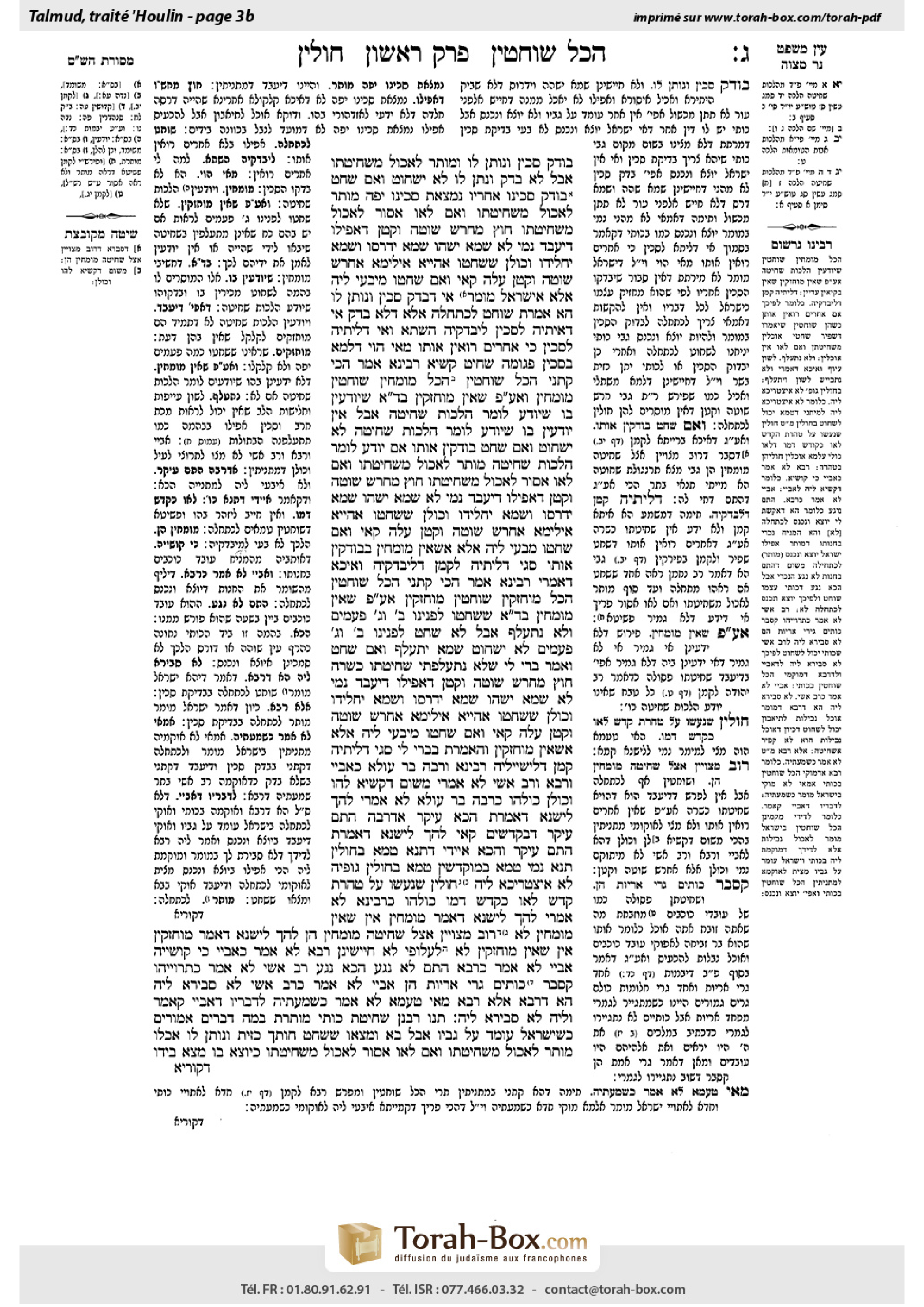
Chullin 3b: Talmud study for Daf Yomi
Study the Talmud for Daf Yomi with scanned pages, Hebrew text, English translations from Sefaria and AI-generated French translations.
Passage selection and English or AI-generated French translation are available where the scan has annotations. Daf Study is independent of Torah-Box and Sefaria.
Browse Chullin · חולין · All tractatesChullin 3b text and translations
This page of Chullin includes the Aramaic text, an English translation and an AI-generated French translation, alongside the scan above.
חולין ג׳ ב · Aramaic and Hebrew text
בּוֹדֵק סַכִּין וְנוֹתֵן לוֹ, וּמוּתָּר לֶאֱכוֹל מִשְּׁחִיטָתוֹ. אֲבָל לֹא בָּדַק וְנָתַן לוֹ – לֹא יִשְׁחוֹט, וְאִם שָׁחַט – בּוֹדֵק סַכִּינוֹ אַחֲרָיו. נִמְצֵאת סַכִּינוֹ יָפָה – מוּתָּר לֶאֱכוֹל מִשְּׁחִיטָתוֹ, וְאִם לָאו – אָסוּר לֶאֱכוֹל מִשְּׁחִיטָתוֹ.
חוּץ מֵחֵרֵשׁ שׁוֹטֶה וְקָטָן, דַּאֲפִילּוּ דִּיעֲבַד נָמֵי לָא, שֶׁמָּא יִשְׁהוּ, שֶׁמָּא יִדְרְסוּ, וְשֶׁמָּא יַחֲלִידוּ. וְכוּלָּן שֶׁשָּׁחֲטוּ – אַהֵיָיא? אִילֵּימָא אַחֵרֵשׁ שׁוֹטֶה וְקָטָן – עֲלַהּ קָאֵי, ״וְאִם שָׁחֲטוּ״ מִיבְּעֵי לֵיהּ!
אֶלָּא אַיִּשְׂרָאֵל מְשׁוּמָּד? אִי דְּבָדַק סַכִּין וְנוֹתֵן לוֹ, הָא אָמְרַתְּ שׁוֹחֵט לְכַתְּחִלָּה! אֶלָּא דְּלֹא בָּדַק. אִי דְּאִיתֵיהּ לְסַכִּין – לִיבְדְּקֵיהּ הַשְׁתָּא, וְאִי דְּלֵיתֵיהּ לְסַכִּין – כִּי אֲחֵרִים רוֹאִין אוֹתוֹ מַאי הָוֵי? דִּלְמָא בְּסַכִּין פְּגוּמָה שָׁחֵיט! קַשְׁיָא.
רָבִינָא אָמַר: הָכִי קָתָנֵי – ״הַכֹּל שׁוֹחֲטִין״, הַכֹּל מוּמְחִין שׁוֹחֲטִין, מוּמְחִין וְאַף עַל פִּי שֶׁאֵין מוּחְזָקִין.
בַּמֶּה דְּבָרִים אֲמוּרִים? שֶׁיּוֹדְעִין בּוֹ שֶׁיּוֹדֵעַ לוֹמַר הִלְכוֹת שְׁחִיטָה, אֲבָל אֵין יוֹדְעִין בּוֹ שֶׁיּוֹדֵעַ לוֹמַר הִלְכוֹת שְׁחִיטָה – לֹא יִשְׁחוֹט, וְאִם שָׁחַט – בּוֹדְקִין אוֹתוֹ, אִם יוֹדֵעַ לוֹמַר הִלְכוֹת שְׁחִיטָה – מוּתָּר לֶאֱכוֹל מִשְּׁחִיטָתוֹ, וְאִם לָאו – אָסוּר לֶאֱכוֹל מִשְּׁחִיטָתוֹ.
חוּץ מֵחֵרֵשׁ שׁוֹטֶה וְקָטָן, דַּאֲפִילּוּ דִּיעֲבַד נָמֵי לָא, שֶׁמָּא יִשְׁהוּ, שֶׁמָּא יִדְרְסוּ, וְשֶׁמָּא יַחֲלִידוּ. וְכוּלָּן שֶׁשָּׁחֲטוּ – אַהֵיָיא? אִילֵּימָא אַחֵרֵשׁ שׁוֹטֶה וְקָטָן עֲלַהּ קָאֵי, וְאִם שָׁחֲטוּ מִבְּעֵי לֵיהּ!
אֶלָּא, אַשֶּׁאֵין מוּמְחִין, בְּבוֹדְקִין אוֹתוֹ סַגִּי! דְּלֵיתֵיהּ לְקַמַּן דְּלִיבְדְּקֵיהּ.
וְאִיכָּא דְאָמְרִי, רָבִינָא אָמַר: הָכִי קָתָנֵי – ״הַכֹּל שׁוֹחֲטִין״, הַכֹּל מוּחְזָקִין שׁוֹחֲטִין, מוּחְזָקִין אַף עַל פִּי שֶׁאֵין מוּמְחִין. בַּמֶּה דְּבָרִים אֲמוּרִים? שֶׁשָּׁחֲטוּ לְפָנֵינוּ שְׁתַּיִם וְשָׁלֹשׁ פְּעָמִים וְלֹא נִתְעַלֵּף, אֲבָל לֹא שָׁחַט לְפָנֵינוּ שְׁתַּיִם וְשָׁלֹשׁ פְּעָמִים – לֹא יִשְׁחוֹט, שֶׁמָּא יִתְעַלֵּף. וְאִם שָׁחַט וְאָמַר: ״בָּרִי לִי שֶׁלֹּא נִתְעַלַּפְתִּי״ – שְׁחִיטָתוֹ כְּשֵׁרָה.
חוּץ מֵחֵרֵשׁ שׁוֹטֶה וְקָטָן, דַּאֲפִילּוּ דִּיעֲבַד נָמֵי לָא, שֶׁמָּא יִשְׁהוּ, שֶׁמָּא יִדְרְסוּ, וְשֶׁמָּא יַחֲלִידוּ. וְכוּלָּן שֶׁשָּׁחֲטוּ – אַהֵיָיא? אִילֵּימָא אַחֵרֵשׁ שׁוֹטֶה וְקָטָן עֲלַהּ קָאֵי, ״וְאִם שָׁחֲטוּ״ מִיבְּעֵי לֵיהּ!
אֶלָּא, אַשֶּׁאֵין מוּחְזָקִין, וְהָאָמְרַתְּ: בְּ״בָרִי לִי״ סַגִּי! דְּלֵיתֵיהּ קַמַּן דְּלִישַׁיְּילֵיהּ.
רָבִינָא וְרַבָּה בַּר עוּלָּא, כְּאַבַּיֵּי וְרָבָא וְרַב אָשֵׁי לָא אָמְרִי, מִשּׁוּם דְּקַשְׁיָא לְהוּ ״וְכוּלָּן״.
כּוּלְּהוּ כְּרַבָּה בַּר עוּלָּא לָא אָמְרִי, לְהַךְ לִישָּׁנָא דְּאָמְרַתְּ הָכָא עִיקָּר – אַדְּרַבָּה, הָתָם עִיקָּר, דִּבְקָדָשִׁים קָאֵי.
לְהַךְ לִישָּׁנָא דְּאָמְרַתְּ: הָתָם עִיקָּר, וְהָכָא אַיְּידֵי דִּתְנָא טָמֵא בְּחוּלִּין תְּנָא נָמֵי טָמֵא בְּמוּקְדָּשִׁין – טָמֵא בְּחוּלִּין גּוּפֵיהּ לָא אִיצְטְרִיכָא לֵיהּ, חוּלִּין שֶׁנַּעֲשׂוּ עַל טׇהֳרַת קֹדֶשׁ לָאו כְּקֹדֶשׁ דָּמוּ.
כּוּלְּהוּ כְּרָבִינָא לָא אָמְרִי, לְהַךְ לִישָּׁנָא דְּאָמַר: מוּמְחִין אִין, שֶׁאֵין מוּמְחִין לָא – רוֹב מְצוּיִין אֵצֶל שְׁחִיטָה מוּמְחִין הֵן.
לְהַךְ לִישָּׁנָא דְּאָמַר: מוּחְזָקִין אִין, שֶׁאֵין מוּחְזָקִין לָא – לְעִלּוֹפֵי לָא חָיְישִׁינַן.
רָבָא לָא אָמַר כְּאַבַּיֵּי, כִּי קוּשְׁיֵיהּ. אַבָּיֵי לָא אָמַר כְּרָבָא, הָתָם לָא נָגַע, הָכָא נָגַע.
רַב אָשֵׁי לָא אָמַר כְּתַרְוַיְיהוּ, קָסָבַר: כּוּתִים גֵּרֵי אֲרָיוֹת הֵן.
אַבָּיֵי לָא אָמַר כְּרַב אָשֵׁי, לָא סְבִירָא לֵיהּ הָא דְּרָבָא. אֶלָּא רָבָא, מַאי טַעְמָא לָא אָמַר כִּשְׁמַעְתֵּיהּ?
לִדְבָרָיו דְּאַבָּיֵי קָאָמַר, וְלֵיהּ לָא סְבִירָא לֵיהּ.
תָּנוּ רַבָּנַן: שְׁחִיטַת כּוּתִי מוּתֶּרֶת, בַּמֶּה דְּבָרִים אֲמוּרִים? כְּשֶׁיִּשְׂרָאֵל עוֹמֵד עַל גַּבָּיו, אֲבָל בָּא וּמְצָאוֹ שֶׁשָּׁחַט – חוֹתֵךְ כַּזַּיִת וְנוֹתֵן לוֹ, אֲכָלוֹ – מוּתָּר לֶאֱכוֹל מִשְּׁחִיטָתוֹ, וְאִם לָאו – אָסוּר לֶאֱכוֹל מִשְּׁחִיטָתוֹ.
כַּיּוֹצֵא בּוֹ, מָצָא בְּיָדוֹ
Chullin 3b · English translation
one examines a knife to ensure that it is perfectly smooth with no nicks and gives it to the transgressor, and it is permitted to eat from what he slaughtered. But if one did not examine the knife and give it to the transgressor, the transgressor may not slaughter an animal ab initio. And if the transgressor slaughtered an animal, one examines his knife after his slaughter. If his knife is found to be perfectly smooth, it is permitted to eat meat from what he slaughtered, and if not, it is prohibited to eat from what he slaughtered.
And it teaches: This is the halakha with regard to all people except for a deaf-mute, an imbecile, and a minor, whose slaughter is not valid even after the fact. The reason the Sages deemed such slaughter not valid is lest people in these categories interrupt the slaughter, lest they press the knife in the course of slaughter, and lest they conceal the knife beneath the windpipe or the gullet in the course of an inverted slaughter. The Gemara asks: If so, with regard to the clause in the mishna that follows: And any of them who slaughtered an animal and others see and supervise them, their slaughter is valid, to which case in the mishna is it referring? If we say that the reference is to the case of a deaf-mute, an imbecile, and a minor, since that is the halakha to which it stands adjacent, the tanna should have formulated the phrase: And if they slaughtered, instead of: And any of them who slaughtered.
Rather, perhaps the reference is to the case of a Jewish transgressor who slaughters. The Gemara asks: In what case? If it is a case where one examined a knife and gave it to the transgressor, didn’t you say in that case that the transgressor may slaughter ab initio? Rather, perhaps the reference is to a case where one did not examine the knife. If it is a case where the knife is available, let him examine the knife now to make sure that there are no nicks. And if it is a case where the knife is not available, then when others see him slaughter, what of it? How can one eat from what he slaughtered? Perhaps he slaughtered the animal with a notched knife. The Gemara concedes that the formulation of the mishna: And any of them who slaughtered, is difficult according to this explanation of the mishna.
§ Ravina said in resolution of the apparent contradiction in the mishna that this is what the mishna is teaching: Everyone slaughters, i.e., everyone who is an expert in the halakhot of ritual slaughter slaughters; all experts are qualified to slaughter, and this is the halakha even if they are not established as accustomed to slaughter with a steady hand and without fainting.
In what case is this statement said? It is said in a case where people know about him that he knows and is able to recite the halakhot of ritual slaughter. But if people do not know about him that he knows and is able to recite the halakhot of ritual slaughter, he may not slaughter an animal ab initio. And if he slaughtered an animal, one examines him; if he knows and is able to recite the halakhot of ritual slaughter it is permitted to eat meat from what he slaughtered, and if not, it is prohibited to eat from what he slaughtered.
And it teaches: This is the halakha with regard to all people except for a deaf-mute, an imbecile, and a minor, whose slaughter is not valid even after the fact. The reason the Sages deemed such slaughter not valid is lest people in these categories interrupt the slaughter, lest they press the knife in the course of slaughter, and lest they conceal the knife beneath the windpipe or the gullet in the course of an inverted slaughter. The Gemara asks: If so, with regard to the clause in the mishna that follows: And any of them who slaughtered an animal and others see and supervise them, their slaughter is valid, to which case in the mishna is this referring? If we say that the reference is to the case of a deaf-mute, an imbecile, and a minor, since that is the halakha to which it stands adjacent, the tanna should have formulated the phrase: And if they slaughtered, instead of: And any of them who slaughtered.
Rather, perhaps the reference is to a case where they are not experts. The Gemara rejects the possibility that they are not experts, as in that case, if one examines him after the slaughter to determine his expertise in the halakhot of ritual slaughter, it is sufficient. The Gemara answers: Supervision is necessary in the case where the one who slaughtered the animal is not before us so that we can examine him.
And there are those who say that Ravina said that this is what the mishna is teaching: Everyone slaughters, i.e., everyone who is established as accustomed to slaughter with a steady hand and without fainting slaughters; all those established concerning this are qualified to slaughter, even if it is not known if they are experts. In what case is this statement said? It is said in a case where they slaughtered before us two or three times and did not faint. But if he did not slaughter before us two or three times he may not slaughter an animal ab initio, lest he faint. And if he slaughtered an animal and said: It is clear to me that I did not faint, his slaughter is valid.
And it teaches: This is the halakha with regard to all people except for a deaf-mute, an imbecile, and a minor, whose slaughter is not valid even after the fact. The reason the Sages deemed such slaughter not valid is lest people in these categories interrupt the slaughter, lest they press the knife in the course of slaughter, and lest they conceal the knife beneath the windpipe or the gullet in the course of an inverted slaughter. The Gemara asks: If so, with regard to the clause in the mishna that follows: And any of them who slaughtered an animal and others see and supervise them, their slaughter is valid, to which case in the mishna is this referring? If we say that the reference is to the case of a deaf-mute, an imbecile, and a minor, since that is the halakha to which it stands adjacent, the tanna should have formulated the phrase: And if they slaughtered, instead of: And any of them who slaughtered.
Rather, perhaps the reference is to a case where they are not established as accustomed to slaughter with a steady hand and without fainting. The Gemara rejects that possibility, as in that case, didn’t you say that if one said after the slaughter: It is clear to me that I did not faint, it is sufficient? The Gemara answers: Supervision is necessary in the case where the one who slaughtered the animal is not before us so that we can ask him whether he fainted.
The Gemara summarizes: Ravina and Rabba bar Ulla did not say a resolution to the apparent contradiction in the mishna like that of Abaye, Rava, and Rav Ashi due to the fact that the phrase in the mishna: And any of them who slaughtered, is difficult for them.
All of the other amora’im did not say a resolution to the apparent contradiction in the mishna like that of Rabba bar Ulla, who interprets the mishna as referring to the case of a ritually impure person; according to that version that you said: The mishna here is the primary source for the halakha of a ritually impure person who slaughtered a sacrificial animal, the other amora’im reject this interpretation because, on the contrary, the mishna there is the primary source, as it is standing in tractate Zevaḥim, which deals with sacrificial animals.
The amora’im also reject the interpretation according to that other version that you said: The mishna there is the primary source, and here, since the tanna taught the case of a ritually impure person who slaughtered non-sacred animals, he teaches the case of a ritually impure person who slaughtered sacrificial animals as well. The reason is that it was not necessary for the tanna to teach the case itself of a ritually impure person who slaughtered a non-sacred animal, as in the opinion of the other amora’im, the halakhic status of non-sacred foods that were prepared according to the strictures of sacrificial food is not like that of sacrificial food, and it is permitted to render such food impure.
All of the other amora’im did not say a resolution to the apparent contradiction in the mishna like that of Ravina; according to that version that he said: Experts, yes, may slaughter ab initio, but those that it is not known that they are experts, no, they may not slaughter ab initio, the other amora’im disagree because they hold that the majority of those associated with slaughter are experts. Therefore, even if it is not known whether they are experts, their slaughter is valid.
According to that version that Ravina said: People who are established as accustomed to slaughter without fainting, yes, they may slaughter ab initio, but people who are not established as accustomed to slaughter without fainting, no, they may not slaughter ab initio, the other amora’im disagree because they hold that we are not concerned for the possibility of fainting.
Rava did not say a resolution like that of Abaye, that the mishna is referring to a Samaritan, in accordance with the difficulty that he raised from the halakha of wine belonging to a Jew to which a gentile has access. Abaye did not say a resolution like that of Rava, that a Samaritan may slaughter ab initio if a Jew enters and exits, because there, in the case of wine, the gentile does not touch the wine; therefore, it is sufficient if the Jew enters and exits. Here, in the case of slaughter, the Samaritan touches the animal in the course of slaughter, and he can disqualify the slaughter in an instant. Therefore, Abaye holds that it is insufficient for a Jew to enter and exit.
Rav Ashi did not say a resolution like that of both of them, Abaye and Rava, because he holds: Samaritans are converts who converted under duress due to the threat posed by lions, and their conversion is void; therefore, their halakhic status is that of a gentile, whose slaughter is not valid.
Abaye did not say a resolution like that of Rav Ashi, who interprets the mishna as referring to a Jewish transgressor whose transgression is that he eats unslaughtered animal carcasses to satisfy his appetite, because he does not hold that which Rava said, that such a transgressor may slaughter ab initio if his knife is examined beforehand by someone reliable. But as for Rava, what is the reason that he did not say a resolution in accordance with his own statement of halakha with regard to the slaughter of a transgressor and explain the mishna in the manner that Rav Ashi did?
The Gemara answers: When Rava explained that the tanna in the mishna is referring to the slaughter of a Samaritan, he stated his opinion in accordance with the statement of Abaye in order to resolve the difficulty that Abaye raised; but he himself does not hold accordingly.
§ The Sages taught in a baraita: The slaughter performed by a Samaritan is permitted ab initio. In what case is this statement said? It is said in a case where there is a Jew standing over him and supervising to ensure that the slaughter was performed properly. But if the Jew came and found that the Samaritan already slaughtered the animal, the Jew cuts an olive-bulk of meat from the slaughtered animal and gives it to the Samaritan to eat. If the Samaritan ate it, it is permitted for the Jew to eat meat from what the Samaritan slaughtered. But if the Samaritan did not eat the meat, it is prohibited to eat from what the Samaritan slaughtered.
Similarly, if the Jew found in the possession of a Samaritan
Chullin 3b · Traduction française (IA)
On examine un couteau pour s'assurer qu'il est parfaitement lisse sans égratangements et on le donne au transgresseur, et il est permis de manger de ce qu'il a tué. Mais si l'on n'a pas examiné le couteau et l'on l'a donné au transgresseur, le transgresseur ne peut pas tuer un animal ab initio. Et si le transgresseur a tué un animal, on examine son couteau après son meurtre. Si son couteau est trouvé parfaitement lisse, il est permis de manger de ce qu'il a tué, et si ce n'est pas le cas, il est interdit de manger de ce qu'il a tué.
Et cela enseigne : c'est la halakha concernant tous les gens sauf un sourd-muet, un imbécile et un mineur, dont la mise à mort n'est pas valide même après coup. La raison pour laquelle les Sages ont jugé que ce genre de mise à mort n'était pas valide est afin que les gens de ces catégories ne perturbent pas la mise à mort, afin qu'ils ne pressent pas le couteau pendant la mise à mort, et afin qu'ils ne cachent pas le couteau sous la trachée ou l'œsophage pendant une mise à mort inversée. La Guemara pose la question : Si c'est ainsi, concernant la clause de la mitsva qui suit : Et tout celui qui a tué un animal et d'autres l'ont vu et surveillé, sa mise à mort est valide, à quel cas de la mitsva fait-il référence ? Si nous disons que la référence est au cas d'un sourd-muet, d'un imbécile et d'un mineur, puisque c'est la halakha à laquelle elle est adjacente, le tanna aurait dû formuler la phrase : Et s'ils ont tué, au lieu de : Et tout celui qui a tué.
Plutôt, peut-être la référence est au cas d'un transgresseur juif qui sacrifie. La Guemara pose la question : Dans quel cas ? Si c'est un cas où l'on a examiné un couteau et l'on l'a donné au transgresseur, n'avez-vous pas dit dans ce cas que le transgresseur peut sacrifier ab initio ? Plutôt, peut-être la référence est à un cas où le couteau n'a pas été examiné. Si c'est un cas où le couteau est disponible, laissez-le examiner le couteau maintenant pour s'assurer qu'il n'y a pas d'égratangements. Et si c'est un cas où le couteau n'est pas disponible, alors quand d'autres le voient sacrifier, qu'y a-t-il ? Comment peut-on manger de ce qu'il a sacrifié ? Peut-être qu'il a sacrifié l'animal avec un couteau égratangé. La Guemara admet que la formulation de la mitsva : Et tout celui qui a sacrifié, est difficile selon cette explication de la mitsva.
§ Ravina a dit en résolution de la contradiction apparente dans la mitsva que c'est ce que la mitsva enseigne : Tout le monde sacrifie, c'est-à-dire tout celui qui est expert dans les halakhot du sacrifice rituel sacrifie ; tous les experts sont qualifiés à sacrifier, et c'est la halakha même s'ils ne sont pas établis comme habitués à sacrifier avec une main ferme et sans s'évanouir.
Dans quel cas cette déclaration est-elle dite ? Elle est dite dans un cas où les gens savent qu'il sait et qu'il est capable de réciter les halakhot du sacrifice rituel. Mais si les gens ne savent pas qu'il sait et qu'il est capable de réciter les halakhot du sacrifice rituel, il ne peut pas sacrifier un animal ab initio. Et si il a sacrifié un animal, on examine lui ; si il sait et est capable de réciter les halakhot du sacrifice rituel, il est permis de manger de ce qu'il a sacrifié, et si ce n'est pas le cas, il est interdit de manger de ce qu'il a sacrifié.
Et cela enseigne : c'est la halakha concernant tous les gens sauf un sourd-muet, un imbécile et un mineur, dont la mise à mort n'est pas valide même après coup. La raison pour laquelle les Sages ont jugé que cette mise à mort n'était pas valide est afin que les gens de ces catégories ne perturbent pas la mise à mort, afin qu'ils ne pressent pas le couteau pendant la mise à mort, et afin qu'ils ne cachent pas le couteau sous la trachée ou l'œsophage pendant une mise à mort inversée. La Guemara pose la question : Si c'est ainsi, concernant la clause de la mitsna qui suit : Et tout celui qui a accompli la mise à mort d'un animal et d'autres l'ont vu et surveillé, sa mise à mort est valide, à quel cas de la mitsna fait-il référence ? Si nous disons que la référence est au cas d'un sourd-muet, d'un imbécile et d'un mineur, puisque c'est la halakha à laquelle elle est adjacente, le tanna aurait dû formuler la phrase : Et s'ils ont accompli la mise à mort, au lieu de : Et tout celui qui a accompli la mise à mort.
Plutôt, peut-être la référence est à un cas où ils ne sont pas des experts. La Guemara rejette la possibilité qu'ils ne soient pas des experts, car dans ce cas, si l'on examine après la mise à mort s'il est expert dans les halakhot de la mise à mort rituelle, cela suffit. La Guemara répond : La surveillance est nécessaire dans le cas où celui qui a accompli la mise à mort de l'animal n'est pas devant nous afin que nous puissions l'examiner.
Et certains disent que Ravina a dit que c'est ce que la mitsna enseigne : Tout le monde peut sacrifier, c'est-à-dire tout celui qui est établi comme habitué à sacrifier avec une main ferme et sans s'évanouir sacrifie ; tous ceux établis à ce sujet sont qualifiés à sacrifier, même si on ne sait pas s'ils sont des experts. Dans quel cas cette déclaration est-elle dite ? Elle est dite dans un cas où ils ont sacrifié devant nous deux ou trois fois et n'ont pas s'évanoui. Mais si il n'a pas sacrifié devant nous deux ou trois fois, il ne peut pas sacrifier un animal ab initio, de peur qu'il s'évanouisse. Et si il a sacrifié un animal et a dit : Il est clair pour moi que je n'ai pas s'évanoui, son sacrifice est valide.
Et cela enseigne : c'est la halakha concernant tous les gens sauf un sourd-muet, un imbécile et un mineur, dont le sacrifice n'est pas valide même après coup. La raison pour laquelle les Sages ont jugé que ce genre de sacrifice n'était pas valide est afin que les gens de ces catégories ne perturbent pas le sacrifice, afin qu'ils ne pressent pas le couteau pendant le sacrifice, et afin qu'ils ne cachent pas le couteau sous la trachée ou l'œsophage pendant un sacrifice inversé. La Guemara pose la question : Si c'est ainsi, concernant la clause de la mitsna qui suit : Et tout celui qui a sacrifié un animal et d'autres l'ont vu et surveillé, son sacrifice est valide, à quel cas de la mitsna fait-il référence ? Si nous disons que la référence est au cas d'un sourd-muet, d'un imbécile et d'un mineur, puisque c'est la halakha à laquelle elle est adjacente, le tanna aurait dû formuler la phrase : Et s'ils ont sacrifié, au lieu de : Et tout celui qui a sacrifié.
Au contraire, peut-être la référence est-elle à un cas où ils ne sont pas établis comme habitués à sacrifier avec une main ferme et sans s'évanouir. La Guemara rejette cette possibilité, car dans ce cas, n'avez-vous pas dit que si l'on dit après la sacrifice : Je suis sûr que je n'ai pas perdu connaissance, cela suffit ? La Guemara répond : La surveillance est nécessaire dans le cas où celui qui a sacrifié l'animal n'est pas devant nous afin que nous puissions lui demander s'il s'est évanoui.
La Guemara résume : Ravina et Rabba bar Ulla n'ont pas dit une résolution à l'apparente contradiction de la mitsva comme celle d'Abaye, Rava et Rav Ashi, en raison du fait que la phrase dans la mitsva : Et tout celui qui a sacrifié, est difficile pour eux.
Tous les autres amoraïm n'ont pas dit une résolution à l'apparente contradiction de la mitsva comme celle de Rabba bar Ulla, qui interprète la mitsva comme faisant référence au cas d'une personne impure rituellement ; selon cette version que vous avez dite : La mitsva ici est la source principale de la halakha d'une personne impure rituellement qui a sacrifié un animal sacré, les autres amoraïm rejettent cette interprétation, car, au contraire, la mitsva là est la source principale, car elle est présente dans le traité Zevaḥim, qui traite des animaux sacrés.
Les amoraïm rejettent également l'interprétation selon cette autre version que vous avez dite : La mitsna là est la source principale, et ici, puisque le tanna a enseigné le cas d'une personne impure rituellement qui a tué des animaux non sacrés, il enseigne aussi le cas d'une personne impure rituellement qui a tué des animaux sacrés. La raison est que le tanna n'avait pas besoin d'enseigner lui-même le cas d'une personne impure rituellement qui a tué un animal non sacré, car, selon l'opinion des autres amoraïm, le statut halakhique des aliments non sacrés préparés selon les règles des aliments sacrés n'est pas comme celui des aliments sacrés, et il est permis de rendre tels aliments impurs.
Tous les autres amoraïm n'ont pas émis une résolution sur la contradiction apparente de la mitsna comme celle de Ravina ; selon cette version qu'il a émise : Les experts, oui, peuvent sacrifier dès le début, mais ceux dont on ne sait pas s'ils sont experts, non, ils ne peuvent pas sacrifier dès le début, les autres amoraïm s'opposent à cela car ils pensent que la majorité de ceux associés à la sacrifice sont des experts. Par conséquent, même si on ne sait pas s'ils sont experts, leur sacrifice est valide.
Selon cette version que Ravina a émise : Les gens établis comme habitués à sacrifier sans s'évanouir, oui, ils peuvent sacrifier dès le début, mais les gens qui ne sont pas établis comme habitués à sacrifier sans s'évanouir, non, ils ne peuvent pas sacrifier dès le début, les autres amoraïm s'opposent à cela car ils pensent que nous ne nous inquiétons pas de la possibilité d'évanouissement.
Rava n'a pas dit une résolution comme celle d'Abaye, qui considère que la mitsna fait référence à un Samaritain, conformément à la difficulté qu'il a soulevée à partir de la halakha du vin appartenant à un Juif auquel un non-Juif a accès. Abaye n'a pas dit une résolution comme celle de Rava, qui considère qu'un Samaritain peut sacrifier dès le début si un Juif entre et sort, car là, dans le cas du vin, le non-Juif ne touche pas le vin ; par conséquent, il suffit que le Juif entre et sorte. Ici, dans le cas du sacrifice, le Samaritain touche l'animal pendant le sacrifice, et il peut invalider le sacrifice instantanément. Par conséquent, Abaye considère que ce n'est pas suffisant que le Juif entre et sorte.
Rav Ashi n'a pas dit une résolution comme celle des deux, Abaye et Rava, car il considère que les Samaritains sont des convertis qui ont converti sous la contrainte en raison de la menace des lions, et leur conversion est nulle ; par conséquent, leur statut halakhique est celui d'un non-Juif, dont le sacrifice n'est pas valide.
Abaye n'a pas dit une résolution comme celle de Rav Ashi, qui interprète la mitsna comme faisant référence à un transgresseur juif dont la transgression est de manger des carcasses d'animaux non sacrifiés pour satisfaire son appétit, car il ne considère pas ce que Rava a dit, à savoir qu'un tel transgresseur peut sacrifier dès le début si son couteau est examiné d'abord par une personne de confiance. Mais concernant Rava, quelle est la raison qu'il n'a pas dit une résolution conformément à son propre déclaration de halakha concernant le sacrifice du transgresseur et expliquer la mitsna de la manière que Rav Ashi a faite ?
La Guemara répond : Lorsque Rava a expliqué que le tanna dans la mitsna fait référence à la mise à mort d'un Samaritain, il a exprimé son opinion conformément à la déclaration d'Abaye afin de résoudre la difficulté que Abaye avait soulevée ; mais il ne partageait pas cet avis lui-même.
§ Les Sages ont enseigné dans une baraïta : La mise à mort effectuée par un Samaritain est permise dès le début. Dans quel cas cette déclaration est-elle dite ? Elle est dite dans le cas où il y a un Juif qui est debout sur lui et qui surveille pour s'assurer que la mise à mort a été effectuée correctement. Mais si le Juif est venu et a trouvé que le Samaritain avait déjà effectué la mise à mort de l'animal, le Juif coupe une quantité d'olive de viande de l'animal sacrifié et la donne au Samaritain pour manger. Si le Samaritain l'a mangé, il est permis au Juif de manger de la viande provenant de la mise à mort du Samaritain. Mais si le Samaritain n'a pas mangé la viande, il est interdit de manger de la viande provenant de la mise à mort du Samaritain.
De même, si le Juif a trouvé dans la possession d'un Samaritain
Traduction française générée par IA à partir de l’édition anglaise de Sefaria. Vérifie toujours un passage avec le texte source.
Text from Sefaria: William Davidson Edition - Vocalized Aramaic (unknown); William Davidson Edition - English (CC BY NC).