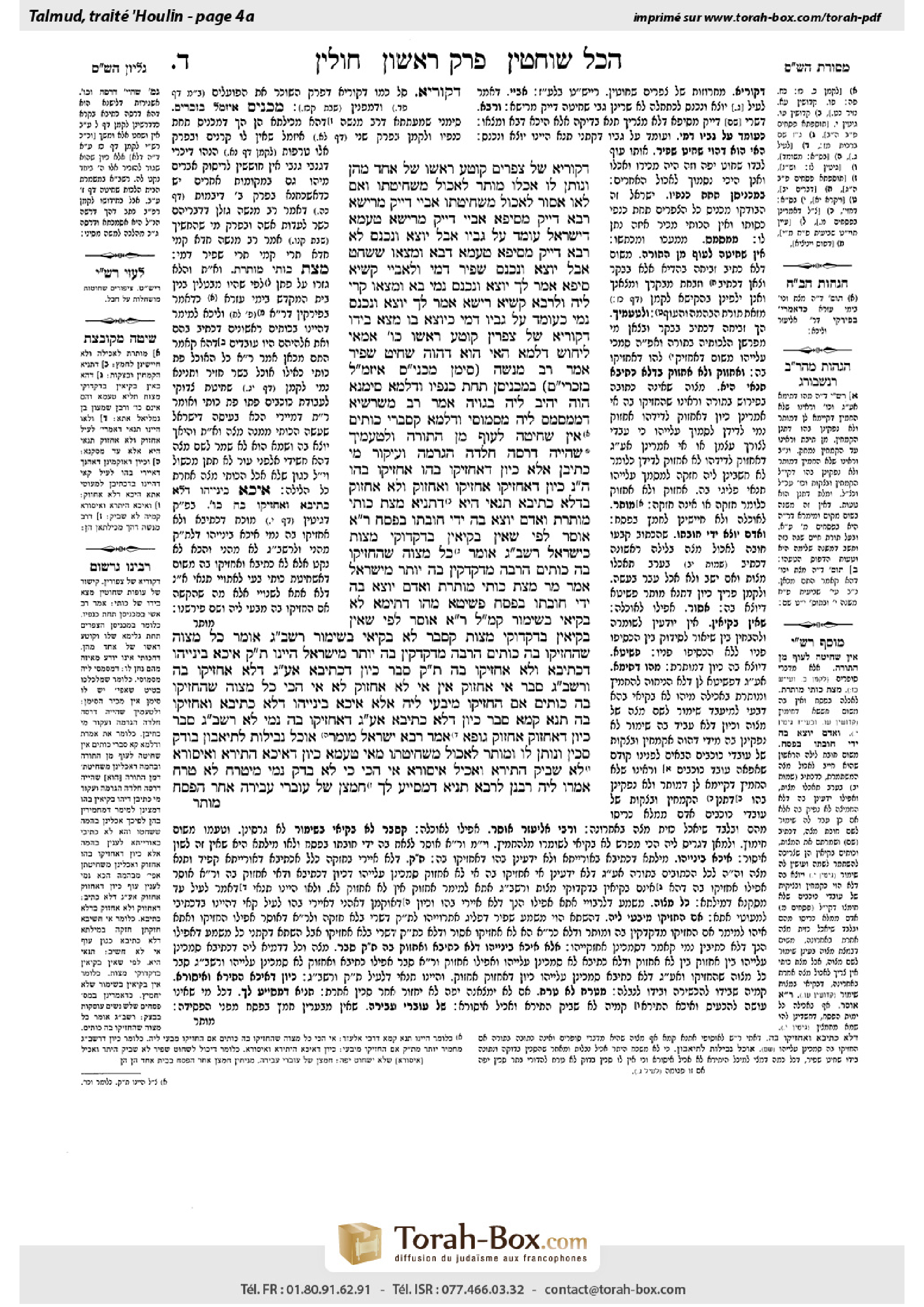
Chullin 4a: Talmud study for Daf Yomi
Study the Talmud for Daf Yomi with scanned pages, Hebrew text, English translations from Sefaria and AI-generated French translations.
Passage selection and English or AI-generated French translation are available where the scan has annotations. Daf Study is independent of Torah-Box and Sefaria.
Browse Chullin · חולין · All tractatesChullin 4a text and translations
This page of Chullin includes the Aramaic text, an English translation and an AI-generated French translation, alongside the scan above.
חולין ד׳ א · Aramaic and Hebrew text
דְּקוּרְיָא שֶׁל צִפֳּרִים, קוֹטֵעַ רֹאשׁוֹ שֶׁל אֶחָד מֵהֶן וְנוֹתֵן לוֹ. אֲכָלוֹ – מוּתָּר לֶאֱכוֹל מִשְּׁחִיטָתוֹ, וְאִם לָאו – אָסוּר לֶאֱכוֹל מִשְּׁחִיטָתוֹ.
אַבָּיֵי דָּיֵיק מֵרֵישָׁא, רָבָא דָּיֵיק מִסֵּיפָא. אַבָּיֵי דָּיֵיק מֵרֵישָׁא: טַעְמָא דְּיִשְׂרָאֵל עוֹמֵד עַל גַּבָּיו, אֲבָל יוֹצֵא וְנִכְנָס – לָא.
רָבָא דָּיֵיק מִסֵּיפָא, טַעְמָא דְּבָא וּמְצָאוֹ שֶׁשָּׁחַט, אֲבָל יוֹצֵא וְנִכְנָס – שַׁפִּיר דָּמֵי.
וּלְאַבָּיֵי קַשְׁיָא סֵיפָא, אָמַר לָךְ: יוֹצֵא וְנִכְנָס נָמֵי ״בָּא וּמְצָאוֹ״ קָרֵי לֵיהּ. וּלְרָבָא קַשְׁיָא רֵישָׁא, אָמַר לָךְ: יוֹצֵא וְנִכְנָס נָמֵי כְּעוֹמֵד עַל גַּבָּיו דָּמֵי.
כַּיּוֹצֵא בּוֹ, מָצָא בְּיָדוֹ דְּקוּרְיָא שֶׁל צִפֳּרִין, קוֹטֵעַ רֹאשׁוֹ כּוּ׳. אַמַּאי? לֵיחוּשׁ דִּלְמָא הַאי הוּא דַּהֲוָה שָׁחֵיט שַׁפִּיר!
אָמַר רַב מְנַשֶּׁה: (סִימָן: מַכְנִיס, אִיזְמֵל, בִּזְכָרִים) בְּמַכְנִיסָן תַּחַת כְּנָפָיו.
וְדִלְמָא סִימָנָא הֲוָה יָהֵיב לֵיהּ בְּגַוֵּיהּ? אָמַר רַב מְשַׁרְשְׁיָא: דִּמְמַסְמֵס לֵיהּ מַסְמוֹסֵי.
וְדִלְמָא קָסָבְרִי כּוּתִים: אֵין שְׁחִיטָה לָעוֹף מִן הַתּוֹרָה?
וּלְטַעְמָיךְ, שְׁהִיָּיה, דְּרָסָה, חֲלָדָה, הַגְרָמָה, וְעִיקּוּר – מִי כְּתִיבָן?
אֶלָּא, כֵּיוָן דְּאַחְזִיקוּ בְּהוּ – אַחְזִיקוּ בְּהוּ. הָכָא נָמֵי: כֵּיוָן דְּאַחְזִיקוּ – אַחְזִיקוּ.
וְאַחְזוּק וְלָא אַחְזוּק בִּדְלָא כְּתִיבָא, תַּנָּאֵי הִיא, דְּתַנְיָא: מַצַּת כּוּתִי מוּתֶּרֶת, וְאָדָם יוֹצֵא בָּהּ יְדֵי חוֹבָתוֹ בַּפֶּסַח.
רַבִּי אֶלְעָזָר אוֹסֵר, לְפִי שֶׁאֵין בְּקִיאִין בְּדִקְדּוּקֵי מִצְוֹת כְּיִשְׂרָאֵל.
רַבָּן שִׁמְעוֹן בֶּן גַּמְלִיאֵל אוֹמֵר: כׇּל מִצְוָה שֶׁהֶחֱזִיקוּ בָּהּ כּוּתִים, הַרְבֵּה מְדַקְדְּקִין בָּהּ יוֹתֵר מִיִּשְׂרָאֵל.
אָמַר מָר: מַצַּת כּוּתִי מוּתֶּרֶת, וְאָדָם יוֹצֵא בָּהּ יְדֵי חוֹבָתוֹ בַּפֶּסַח. פְּשִׁיטָא! מַהוּ דְּתֵימָא: לָא בְּקִיאִי בְּשִׁימּוּר, קָא מַשְׁמַע לַן. רַבִּי אֶלְעָזָר אוֹסֵר, לְפִי שֶׁאֵין בְּקִיאִין בְּדִקְדּוּקֵי מִצְוֹת. קָסָבַר: לָא בְּקִיאִי בְּשִׁימּוּר.
רַבָּן שִׁמְעוֹן בֶּן גַּמְלִיאֵל אוֹמֵר: כׇּל מִצְוָה שֶׁהֶחֱזִיקוּ בָּהּ כּוּתִים, הַרְבֵּה מְדַקְדְּקִין בָּהּ יוֹתֵר מִיִּשְׂרָאֵל. הַיְינוּ תַּנָּא קַמָּא? אִיכָּא בֵּינַיְיהוּ דִּכְתִיבָא וְלָא אַחְזִיקוּ בַּהּ, תַּנָּא קַמָּא סָבַר: כֵּיוָן דִּכְתִיבָא, אַף עַל גַּב דְּלָא אַחְזִיקוּ בַּהּ, וְרַבָּן שִׁמְעוֹן בֶּן גַּמְלִיאֵל סָבַר: אִי אַחְזוּק – אִין, אִי לָא אַחְזוּק – לָא.
אִי הָכִי, ״כׇּל מִצְוָה שֶׁהֶחֱזִיקוּ בָּהּ כּוּתִים״ – ״אִם הֶחְזִיקוּ״ מִיבְּעֵי לֵיהּ!
אֶלָּא, אִיכָּא בֵּינַיְיהוּ דְּלָא כְּתִיבָא וְאַחְזִיקוּ בַּהּ: תַּנָּא קַמָּא סָבַר, כֵּיוָן דְּלָא כְּתִיבָא, אַף עַל גַּב דְּאַחְזִיקוּ בַּהּ – נָמֵי לָא; רַבָּן שִׁמְעוֹן בֶּן גַּמְלִיאֵל סָבַר, כֵּיוָן דְּאַחְזוּק – אַחְזוּק.
גּוּפָא אָמַר רָבָא: יִשְׂרָאֵל מְשׁוּמָּד, אוֹכֵל נְבֵילוֹת לְתֵיאָבוֹן – בּוֹדֵק סַכִּין וְנוֹתֵן לוֹ, וּמוּתָּר לֶאֱכוֹל מִשְּׁחִיטָתוֹ.
מַאי טַעְמָא? כֵּיוָן דְּאִיכָּא הֶתֵּירָא וְאִיסּוּרָא, לָא שָׁבֵיק הֶתֵּירָא וְאָכֵיל אִיסּוּרָא.
אִי הָכִי, כִּי לָא בְּדַק נָמֵי, מִיטְרָח לָא טָרַח.
אֲמַרוּ לֵיהּ רַבָּנַן לְרָבָא: תַּנְיָא דִּמְסַיַּיע לָךְ, חֲמֵצָן שֶׁל עוֹבְרֵי עֲבֵירָה אַחַר הַפֶּסַח
Chullin 4a · English translation
a string [dekurya] of birds, and the Jew does not know whether they were properly slaughtered, he severs the head of one of them and gives it to the Samaritan to eat. If the Samaritan ate it, it is permitted for the Jew to eat the meat from what the Samaritan slaughtered. But if the Samaritan did not eat the meat, it is prohibited to eat from what the Samaritan slaughtered.
In arriving at their respective interpretations of the mishna, Abaye inferred from the first clause of the baraita and Rava inferred from the latter clause of the baraita. Abaye inferred from the first clause: The slaughter performed by a Samaritan is permitted in a case where there is a Jew actively supervising to ensure that the slaughter was performed properly, that the reason it is permitted is that the Jew is standing over him. But if the Jew exits and enters, then no, it is prohibited to eat from what the Samaritan slaughtered.
Rava inferred from the latter clause: If the Jew came and found that the Samaritan already slaughtered the animal, the Jew cuts an olive-bulk of meat from the slaughtered animal and gives it to the Samaritan to eat. The reason that it is necessary to administer this test is due only to the fact that the Jew came and found that the Samaritan already slaughtered the animal. But in a case where the Jew exits and enters, it is permitted to eat from what the Samaritan slaughtered ab initio.
The Gemara raises an objection: And according to Abaye, the latter clause is difficult. The Gemara answers that Abaye could have said to you: The tanna also characterizes the case where a Jew exits and enters as a case of: If the Jew came and found the Samaritan. The Gemara raises an objection: And according to Rava, the first clause is difficult. The Gemara answers that Rava could have said to you: The case where a Jew exits and enters is also considered like a case where the Jew is standing over him, and it is included in that halakha.
§ The baraita continues: Similarly, if the Jew found a string of birds in the possession of a Samaritan, and the Jew does not know whether they were properly slaughtered, he severs the head of one of them and gives it to the Samaritan to eat. If the Samaritan ate it, it is permitted for the Jew to eat from what the Samaritan slaughtered. But if the Samaritan did not eat the meat, it is prohibited to eat from what the Samaritan slaughtered. The Gemara asks: Why is that a reliable indication? Let us be concerned that perhaps it is this bird alone, whose head the Jew severed, that the Samaritan slaughtered properly, and the rest are unslaughtered carcasses.
Rav Menashe said an answer to this question. Before presenting his answer, the Gemara cites a mnemonic for the three statements of Rav Menashe cited in this tractate, this one and two others: Inserts, a scalpel (see 31a), into rams (see 51a). Rav Menashe’s answer is as follows: The case in the baraita is one where the Jew inserts the string of birds under the corners of his garment and hands the Samaritan the head of one of the birds. In that way, the Samaritan has no way of knowing from which bird the head was taken. If he ate it, apparently all the birds were slaughtered properly.
The Gemara challenges: And perhaps the Samaritan placed a distinguishing mark in that bird, indicating to him that it is the kosher one. Rav Mesharshiyya said: The case in the baraita is one where the Jew crushed the head that he gave the Samaritan, thereby rendering it indistinguishable from the others.
The Gemara challenges this answer: And perhaps the Samaritans hold there is no source for the slaughter of a bird in the Torah. Therefore, the fact that the Samaritan ate the bird’s head is no proof that the bird was properly slaughtered.
The Gemara rejects that possibility: And according to your reasoning, those actions that disqualify the slaughter of an animal: Interrupting the slaughter, pressing the knife, concealing the knife in the course of an inverted slaughter, diverting [hagrama] the knife from the place of slaughter, and ripping the simanim from their place before cutting them, are they written in the Torah?
Rather, even though the details are not all written in the Torah, once the Samaritans embraced those disqualifications, they embraced them, and a Jew may rely on their slaughter; when they eat from the meat, it is permitted for a Jew to eat the meat as well. Here too, although the requirement of ritual slaughter for a bird is not written in the Torah, once the Samaritans embraced the mitzva of ritual slaughter, they embraced it in the same manner that it is performed by Jews.
And with regard to mitzvot that are not written explicitly in the Torah that Samaritans embraced, the question of whether they are presumed to fulfill them in the manner that Jews fulfill them or they are not presumed to do so is a dispute between tanna’im, as it is taught in a baraita: It is permitted to eat the matza of a Samaritan on Passover, and a person fulfills his obligation to eat matza on the first night of Passover with it.
Rabbi Elazar prohibits the consumption of the matza of a Samaritan on Passover, because the Samaritans are not experts in the details of mitzvot like Jews and do not know the precise nature of leaven prohibited by the Torah.
Rabban Shimon ben Gamliel says: On the contrary, with regard to any mitzva that the Samaritans embraced and accepted upon themselves, they are more exacting in its observance than are Jews. Therefore, one may assume that they prepared the matza properly.
The Gemara proceeds to analyze that baraita. The Master said: It is permitted to eat the matza of a Samaritan on Passover, and a person fulfills his obligation to eat matza on the first night of Passover with it. The Gemara asks: Isn’t it obvious that if the matza is permitted one fulfills his obligation with it on Passover? The Gemara answers: Lest you say that Samaritans are not expert in the mitzva of guarding the matza for the sake of the mitzva, the tanna teaches us that they are expert. Rabbi Elazar deems it prohibited to eat the matza of Samaritans on Passover, due to the fact that the Samaritans are not experts in the details of mitzvot. He holds that Samaritans are not expert in the mitzva of guarding the matza for the sake of the mitzva.
Rabban Shimon ben Gamliel says: With regard to any mitzva that Samaritans embraced and accepted upon themselves, they are more exacting in its observance than are Jews. The Gemara raises an objection: That is identical to the opinion of the first tanna. The Gemara explains: There is a practical difference between their opinions with regard to a mitzva that is written but with regard to which the Samaritans did not embrace it. The first tanna holds: Once the mitzva is written in the Torah, even if there is no knowledge that they embraced it, Samaritans can be relied upon to perform it properly. And Rabban Shimon ben Gamliel holds: Even with regard to a mitzva written in the Torah, if they embraced its observance, yes, one may rely on the Samaritans, but if they did not embrace its observance, no, one may not rely on them.
The Gemara challenges: If it is so that this is the opinion of Rabban Shimon ben Gamliel, the formulation of his statement is imprecise. He said: With regard to any mitzva that Samaritans embraced and accepted upon themselves, they are more exacting in its observance than are Jews; this indicates that one may rely upon Samaritans to observe those mitzvot even if they are not written in the Torah. Therefore, he should have said: If they embraced, which addresses the statement of the first tanna. Contrary to the first tanna, who said that one may rely upon Samaritans with regard to any mitzva that is written, Rabban Shimon ben Gamliel says that one may rely upon them only if they embraced the mitzva.
Rather, there is a practical difference between their opinions with regard to a mitzva that is not written and with regard to which the Samaritans embraced its observance. The first tanna holds: Since it is not written, even though they embraced its observance one may also not rely upon them. Rabban Shimon ben Gamliel holds: Once it is known that they embraced observance of a mitzva, they embraced the mitzva and one may rely upon them.
§ With regard to the statement of Rava cited earlier (3a), the Gemara analyzes the matter itself. Rava says: In the case of a Jewish transgressor whose transgression is that he eats unslaughtered animal carcasses to satisfy his appetite, if he seeks to slaughter an animal, one examines a knife to ensure that it is perfectly smooth with no nicks and gives it to the transgressor, and it is permitted to eat from what he slaughtered.
The Gemara explains: What is the reason? Since in this case there is the option to slaughter the animal in a permitted manner or to slaughter the animal in a prohibited manner, such a transgressor would not intentionally forsake the permitted manner and eat food slaughtered in a prohibited manner. Since he has a knife that was examined and the majority of those associated with slaughter are experts, the food is presumed to be permitted, and there is no concern that perhaps he intentionally sabotaged the slaughter.
The Gemara challenges: If so, then even in a case where the Jew did not examine the knife, it should be permitted to eat from the animal slaughtered by the transgressor. The Gemara answers: It is prohibited because if the transgressor discovers that the knife is flawed, he does not exert himself to replace it with a knife with a smooth blade.
The Sages said to Rava: A baraita is taught that supports your opinion: With regard to the leavened bread of transgressors, who do not eradicate their leavened bread before Passover, after Passover
Chullin 4a · Traduction française (IA)
Une chaîne [dekurya] d'oiseaux, et le Juif ne sait pas s'ils ont été sacrifiés correctement, il coupe la tête d'un d'entre eux et la donne au Samaritain pour qu'il l'eat. Si le Samaritain l'a mangé, il est permis au Juif de manger la viande provenant du sacrifice du Samaritain. Mais si le Samaritain n'a pas mangé la viande, il est interdit de manger de la viande provenant du sacrifice du Samaritain.
Pour arriver à leurs interprétations respectives de la mitsna, Abaye a tiré de la première partie de la baraïta, et Rava a tiré de la seconde partie de la baraïta. Abaye a tiré de la première partie : Le sacrifice effectué par un Samaritain est permis dans le cas où un Juif supervise activement pour s'assurer que le sacrifice a été effectué correctement, car la raison pour laquelle il est permis est que le Juif est présent. Mais si le Juif entre et sort, alors non, il est interdit de manger de la viande provenant du sacrifice du Samaritain.
Rava a tiré de la seconde partie : Si le Juif est arrivé et a trouvé que le Samaritain avait déjà sacrifié l'animal, le Juif coupe une quantité d'olive de viande de l'animal sacrifié et la donne au Samaritain pour qu'il l'eat. La raison pour laquelle il est nécessaire d'administrer ce test est uniquement en raison du fait que le Juif est arrivé et a trouvé que le Samaritain avait déjà sacrifié l'animal. Mais dans le cas où le Juif entre et sort, il est permis de manger de la viande provenant du sacrifice du Samaritain dès le début.
Le Guemara soulève une objection : Et selon Abaye, la seconde partie est difficile. Le Guemara répond que Abaye aurait pu dire à vous : Le tanna caractérise également le cas où un Juif entre et sort comme un cas de : Si le Juif est arrivé et a trouvé le Samaritain. Le Guemara soulève une objection : Et selon Rava, la première partie est difficile. Le Guemara répond que Rava aurait pu dire à vous : Le cas où un Juif entre et sort est également considéré comme un cas où le Juif est présent, et il est inclus dans cette halakha.
§ La baraïta continue : De même, si le Juif trouva une chaîne d'oiseaux en possession d'un Samaritain, et le Juif ne sait pas s'ils ont été sacrifiés correctement, il coupe la tête d'un d'entre eux et la donne au Samaritain pour qu'il l'eat. Si le Samaritain l'a mangé, il est permis au Juif de manger de la viande provenant du sacrifice du Samaritain. Mais si le Samaritain n'a pas mangé la viande, il est interdit de manger de la viande provenant du sacrifice du Samaritain. Le Guemara demande : Pourquoi cela est-il un indicateur fiable ? Laissons-nous inquiéter que peut-être c'est cet oiseau seul, dont la tête le Juif a coupé, que le Samaritain a sacrifié correctement, et les autres sont des cadavres non sacrifiés.
Rav Menashe a donné une réponse à cette question. Avant de présenter sa réponse, le Guemara cite un mnémonique pour les trois déclarations de Rav Menashe citées dans ce traité, celle-ci et deux autres : Insère, un scalpel (voir 31a), dans des béliers (voir 51a). La réponse de Rav Menashe est la suivante : Le cas dans la baraïta est celui où le Juif insère la chaîne d'oiseaux sous les angles de sa robe et donne à l'homme Samaritain la tête d'un des oiseaux. Ainsi, l'homme Samaritain n'a aucun moyen de savoir d'quelle oie la tête provenait. Si il l'a mangé, apparemment tous les oiseaux ont été sacrifiés correctement.
Le Guemara conteste : Et peut-être que le Samaritain a marqué cet oiseau, indiquant à lui qu'il est l'oiseau kasher. Rav Mesharshiyya a dit : Le cas dans la baraïta est celui où le Juif a écrasé la tête qu'il avait donnée au Samaritain, ce qui le rend indistinct des autres.
Le Guemara conteste cette réponse : Et peut-être que les Samaritains n'ont pas de source dans la Torah pour la découpe d'un oiseau. Par conséquent, le fait que l'homme Samaritain ait mangé la tête de l'oiseau n'est pas une preuve qu'il a été sacrifié correctement.
Le Guemara rejette cette possibilité : Et selon votre raisonnement, ces actions qui rendent le sacrifice d'un animal invalide : interrompre le sacrifice, appuyer le couteau, cacher le couteau lors d'un sacrifice inversé, détourner le couteau du lieu du sacrifice, et arracher les simanim de leur place avant de les couper, sont-elles écrites dans la Torah ?
Plutôt, même si les détails ne sont pas tous écrits dans la Torah, une fois que les Samaritains ont adopté ces interdits, ils les ont adoptés, et un Juif peut se fier à leur sacrifice ; lorsqu'ils mangent de la viande, il est permis au Juif de manger la viande également. De même, bien que la exigence de sacrifice rituel pour un oiseau ne soit pas écrite dans la Torah, une fois que les Samaritains ont adopté la mitsva du sacrifice rituel, ils l'ont adoptée de la même manière que les Juifs.
Et concernant les mitsvot qui ne sont pas explicitement écrites dans la Torah que les Samaritains ont adoptées, la question de savoir s'ils sont supposés les accomplir de la même manière que les Juifs ou non est un débat entre les tannaïm, comme il est enseigné dans une baraïta : Il est permis de manger la matza d'un Samaritain pendant la Pessah, et une personne remplit son obligation de manger la matza la première nuit de Pessah avec cela.
Rabbi Elazar interdit la consommation de la matza d'un Samaritain pendant la Pessah, car les Samaritains ne sont pas des experts dans les détails des mitsvot comme les Juifs et ne connaissent pas la nature précise de la levain interdit par la Torah.
Rabban Shimon ben Gamliel dit : Au contraire, concernant toute mitsva que les Samaritains ont adoptée et acceptée sur eux, ils sont plus exigeants dans son observance que les Juifs. Par conséquent, on peut supposer qu'ils ont préparé la matza correctement.
La Guemara continue d'analyser cette baraïta. Le Maître dit : Il est permis de manger la matza d'un Samaritain pendant la Pessah, et une personne accomplit son obligation de manger de la matza la première nuit de Pessah avec cela. La Guemara demande : N'est-ce pas évident que si la matza est permise, on accomplit son obligation avec elle pendant la Pessah ? La Guemara répond : Afin de ne pas dire que les Samaritains ne sont pas experts dans l'accomplissement de la Mitsva de garder la matza pour l'accomplissement de la Mitsva, le tanna nous apprend qu'ils sont experts. Rabbi Elazar considère que c'est interdit de manger la matza des Samaritains pendant la Pessah, en raison du fait que les Samaritains ne sont pas experts dans les détails des Mitsvot. Il considère que les Samaritains ne sont pas experts dans la Mitsva de garder la matza pour l'accomplissement de la Mitsva.
Rabban Shimon ben Gamliel dit : Concernant toute Mitsva que les Samaritains ont adoptée et acceptée sur eux-mêmes, ils sont plus exigeants dans son observance que les Juifs. La Guemara émet une objection : Cela est identique à l'opinion du premier tanna. La Guemara explique : Il y a une différence pratique entre leurs opinions concernant une Mitsva qui est écrite mais concernant laquelle les Samaritains n'ont pas adoptée. Le premier tanna considère : Une fois que la Mitsva est écrite dans la Torah, même si on ne sait pas qu'ils l'ont adoptée, les Samaritains peuvent être confiés pour l'accomplir correctement. Et Rabban Shimon ben Gamliel considère : Même concernant une Mitsva écrite dans la Torah, si ils ont adopté son observance, oui, on peut confier les Samaritains, mais si ils n'ont pas adopté son observance, non, on ne peut pas confier les Samaritains.
La Guemara conteste : Si c’est ainsi que c’est l’opinion de Rabban Shimon ben Gamliel, la formulation de son propos est imprecise. Il dit : Concernant toute mitsva que les Samaritains ont adoptée et acceptée sur eux-mêmes, ils sont plus exigeants dans son observance que les Juifs ; cela indique qu’on peut confier les Samaritains pour l’observance de ces mitsvot même si elles ne sont pas écrites dans la Torah. Par conséquent, il aurait dû dire : Si ils ont adopté, ce qui concerne la déclaration du premier tanna. Contrairement au premier tanna, qui considère qu’on peut confier les Samaritains concernant toute mitsva qui est écrite, Rabban Shimon ben Gamliel considère qu’on peut confier les Samaritains seulement si ils ont adopté la mitsva.
Plutôt, il y a une différence pratique entre leurs opinions concernant une mitsva qui n’est pas écrite et concernant laquelle les Samaritains ont adopté son observance. Le premier tanna considère : Puisque cela n’est pas écrit, même si ils ont adopté son observance, on ne peut pas confier les Samaritains. Rabban Shimon ben Gamliel considère : Une fois qu’on sait qu’ils ont adopté l’observance d’une mitsva, ils ont adopté la mitsva et on peut confier les Samaritains.
§ Concernant la déclaration de Rava citée plus tôt (3a), la Guemara analyse la question elle-même. Rava dit : Dans le cas d’un transgresseur juif dont la transgression est qu’il mange des carcasses d’animaux non sacrifiés pour satisfaire son appétit, si il cherche à sacrifier un animal, on examine un couteau pour s’assurer qu’il est parfaitement lisse sans entailles et on le donne au transgresseur, et il est permis de manger de ce qu’il a sacrifié.
La Guemara explique : Quelle est la raison ? Puisque dans ce cas il y a l’option de sacrifier l’animal d’une manière permise ou de sacrifier l’animal d’une manière interdite, ce transgresseur ne voudrait pas intentionnellement abandonner la manière permise et manger de la nourriture sacrifiée d’une manière interdite. Puisque il a un couteau examiné et la majorité de ceux associés à la sacrification sont des experts, la nourriture est considérée comme permise, et il n’y a pas de crainte que peut-être il ait intentionnellement saboté la sacrification.
La Guemara conteste : Si c’est ainsi, alors même dans le cas où le Juif n’a pas examiné le couteau, il devrait être permis de manger de l’animal sacrifié par le transgresseur. La Guemara répond : C’est interdit, car si le transgresseur découvre que le couteau est déficient, il ne s’efforce pas de le remplacer par un couteau lisse.
Les Sages dirent à Rava : Une baraïta est enseignée qui soutient votre opinion : Concernant le pain levé des transgresseurs, qui n’éliminent pas leur pain levé avant la Pessah, après la Pessah
Traduction française générée par IA à partir de l’édition anglaise de Sefaria. Vérifie toujours un passage avec le texte source.
Text from Sefaria: William Davidson Edition - Vocalized Aramaic (unknown); William Davidson Edition - English (CC BY NC).