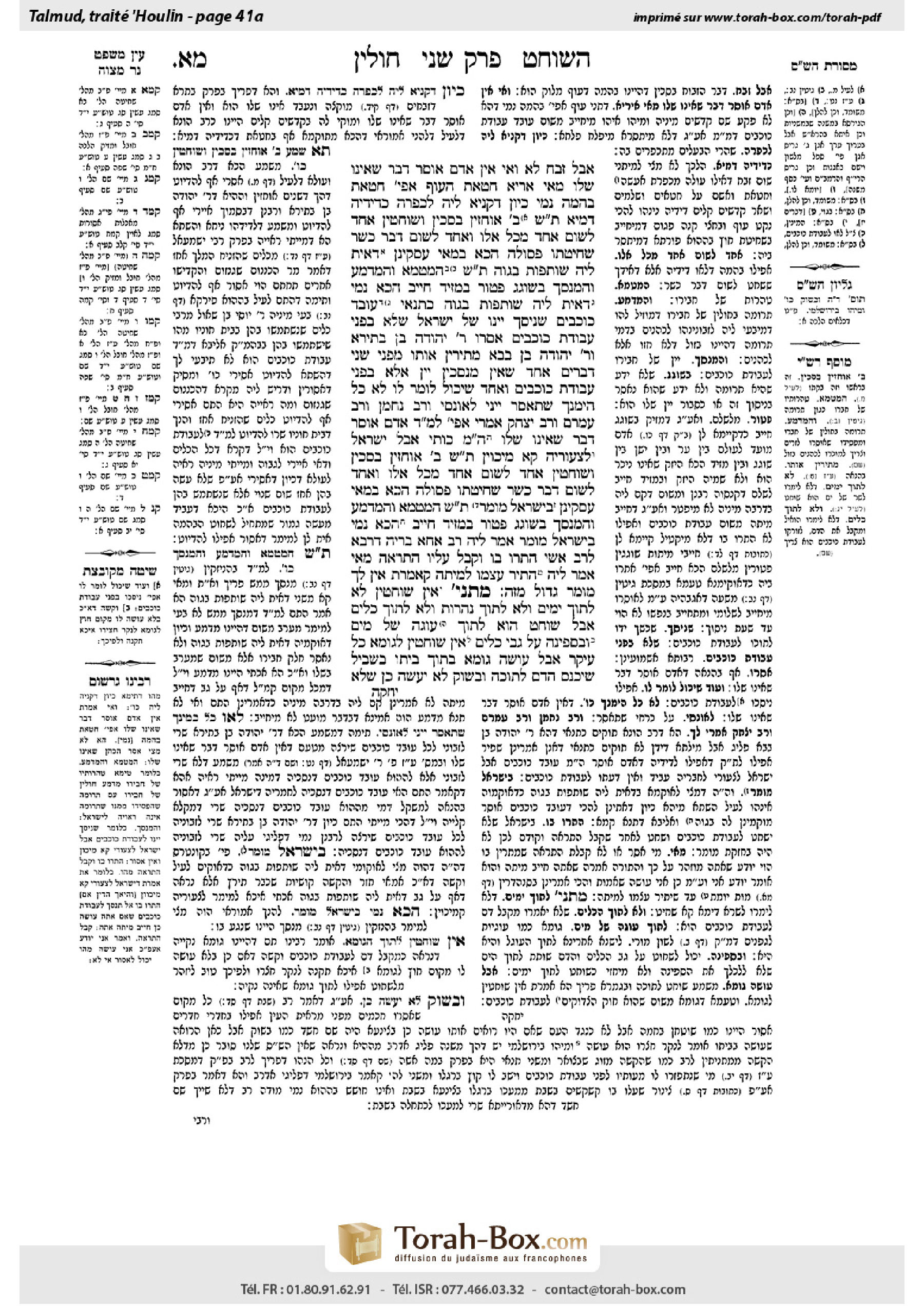
Chullin 41a: Talmud study for Daf Yomi
Study the Talmud for Daf Yomi with scanned pages, Hebrew text, English translations from Sefaria and AI-generated French translations.
Passage selection and English or AI-generated French translation are available where the scan has annotations. Daf Study is independent of Torah-Box and Sefaria.
Browse Chullin · חולין · All tractatesChullin 41a text and translations
This page of Chullin includes the Aramaic text, an English translation and an AI-generated French translation, alongside the scan above.
חולין מ״א א · Aramaic and Hebrew text
אֲבָל זֶבַח לָא. וְאִי אֵין אָדָם אוֹסֵר דָּבָר שֶׁאֵינוֹ שֶׁלּוֹ, מַאי אִרְיָא חַטַּאת הָעוֹף? אֲפִילּוּ חַטַּאת בְּהֵמָה נָמֵי, כֵּיוָן דְּקַנְיָא לֵיהּ לְכַפָּרָה כְּדִידֵיהּ דָּמְיָא.
תָּא שְׁמַע: שְׁנַיִם אוֹחֲזִין בְּסַכִּין וְשׁוֹחֲטִין, אֶחָד לְשׁוּם אֶחָד מִכׇּל אֵלּוּ, וְאֶחָד לְשׁוּם דָּבָר כָּשֵׁר – שְׁחִיטָתוֹ פְּסוּלָה. הָכָא בְּמַאי עָסְקִינַן? דְּאִית לֵיהּ שׁוּתָּפוּת בְּגַוַּהּ.
תָּא שְׁמַע: הַמְטַמֵּא, וְהַמְדַמֵּעַ, וְהַמְנַסֵּךְ – בְּשׁוֹגֵג פָּטוּר, בְּמֵזִיד חַיָּיב. הָכָא נָמֵי דְּאִית לֵיהּ שׁוּתָּפוּת בְּגַוַּהּ.
כְּתַנָּאֵי: גּוֹי שֶׁנִּיסֵּךְ יֵינוֹ שֶׁל יִשְׂרָאֵל שֶׁלֹּא בִּפְנֵי עֲבוֹדָה זָרָה – אֲסָרוֹ, רַבִּי יְהוּדָה בֶּן בְּתֵירָא וְרַבִּי יְהוּדָה בֶּן בָּבָא מַתִּירִין אוֹתוֹ מִפְּנֵי שְׁנֵי דְבָרִים: אֶחָד – שֶׁאֵין מְנַסְּכִין יַיִן אֶלָּא בִּפְנֵי עֲבוֹדָה זָרָה, וְאֶחָד – שֶׁיָּכוֹל לוֹמַר לוֹ ״לֹא כׇּל הֵימֶנָּךְ שֶׁתֶּאֱסֹר יֵינִי לְאוֹנְסִי״.
וְרַב נַחְמָן וְרַב עַמְרָם וְרַב יִצְחָק אָמְרִי: אֲפִילּוּ לְמַאן דְּאָמַר אָדָם אוֹסֵר דָּבָר שֶׁאֵינוֹ שֶׁלּוֹ – הָנֵי מִילֵּי גּוֹי, אֲבָל יִשְׂרָאֵל לְצַעוֹרֵיהּ קָא מִיכַּוֵּין.
תָּא שְׁמַע: שְׁנַיִם אוֹחֲזִין בְּסַכִּין וְשׁוֹחֲטִין, אֶחָד לְשׁוּם אֶחָד מִכׇּל אֵלּוּ וְאֶחָד לְשׁוּם דָּבָר כָּשֵׁר – שְׁחִיטָתוֹ פְּסוּלָה. הָכָא בְּמַאי עָסְקִינַן? בְּיִשְׂרָאֵל מְשׁוּמָּד.
תָּא שְׁמַע: הַמְטַמֵּא וְהַמְדַמֵּעַ וְהַמְנַסֵּךְ, בְּשׁוֹגֵג – פָּטוּר, בְּמֵזִיד – חַיָּיב. הָכָא נָמֵי בְּיִשְׂרָאֵל מְשׁוּמָּד.
אֲמַר לֵיהּ רַב אַחָא בְּרֵיהּ דְּרָבָא לְרַב אָשֵׁי: הִתְרוּ בּוֹ וְקִבֵּל עָלָיו הַתְרָאָה, מַאי? אֲמַר לֵיהּ: הִתִּיר עַצְמוֹ לְמִיתָה קָאָמְרַתְּ? אֵין לָךְ מְשׁוּמָּד גָּדוֹל מִזֶּה.
מַתְנִי׳ אֵין שׁוֹחֲטִין לֹא לְתוֹךְ יַמִּים, וְלֹא לְתוֹךְ נְהָרוֹת, וְלֹא לְתוֹךְ כֵּלִים, אֲבָל שׁוֹחֵט הוּא לְתוֹךְ עוּגָה שֶׁל מַיִם. וּבִסְפִינָה, עַל גַּבֵּי כֵלִים. אֵין שׁוֹחֲטִין לַגּוּמָּא כׇּל עִיקָּר, אֲבָל עוֹשֶׂה גּוּמָּא בְּתוֹךְ בֵּיתוֹ בִּשְׁבִיל שֶׁיִּכָּנֵס הַדָּם לְתוֹכָהּ. וּבַשּׁוּק לֹא יַעֲשֶׂה כֵּן, שֶׁלֹּא
Chullin 41a · English translation
But in the case of an animal offering there is no way in which one can violate all three prohibitions simultaneously. But if a person does not render forbidden an item that is not his, why must the tanna teach the halakha specifically with regard to a bird sin offering? The same halakha would apply even in the case of an animal sin offering. This is because cutting one siman for idolatry does not render the animal forbidden, as the priest has the exclusive right to derive benefit from it, so it does not belong to the owner anymore. Therefore, one would violate the three prohibitions simultaneously. The Gemara answers: Since one who brings a sin offering acquires the animal for his atonement, its status is like that of an animal that is his, and he renders it forbidden with the first cut at the beginning of the slaughter.
The Gemara suggests: Come and hear another objection from the mishna: If there were two people grasping a knife together and slaughtering an animal, one slaughtering for the sake of one of all those enumerated in the first clause of the mishna and one slaughtering for the sake of a legitimate matter, their slaughter is not valid. Based on the formulation of the mishna, the one slaughtering with improper intent is not necessarily the owner of the animal. How, then, can he render the animal forbidden? Apparently, one can render forbidden an item that is not his. The Gemara answers: What are we dealing with here? We are dealing with a case where the one with improper intent has a partnership share in the animal, so he is rendering his own animal forbidden.
The Gemara suggests: Come and hear another objection from a mishna (Gittin 52b): With regard to one who renders another’s food impure, and one who mixes teruma with another’s non-sacred produce, and one who pours another’s wine as a libation before an idol, if he did so unwittingly, he is exempt from payment of damages, even though he caused the other monetary loss. If he did so intentionally, he is liable to pay damages. Apparently, one can render forbidden an item that is not his. The Gemara answers: Here too it is a case where the one who caused the damage has a partnership share in the produce.
The Gemara notes that the dispute whether one who slaughters another’s animal for idol worship renders the animal forbidden, in accordance with Rav Huna, or does not render it forbidden, in accordance with Rav Naḥman, Rav Amram, and Rav Yitzḥak, is parallel to a dispute between tanna’im in a baraita: In the case of a gentile who poured a Jew’s wine as an idolatrous libation, but not in the presence of an object of idol worship, he has rendered the wine forbidden. Rabbi Yehuda ben Beteira and Rabbi Yehuda ben Bava permit drinking the wine due to two factors: One is that the presumption is that idol worshippers pour wine as an idolatrous libation only in the presence of an object of idol worship. And the other one is that even if the gentile poured the wine as an idolatrous libation, the Jew can say to the gentile: It is not within your power to render my wine forbidden against my will.
And Rav Naḥman, and Rav Amram, and Rav Yitzḥak say: Although Rav Huna’s opinion is compatible only with the opinion of the first tanna in the baraita and not with the opinion of Rabbi Yehuda ben Beteira and Rabbi Yehuda ben Bava, we can state our opinion even according to the one who says that a person renders forbidden an item that is not his, e.g., by pouring his wine as a libation or slaughtering his animal for idol worship. This statement applies only in a case where a gentile pours the libation or slaughters the animal. But if a Jew pours the wine or slaughters the animal, presumably he intends to torment that other person, and not to engage in idol worship. Therefore, a Jew does not render the animal forbidden.
The Gemara suggests: Come and hear a contradiction to that distinction from the mishna: If there were two people grasping a knife together and slaughtering an animal, one slaughtering for the sake of one of all those enumerated in the first clause of the mishna and one slaughtering for the sake of a legitimate matter, their slaughter is not valid. As the mishna is discussing a case involving Jews, this indicates that even a Jew who slaughters an animal for idol worship renders it forbidden. The Gemara answers: What are we dealing with here? We are dealing with the case of a Jewish transgressor whose intent when declaring that his slaughter is for the sake of mountains, hills, or other natural entities is for idol worship.
The Gemara suggests: Come and hear a contradiction to the distinction between a Jew and gentile from a mishna (Gittin 52b): With regard to one who renders another’s food impure, and one who mixes teruma with another’s non-sacred produce, and one who pours another’s wine as a libation before an idol, if he did so unwittingly, he is exempt from payment of damages, even though he caused the other monetary loss. If he did so intentionally, he is liable to pay damages. Apparently, a Jew who pours wine as a libation for idolatry renders wine that is not his forbidden. The Gemara answers: Here too the reference is to an apostate Jew whose intent is for idol worship.
Rav Aḥa, son of Rava, said to Rav Ashi: With regard to a Jew who is not a transgressor but declared that he is slaughtering another’s animal for idolatry, if those who heard his declaration forewarned him that doing so is prohibited by Torah law and is punishable by death, and he acknowledged the forewarning and said: It is in full knowledge of the prohibition and the punishment that I do so, what is the halakha? Does he render the animal forbidden in that case? Rav Ashi said to him: Are you saying a case where he subjected himself to death by acknowledging the forewarning? You have no transgressor greater than that, and he certainly renders the animal forbidden.
MISHNA: One may not slaughter an animal and have its blood flow, neither into seas, nor into rivers, nor into vessels, as in all those cases it appears that he is slaughtering the animal in the manner of idolaters. But one may slaughter an animal and have its blood flow into a round excavation containing water. And on a ship, one may slaughter an animal onto vessels as it is clear that his objective is to avoid sullying the ship. One may not slaughter an animal and have its blood flow into a small hole in the ground at all, but one may fashion a small hole inside his house so that the blood will enter into it. And in the marketplace one may not do so, so that he will not
Chullin 41a · Traduction française (IA)
Mais dans le cas d'un sacrifice animal, il n'y a pas de manière dans laquelle on puisse enfreindre les trois prohibitions simultanément. Mais si une personne ne rend pas interdit un objet qui n'est pas le sien, pourquoi le tanna enseigne-t-il spécifiquement la halakha concernant un oiseau sacrifice expiatoire ? La même halakha s'appliquerait même dans le cas d'un sacrifice animal. Cela est dû au fait que couper un siman pour l'idolâtrie ne rend pas l'animal interdit, car le prêtre a le droit exclusif de bénéficier de lui, donc il n'appartient plus à l'owner. Ainsi, on enfreint les trois prohibitions simultanément. La Guemara répond : Puisque celui qui apporte un sacrifice expiatoire acquiert l'animal pour son expiation, son statut est celui d'un animal qui est le sien, et il rend interdit avec le premier coup au début de la bête.
La Guemara suggère : Viens écouter une autre objection tirée de la mitsva : Si deux personnes saisissaient un couteau ensemble et tuaient un animal, l'une tuant pour le compte de l'un de ceux énumérés dans la première clause de la mitsva et l'autre tuant pour une cause légitime, leur tuage n'est pas valide. Selon la formulation de la mitsva, celui qui tue avec l'intention incorrecte n'est pas nécessairement l'owner de l'animal. Comment alors peut-il rendre l'animal interdit ? Apparemment, on peut rendre interdit un objet qui n'est pas le sien. La Guemara répond : De quoi sommes-nous en train de parler ? Nous parlons d'un cas où celui qui a l'intention incorrecte a une part dans l'animal, donc il rend son propre animal interdit.
La Guemara suggère : Viens écouter une autre objection tirée d'une mitsva (Gittin 52b) : Concernant celui qui rend impur la nourriture d'autrui, et celui qui mélange la terouma avec les produits non sacrés d'autrui, et celui qui verse le vin d'autrui comme libation devant un idole, si cela s'est produit sans connaissance, il est exempt de dommages, même s'il a causé une perte monétaire à l'autre. Si cela s'est produit intentionnellement, il est tenu responsable de dommages. Apparemment, on peut rendre interdit un objet qui n'est pas le sien. La Guemara répond : Ici aussi, il s'agit d'un cas où celui qui a causé le préjudice a une part dans les produits.
La Guemara note que le débat sur le fait que celui qui tue un animal d'autrui pour l'idolâtrie rend l'animal interdit, selon Rav Huna, ou ne le rend pas interdit, selon Rav Naḥman, Rav Amram et Rav Yitzḥak, est parallèle à un débat entre tanna’im dans une baraïta : Dans le cas d'un non-Juif qui a versé le vin d'un Juif comme libation idolâtre, mais pas en présence d'un objet d'idolâtrie, il a rendu le vin interdit. Rabbi Yehuda ben Beteira et Rabbi Yehuda ben Bava permettent de boire le vin en raison de deux facteurs : l'un est que l'on suppose que les idolâtres versent du vin comme libation idolâtre uniquement en présence d'un objet d'idolâtrie. Et l'autre est que même si le non-Juif a versé le vin comme libation idolâtre, le Juif peut dire au non-Juif : Ce n'est pas dans votre pouvoir de rendre mon vin interdit contre ma volonté.
Et Rav Naḥman, Rav Amram et Rav Yitzḥak disent : Bien que l'opinion de Rav Huna soit compatible uniquement avec l'opinion du premier tanna dans la baraïta et non avec celle de Rabbi Yehuda ben Beteira et Rabbi Yehuda ben Bava, nous pouvons affirmer notre opinion même selon celui qui dit qu'une personne rend interdit un objet qui n'est pas le sien, par exemple en versant son vin comme libation ou en tuant son animal pour l'idolâtrie. Cette déclaration s'applique uniquement dans le cas où un non-Juif verse la libation ou tue l'animal. Mais si un Juif verse le vin ou tue l'animal, on suppose qu'il vise à tourmenter cette autre personne, et non à participer à l'idolâtrie. Ainsi, un Juif ne rend pas l'animal interdit.
La Guemara suggère : Viens écouter une contradiction à cette distinction tirée de la mitsva : Si deux personnes saisissaient un couteau ensemble et tuaient un animal, l'une tuant pour le compte de l'un de ceux énumérés dans la première clause de la mitsva et l'autre tuant pour une cause légitime, leur tuage n'est pas valide. Comme la mitsva parle d'un cas impliquant des Juifs, cela indique que même un Juif qui tue un animal pour l'idolâtrie rend l'animal interdit. La Guemara répond : De quoi sommes-nous en train de parler ? Nous parlons du cas d'un transgresseur juif dont l'intention lorsqu'il déclare que son tuage est pour les montagnes, les collines ou d'autres entités naturelles est pour l'idolâtrie.
La Guemara suggère : Viens écouter une contradiction à la distinction entre Juif et non-Juif d'une Michna (Gittin 52b) : Concernant celui qui rend impur la nourriture d'autrui, et celui qui mélange la terouma avec les produits non sacrés d'autrui, et celui qui verse le vin d'autrui comme libation devant un idole, si cela s'est produit sans connaissance, il est exempt de dommages, même s'il a causé une perte monétaire à l'autre. Si cela s'est produit intentionnellement, il est tenu responsable de dommages. Apparemment, un Juif qui verse du vin comme libation pour l'idolâtrie rend interdit le vin qui n'est pas le sien. La Guemara répond : Ici aussi, la référence est à un Juif apostat dont l'intention est pour l'idolâtrie.
Rav Aḥa, fils de Rava, a dit à Rav Ashi : Concernant un Juif qui n'est pas un transgresseur mais déclare qu'il tue un animal d'autrui pour l'idolâtrie, si ceux qui ont entendu sa déclaration l'avaient averti que cela est interdit par la Torah et punissable par la mort, et s'il a reconnu l'avertissement et a dit : Je le fais en pleine connaissance de l'interdiction et de la punition, quelle est la halakha ? Est-ce qu'il rend l'animal interdit dans ce cas ? Rav Ashi a répondu à lui : Est-ce que tu dis un cas où il s'est soumis à la mort en reconnaissant l'avertissement ? Tu n'as pas de transgresseur plus grand que celui-ci, et il rend certainement l'animal interdit.
MICHNA : On ne peut pas sacrifier un animal et laisser son sang couler, que ce soit dans les mers, les rivières ou les récipients, car dans tous ces cas, il semble qu'on sacrifie l'animal selon la manière des idolâtres. On peut cependant sacrifier un animal et laisser son sang couler dans une excavation ronde contenant de l'eau. Sur un navire, on peut sacrifier un animal sur des récipients, car il est clair que son objectif est d'éviter de salir le navire. On ne peut pas sacrifier un animal et laisser son sang couler dans un petit trou du sol, mais on peut faire un petit trou à l'intérieur de sa maison afin que le sang y entre. Et dans le marché, on ne peut pas faire cela, afin qu'on ne
Traduction française générée par IA à partir de l’édition anglaise de Sefaria. Vérifie toujours un passage avec le texte source.
Text from Sefaria: William Davidson Edition - Vocalized Aramaic (unknown); William Davidson Edition - English (CC BY NC).