Chullin 41b: Talmud study for Daf Yomi
Study the Talmud for Daf Yomi with scanned pages, Hebrew text, English translations from Sefaria and AI-generated French translations.
Passage selection and English or AI-generated French translation are available where the scan has annotations. Daf Study is independent of Torah-Box and Sefaria.
Browse Chullin · חולין · All tractatesChullin 41b text and translations
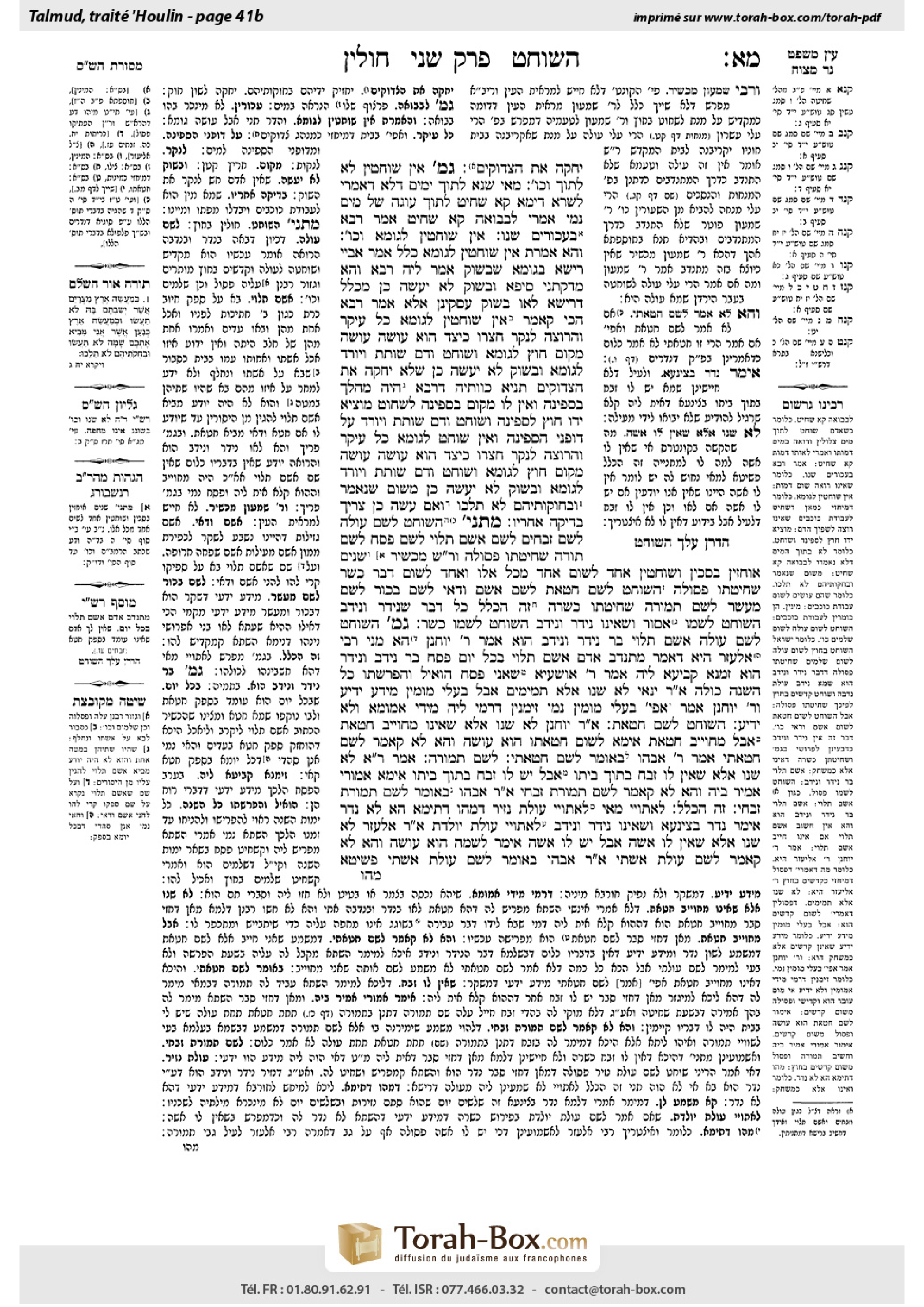
This page of Chullin includes the Aramaic text, an English translation and an AI-generated French translation, alongside the scan above.
חולין מ״א ב · Aramaic and Hebrew text
יְחַקֶּה אֶת הַמִּינִין.
גְּמָ׳ אֵין שׁוֹחֲטִין לֹא לְתוֹךְ וְכוּ׳. מַאי שְׁנָא לְתוֹךְ יַמִּים דְּלָא? דְּאָמְרִי: לְשָׂרָא דְּיַמָּא קָא שָׁחֵיט. לְתוֹךְ עוּגָה שֶׁל מַיִם נָמֵי אָמְרִי: לְבָבוּאָה קָא שָׁחֵיט. אָמַר רָבָא: בַּעֲכוּרִים שָׁנוּ.
אֵין שׁוֹחֲטִין לַגּוּמָּא וְכוּ׳. וְהָא אָמְרַתְּ: אֵין שׁוֹחֲטִין לַגּוּמָּא כְּלָל? אָמַר אַבָּיֵי: רֵישָׁא בְּגוּמָּא שֶׁבַּשּׁוּק.
אֲמַר לֵיהּ רָבָא: וְהָא מִדְּקָתָנֵי סֵיפָא ״וּבַשּׁוּק לֹא יַעֲשֶׂה כֵּן״, מִכְּלָל דְּרֵישָׁא לָאו בְּשׁוּק עָסְקִינַן!
אֶלָּא אָמַר רָבָא, הָכִי קָאָמַר: אֵין שׁוֹחֲטִין לַגּוּמָּא כׇּל עִיקָּר, וְהָרוֹצֶה לְנַקֵּר חֲצֵרוֹ, כֵּיצַד הוּא עוֹשֶׂה? עוֹשֶׂה מָקוֹם חוּץ לַגּוּמָּא וְשׁוֹחֵט, וְדָם שׁוֹתֵת וְיוֹרֵד לַגּוּמָּא, וּבַשּׁוּק לֹא יַעֲשֶׂה כֵּן, שֶׁלֹּא יְחַקֶּה אֶת הַמִּינִין.
תַּנְיָא כְּוָותֵיהּ דְּרָבָא: הָיָה מְהַלֵּךְ בִּסְפִינָה וְאֵין לוֹ מָקוֹם בַּסְּפִינָה לִשְׁחוֹט – מוֹצִיא יָדוֹ חוּץ לַסְּפִינָה וְשׁוֹחֵט, וְדָם שׁוֹתֵת וְיוֹרֵד עַל דּוֹפְנֵי הַסְּפִינָה, וְאֵין שׁוֹחֵט לַגּוּמָּא כׇּל עִיקָּר.
וְהָרוֹצֶה לְנַקֵּר חֲצֵרוֹ, כֵּיצַד הוּא עוֹשֶׂה? עוֹשֶׂה מָקוֹם חוּץ לַגּוּמָּא וְשׁוֹחֵט, וְדָם שׁוֹתֵת וְיוֹרֵד לַגּוּמָּא. וּבַשּׁוּק לֹא יַעֲשֶׂה כֵּן, מִשּׁוּם שֶׁנֶּאֱמַר: ״וּבְחֻקֹּתֵיהֶם לֹא תֵלֵכוּ״, וְאִם עָשָׂה כֵּן – צָרִיךְ בְּדִיקָה אַחֲרָיו.
מַתְנִי׳ הַשּׁוֹחֵט לְשֵׁם עוֹלָה, לְשֵׁם זְבָחִים, לְשֵׁם אָשָׁם תָּלוּי, לְשֵׁם פֶּסַח, לְשֵׁם תּוֹדָה – שְׁחִיטָתוֹ פְּסוּלָה, וְרַבִּי שִׁמְעוֹן מַכְשִׁיר.
שְׁנַיִם אוֹחֲזִין בְּסַכִּין וְשׁוֹחֲטִין, אֶחָד לְשׁוּם אֶחָד מִכׇּל אֵלּוּ, וְאֶחָד לְשׁוּם דָּבָר כָּשֵׁר – שְׁחִיטָתוֹ פְּסוּלָה. הַשּׁוֹחֵט לְשֵׁם חַטָּאת, לְשֵׁם אָשָׁם וַדַּאי, לְשֵׁם בְּכוֹר, לְשֵׁם מַעֲשֵׂר, לְשֵׁם תְּמוּרָה – שְׁחִיטָתוֹ כְּשֵׁרָה.
זֶה הַכְּלָל: כׇּל דָּבָר שֶׁנִּידָּר וְנִידָּב – הַשּׁוֹחֵט לִשְׁמוֹ אָסוּר, וְשֶׁאֵינוֹ נִידָּר וְנִידָּב – הַשּׁוֹחֵט לִשְׁמוֹ כָּשֵׁר.
גְּמָ׳ הַשּׁוֹחֵט לְשֵׁם עוֹלָה. אָשָׁם תָּלוּי בַּר נִידָּר וְנִידָּב הוּא? אָמַר רַבִּי יוֹחָנָן: הָא מַנִּי? רַבִּי אֶלְעָזָר הִיא, דְּאָמַר: מִתְנַדֵּב אָדָם אָשָׁם תָּלוּי בְּכׇל יוֹם.
פֶּסַח בַּר נִידָּב וְנִידָּר הוּא? זִמְנָא קְבִיעָא לֵיהּ! אָמַר רַבִּי אוֹשַׁעְיָא: שָׁאנֵי פֶּסַח, הוֹאִיל וְהַפְרָשָׁתוֹ כׇּל הַשָּׁנָה כּוּלָּהּ.
אָמַר רַבִּי יַנַּאי: לֹא שָׁנוּ אֶלָּא תְּמִימִים, אֲבָל בַּעֲלֵי מוּמִין – מִידָּע יְדִיעַ. וְרַבִּי יוֹחָנָן אָמַר: אֲפִילּוּ בַּעֲלֵי מוּמִין נָמֵי, זִימְנִין דִּרְמֵי לֵיהּ מִידֵּי אַמּוּמָא וְלָא יְדִיעַ.
הַשּׁוֹחֵט לְשֵׁם חַטָּאת, אָמַר רַבִּי יוֹחָנָן: לֹא שָׁנוּ אֶלָּא שֶׁאֵינוֹ מְחוּיָּיב חַטָּאת, אֲבָל מְחוּיָּיב חַטָּאת – אֵימָא לְשׁוּם חַטָּאתוֹ הוּא עוֹשֶׂה. וְהָא לָא קָאָמַר ״לְשֵׁם חַטָּאתִי״? אָמַר רַבִּי אֲבָהוּ: בְּאוֹמֵר ״לְשֵׁם חַטָּאתִי״.
לְשֵׁם תְּמוּרָה, אָמַר רַבִּי אֶלְעָזָר: לֹא שָׁנוּ אֶלָּא שֶׁאֵין לוֹ זֶבַח בְּתוֹךְ בֵּיתוֹ, אֲבָל יֵשׁ לוֹ זֶבַח בְּתוֹךְ בֵּיתוֹ – אֵימָא אֲמוֹרֵי אֲמַיר בֵּיהּ. וְהָא לָא קָאָמַר ״לְשֵׁם תְּמוּרַת זִבְחִי״? אָמַר רַבִּי אֲבָהוּ: בְּאוֹמֵר ״לְשֵׁם תְּמוּרַת זִבְחִי״.
״זֶה הַכְּלָל״ לְאֵתוֹיֵי מַאי? לְאֵתוֹיֵי עוֹלַת נָזִיר, דְּמַהוּ דְּתֵימָא: הָא לָא נְדַר, אֵימַר נֶדֶר בְּצִינְעָא.
וְשֶׁאֵינוֹ נִידָּר וְנִידָּב, לְאֵתוֹיֵי עוֹלַת יוֹלֶדֶת.
אָמַר רַבִּי אֶלְעָזָר: לֹא שָׁנוּ אֶלָּא שֶׁאֵין לוֹ אִשָּׁה, אֲבָל יֵשׁ לוֹ אִשָּׁה – אֵימַר לִשְׁמָהּ הוּא עוֹשֶׂה. וְהָא לָא קָאָמַר ״לְשֵׁם עוֹלַת אִשְׁתִּי״? אָמַר רַבִּי אֲבָהוּ: בְּאוֹמֵר ״לְשֵׁם עוֹלַת אִשְׁתִּי״.
פְּשִׁיטָא?
Chullin 41b · English translation
appear to emulate [yeḥakkeh] the heretics.
GEMARA: The mishna teaches: One may not slaughter an animal and have its blood flow, neither into seas, nor into rivers, nor into vessels, but one may slaughter an animal and have its blood flow into a round excavation containing water. The Gemara asks: What is different about slaughter into seas? Is it that one may not perform it, as onlookers will say: He is slaughtering to the angel of the sea? If so, slaughter into a round excavation containing water should also be prohibited, as onlookers will say: He is slaughtering to his reflection [bavua], which is also similar to idolatry. Rava said: The tanna’im taught that halakha in the case of murky water, in which no reflection can be seen.
§ The mishna states: One may not slaughter an animal and have its blood flow into a small hole in the ground at all, but one may fashion a small hole inside his house so that the blood will enter into it. The Gemara asks: How is it permitted to slaughter and have the blood flow into a hole inside his house? But didn’t you initially say that one may not slaughter an animal and have its blood flow into a small hole in the ground at all? Abaye said: The first clause of the mishna, where there is a blanket prohibition against having the blood flow into a small hole, is referring to a small hole that is in the marketplace.
Rava said to him: But isn’t it so that from the fact that the latter clause teaches: And in the marketplace one may not do so, it may be inferred that in the first clause we are not dealing with the marketplace?
Rather, Rava said that this is what the mishna is saying: One may not slaughter an animal and have its blood flow into a small hole in the ground at all. And one who wishes to clean his courtyard and ensure that it will not be sullied in blood, how does he do so? He fashions a place with an incline or a furrow outside the small hole, and slaughters the animal there, and the blood flows and descends into the hole. And in the marketplace one may not do so, so that he will not appear to emulate the heretics.
It is taught in a baraita in accordance with the opinion of Rava: If one was traveling on a ship and he has no place on the ship to slaughter an animal, he extends his hand with a knife, holds the head of the animal outside the walls of the ship, and slaughters the animal there; and the blood flows and descends down the sides of the ship. He may not slaughter an animal and have its blood flow directly into the sea. And one may not slaughter an animal and have its blood flow into a small hole in the ground at all.
And one who wishes to clean his courtyard and ensure that it will not be sullied with blood, how does he do so? He fashions a place with an incline or a furrow outside the small hole, and slaughters the animal there, and the blood flows and descends into the hole. And in the marketplace, one may not do so, as it is stated: “Neither shall you follow their statutes” (Leviticus 18:3). And if he did so, he requires examination after his actions to ascertain whether he is a heretic.
MISHNA: In the case of one who slaughters an animal and asserts that he is slaughtering it for the sake of a burnt offering, for the sake of a peace offering, for the sake of a provisional guilt offering, for the sake of a Paschal offering, or for the sake of a thanks offering, his slaughter is not valid, as it appears that he is consecrating animals and slaughtering sacrificial animals outside the Temple. And Rabbi Shimon deems his slaughter valid.
If there were two people grasping a knife together and slaughtering an animal, one slaughtering for the sake of one of all those enumerated in the first clause of the mishna and one slaughtering for the sake of a legitimate matter, their slaughter is not valid. With regard to one who slaughters an animal for the sake of a sin offering, for the sake of a guilt offering for a definite transgression, for the sake of the offering of a firstborn, for the sake of the offering of animal tithe, or for the sake of a substitute for a sacrificial animal, his slaughter is valid. All of these offerings may be brought only as obligations and not as gifts. Therefore, there is no concern that he consecrated the animals.
This is the principle: For any item, i.e., offering, which is consecrated as a voluntary vow or gift, in the case of one who slaughters for its sake the animal is forbidden. And for any offering that is not consecrated as a voluntary vow or gift but is an obligation that is incumbent upon him, in the case of one who slaughters for its sake the animal is permitted.
GEMARA: The mishna teaches: In the case of one who slaughters an animal and asserts that he is slaughtering it for the sake of a burnt offering, for the sake of a peace offering, for the sake of a provisional guilt offering, for the sake of a Paschal offering, or for the sake of a thanks offering, the slaughter is not valid. This is because one who slaughters for the sake of any type of offering that is consecrated as a vow or as a gift renders the animal forbidden. The Gemara asks: Is a provisional guilt offering fit to be consecrated as a vow or as a gift? A provisional guilt offering is brought only when one is obligated to do so due to uncertainty whether or not he is liable to bring a sin offering. Rabbi Yoḥanan said: In accordance with whose opinion is this halakha in the mishna? It is in accordance with the opinion of Rabbi Elazar, who says in a mishna (Karetot 25a): A person donates a provisional guilt offering every day if he chooses, due to concern that perhaps he violated a prohibition.
The Gemara asks: Is a Paschal offering fit to be consecrated as a vow or as a gift? The time is fixed for its offering on Passover eve, when bringing it is an obligation, and it may not be brought on any other day. Rabbi Oshaya said: The Paschal offering is different, since although the date for bringing and slaughtering it is the fourteenth of Nisan, its designation can be performed throughout the entire year.
Rabbi Yannai says: The Sages taught that slaughter of an animal for the sake of an offering is not valid only if the animals were unblemished. But with regard to animals with blemishes, the slaughterer knows that they are blemished and disqualified from sacrifice. Therefore, despite his declaration, there is no concern that his actual intent was to slaughter the animal for that purpose. And Rabbi Yoḥanan says: Slaughter of an animal for the sake of an offering is not valid even if the animals were blemished as well, as there are times that an item is cast over the blemish and covers it, and he does not know that the animal is blemished.
The mishna teaches: With regard to one who slaughters an animal for the sake of a sin offering, his slaughter is valid, as, since one cannot voluntarily contribute a sin offering, there is no concern that the onlookers will draw the wrong conclusion. Rabbi Yoḥanan says: The Sages taught that slaughter of an animal for the sake of a sin offering is valid only with regard to a slaughterer who is not liable to bring a sin offering. But a slaughterer who knows that he is liable to bring a sin offering, his slaughter is not valid. Say that he is performing consecration and slaughter for the sake of his sin offering. The Gemara asks: But didn’t he say before the slaughter: For the sake of a sin offering, and he did not say: For the sake of my sin offering? Why, then, is that a concern? Rabbi Abbahu said: Indeed, the reference is to a case where he says: I am slaughtering this animal for the sake of my sin offering.
The mishna teaches: With regard to one who slaughters for the sake of a substitute for a sacrificial animal, his slaughter is valid. Rabbi Elazar says: The Sages taught that the slaughter is valid only in a case where he does not have an animal consecrated as an offering inside his house for which it can be the substitute, but if he has an animal consecrated as an offering in his house, say that he is substituting this animal for it, and the slaughter is not valid. The Gemara asks: But didn’t he say before the slaughter: For the sake of a substitute for a sacrificial animal, and he did not say: For the sake of a substitute for my animal consecrated as an offering? Why, then, is that a concern? Rabbi Abbahu said: Indeed, the reference is to a case where he says: I am slaughtering this animal for the sake of a substitute for my animal consecrated as an offering.
The mishna states that this is the principle: For any offering that is consecrated as a voluntary vow or gift, in the case of one who slaughters for its sake, the animal is forbidden. The Gemara asks: What case does this clause add? The list in the mishna appears to be comprehensive. The Gemara answers: The clause serves to add the burnt offering of a nazirite. As, lest you say there is no concern in that case, as that person did not vow to become a nazirite and could not possibly be obligated to bring that offering, therefore, the tanna teaches that there is a concern if he said he was slaughtering for the sake of the burnt offering of a nazirite. Say that perhaps he vowed to become a nazirite in private, and no one else was aware of it.
The Gemara asks: What is added by the second half of the principle: And for any offering that is not consecrated as a voluntary vow or as a gift, in the case of one who slaughters for its sake the animal is permitted? The Gemara answers: It serves to add the burnt offering of a woman after childbirth. If one slaughters an animal for the sake of a burnt offering of a woman after childbirth, the slaughter is valid, as it is an obligation.
Rabbi Elazar says: The Sages taught that the slaughter is valid only in a case where he does not have a wife. But if he has a wife, say that he performs consecration and slaughter of the animal for her sake and therefore the slaughter is not valid. The Gemara asks: But didn’t he say before the slaughter: For the sake of the burnt offering of a woman after childbirth, and he did not say: For the sake of the burnt offering of my wife after childbirth? Why, then, is that a concern? Rabbi Abbahu said: Indeed, the reference is to a case where he says: I am slaughtering this animal for the sake of the burnt offering of my wife after childbirth.
The Gemara objects: This is obvious. Clearly, if he explicitly declared that the slaughter is for the sake of the burnt offering of his wife after childbirth the slaughter is not valid.
Chullin 41b · Traduction française (IA)
sembler imiter les hérétiques.
GUEMARA : La mitsva enseigne : On ne doit pas sacrifier un animal et laisser son sang couler, ni dans les mers, ni dans les rivières, ni dans des récipients, mais on peut sacrifier un animal et laisser son sang couler dans une excavation ronde contenant de l'eau. La Guemara pose la question : Qu'est-ce qui diffère dans le sacrifice dans les mers ? Est-ce que cela est interdit, car les spectateurs diront : Il sacrifie à l'ange des mers ? Si c'est le cas, le sacrifice dans une excavation ronde contenant de l'eau devrait aussi être interdit, car les spectateurs diront : Il sacrifie à son reflet [bavua], ce qui est également semblable à l'idolâtrie. Rava dit : Les tannaïm ont enseigné que la halakha dans le cas d'eau trouble, où on ne peut pas voir de reflet.
§ La mitsva stipule : On ne doit pas sacrifier un animal et laisser son sang couler dans un petit trou du sol, mais on peut faire un petit trou à l'intérieur de sa maison afin que le sang entre dedans. La Guemara pose la question : Comment est-il permis de sacrifier et de laisser le sang couler dans un trou à l'intérieur de sa maison ? Mais n'avez-vous pas dit auparavant que l'on ne doit pas sacrifier un animal et laisser son sang couler dans un petit trou du sol ? Abaye dit : La première clause de la mitsva, où il y a une interdiction générale de laisser le sang couler dans un petit trou, fait référence à un petit trou dans le marché.
Rava dit à lui : Mais n'est-ce pas le cas que, du fait que la clause ultérieure enseigne : Et dans le marché on ne peut pas le faire, on peut en déduire que dans la première clause nous ne parlons pas du marché ?
Plutôt, Rava dit que c'est ce que la mitsva dit : On ne doit pas sacrifier un animal et laisser son sang couler dans un petit trou du sol. Et celui qui veut nettoyer son courtil et s'assurer qu'il ne sera pas souillé de sang, comment fait-il ? Il fait un endroit avec une pente ou un sillon en dehors du petit trou, et sacrifie l'animal là, et le sang coule et descend dans le trou. Et dans le marché on ne peut pas le faire, afin qu'il ne semble pas imiter les hérétiques.
Il est enseigné dans une baraïta selon l'opinion de Rava : Si l'on voyageait sur un bateau et qu'on n'avait pas de place sur le bateau pour sacrifier un animal, on étendait sa main avec un couteau, tenait la tête de l'animal en dehors des murs du bateau, et sacrifiait l'animal là ; et le sang coulait et descendait le long des côtés du bateau. On ne peut pas sacrifier un animal et laisser son sang couler directement dans la mer. Et on ne doit pas sacrifier un animal et laisser son sang couler dans un petit trou du sol.
Et celui qui veut nettoyer son courtil et s'assurer qu'il ne sera pas souillé de sang, comment fait-il ? Il fait un endroit avec une pente ou un sillon en dehors du petit trou, et sacrifie l'animal là, et le sang coule et descend dans le trou. Et dans le marché, on ne peut pas le faire, car il est dit : « Ni ne suivrez leurs statuts » (Lévitique 18:3). Et s'il l'avait fait, il devrait être examiné après ses actions pour déterminer s'il est hérétique.
MICHNA : Dans le cas d'une personne qui sacrifie un animal et affirme qu'il sacrifie pour l'holocauste, pour l'offrande de paix, pour l'offrande de culpabilité provisoire, pour l'offrande pascal, ou pour l'offrande de remerciement, son sacrifice n'est pas valide, car il semble qu'il consacre des animaux et sacrifie des animaux sacrés en dehors du Temple. Rabbi Shimon considère son sacrifice comme valide.
Si deux personnes saisissent un couteau ensemble et sacrifient un animal, l'une sacrifiant pour l'un des cas énumérés dans la première clause de la mitsna et l'autre sacrifiant pour une cause légitime, leur sacrifice n'est pas valide. Concernant celui qui sacrifie un animal pour l'offrande de culpabilité, pour l'offrande de culpabilité pour une transgression définie, pour l'offrande du premier-né, pour l'offrande de l'animal titulaire, ou pour l'offrande de remplacement d'un animal sacré, son sacrifice est valide. Toutes ces offrandes peuvent être apportées uniquement comme obligations et non comme dons. Par conséquent, il n'y a pas de crainte qu'il ait consacré les animaux.
C'est le principe : Pour toute chose, c'est-à-dire offrande, qui est consacrée comme un vœu volontaire ou comme un don, dans le cas d'une personne qui sacrifie pour sa cause, l'animal est interdit. Et pour toute offrande qui n'est pas consacrée comme un vœu volontaire ou comme un don mais est une obligation qui incombe à lui, dans le cas d'une personne qui sacrifie pour sa cause, l'animal est permis.
GUEMARA : La mitsva enseigne : Dans le cas d'une personne qui sacrifie un animal et affirme qu'il sacrifie pour l'holocauste, pour l'offrande de paix, pour l'offrande de culpabilité provisoire, pour l'offrande pascal, ou pour l'offrande de remerciement, le sacrifice n'est pas valide. Cela est dû au fait qu'une personne qui sacrifie pour l'offrande de n'importe quel type d'offrande consacrée comme un vœu ou comme un don rend l'animal interdit. La Guemara pose la question : Une offrande de culpabilité provisoire est-elle adaptée à être consacrée comme un vœu ou comme un don ? Une offrande de culpabilité provisoire est apportée uniquement lorsque l'on est obligé de le faire en raison de l'incertitude sur la responsabilité d'apporter une offrande de culpabilité. Rabbi Yoḥanan dit : Selon l'opinion de qui est cette halakha dans la mitsva ? C'est selon l'opinion de Rabbi Elazar, qui dit dans une mitsva (Karetot 25a) : Une personne donne une offrande de culpabilité provisoire chaque jour s'il le souhaite, en raison de la crainte qu'il ait violé une interdiction.
La Guemara pose la question : Une offrande pascal est-elle adaptée à être consacrée comme un vœu ou comme un don ? Le temps est fixé pour son apport le soir de la Pâque, lorsque l'apport est une obligation, et il ne peut être apporté un autre jour. Rabbi Oshaya dit : L'offrande pascal est différente, car bien que la date d'apport et de sacrifice soit le quatorzième de Nisan, sa désignation peut être effectuée tout au long de l'année.
Rabbi Yannai dit : Les Sages enseignent que la mise à mort d'un animal pour l'offrande n'est pas valable uniquement si les animaux sont sans tache. Mais concernant les animaux tachés, le boucher sait qu'ils sont tachés et incompatibles avec l'offrande. Par conséquent, malgré sa déclaration, il n'y a pas de crainte que son intention réelle fût de sacrifier l'animal à cet effet. Rabbi Yoḥanan dit : La mise à mort d'un animal pour l'offrande n'est pas valable même si les animaux sont tachés, car il y a des moments où un objet est jeté sur la tache et la recouvre, et il ne sait pas que l'animal est taché.
La mitsna enseigne : Concernant celui qui sacrifie un animal pour l'offrande expiatoire, sa mise à mort est valable, car, puisque l'on ne peut pas volontairement offrir un sacrifice expiatoire, il n'y a pas de crainte que les spectateurs tirent une conclusion erronée. Rabbi Yoḥanan dit : Les Sages enseignent que la mise à mort d'un animal pour l'offrande expiatoire est valable uniquement concernant un boucher non tenu de présenter un sacrifice expiatoire. Mais un boucher qui sait qu'il est tenu de présenter un sacrifice expiatoire, sa mise à mort n'est pas valable. Disons qu'il effectue la consécration et la mise à mort pour son propre sacrifice expiatoire. La Guemara demande : Mais n'avait-il pas dit avant la mise à mort : Pour l'offrande expiatoire, et il n'avait pas dit : Pour mon propre sacrifice expiatoire ? Pourquoi, alors, cela constitue-t-il une crainte ? Rabbi Abbahu dit : En effet, la référence est à un cas où il dit : Je sacrifie cet animal pour mon propre sacrifice expiatoire.
La mitsna enseigne : Concernant celui qui sacrifie pour le substitut d'un animal sacré, sa mise à mort est valable. Rabbi Elazar dit : Les Sages enseignent que la mise à mort est valable uniquement dans le cas où il n'a pas d'animal consacré comme offrande chez lui pour lequel il peut être substitué, mais s'il a un animal consacré comme offrande chez lui, disons qu'il substitue cet animal à celui-ci, et la mise à mort n'est pas valable. La Guemara demande : Mais n'avait-il pas dit avant la mise à mort : Pour le substitut d'un animal sacré, et il n'avait pas dit : Pour le substitut de mon animal consacré ? Pourquoi, alors, cela constitue-t-il un problème ? Rabbi Abbahu dit : En effet, la référence est à un cas où il dit : Je sacrifie cet animal pour le substitut de mon animal consacré.
La mitsna stipule que ce principe est le suivant : Pour toute offrande consacrée comme vœu volontaire ou comme don, dans le cas où l'on sacrifie pour son compte, l'animal est interdit. La Guemara demande : Quel cas cette clause ajoute-t-elle ? La liste de la mitsna semble être exhaustive. La Guemara répond : Cette clause sert à ajouter l'holocauste du nazir. Car, crainte que vous ne disiez pas qu'il y a une crainte dans ce cas, car cette personne n'a pas fait de vœu de devenir un nazir et ne pouvait pas être tenu de présenter cette offrande, donc le tanna enseigne qu'il y a une crainte s'il dit qu'il sacrifie pour l'holocauste du nazir. Disons que peut-être il a fait un vœu de devenir un nazir en privé, et personne ne savait.
La Guemara demande : Quel est l'ajout de la seconde moitié du principe : Et pour toute offrande qui n'est pas consacrée comme vœu volontaire ou comme don, dans le cas où l'on sacrifie pour son compte, l'animal est permis ? La Guemara répond : Elle sert à ajouter l'holocauste d'une femme après l'accouchement. Si l'on sacrifie un animal pour l'holocauste d'une femme après l'accouchement, la mise à mort est valable, car c'est une obligation.
Rabbi Elazar dit : Les Sages enseignent que la mise à mort est valable uniquement dans le cas où il n'a pas de femme. Mais s'il a une femme, disons qu'il effectue la consécration et la mise à mort de l'animal pour son compte et donc la mise à mort n'est pas valable. La Guemara demande : Mais n'avait-il pas dit avant la mise à mort : Pour l'holocauste de la femme après l'accouchement, et il n'avait pas dit : Pour l'holocauste de ma femme après l'accouchement ? Pourquoi, alors, cela constitue-t-il une crainte ? Rabbi Abbahu dit : En effet, la référence est à un cas où il dit : Je sacrifie cet animal pour l'holocauste de ma femme après l'accouchement.
La Guemara s'oppose : Cela est évident. Évidemment, si l'on a déclaré explicitement que la mise à mort est pour l'holocauste de sa femme après l'accouchement, la mise à mort n'est pas valable.
Traduction française générée par IA à partir de l’édition anglaise de Sefaria. Vérifie toujours un passage avec le texte source.
Text from Sefaria: William Davidson Edition - Vocalized Aramaic (unknown); William Davidson Edition - English (CC BY NC).