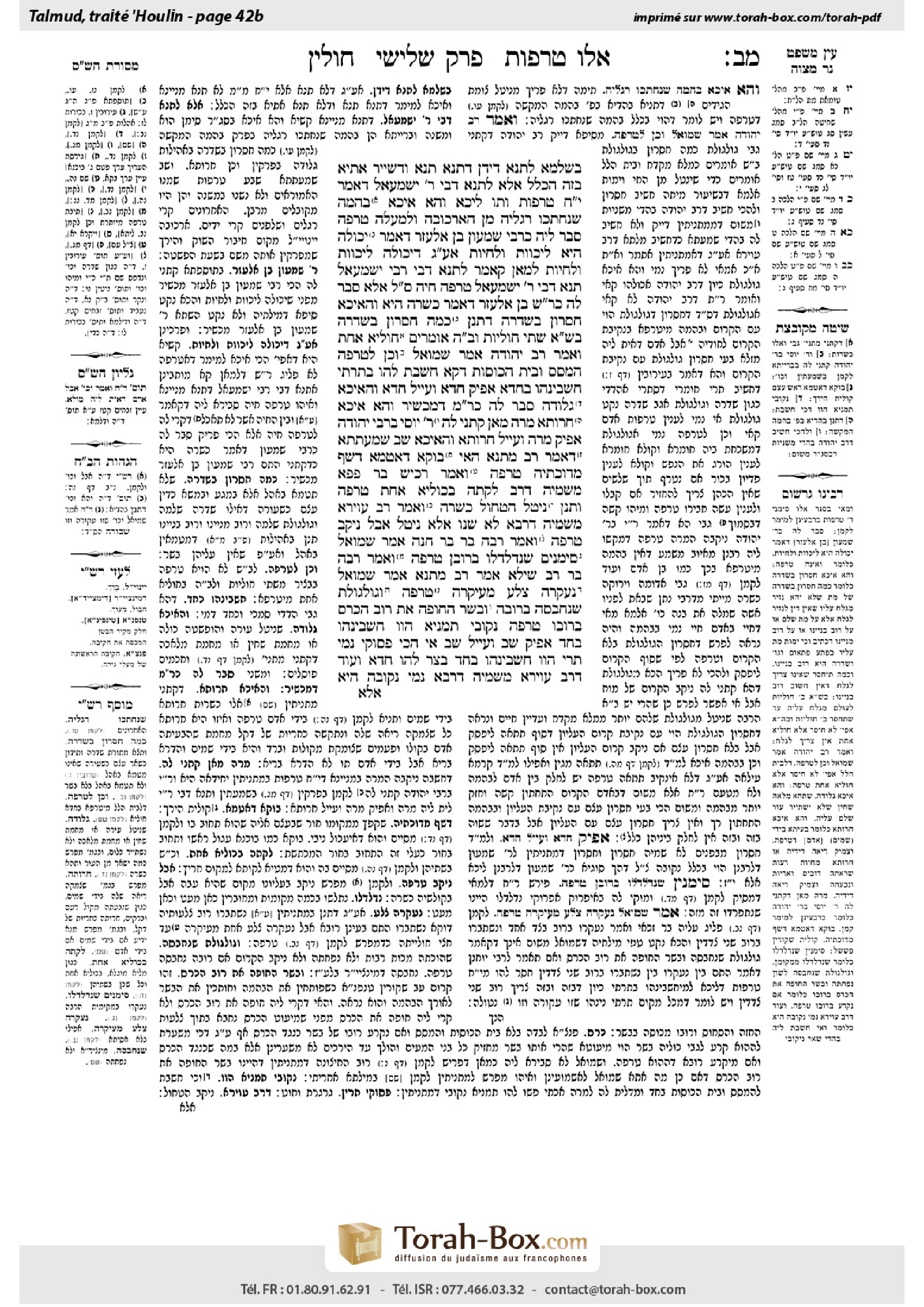
Chullin 42b: Talmud study for Daf Yomi
Study the Talmud for Daf Yomi with scanned pages, Hebrew text, English translations from Sefaria and AI-generated French translations.
Passage selection and English or AI-generated French translation are available where the scan has annotations. Daf Study is independent of Torah-Box and Sefaria.
Browse Chullin · חולין · All tractatesChullin 42b text and translations
This page of Chullin includes the Aramaic text, an English translation and an AI-generated French translation, alongside the scan above.
חולין מ״ב ב · Aramaic and Hebrew text
בִּשְׁלָמָא לְתַנָּא דִּידַן, דִּתְנָא, תְּנָא וּדְשַׁיַּיר – אָתְיָא בְּזֶה הַכְּלָל, אֶלָּא לְתַנָּא דְּבֵי רַבִּי יִשְׁמָעֵאל דְּאָמַר: שְׁמוֹנֶה עֶשְׂרֵה טְרֵפוֹת וְתוּ לֵיכָּא, וְהָא אִיכָּא בְּהֵמָה שֶׁנֶּחְתְּכוּ רַגְלֶיהָ מִן הָאַרְכּוּבָּה וּלְמַעְלָה טְרֵפָה? סָבַר לֵיהּ כְּרַבִּי שִׁמְעוֹן בֶּן אֶלְעָזָר, דְּאָמַר: יְכוֹלָה הִיא לִיכּוֹוֹת וְלִחְיוֹת.
אַף עַל גַּב דִּיכוֹלָה לִיכּוֹוֹת וְלִחְיוֹת, לְמַאן קָאָמַר? לְתַנָּא דְּבֵי רַבִּי יִשְׁמָעֵאל, תַּנָּא דְּבֵי רַבִּי יִשְׁמָעֵאל טְרֵפָה חַיָּה סְבִירָא לֵיהּ! אֶלָּא סָבַר לַהּ כְּרַבִּי שִׁמְעוֹן בֶּן אֶלְעָזָר, דְּאָמַר: ״כְּשֵׁרָה הִיא״.
וְהָאִיכָּא חִסָּרוֹן בַּשִּׁדְרָה, דִּתְנַן: כַּמָּה חִסָּרוֹן בַּשִּׁדְרָה? בֵּית שַׁמַּאי אוֹמְרִים: שְׁתֵּי חוּלְיוֹת, וּבֵית הִלֵּל אוֹמְרִים: חוּלְיָא אַחַת; וְאָמַר רַב יְהוּדָה אָמַר שְׁמוּאֵל: וְכֵן לִטְרֵפָה.
הֶמְסֵס וּבֵית הַכּוֹסוֹת, דְּקָא חָשְׁבַתְּ לְהוּ בְּתַרְתֵּי, חַשְׁבִינְהוּ בַּחֲדָא, אַפֵּיק חֲדָא וְעַיֵּיל חֲדָא.
וְהָאִיכָּא גְּלוּדָה? סָבַר לַהּ כְּרַבִּי מֵאִיר דְּמַכְשַׁיר.
וְהָא אִיכָּא חֲרוּתָא? מָרָה – מַאן קָתָנֵי לַהּ? רַבִּי יוֹסֵי בְּרַבִּי יְהוּדָה. אַפֵּיק מָרָה, וְעַיֵּיל חֲרוּתָא.
וְהָאִיכָּא שַׁב שְׁמַעְתָּתָא, דְּאָמַר רַב מַתְנָא: הַאי בּוּקָא דְּאַטְמָא דְּשַׁף מִדּוּכְתֵּיהּ – טְרֵפָה, וְאָמַר רָכִישׁ בַּר פָּפָּא מִשְּׁמֵיהּ דְּרַב: לָקְתָה בְּכוּלְיָא אַחַת – טְרֵפָה, וּתְנַן: נִיטַּל הַטְּחוֹל – כְּשֵׁרָה, וְאָמַר רַב עַוִּירָא מִשְּׁמֵיהּ דְּרָבָא: לֹא שָׁנוּ אֶלָּא נִיטַּל, אֲבָל נִיקַּב – טְרֵפָה.
וְאָמַר רַבָּה בַּר בַּר חָנָה אָמַר שְׁמוּאֵל: סִימָנִים שֶׁנִּדַּלְדְּלוּ בְּרוּבָּן – טְרֵפָה. וְאָמַר רַבָּה בַּר רַב שֵׁילָא אָמַר רַב מַתְנָא אָמַר שְׁמוּאֵל: נֶעֶקְרָה צֵלָע מֵעִיקָּרָהּ – טְרֵפָה, וְגוּלְגּוֹלֶת שֶׁנֶּחְבְּסָה בְּרוּבָּה, וּבָשָׂר הַחוֹפֶה אֶת רוֹב הַכָּרֵס בְּרוּבּוֹ – טְרֵפָה.
נְקוּבֵי תְּמָנְיָא הָווּ, חַשְׁבִינְהוּ בְּחַד, אַפֵּיק שַׁב, וְעַיֵּיל שַׁב.
אִי הָכִי, פְּסוּקֵי נָמֵי תְּרֵי הָווּ, חַשְּׁבִינְהוּ בְּחַד, בָּצַר לְהוּ חֲדָא, וְעוֹד, דְּרַב עַוִּירָא מִשְּׁמֵיהּ דְּרָבָא נָמֵי נְקוּבָה הִיא!
Chullin 42b · English translation
Granted, with regard to the tanna of our mishna, one can say that the cases of tereifot that he taught explicitly in the mishna, he taught, and that any case that he omitted comes under the general statement beginning: This is the principle. But with regard to the tanna of the school of Rabbi Yishmael, who said: Eighteen tereifot, one must ask: And are there no more cases of tereifot? But aren’t there the four cases represented by the mnemonic beit, samekh, gimmel, reish, the first of which is taught in a mishna (76a): An animal whose hind legs were severed from the leg joint and above is a tereifa? The Gemara responds: The tanna of the school of Rabbi Yishmael holds in accordance with the opinion of Rabbi Shimon ben Elazar, who says: The severed leg can be cauterized and the animal will live. Therefore, such a wound does not render the animal a tereifa.
The Gemara objects: But even if one holds that the severed leg can be cauterized and the animal will live, this does not mean that the animal is not a tereifa. According to whom is the question: But aren’t there the cases of beit, samekh, gimmel, reish, stated? It is stated according to the tanna of the school of Rabbi Yishmael, who holds that there are only eighteen tereifot. But the tanna of the school of Rabbi Yishmael maintains that a tereifa can live. If so, the fact that the animal can live if the stump of its severed limb is cauterized is immaterial to whether it is a tereifa. Rather, say that the tanna holds in accordance with the opinion of Rabbi Shimon ben Elazar insofar as he says that an animal with a severed leg is kosher. Yet, he disagrees with the claim that the reason is because the animal can survive.
The Gemara objects: But isn’t there the case of a deficiency in the spine? As we learned in a mishna (Oholot 2:3): How much is considered a deficiency in the spine of a corpse so that it will not be considered a full corpse to impart impurity in a tent? Beit Shammai say: Two missing vertebrae, and Beit Hillel say: One vertebra. And Rav Yehuda says that Shmuel says: Just as Beit Shammai and Beit Hillel disagree with regard to ritual impurity, so too they disagree with regard to a tereifa, i.e., according to Beit Hillel an animal missing only one vertebra is a tereifa. This is not included in the count of Rabbi Yishmael.
The Gemara responds: The omasum or the reticulum that were perforated on their outer walls, which you count as two separate cases, should be counted as one case. Accordingly, one case has been removed from the count of eighteen tereifot and one case has been inserted, i.e., the case of a deficiency in the spine, and there are still only eighteen cases.
The Gemara asks: But isn’t there the case of the tereifa mentioned in the mishna on 54a of an animal whose hide was removed? The Gemara responds: The tanna of the school of Rabbi Yishmael holds in accordance with the opinion of Rabbi Meir, who deems such an animal kosher.
The Gemara asks: But isn’t there also the case of an animal that is a tereifa because of a shriveled lung? The Gemara responds: The mishna states that a perforated gallbladder renders the animal a tereifa; but who teaches this? Rabbi Yosei, son of Rabbi Yehuda, teaches this. Therefore, the tanna removed the gallbladder from the list, since it is only the opinion of an individual, and inserted a shriveled lung.
The Gemara asks: But aren’t there the seven additional halakhot, i.e., cases of tereifot, taught by amora’im? The Gemara enumerates the seven halakhot: As Rav Mattana says: This head of the femur that was completely dislocated renders the animal a tereifa. And Rakhish bar Pappa says in the name of Rav: If the animal was diseased even in one kidney, it is a tereifa. And we learned in a mishna (54a) that if the spleen was removed the animal is kosher, and with regard to this mishna, Rav Avira says in the name of Rava: They taught this only when the spleen was removed; but if it was perforated, the animal is a tereifa.
The Gemara continues: And Rabba bar bar Ḥana says that Shmuel says: If the two organs that must be severed in ritual slaughter [simanim], i.e., the windpipe and the gullet, were mostly detached, the animal is a tereifa. And Rabba bar Rav Sheila says that Rav Mattana says that Shmuel says: If a rib was torn out from its root, along with half of the attached vertebra, the animal is a tereifa; and a skull that was mostly crushed, even if the membranes are intact, renders the animal a tereifa; and if a majority of the flesh that envelops the majority of the rumen was torn, the animal is a tereifa.
The Gemara responds: There are eight cases of perforated organs mentioned in the mishna that render an animal a tereifa. The tanna of the school of Rabbi Yishmael counts them all as one case. Accordingly, he removed seven cases from the count of eighteen and inserted these seven halakhot.
The Gemara challenges: If so, since there are also two cases of cut organs in the mishna, the spinal cord and the windpipe, let the tanna count them as one. The count of tereifot then falls one short of eighteen. And furthermore, if all the cases of perforated organs are counted as one, then one cannot insert the case taught by Rav Avira in the name of Rava, i.e., that of a perforated spleen, since it is also a case of a perforated organ. If so, the count falls two short of eighteen.
Chullin 42b · Traduction française (IA)
Bien que l'on puisse dire concernant le tanna de notre mitsna, que les cas de tereifot qu'il a explicitement enseignés dans la mitsna, il les a enseignés, et que tout cas qu'il a omis relève de l'affirmation générale qui commence par : C'est le principe. Mais concernant le tanna de la maison de Rabbi Yishmael, qui a dit : Dix-huit tereifot, il faut poser la question : Et n'y a-t-il pas d'autres cas de tereifot ? N'y a-t-il pas les quatre cas représentés par le mnémonique beth, samekh, gimmel, resh, le premier desquels est enseigné dans une mitsna (76a) : Un animal dont les jambes arrière ont été sectionnées au niveau du coude et au-dessus est un tereifa ? La Guemara répond : Le tanna de la maison de Rabbi Yishmael suit l'opinion de Rabbi Shimon ben Elazar, qui dit : La jambe sectionnée peut être cauterisée et l'animal vivra. Par conséquent, une telle blessure ne rend pas l'animal un tereifa.
La Guemara s'oppose : Mais même si l'on considère que la jambe sectionnée peut être cauterisée et que l'animal vivra, cela ne signifie pas que l'animal n'est pas un tereifa. Selon qui est la question : Et n'y a-t-il pas les cas de beth, samekh, gimmel, resh, mentionnés ? Il est mentionné selon le tanna de la maison de Rabbi Yishmael, qui considère qu'il n'y a que dix-huit tereifot. Mais le tanna de la maison de Rabbi Yishmael affirme que l'animal peut vivre. Si c'est ainsi, le fait que l'animal puisse vivre si le reste de sa jambe sectionnée est cauterisé est sans importance pour savoir s'il est un tereifa. Plutôt, disons que le tanna suit l'opinion de Rabbi Shimon ben Elazar en ce qu'il dit qu'un animal avec une jambe sectionnée est acceptable. Cependant, il s'oppose à l'affirmation que la raison est que l'animal peut survivre.
La Guemara s'oppose : Et n'y a-t-il pas le cas d'une insuffisance dans la colonne vertébrale ? Comme nous l'avons appris dans une mitsna (Oholot 2:3) : Combien est-ce qu'on considère comme une insuffisance dans la colonne vertébrale d'un cadavre, de sorte qu'il ne soit pas considéré comme un cadavre complet pour transmettre l'impureté dans une tente ? Beit Shammai disent : Deux vertèbres manquantes, et Beit Hillel disent : Une vertèbre. Et Rav Yehuda dit que Shmuel dit : Comme Beit Shammai et Beit Hillel s'opposent concernant l'impureté rituelle, ainsi aussi ils s'opposent concernant un tereifa, c'est-à-dire, selon Beit Hillel, un animal manquant d'une seule vertèbre est un tereifa. Ce cas n'est pas inclus dans le décompte de Rabbi Yishmael.
La Guemara répond : Les omoplates ou le réseau de la rate qui étaient perçés sur leurs parois externes, que vous comptez comme deux cas séparés, devraient être comptés comme un seul cas. Ainsi, un cas a été retiré du décompte des dix-huit tereifot et un cas a été ajouté, c'est-à-dire le cas d'une insuffisance dans la colonne vertébrale, et il reste encore seulement dix-huit cas.
La Guemara pose la question : Et n'y a-t-il pas le cas du tereifa mentionné dans la mitsna de 54a d'un animal dont la peau a été retirée ? La Guemara répond : Le tanna de la maison de Rabbi Yishmael suit l'opinion de Rabbi Meir, qui considère que cet animal est kosher.
La Guemara pose la question : Et n'y a-t-il pas aussi le cas d'un animal qui est un tereifa en raison d'un poumon atrophié ? La Guemara répond : La mitsva stipule qu'un gallbladder perforé rend l'animal un tereifa ; mais qui enseigne cela ? Rabbi Yosei, fils de Rabbi Yehuda, enseigne cela. Par conséquent, le tanna a retiré le gallbladder de la liste, car il s'agit uniquement de l'opinion d'un individu, et a ajouté un poumon atrophié.
La Guemara pose la question : Et n'y a-t-il pas les sept halakhot supplémentaires, c'est-à-dire les cas de tereifot, enseignés par les amoraïm ? La Guemara énumère les sept halakhot : Comme Rav Mattana dit : Cette tête du fémur complètement délogée rend l'animal un tereifa. Et Rakhish bar Pappa dit en nom de Rav : Si l'animal était malade même dans un rein, il est un tereifa. Et nous avons appris dans une mitsva (54a) que si le rateau avait été retiré, l'animal est kosher, et concernant cette mitsva, Rav Avira dit en nom de Rava : Ils ont enseigné cela seulement quand le rateau avait été retiré ; mais si c'était perforé, l'animal est un tereifa.
La Guemara continue : Et Rabba bar bar Ḥana dit que Shmuel dit : Si les deux organes qui doivent être sectionnés lors de la bataille rituelle [simanim], c'est-à-dire la trachée et le gosier, étaient largement détachés, l'animal est un tereifa. Et Rabba bar Rav Sheila dit que Rav Mattana dit que Shmuel dit : Si une côte avait été arrachée à sa racine, avec la moitié de la vertèbre attachée, l'animal est un tereifa ; et un crâne presque écrasé, même si les membranes sont intactes, rend l'animal un tereifa ; et si la majorité de la chair enveloppant la majorité du rumen avait été déchirée, l'animal est un tereifa.
La Guemara répond : Il y a huit cas d'organes perçés mentionnés dans la mitsna qui rendent un animal tereifa. Le tanna de la maison de Rabbi Yishmael les compte tous comme un seul cas. Ainsi, il a retiré sept cas du décompte des dix-huit et a ajouté ces sept halakhot.
La Guemara s'oppose : Si c'est ainsi, puisque dans la mitsna il y a aussi deux cas d'organes coupés, la moelle épinière et la trachée, le tanna devrait les compter comme un seul cas. Le décompte des tereifot tombe alors un cas en deçà des dix-huit. Et de plus, si tous les cas d'organes perçés sont comptés comme un seul, alors on ne peut pas ajouter le cas enseigné par Rav Avira en nom de Rava, c'est-à-dire celui du rate perforé, car il s'agit aussi d'un cas d'organe perforé. Si c'est ainsi, le décompte tombe deux cas en deçà des dix-huit.
Traduction française générée par IA à partir de l’édition anglaise de Sefaria. Vérifie toujours un passage avec le texte source.
Text from Sefaria: William Davidson Edition - Vocalized Aramaic (unknown); William Davidson Edition - English (CC BY NC).