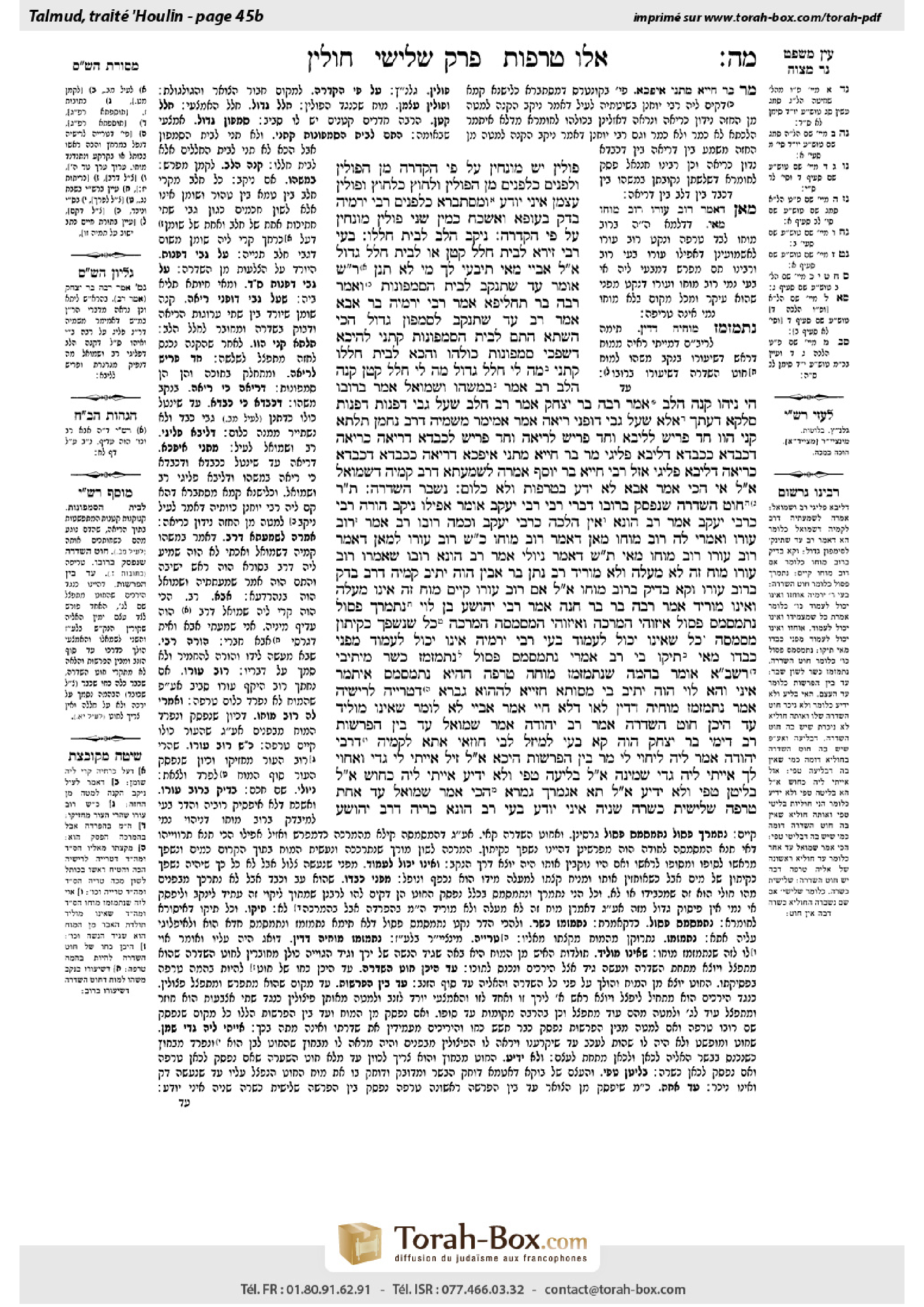
Chullin 45b: Talmud study for Daf Yomi
Study the Talmud for Daf Yomi with scanned pages, Hebrew text, English translations from Sefaria and AI-generated French translations.
Passage selection and English or AI-generated French translation are available where the scan has annotations. Daf Study is independent of Torah-Box and Sefaria.
Browse Chullin · חולין · All tractatesChullin 45b text and translations
This page of Chullin includes the Aramaic text, an English translation and an AI-generated French translation, alongside the scan above.
חולין מ״ה ב · Aramaic and Hebrew text
פּוֹלִין יֵשׁ מוּנָּחִין עַל פִּי הַקְּדֵרָה, מִן הַפּוֹלִין וְלִפְנִים – כְּלִפְנִים, מִן הַפּוֹלִין וְלַחוּץ – כְּלַחוּץ, וּפוֹלִין עַצְמָן אֵינִי יוֹדֵעַ. וּמִסְתַּבְּרָא כְּלִפְנִים.
רַבִּי יִרְמְיָה בְּדַק בְּעוֹפָא, וְאַשְׁכַּח כְּמִין שְׁנֵי פּוֹלִין מוּנָּחִין עַל פִּי הַקְּדֵרָה.
נִיקַּב הַלֵּב לְבֵית חֲלָלוֹ, בָּעֵי רַבִּי זֵירָא: לְבֵית חָלָל קָטָן אוֹ לְבֵית חָלָל גָּדוֹל? אֲמַר לֵיהּ אַבָּיֵי: מַאי תִּיבְּעֵי לָךְ? מִי לָא תְּנַן: רַבִּי שִׁמְעוֹן אוֹמֵר ״עַד שֶׁתִּנָּקֵב לְבֵית הַסִּמְפּוֹנוֹת״, וְאָמַר רַבָּה בַּר תַּחְלִיפָא אָמַר רַבִּי יִרְמְיָה בַּר אַבָּא אָמַר רַב: עַד שֶׁתִּנָּקֵב לְסִמְפּוֹן גָּדוֹל.
הָכִי הַשְׁתָּא? הָתָם לְבֵית הַסִּמְפּוֹנוֹת קָתָנֵי, לְהֵיכָא דְּשָׁפְכִי סִמְפּוֹנוֹת כּוּלְּהוּ, וְהָכָא לְבֵית חֲלָלוֹ קָתָנֵי – מָה לִי חָלָל גָּדוֹל, מָה לִי חָלָל קָטָן!
קְנֵה הַלֵּב, רַב אָמַר: בְּמַשֶּׁהוּ, וּשְׁמוּאֵל אָמַר: בְּרוּבּוֹ.
הֵי נִיהוּ קְנֵה הַלֵּב? אָמַר רַבָּה בַּר יִצְחָק אָמַר רַב: חֵלֶב שֶׁעַל גַּבֵּי דְּפָנוֹת. דְּפָנוֹת סָלְקָא דַּעְתָּךְ? אֶלָּא: שֶׁעַל גַּבֵּי דּוֹפְנֵי רֵיאָה.
אָמַר אַמֵּימָר מִשְּׁמֵיהּ דְּרַב נַחְמָן: תְּלָתָא קְנֵי הָווּ, חַד פָּרֵישׁ לְלִיבָּא, וְחַד פָּרֵישׁ לְרֵיאָה, וְחַד פָּרֵישׁ לְכַבְדָּא. דְּרֵיאָה – כְּרֵיאָה, דְּכַבְדָּא – כְּכַבְדָּא, דְּלִיבָּא – פְּלִיגִי.
מָר בַּר חִיָּיא מַתְנִי אִיפְּכָא: דְּרֵיאָה – כְּכַבְדָּא, דְּכַבְדָּא – כְּרֵיאָה, דְּלִיבָּא – פְּלִיגִי.
אֲזַל רַבִּי חִיָּיא בַּר יוֹסֵף אַמְרַהּ לִשְׁמַעְתָּא דְרַב קַמֵּיהּ דִּשְׁמוּאֵל, אֲמַר לֵיהּ: אִי הָכִי אָמַר אַבָּא – לָא יָדַע בִּטְרֵפוֹת וְלֹא כְּלוּם.
(נשבר) [נִשְׁבְּרָה] הַשִּׁדְרָה, תָּנוּ רַבָּנַן: חוּט הַשִּׁדְרָה שֶׁנִּפְסַק בְּרוּבּוֹ – דִּבְרֵי רַבִּי; רַבִּי יַעֲקֹב אוֹמֵר: אֲפִילּוּ נִיקַּב.
הוֹרָה רַבִּי כְּרַבִּי יַעֲקֹב. אָמַר רַב הוּנָא: אֵין הֲלָכָה כְּרַבִּי יַעֲקֹב.
וְכַמָּה רוּבּוֹ? רַב אָמַר: רוֹב עוֹרוֹ, וְאָמְרִי לַהּ: רוֹב מוֹחוֹ.
מַאן דְּאָמַר רוֹב מוֹחוֹ – כׇּל שֶׁכֵּן רוֹב עוֹרוֹ, לְמַאן דְּאָמַר רוֹב עוֹרוֹ – רוֹב מוֹחוֹ מַאי?
תָּא שְׁמַע, דְּאָמַר נִיוְלִי אָמַר רַב הוּנָא: רוּבּוֹ שֶׁאָמְרוּ – רוֹב עוֹרוֹ, מוֹחַ זֶה – לֹא מַעֲלֶה וְלֹא מוֹרִיד.
רַב נָתָן בַּר אָבִין הֲוָה יָתֵיב קַמֵּיהּ דְּרַב, בְּדַק בְּרוֹב עוֹרוֹ, וְקָא בָּדֵיק בְּרוֹב מוֹחוֹ. אֲמַר לֵיהּ: אִם רוֹב עוֹרוֹ קַיָּים, מוֹחַ זֶה אֵינוֹ מַעֲלֶה וְאֵינוֹ מוֹרִיד.
אָמַר רַבָּה בַּר בַּר חָנָה אָמַר רַבִּי יְהוֹשֻׁעַ בֶּן לֵוִי: נִתְמָרֵךְ – פָּסוּל, נִתְמַסְמֵס – פָּסוּל. אֵיזוֹהִי הַמְרָכָה וְאֵיזוֹהִי הֲמַסְמָסָה? הַמְרָכָה – כֹּל שֶׁנִּשְׁפָּךְ כְּקִיתוֹן, (מסמסה) [הֲמַסְמָסָה] – כֹּל שֶׁאֵינוֹ יָכוֹל לַעֲמוֹד.
בָּעֵי רַבִּי יִרְמְיָה: אֵינוֹ יָכוֹל לַעֲמוֹד מִפְּנֵי כׇּבְדוֹ, מַאי? תֵּיקוּ. בֵּי רַב אָמְרִי: נִתְמַסְמֵס – פָּסוּל, נִתְמַזְמֵז – כָּשֵׁר. מֵיתִיבִי: רַבִּי שִׁמְעוֹן בֶּן אֶלְעָזָר אוֹמֵר: בְּהֵמָה שֶׁנִּתְמַזְמֵז מוֹחָה – טְרֵפָה! הָהִיא נִתְמַסְמֵס אִיתְּמַר.
אִינִי, וְהָא לֵוִי הֲוָה יָתֵיב בֵּי מַסּוּתָא, חַזְיֵיהּ לְהָהוּא גַּבְרָא דְּטַרְיֵיהּ לְרֵישֵׁיהּ, אֲמַר: נִתְמַזְמֵז מוֹחֵיהּ דְּדֵין, לָאו דְּלָא חָיֵי? אָמַר אַבָּיֵי: לָא, לוֹמַר שֶׁאֵינוֹ מוֹלִיד.
עַד הֵיכָן חוּט הַשִּׁדְרָה? אָמַר רַב יְהוּדָה אָמַר שְׁמוּאֵל: עַד בֵּין הַפָּרָשׁוֹת.
רַב דִּימִי בַּר יִצְחָק הֲוָה קָא בָּעֵי לְמֵיזַל לְבֵי חוֹזָאֵי, אֲתָא לְקַמֵּיהּ דְּרַבִּי יְהוּדָה, אֲמַר לֵיהּ: לַיחְוֵי לִי מָר בֵּין הַפָּרָשׁוֹת הֵיכָא? אֲמַר לֵיהּ: זִיל אַיְיתִי לִי גְּדִי וְאַחְוִי לָךְ. אַיְיתִי לֵיהּ גְּדִי שָׁמֵן, אֲמַר לֵיהּ: בְּלִיעָן טְפֵי וְלָא יְדִיעַ. אַיְיתִי לֵיהּ כָּחוּשׁ, אֲמַר לֵיהּ: בְּלִיטָן טְפֵי וְלָא יְדִיעַ.
אֲמַר לֵיהּ: תָּא אַגְמְרָךְ גְּמָרָא, הָכִי אָמַר שְׁמוּאֵל: עַד אַחַת – טְרֵפָה, שְׁלִישִׁית – כְּשֵׁרָה, שְׁנִיָּה – אֵינִי יוֹדֵעַ.
בָּעֵי רַב הוּנָא בְּרֵיהּ דְּרַב יְהוֹשֻׁעַ:
Chullin 45b · English translation
beans lie at the opening of the skull, where the spinal cord exits. From the beans inward, the nerve tissue is considered like the inside, i.e., the brain. Therefore, if its membrane is perforated, even minimally, the animal is a tereifa. From the beans outward, the nerve tissue is considered like the outside, i.e., the spinal cord. A perforation of the membrane in this area renders the animal a tereifa only if the spinal cord is mostly cut. And with regard to the area of the beans themselves, I do not know what the halakha is; but it stands to reason that it is considered like the inside.
The Gemara relates that Rabbi Yirmeya inspected a bird and found protrusions similar to two beans lying on the opening of the skull.
§ The mishna states: If the heart was perforated to its chamber, the animal is a tereifa. Rabbi Zeira raises a dilemma: Is the mishna referring to the small chamber within the heart or to the large chamber? Abaye said to him: What is your dilemma? Didn’t we learn in the mishna with regard to the lung: Rabbi Shimon says: It is not a tereifa unless it is perforated through to the bronchi? And Rabba bar Taḥlifa says that Rabbi Yirmeya bar Abba says that Rav says: Rabbi Shimon means that it is not a tereifa unless it is perforated through to the large bronchus. If so, it may be presumed that the mishna is referring to the large chamber of the heart as well.
The Gemara responds: How can these cases be compared? There, the mishna teaches: To the bronchi [simponot], in the plural form, i.e., the one bronchus into which all the bronchi [simponot] empty out. But here, with regard to the heart, it teaches: To the chamber. What is it to me if this is a large chamber and what is it to me if it is a small chamber? The language does not indicate one or the other.
§ With regard to the aorta, the chief artery exiting the heart, Rav says: Like the heart itself, if it is perforated in any amount the animal is a tereifa. And Shmuel says: The animal is a tereifa only if the aorta is perforated in its majority.
The Gemara asks: Which blood vessel is the aorta? Rabba bar Yitzḥak says that Rav says: This is the artery found in the fat on the sides. The Gemara asks: Can it enter your mind to say that this is referring to the sides of the animal, i.e., the ribs, which are not adjacent to the heart? Rather, this is referring to the artery covered in fat that exits the heart and passes on the sides of the lung.
Ameimar says in the name of Rav Naḥman: There are three ducts adjacent to one another in an animal’s chest. One separates to the heart, and one separates to the lung, and one separates to the liver. The duct of the lung is treated like the lung, and renders the animal a tereifa if perforated in any amount. The duct of the liver is treated like the liver, and only if it is completely missing does it render the animal a tereifa, in accordance with the mishna. As for the duct of the heart, the aorta, Rav and Shmuel disagree as to the measure of its perforation, as mentioned above.
Mar bar Ḥiyya teaches the opposite: The duct of the lung is treated like the liver and renders the animal a tereifa only if it is completely missing. The duct of the liver is treated like the lung, and a perforation of any amount renders the animal a tereifa. And with regard to the duct of the heart, Rav and Shmuel disagree.
The Gemara relates that Rabbi Ḥiyya bar Yosef went and stated the halakha of Rav, that an aorta perforated in any amount renders an animal a tereifa, before Shmuel. Shmuel said to him: If Abba, i.e., Rav, actually said so, he knows nothing at all about tereifot.
§ The mishna states: If the spinal column was broken and its cord was cut, the animal is a tereifa. With regard to this the Sages taught: If the spinal cord was cut in its majority, the animal is a tereifa. This is the statement of Rabbi Yehuda HaNasi. Rabbi Ya’akov says: It is a tereifa even if the spinal cord was only perforated.
The Gemara notes: Rabbi Yehuda HaNasi ruled in accordance with the opinion of Rabbi Ya’akov that even a small perforation of the spinal cord renders the animal a tereifa. Rav Huna says: The halakha is not in accordance with the opinion of Rabbi Ya’akov.
The Gemara asks: And how much is considered a majority of the spinal cord to render the animal a tereifa? Rav says: A majority of the circumference of its surrounding membranes, the meninges. And some say a majority of the nerve tissue of the spinal cord itself. In other words, even if the meninges are intact, the animal is a tereifa if a majority of the nerve tissue is cut.
The Gemara notes: According to the one who says that the animal is a tereifa if a majority of the nerve tissue is severed, all the more so if a majority of the meninges is cut, since if the meninges, the protective membranes, are damaged, the nerve tissue itself will certainly be damaged soon thereafter. But according to the one who says that a tear in a majority of the meninges renders it a tereifa, what is the halakha in a case where only a majority of the nerve tissue was cut? Perhaps the intact membranes will keep the damage from spreading.
The Gemara suggests: Come and hear a proof: As Nayyoli says that Rav Huna says: The majority of the spinal cord, which they said renders the animal a tereifa if cut, is the majority of the meninges. But this nerve tissue makes no difference.
The Gemara relates that Rav Natan bar Avin was sitting before Rav. Rav Natan first checked the spinal cord to make sure that a majority of the meninges was intact, and then was checking to see that a majority of its nerve tissue was intact. Rav said to him: If a majority of the meninges is intact, this nerve tissue makes no difference.
§ Rabba bar bar Ḥana says that Rabbi Yehoshua ben Levi says: If the spinal cord was liquefied [nitmareikh], the animal is unfit for consumption. Even if it softened [nitmasmeis], the animal is unfit, i.e., a tereifa. What is liquefaction, and what is softening? Liquefaction is any case in which the nerve tissue becomes liquid, and if the membrane is punctured it can be poured out like water from a jug. Softening is any case in which the nerve tissue cannot stand upright on its own and sags when it is not being supported.
Rabbi Yirmeya raises a dilemma: In a case where the spinal cord became unusually heavy such that it cannot stand upright due to its weight, but not due to softening or melting, what is the halakha? The Gemara responds: The question shall stand unresolved. In the study hall they say: If the spinal cord softened due to disease, the animal is unfit for consumption. But if some of its tissue softened and was emptied from the spinal cord, the animal remains kosher. The Gemara raises an objection based on a baraita: Rabbi Shimon ben Elazar says: An animal whose nerve tissue was emptied [nitmazmez] from the spinal cord is a tereifa. The Gemara responds: That version of the baraita is incorrect. In fact, the word softened [nitmasmes] was stated, not the word emptied.
The Gemara asks: Is that so, that an animal whose nerve tissue has dissolved is kosher? But didn’t it happen that Levi was sitting in the bathhouse, where he saw a certain man who banged his head severely, whereupon he said: This man’s nerve tissue has softened and been emptied? Is it not that Levi meant that the man cannot live? If so, the softening and emptying of the nerve tissue should render an animal a tereifa. Abaye said: No, he intended to say that the man cannot reproduce, since head trauma might lead to infertility.
§ The Gemara asks: Until where does the spinal cord extend downward, such that if it is cut above that point the animal is a tereifa? Rav Yehuda says that Shmuel says: Until the point between the branches of the spinal cord that split off behind the thighs.
The Gemara recounts: Rav Dimi bar Yitzḥak wanted to go to Bei Ḥozai. He came before Rabbi Yehuda and said to him: Master, show me, where is the area between the branches to which Shmuel referred? Rabbi Yehuda said to him: Go bring me a kid and I will show you. Rav Dimi bar Yitzḥak brought him a choice kid with much fat. Rabbi Yehuda said to him: The location is buried very deep in the fat and is not recognizable. He brought Rabbi Yehuda a lean kid. Rabbi Yehuda said to him: The bones jut out very far, and the location is not recognizable.
Rabbi Yehuda said to him: Come, I will teach you a tradition without showing you: This is what Shmuel said: There are three successive points around the same bone behind the pelvis at which branches diverge from the spinal cord. If the spinal cord is cut anywhere until the first gap between these branches, the animal is a tereifa. If it is severed anywhere after the third gap, i.e., after the third branch, the animal is kosher. If it was severed within the second gap, i.e., between these areas, I do not know the halakha.
Rav Huna, son of Rav Yehoshua, raises a dilemma:
Chullin 45b · Traduction française (IA)
Les haricots sont situés à l'ouverture du crâne, là où le cordon spinal sort. À partir des haricots vers l'intérieur, le tissu nerveux est considéré comme l'intérieur, c'est-à-dire le cerveau. Ainsi, si sa membrane est percée, même légèrement, l'animal est un tereifa. À partir des haricots vers l'extérieur, le tissu nerveux est considéré comme l'extérieur, c'est-à-dire le cordon spinal. Une perforation de la membrane dans cette zone rend l'animal tereifa uniquement si le cordon spinal est principalement tranché. Et concernant la zone des haricots eux-mêmes, je ne sais pas ce que la halakha en dit ; mais il est raisonnable de penser qu'il est considéré comme l'intérieur.
Le Guemara rapporte que Rabbi Yirmeya a examiné un oiseau et a trouvé des bosses semblables à deux haricots situés à l'ouverture du crâne.
§ La mitsna stipule : Si le cœur a été percé jusqu'à sa cavité, l'animal est un tereifa. Rabbi Zeira soulève un dilemme : La mitsna fait-elle référence à la petite cavité du cœur ou à la grande cavité ? Abaye lui a dit : Quel est votre dilemme ? N'avons-nous pas appris dans la mitsna concernant le poumon : Rabbi Shimon dit : Ce n'est pas un tereifa à moins qu'il ne soit percé jusqu'aux bronches ? Et Rabba bar Taḥlifa dit que Rabbi Yirmeya bar Abba dit que Rav dit : Rabbi Shimon signifie que ce n'est pas un tereifa à moins qu'il ne soit percé jusqu'aux grandes bronches. Si c'est ainsi, on peut supposer que la mitsna fait référence à la grande cavité du cœur également.
Le Guemara répond : Comment peuvent ces cas être comparés ? Là, la mitsva enseigne : jusqu'aux bronches [simponot], au pluriel, c'est-à-dire la seule bronche dans laquelle toutes les bronches [simponot] se vident. Mais ici, concernant le cœur, elle enseigne : jusqu'à la cavité. Qu'est-ce que cela me fait si c'est une grande cavité et qu'est-ce que cela me fait si c'est une petite cavité ? La langue ne précise ni l'un ni l'autre.
§ Concernant l'aorte, l'artère principale sortant du cœur, Rav dit : Comme le cœur lui-même, si elle est percée en quelque quantité que ce soit, l'animal est un tereifa. Et Shmuel dit : L'animal est un tereifa uniquement si l'aorte est percée dans sa majorité.
Le Guemara pose la question : Quelle artère est l'aorte ? Rabba bar Yitzḥak dit que Rav dit : C'est l'artère trouvée dans la graisse aux côtés. Le Guemara pose la question : Est-ce que cela entre dans votre esprit de dire que cela fait référence aux côtés de l'animal, c'est-à-dire les côtes, qui ne sont pas adjacents au cœur ? Plutôt, cela fait référence à l'artère recouverte de graisse qui sort du cœur et passe aux côtés des poumons.
Ameimar dit au nom de Rav Naḥman : Il y a trois canaux adjacents dans la poitrine d'un animal. Un se sépare vers le cœur, un vers le poumon, et un vers le foie. Le canal du poumon est traité comme le poumon, et rend l'animal tereifa si percé en quelque quantité que ce soit. Le canal du foie est traité comme le foie, et uniquement s'il est complètement manquant rend-il l'animal tereifa, conformément à la mitsna. En ce qui concerne le canal du cœur, l'aorte, Rav et Shmuel divergent sur la mesure de sa perforation, comme mentionné ci-dessus.
Mar bar Ḥiyya enseigne l'opposé : Le canal du poumon est traité comme le foie et rend l'animal tereifa uniquement s'il est complètement manquant. Le canal du foie est traité comme le poumon, et une perforation en quelque quantité que ce soit rend l'animal tereifa. Et concernant le canal du cœur, Rav et Shmuel divergent.
Le Guemara rapporte que Rabbi Ḥiyya bar Yosef est allé et a exposé la halakha de Rav, que l'aorte percée en quelque quantité que ce soit rend un animal tereifa, devant Shmuel. Shmuel a dit à lui : Si Abba, c'est-à-dire Rav, a vraiment dit cela, il ne sait rien du tout sur les tereifot.
§ La mitsva stipule : Si la colonne vertébrale a été brisée et son cordon spinal tranché, l'animal est un tereifa. Concernant cela, les Sages ont enseigné : Si le cordon spinal a été tranché dans sa majorité, l'animal est un tereifa. C'est la déclaration de Rabbi Yehuda HaNasi. Rabbi Ya’akov dit : C'est un tereifa même si le cordon spinal a été seulement percé.
Le Guemara note : Rabbi Yehuda HaNasi a rendu un jugement conformément à l'opinion de Rabbi Ya’akov, qui considère même une petite perforation du cordon spinal comme rendant l'animal tereifa. Rav Huna dit : La halakha ne suit pas l'opinion de Rabbi Ya’akov.
Le Guemara pose la question : Et quelle quantité est considérée comme une majorité du cordon spinal pour rendre l'animal tereifa ? Rav dit : Une majorité de la circonférence de ses membranes, les méninges. Et certains disent une majorité du tissu nerveux du cordon spinal lui-même. En d'autres termes, même si les méninges sont intactes, l'animal est tereifa si une majorité du tissu nerveux est tranché.
Le Guemara note : Selon celui qui dit que l'animal est tereifa si une majorité du tissu nerveux est tranchée, encore plus encore si une majorité des méninges est tranchée, car si les méninges, les membranes protectrices, sont endommagées, le tissu nerveux lui-même sera certainement endommagé peu après. Mais selon celui qui dit que une déchirure dans la majorité des méninges rend l'animal tereifa, quelle est la halakha dans le cas où seule une majorité du tissu nerveux a été tranchée ? Peut-être que les méninges intactes empêcheront la propagation des dommages.
Le Guemara suggère : Venez entendre une preuve : Comme Nayyoli dit que Rav Huna dit : La majorité du cordon spinal, qu'ils disent rendre l'animal tereifa si tranché, est la majorité des méninges. Mais ce tissu nerveux n'a pas d'importance.
Le Guemara rapporte que Rav Natan bar Avin était assis devant Rav. Rav Natan a d'abord vérifié le cordon spinal pour s'assurer que la majorité des méninges était intacte, puis a vérifié si la majorité de son tissu nerveux était intacte. Rav a dit à lui : Si la majorité des méninges est intacte, ce tissu nerveux n'a pas d'importance.
§ Rabba bar bar Ḥana dit que Rabbi Yéhoshua ben Lévi dit : Si le cordon spinal est devenu liquide [nitmareikh], l'animal est impur. Même si le cordon spinal s'est simplement ramolli [nitmasmeis], l'animal est impur, c'est-à-dire un tereifa. Qu'est-ce que la liquefaction et qu'est-ce que le ramollissement ? La liquefaction est tout cas où le tissu nerveux devient liquide, et si la membrane est percée, on peut le verser comme de l'eau d'un tonneau. Le ramollissement est tout cas où le tissu nerveux ne peut pas rester debout tout seul et s'affaisse lorsqu'il n'est pas soutenu.
Rabbi Yirméya soulève un dilemme : Dans un cas où le cordon spinal est devenu anormalement lourd tel qu'il ne peut pas rester debout à cause de son poids, mais pas à cause de son ramollissement ou de sa liquefaction, quelle est la halakha ? La Guemara répond : La question restera sans réponse. Dans l'étude, on dit : Si le cordon spinal s'est ramolli à cause d'une maladie, l'animal est impur. Mais si une partie de son tissu s'est ramolli et a été évacuée du cordon spinal, l'animal reste pur. La Guemara soulève un objection basée sur une baraïta : Rabbi Shim'on ben Eléazar dit : Un animal dont le tissu nerveux a été évacué [nitmazmez] du cordon spinal est un tereifa. La Guemara répond : Cette version de la baraïta est incorrecte. En réalité, le mot ramollissement [nitmasmes] a été utilisé, pas le mot évacuation.
La Guemara demande : Est-ce que cela est vrai, qu'un animal dont le tissu nerveux s'est dissous est pur ? Mais n'est-il pas arrivé que Lévi soit assis dans la salle de bain, où il a vu un certain homme qui s'est heurté la tête, oùupon il a dit : Ce homme a eu son tissu nerveux ramolli et évacué ? N'est-ce pas que Lévi voulait dire que l'homme ne peut plus vivre ? Si c'est le cas, le ramollissement et l'évacuation du tissu nerveux devraient rendre un animal un tereifa. Abaye dit : Non, il voulait dire que l'homme ne peut plus avoir d'enfants, car une traumatisme crânien pourrait entraîner une infertilité.
§ La Guemara demande : Jusqu'où le cordon spinal s'étend vers le bas, de telle sorte que si on le coupe au-dessus de ce point l'animal est tereifa ? Rav Yéhuda dit que Shmuel dit : Jusqu'au point entre les branches du cordon spinal qui se séparent derrière les cuisses.
La Guemara rapporte : Rav Dimi bar Yitzḥak voulait aller chez Bei Ḥozai. Il est venu devant Rabbi Yéhuda et lui a dit : Maître, montre-moi, où est la zone entre les branches à laquelle Shmuel faisait référence ? Rabbi Yéhuda lui a dit : Va me rapporter un petit agneau et je te montrerai. Rav Dimi bar Yitzḥak a apporté à Rabbi Yéhuda un petit agneau gras. Rabbi Yéhuda lui a dit : La zone est très profondément enfouie dans la graisse et n'est pas reconnaissable. Il a apporté à Rabbi Yéhuda un petit agneau maigre. Rabbi Yéhuda lui a dit : Les os sortent beaucoup, et la zone n'est pas reconnaissable.
Rabbi Yéhuda lui a dit : Viens, je vais te transmettre une tradition sans te la montrer : C'est ce que Shmuel a dit : Il y a trois points successifs autour du même os derrière le pelvis où les branches divergent du cordon spinal. Si le cordon spinal est coupé n'importe où jusqu'au premier espace entre ces branches, l'animal est tereifa. Si on le coupe n'importe où après la troisième branche, c'est-à-dire après la troisième division, l'animal est kosher. Si on l'a coupé dans l'espace entre ces branches, c'est-à-dire entre ces zones, je ne sais pas la halakha.
Rav Huna, fils de Rav Yéhoshua, pose un dilemme :
Traduction française générée par IA à partir de l’édition anglaise de Sefaria. Vérifie toujours un passage avec le texte source.
Text from Sefaria: William Davidson Edition - Vocalized Aramaic (unknown); William Davidson Edition - English (CC BY NC).