Chullin 46a: Talmud study for Daf Yomi
Study the Talmud for Daf Yomi with scanned pages, Hebrew text, English translations from Sefaria and AI-generated French translations.
Passage selection and English or AI-generated French translation are available where the scan has annotations. Daf Study is independent of Torah-Box and Sefaria.
Browse Chullin · חולין · All tractatesChullin 46a text and translations
This page of Chullin includes the Aramaic text, an English translation and an AI-generated French translation, alongside the scan above.
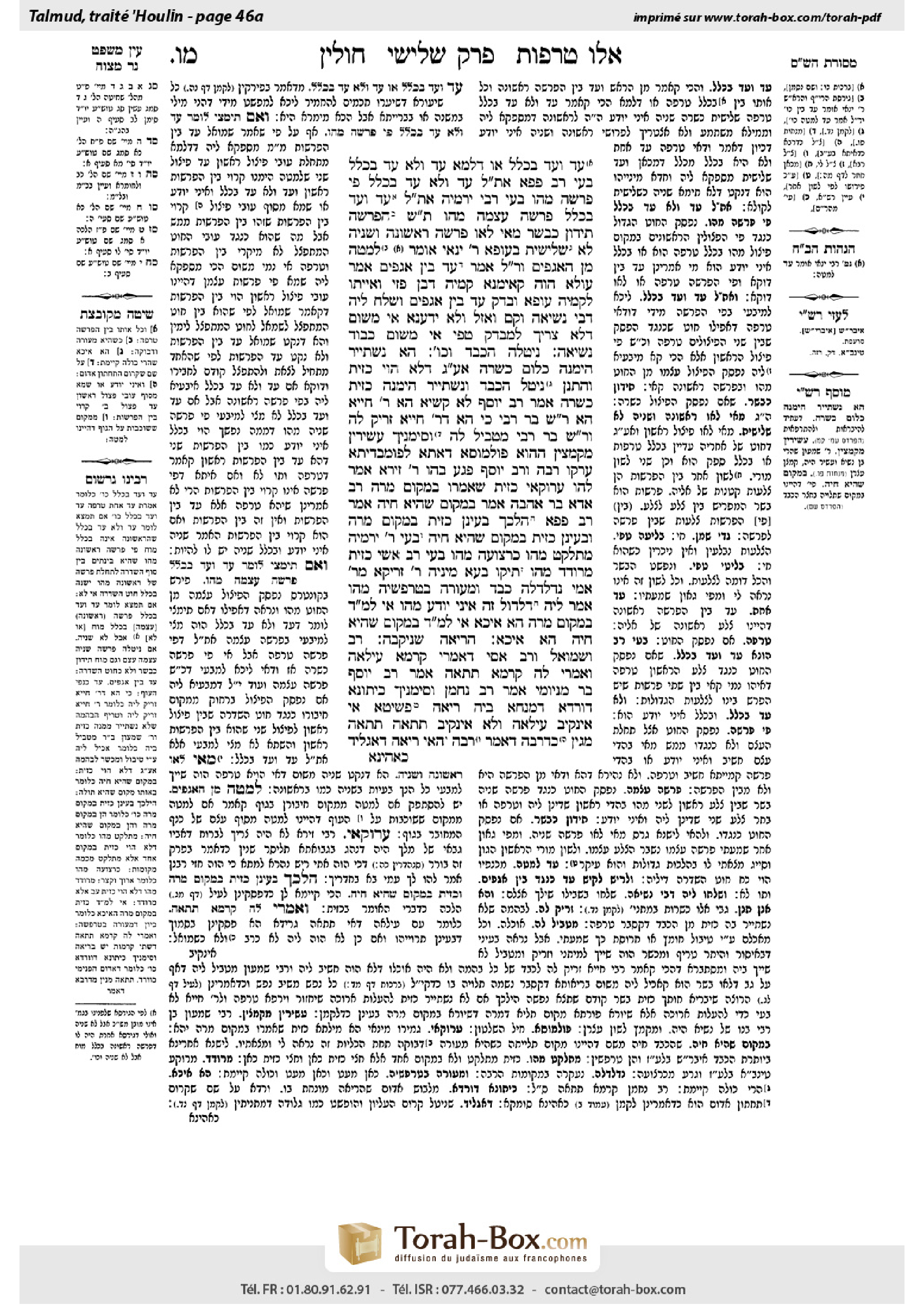
חולין מ״ו א · Aramaic and Hebrew text
עַד וְעַד בַּכְּלָל, אוֹ דִּלְמָא עַד וְלֹא עַד בַּכְּלָל?
בָּעֵי רַב פָּפָּא: אִם תִּמְצֵי לוֹמַר, עַד וְלֹא עַד בַּכְּלָל, פִּי פָרָשָׁה מַהוּ?
בָּעֵי רַבִּי יִרְמְיָה: אִם תִּמְצֵי לוֹמַר, עַד וְעַד בַּכְּלָל, פָּרָשָׁה עַצְמָהּ מַהוּ?
תָּא שְׁמַע: הַפָּרָשָׁה תִּידּוֹן כְּבָשָׂר. מַאי לָאו פָּרָשָׁה רִאשׁוֹנָה וּשְׁנִיָּה? לָא, שְׁלִישִׁית.
בְּעוֹפָא, רַבִּי יַנַּאי אוֹמֵר: לְמַטָּה מִן הָאֲגַפַּיִם, וְרֵישׁ לָקִישׁ אָמַר: עַד בֵּין אֲגַפַּיִם.
אָמַר עוּלָּא: הֲוָה קָאֵימְנָא קַמֵּיהּ דְּבֶן פַּזִּי, וְאַיְיתוֹ לְקַמֵּיהּ עוֹפָא, וּבְדַק עַד בֵּין אֲגַפַּיִם, וּשְׁלַח לֵיהּ דְּבֵי נְשִׂיאָה וְקָם וַאֲזַל, וְלָא יָדַעְנָא אִי מִשּׁוּם דְּלָא צְרִיךְ לְמִבְדַּק טְפֵי, אִי מִשּׁוּם כְּבוֹד נְשִׂיאָה.
נִיטְּלָה הַכָּבֵד וְכוּ׳. הָא נִשְׁתַּיֵּיר הֵימֶנָּה כְּלוּם – כְּשֵׁרָה, אַף עַל גַּב דְּלָא הָוֵי כְּזַיִת, וְהָתְנַן: נִיטַּל הַכָּבֵד וְנִשְׁתַּיֵּיר הֵימֶנָּה כְּזַיִת – כְּשֵׁרָה!
אָמַר רַב יוֹסֵף: לָא קַשְׁיָא, הָא רַבִּי חִיָּיא, הָא רַבִּי שִׁמְעוֹן בַּר רַבִּי, כִּי הָא דְּרַבִּי חִיָּיא זָרֵיק לַהּ, וְרַבִּי שִׁמְעוֹן בַּר רַבִּי מְטַבֵּיל לַהּ, וְסִימָנָיךְ: ״עֲשִׁירִין מְקַמְּצִין״.
הָהוּא פּוּלְמוּסָא דַּאֲתָא לְפוּמְבְּדִיתָא, עֲרַקוּ רַבָּה וְרַב יוֹסֵף, פְּגַע בְּהוּ רַבִּי זֵירָא, אֲמַר לְהוּ: עָרוֹקָאֵי, כְּזַיִת שֶׁאָמְרוּ בִּמְקוֹם מָרָה. רַב אַדָּא בַּר אַהֲבָה אָמַר: בִּמְקוֹם שֶׁהִיא חַיָּה. אָמַר רַב פָּפָּא: הִלְכָּךְ, בָּעֵינַן כְּזַיִת בִּמְקוֹם מָרָה, וּבָעֵינַן כְּזַיִת בִּמְקוֹם שֶׁהִיא חַיָּה.
בָּעֵי רַבִּי יִרְמְיָה: מִתְלַקֵּט, מַהוּ? כִּרְצוּעָה, מַהוּ? בָּעֵי רַב אָשֵׁי: כְּזַיִת מְרוּדָּד, מַהוּ? תֵּיקוּ.
בְּעָא מִינֵּיהּ רַבִּי זְרִיקָא מֵרַבִּי אַמֵּי: נִדַּלְדְּלָה כָּבֵד וּמְעוֹרָה בְּטַרְפְּשֶׁיהָ, מַהוּ? אֲמַר לֵיהּ: דִּלְדּוּל זֶה אֵינִי יוֹדֵעַ מַהוּ, אִי לְמַאן דְּאָמַר בִּמְקוֹם מָרָה – הָא אִיכָּא, אִי לְמַאן דְּאָמַר בִּמְקוֹם שֶׁהִיא חַיָּה – הָא אִיכָּא.
הָרֵיאָה שֶׁנִּיקְּבָה, רַב וּשְׁמוּאֵל וְרַב אַסִּי דְאָמְרִי: קְרָמָא עִילָּאָה, וְאָמְרִי לַהּ: קְרָמָא תַּתָּאָה. אָמַר רַב יוֹסֵף בַּר מִנְיוֹמֵי אָמַר רַב נַחְמָן: וְסִימָנָיךְ כִּיתּוּנָא דְּוַרְדָּא דְּמַנְּחָא בֵּיהּ רֵיאָה.
פְּשִׁיטָא: אִי אִינְּקִיב עִילָּאָה וְלָא אִינְּקִיב תַּתָּאָה – תַּתָּאָה מֵגֵין, כִּדְרַבָּה, דְּאָמַר רַבָּה: הַאי רֵיאָה דְּאִגְּלִיד
Chullin 46a · English translation
When Shmuel says that the animal is certainly a tereifa if the spinal cord is cut anywhere until the first gap, does he mean until and including the first gap, in which case if it is cut within the first gap the animal is a tereifa? Or perhaps he means until and not including the length of the gap itself?
Rav Pappa raises a dilemma: If you say that Shmuel means until and not including the length of the first gap, and if the spinal cord is cut in the first gap the halakha is unknown, then if the spinal cord was cut in the mouth of the first branch, exactly where it branches off, what is the halakha? Is it considered to be within the first gap, in which case the halakha is unknown? Or is it considered before the gap, in which case a tear in the mouth renders the animal a tereifa?
Rabbi Yirmeya raises a dilemma: If you say that Shmuel means until and including the measure of the first gap, and if the spinal cord is cut in the first gap the animal is a tereifa, then if the first branch itself, i.e., the first pair of branching nerves, was cut from the spinal cord, what is the halakha?
The Gemara suggests: Come and hear a proof from a baraita: The branch of the spine that was cut shall be considered as normal flesh, not as the spine. Therefore, it does not render the animal a tereifa, unlike the spinal cord itself. What, is it not referring even to the first or second branch? The Gemara responds: No, the baraita is referring only to the third branch. But if either of the first two pairs of nerves that branch off from the spinal cord are cut, the animal is a tereifa.
With regard to a bird, the Sages disagreed as to the lower boundary of the spinal cord, above which if it is cut, the bird will be rendered a tereifa. Rabbi Yannai says: The spinal cord extends until below the level of the wings. And Reish Lakish says: Until the point between the wings, not below them.
Ulla says: I was standing before Rabbi Shimon ben Pazi, and they brought before him a bird whose spine had been injured, and he checked until the point between the wings. And at that point a messenger of the house of the Nasi sent for him, and he got up and went, and I do not know if he left because one does not need to check beyond that point, or if due to the honor of the Nasi he left without completing the inspection.
§ The mishna states: If the liver was removed and nothing remained of it, the animal is a tereifa. The Gemara asks: It follows, therefore, that if anything remained of it, the animal is kosher, even if the remaining piece does not constitute an olive-bulk. But didn’t we learn in a mishna on 54a: If the liver was removed and an olive-bulk of it remained, it is kosher? One can infer that if less remained, it is a tereifa.
Rav Yosef said: This is not difficult. This mishna is in accordance with the opinion of Rabbi Ḥiyya, while that mishna later in the chapter is in accordance with the opinion of Rabbi Shimon, son of Rabbi Yehuda HaNasi. This is like that incident in which an amount smaller than an olive-bulk remained of the liver, and Rabbi Ḥiyya discarded it, as he holds that the animal is a tereifa, but Rabbi Shimon, son of Rabbi Yehuda HaNasi, dipped it in a seasoning and ate it. And your mnemonic to remember which Sage maintained which opinion is: The rich are stingy. Rabbi Shimon, son of Rabbi Yehuda HaNasi, was wealthy, but he nevertheless did not allow the meat to go to waste.
The Gemara relates that a certain royal army came to Pumbedita, and Rabba and Rav Yosef fled the city, whereupon Rabbi Zeira met them. Rabbi Zeira said to them: Refugees, hear this halakha: The olive-bulk that the Sages said must remain of the liver so the animal will remain kosher must be in the place where the liver connects to the gallbladder. Rav Adda bar Ahava says: The olive-bulk must be in the place that the liver lives, i.e., is connected to the other organs, under the right kidney. Rav Pappa said: Therefore, in order to satisfy both opinions, we require an olive-bulk in the place of the gallbladder, and we also require an olive-bulk in the place that it lives. Otherwise, the animal is a tereifa.
Rabbi Yirmeya raises a dilemma: If the olive-bulk that remained was not all in one piece, but rather small pieces that could be gathered together to form the requisite measure, what is the halakha? Alternatively, if it was long and thin like a strip, what is the halakha? Rav Ashi raises a dilemma: If the olive-bulk was flat, broad but thinner than an olive, what is the halakha? To all these questions the Gemara responds: The dilemma shall stand unresolved.
Rabbi Zerika asked Rabbi Ami: If the liver was detached from the other organs in numerous places and was attached only to its membranes [betarpasheha], but the liver itself remained intact, what is the halakha? Rabbi Ami said to him: With regard to the halakha, I do not know what the significance is of this detachment that you mentioned. If you rule according to the one who says that an olive-bulk must remain in the place of the gallbladder, that is the case here. And if you rule according to the one who says that it must be in the place that it lives, that is the case here as well. Consequently, there is no doubt that the animal is kosher.
§ The mishna states: The lung that was perforated renders the animal a tereifa. The Gemara quotes Rav and Shmuel and Rav Asi, who all say: The mishna is referring specifically to the outer membrane. And some say that they said that the mishna is referring specifically to the inner membrane. Rav Yosef bar Minyumi said that Rav Naḥman said: And your mnemonic should be: The red robe in which the lung rests. The inner membrane is red, while the outer membrane is white, and according to Rav Naḥman, the mishna is referring to the inner membrane.
The Gemara comments: It is obvious that if the outer membrane is perforated but the inner membrane is not perforated, the inner membrane protects the lung, and the animal is kosher. This is in accordance with the statement of Rabba, as Rabba says: This animal with a lung whose outer membrane was removed,
Chullin 46a · Traduction française (IA)
Lorsque Shmuel affirme que l'animal est certainement tereifa si le cordon spinal est coupé n'importe où jusqu'au premier interstice, veut-il dire jusqu'au premier interstice inclus, dans ce cas si le cordon est coupé dans le premier interstice l'animal est tereifa ? Ou bien veut-il dire jusqu'au premier interstice exclu, et si le cordon est coupé dans l'interstice lui-même, la halakha est-elle inconnue ?
Rav Pappa soulève un dilemme : Si vous dites que Shmuel entend jusqu'au premier interstice exclu, et si le cordon est coupé dans l'interstice, la halakha est inconnue, alors si le cordon a été coupé à la bouche du premier branchement, exactement là où il se branche, quelle est la halakha ? Est-ce considéré comme étant dans le premier interstice, dans ce cas la halakha est inconnue ? Ou bien est-ce considéré comme avant l'interstice, dans ce cas une entaille à la bouche rend l'animal tereifa ?
Rabbi Yirmeya soulève un dilemme : Si vous dites que Shmuel entend jusqu'au premier interstice inclus, et si le cordon est coupé dans le premier interstice l'animal est tereifa, alors si le premier branchement lui-même, c'est-à-dire la première paire de nerfs ramifiés, a été coupé du cordon spinal, quelle est la halakha ?
La Guemara suggère : Venez entendre une preuve tirée d'une baraïta : La branche du cordon spinal qui a été coupée est considérée comme de la chair normale, pas comme le cordon spinal lui-même. Ainsi, elle ne rend pas l'animal tereifa, contrairement au cordon spinal lui-même. Qu'est-ce que cela ne se réfère pas même à la première ou deuxième branche ? La Guemara répond : Non, la baraïta se réfère uniquement à la troisième branche. Mais si l'un des deux premiers couples de nerfs qui se ramifient du cordon spinal est coupé, l'animal est tereifa.
Concernant un oiseau, les Sages s'entendaient sur la limite inférieure du cordon spinal, au-delà de laquelle si celui-ci est coupé, l'oiseau est rendu tereifa. Rabbi Yannai dit : Le cordon spinal s'étend jusqu'au niveau en dessous des ailes. Et Reish Lakish dit : Jusqu'au point entre les ailes, pas en dessous.
Ulla dit : J'étais devant Rabbi Shimon ben Pazi, et on lui présenta un oiseau dont le cordon spinal était endommagé, et il vérifia jusqu'au point entre les ailes. Et à ce moment-là, un messager de la maison du Nasi vint le chercher, et il se leva et partit, et je ne sais pas s'il est parti parce qu'on n'a pas besoin de vérifier au-delà de ce point, ou bien à cause de l'honneur du Nasi qu'il est parti sans achever l'inspection.
§ La michna stipule : Si le foie a été retiré et qu'il ne reste rien de celui-ci, l'animal est tereifa. La Guemara demande : Il s'ensuit donc que si quelque chose reste de celui-ci, l'animal est kosher, même si la partie restante ne constitue pas un volume d'olive. Mais n'avons-nous pas appris dans une michna sur 54a : Si le foie a été retiré et qu'un volume d'olive en reste, il est kosher ? On peut en déduire que si moins reste, l'animal est tereifa.
Rav Yosef dit : Ce n'est pas difficile. Cette michna est selon l'opinion de Rabbi Ḥiyya, tandis que celle-ci plus tard dans le chapitre est selon l'opinion de Rabbi Shimon, fils de Rabbi Yehuda HaNasi. C'est comme l'incident où un montant inférieur à un volume d'olive restait du foie, et Rabbi Ḥiyya le rejetait, car il considère que l'animal est tereifa, mais Rabbi Shimon, fils de Rabbi Yehuda HaNasi, le trempa dans un condiment et le mangea. Et votre mnémotechnique pour se souvenir de quelle Sage maintient quelle opinion est : Les riches sont avares. Rabbi Shimon, fils de Rabbi Yehuda HaNasi, était riche, mais il n'a pas permis que la viande ne soit pas gaspillée.
La Guemara rapporte qu'une certaine armée royale est venue à Pumbedita, et Rabba et Rav Yosef ont fui la ville, où Rabbi Zeira les a rencontrés. Rabbi Zeira a dit à eux : Réfugiés, écoutez cette halakha : Le volume d'olive que les Sages ont dit doit rester du foie afin que l'animal reste kosher doit être à l'endroit où le foie se connecte à la vésicule biliaire. Rav Adda bar Ahava dit : Le volume d'olive doit être à l'endroit où le foie vit, c'est-à-dire connecté aux autres organes, sous le rein droit. Rav Pappa dit : Ainsi, afin de satisfaire les deux opinions, nous exigeons un volume d'olive à l'endroit de la vésicule biliaire, et nous exigeons également un volume d'olive à l'endroit où il vit. Sinon, l'animal est tereifa.
Rabbi Yirmeya soulève un dilemme : Si le volume d'olive restant n'était pas tout en un seul morceau, mais plutôt des petits morceaux qui pouvaient être rassemblés pour former la mesure requise, quelle est la halakha ? Alternativement, si c'était long et fin comme une bande, quelle est la halakha ? Rav Ashi soulève un dilemme : Si le volume d'olive était plat, large mais plus fin qu'une olive, quelle est la halakha ? Pour toutes ces questions, la Guemara répond : Le dilemme restera sans solution.
Rabbi Zerika a demandé à Rabbi Ami : Si le foie était détaché des autres organes à plusieurs endroits et était attaché uniquement à ses membranes [betarpasheha], mais le foie lui-même restait intact, quelle est la halakha ? Rabbi Ami a dit à lui : En ce qui concerne la halakha, je ne sais pas ce que la détachement que vous mentionnez a d'importance. Si vous jugez selon celui qui dit qu'un volume d'olive doit rester à l'endroit de la vésicule biliaire, c'est le cas ici. Et si vous jugez selon celui qui dit qu'il doit être à l'endroit où il vit, c'est le cas ici également. Ainsi, il n'y a aucun doute que l'animal est kosher.
§ La michna stipule : Le poumon perforé rend l'animal tereifa. La Guemara cite Rav et Shmuel et Rav Asi, qui disent tous : La michna se réfère spécifiquement à la membrane externe. Et certains disent qu'ils ont dit que la michna se réfère spécifiquement à la membrane interne. Rav Yosef bar Minyumi a dit que Rav Naḥman a dit : Et votre mnémotechnique devrait être : La robe rouge dans laquelle le poumon repose. La membrane interne est rouge, tandis que la membrane externe est blanche, et selon Rav Naḥman, la michna se réfère à la membrane interne.
La Guemara commente : Il est évident que si la membrane externe est percée mais que la membrane interne n’est pas percée, la membrane interne protège le poumon et l’animal est acceptable. Cela correspond à la déclaration de Rabba, car Rabba dit : « Cet animal dont le poumon a eu sa membrane externe retirée »,
Traduction française générée par IA à partir de l’édition anglaise de Sefaria. Vérifie toujours un passage avec le texte source.
Text from Sefaria: William Davidson Edition - Vocalized Aramaic (unknown); William Davidson Edition - English (CC BY NC).