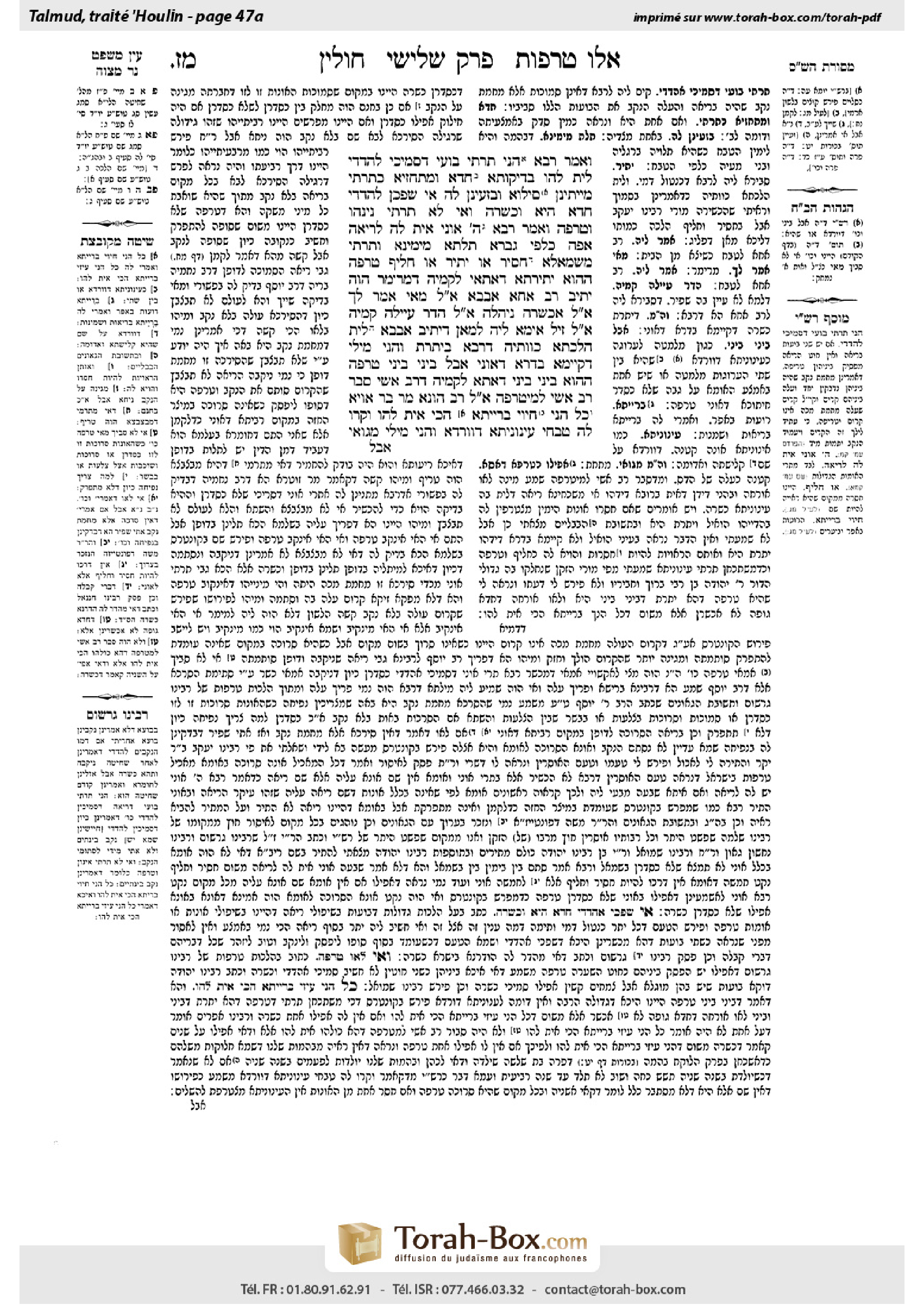
Chullin 47a: Talmud study for Daf Yomi
Study the Talmud for Daf Yomi with scanned pages, Hebrew text, English translations from Sefaria and AI-generated French translations.
Passage selection and English or AI-generated French translation are available where the scan has annotations. Daf Study is independent of Torah-Box and Sefaria.
Browse Chullin · חולין · All tractatesChullin 47a text and translations
This page of Chullin includes the Aramaic text, an English translation and an AI-generated French translation, alongside the scan above.
חולין מ״ז א · Aramaic and Hebrew text
וְאָמַר רָבָא: הָנֵי תַּרְתֵּי בּוּעֵי דִּסְמִיכָן לַהֲדָדֵי, לֵית לְהוּ בְּדִיקוּתָא. חֲדָא וּמִתְחַזְיָא כְּתַרְתֵּי – מַיְיתִינַן סִילְוָא וּבָזְעִינַן לַהּ, אִי שָׁפְכָן לַהֲדָדֵי – חֲדָא הִיא וּכְשֵׁרָה, וְאִי לָא – תַּרְתֵּי נִינְהוּ וּטְרֵפָה.
וְאָמַר רָבָא: חָמֵשׁ אוּנֵּי אִית לַהּ לְרֵיאָה, אַפַּהּ כְּלַפֵּי גַּבְרָא – תְּלָתָא מִיַּמִּינָא וְתַרְתֵּי מִשְּׂמָאלָא. חַסִּיר אוֹ יַתִּיר אוֹ חֲלִיף – טְרֵפָה.
הָהוּא יַתִּירְתָּא דַּאֲתַאי לְקַמֵּיהּ דְּמָרִימָר, הֲוָה יָתֵיב רַב אַחָא אַבָּבָא. אֲמַר לֵיהּ: מַאי אֲמַר לָךְ? אֲמַר לֵיהּ: אַכְשְׁרַהּ נִיהֲלִי. אֲמַר לֵיהּ: הֲדַר עַיְּילַהּ קַמֵּיהּ! אֲמַר לֵיהּ: זִיל אֵימָא לֵיהּ לְמַאן דְּיָתֵיב אַבָּבָא, לֵית הִלְכְתָא כְּוָותֵיהּ דְּרָבָא בִּיתֶרֶת.
וְהָנֵי מִילֵּי – דְּקָיְימָא בְּדָרָא דְּאוּנֵּי, אֲבָל בֵּינֵי בֵּינֵי – טְרֵפָה.
הָהוּא בֵּינֵי בֵּינֵי דַּאֲתָא לְקַמֵּיהּ דְּרַב אָשֵׁי, סָבַר רַב אָשֵׁי לְמִיטְרְפַהּ. אֲמַר לֵיהּ רַב הוּנָא מָר בַּר אַוְיָא: כֹּל הָנֵי חֵיוֵי בָּרָיָיתָא הָכִי אִית לְהוּ, וְקָרוּ לַהּ טַבָּחֵי עֵינוּנִיתָא דְּוַורְדָּא. וְהָנֵי מִילֵּי מִגַּוַּאי,
Chullin 47a · English translation
And Rava says: These two cysts that are adjacent to one another on the lung have no need for inspection. The animal is definitely a tereifa, since it is presumed that the cysts formed around a perforation in the lung. But if there is only one cyst that looks like two, due to a depression in the middle, we bring a thorn and pierce it to remove the fluid inside. If the fluids from either side empty into one another, this indicates that it is one cyst, and the animal is kosher. And if not, they are two separate cysts, and the animal is a tereifa.
§ And Rava says: The lung has five lobes [unnei]. When the animal hangs by its legs with its face toward the person checking it, he sees three lobes on his right and two on his left. If the animal is missing a lobe or has an extra lobe, or if the lobes were switched, with two on the right and three on the left, the animal is a tereifa.
The Gemara relates that a certain lung that had an extra lobe was brought before Mareimar. Rav Aḥa was sitting at the door of Mareimar’s house. When the animal’s owner was leaving, Rav Aḥa said to him: What did Mareimar say to you? The man said to him: Mareimar deemed it kosher. Rav Aḥa was surprised by this, because it contradicts Rava’s statement, so he said to him: Turn around and bring the animal before him. The owner did so. Mareimar realized why he was being asked twice, and said to him: Go tell whomever is sitting at the door: The halakha is not in accordance with the opinion of Rava in the case of an animal that has an extra lobe.
The Gemara adds: And this statement applies only when the extra lobe stands in line with the other lobes, on the left or right. But if it is in between the two sides, the animal is a tereifa.
The Gemara relates that a certain animal with an extra lobe in between the two sides was brought before Rav Ashi. Rav Ashi thought to deem it a tereifa. Rav Huna Mar bar Avya said to him: All those animals that graze outside in the fields have extra lobes like this, and butchers call it the little rose lobe. The Gemara adds: And this statement applies only when the extra lobe is on the inside face of the lung, facing the heart.
Chullin 47a · Traduction française (IA)
Et Rava dit : Ces deux kystes qui sont adjacents l'un à l'autre dans le poumon n'ont pas besoin d'être examinés. L'animal est certainement tereifa, car on suppose que les kystes se sont formés autour d'une perforation dans le poumon. Mais si c'est un seul kyste qui a l'air de deux, à cause d'une dépression au milieu, on introduit une épine et on le perfore pour enlever le liquide à l'intérieur. Si les liquides des deux côtés s'écoulent l'un dans l'autre, cela indique qu'il s'agit d'un seul kyste, et l'animal est propre. Et si ce n'est pas le cas, ils sont deux kystes séparés, et l'animal est tereifa.
§ Et Rava dit : Le poumon a cinq lobes [unnei]. Lorsque l'animal est suspendu par les pattes avec le visage tourné vers la personne qui l'examine, il voit trois lobes à droite et deux à gauche. Si l'animal manque un lobe ou en a un de trop, ou si les lobes sont inversés, avec deux à droite et trois à gauche, l'animal est tereifa.
La Guemara rapporte que certains poumons ayant un lobe de trop furent présentés devant Mareimar. Rav Aḥa était assis à la porte de la maison de Mareimar. Lorsque l'propriétaire de l'animal partait, Rav Aḥa dit à lui : Qu'est-ce que Mareimar a dit à toi ? L'homme lui répondit : Mareimar a estimé qu'il était propre. Rav Aḥa fut surpris par cela, car cela contredit l'opinion de Rava, donc il dit à lui : Tourne-toi et présente l'animal devant lui. L'propriétaire le fit. Mareimar comprit pourquoi il était demandé deux fois, et dit à lui : Va dire à celui qui est assis à la porte : La halakha n'est pas en accord avec l'opinion de Rava dans le cas d'un animal ayant un lobe de trop.
La Guemara ajoute : Et cette déclaration s'applique seulement lorsque le lobe supplémentaire est aligné avec les autres lobes, à gauche ou à droite. Mais si celui-ci est entre les deux côtés, l'animal est tereifa.
La Guemara rapporte que certains animaux ayant un lobe de trop entre les deux côtés furent présentés devant Rav Ashi. Rav Ashi avait l'intention de considérer l'animal comme tereifa. Rav Huna Mar bar Avya dit à lui : Tous les animaux qui paissent en plein air ont des lobes supplémentaires comme cela, et les bouchers l'appellent le petit lobe de rose. La Guemara ajoute : Et cette déclaration s'applique seulement lorsque le lobe supplémentaire est sur la face interne du poumon, tourné vers le cœur.
Traduction française générée par IA à partir de l’édition anglaise de Sefaria. Vérifie toujours un passage avec le texte source.
Text from Sefaria: William Davidson Edition - Vocalized Aramaic (unknown); William Davidson Edition - English (CC BY NC).