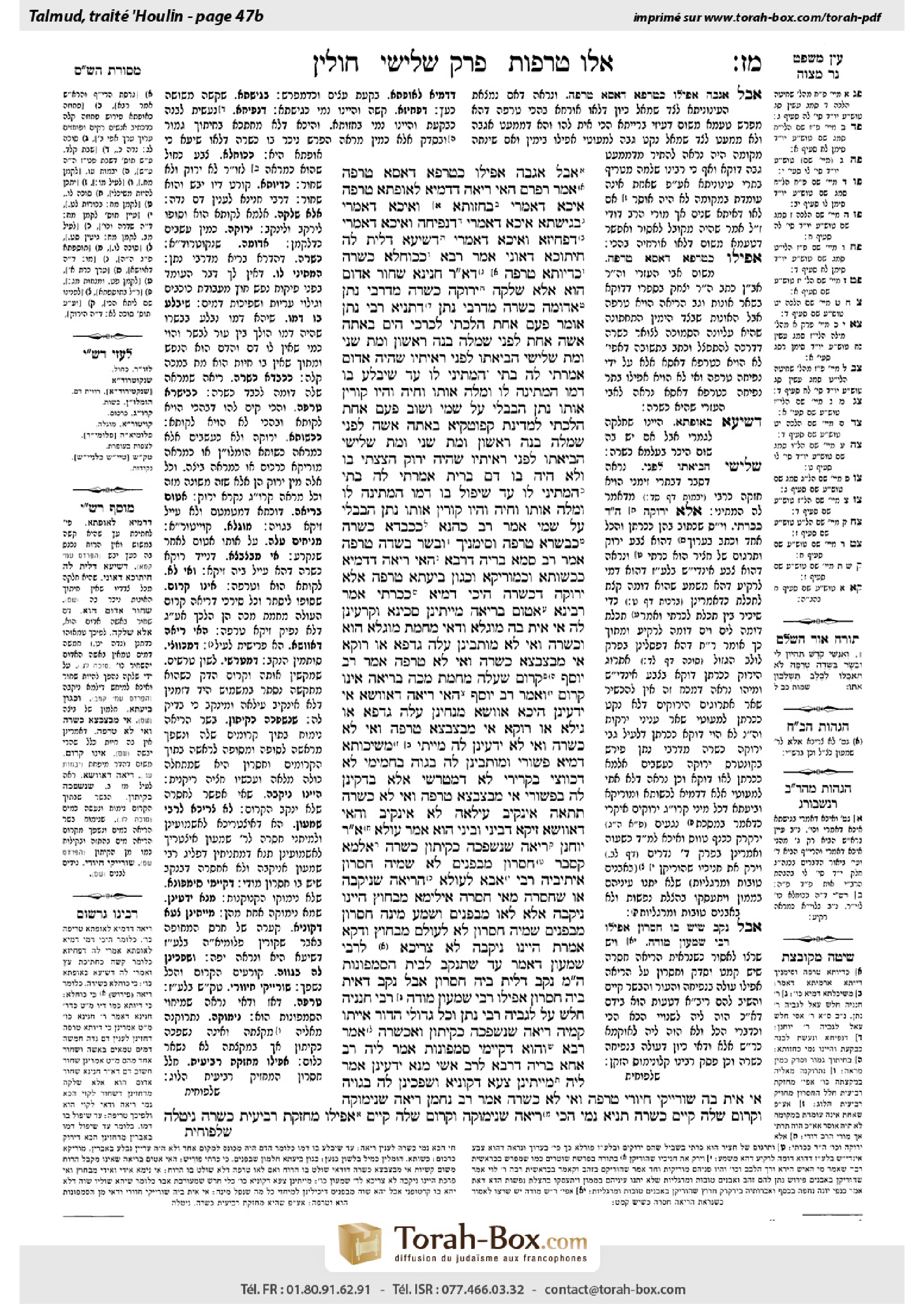
Chullin 47b: Talmud study for Daf Yomi
Study the Talmud for Daf Yomi with scanned pages, Hebrew text, English translations from Sefaria and AI-generated French translations.
Passage selection and English or AI-generated French translation are available where the scan has annotations. Daf Study is independent of Torah-Box and Sefaria.
Browse Chullin · חולין · All tractatesChullin 47b text and translations
This page of Chullin includes the Aramaic text, an English translation and an AI-generated French translation, alongside the scan above.
חולין מ״ז ב · Aramaic and Hebrew text
אֲבָל אַגַּבַּהּ, אֲפִילּוּ כְּטַרְפָּא דְאָסָא – טְרֵפָה.
אָמַר רַפְרָם: הַאי רֵיאָה דְּדָמְיָא לְאוּפְתָּא – טְרֵפָה. אִיכָּא דְּאָמְרִי בַּחֲזוּתָא, וְאִיכָּא דְּאָמְרִי בְּגִישְׁתָּא. אִיכָּא דְּאָמְרִי דִּנְפִיחָה, וְאִיכָּא דְּאָמְרִי דִּפְחִיזָא, וְאִיכָּא דְּאָמְרִי דְּשִׁיעָא, דְּלֵית לַהּ חִיתּוּכָא דְאוּנֵּי.
אָמַר רָבָא: כְּכוּחְלָא – כְּשֵׁרָה, כִּדְיוֹתָא – טְרֵפָה, דְּאָמַר רַבִּי חֲנִינָא: שָׁחוֹר אָדוֹם הוּא, אֶלָּא שֶׁלָּקָה.
יְרוּקָּה – כְּשֵׁרָה, מִדְּרַבִּי נָתָן. אֲדוּמָּה – כְּשֵׁרָה, מִדְּרַבִּי נָתָן. דְּתַנְיָא: רַבִּי נָתָן אוֹמֵר: פַּעַם אַחַת הָלַכְתִּי לִכְרַכֵּי הַיָּם, בָּאתָה אִשָּׁה אַחַת לְפָנַי שֶׁמָּלָה בְּנָהּ רִאשׁוֹן וָמֵת, שֵׁנִי וָמֵת, שְׁלִישִׁי – הֱבִיאַתּוּ לְפָנַי. רְאִיתִיו שֶׁהָיָה אָדוֹם, אָמַרְתִּי לָהּ: בִּתִּי, הַמְתִּינִי לוֹ עַד שֶׁיִּבָּלַע בּוֹ דָּמוֹ. הִמְתִּינָה לוֹ וּמָלָה אוֹתוֹ וְחָיָה, וְהָיוּ קוֹרִין אוֹתוֹ נָתָן הַבַּבְלִי עַל שְׁמִי.
וְשׁוּב פַּעַם אַחַת הָלַכְתִּי לִמְדִינַת קַפּוֹטְקְיָא, בָּאתָה אִשָּׁה לְפָנַי, שֶׁמָּלָה בְּנָהּ רִאשׁוֹן וָמֵת, שֵׁנִי וָמֵת, שְׁלִישִׁי הֱבִיאַתּוּ לְפָנַי, רְאִיתִיו שֶׁהָיָה יָרוֹק, הֵצַצְתִּי בּוֹ וְלֹא הָיָה בּוֹ דַּם בְּרִית, אָמַרְתִּי לָהּ: בִּתִּי, הַמְתִּינִי לוֹ עַד שֶׁיִּפּוֹל בּוֹ דָּמוֹ, הִמְתִּינָה לוֹ וּמָלָה אוֹתוֹ וְחָיָה, וְהָיוּ קוֹרִין אוֹתוֹ נָתָן הַבַּבְלִי עַל שְׁמִי.
אָמַר רַב כָּהֲנָא: כְּכַבְדָּא – כְּשֵׁרָה, כְּבִשְׂרָא – טְרֵפָה, וְסִימָנָיךְ: ״וּבָשָׂר בַּשָּׂדֶה טְרֵפָה״.
אָמַר רַב סַמָּא בְּרֵיהּ דְּרָבָא: הַאי רֵיאָה דְּדָמְיָא כִּכְשׁוּתָא, וּכְמוֹרִיקָא, וּכְגוֹן בֵּיעֲתָא – טְרֵפָה. אֶלָּא יְרוּקָּה דִּכְשֵׁרָה הֵיכִי דָּמְיָא? כְּכַרָּתֵי.
אָמַר רָבִינָא: אָטוּם בְּרֵיאָה, מַיְיתִינַן סַכִּינָא וְקָרְעִינַן לַהּ, אִי אִית בַּהּ מוּגְלָא – וַדַּאי מֵחֲמַת מוּגְלָא הוּא, וּכְשֵׁרָה, וְאִי לָא – מוֹתְבִינַן עֲלַהּ גַּדְפָּא אוֹ רוּקָּא, אִי מְבַצְבְּצָא – כְּשֵׁרָה, וְאִי לָא – טְרֵפָה.
אָמַר רַב יוֹסֵף: קְרוּם שֶׁעָלָה מֵחֲמַת מַכָּה בָּרֵיאָה – אֵינוֹ קְרוּם, וְאָמַר רַב יוֹסֵף: הַאי רֵיאָה דְּאָוְושָׁא, אִי יָדְעִינַן הֵיכָא אָוְושָׁא – מַנְּחִינַן עֲלַהּ גַּדְפָּא אוֹ גִילָא אוֹ רוּקָּא, אִי מְבַצְבְּצָא – טְרֵפָה, וְאִי לָא – כְּשֵׁרָה, וְאִי לָא יָדְעִינַן לַהּ – מַיְיתִינַן מְשִׁיכְלְתָא דְּמַיָּא פָּשׁוֹרֵי וּמוֹתְבִינַן לַהּ בְּגַוַּהּ.
בְּחַמִּימֵי לָא – דְּכָוְוצִי, בְּקָרִירֵי לָא – דִּמְטָרְשִׁי, אֶלָּא בָּדְקִינַן לַהּ בְּפָשׁוֹרֵי. אִי מְבַצְבְּצָא – טְרֵפָה, וְאִי לָא – כְּשֵׁרָה. תַּתָּאָה אִינְּקִיב, עִילָּאָה לָא אִינְּקִיב, וְהַאי דְּאָוְושָׁא – זִיקָא דְּבֵינֵי וּבֵינֵי הוּא.
אָמַר עוּלָּא אָמַר רַבִּי יוֹחָנָן: רֵיאָה שֶׁנִּשְׁפְּכָה כְּקִיתוֹן, כְּשֵׁרָה. אַלְמָא קָסָבַר: חִסָּרוֹן מִבִּפְנִים לָא שְׁמֵיהּ חִסָּרוֹן.
אֵיתִיבֵיהּ רַבִּי אַבָּא לְעוּלָּא: ״הָרֵיאָה שֶׁנִּיקְּבָה אוֹ שֶׁחָסְרָה״. מַאי חָסְרָה? אִילֵימָא מִבַּחוּץ – הַיְינוּ נִיקְּבָה! אֶלָּא לָאו מִבִּפְנִים, וּשְׁמַע מִינַּהּ: חִסָּרוֹן מִבִּפְנִים שְׁמֵיהּ חִסָּרוֹן!
לָא, לְעוֹלָם מִבַּחוּץ, וּדְקָא אָמְרַתְּ הַיְינוּ נִיקְּבָה – לָא צְרִיכָא לְרַבִּי שִׁמְעוֹן, דְּאָמַר: עַד שֶׁתִּנָּקֵב לְבֵית הַסִּמְפּוֹנוֹת. הָנֵי מִילֵּי נֶקֶב דְּלֵית בֵּיהּ חִסָּרוֹן, אֲבָל נֶקֶב דְּאִית בֵּיהּ חִסָּרוֹן – אֲפִילּוּ רַבִּי שִׁמְעוֹן מוֹדֶה.
רַבִּי חֲנַנְיָה חֲלַשׁ, עָל לְגַבֵּיהּ רַבִּי נָתָן וְכׇל גְּדוֹלֵי הַדּוֹר, אַיְיתוֹ קַמֵּיהּ רֵיאָה שֶׁנִּשְׁפְּכָה כְּקִיתוֹן, וְאַכְשְׁרַהּ.
אָמַר רָבָא: וְהוּא דְּקָיְימִי סִמְפּוֹנוֹת. אֲמַר לֵיהּ רַב אַחָא בְּרֵיהּ דְּרָבָא לְרַב אָשֵׁי: מְנָא יָדְעִינַן? אֲמַר לֵיהּ: מַיְיתִינַן צָעָא דְּקוּנְיָא, וְשָׁפְכִינַן לַהּ בְּגַוֵּיהּ. אִי אִית בַּהּ שׁוּרְיָיקֵי חִיוָּרֵי – טְרֵפָה, וְאִי לָא – כְּשֵׁרָה.
אָמַר רַב נַחְמָן: רֵיאָה שֶׁנִּימּוֹקָה וּקְרוּם שֶׁלָּהּ קַיָּים – כְּשֵׁרָה. תַּנְיָא נָמֵי הָכִי: רֵיאָה שֶׁנִּימּוֹקָה וּקְרוּם שֶׁלָּהּ קַיָּים, אֲפִילּוּ מַחְזֶקֶת רְבִיעִית – כְּשֵׁרָה. נִיטְּלָה
Chullin 47b · English translation
But if it is on the back of the lung, even if it is as small as a myrtle leaf, the animal is a tereifa.
§ Rafram says: This lung that is similar to a chip of wood renders the animal a tereifa. There are those who say that the similarity lies in its appearance, i.e., if it is pale like wood. And there are those who say that it lies in its feeling, i.e., if it is hard like wood. There are those who say that it is swollen. And there are those who say that it is light. And there are those who say that it is completely smooth, that it has no sectioning of lobes.
§ Rava says: If the lung assumed a dark color like eye shadow, the animal is kosher. If its color is black like ink, the animal is a tereifa. As Rabbi Ḥanina says: Menstrual blood that appears black is actually red, except that it decayed. Black color is therefore a sign of decay, and the lung is assumed to be defective.
The Gemara continues: If the lung was green, the animal is kosher, as can be derived from the episode of Rabbi Natan. And if it was red, it is kosher, as can be derived from the episode of Rabbi Natan. As it is taught in a baraita: Rabbi Natan says: Once I went to the cities overseas, where one woman came before me who circumcised her first son and he died, and she circumcised her second son and he died, and out of concern that circumcising her third son might cause him to die as well, she brought him before me. I saw that he was red, so I said to her: My daughter, wait for him until his blood is absorbed into him. She waited for him until his blood was absorbed into him and then circumcised him, and he survived. And they would call him Natan the Babylonian after my name. This incident indicates that a red lung can heal.
Rabbi Natan further related: And on another occasion I went to the state of Cappadocia, and a woman came before me who circumcised her first son and he died, and she circumcised her second son and he died. Out of concern that circumcising her third son might cause him to die as well, she brought him before me. I saw that he was green, i.e., pale. I looked at him and saw that he did not have the blood of circumcision in him, i.e., he had a deficiency of blood such that no blood would emerge from the circumcision. I said to her: My daughter, wait until his blood enters him. She waited for his blood to increase and then circumcised him, and he survived. And they would call his name Natan the Babylonian after my name. This incident indicates that a green lung can heal as well.
Rav Kahana says: If the lung has an appearance like the liver, the animal is kosher. If it has an appearance like flesh, the animal is a tereifa. And your mnemonic to remember that the latter is a tereifa is the verse: “You shall not eat any flesh that is torn of animals [tereifa] in the field” (Exodus 22:30).
Rav Sama, son of Rava, says: This lung whose appearance resembles dodder, or saffron, or has a yellow color such as that of an egg yolk, renders the animal a tereifa. Since all of these appearances are various shades of green, the Gemara asks: But the green lung that is kosher, what is it like? The Gemara responds: It is like a leek.
§ Ravina says: If there was a sealed area in the lung that does not inflate, we bring a knife and tear it open. If there is pus in the sealed area, then it was definitely sealed due to the pus, and the animal is kosher. But if we do not find pus there, we lay a feather or saliva on the opening and inflate the lung. If the saliva bubbles or the feather moves, the animal is kosher, since some air does reach the area, and if not, there is some defect in the lung, and the animal is a tereifa.
Rav Yosef says: A membrane that appeared due to a wound in the lung, i.e., a scab that covered a perforation through the lung, is not considered a true membrane, since it does not last. And Rav Yosef says: With regard to this lung that emits a sound when inflated, if we know from where it emits a sound, we set a feather, or straw, or saliva on that point. If the saliva bubbles when the lung is inflated, the animal is a tereifa, since this proves that the lung is perforated through both membranes. And if not, the animal is kosher. And if we do not know from where it emits a sound, we bring a basin of tepid water and set the lung inside it.
One cannot place it in hot water, as it causes the lung to contract, closing the perforation. And one cannot place it in cold water, as it hardens the lung and may cause it to crack. Rather, we check it in tepid water. If the water bubbles, the animal is a tereifa. And if not, the animal is kosher, since it is apparent that only the inner membrane is perforated and the outer membrane is not perforated, and the fact that it emits a sound is due to the air moving in the space between the two membranes.
§ Ulla says that Rabbi Yoḥanan says: An animal with a lung that liquefied and can be poured out like water from a jug is kosher. The Gemara notes: Evidently, Rabbi Yoḥanan holds that a deficiency on the inside of an organ is not considered a deficiency. Only a deficiency in the wall or membrane of an organ renders an animal a tereifa.
Rabbi Abba raised an objection to Ulla from the mishna, which states: The lung that was perforated or that was missing a piece renders the animal a tereifa. What is the case of a lung that was missing a piece? If we say that it was missing a piece on the outside, this is the same as if it was perforated, since any missing piece of the lung wall would constitute a perforation. Rather, is it not referring to a missing piece on the inside? If so, learn from the mishna that a deficiency on the inside of an organ is considered a deficiency to render the animal a tereifa.
The Gemara responds: No, the mishna actually is referring to a missing piece on the outside. And with regard to that which you said: This is the same as if it was perforated, one may respond that no, it is necessary to mention both cases to account for the opinion of Rabbi Shimon in the mishna, who says: It is not a tereifa until the lung is perforated through to the bronchi. By mentioning both cases, the mishna teaches that this statement of Rabbi Shimon applies only to a small perforation that does not constitute a deficiency. But in the case of a perforation so large that it constitutes a deficiency, even Rabbi Shimon concedes that it renders the animal a tereifa even if the perforation does not reach the bronchi.
The Gemara relates that Rabbi Ḥananya became sick. Rabbi Natan and all the eminent scholars of the generation entered before him to visit. They brought before him a lung that could be poured out like water from a jug, and he deemed the animal kosher.
Rava said: This is the halakha only if the bronchi still exist and only the flesh of the lung has liquefied. Rav Aḥa, son of Rava, said to Rav Ashi: From where do we know whether the bronchi still exist? Rav Ashi said to him: We bring a glazed earthenware vessel with no cracks, so the contents can be observed, and we pour the lung into it. If there are white streaks in it, the animal is a tereifa, as the white streaks are remains of the liquefied bronchi. And if not, the animal is kosher.
Rav Naḥman says: If the lung was partially atrophied and only part of the flesh remains, but its membrane still exists, the animal is kosher. The Gemara notes: This is also taught in a baraita: If the lung was atrophied, but its membrane still exists, even if the space vacated by the atrophied lung can hold a quarter-log of fluid, the animal is kosher.
Chullin 47b · Traduction française (IA)
Mais si cela est sur la face du poumon, même si cela est aussi petit qu'une feuille de laurier, l'animal est un tereifa.
§ Rafram dit : Ce poumon qui ressemble à un morceau de bois rend l'animal tereifa. Certains disent que la ressemblance réside dans son apparence, c'est-à-dire s'il est pâle comme le bois. D'autres disent que la ressemblance réside dans sa texture, c'est-à-dire s'il est dur comme le bois. D'autres disent qu'il est enflé. D'autres disent qu'il est léger. D'autres disent qu'il est parfaitement lisse, sans division des lobes.
§ Rava dit : Si le poumon a pris une couleur sombre comme un fard à paupières, l'animal est acceptable. Si sa couleur est noire comme de l'encre, l'animal est tereifa. Comme dit Rabbi Ḥanina : Le sang menstruel qui apparaît noir est en réalité rouge, sauf qu'il a pourri. La couleur noire est donc un signe de pourriture, et le poumon est considéré comme déficient.
La Guemara continue : Si le poumon était vert, l'animal est acceptable, comme on peut en déduire de l'incident de Rabbi Natan. Et si le poumon était rouge, il est acceptable, comme on peut en déduire de l'incident de Rabbi Natan. Comme il est enseigné dans une baraïta : Rabbi Natan dit : Une fois, je suis allé aux villes d'outre-mer, où une femme est venue me voir qui avait circoncis son premier fils et il était mort, et elle avait circoncis son deuxième fils et il était mort. En crainte que circoncire son troisième fils ne cause sa mort également, elle m'a amené. J'ai vu qu'il était rouge, et j'ai dit à elle : Ma fille, attends qu'il absorbe son sang. Elle a attendu qu'il absorbe son sang et puis l'a circoncis, et il a survécu. Et on appelait son nom Natan le Babylonien après mon nom. Cet incident montre que le poumon rouge peut guérir.
Rabbi Natan ajoute : Et un autre jour, je suis allé dans l'état de Cappadocie, et une femme est venue me voir qui avait circoncis son premier fils et il était mort, et elle avait circoncis son deuxième fils et il était mort. En crainte que circoncire son troisième fils ne cause sa mort également, elle m'a amené. J'ai vu qu'il était vert, c'est-à-dire pâle. J'ai regardé et j'ai vu qu'il n'avait pas de sang de circoncision en lui, c'est-à-dire qu'il manquait de sang tellement qu'aucun sang ne sortirait de la circoncision. J'ai dit à elle : Ma fille, attends que son sang entre en lui. Elle a attendu que son sang augmente et puis l'a circoncis, et il a survécu. Et on appelait son nom Natan le Babylonien après mon nom. Cet incident montre que le poumon vert peut guérir également.
Rav Kahana dit : Si le poumon a l'apparence du foie, l'animal est acceptable. Si l'apparence est celle de la chair, l'animal est tereifa. Et votre mnémonique pour retenir que ceci est tereifa est la verset : « Vous ne mangerez aucun animal dont la chair est déchirée [tereifa] dans le champ » (Exode 22:30).
Rav Sama, fils de Rava, dit : Ce poumon dont l'apparence ressemble à la dodder, ou au safran, ou qui a une couleur jaune comme celle de la jaune d'œuf, rend l'animal tereifa. Puisque toutes ces appartenances sont des nuances de vert, la Guemara demande : Mais le poumon vert qui est acceptable, de quelle couleur est-il ? La Guemara répond : Il ressemble à un ail.
§ Ravina dit : Si une zone scellée existait dans le poumon qui ne s'insuffle pas, on apporte un couteau et on le déchire. Si du pus est présent dans la zone scellée, alors c'était certainement scellé à cause du pus, et l'animal est acceptable. Mais si on ne trouve pas de pus là, on place une plume ou du salive sur l'ouverture et on insuffle le poumon. Si le salive bouille ou la plume bouge, l'animal est acceptable, car de l'air atteint la zone, et si non, il y a un défaut dans le poumon, et l'animal est tereifa.
Rav Yosef dit : Une membrane qui s'est formée à cause d'une plaie dans le poumon, c'est-à-dire une croûte qui recouvrait une perforation dans le poumon, n'est pas considérée comme une membrane réelle, car elle ne dure pas. Et Rav Yosef dit : Concernant ce poumon qui émet un son lorsqu'on l'insuffle, si on sait d'où il émet un son, on place une plume, ou des pailles, ou du salive sur ce point. Si le salive bouille lorsqu'on insuffle le poumon, l'animal est tereifa, car cela prouve que le poumon est perforé à travers les deux membranes. Et si non, l'animal est acceptable. Et si on ne sait pas d'où il émet un son, on apporte un bassin d'eau tiède et on place le poumon dedans.
On ne peut pas le placer dans de l'eau chaude, car cela fait contracter le poumon, fermant la perforation. Et on ne peut pas le placer dans de l'eau froide, car cela durcit le poumon et peut le faire éclater. On le vérifie donc dans de l'eau tiède. Si l'eau bouille, l'animal est tereifa. Et si non, l'animal est acceptable, car il est évident que seul la membrane interne est perforée et la membrane externe n'est pas perforée, et le fait qu'il émet un son est dû à l'air qui se déplace dans l'espace entre les deux membranes.
§ Ulla dit que Rabbi Yoḥanan dit : Un animal dont le poumon a liqueuri et peut être versé comme de l'eau d'un tonneau est acceptable. La Guemara note : Évidemment, Rabbi Yoḥanan considère qu'un défaut à l'intérieur d'un organe n'est pas considéré comme un défaut. Seul un défaut dans la paroi ou la membrane d'un organe rend l'animal tereifa.
Rabbi Abba a soulevé un objet contre Ulla à partir de la mitsva, qui stipule : Le poumon qui était perforé ou qui manquait un morceau rend l'animal tereifa. Quel est le cas d'un poumon qui manquait un morceau ? Si on dit qu'il manquait un morceau à l'extérieur, c'est la même chose qu'un poumon perforé, car toute pièce manquante de la paroi du poumon constituerait une perforation. Plutôt, n'est-ce pas ce qui est dit d'un morceau manquant à l'intérieur ? Si c'est le cas, apprendre de la mitsva qu'un défaut à l'intérieur d'un organe est considéré comme un défaut pour rendre l'animal tereifa.
La Guemara répond : Non, la mitsva fait en réalité référence à une pièce manquante à l'extérieur. Et concernant ce que vous avez dit : cela équivaut à un trou percé, on peut répondre que non, il est nécessaire de mentionner les deux cas pour rendre compte de l'opinion du maître Šimon dans la mitsva, qui dit : L'animal n'est pas tereifa jusqu'à ce que le poumon soit percé jusqu'aux bronches. En mentionnant les deux cas, la mitsva enseigne que cette déclaration du maître Šimon s'applique uniquement à un petit trou qui ne constitue pas un défaut. Mais dans le cas d'un trou si grand qu'il constitue un défaut, même le maître Šimon admet que cela rend l'animal tereifa même si le trou ne parvient pas aux bronches.
La Guemara rapporte que le maître Hananja est tombé malade. Le maître Natan et tous les savants éminents de l'époque sont entrés devant lui pour le visiter. Ils lui ont présenté un poumon qui pouvait être versé comme de l'eau d'un tonneau, et il a jugé l'animal propre.
Rava dit : Cette halakha s'applique uniquement si les bronches existent encore et uniquement si la chair du poumon a liquefié. Rav Acha, fils de Rava, a dit à Rav Ashi : D'où savons-nous si les bronches existent encore ? Rav Ashi a répondu à lui : Nous apportons un récipient en terre cuit à l'extérieur sans fissures, afin que son contenu puisse être observé, et nous versons le poumon dedans. Si des traces blanches y sont présentes, l'animal est tereifa, car ces traces blanches sont les restes des bronches liquefiées. Et si ce n'est pas le cas, l'animal est propre.
Rav Naḥman dit : Si le poumon était partiellement atrophié et que seule une partie de la chair reste, mais que sa membrane existe encore, l'animal est propre. La Guemara note : Cela est également enseigné dans une baraïta : Si le poumon était atrophié, mais que sa membrane existe encore, même si l'espace laissé par l'atrophie du poumon peut contenir un quart de log, l'animal est propre.
Traduction française générée par IA à partir de l’édition anglaise de Sefaria. Vérifie toujours un passage avec le texte source.
Text from Sefaria: William Davidson Edition - Vocalized Aramaic (unknown); William Davidson Edition - English (CC BY NC).