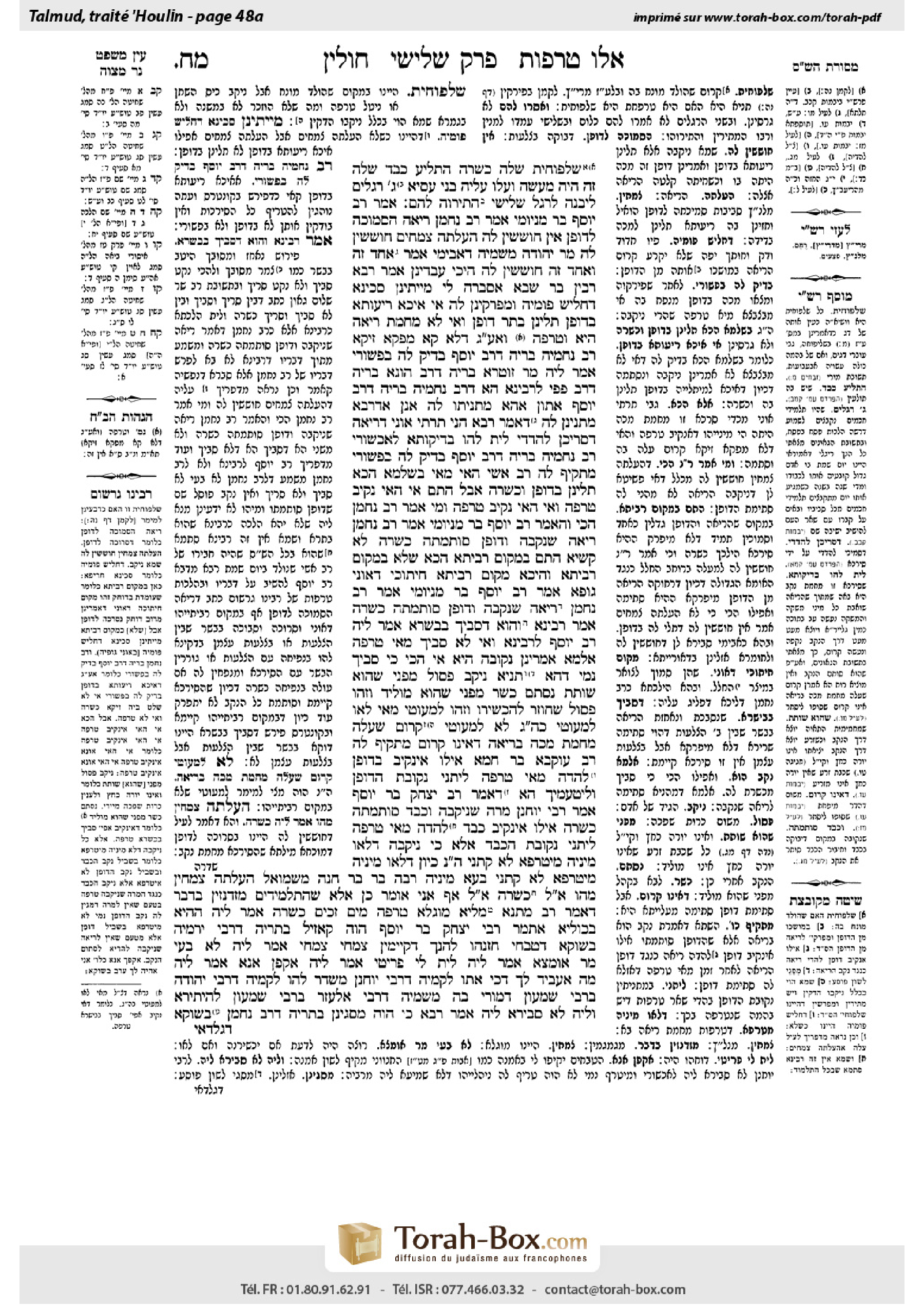
Chullin 48a: Talmud study for Daf Yomi
Study the Talmud for Daf Yomi with scanned pages, Hebrew text, English translations from Sefaria and AI-generated French translations.
Passage selection and English or AI-generated French translation are available where the scan has annotations. Daf Study is independent of Torah-Box and Sefaria.
Browse Chullin · חולין · All tractatesChullin 48a text and translations
This page of Chullin includes the Aramaic text, an English translation and an AI-generated French translation, alongside the scan above.
חולין מ״ח א · Aramaic and Hebrew text
שַׁלְפּוּחִית שֶׁלָּהּ – כְּשֵׁרָה. הִתְלִיעַ כָּבֵד שֶׁלָּהּ – זֶה הָיָה מַעֲשֶׂה, וְעָלוּ עָלֶיהָ בְּנֵי עַסְיָא שְׁלֹשָׁה רְגָלִים לְיַבְנֶה, לְרֶגֶל שְׁלִישִׁי הִתִּירוּהָ לָהֶם.
אָמַר רַב יוֹסֵף בַּר מִנְיוֹמֵי אָמַר רַב נַחְמָן: רֵיאָה הַסְּמוּכָה לַדּוֹפֶן – אֵין חוֹשְׁשִׁין לָהּ, הֶעֶלְתָה צְמָחִים – חוֹשְׁשִׁין לָהּ. מָר יְהוּדָה מִשְּׁמֵיהּ דַּאֲבִימִי אָמַר: אֶחָד זֶה וְאֶחָד זֶה – חוֹשְׁשִׁין לָהּ.
הֵיכִי עָבְדִינַן? אָמַר רָבָא: רָבִין בַּר שְׁבָא אַסְבְּרַהּ לִי, מַיְיתִינַן סַכִּינָא דַּחֲלִישׁ פּוּמֵּיהּ וּמְפָרְקִינַן לַהּ; אִי אִיכָּא רֵיעוּתָא בְּדוֹפֶן – תָּלֵינַן בָּתַר דּוֹפֶן, וְאִי לָא – מֵחֲמַת רֵיאָה הִיא, וּטְרֵפָה, וְאַף עַל גַּב דְּלָא קָא מַפְּקָא זִיקָא.
רַב נְחֶמְיָה בְּרֵיהּ דְּרַב יוֹסֵף בָּדֵיק לַהּ בְּפָשׁוֹרֵי. אֲמַר לֵיהּ מָר זוּטְרָא בְּרֵיהּ דְּרַב הוּנָא בְּרֵיהּ דְּרַב פַּפֵּי לְרָבִינָא: הָא דְּרַב נְחֶמְיָה בְּרֵיהּ דְּרַב יוֹסֵף, אַתּוּן אַהָא מַתְנִיתוּ לַהּ, אֲנַן אַדְּרָבָא מַתְנֵינַן לַהּ, דְּאָמַר רָבָא: הָנֵי תַּרְתֵּי אוּנֵּי דְּרֵיאָה דִּסְרִיכָן לַהֲדָדֵי לֵית לְהוּ בְּדִיקוּתָא לְאַכְשׁוֹרֵי. רַב נְחֶמְיָה בְּרֵיהּ דְּרַב יוֹסֵף בָּדֵיק לַהּ בְּפָשׁוֹרֵי.
מַתְקֵיף לַהּ רַב אָשֵׁי: הַאי מַאי? בִּשְׁלָמָא הָכָא תָּלֵינַן בְּדוֹפֶן, וּכְשֵׁרָה, אֲבָל הָתָם – אִי הַאי נְקִיב – טְרֵפָה, וְאִי הַאי נְקִיב – טְרֵפָה.
וּמִי אָמַר רַב נַחְמָן הָכִי? וְהָאָמַר רַב יוֹסֵף בַּר מִנְיוֹמֵי אָמַר רַב נַחְמָן: רֵיאָה שֶׁנִּקְּבָה וְדוֹפֶן סוֹתַמְתָּהּ – כְּשֵׁרָה! לָא קַשְׁיָא, הָתָם בִּמְקוֹם רְבִיתָא, הָכָא שֶׁלֹּא בִּמְקוֹם רְבִיתָא.
וְהֵיכָא מְקוֹם רְבִיתָא? חִיתּוּכֵי דְּאוּנֵּי.
גּוּפָא, אָמַר רַב יוֹסֵף בַּר מִנְיוֹמֵי אָמַר רַב נַחְמָן: רֵיאָה שֶׁנִּקְּבָה וְדוֹפֶן סוֹתַמְתָּהּ – כְּשֵׁרָה. אָמַר רָבִינָא: וְהוּא דִּסְבִיךְ בְּבִשְׂרָא. אֲמַר לֵיהּ רַב יוֹסֵף לְרָבִינָא: וְאִי לָא סְבִיךְ מַאי? טְרֵפָה, אַלְמָא אָמְרִינַן נְקוּבָה הִיא. אִי הָכִי, כִּי סְבִיךְ נָמֵי!
דְּהָא תַּנְיָא: נִיקַּב – פָּסוּל, מִפְּנֵי שֶׁהוּא שׁוֹתֵת; נִסְתַּם – כָּשֵׁר, מִפְּנֵי שֶׁהוּא מוֹלִיד, וְזֶהוּ פְּסוּל שֶׁחוֹזֵר לְהֶכְשֵׁירוֹ. וְזֶהוּ לְמַעוֹטֵי מַאי? לָאו לְמַעוֹטֵי כְּהַאי גַוְונָא.
לָא, לְמַעוֹטֵי קְרוּם שֶׁעָלָה מֵחֲמַת מַכָּה בָּרֵיאָה, דְּאֵינוֹ קְרוּם.
מַתְקֵיף לַהּ רַב עוּקְבָא בַּר חָמָא: אִילּוּ אִינְּקִיב דּוֹפֶן לַהֲדַהּ, מַאי? טְרֵפָה! לִיתְנֵי נְקוּבַת הַדּוֹפֶן!
וְלִיטַעְמָיךְ, הָא דְּאָמַר רַב יִצְחָק בַּר יוֹסֵף אָמַר רַבִּי יוֹחָנָן: מָרָה שֶׁנִּיקְּבָה וְכָבֵד סוֹתַמְתָּהּ – כְּשֵׁרָה, אִילּוּ אִינְּקִיב כָּבֵד לַהֲדַהּ, מַאי? טְרֵפָה! לִיתְנֵי: נְקוּבַת הַכָּבֵד.
אֶלָּא, כִּי נִיקְּבָה דְּלָאו מִינֵּיהּ מִיטַּרְפָא – לָא קָתָנֵי; הָכָא נָמֵי, כֵּיוָן דְּלָאו מִינֵּיהּ מִיטַּרְפָא – לָא קָתָנֵי.
בְּעָא מִינֵּיהּ רַבָּה בַּר בַּר חָנָה מִשְּׁמוּאֵל: הֶעֶלְתָה צְמָחִין, מַהוּ? אֲמַר לֵיהּ: כְּשֵׁרָה. אֲמַר לֵיהּ: אַף אֲנִי אוֹמֵר כֵּן, אֶלָּא שֶׁהַתַּלְמִידִים מִזְדַּנְּזִין בַּדָּבָר, דְּאָמַר רַב מַתְנָא: מַלְיָא מוּגְלָא – טְרֵפָה, מַיִם זַכִּים – כְּשֵׁרָה. אֲמַר לֵיהּ: הָהִיא בְּכוּלְיָא אִתְּמַר.
רַבִּי יִצְחָק בַּר יוֹסֵף הֲוָה קָאָזֵיל בָּתְרֵיהּ דְּרַבִּי יִרְמְיָה בְּשׁוּקָא דְּטַבָּחֵי, חֲזָנְהוּ לְהָנָךְ דְּקָיְימִין צִמְחֵי צִמְחֵי. אֲמַר לֵיהּ: לָא בָּעֵי מָר אוּמְצָא? אֲמַר לֵיהּ: לֵית לִי פְּרִיטֵי. אֲמַר לֵיהּ: אַקְּפַן אֲנָא. אֲמַר לֵיהּ: מָה אֶעֱבֵיד לָךְ, דְּכִי אָתוּ לְקַמֵּיהּ דְּרַבִּי יוֹחָנָן מְשַׁדַּר לְהוּ לְקַמֵּיהּ דְּרַבִּי יְהוּדָה בְּרַבִּי שִׁמְעוֹן, דְּמוֹרֵי בַּהּ מִשְּׁמֵיהּ דְּרַבִּי אֶלְעָזָר בְּרַבִּי שִׁמְעוֹן לְהֶיתֵּירָא, וְלֵיהּ לָא סְבִירָא לֵיהּ.
אָמַר רָבָא: כִּי הֲוָה מְסַגֵּינַן בָּתְרֵיהּ דְּרַב נַחְמָן בְּשׁוּקָא
Chullin 48a · English translation
If its womb was removed, the animal is kosher. If its liver became infested by worms, with regard to this there was an incident, and the residents of Asia Minor went up on three occasions to the great Sanhedrin in Yavne to inquire with regard to the halakha. On the first two occasions they did not receive an answer; on the third occasion, after the Sanhedrin had deliberated, they permitted the animal to them.
§ Rav Yosef bar Minyumi says that Rav Naḥman says: With regard to a lung that is adjacent, i.e., attached, to the ribs in the chest wall, one need not be concerned about the possibility that it became attached as a result of a perforation in the lung as opposed to some injury to the chest wall. But if cysts full of pus sprouted on the lung itself in the area of its attachment to the chest wall, one must be concerned about the possibility that it was perforated, and that this gave rise to the cysts. Mar Yehuda says in the name of Avimi: In both this case and that case, whether or not there are cysts on the lung, one must be concerned about the possibility that the lung was perforated.
The Gemara asks: How do we perform an examination to determine whether the injury is in the chest wall or the lung? Rava said: Ravin bar Sheva explained the procedure to me: We bring a knife whose edge is sharp and thin, and we separate the lung from the chest wall. If there is a defect, a wound or disease, in the chest wall, we attribute the attachment to the defect in the chest wall. And if not, we presume that the attachment is due to a defect in the lung, and the animal is a tereifa. And this is the halakha even though the lung does not expel air when inflated, since it is assumed that a scab covered the perforation, and a scab does not prevent the animal from being rendered a tereifa.
The Gemara relates that Rav Neḥemya, son of Rav Yosef, examined such a lung by inflating it in tepid water to see if bubbles would appear. Mar Zutra, son of Rav Huna, son of Rav Pappi, said to Ravina: Concerning this episode of Rav Neḥemya, son of Rav Yosef, you teach it as being about this case of a lung attached to the chest wall. But we teach it as being about the case of Rava, as Rava says: These two lobes of the lung that adhere to one another have no means of inspection to deem them kosher. Still, Rav Neḥemya, son of Rav Yosef, examined such a lung by inflating it in tepid water. If no bubbles appeared he would deem the lung kosher.
Rav Ashi objects to this: What is this? How can an animal with a lung whose lobes adhered to one another be permitted by means of such an inspection? Granted, here, in the case of a lung attached to the chest wall, we attribute the attachment to an injury in the chest wall rather than the lung, and the animal is kosher. But there, in the case of an adhesion between two lobes, what can be said? If this lobe was perforated the animal is a tereifa, and if that lobe was perforated the animal is a tereifa. Even if a scab covers the perforation and prevents bubbles from appearing, the animal is still a tereifa.
Rav Naḥman stated that if there are cysts on the lung in the area of its attachment to the chest wall, one must be concerned about the possibility that the lung was perforated. Evidently, if the lung was perforated, the animal is a tereifa. The Gemara asks: And did Rav Naḥman really say this? But doesn’t Rav Yosef bar Minyumi say that Rav Naḥman says: If the lung was perforated but the chest wall seals the perforation, the animal is kosher? The Gemara responds: This is not difficult. There, Rav Naḥman is referring to a lung attached to the chest wall in the place that it grows [revita] naturally. In that case, if the chest wall seals the perforation it will remain sealed, and the animal can live. But here, Rav Naḥman is referring to a lung attached to the chest wall not in the place that it grows.
The Gemara clarifies: And where is the place that it grows? It is the area of the sectioning of the lobes, i.e., the front of the lung where the lobes are adjacent to the chest wall on all sides.
§ Since the Gemara cited the statement of Rav Naḥman, the Gemara turns to the matter itself: Rav Yosef bar Minyumi says that Rav Naḥman says: If the lung was perforated but the chest wall sealed the perforation, the animal is kosher. With regard to this statement, Ravina said: And this is the halakha only when the lung is tangled in the flesh of the chest wall, between the ribs. Rav Yosef said to Ravina: And if it is not tangled, what is the halakha? The animal is a tereifa. Evidently, we say that the lung is perforated. But if so, when it is tangled as well, it should be deemed a tereifa.
As isn’t it taught in a baraita: If a man’s penis was perforated, he is unfit to marry a Jewish woman of fit lineage, because his semen is discharged gently and he cannot procreate, in accordance with the verse: “He that is crushed or maimed in his private parts shall not enter into the assembly of the Lord” (Deuteronomy 23:2). But if the perforation was later sealed with flesh, he is fit, because now he can procreate. And this is an instance of someone who is unfit who returns to his previous state of fitness. Rav Yosef continues: When the baraita states: And this is, what does it serve to exclude? Does it not serve to exclude a case like this, where the lung was perforated and then sealed by the chest wall, in which case the animal would not become kosher again?
The Gemara responds: No, the phrase serves to exclude a membrane that appeared due to a wound in the lung, which is not considered a membrane that can seal a perforation, because it is temporary. By contrast, the flesh of the chest wall is considered a permanent seal on the lungs and renders the animal kosher.
Rav Ukva bar Ḥama objects to the ruling of Rav Naḥman that if a lung was perforated but the chest wall sealed the perforation, the animal is kosher: If flesh in the chest wall was perforated against the perforation in the lung, what would the halakha be? The animal would be a tereifa, since air can now escape from the lung. Evidently, the question of whether the animal is permitted is dependent on the state of the chest wall. If so, let the mishna teach, in addition to the given list of tereifot: An animal whose chest wall was perforated.
The Gemara responds: And according to your reasoning, one can also ask: The mishna states that if the gallbladder was perforated, the animal is a tereifa. That which Rav Yitzḥak bar Yosef says that Rabbi Yoḥanan says with regard to this, that if the gallbladder was perforated but the liver sealed the perforation the animal is kosher, is difficult. If the liver were perforated against the perforation in the gallbladder, what would the halakha be? The animal would be a tereifa. If so, let the mishna also teach: An animal whose liver was perforated.
Rather, one must say that the mishna does not teach cases where the perforated organ is not the one by which the animal is rendered a tereifa. Here, too, in the case of a lung sealed by the chest wall, since the perforated organ, i.e., the chest wall, is not the one by which the animal is rendered a tereifa, the mishna does not teach it.
§ Rabba bar bar Ḥana asked Shmuel: If the lung grew cysts full of pus, what is the halakha? Shmuel said to him: The animal is kosher. Rabba bar bar Ḥana said to him in reply: I also say so, that the animal is kosher, except that the students doubt the matter, as Rav Mattana says: If the cyst was full of pus, the animal is a tereifa; if it was full of clear fluid, it is kosher. Shmuel said to him: That halakha of Rav Mattana was stated with regard to a cyst on the kidney, not on the lung.
The Gemara relates that Rabbi Yitzḥak bar Yosef was walking after Rabbi Yirmeya in the butchers’ market. He saw these lungs that were full of cysts, and he wished to determine the halakha with regard to them. He said to Rabbi Yirmeya: Doesn’t the Master desire a piece of meat? If so, meat from those animals is for sale. Rabbi Yirmeya, not wanting to issue a ruling with regard to the meat, said to him: I have no money. Rabbi Yitzḥak bar Yosef said to him: I will buy them for you on credit. Rabbi Yirmeya realized that he could not avoid issuing a ruling, so he said to him: What can I do for you? As when people came before Rabbi Yoḥanan with such lungs, he would send them before Rabbi Yehuda, son of Rabbi Shimon, who would instruct them in such cases in the name of Rabbi Elazar, son of Rabbi Shimon, to permit the meat for consumption. But Rabbi Yoḥanan himself does not hold accordingly, and does not permit the meat. I practice stringency in accordance with his opinion.
Rava said: When we would walk after Rav Naḥman in the market
Chullin 48a · Traduction française (IA)
Si son utérus a été retiré, l'animal est propre. Si son foie est infesté de vers, il y a eu un incident à ce sujet, et les habitants de l'Asie Mineure sont montés trois fois devant le grand Sanhédrin à Yavne pour demander l'halakha. Les deux premières fois, ils n'ont pas reçu de réponse ; la troisième fois, après que le Sanhédrin ait délibéré, ils ont permis l'animal à ces personnes.
§ Rav Yosef bar Minyumi dit que Rav Naḥman dit : Concernant un poumon adjacent, c'est-à-dire attaché, aux côtes dans la paroi thoracique, on ne doit pas s'inquiéter du fait qu'il soit attaché en raison d'une perforation du poumon plutôt qu'une blessure à la paroi thoracique. Mais si des kystes remplis de pus se sont développés sur le poumon lui-même dans la zone de son attachement à la paroi thoracique, on doit s'inquiéter du fait qu'il ait été perforé, et que cela ait donné naissance aux kystes. Mar Yehuda dit au nom d'Avimi : Dans les deux cas, qu'il y ait des kystes sur le poumon ou non, on doit s'inquiéter du fait que le poumon ait été perforé.
Le Guemara pose la question : Comment effectuons-nous l'examen pour déterminer si la blessure est dans la paroi thoracique ou dans le poumon ? Rava dit : Ravin bar Sheva m'a expliqué la procédure : Nous apportons un couteau dont la lame est aiguisée et fine, et nous séparons le poumon de la paroi thoracique. Si il y a un défaut, une plaie ou une maladie dans la paroi thoracique, nous attribuons l'attachement à ce défaut dans la paroi thoracique. Et si non, nous supposons que l'attachement est dû à un défaut dans le poumon, et l'animal est un tereifa. Et c'est ainsi que l'halakha est même si le poumon ne libère pas d'air lorsqu'il est gonflé, car on suppose qu'un croûte a recouvert la perforation, et un croûte ne bloque pas l'animal de devenir un tereifa.
Le Guemara rapporte que Rav Néchemyah, fils de Rav Yosef, a examiné un tel poumon en le gonflant dans de l'eau tiède pour voir si des bulles apparaîtraient. Mar Zutra, fils de Rav Huna, fils de Rav Pappi, a dit à Ravina : Concernant ce cas de Rav Néchemyah, fils de Rav Yosef, vous l'enseignez comme étant celui d'un poumon attaché à la paroi thoracique. Mais nous l'enseignons comme étant celui de Rava, car Rava dit : Ces deux lobes du poumon qui s'attachent l'un à l'autre n'ont aucun moyen d'examen pour être considérés comme propres. Cependant, Rav Néchemyah, fils de Rav Yosef, a examiné un tel poumon en le gonflant dans de l'eau tiède. Si aucune bulle n'apparaissait, il considérait le poumon comme propre.
Rav Ashi s'oppose à cela : Qu'est-ce que cela ? Comment un animal dont les lobes du poumon s'attachent l'un à l'autre peut-il être permis par un tel examen ? En effet, ici, dans le cas d'un poumon attaché à la paroi thoracique, nous attribuons l'attachement à une blessure dans la paroi thoracique plutôt que dans le poumon, et l'animal est propre. Mais là, dans le cas d'une adhérence entre deux lobes, que pouvons-nous dire ? Si ce lobe a été perforé, l'animal est un tereifa, et si ce lobe a été perforé, l'animal est un tereifa. Même si un croûte couvre la perforation et empêche les bulles d'apparaître, l'animal reste un tereifa.
Rav Naḥman a déclaré que si des kystes sont présents sur le poumon dans la zone de son attachement à la paroi thoracique, on doit s'inquiéter du fait que le poumon ait été perforé. Évidemment, si le poumon a été perforé, l'animal est tereifa. Le Guemara pose la question : Et Rav Naḥman a-t-il vraiment dit cela ? Mais ne dit pas Rav Yosef bar Minyumi que Rav Naḥman dit : Si le poumon a été perforé mais que la paroi thoracique scelle la perforation, l'animal est kosher ? Le Guemara répond : Ce n'est pas difficile. Là, Rav Naḥman parle d'un poumon attaché à la paroi thoracique dans la zone où il grandit naturellement. Dans ce cas, si la paroi thoracique scelle la perforation, elle restera scellée, et l'animal peut vivre. Mais ici, Rav Naḥman parle d'un poumon attaché à la paroi thoracique sans être dans la zone où il grandit.
Le Guemara clarifie : Et où est la zone où il grandit ? C'est la zone de la section des lobes, c'est-à-dire la face avant du poumon où les lobes sont adjacents à la paroi thoracique de tous les côtés.
§ Puisque le Guemara a cité la déclaration de Rav Naḥman, le Guemara se tourne vers la question elle-même : Rav Yosef bar Minyumi dit que Rav Naḥman dit : Si le poumon a été perforé mais que la paroi thoracique scelle la perforation, l'animal est kosher. Concernant cette déclaration, Ravina dit : Et c'est ainsi que l'halakha est seulement lorsque le poumon est enroulé dans la chair de la paroi thoracique, entre les côtes. Rav Yosef dit à Ravina : Et si ce n'est pas enroulé, quelle est l'halakha ? L'animal est tereifa. Évidemment, nous disons que le poumon est perforé. Mais si tel est le cas, lorsqu'il est enroulé également, il devrait être considéré comme tereifa.
N'est-ce pas enseigné dans une baraïta : Si la verge d'un homme a été perforée, il est inadmissible pour épouser une femme juive de lignage propre, car son sperme est émis doucement et il ne peut pas procréer, conformément à la parole : « Celui qui est écrasé ou maimé dans ses parties privées ne doit pas entrer dans l'assemblée du Seigneur » (Deutéronome 23:2). Mais si la perforation a été plus tard scellée par la chair, il est admissible, car maintenant il peut procréer. Et c'est un exemple d'une personne inadmissible qui revient à son état antérieur d'admissibilité. Rav Yosef continue : Lorsque la baraïta dit : « Et c'est », que sert cela d'exclure ? N'est-ce pas pour exclure un cas comme celui-ci, où le poumon a été perforé et scellé par la paroi thoracique, dans lequel cas l'animal ne deviendrait pas propre à nouveau ?
Le Guemara répond : Non, cette phrase sert à exclure une membrane apparue en raison d'une plaie dans le poumon, qui n'est pas considérée comme une membrane capable de sceller une perforation, car elle est temporaire. En revanche, la chair de la paroi thoracique est considérée comme un scellement permanent sur les poumons et rend l'animal propre.
Rav Ukva bar Ḥama s'oppose à la décision de Rav Naḥman selon laquelle si un poumon était percé mais la paroi thoracique fermait la perforation, l'animal est propre : Si la chair de la paroi thoracique était percée contre la perforation du poumon, quelle serait la halakha ? L'animal serait un tereifa, puisque l'air peut maintenant s'échapper du poumon. Évidemment, la question de savoir si l'animal est permis dépend de l'état de la paroi thoracique. Si tel est le cas, la mishna devrait enseigner, en plus de la liste donnée des tereifot : Un animal dont la paroi thoracique était percée.
La Guemara répond : Et selon votre raisonnement, on pourrait aussi poser la question : La mishna stipule que si la vésicule biliaire était percée, l'animal est un tereifa. Ce que dit Rav Yitzḥak bar Yosef, selon Rabbi Yoḥanan, concernant cela, à savoir que si la vésicule biliaire était percée mais le foie fermait la perforation, l'animal est propre, est difficile. Si le foie était percé contre la perforation de la vésicule biliaire, quelle serait la halakha ? L'animal serait un tereifa. Si tel est le cas, la mishna devrait aussi enseigner : Un animal dont le foie était percé.
Plutôt, il faut dire que la mishna ne traite pas les cas où l'organe perforé n'est pas celui par lequel l'animal est rendu tereifa. Ici aussi, dans le cas d'un poumon fermé par la paroi thoracique, puisque l'organe perforé, c'est-à-dire la paroi thoracique, n'est pas celui par lequel l'animal est rendu tereifa, la mishna ne traite pas ce cas.
§ Rabba bar bar Ḥana a interrogé Shmuel : Si les poumons présentaient des kystes remplis de pus, quelle est la halakha ? Shmuel lui a répondu : L'animal est propre. Rabba bar bar Ḥana lui a répondu en retour : Je dis aussi cela, c'est-à-dire que l'animal est propre, sauf que les étudiants douteront de la question, comme dit Rav Mattana : Si la kyste était remplie de pus, l'animal est un tereifa ; si elle était remplie de liquide clair, il est propre. Shmuel lui a dit : Cette halakha de Rav Mattana a été émise concernant une kyste sur le rein, pas sur le poumon.
La Guemara rapporte que Rabbi Yitzḥak bar Yosef marchait après Rabbi Yirmeya dans le marché des bouchers. Il vit ces poumons remplis de kystes, et voulait déterminer la halakha concernant ceux-ci. Il dit à Rabbi Yirmeya : Le Maître ne désire-t-il pas un morceau de viande ? Si tel est le cas, la viande de ces animaux est à la vente. Rabbi Yirmeya, ne voulant pas émettre un avis concernant la viande, dit à lui : Je n'ai pas d'argent. Rabbi Yitzḥak bar Yosef dit à lui : Je vous achèterai ceux-ci à crédit. Rabbi Yirmeya comprit qu'il ne pouvait éviter d'émettre un avis, donc il dit à lui : Que puis-je faire pour vous ? Comme quand des gens venaient devant Rabbi Yoḥanan avec de tels poumons, il les envoyait devant Rabbi Yehuda, fils de Rabbi Shimon, qui les instruisait dans tels cas en nom de Rabbi Elazar, fils de Rabbi Shimon, pour permettre la consommation de la viande. Mais Rabbi Yoḥanan lui-même ne suit pas cette opinion, et ne permet pas la consommation de la viande. Je pratique la stricte en conformité avec son opinion.
Rava dit : Quand nous marchions après Rav Naḥman dans le marché
Traduction française générée par IA à partir de l’édition anglaise de Sefaria. Vérifie toujours un passage avec le texte source.
Text from Sefaria: William Davidson Edition - Vocalized Aramaic (unknown); William Davidson Edition - English (CC BY NC).