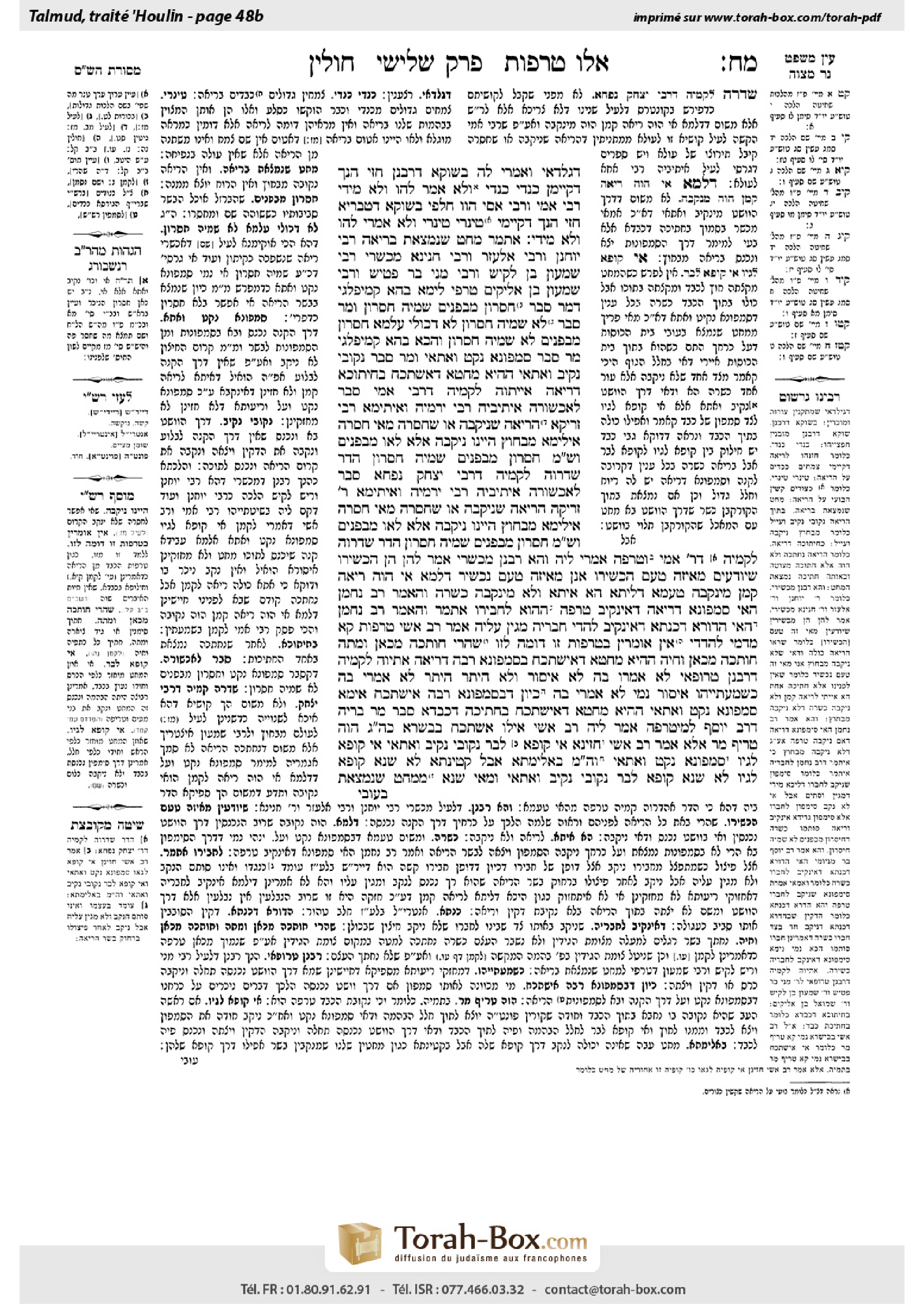
Chullin 48b: Talmud study for Daf Yomi
Study the Talmud for Daf Yomi with scanned pages, Hebrew text, English translations from Sefaria and AI-generated French translations.
Passage selection and English or AI-generated French translation are available where the scan has annotations. Daf Study is independent of Torah-Box and Sefaria.
Browse Chullin · חולין · All tractatesChullin 48b text and translations
This page of Chullin includes the Aramaic text, an English translation and an AI-generated French translation, alongside the scan above.
חולין מ״ח ב · Aramaic and Hebrew text
דְּגִלְדָּאֵי, וְאָמְרִי לַהּ בְּשׁוּקָא דְּרַבָּנַן, חָזֵי הָנָךְ דְּקָיְימָן כַּנְדֵי כַּנְדֵי, וְלָא אָמַר לְהוּ וְלָא מִידֵּי.
רַבִּי אַמֵּי וְרַבִּי אַסִּי הֲווֹ חָלְפִי בְּשׁוּקָא דִּטְבֶרְיָא, (חָזֵי) [חֲזֹנְהוּ] הָנָךְ דְּקָיְימִי טִינָּרֵי טִינָּרֵי, וְלָא אָמְרִי לְהוּ וְלָא מִידֵּי.
אִתְּמַר: מַחַט שֶׁנִּמְצֵאת בָּרֵיאָה – רַבִּי יוֹחָנָן וְרַבִּי אֶלְעָזָר וְרַבִּי חֲנִינָא מַכְשְׁרִי, רַבִּי שִׁמְעוֹן בֶּן לָקִישׁ וְרַבִּי מָנִי בַּר פַּטִּישׁ וְרַבִּי שִׁמְעוֹן בֶּן אֶלְיָקִים טָרְפִי.
לֵימָא בְּהָא קָמִיפַּלְגִי, דְּמָר סָבַר: חִסָּרוֹן מִבִּפְנִים – שְׁמֵיהּ חִסָּרוֹן, וּמָר סָבַר: לָא שְׁמֵיהּ חִסָּרוֹן? לָא, דְּכוּלֵּי עָלְמָא חִסָּרוֹן מִבִּפְנִים – לָא שְׁמֵיהּ חִסָּרוֹן, וְהָכָא בְּהָא קָמִיפַּלְגִי: מָר סָבַר: סִמְפּוֹנָא נְקַט וַאֲתַאי, וּמָר סָבַר: נַקּוֹבֵי נַקֵּיב וַאֲתַאי.
הָהִיא מַחְטָא דְּאִשְׁתְּכַח בְּחִיתּוּכָא דְּרֵיאָה, אַיְיתוּהָ לְקַמֵּיהּ דְּרַבִּי אַמֵּי, סְבַר לְאַכְשׁוֹרַהּ. אֵיתִיבֵיהּ רַבִּי יִרְמְיָה, וְאִיתֵּימָא רַבִּי זְרִיקָא: ״הָרֵיאָה שֶׁנִּיקְּבָה אוֹ שֶׁחָסְרָה״. מַאי חָסְרָה? אִילֵימָא מִבַּחוּץ – הַיְינוּ נִיקְּבָה! אֶלָּא לָאו מִבִּפְנִים, וּשְׁמַע מִינַּהּ: חִסָּרוֹן מִבִּפְנִים – שְׁמֵיהּ חִסָּרוֹן.
הֲדַר שַׁדְּרוּהָ לְקַמֵּיהּ דְּרַבִּי יִצְחָק נַפָּחָא, סְבַר לְאַכְשׁוֹרַהּ, אֵיתִיבֵיהּ רַבִּי יִרְמְיָה, וְאִיתֵּימָא רַבִּי זְרִיקָא: ״הָרֵיאָה שֶׁנִּיקְּבָה אוֹ שֶׁחָסְרָה״. מַאי חָסְרָה? אִילֵימָא מִבַּחוּץ – הַיְינוּ נִיקְּבָה! אֶלָּא לָאו מִבִּפְנִים? וּשְׁמַע מִינַּהּ: חִסָּרוֹן מִבִּפְנִים – שְׁמֵיהּ חִסָּרוֹן!
הֲדַר שַׁדְּרוּהָ לְקַמֵּיהּ דְּרַבִּי אַמֵּי וְטַרְפַהּ. אָמְרִי לֵיהּ: וְהָא רַבָּנַן מַכְשְׁרִי? אָמַר לָהֶן: הֵן הִכְשִׁירוּ, שֶׁיּוֹדְעִים מֵאֵיזֶה טַעַם הִכְשִׁירוּ, אָנוּ מֵאֵיזֶה טַעַם נַכְשִׁיר? דִּלְמָא אִי הֲוָה רֵיאָה קַמַּן מִינַּקְבָה.
טַעְמָא דְּלֵיתַהּ, הָא אִיתַהּ וְלָא מִינַּקְבָה – כְּשֵׁרָה, וְהָאָמַר רַב נַחְמָן: הַאי סִמְפּוֹנָא דְּרֵיאָה דְּאִינְּקִיב – טְרֵפָה, הָהוּא לַחֲבֵירוֹ אִתְּמַר.
וְהָאָמַר רַב נַחְמָן: הַאי הֲדוֹרָא דְּכַנְתָּא דְּאִינְּקִיב לַהֲדֵי חַבְרֵיהּ – מַגֵּין עֲלֵיהּ, אָמַר רַב אָשֵׁי: טְרֵפוֹת קָא מְדַמֵּי לַהֲדָדֵי? אֵין אוֹמְרִין בִּטְרֵפוֹת זוֹ דּוֹמָה לָזוֹ, שֶׁהֲרֵי חוֹתְכָהּ מִכָּאן וּמֵתָה, חוֹתְכָהּ מִכָּאן וְחַיָּה!
הָהִיא מַחְטָא דְּאִישְׁתְּכַח בְּסִמְפּוֹנָא רַבָּה דְּרֵיאָה, אַתְיוּהָ לְקַמֵּיה דְּרַבָּנַן טָרוֹפָאֵי, לָא אֲמַרוּ בָּהּ לָא אִיסּוּר וְלָא הֶיתֵּר. הֶיתֵּר לָא אָמְרִי בַּהּ – כִּשְׁמַעְתַּיְיהוּ, אִיסּוּר נָמֵי לָא אָמְרִי בַּהּ – כֵּיוָן דִּבְסִמְפּוֹנָא רַבָּה אִישְׁתְּכַח, אֵימָא סִמְפּוֹנָא נְקַט וַאֲתַאי.
הָהִיא מַחְטָא דְּאִישְׁתְּכַח בַּחֲתִיכָה דְּכַבְדָּא, סְבַר מָר בְּרֵיהּ דְּרַב יוֹסֵף לְמִיטְרְפַהּ, אֲמַר לֵיהּ רַב אָשֵׁי: אִילּוּ אִשְׁתְּכַח בְּבִשְׂרָא כְּהַאי גַוְונָא הֲוָה טָרֵיף מָר? אֶלָּא אָמַר רַב אָשֵׁי: חָזֵינָא, אִי קוֹפָא לְבַר – נַקּוֹבֵי נַקֵּיב וַאֲתַאי, אִי קוֹפָא לְגָיו – סִמְפּוֹנָא נְקַט וַאֲתַאי.
וְהָנֵי מִילֵּי בְּאַלִּימְתָּא, אֲבָל קַטִּינְתָּא, לָא שְׁנָא קוֹפָא לְגָיו, לָא שְׁנָא קוֹפָא לְבַר, נַקּוֹבֵי נַקֵּיב וַאֲתַאי.
וּמַאי שְׁנָא מִמַּחַט שֶׁנִּמְצֵאת
Chullin 48b · English translation
of the skinners, and some say in the market of the Sages, he would see these lungs that were full of jugs, i.e., they were covered in large cysts full of liquid, and he would not say anything to the butchers. Evidently, he held that the animals were kosher.
The Gemara relates that Rabbi Ami and Rabbi Asi were passing through the market of Tiberias. They saw these lungs that were full of rocks, i.e., large, hard growths, and they did not say anything to the butchers. Evidently, they held that the animals were kosher.
§ It was stated that the amora’im disagree with regard to a needle that was found in the lung of a slaughtered animal: Rabbi Yoḥanan and Rabbi Elazar and Rabbi Ḥanina deem the animal kosher, while Rabbi Shimon ben Lakish and Rabbi Mani bar Pattish and Rabbi Shimon ben Elyakim deem it a tereifa.
The Gemara suggests: Let us say that they disagree about this: That one Sage, i.e., those who deem it a tereifa, holds that a deficiency on the inside of the lung, created by the needle, is considered a deficiency, rendering the animal a tereifa; and one Sage, i.e., those who deem it kosher, holds that it is not considered a deficiency. The Gemara responds: No, everyone holds that a deficiency on the inside is not considered a deficiency. And here, in the case of a needle, the Sages disagree with regard to this: One Sage, i.e., those who deem it kosher, holds that the needle took the respiratory route and came into the lung without perforating the membrane; and one Sage, i.e., those who deem it a tereifa, holds that it perforated its way out of the digestive system and came through to the lung by perforating its membrane.
The Gemara relates that a certain needle was found in a piece of lung after it had been cut into pieces. People there brought it before Rabbi Ami, and he thought to deem it kosher. Rabbi Yirmeya, and some say Rabbi Zerika, raised an objection to this possible ruling from the mishna: The lung that was perforated or that was missing a piece renders the animal a tereifa. Now, what is the case of a lung that was missing a piece? If we say that it was missing a piece on the outside, this is the same as if it was perforated, since any missing piece of the lung wall constitutes a perforation. Rather, is it not referring to a missing piece on the inside? If so, learn from the mishna that a deficiency on the inside of an organ is considered a deficiency, and the needle certainly caused a deficiency inside the lung.
Rabbi Ami did not decide the matter, so they then sent the lung before Rabbi Yitzḥak Nappaḥa. He, too, thought to deem it kosher. Rabbi Yirmeya, and some say Rabbi Zerika, raised an objection to this from the mishna: The lung that was perforated or that was missing a piece renders the animal a tereifa. Now, what is the case of a lung that was missing a piece? If we say that it was missing a piece on the outside, this is the same as if it was perforated. Rather, is it not referring to a missing piece on the inside? If so, learn from the mishna that a deficiency on the inside of an organ is considered a deficiency.
They then sent the lung back before Rabbi Ami, and he deemed the animal a tereifa. They said to him: But don’t the Rabbis, i.e., Rabbi Yoḥanan, Rabbi Elazar, and Rabbi Ḥanina, deem it kosher? Rabbi Ami said to them: They deemed it kosher since they knew for which reason they deemed it kosher. They were confronted with a whole lung and could see that it had no perforation. But we, for which reason shall we deem it kosher? We see only part of the lung. Perhaps if the whole lung was before us we would see that its membrane was perforated.
The Gemara asks: One can infer that the reason he deemed it a tereifa is that the entire lung was not before him, but if it had been before him and the membrane had not been perforated, then he would have deemed the animal kosher. But doesn’t Rav Naḥman say: This bronchus of the lung that was perforated renders the animal a tereifa? Accordingly, even if the needle entered the lung through a bronchus the animal ought to be a tereifa. The Gemara responds: That statement of Rav Naḥman was stated in reference to a case where a needle pierced from one bronchus into another. Since the bronchi are hard, one bronchus cannot seal a perforation in another. By contrast, when a needle perforates the bronchi and continues into the flesh of the lung, soft tissue left behind can seal the perforation.
The Gemara asks: But doesn’t Rav Naḥman say: If this spiral colon was perforated against another coil of the intestine, the other coil protects it by sealing the perforation? If so, why does a bronchus not seal a perforation in another bronchus? Rav Ashi said: Are you comparing tereifot to one another? One cannot say with regard to tereifot: This is similar to that, as one cuts an animal from here, in one place, and it dies, while one cuts it from there, in another place, and it lives.
The Gemara recounts the case of a certain needle that was found in the large, i.e., main, bronchus of the lung. They brought it before the Rabbis who deem an animal tereifa if a needle is found in the lungs, i.e., Rabbi Shimon ben Lakish, Rabbi Mani bar Pattish, and Rabbi Shimon ben Elyakim. They did not say that it was prohibited, nor that it was permitted. They did not say it was permitted, in accordance with their ruling, but they also did not say it was prohibited since the needle was found in the large bronchus, and one can therefore say that it likely took the respiratory route and came into the lung rather than perforating through from the digestive system.
§ The Gemara relates that there was a certain needle that was found in a piece of liver. Mar, son of Rav Yosef, thought to deem the animal a tereifa. Rav Ashi said to him: If a needle had been found in the flesh, like this case where it was found in the liver, would the Master have deemed it a tereifa? A perforated liver, like perforated flesh, does not in itself render the animal a tereifa, as is evident from the mishna (42a). Rather, Rav Ashi said that we see: If the eye of the needle faces outward, toward the stomach cavity, one must presume that it perforated its way out of the gullet, rendering the animal a tereifa, and thereby came to the liver. If the eye of the needle faces inward, buried in the liver, and the sharp end of the needle is facing outward, one may presume that it took hold of a blood vessel and came to the liver through it, rather than through the gullet, and the animal is kosher.
The Gemara adds: And this statement applies only to a thick needle, the eye of which is not sharp enough to cause a perforation by itself. But if the needle is thin, it is no different if the eye faces inward and it is no different if the eye faces outward, and one must presume that it perforated its way out of the gullet and thereby came to the liver.
The Gemara asks: And in what way is this case different from that of a needle that is found
Chullin 48b · Traduction française (IA)
des bouchers, et certains disent dans le marché des Sages, il voyait ces poumons qui étaient pleins de jarres, c'est-à-dire qu'ils étaient recouverts de grandes kystes remplies de liquide, et il ne disait rien aux bouchers. Évidemment, il considérait que les animaux étaient kasher.
La Guemara rapporte que Rabbi Ami et Rabbi Asi passaient par le marché de Tébérija. Ils virent ces poumons qui étaient pleins de rochers, c'est-à-dire de grandes croissances dures, et ils ne dirent rien aux bouchers. Évidemment, ils considéraient que les animaux étaient kasher.
§ On a dit que les amoraïm divergent concernant une aiguille trouvée dans le poumon d'un animal sacrifié : Rabbi Yochanan et Rabbi Eléazar et Rabbi Chanina considèrent l'animal comme kasher, tandis que Rabbi Shimon ben Lakish et Rabbi Mani bar Pattish et Rabbi Shimon ben Elyakim le considèrent comme tereifa.
La Guemara suggère : Disons qu'ils divergent à ce sujet : l'un des Sages, c'est-à-dire ceux qui considèrent l'animal comme tereifa, considère que la déficience à l'intérieur du poumon, causée par l'aiguille, est considérée comme une déficience, rendant l'animal tereifa ; et l'autre Sage, c'est-à-dire ceux qui considèrent l'animal comme kasher, considère qu'il ne s'agit pas d'une déficience. La Guemara répond : Non, tout le monde considère que la déficience à l'intérieur n'est pas considérée comme une déficience. Et ici, dans le cas d'une aiguille, les Sages divergent à ce sujet : l'un des Sages, c'est-à-dire ceux qui considèrent l'animal comme kasher, considère que l'aiguille a emprunté le chemin respiratoire et est entrée dans le poumon sans percer la membrane ; et l'autre Sage, c'est-à-dire ceux qui considèrent l'animal comme tereifa, considère qu'elle a percé son chemin depuis le système digestif et est entrée dans le poumon en perçant sa membrane.
La Guemara rapporte que l'on trouva une aiguille dans un morceau de poumon après qu'il avait été coupé en morceaux. Les gens y amenèrent cela devant Rabbi Ami, et il pensa le déclarer kasher. Rabbi Yirméya, et certains disent Rabbi Zérikha, souleva une objection à ce possible arrêt tiré de la mitsva : Le poumon percé ou manquant d'une partie rend l'animal tereifa. Maintenant, quel est le cas d'un poumon manquant d'une partie ? Si l'on dit qu'il manquait une partie à l'extérieur, c'est la même chose qu'un poumon percé, puisque toute partie manquante de la paroi du poumon constitue une perforation. Plutôt, n'est-ce pas plutôt une partie manquante à l'intérieur ? Si c'est le cas, apprends de la mitsva que la déficience à l'intérieur d'un organe est considérée comme une déficience, et l'aiguille a certainement causé une déficience à l'intérieur du poumon.
Rabbi Ami ne décida pas la question, donc on envoya le poumon devant Rabbi Yitzhak Nappaĥa. Celui-ci, également, pensa le déclarer kasher. Rabbi Yirméya, et certains disent Rabbi Zérikha, souleva une objection à ce sujet à partir de la mitsva : Le poumon percé ou manquant d'une partie rend l'animal tereifa. Maintenant, quel est le cas d'un poumon manquant d'une partie ? Si l'on dit qu'il manquait une partie à l'extérieur, c'est la même chose qu'un poumon percé. Plutôt, n'est-ce pas plutôt une partie manquante à l'intérieur ? Si c'est le cas, apprends de la mitsva que la déficience à l'intérieur d'un organe est considérée comme une déficience.
On envoya alors le poumon devant Rabbi Ami à nouveau, et il déclara l'animal tereifa. On lui dit : Mais ne considèrent pas les Rabbins, c'est-à-dire Rabbi Yochanan, Rabbi Eléazar et Rabbi Chanina, l'animal comme kasher ? Rabbi Ami répondit à ceux-ci : Ils le considéraient comme kasher car ils savaient pour quelle raison ils le considéraient comme kasher. Ils étaient confrontés à un poumon entier et pouvaient voir qu'il n'y avait pas de perforation. Mais nous, pour quelle raison devons-nous le considérer comme kasher ? Nous ne voyons qu'une partie du poumon. Peut-être que si le poumon entier était devant nous, nous aurions vu que sa membrane était perforée.
La Guemara pose la question : On peut inférer que la raison pour laquelle il l'a considéré comme tereifa est que le poumon entier n'était pas devant lui, mais si le poumon avait été devant lui et que la membrane n'avait pas été perforée, alors il l'aurait considéré comme kasher. Mais ne dit pas Rav Naḥman : Ce bronchus du poumon qui est perforé rend l'animal tereifa ? Ainsi, même si l'aiguille est entrée dans le poumon par un bronchus, l'animal devrait être tereifa. La Guemara répond : Cette déclaration de Rav Naḥman était faite en référence à un cas où une aiguille a percé d'un bronchus à un autre. Puisque les bronches sont dures, un bronchus ne peut pas sceller une perforation dans un autre. En revanche, lorsque l'aiguille perfore les bronches et continue dans la chair du poumon, le tissu mou laissé derrière peut sceller la perforation.
La Guemara pose la question : Mais ne dit pas Rav Naḥman : Si ce colon spiral est perforé contre un autre coil de l'intestin, le coil protège en scellant la perforation ? Si c'est le cas, pourquoi un bronchus ne scelle-t-il pas une perforation dans un autre bronchus ? Rav Ashi dit : Compariez-vous les tereifot les uns aux autres ? On ne peut pas dire concernant les tereifot : cela est semblable à cela, puisqu'on découpe un animal d'ici, dans un endroit, et il meurt, tandis qu'on le découpe là, dans un autre endroit, et il vit.
La Guemara rapporte le cas d'une aiguille trouvée dans le grand, c'est-à-dire le principal, bronchus du poumon. Ils l'amenèrent devant les Rabbins qui considèrent un animal comme tereifa si une aiguille est trouvée dans les poumons, c'est-à-dire Rabbi Shimon ben Lakish, Rabbi Mani bar Pattish et Rabbi Shimon ben Elyakim. Ils ne dirent pas qu'il était interdit, ni qu'il était permis. Ils ne dirent pas qu'il était permis, conformément à leur arrêt, mais ils ne dirent pas non plus qu'il était interdit, puisque l'aiguille était trouvée dans le grand bronchus, et on peut donc dire qu'elle a probablement emprunté le chemin respiratoire et est entrée dans le poumon plutôt que de percer depuis le système digestif.
§ La Guemara rapporte que l'on trouva un certain aiguillon dans un morceau de foie. Mar, fils de Rav Yosef, pensa déclarer l'animal téréifé. Rav Ashi lui dit : Si l'on avait trouvé un aiguillon dans la viande, comme dans ce cas-ci où il était trouvé dans le foie, le Maître aurait-il jugé l'animal téréifé ? Un foie perforé, comme une viande perforée, ne rend pas en soi l'animal téréifé, comme on le voit dans la mitsva (42a). En réalité, Rav Ashi dit que l'on voit : Si l'œil de l'aiguillon est tourné vers l'extérieur, vers la cavité stomacale, on doit supposer qu'il s'est frayé un chemin hors de l'œsophage, rendant l'animal téréifé, et donc est arrivé au foie. Si l'œil de l'aiguillon est tourné vers l'intérieur, enfoui dans le foie, et que la pointe de l'aiguillon est tournée vers l'extérieur, on peut supposer qu'il s'est accroché à un vaisseau sanguin et est arrivé au foie par ce moyen, plutôt que par l'œsophage, et l'animal est propre.
La Guemara ajoute : Et cette déclaration s'applique uniquement à un aiguillon épais, dont l'œil n'est pas assez aigu pour provoquer une perforation par lui-même. Mais si l'aiguillon est fin, il n'y a pas de différence si l'œil est tourné vers l'intérieur ou vers l'extérieur, et on doit supposer qu'il s'est frayé un chemin hors de l'œsophage et donc est arrivé au foie.
La Guemara pose la question : Et dans quelle mesure ce cas diffère-t-il de celui d'un aiguillon trouvé
Traduction française générée par IA à partir de l’édition anglaise de Sefaria. Vérifie toujours un passage avec le texte source.
Text from Sefaria: William Davidson Edition - Vocalized Aramaic (unknown); William Davidson Edition - English (CC BY NC).