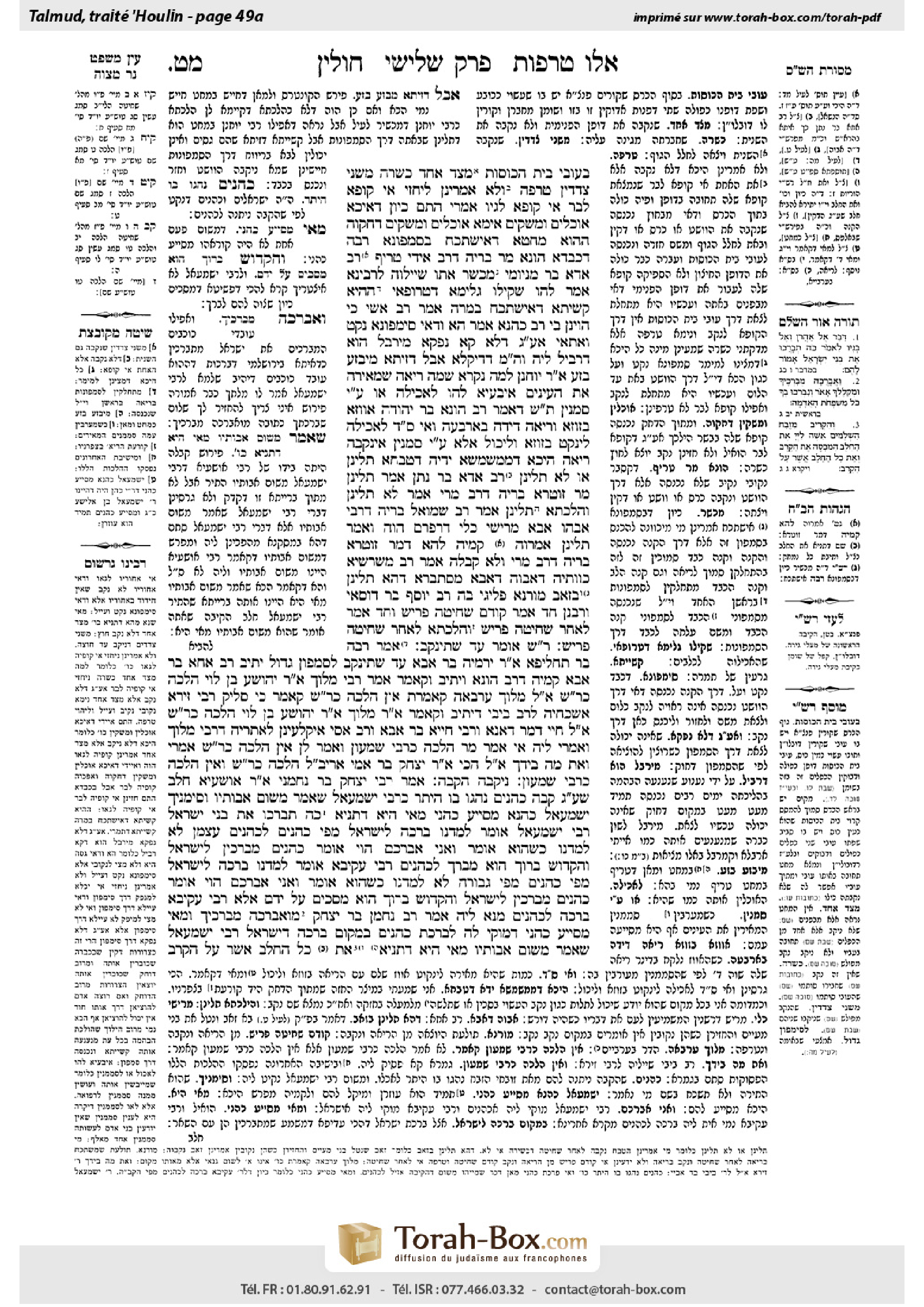
Chullin 49a: Talmud study for Daf Yomi
Study the Talmud for Daf Yomi with scanned pages, Hebrew text, English translations from Sefaria and AI-generated French translations.
Passage selection and English or AI-generated French translation are available where the scan has annotations. Daf Study is independent of Torah-Box and Sefaria.
Browse Chullin · חולין · All tractatesChullin 49a text and translations
This page of Chullin includes the Aramaic text, an English translation and an AI-generated French translation, alongside the scan above.
חולין מ״ט א · Aramaic and Hebrew text
בְּעוֹבִי בֵּית הַכּוֹסוֹת מִצַּד אֶחָד כְּשֵׁרָה, מִשְּׁנֵי צְדָדִין טְרֵפָה, וְלָא אָמְרִינַן לִיחְזֵי אִי קוֹפָא לְבַר אִי קוֹפָא לְגָיו?
אָמְרִי: הָתָם, כֵּיוָן דְּאִיכָּא אֳכָלִים וּמַשְׁקִים – אֵימָא אֳכָלִים וּמַשְׁקִים דַּחְקוּהָ.
הָהוּא מַחְטָא דְּאִישְׁתְּכַח בְּסִמְפּוֹנָא רַבָּה דְּכַבְדָּא, הוּנָא מָר בְּרֵיהּ דְּרַב אִידִי טָרֵיף, רַב אַדָּא בַּר מִנְיוֹמֵי מַכְשַׁר. אֲתוֹ שַׁיְילוּהּ לְרָבִינָא, אֲמַר לְהוּ: שְׁקִילוּ גְּלִימָא דְּטָרוֹפָאֵי.
הָהִיא קְשִׁיתָא דְּאִישְׁתְּכַח בְּמָרָה, אָמַר רַב אָשֵׁי: כִּי הֲוֵינַן בֵּי רַב כָּהֲנָא, אָמַר: הָא וַדַּאי סִימְפּוֹנָא נְקַט וַאֲתַאי, אַף עַל גַּב דְּלָא קָא נָפְקָא, מִירְבָּל הוּא דְּרָבֵיל לַיהּ, וְהָנֵי מִילֵּי דְּדִיקְלָא, אֲבָל דְּזֵיתָא מִיבְזָע בָּזַע.
אָמַר רַבִּי יוֹחָנָן: לָמָּה נִקְרָא שְׁמָהּ רֵיאָה – שֶׁמְּאִירָה אֶת הָעֵינַיִם. אִיבַּעְיָא לְהוּ: לַאֲכִילָה, אוֹ עַל יְדֵי סַמָּנִין?
תָּא שְׁמַע, דְּאָמַר רַב הוּנָא בַּר יְהוּדָה: אֲוָוזָא בְּזוּזָא, וְרֵיאָה דִּידַהּ בְּאַרְבְּעָה. וְאִי סָלְקָא דַעְתָּךְ לַאֲכִילָה – לִינְקֹט בְּזוּזָא וְלֵיכוֹל! אֶלָּא, עַל יְדֵי סַמָּנִין.
אִינַּקְבָה רֵיאָה הֵיכָא דִּמְמַשְׁמְשָׁא יְדֵיהּ דְּטַבָּחָא, תָּלֵינַן אוֹ לָא תָּלֵינַן? רַב אַדָּא בַּר נָתָן אָמַר: תָּלֵינַן, מָר זוּטְרָא בְּרֵיהּ דְּרַב מָרִי אָמַר: לָא תָּלֵינַן, וְהִלְכְתָא: תָּלֵינַן.
אָמַר רַב שְׁמוּאֵל בְּרֵיהּ דְּרַבִּי אֲבָהוּ: אַבָּא מֵרֵישֵׁי כַּלֵּי דְּרַפְרָם הֲוָה, וַאֲמַר: תָּלֵינַן. אַמְרוּהָ קַמֵּיהּ לְהָא דְּמָר זוּטְרָא בְּרֵיהּ דְּרַב מָרִי, וְלָא קַבְּלַהּ.
אָמַר רַב מְשַׁרְשְׁיָא: כְּוָותֵיהּ דַּאֲבוּהּ דְּאַבָּא מִסְתַּבְּרָא, דְּהָא תָּלֵינַן בִּזְאֵב.
מוּרְנָא, פְּלִיגִי בַּהּ רַב יוֹסֵף בַּר דּוֹסַאי וְרַבָּנַן, חַד אָמַר: קוֹדֶם שְׁחִיטָה פָּרֵישׁ, וְחַד אָמַר: לְאַחַר שְׁחִיטָה פָּרֵישׁ, וְהִלְכְתָא: לְאַחַר שְׁחִיטָה פָּרֵישׁ.
רַבִּי שִׁמְעוֹן אוֹמֵר: עַד שֶׁתִּינָּקֵב. אָמַר רַבָּה בַּר תַּחְלִיפָא אָמַר רַב יִרְמְיָה בַּר אַבָּא: עַד שֶׁתִּינָּקֵב לְסִמְפּוֹן גָּדוֹל.
יָתֵיב רַב אַחָא בַּר אַבָּא קַמֵּיהּ דְּרַב הוּנָא, וְיָתֵיב וְקָאָמַר: אָמַר רַבִּי מַלּוּךְ אָמַר רַבִּי יְהוֹשֻׁעַ בֶּן לֵוִי: הֲלָכָה כְּרַבִּי שִׁמְעוֹן. אֲמַר לֵיהּ: מַלּוּךְ עַרְבָאָה קָאָמְרַתְּ? אֵין הֲלָכָה כְּרַבִּי שִׁמְעוֹן קָאָמַר!
כִּי סָלֵיק רַבִּי זֵירָא, אַשְׁכְּחֵיהּ לְרַב בִּיבִי דְּיָתֵיב וְקָאָמַר: אָמַר רַבִּי מַלּוּךְ אָמַר רַבִּי יְהוֹשֻׁעַ בֶּן לֵוִי: הֲלָכָה כְּרַבִּי שִׁמְעוֹן. אֲמַר לֵיהּ: חַיֵּי דְּמָר, דַּאֲנָא וְרַבִּי חִיָּיא בַּר אַבָּא וְרַב אַסִּי אִיקַּלְעִינַן לְאַתְרֵיהּ דְּרַבִּי מַלּוּךְ, וַאֲמַרִי לֵיהּ: אִי אָמַר מָר הֲלָכָה כְּרַבִּי שִׁמְעוֹן? וַאֲמַר לַן: אֵין הֲלָכָה כְּרַבִּי שִׁמְעוֹן אֲמַרִי. וְאַתְּ מָה בִּידָךְ? אֲמַר לֵיהּ: הָכִי אָמַר רַבִּי יִצְחָק בַּר אַמֵּי אָמַר רַבִּי יְהוֹשֻׁעַ בֶּן לֵוִי: הֲלָכָה כְּרַבִּי שִׁמְעוֹן.
וְאֵין הֲלָכָה כְּרַבִּי שִׁמְעוֹן.
נִיקְּבָה הַקֵּבָה. אָמַר רַבִּי יִצְחָק בַּר נַחְמָנִי אָמַר רַבִּי אוֹשַׁעְיָא: חֵלֶב שֶׁעַל גַּבֵּי קֵבָה – כֹּהֲנִים נָהֲגוּ בּוֹ הֶיתֵּר, כְּרַבִּי יִשְׁמָעֵאל שֶׁאָמַר מִשּׁוּם אֲבוֹתָיו. וְסִימָנָיךְ: ״יִשְׁמָעֵאל כָּהֲנָא מְסַיַּיע כָּהֲנֵי״.
מַאי הִיא? דְּתַנְיָא: ״כֹּה תְבָרְכוּ אֶת בְּנֵי יִשְׂרָאֵל״, רַבִּי יִשְׁמָעֵאל אוֹמֵר: לָמַדְנוּ בְּרָכָה לְיִשְׂרָאֵל מִפִּי כֹּהֲנִים, לְכֹהֲנִים עַצְמָן לֹא לָמַדְנוּ. כְּשֶׁהוּא אוֹמֵר: ״וַאֲנִי אֲבָרְכֵם״ – הֱוֵי אוֹמֵר: כֹּהֲנִים מְבָרְכִין לְיִשְׂרָאֵל, וְהַקָּדוֹשׁ בָּרוּךְ הוּא מְבָרֵךְ לַכֹּהֲנִים.
רַבִּי עֲקִיבָא אוֹמֵר: לָמַדְנוּ בְּרָכָה לְיִשְׂרָאֵל מִפִּי כֹהֲנִים, מִפִּי גְבוּרָה לֹא לָמַדְנוּ. כְּשֶׁהוּא אוֹמֵר ״וַאֲנִי אֲבָרְכֵם״ – הֱוֵי אוֹמֵר: כֹּהֲנִים מְבָרְכִין לְיִשְׂרָאֵל, וְהַקָּדוֹשׁ בָּרוּךְ הוּא מַסְכִּים עַל יָדָם.
אֶלָּא רַבִּי עֲקִיבָא, בְּרָכָה לְכֹהֲנִים מְנָא לֵיהּ? אָמַר רַב נַחְמָן בַּר יִצְחָק: מִ״וַּאֲבָרְכָה מְבָרְכֶיךָ״.
וּמַאי מְסַיַּיע כָּהֲנֵי? דְּמוֹקֵי לֵהּ לְבִרְכַּת כֹּהֲנִים בִּמְקוֹם בְּרָכָה דְּיִשְׂרָאֵל.
רַבִּי יִשְׁמָעֵאל שֶׁאָמַר מִשּׁוּם אֲבוֹתָיו, מַאי הִיא? דְּתַנְיָא: ״אֶת כׇּל הַחֵלֶב אֲשֶׁר עַל הַקֶּרֶב
Chullin 49a · English translation
embedded in the thickness of the wall of the reticulum, where the halakha is as follows: If the needle protrudes from one side, i.e., the inner side of the stomach wall, the animal is kosher, but if it protrudes from both sides, it is a tereifa; and if it protrudes only on the inside we do not say: See if the eye of the needle is facing outward or if the eye of the needle is facing inward? Rather, the animal is deemed kosher even if the eye is facing outward, and that is not considered evidence that the needle perforated through the gullet into the chest cavity and then perforated the thickness of the reticulum.
The Sages say in response: There, in the case of the reticulum, since there are food and liquid present, one may say that the food and liquid pushed the eye of the needle through the stomach wall. Therefore, even if the eye points outward, one may still presume that the needle came from the inside, and the animal is kosher.
The Gemara relates that there was a certain needle that was found in the large duct of a liver. Huna Mar, son of Rav Idi, deemed the animal a tereifa, while Rav Adda bar Minyumi deemed it kosher. They came and asked Ravina about the issue, and he said to them: Take the robe of those who deemed it a tereifa. They must pay restitution to the owner of the animal, who was wrongfully forced to discard his kosher meat.
The Gemara relates that there was a certain date pit that was found in a gallbladder. Rav Ashi said: When we were in the house of Rav Kahana as students, he would say with regard to such a case: This date pit certainly took the route of the duct connecting the liver and gallbladder and came through it to the gallbladder, as it is not sharp enough to have perforated the gallbladder from without. Even though it is large enough that it does not exit the gallbladder if one tries to squeeze it into the duct, one may still assume that the movements of the animal’s body gradually cause it to slip through the duct. The Gemara adds: And this statement applies only to the pit of a palm, i.e., of a date, but the pit of an olive is pointed. Therefore, one must be concerned that it has pierced the wall of the gallbladder, rendering the animal a tereifa.
§ The Gemara returns to its discussion of the lung: Rabbi Yoḥanan says: Why is the lung called rei’a in Hebrew? Because it lights up [me’ira] the eyes of one who eats it. A dilemma was raised before the Sages: Is Rabbi Yoḥanan referring to a lung eaten as is, or is he referring to a lung eaten only through its treatment with certain substances?
The Gemara suggests: Come and hear a resolution from that which Rav Huna bar Yehuda says: A goose may be purchased for a dinar, but its lung may be purchased for four dinars. And if it should enter your mind that Rabbi Yoḥanan is referring to eating the lung without treating it, one has no incentive to buy a lung separately for more money. Let him buy the whole goose for a dinar and eat the lung that comes included. Rather, it must be that the lung gains special properties only through treatment with certain substances, and this treatment is the reason for the higher price.
§ The Gemara asks: If the lung is perforated where the hand of the butcher handles it after slaughter, do we attribute the perforation to the butcher’s handling, or do we not attribute the perforation to the handling, in which case the animal is a tereifa? Rav Adda bar Natan says: We attribute it to the butcher’s handling, while Mar Zutra, son of Rav Mari, says: We do not attribute it to the handling. And the halakha is that we attribute it to the handling.
Rav Shmuel, son of Rabbi Abbahu, said: My father was one of the heads of the kalla lectures of Rafram, and he said: We attribute it to the handling. They said this halakha of Mar Zutra, son of Rav Mari, who held the opposite, before Rav Shmuel, and he did not accept it.
Rav Mesharshiyya said: It stands to reason that the halakha is in accordance with the opinion of Grandfather, i.e., Rav Adda bar Natan, as we attribute perforations to a wolf. If slaughtered meat is recovered from a wolf and found to have a perforation that would have rendered the animal a tereifa, one may attribute the perforation to the wolf and presume that it did not exist beforehand.
Furthermore, if a perforation was caused by a worm [murana], Rav Yosef bar Dosai and the Rabbis disagree. One says that the worm emerged from the lung and perforated it before the slaughter, and the animal is a tereifa, and one says that it emerged after the slaughter, and the animal is kosher. And the halakha is that one presumes that it emerged after the slaughter.
§ The mishna states: Rabbi Shimon says: An animal with a perforated lung is not a tereifa until it is perforated through to the bronchi. With regard to this, Rabba bar Taḥlifa says that Rav Yirmeya bar Abba says: Rabbi Shimon meant specifically that it is not a tereifa unless it is perforated through to the large bronchus, from which the smaller bronchi branch out.
The Gemara relates that Rav Aḥa bar Abba sat before Rav Huna, and he was sitting and saying: Rabbi Malokh says that Rabbi Yehoshua ben Levi says: The halakha is in accordance with the opinion of Rabbi Shimon. Rav Huna said to him: Are you saying this in the name of Malokh the Arab? He says that the halakha is not in accordance with Rabbi Shimon.
The Gemara continues: When Rabbi Zeira went up to Eretz Yisrael, he found Rav Beivai, who was sitting and saying: Rabbi Malokh says that Rabbi Yehoshua ben Levi says: The halakha is in accordance with the opinion of Rabbi Shimon. Rabbi Zeira said to him: On the Master’s life, I and Rabbi Ḥiyya bar Abba and Rav Asi visited the place of residence of Rabbi Malokh, and we said to him: Did the Master say that the halakha is in accordance with the opinion of Rabbi Shimon? And he said to us: I said that the halakha is not in accordance with the opinion of Rabbi Shimon. Rav Beivai asked Rabbi Zeira: And you, what more do you have in your possession on this matter? Rabbi Zeira said to him: This is what Rabbi Yitzḥak bar Ami says that Rabbi Yehoshua ben Levi says: The halakha is in accordance with the opinion of Rabbi Shimon.
The Gemara rules: And the halakha is not in accordance with the opinion of Rabbi Shimon. Any perforation of the membranes of the lung renders the animal a tereifa.
§ The mishna states: If the abomasum was perforated, the animal is a tereifa. Concerning this, Rabbi Yitzḥak bar Naḥmani says that Rabbi Oshaya says: With regard to fat that is on the abomasum, the priests accustomed themselves to consider it permitted, and they would eat it along with the rest of the abomasum, which was given to them from non-sacred animals as one of the gifts of the priesthood. This is in accordance with the opinion of Rabbi Yishmael that he says in the name of his forefathers. And since there is a disagreement between the Sages with regard to this issue, your mnemonic to remember the lenient opinion is the idiom: Yishmael the priest generally helps the priests.
The Gemara clarifies: What is this, i.e., where does Rabbi Yishmael help the priests? As it is taught in a baraita: The verse states with regard to the priestly benediction: “So you shall bless the children of Israel” (Numbers 6:23). Rabbi Yishmael says: We learn from this verse about a blessing for Israel from the mouth of the priests, but we have not learned about a blessing for the priests themselves. When it says afterward with regard to the priests: “And they shall put My name upon the children of Israel, and I will bless them” (Numbers 6:27), you must say: The priests bless Israel, and the Holy One, Blessed be He, blesses the priests.
Rabbi Akiva says a different interpretation: We learned from the verse about a blessing for Israel from the mouth of the priests, but we have not learned about a blessing for Israel from the mouth of the Almighty. When it says afterward: “And they shall put My name upon the children of Israel, and I will bless them,” you must say: The priests bless Israel, and the Holy One, Blessed be He, affirms their blessing. The word “them” is referring to Israel.
The Gemara asks: But then from where does Rabbi Akiva learn about a blessing for the priests? Rav Naḥman bar Yitzḥak said: He learns it from God’s promise to Abraham: “And I will bless them that bless you” (Genesis 12:3). All who bless the Jewish people are blessed themselves.
The Gemara asks: And in what sense does only Rabbi Yishmael help the priests, given that Rabbi Akiva concedes that the priests are also blessed? The Gemara responds: He helps the priests in the sense that he establishes the blessing for the priests in the same place, the same verse, that one finds the blessing of Israel, indicating that they receive the same blessing.
It was stated that the priests accustomed themselves to permit the fat on the abomasum, in accordance with the statement of Rabbi Yishmael that he says in the name of his forefathers. The Gemara clarifies: What is this statement? As it is taught in a baraita that when the verse states with regard to forbidden fats mentioned in the Torah: “All the fat that is upon the innards” (Leviticus 3:3),
Chullin 49a · Traduction française (IA)
Implanté dans l'épaisseur de la paroi du réseau, la halakha est la suivante : Si l'aiguille sort d'un côté, c'est-à-dire du côté interne de la paroi stomacale, l'animal est acceptable, mais si elle sort des deux côtés, il s'agit d'un tereifa ; et si elle sort seulement de l'intérieur, nous ne disons pas : Vérifiez si l'œil de l'aiguille est tourné vers l'extérieur ou si l'œil de l'aiguille est tourné vers l'intérieur ? Plutôt, l'animal est considéré comme acceptable même si l'œil est tourné vers l'extérieur, et cela ne constitue pas une preuve que l'aiguille a percé le gosier jusqu'à la cavité thoracique et a ensuite percé l'épaisseur du réseau.
Les Sages disent en réponse : Là, dans le cas du réseau, puisque des aliments et des liquides sont présents, on peut dire que les aliments et les liquides ont poussé l'œil de l'aiguille à travers la paroi stomacale. Par conséquent, même si l'œil est tourné vers l'extérieur, on peut encore supposer que l'aiguille est venue de l'intérieur, et l'animal est acceptable.
Le Guemara rapporte qu'il y avait une certaine aiguille trouvée dans le grand conduit du foie. Huna Mar, fils de Rav Idi, considérait l'animal comme tereifa, tandis que Rav Adda bar Minyumi le considérait comme acceptable. Ils sont allés demander l'avis de Ravina sur cette question, et il leur a dit : Prenez la robe de ceux qui l'ont considéré comme tereifa. Ils doivent indemniser le propriétaire de l'animal, qui a été injustement contraint de jeter son viande acceptable.
Le Guemara rapporte qu'il y avait une certaine noix de dattes trouvée dans la vésicule biliaire. Rav Ashi a dit : Quand nous étions chez Rav Kahana en tant qu'étudiants, il disait à propos de tels cas : Cette noix de dattes a certainement suivi le chemin du conduit reliant le foie à la vésicule biliaire et est passée à travers pour arriver à la vésicule biliaire, car elle n'est pas assez aiguë pour avoir percé la vésicule biliaire depuis l'extérieur. Même si elle est assez grande pour ne pas sortir de la vésicule biliaire si on essaie de la pousser dans le conduit, on peut encore supposer que les mouvements du corps de l'animal provoquent progressivement son glissement à travers le conduit. Le Guemara ajoute : Et cette déclaration s'applique uniquement à la noix d'une date, c'est-à-dire d'une date, mais la noix d'un olivier est pointue. Par conséquent, on doit s'inquiéter qu'elle ait percé la paroi de la vésicule biliaire, rendant l'animal tereifa.
§ Le Guemara reprend sa discussion sur le poumon : Rabbi Yoḥanan dit : Pourquoi le poumon est-il appelé rei’a en hébreu ? Parce qu'il éclaire [me’ira] les yeux de celui qui le mange. Un dilemme a été soulevé devant les Sages : Rabbi Yoḥanan fait-il référence à un poumon mangé tel quel, ou fait-il référence à un poumon mangé uniquement après son traitement avec certains substances ?
Le Guemara suggère : Venez écouter une résolution à partir de ce que Rav Huna bar Yehuda dit : Un canard peut être acheté pour un dinar, mais son poumon peut être acheté pour quatre dinars. Et si cela vous vient à l'esprit que Rabbi Yoḥanan fait référence à un poumon mangé sans traitement, on n'a pas d'incitation à acheter un poumon séparément à un prix plus élevé. Laissez-le acheter le canard entier pour un dinar et manger le poumon qui est inclus. Plutôt, il doit être que le poumon gagne des propriétés spéciales uniquement grâce à son traitement avec certaines substances, et ce traitement est la raison du prix plus élevé.
§ Le Guemara pose la question : Si le poumon est percé là où la main du boucher le manipule après l'abattage, attribuons-nous cette perforation à la manipulation du boucher, ou ne l'attribuons-nous pas, dans ce cas l'animal est tereifa ? Rav Adda bar Natan dit : Nous attribuons cela à la manipulation du boucher, tandis que Mar Zutra, fils de Rav Mari, dit : Nous ne l'attribuons pas à la manipulation. Et la halakha est que nous l'attribuons à la manipulation.
Rav Shmuel, fils de Rabbi Abbahu, a dit : Mon père était l'un des chefs des cours de kalla de Rafram, et il a dit : Nous l'attribuons à la manipulation. Ils ont dit cette halakha de Mar Zutra, fils de Rav Mari, qui avait l'opinion contraire, devant Rav Shmuel, et il ne l'a pas acceptée.
Rav Mesharshiyya a dit : Il est logique que la halakha soit selon l'opinion de Grand-père, c'est-à-dire Rav Adda bar Natan, car nous attribuons les perforations à un loup. Si de la viande abattue provenant d'un loup est retrouvée et qu'elle présente une perforation qui aurait rendu l'animal tereifa, on peut attribuer cette perforation au loup et supposer qu'elle n'existait pas auparavant.
De plus, si une perforation a été causée par un vers [murana], Rav Yosef bar Dosai et les Rabbins sont en désaccord. L'un dit que le vers est sorti du poumon et a perforé celui-ci avant l'abattage, et l'animal est tereifa, et l'autre dit qu'il est sorti après l'abattage, et l'animal est acceptable. Et la halakha est que l'on suppose qu'il est sorti après l'abattage.
§ La mishna stipule : Rabbi Shimon dit : Un animal avec un poumon perforé n'est pas tereifa jusqu'à ce qu'il soit perforé jusqu'aux bronches. À ce sujet, Rabba bar Taḥlifa dit que Rav Yirmeya bar Abba dit : Rabbi Shimon voulait dire spécifiquement qu'il n'est pas tereifa à moins qu'il ne soit perforé jusqu'au grand bronchus, duquel partent les petits bronches.
Le Guemara rapporte que Rav Aḥa bar Abba était assis devant Rav Huna, et il était assis en disant : Rabbi Malokh dit que Rabbi Yehoshua ben Levi dit : La halakha suit l'opinion de Rabbi Shimon. Rav Huna a dit à lui : Est-ce que vous dites cela au nom de Malokh l'Arabe ? Il dit que la halakha ne suit pas l'opinion de Rabbi Shimon.
La Guemara continue : Quand Rabbi Zéira est monté en Terre d'Israël, il a trouvé Rav Béivai, qui était assis et disait : Rabbi Malokh dit que Rabbi Yéhoshua ben Levi dit : la halakha suit l'opinion de Rabbi Shimon. Rabbi Zéira a dit à lui : Sur la vie du Maître, moi et Rabbi Chiyah bar Abba et Rav Asi avons visité la résidence de Rabbi Malokh, et nous avons dit à lui : Le Maître a-t-il dit que la halakha suit l'opinion de Rabbi Shimon ? Et il a dit à nous : J'ai dit que la halakha ne suit pas l'opinion de Rabbi Shimon. Rav Béivai a demandé à Rabbi Zéira : Et toi, qu'as-tu de plus à ce sujet ? Rabbi Zéira a dit à lui : C'est ce que Rabbi Yitzhak bar Ami dit que Rabbi Yéhoshua ben Levi dit : la halakha suit l'opinion de Rabbi Shimon.
La Guemara déclare : Et la halakha ne suit pas l'opinion de Rabbi Shimon. Tout percement des membranes du poumon rend l'animal téréif.
§ La mitsna dit : Si l'abomasum était percé, l'animal est téréif. À ce sujet, Rabbi Yitzhak bar Naḥmani dit que Rabbi Oshaya dit : Concernant la graisse qui est sur l'abomasum, les prêtres s'habituaient à considérer cela comme permis, et ils le mangeaient avec le reste de l'abomasum, qui leur était donné par des animaux non sacrés comme l'une des offrandes du sacerdoce. Cela correspond à l'opinion de Rabbi Yishmael qui le dit en nom de ses aïeuls. Et puisqu'il y a un désaccord entre les Sages concernant cette question, votre mnémonique pour se souvenir de l'opinion clémente est l'expression : Yishmael le prêtre aide généralement les prêtres.
La Guemara clarifie : Qu'est-ce que cela, c'est-à-dire où Rabbi Yishmael aide-t-il les prêtres ? Comme il est enseigné dans une baraïta : La parole dit concernant la bénédiction des prêtres : « Ainsi vous bénirez les enfants d'Israël » (Nombres 6:23). Rabbi Yishmael dit : Nous apprenons de cette parole une bénédiction pour Israël à la bouche des prêtres, mais nous n'avons pas appris une bénédiction pour les prêtres eux-mêmes. Lorsqu'il dit ensuite concernant les prêtres : « Et ils placeront mon nom sur les enfants d'Israël, et je bénirai ceux-ci » (Nombres 6:27), vous devez dire : Les prêtres bénissent Israël, et le Saint, le Bienheureux, bénit les prêtres.
Rabbi Akiva dit une autre interprétation : Nous apprenons de la parole une bénédiction pour Israël à la bouche des prêtres, mais nous n'avons pas appris une bénédiction pour Israël à la bouche de l'Éternel. Lorsqu'il dit ensuite : « Et ils placeront mon nom sur les enfants d'Israël, et je bénirai ceux-ci », vous devez dire : Les prêtres bénissent Israël, et l'Éternel, le Bienheureux, approuve leur bénédiction. Le mot « ceux-ci » fait référence à Israël.
La Guemara demande : Mais alors d'où Rabbi Akiva apprend-il une bénédiction pour les prêtres ? Rav Naḥman bar Yitzḥak a dit : Il l'apprend de la promesse de Dieu à Abraham : « Et je bénirai ceux qui vous bénissent » (Genèse 12:3). Tous ceux qui bénissent le peuple juif sont eux-mêmes bénis.
La Guemara demande : Et dans quel sens Yishmael aide-t-il seulement les prêtres, étant donné que Rabbi Akiva reconnaît que les prêtres sont aussi bénis ? La Guemara répond : Il aide les prêtres dans le sens où il établit la bénédiction pour les prêtres dans la même place, la même parole, où l'on trouve la bénédiction d'Israël, indiquant qu'ils reçoivent la même bénédiction.
Il a été dit que les prêtres s'habituaient à permettre la graisse sur l'abomasum, conformément à l'affirmation de Rabbi Yishmael qui le dit en nom de ses aïeuls. La Guemara clarifie : Quelle est cette affirmation ? Comme il est enseigné dans une baraïta que lorsque la Torah mentionne les graisses interdites et dit : « Toute la graisse qui est sur les viscères » (Lévitique 3:3),
Traduction française générée par IA à partir de l’édition anglaise de Sefaria. Vérifie toujours un passage avec le texte source.
Text from Sefaria: William Davidson Edition - Vocalized Aramaic (unknown); William Davidson Edition - English (CC BY NC).