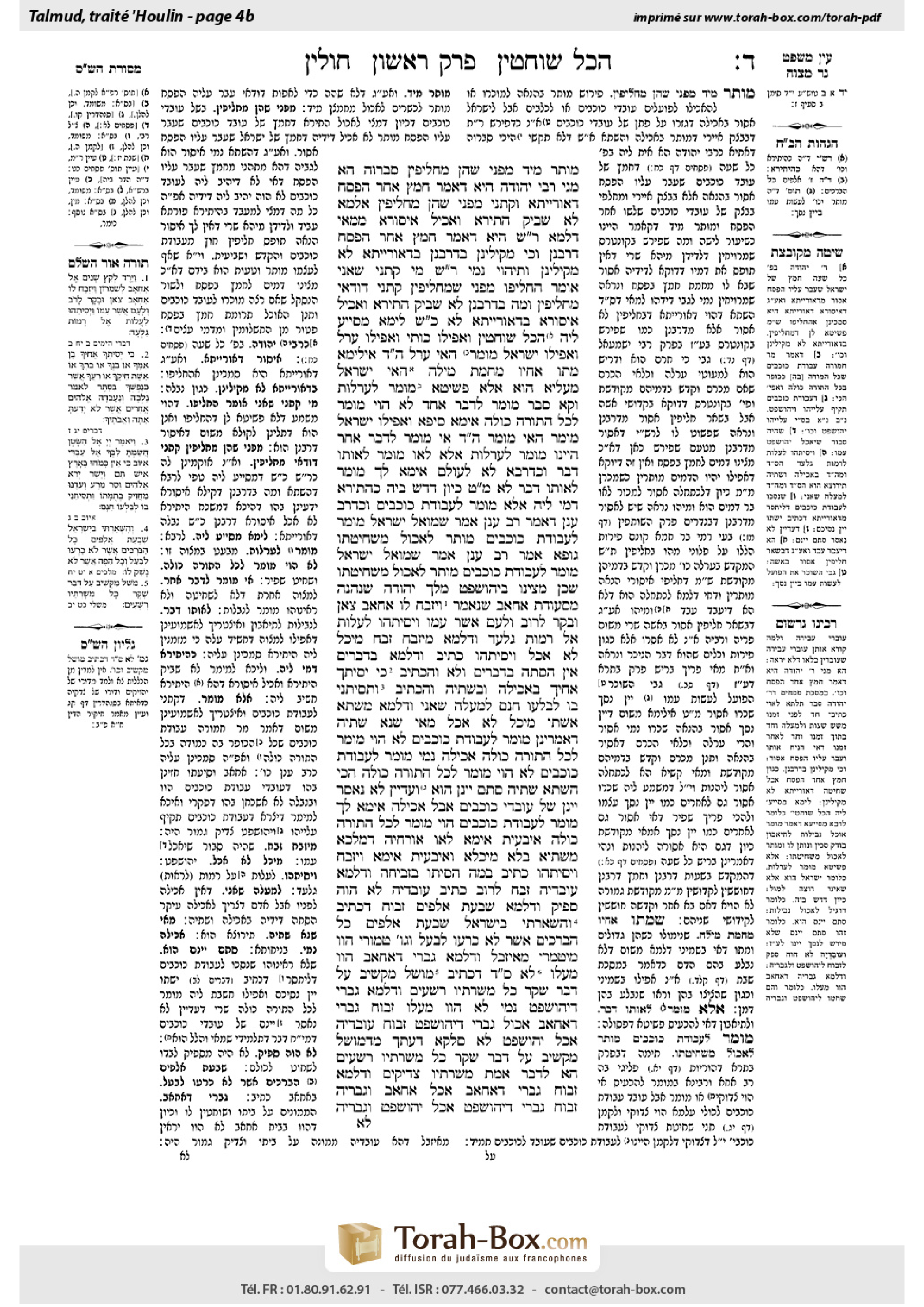
Chullin 4b: Talmud study for Daf Yomi
Study the Talmud for Daf Yomi with scanned pages, Hebrew text, English translations from Sefaria and AI-generated French translations.
Passage selection and English or AI-generated French translation are available where the scan has annotations. Daf Study is independent of Torah-Box and Sefaria.
Browse Chullin · חולין · All tractatesChullin 4b text and translations
This page of Chullin includes the Aramaic text, an English translation and an AI-generated French translation, alongside the scan above.
חולין ד׳ ב · Aramaic and Hebrew text
מוּתָּר מִיָּד, מִפְּנֵי שֶׁהֵן מַחְלִיפִין.
סַבְרוּהָ, הָא מַנִּי? רַבִּי יְהוּדָה הִיא, דְּאָמַר: חָמֵץ אַחַר הַפֶּסַח דְּאוֹרָיְיתָא, וְקָתָנֵי: מִפְּנֵי שֶׁהֵן מַחְלִיפִין, אַלְמָא לָא שָׁבֵיק הֶתֵּירָא וְאָכֵיל אִיסּוּרָא.
מִמַּאי? דִּלְמָא רַבִּי שִׁמְעוֹן הִיא, דְּאָמַר: חָמֵץ אַחַר הַפֶּסַח דְּרַבָּנַן, וְכִי מְקִילִּינַן – בִּדְרַבָּנַן, בִּדְאוֹרָיְיתָא – לָא מְקִילִּינַן!
וְתִיהְוֵי נָמֵי רַבִּי שִׁמְעוֹן, מִי קָתָנֵי ״שֶׁאֲנִי אוֹמֵר הֶחְלִיפוּ״? מִפְּנֵי שֶׁמַּחְלִיפִין קָתָנֵי, דְּוַדַּאי מַחְלִיפִין. וּמָה בִּדְרַבָּנַן לָא שָׁבֵיק הֶתֵּירָא וְאָכֵיל אִיסּוּרָא, בִּדְאוֹרָיְיתָא לֹא כׇּל שֶׁכֵּן?
לֵימָא מְסַיַּיע לֵיהּ, הַכֹּל שׁוֹחֲטִין, וַאֲפִילּוּ כּוּתִי, וַאֲפִילּוּ עָרֵל, וַאֲפִילּוּ יִשְׂרָאֵל מְשׁוּמָּד. הַאי עָרֵל הֵיכִי דָמֵי? אִילֵּימָא מֵתוּ אֶחָיו מֵחֲמַת מִילָּה – הַאי יִשְׂרָאֵל מְעַלְּיָא הוּא! אֶלָּא פְּשִׁיטָא מְשׁוּמָּד לַעֲרֵלוּת, וְקָא סָבַר מְשׁוּמָּד לְדָבָר אֶחָד לָא הָוֵי מְשׁוּמָּד לְכׇל הַתּוֹרָה כּוּלָּהּ.
אֵימָא סֵיפָא, וַאֲפִילּוּ יִשְׂרָאֵל מְשׁוּמָּד. הַאי מְשׁוּמָּד הֵיכִי דָמֵי? אִי מְשׁוּמָּד לְדָבָר אַחֵר – הַיְינוּ מְשׁוּמָּד לַעֲרֵלוּת, אֶלָּא לָאו מְשׁוּמָּד לְאוֹתוֹ דָּבָר, וְכִדְרָבָא.
לָא, לְעוֹלָם אֵימָא לָךְ: מְשׁוּמָּד לְאוֹתוֹ דָּבָר לָא, מַאי טַעְמָא? כֵּיוָן דְּדָשׁ בֵּיהּ – כְּהֶתֵּירָא דָּמֵי לֵיהּ. אֶלָּא מְשׁוּמָּד לַעֲבוֹדָה זָרָה, וְכִדְרַב עָנָן, דְּאָמַר רַב עָנָן אָמַר שְׁמוּאֵל: יִשְׂרָאֵל מְשׁוּמָּד לַעֲבוֹדָה זָרָה מוּתָּר לֶאֱכוֹל מִשְּׁחִיטָתוֹ.
גּוּפָא, אָמַר רַב עָנָן אָמַר שְׁמוּאֵל: יִשְׂרָאֵל מְשׁוּמָּד לַעֲבוֹדָה זָרָה מוּתָּר לֶאֱכוֹל מִשְּׁחִיטָתוֹ, שֶׁכֵּן מָצִינוּ בִּיהוֹשָׁפָט מֶלֶךְ יְהוּדָה שֶׁנֶּהֱנָה מִסְּעוּדַת אַחְאָב, שֶׁנֶּאֱמַר: ״וַיִּזְבַּח לוֹ אַחְאָב צֹאן וּבָקָר לָרֹב וְלָעָם אֲשֶׁר עִמּוֹ וַיְסִיתֵהוּ לַעֲלוֹת אֶל רָמֹת גִּלְעָד״.
וְדִלְמָא מִיזְבָּח זְבַח, מֵיכַל לָא אֲכַל! ״וַיְסִיתֵהוּ״ כְּתִיב, וְדִלְמָא בִּדְבָרִים, אֵין הֲסָתָה בִּדְבָרִים.
וְלָא? וְהָכְתִיב: ״כִּי יְסִיתְךָ אָחִיךָ״! בַּאֲכִילָה וּבִשְׁתִיָּה, וְהָכְתִיב: ״וַתְּסִיתֵנִי בוֹ לְבַלְּעוֹ חִנָּם״! לְמַעְלָה שָׁאנֵי.
וְדִלְמָא מִשְׁתָּא אִשְׁתִּי, מֵיכַל לָא אֲכַל? מַאי שְׁנָא שְׁתִיָּה – דְּאָמְרִינַן: מְשׁוּמָּד לַעֲבוֹדָה זָרָה לָא הָוֵי מְשׁוּמָּד לְכׇל הַתּוֹרָה כּוּלָּהּ, אֲכִילָה נָמֵי – מְשׁוּמָּד לַעֲבוֹדָה זָרָה לָא הָוֵי מְשׁוּמָּד לְכׇל הַתּוֹרָה כּוּלָּהּ.
הָכִי הַשְׁתָּא? שְׁתִיָּה – סְתָם יֵינָן הוּא, וַעֲדַיִין לֹא נֶאֱסַר יֵינָן שֶׁל גּוֹיִם, אֲבָל אֲכִילָה – אֵימָא לָךְ: מְשׁוּמָּד לַעֲבוֹדָה זָרָה הֲוֵי מְשׁוּמָּד לְכׇל הַתּוֹרָה כּוּלָּהּ.
אִיבָּעֵית אֵימָא: לָאו אוֹרְחֵיהּ דְּמַלְכָּא מִשְׁתְּיָא בְּלָא מֵיכְלָא, וְאִיבָּעֵית אֵימָא: ״וַיִּזְבַּח … וַיְסִיתֵהוּ״ כְּתִיב, בַּמָּה הֱסִיתוֹ – בִּזְבִיחָה.
וְדִלְמָא עוֹבַדְיָה זְבַח? ״לָרוֹב״ כְּתִיב, עוֹבַדְיָה לָא הֲוָה סָפֵיק.
וְדִלְמָא שִׁבְעַת אֲלָפִים זְבוּח, דִּכְתִיב: ״וְהִשְׁאַרְתִּי בְיִשְׂרָאֵל שִׁבְעַת אֲלָפִים כׇּל הַבִּרְכַּיִם אֲשֶׁר לֹא כָרְעוּ לַבַּעַל וְגוֹ׳״, טַמּוֹרֵי הֲווֹ מִיטַּמְּרִי מֵאִיזֶבֶל.
וְדִלְמָא גַּבְרֵי דְאַחְאָב הֲווֹ מְעַלּוּ? לָא סָלְקָא דַּעְתָּךְ, דִּכְתִיב: ״מֹשֵׁל מַקְשִׁיב עַל דְּבַר שָׁקֶר כׇּל מְשָׁרְתָיו רְשָׁעִים״.
וְדִלְמָא גַּבְרֵי דִּיהוֹשָׁפָט נָמֵי לָא הֲווֹ מְעַלּוּ, זְבוּח גַּבְרֵי דְּאַחְאָב אֲכוּל גַּבְרֵי דִּיהוֹשָׁפָט, זְבוּח עוֹבַדְיָה אֲכַל יְהוֹשָׁפָט.
לָא סָלְקָא דַּעְתָּךְ, מִדְּ״מוֹשֵׁל מַקְשִׁיב עַל דְּבַר שָׁקֶר כׇּל מְשָׁרְתָיו רְשָׁעִים״, הָא לִדְבַר אֱמֶת – מְשָׁרְתָיו צַדִּיקִים.
וְדִלְמָא זְבוּח גַּבְרֵי דְּאַחְאָב אֲכַל אַחְאָב וְגַבְרֵיהּ, זְבוּח גַּבְרֵי דִּיהוֹשָׁפָט אֲכַל יְהוֹשָׁפָט וְגַבְרֵיהּ?
Chullin 4b · English translation
it is permitted immediately, due to the fact that they exchange the forbidden leavened bread in their possession with permitted leavened bread belonging to gentiles immediately after Passover.
The Sages who cited this proof assumed that this baraita is in accordance with whose opinion? They assumed it is in accordance with the opinion of Rabbi Yehuda, who says: Leavened bread that was not eradicated before Passover is forbidden after Passover by Torah law. The Gemara comments: And nevertheless it is taught that it is permitted due to the fact that the transgressors exchange their leavened bread with that of gentiles. Apparently, even one who performs transgressions does not intentionally forsake the permitted and eat forbidden food, where the permitted food is easily accessible.
The Gemara asks: From where in the baraita can this be proven? Perhaps the baraita is in accordance with the opinion of Rabbi Shimon, who says: Leavened bread that was not eradicated before Passover is prohibited after Passover by rabbinic law. And accordingly, when we are lenient it is with regard to prohibitions by rabbinic law, whereas with regard to prohibitions by Torah law, e.g., the prohibition of an unslaughtered carcass, we are not lenient.
The Gemara answers: And let the baraita be even in accordance with the opinion of Rabbi Shimon. Does the tanna teach: As I say that they exchanged their leavened bread for the leavened bread of a gentile, which would indicate that it is an assumption? He teaches: Due to the fact that they exchange, as a statement of fact, as they certainly exchange. And if in cases involving prohibitions by rabbinic law the transgressor does not intentionally forsake the permitted and eat forbidden food, then in prohibitions by Torah law is it not all the more so reasonable that he would not forsake the permitted in favor of the forbidden?
Let us say that the following baraita supports the opinion of Rava: Everyone slaughters, and even a Samaritan, and even an uncircumcised man, and even a Jewish transgressor. The Gemara asks: This uncircumcised man, what are the circumstances? If we say that he is an uncircumcised man whose brothers died due to circumcision and the concern is that he might suffer a similar fate, clearly he may slaughter, as he is a full-fledged Jew and not a transgressor at all. Rather, it is obvious that he is a transgressor with regard to remaining uncircumcised, as he refuses to be circumcised, and the tanna holds that he may nevertheless slaughter an animal since a transgressor concerning one matter is not a transgressor concerning the entire Torah.
Say the latter clause of the baraita: And even a Jewish transgressor. This transgressor, what are the circumstances? If he is a transgressor concerning another matter besides eating unslaughtered animal carcasses, that is identical to the case of a transgressor with regard to remaining uncircumcised. Rather, is it not that he is a transgressor concerning the same matter of eating unslaughtered carcasses, and the baraita is in accordance with the opinion of Rava, who said that one may even rely on the slaughter of a Jewish transgressor whose transgression is that he eats unslaughtered animal carcasses to satisfy his appetite, ab initio?
The Gemara rejects that proof: No, actually I will say to you: The slaughter of a transgressor concerning the same matter is not valid. What is the reason? It is that since he has become accustomed to performance of that transgression, it is like a permitted act for him, and the concern is that he is not at all careful to slaughter the animal properly. Rather, the transgressor mentioned in the baraita is a transgressor with regard to idol worship, and it is in accordance with the opinion of Rav Anan, as Rav Anan says that Shmuel says: With regard to a Jew who is a transgressor with regard to idol worship, it is permitted to eat from what he slaughters.
§ The Gemara analyzes the matter itself: Rav Anan says that Shmuel says: With regard to a Jew who is a transgressor with regard to idol worship, it is permitted to eat from what he slaughters, as we found with regard to Jehoshaphat, king of Judea, who partook of the feast prepared by Ahab, king of Israel, who was a transgressor with regard to idol worship, as it is stated: “And Ahab slaughtered sheep and cattle for him in abundance, and for the people that were with him, and incited him to go up with him to Ramoth Gilead” (II Chronicles 18:2).
The Gemara raises an objection: And perhaps Ahab slaughtered the animals, but Jehoshaphat did not eat the meat of those animals. The Gemara explains: It is written: “And incited him,” indicating that there was an element of persuasion that presumably involved food. The Gemara challenges this explanation: And perhaps Ahab incited him with his words. The Gemara answers: There is no incitement with words.
The Gemara asks: And is there not incitement with words? But isn’t it written: “If your brother…entices you secretly, saying: Let us go and serve other gods” (Deuteronomy 13:7)? The Gemara answers: There too the incitement is with eating and with drinking. The Gemara asks: But isn’t it written that God said to Satan, who denounced Job: “And you incited Me against him, to destroy him gratuitously” (Job 2:3)? Clearly Satan did not incite God with food and drink. The Gemara answers: Incitement against the One on High is different, as the term is used metaphorically. By contrast, incitement with regard to people involves food and drink.
The Gemara challenges: And perhaps Jehoshaphat drank at the feast but did not eat. The Gemara responds: What is different about drinking wine with Ahab that it would be permitted? It would be permitted because we say: A transgressor with regard to idol worship is not considered a transgressor with regard to the entire Torah and therefore his wine is not forbidden. With regard to eating a transgressor’s food too, a transgressor with regard to idol worship is not considered a transgressor with regard to the entire Torah. Therefore, the meat of an animal that he slaughters is not forbidden.
The Gemara asks: How can these cases be compared? With regard to drinking, Ahab’s wine is considered ordinary wine of gentiles, and the ordinary wine of gentiles was not yet prohibited, as the Sages issued that decree only several generations later. Therefore, it was permitted for Jehoshaphat to drink Ahab’s wine. But with regard to eating, I will say to you: A transgressor with regard to idol worship is considered a transgressor with regard to the entire Torah. Therefore, it was prohibited for Jehoshaphat to eat the meat from the animals slaughtered by Ahab.
The Gemara answers: If you wish, say: It is clear that Jehoshaphat ate at the feast, as it is not typical conduct of a king to drink wine without eating. And if you wish, say instead: “And Ahab slaughtered sheep and cattle for him in abundance, and for the people that were with him, and incited him,” is written, indicating: With what did Ahab incite Jehoshaphat? It was with slaughter of an animal. Apparently, it is permitted to eat from an animal slaughtered by a transgressor with regard to idol worship.
The Gemara suggests: And perhaps Obadiah, who was the majordomo of Ahab’s household and a righteous man, slaughtered the animals. The Gemara rejects that suggestion: “In abundance” is written, and Obadiah would not have managed to slaughter all the animals himself.
The Gemara suggests: And perhaps the seven thousand righteous people slaughtered the animals, as it is written: “And I will leave seven thousand in Israel, all the knees that have not bowed to Baal, and every mouth that has not kissed it” (I Kings 19:18). The Gemara rejects that suggestion: They were hiding from Jezebel, Ahab’s wife, and would not have gone to the palace to slaughter animals for the feast.
The Gemara suggests: And perhaps, although Ahab was an idolater, the men in the employ of Ahab were upstanding people, not idolaters, and they slaughtered the animals. The Gemara rejects that suggestion: That possibility should not enter your mind, as it is written: “If a ruler hearkens to matters of falsehood, all his servants are wicked” (Proverbs 29:12).
The Gemara suggests: And perhaps the men in the employ of Jehoshaphat were also not upstanding, and the animals that the men in the employ of Ahab slaughtered, the men in the employ of Jehoshaphat ate, and the animals that Obadiah slaughtered, Jehoshaphat ate.
The Gemara rejects that suggestion: That possibility should not enter your mind; from the fact that it is written: “If a ruler hearkens to matters of falsehood, all his servants are wicked,” it may be inferred that if a ruler hearkens to matters of truth, all his servants are righteous.
The Gemara suggests: And perhaps the animals that the men in the employ of Ahab slaughtered, Ahab and his men ate, and the animals that the men in the employ of Jehoshaphat slaughtered, Jehoshaphat and his men ate.
Chullin 4b · Traduction française (IA)
il est permis immédiatement, en raison du fait qu'ils échangent le pain aisé interdit qui leur appartient avec du pain aisé permis appartenant aux non-Juifs immédiatement après la Pessah.
Les Sages qui ont cité cette preuve ont supposé que ce baraïta est conforme à l'opinion de qui ? Ils ont supposé qu'il est conforme à l'opinion de Rabbi Yéhuda, qui dit : Le pain aisé qui n'a pas été éradiqué avant la Pessah est interdit après la Pessah selon la Loi divine. La Guemara commente : Et pourtant, il est enseigné qu'il est permis en raison du fait qu'ils échangent leur pain aisé avec celui des non-Juifs. Apparemment, même celui qui commet des transgressions ne renonce pas volontairement au permis pour manger de l'interdit, où le permis est facilement accessible.
La Guemara pose la question : D'où dans le baraïta peut-on prouver cela ? Peut-être que le baraïta est conforme à l'opinion de Rabbi Shimon, qui dit : Le pain aisé qui n'a pas été éradiqué avant la Pessah est interdit après la Pessah selon la loi rabbinique. Et ainsi, lorsque nous sommes leniants, c'est concernant les interdits rabbiniques, tandis que concernant les interdits selon la Loi divine, par exemple l'interdiction du cadavre non sacrifié, nous ne sommes pas lenients.
La Guemara répond : Et que le baraïta soit même conforme à l'opinion de Rabbi Shimon. Le tanna enseigne-t-il : Comme je dis qu'ils ont échangé leur pain aisé avec celui des non-Juifs, ce qui indiquerait une hypothèse ? Il enseigne : En raison du fait qu'ils échangent, comme une affirmation de fait, car ils échangent certainement. Et si dans les cas d'interdits rabbiniques le transgresseur ne renonce pas volontairement au permis pour manger de l'interdit, alors dans les interdits selon la Loi divine, n'est-il pas encore plus raisonnable qu'il ne renonce pas au permis en faveur de l'interdit ?
Disons que le baraïta suivant soutient l'opinion de Rava : Tout le monde sacrifie, même un Samaritain, même un homme non circoncis, même un transgresseur juif. La Guemara pose la question : Ce dernier, quels sont les circonstances ? Si nous disons qu'il est un homme non circoncis dont les frères sont morts à cause de la circoncision et la crainte est qu'il puisse subir un sort similaire, clairement il peut sacrifier, car il est un Juif complet et non un transgresseur du tout. Plutôt, il est évident qu'il est un transgresseur concernant la non-circoncision, car il refuse de se faire circoncire, et le tanna considère qu'il peut toutefois sacrifier un animal, car un transgresseur concernant une seule chose n'est pas un transgresseur concernant toute la Torah.
Disons la dernière partie du baraïta : Et même un transgresseur juif. Ce transgresseur, quels sont les circonstances ? Si c'est un transgresseur concernant une autre chose que la consommation de cadavres non sacrifiés, c'est identique au cas du transgresseur concernant la non-circoncision. Plutôt, n'est-ce pas qu'il est un transgresseur concernant la même chose, la consommation de cadavres non sacrifiés, et le baraïta est conforme à l'opinion de Rava, qui dit qu'on peut même compter sur le sacrifice d'un transgresseur juif dont la transgression est qu'il mange des cadavres non sacrifiés pour satisfaire son appétit, dès le début.
La Guemara rejette cette preuve : Non, en réalité je vais te dire : Le sacrifice d'un transgresseur concernant la même chose n'est pas valide. Quelle est la raison ? C'est parce qu'il s'est habitué à la transgression, ce qui est comme une action permise pour lui, et la crainte est qu'il ne soit pas du tout soigneux dans la manière de sacrifier l'animal. Plutôt, le transgresseur mentionné dans le baraïta est un transgresseur concernant l'idolâtrie, et il est conforme à l'opinion de Rav Anan, car Rav Anan dit que Shmuel dit : Concernant un Juif qui est un transgresseur concernant l'idolâtrie, il est permis de manger de ce qu'il sacrifie.
§ La Guemara analyse la question elle-même : Rav Anan dit que Shmuel dit : Concernant un Juif qui est un transgresseur concernant l'idolâtrie, il est permis de manger de ce qu'il sacrifie, comme nous l'avons trouvé concernant Jéhoshaphat, roi de Juda, qui a participé au festin préparé par Ahab, roi d'Israël, qui était un transgresseur concernant l'idolâtrie, comme il est dit : « Et Ahab sacrifia des brebis et des bœufs en abondance, et pour le peuple qui était avec lui, et il incita lui à monter avec lui à Ramoth-Gilead » (II Chroniques 18:2).
La Guemara soulève une objection : Et peut-être Ahab a sacrifié les animaux, mais Jéhoshaphat n'a pas mangé la viande de ces animaux. La Guemara explique : Il est écrit : « Et il l'incita », indiquant qu'il y avait un élément de persuasion qui impliquait probablement de la nourriture. La Guemara conteste cette explication : Et peut-être Ahab l'incita avec ses paroles. La Guemara répond : Il n'y a pas d'incitation avec des paroles.
La Guemara pose la question : Et n'y a-t-il pas une incitation avec des paroles ? Mais n'est-il pas écrit : « Si ton frère… t'entraîne secrètement, disant : Allons servir d'autres dieux » (Deutéronome 13:7) ? La Guemara répond : Là aussi, l'incitation est avec la nourriture et le boire. La Guemara pose la question : Mais n'est-il pas écrit que Dieu dit à Satan, qui a dénoncé Job : « Et tu as incité Moi contre lui, pour le détruire gratuitement » (Job 2:3) ? Évidemment, Satan n'a pas incité Dieu avec la nourriture et le boire. La Guemara répond : L'incitation contre l'Éternel est différente, car le terme est utilisé métaphoriquement. En revanche, l'incitation concernant les gens implique la nourriture et le boire.
La Guemara conteste : Et peut-être Jéhoshaphat a bu à la fête mais n'a pas mangé. La Guemara répond : Qu'est-ce qui est différent dans le vin avec Ahab qui le rendrait permis ? Il serait permis parce que nous disons : Un transgresseur concernant l'idolâtrie n'est pas considéré comme un transgresseur concernant toute la Torah et donc son vin n'est pas interdit. Concernant la consommation de la nourriture d'un transgresseur, un transgresseur concernant l'idolâtrie n'est pas considéré comme un transgresseur concernant toute la Torah. Par conséquent, la viande d'un animal qu'il sacrifie n'est pas interdite.
La Guemara pose la question : Comment peuvent ces cas être comparés ? En ce qui concerne la boisson, le vin d'Achab est considéré comme du vin ordinaire des Gentils, et le vin ordinaire des Gentils n'était pas encore interdit, car les Sages ont émis cette déclaration seulement plusieurs générations plus tard. Par conséquent, il était permis à Jéshophat de boire le vin d'Achab. En ce qui concerne la nourriture, je dirai ceci : celui qui transgresse en matière d'idolâtrie est considéré comme celui qui transgresse l'ensemble de la Torah. Par conséquent, il était interdit à Jéshophat de manger la viande des animaux sacrifiés par Achab.
La Guemara répond : Si vous le souhaitez, dites : Il est clair que Jéshophat a mangé lors de la fête, car il n'est pas typique du comportement d'un roi de boire du vin sans manger. Et si vous le souhaitez, dites plutôt : « Et Achab sacrifia des brebis et des bœufs en abondance, et pour les gens qui étaient avec lui, et il incita lui », est écrit, indiquant : Avec quoi Achab a-t-il incité Jéshophat ? C'était avec le sacrifice d'un animal. Apparemment, il est permis de manger d'un animal sacrifié par un transgresseur en matière d'idolâtrie.
La Guemara suggère : Et peut-être Obadiah, qui était le majordomo de la maison d'Achab et un homme juste, a sacrifié les animaux. La Guemara rejette cette suggestion : « En abondance » est écrit, et Obadiah n'aurait pas été capable de sacrifier tous les animaux lui-même.
La Guemara suggère : Et peut-être les sept mille justes ont tué les animaux, car il est écrit : « Et je laisserai sept mille en Israël, tous les genoux qui n'ont pas révéré Baal, et toute bouche qui n'a pas baisé cela » (I Rois 19:18). La Guemara rejette cette suggestion : Ils se cachaient de Jézabel, la femme d'Achab, et n'auraient pas été allés au palais pour tuer des animaux pour la fête.
La Guemara suggère : Et peut-être, bien que Achab fût un idolâtre, les hommes employés par Achab étaient des gens droits, pas des idolâtres, et ils ont tué les animaux. La Guemara rejette cette suggestion : Cette possibilité ne doit pas entrer en votre esprit, car il est écrit : « Si un roi écoute des choses de mensonge, tous ses serviteurs sont mauvais » (Proverbes 29:12).
La Guemara suggère : Et peut-être les hommes employés par Jéshophat étaient aussi des gens droits, et les animaux que les hommes employés par Achab tuaient, les hommes employés par Jéshophat mangeaient, et les animaux que Obadiah tuait, Jéshophat mangeait.
La Guemara rejette cette suggestion : Cette possibilité ne doit pas entrer en votre esprit ; puisque cela est écrit : « Si un roi écoute des choses de mensonge, tous ses serviteurs sont mauvais », on peut en déduire que si un roi écoute des choses de vérité, tous ses serviteurs sont justes.
La Guemara suggère : Et peut-être les animaux que les hommes employés par Achab sacrifiaient, Achab et ses hommes mangeaient, et les animaux que les hommes employés par Jéshophat sacrifiaient, Jéshophat et ses hommes mangeaient.
Traduction française générée par IA à partir de l’édition anglaise de Sefaria. Vérifie toujours un passage avec le texte source.
Text from Sefaria: William Davidson Edition - Vocalized Aramaic (unknown); William Davidson Edition - English (CC BY NC).