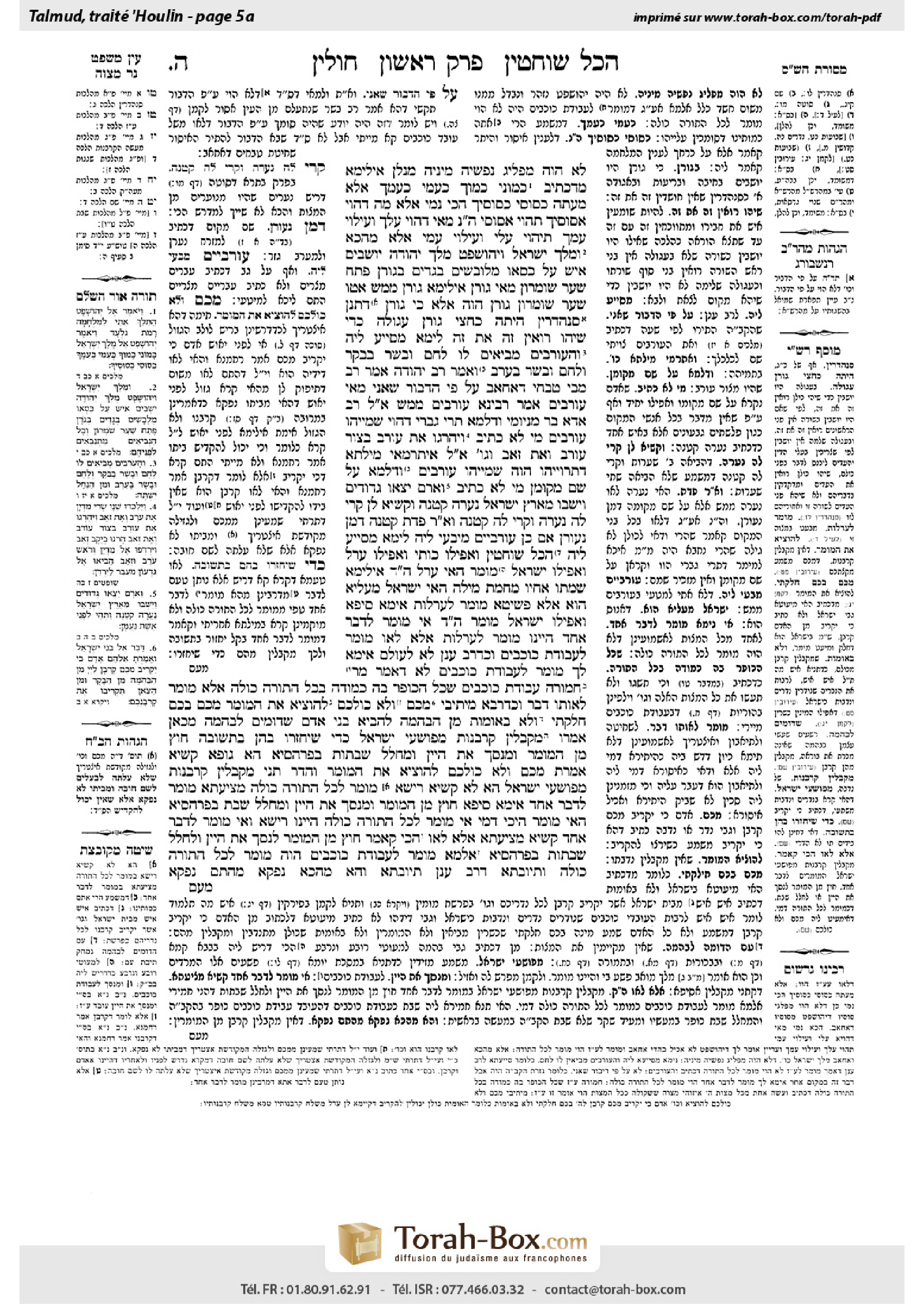
Chullin 5a: Talmud study for Daf Yomi
Study the Talmud for Daf Yomi with scanned pages, Hebrew text, English translations from Sefaria and AI-generated French translations.
Passage selection and English or AI-generated French translation are available where the scan has annotations. Daf Study is independent of Torah-Box and Sefaria.
Browse Chullin · חולין · All tractatesChullin 5a text and translations
This page of Chullin includes the Aramaic text, an English translation and an AI-generated French translation, alongside the scan above.
חולין ה׳ א · Aramaic and Hebrew text
לָא הֲוָה מְפַלֵּיג נַפְשֵׁיהּ מִינֵּיהּ, מְנָלַן? אִילֵּימָא מִדִּכְתִיב ״כָּמוֹנִי כָמוֹךָ כְּעַמִּי כְעַמֶּךָ״, אֶלָּא מֵעַתָּה ״כְּסוּסַי כְּסוּסֶיךָ״ הָכִי נָמֵי? אֶלָּא מָה דְּהָוֵי אַסּוּסֶיךָ תֶּהֱוֵי אַסּוּסַי, הָכִי נָמֵי מַאי דְּהָוֵי עֲלָךְ וְעִילָּוֵי עַמָּךְ תֶּיהֱוֵי עֲלַי וְעִילָּוֵי עַמִּי.
אֶלָּא מֵהָכָא: ״וּמֶלֶךְ יִשְׂרָאֵל וִיהוֹשָׁפָט מֶלֶךְ יְהוּדָה יֹשְׁבִים אִישׁ עַל כִּסְאוֹ מְלֻבָּשִׁים בְּגָדִים בְּגֹרֶן פֶּתַח שַׁעַר שֹׁמְרוֹן״. מַאי גּוֹרֶן? אִילֵּימָא גּוֹרֶן מַמָּשׁ, אַטּוּ שַׁעַר שׁוֹמְרוֹן גּוֹרֶן הֲוָה? אֶלָּא כִּי גוֹרֶן, דִּתְנַן: סַנְהֶדְרִין הָיְתָה כַּחֲצִי גוֹרֶן עֲגוּלָּה כְּדֵי שֶׁיְּהוּ רוֹאִין זֶה אֶת זֶה.
לֵימָא מְסַיַּיע לֵיהּ, ״וְהָעֹרְבִים מְבִיאִים לוֹ לֶחֶם וּבָשָׂר בַּבֹּקֶר וְלֶחֶם וּבָשָׂר בָּעָרֶב״, וְאָמַר רַב יְהוּדָה אָמַר רַב: מִבֵּי טַבָּחֵי דְאַחְאָב. עַל פִּי הַדִּבּוּר שָׁאנֵי.
מַאי עוֹרְבִים? אָמַר רָבִינָא: עוֹרְבִים מַמָּשׁ. אֲמַר לֵיהּ רַב אַדָּא בַּר מִנְיוֹמֵי: וְדִלְמָא תְּרֵי גַבְרֵי דְּהָוֵי שְׁמַיְיהוּ עוֹרְבִים! מִי לָא כְּתִיב: ״וַיַּהַרְגוּ אֶת עוֹרֵב בְּצוּר עוֹרֵב וְאֶת זְאֵב וְגוֹ׳״? אֲמַר לֵיהּ: אִיתְרְמַאי מִילְּתָא דְּתַרְוַיְיהוּ הֲוָה שְׁמַיְיהוּ עוֹרְבִים?
וְדִלְמָא עַל שֵׁם מְקוֹמָן! מִי לָא כְּתִיב: ״וַאֲרָם יָצְאוּ גְדוּדִים וַיִּשְׁבּוּ מֵאֶרֶץ יִשְׂרָאֵל נַעֲרָה קְטַנָּה״, וְקַשְׁיָא לַן: קָרֵי לַהּ ״נַעֲרָה״ וְקָרֵי לַהּ ״קְטַנָּה״, וְאָמַר רַבִּי פְּדָת: קְטַנָּה דְּמִן נְעוֹרָן! אִם כֵּן ״עוֹרְבִיִּים״ מִיבְּעֵי לֵיהּ.
לֵימָא מְסַיַּיע לֵיהּ: הַכֹּל שׁוֹחֲטִין, וַאֲפִילּוּ כּוּתִי, וַאֲפִילּוּ עָרֵל, וַאֲפִילּוּ יִשְׂרָאֵל מְשׁוּמָּד. הַאי עָרֵל הֵיכִי דָמֵי? אִילֵּימָא שֶׁמֵּתוּ אֶחָיו מֵחֲמַת מִילָּה – הַאי יִשְׂרָאֵל מְעַלְּיָא הוּא! אֶלָּא פְּשִׁיטָא מְשׁוּמָּד לַעֲרֵלוּת.
אֵימָא סֵיפָא: וַאֲפִילּוּ יִשְׂרָאֵל מְשׁוּמָּד, הֵיכִי דָמֵי? אִי מְשׁוּמָּד לְדָבָר אֶחָד – הַיְינוּ מְשׁוּמָּד לַעֲרֵלוּת, אֶלָּא לָאו מְשׁוּמָּד לַעֲבוֹדָה זָרָה, וְכִדְרַב עָנָן.
לָא, לְעוֹלָם אֵימַר לָךְ: מְשׁוּמָּד לַעֲבוֹדָה זָרָה לָא, דְּאָמַר מָר: חֲמוּרָה עֲבוֹדָה זָרָה, שֶׁכׇּל הַכּוֹפֵר בָּהּ כְּמוֹדֶה בְּכׇל הַתּוֹרָה כּוּלָּהּ.
אֶלָּא מְשׁוּמָּד לְאוֹתוֹ דָּבָר, וְכִדְרָבָא.
מֵיתִיבִי: ״מִכֶּם״ – וְלֹא כּוּלְּכֶם, לְהוֹצִיא אֶת הַמְשׁוּמָּד. ״מִכֶּם״ – בָּכֶם חִלַּקְתִּי וְלֹא בְּאוּמּוֹת. ״מִן הַבְּהֵמָה״ – לְהָבִיא בְּנֵי אָדָם שֶׁדּוֹמִים לִבְהֵמָה. מִכָּאן אָמְרוּ: מְקַבְּלִין קׇרְבְּנוֹת מִפּוֹשְׁעֵי יִשְׂרָאֵל כְּדֵי שֶׁיַּחְזְרוּ בָּהֶן בִּתְשׁוּבָה, חוּץ מִן הַמְשׁוּמָּד, וּמְנַסֵּךְ אֶת הַיַּיִן, וּמְחַלֵּל שַׁבָּתוֹת בְּפַרְהֶסְיָא.
הָא גוּפָא קַשְׁיָא, אָמְרַתְּ: ״מִכֶּם״ – וְלֹא כּוּלְּכֶם, לְהוֹצִיא אֶת הַמְשׁוּמָּד, וַהֲדַר תָּנֵי: מְקַבְּלִין קׇרְבָּנוֹת מִפּוֹשְׁעֵי יִשְׂרָאֵל!
הָא לָא קַשְׁיָא, רֵישָׁא – מְשׁוּמָּד לְכׇל הַתּוֹרָה כּוּלָּהּ, מְצִיעֲתָא – מְשׁוּמָּד לְדָבָר אֶחָד.
אֵימָא סֵיפָא: חוּץ מִן הַמְשׁוּמָּד וּמְנַסֵּךְ אֶת הַיַּיִן וּמְחַלֵּל שַׁבָּת בְּפַרְהֶסְיָא. הַאי מְשׁוּמָּד הֵיכִי דָמֵי? אִי מְשׁוּמָּד לְכׇל הַתּוֹרָה כּוּלָּהּ – הַיְינוּ רֵישָׁא, וְאִי מְשׁוּמָּד לְדָבָר אֶחָד – קַשְׁיָא מְצִיעֲתָא.
אֶלָּא לָאו הָכִי קָאָמַר: חוּץ מִן הַמְשׁוּמָּד לְנַסֵּךְ אֶת הַיַּיִן וּלְחַלֵּל שַׁבָּתוֹת בְּפַרְהֶסְיָא, אַלְמָא מְשׁוּמָּד לַעֲבוֹדָה זָרָה הָוֵה מְשׁוּמָּד לְכׇל הַתּוֹרָה כּוּלָּהּ, וּתְיוּבְתָּא דְּרַב עָנָן, תְּיוּבְתָּא.
וְהָא מֵהָכָא נָפְקָא? מֵהָתָם נָפְקָא,
Chullin 5a · English translation
The Gemara rejects that suggestion: Jehoshaphat would not have separated himself from Ahab to eat and drink by himself, as he relied on him completely. From where do we derive this? If we say that it is derived from that which is written that Jehoshaphat said to Ahab: “I am as you are, my people as your people” (I Kings 22:4), i.e., I am equally reliable, this is difficult, as, if that is so, then when Jehoshaphat said at the conclusion of that verse: “My horses as your horses,” can this also be referring to reliability? Rather, Jehoshaphat’s intention was: That which will befall your horses will befall my horses; so too, that which will befall you and your people will befall me and my people.
Rather, it is derived that Jehoshaphat relied upon Ahab from here: “And the king of Israel and Jehoshaphat, king of Judea, sat each on his throne, arrayed in their robes, in a threshing floor, at the entrance of the gate of Samaria” (I Kings 22:10). The Gemara asks: What is the meaning of the term threshing floor in this context? If we say that it was an actual threshing floor; is that to say that the gate of Samaria was a threshing floor? Typically, the gate of a city was the place of assembly for the city’s judges and elders, not a threshing floor. Rather, they were sitting in a configuration like that of a circular threshing floor, i.e., facing each other in a display of amity, as we learned in a mishna (Sanhedrin 36b): A Sanhedrin was arranged in the same layout as half of a circular threshing floor, so that the judges would see each other. This verse demonstrates that Jehoshaphat deliberated with Ahab and relied on his judgment.
The Gemara suggests: Let us say that the verse written with regard to Elijah supports the opinion of Rav Anan. The verse states: “And the ravens [orevim] brought him bread and meat in the morning, and bread and meat in the evening” (I Kings 17:6); and Rav Yehuda said that Rav said: They would bring the meat from the slaughterhouse of Ahab. Clearly, Elijah would not have eaten the meat if Ahab’s slaughter was not valid. The Gemara responds: Since he ate the meat according to the word of God, the case of Elijah is different, and no proof may be cited from there.
The Gemara asks: What is the meaning of orevim in this context? Ravina said: They were actual ravens. Rav Adda bar Minyumi said to him: And perhaps they were two men whose names were Oreb? Isn’t it written: “And they slew Oreb at the Rock of Oreb, and Zeeb they slew at the winepress of Zeeb” (Judges 7:25), indicating that Oreb is a person’s name? Ravina said to him: Did the matter just so happen that the names of both of the people supplying Elijah with food were Oreb? The improbability of this occurrence indicates that they were actual ravens.
The Gemara suggests: And perhaps they are called orevim after the name of their place of origin. Isn’t it written: “And the Arameans had gone out in bands, and had brought away captive out of the land of Israel a minor young woman [na’ara ketana]” (II Kings 5:2)? And it is difficult for us to understand why the verse calls her a young woman and also calls her a minor, which are two different stages in a girl’s development. And Rabbi Pedat said: She was a minor girl who was from a place called Naaran. Perhaps in the case of Elijah they were two people from a place called Oreb. The Gemara rejects that suggestion: If so, Orebites [oreviyyim] should have been written in the verse.
§ Let us say that the following baraita supports the opinion of Rav Anan, who says that it is permitted to eat from the slaughter of a Jew who is a transgressor with regard to idol worship: Everyone slaughters, and even a Samaritan, and even an uncircumcised man, and even a Jewish transgressor. The Gemara analyzes the baraita: This uncircumcised man, what are the circumstances? If we say that he is an uncircumcised man whose brothers died due to circumcision and the concern is that he might suffer a similar fate, clearly one may eat from what he slaughters, as he is a full-fledged Jew and not a transgressor at all. Rather, it is obvious that he is a transgressor with regard to remaining uncircumcised, as he refuses to be circumcised.
Say the latter clause of the baraita: And even a Jewish transgressor. What are the circumstances? If he is a transgressor with regard to one matter, that is identical to the case of a transgressor with regard to remaining uncircumcised. Rather, is it not that he is a transgressor with regard to idol worship, and it is in accordance with the opinion of Rav Anan?
The Gemara rejects that proof: No, actually I will say to you that a transgressor with regard to idol worship may not slaughter, as the Master said: Idol worship is a severe transgression, as with regard to anyone who denies it, it is as though he acknowledges his acceptance of the entire Torah. Conversely, with regard to one who accepts idolatry, it is as though he denies the entire Torah. Therefore, his halakhic status is that of a transgressor with regard to the entire Torah, and his slaughter is not valid.
Rather, the transgressor in the latter clause of the baraita is a transgressor concerning the same matter of eating unslaughtered carcasses, and it is in accordance with the opinion of Rava, who said that one may rely on the slaughter of a transgressor with regard to eating unslaughtered animal carcasses to satisfy his appetite even ab initio.
The Gemara raises an objection to the opinion of Rav Anan from that which is taught in a baraita with regard to the verse: “When any man of you brings an offering unto the Lord, from the animal” (Leviticus 1:2). The tanna infers: “Of you,” indicating: But not all of you. This serves to exclude the transgressor, from whom an offering is not accepted. The tanna continues: The term “of you” is also interpreted to mean that I distinguished among you and not among the nations. Therefore, a gentile may bring an offering even if he is an idol worshipper. The expression “from the animal” serves to include people who are similar to an animal in that they do not recognize God. From here, the Sages stated: One accepts offerings from Jewish transgressors so that they will consequently repent, except for the transgressor, one who pours wine as a libation to idolatry, and one who desecrates Shabbat in public [befarhesya].
This baraita itself is difficult. Initially, you said: “Of you,” indicating: But not all of you. This serves to exclude the transgressor, from whom an offering is not accepted. And then the tanna teaches: One accepts offerings from Jewish transgressors.
The Gemara answers: This is not difficult. The first clause states that an offering is not accepted from a transgressor with regard to the entire Torah. The middle clause states that one accepts an offering from a transgressor with regard to one matter.
The Gemara challenges: Say the last clause: Except for the transgressor, and one who pours wine as a libation to idolatry, and one who desecrates Shabbat in public. With regard to this transgressor in the last clause, what are the circumstances? If the reference is to a transgressor with regard to the entire Torah, that is identical to the first clause: Of you, and not all of you, to exclude the transgressor. And if the reference is to a transgressor with regard to one matter, the middle clause is difficult, as it is stated there that one accepts an offering from a transgressor with regard to one matter.
Rather, is it not that this is what the mishna is saying in the last clause: Except for the transgressor to pour wine as a libation to idolatry or to desecrate Shabbat in public? Apparently, a transgressor with regard to idol worship is a transgressor with regard to the entire Torah, and this baraita is a refutation of the opinion of Rav Anan. The Gemara concludes: It is indeed a conclusive refutation.
The Gemara asks: And is this halakha that one does not accept an offering from a transgressor derived from the verse cited here? It is derived from the verse written there with regard to a sin offering:
Chullin 5a · Traduction française (IA)
La Guemara rejette cette suggestion : Jéhoshaphat n'aurait pas séparé lui-même de Jéhoream pour manger et boire seul, puisqu'il comptait entièrement sur lui. D'où tirons-nous cela ? Si nous disons que cela est tiré de ce qui est écrit que Jéhoshaphat dit à Jéhoream : « Je suis comme toi, mon peuple comme ton peuple » (I Rois 22:4), c'est-à-dire que je suis aussi fiable, cela est difficile, car, si c'est ainsi, alors quand Jéhoshaphat dit à la fin de cette versette : « Mes chevaux comme tes chevaux », peut-on dire que cela fait référence à la fiabilité ? Plutôt, l'intention de Jéhoshaphat était : Ce qui arrivera à tes chevaux arrivera à mes chevaux ; de même, ce qui arrivera à toi et à ton peuple arrivera à moi et à mon peuple.
Plutôt, on tire cela que Jéhoshaphat comptait sur Jéhoream de là : « Et le roi d'Israël et Jéhoshaphat, roi de Juda, s'assirent chacun sur son trône, vêtus de leurs robes, sur un plan de mouture, à l'entrée de la porte de Samarie » (I Rois 22:10). La Guemara demande : Quelle est la signification du terme « plan de mouture » dans ce contexte ? Si nous disons qu'il s'agissait d'un plan de mouture réel ; est-ce que cela signifie que la porte de Samarie était un plan de mouture ? Généralement, la porte d'une ville était le lieu de réunion des juges et des anciens de la ville, pas un plan de mouture. Plutôt, ils étaient assis dans une configuration semblable à celle d'un plan de mouture circulaire, c'est-à-dire face à face dans un geste d'amitié, comme nous l'avons appris dans une mitsva (Sanhédrin 36b) : Le Sanhédrin était disposé de la même manière qu'une moitié d'un plan de mouture circulaire, afin que les juges pussent se voir les uns les autres. Cette versette démontre que Jéhoshaphat a discuté avec Jéhoream et s'est appuyé sur son jugement.
La Guemara suggère : Disons que la versette concernant Elie soutient l'opinion de Rav Anan. La versette dit : « Et les corbeaux [orevim] lui apportèrent du pain et de la viande le matin, et du pain et de la viande le soir » (I Rois 17:6) ; et Rav Yéhuda dit que Rav a dit : Ils apportaient la viande de la boucherie d'Ahab. Évidemment, Elie n'aurait pas mangé cette viande si la boucherie d'Ahab n'était pas valide. La Guemara répond : Puisqu'il a mangé la viande selon la parole de Dieu, le cas d'Elie est différent, et on ne peut pas en tirer de preuve là-dessus.
La Guemara demande : Quelle est la signification d'orevim dans ce contexte ? Ravina dit : Ce sont des corbeaux réels. Rav Adda bar Minyumi lui dit : Et peut-être que ce sont deux hommes dont les noms étaient Oreb ? N'est-il pas écrit : « Et ils tuèrent Oreb à la Roche d'Oreb, et Zéb ils tuèrent à la vigne de Zéb » (Juges 7:25), indiquant que Oreb est un nom de personne ? Ravina lui dit : N'est-ce pas par hasard que les noms des deux personnes qui approvisionnaient Elie étaient Oreb ? L'improbabilité de cet événement indique qu'il s'agissait de corbeaux réels.
La Guemara suggère : Et peut-être qu'ils sont appelés orevim en raison du nom de leur lieu d'origine. N'est-il pas écrit : « Et les Araméens sortirent par bandes, et emmenèrent en captivité d'Israël une jeune fille [na'ara ketana] » (II Rois 5:2) ? Et cela nous pose un problème, car il est difficile de comprendre pourquoi la versette appelle cette jeune fille une jeune fille et aussi une mineure, ce qui sont deux étapes différentes dans le développement d'une fille. Et Rabbi Pedat dit : Elle était une mineure venue d'un lieu appelé Naaran. Peut-être, dans le cas d'Elie, ce sont deux personnes venues d'un lieu appelé Oreb. La Guemara rejette cette suggestion : Si c'est ainsi, on aurait dû écrire « oreviyyim » dans la versette.
§ Disons que la baraïta suivante soutient l'opinion de Rav Anan, qui affirme qu'il est permis de manger de la boucherie d'un Juif qui est un transgresseur concernant l'idolâtrie : Tout le monde bataille, même un Samaritain, même un homme incircumcisé, même un transgresseur juif. La Guemara analyse la baraïta : Cet homme incircumcisé, quels sont les circonstances ? Si nous disons qu'il s'agit d'un homme incircumcisé dont les frères sont morts à cause de la circoncision et que l'inquiétude est qu'il puisse subir un sort similaire, clairement on peut manger de ce qu'il bataille, car il est un Juif complet et non un transgresseur du tout. Plutôt, il est évident qu'il est un transgresseur concernant l'incircumcision, car il refuse la circoncision.
Disons la dernière partie de la baraïta : Et même un transgresseur juif. Quelles sont les circonstances ? Si c'est un transgresseur concernant une seule chose, c'est identique au cas d'un transgresseur concernant l'incircumcision. Plutôt, n'est-ce pas qu'il est un transgresseur concernant l'idolâtrie, et c'est selon l'opinion de Rav Anan ?
La Guemara rejette cette preuve : Non, en réalité je vais te dire que le transgresseur concernant l'idolâtrie ne peut pas batailler, car le Maître a dit : L'idolâtrie est une grave transgression, car concernant celui qui la nie, c'est comme s'il acceptait l'ensemble de la Torah. À l'inverse, concernant celui qui accepte l'idolâtrie, c'est comme s'il niait l'ensemble de la Torah. Donc son statut halakhique est celui d'un transgresseur concernant l'ensemble de la Torah, et sa boucherie n'est pas valide.
Plutôt, le transgresseur mentionné dans la dernière partie de la baraïta est un transgresseur concernant la même matière, à savoir l'ingestion de cadavres non bouchés, et c'est selon l'opinion de Rava, qui a affirmé qu'on peut compter sur la boucherie d'un transgresseur en ce qui concerne la consommation de cadavres non bouchés pour satisfaire son appétit dès le début.
La Guemara soulève une objection contre l'opinion de Rav Anan, à partir de ce qui est enseigné dans une baraïta concernant la parole : « Quand un homme de vous apporte un holocauste à l'Éternel, d'un animal » (Lévitique 1:2). Le tanna déduit : « De vous », ce qui signifie : Mais pas tous de vous. Cela sert à exclure le transgresseur, duquel un holocauste n'est pas accepté. Le tanna continue : Le terme « de vous » est aussi interprété pour signifier que je distingue parmi vous et non parmi les nations. Ainsi, un non-Juif peut apporter un holocauste même s'il est un adorateur d'idoles. L'expression « d'un animal » sert à inclure les personnes semblables à un animal, celles qui ne reconnaissent pas l'Éternel. D'où les Sages ont déclaré : On accepte des holocaustes des Juifs transgressant afin qu'ils puissent ensuite se repentir, sauf le transgresseur, celui qui verse du vin en offrande à l'idolatry, et celui qui profane le Sabbat en public [befarhesya].
Cette baraïta elle-même est difficile. Initialement, vous avez dit : « De vous », ce qui signifie : Mais pas tous de vous. Cela sert à exclure le transgresseur, duquel un holocauste n'est pas accepté. Et ensuite le tanna enseigne : On accepte des holocaustes des Juifs transgressant afin qu'ils puissent ensuite se repentir.
La Guemara répond : Ce n'est pas difficile. La première clause indique qu'un holocauste n'est pas accepté du transgresseur concernant toute la Torah. La clause intermédiaire indique qu'on accepte un holocauste du transgresseur concernant une seule matière.
La Guemara soulève un défi : Dites la dernière clause : Sauf le transgresseur, et celui qui verse du vin en offrande à l'idolatry, et celui qui profane le Sabbat en public. Concernant ce transgresseur de la dernière clause, quelles sont les circonstances ? Si la référence est à un transgresseur concernant toute la Torah, cela est identique à la première clause : « De vous », et non tous de vous, pour exclure le transgresseur. Et si la référence est à un transgresseur concernant une seule matière, la clause intermédiaire est difficile, car il est dit là qu'on accepte un holocauste du transgresseur concernant une seule matière.
Plutôt, n'est-ce pas que c'est ce que la Michna dit dans la dernière clause : Sauf le transgresseur qui verse du vin en offrande à l'idolatry ou qui profane le Sabbat en public ? Apparemment, un transgresseur concernant l'idolatry est un transgresseur concernant toute la Torah, et cette baraïta est une réfutation de l'opinion de Rav Anan. La Guemara conclut : C'est effectivement une réfutation concluante.
La Guemara demande : Et cette halakha selon laquelle on ne accepte pas un sacrifice expiatoire du transgresseur est-elle dérivée de la parole citée ici ? Elle est dérivée de la parole écrite là concernant un sacrifice expiatoire :
Traduction française générée par IA à partir de l’édition anglaise de Sefaria. Vérifie toujours un passage avec le texte source.
Text from Sefaria: William Davidson Edition - Vocalized Aramaic (unknown); William Davidson Edition - English (CC BY NC).