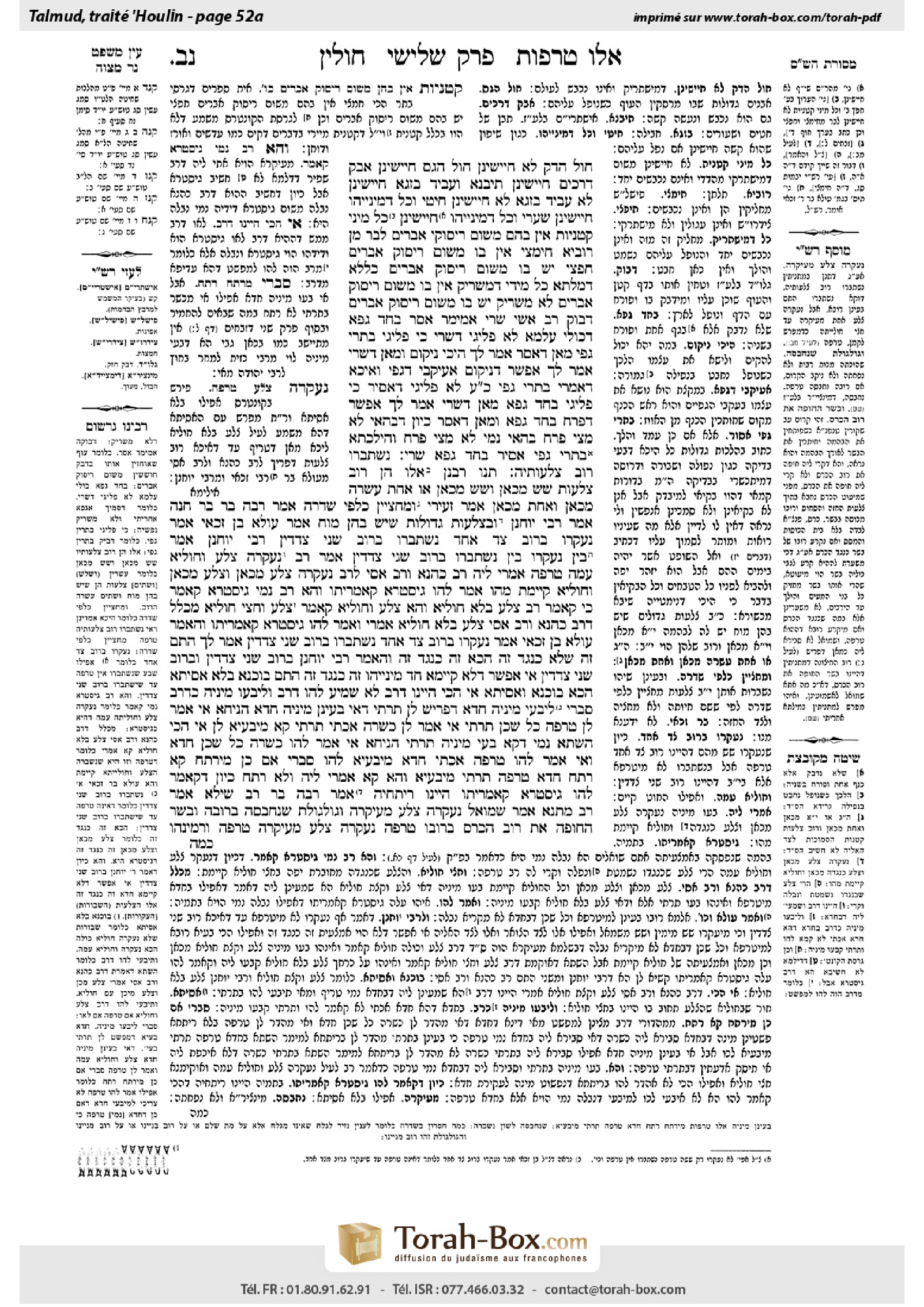
Chullin 52a: Talmud study for Daf Yomi
Study the Talmud for Daf Yomi with scanned pages, Hebrew text, English translations from Sefaria and AI-generated French translations.
Passage selection and English or AI-generated French translation are available where the scan has annotations. Daf Study is independent of Torah-Box and Sefaria.
Browse Chullin · חולין · All tractatesChullin 52a text and translations
This page of Chullin includes the Aramaic text, an English translation and an AI-generated French translation, alongside the scan above.
חולין נ״ב א · Aramaic and Hebrew text
חוֹל הַדַּק – לָא חָיְישִׁינַן; חוֹל הַגַּס – חָיְישִׁינַן; אֲבַק דְּרָכִים – חָיְישִׁינַן; תִּיבְנָא וַעֲבִיד בִּזְגָּא – חָיְישִׁינַן; לָא עָבֵיד בִּזְגָּא – לָא חָיְישִׁינַן.
חִיטֵּי וְכֹל דְּמִינַיְיהוּ – חָיְישִׁינַן; שְׂעָרֵי וְכֹל דְּמִינַיְיהוּ – חָיְישִׁינַן; כׇּל מִינֵי קִטְנִיּוֹת – אֵין בָּהֶם מִשּׁוּם רִיסּוּקֵי אֵבָרִים, לְבַר מִן רוּבְּיָא. חִימְצֵי – אֵין בּוֹ מִשּׁוּם רִיסּוּק אֵבָרִים, חִפְצֵי – יֵשׁ בּוֹ מִשּׁוּם רִיסּוּק אֵבָרִים. כְּלָלָא דְּמִלְּתָא: כֹּל מִידֵּי דְּמַשְׁרֵיק – אֵין בּוֹ מִשּׁוּם רִיסּוּק אֵבָרִים, לָא מַשְׁרֵיק – יֵשׁ בּוֹ מִשּׁוּם רִיסּוּק אֵבָרִים.
דָּבוֹק – רַב אָשֵׁי שָׁרֵי, אַמֵּימָר אָסַר. בְּחַד גַּפָּא – דְּכוּלֵּי עָלְמָא לָא פְּלִיגִי דִּשְׁרֵי, כִּי פְּלִיגִי בִּתְרֵי גַּפֵּי. מַאן דְּאָסַר אָמַר לָךְ: הֵיכִי נֵיקוּם? וּמַאן דְּשָׁרֵי אָמַר לָךְ: אֶפְשָׁר דְּנֵיקוּם אַעִיקְבֵי דְּגַפֵּי.
וְאִיכָּא דְּאָמְרִי: בִּתְרֵי גַּפֵּי כּוּלֵּי עָלְמָא לָא פְּלִיגִי דַּאֲסִיר, כִּי פְּלִיגִי בְּחַד גַּפָּא. מַאן דְּשָׁרֵי אָמַר לָךְ: אֶפְשָׁר דְּפָרַח בְּחַד גַּפָּא, וּמַאן דְּאָסַר: כֵּיוָן דִּבְהַאי לָא מָצֵי פָּרַח, בְּהַאי נָמֵי לָא מָצֵי פָּרַח. וְהִילְכְתָא: בִּתְרֵי גַּפֵּי אֲסִיר, בְּחַד גַּפָּא שְׁרֵי.
נִשְׁתַּבְּרוּ רוֹב צַלְעוֹתֶיהָ. תָּנוּ רַבָּנַן: אֵלּוּ הֵן רוֹב צְלָעוֹת – שֵׁשׁ מִכָּאן וְשֵׁשׁ מִכָּאן, אוֹ אַחַת עֶשְׂרֵה מִכָּאן וְאַחַת מִכָּאן.
אָמַר זְעֵירִי: וּמֵחֶצְיָין כְּלַפֵּי שִׁדְרָה. אָמַר רַבָּה בַּר בַּר חָנָה אָמַר רַבִּי יוֹחָנָן: וּבִצְלָעוֹת גְּדוֹלוֹת שֶׁיֵּשׁ בָּהֶן מוֹחַ.
אָמַר עוּלָּא, בֶּן זַכַּאי אָמַר: נֶעְקְרוּ – בְּרוֹב צַד אֶחָד, נִשְׁתַּבְּרוּ – בְּרוֹב שְׁנֵי צְדָדִין. רַבִּי יוֹחָנָן אָמַר: בֵּין נֶעְקְרוּ בֵּין נִשְׁתַּבְּרוּ – בְּרוֹב שְׁנֵי צְדָדִין.
אָמַר רַב: נֶעֶקְרָה צֵלָע וְחוּלְיָא עִמָּהּ – טְרֵפָה. אָמְרִי לֵיהּ רַב כָּהֲנָא וְרַב אַסִּי לְרַב: נֶעֶקְרָה צֵלָע מִכָּאן וְצֵלָע מִכָּאן, וְחוּלְיָא קַיֶּימֶת, מַהוּ? אֲמַר לְהוּ: גִּיסְטְרָא קָאָמְרִיתוּ?!
וְהָא רַב נָמֵי גִּיסְטְרָא קָאָמַר? כִּי קָאָמַר רַב – צֵלָע בְּלֹא חוּלְיָא.
וְהָא צֵלָע וְחוּלְיָא קָאָמַר? צֵלָע וַחֲצִי חוּלְיָא.
מִכְּלָל דְּרַב כָּהֲנָא וְרַב אַסִּי, צֵלָע בְּלֹא חוּלְיָא אָמְרִי, וַאֲמַר לְהוּ: ״גִּיסְטְרָא קָאָמְרִיתוּ״? וְהָאָמַר עוּלָּא: בֶּן זַכַּאי אָמַר: נֶעְקְרוּ – בְּרוֹב צַד אֶחָד, נִשְׁתַּבְּרוּ – בְּרוֹב שְׁנֵי צְדָדִין.
אָמַר לָךְ: הָתָם זֶה שֶׁלֹּא כְּנֶגֶד זֶה, הָכָא זֶה כְּנֶגֶד זֶה.
וְהָאָמַר רַבִּי יוֹחָנָן: בְּרוֹב שְׁנֵי צְדָדִין, וּבְרוֹב שְׁנֵי צְדָדִין אִי אֶפְשָׁר דְּלָא קָיְימָא (חד) [חֲדָא] מִינַּיְיהוּ זֶה כְּנֶגֶד זֶה!
הָתָם – בּוּכְנָא בְּלָא אֲסִיתָא, הָכָא – בּוּכְנָא וַאֲסִיתָא.
אִי הָכִי, הַיְינוּ דְּרַב? לָא שְׁמִיעַ לְהוּ דְּרַב.
וְלִיבְעוֹ מִינֵּיהּ כִּדְרַב? סָבְרִי: לִיבְעֵי מִינֵּיהּ חֲדָא דְּפָרֵישׁ לַן תַּרְתֵּי, דְּאִי בָּעֵינַן מִינֵּיהּ חֲדָא, הָנִיחָא אִי אֲמַר לַן ״טְרֵפָה״ – כׇּל שֶׁכֵּן תַּרְתֵּי, אִי אֲמַר לַן ״כְּשֵׁרָה״ – אַכַּתִּי תַּרְתֵּי קָא מִיבַּעְיָא לַן.
אִי הָכִי, הַשְׁתָּא נָמֵי דְּקָא בָּעֵי מִינֵּיהּ תַּרְתֵּי, הָנִיחָא אִי אֲמַר לְהוּ ״כְּשֵׁרָה״ – כׇּל שֶׁכֵּן חֲדָא; וְאִי אֲמַר לְהוּ ״טְרֵפָה״, אַכַּתִּי חֲדָא מִיבַּעְיָא לְהוּ.
סָבְרִי: אִם כֵּן מִירְתָּח קָא רָתַח. חֲדָא טְרֵפָה, תַּרְתֵּי מִיבַּעְיָא?
וְהָא קָא אָמְרִי לֵיהּ וְלָא רָתַח, כֵּיוָן דְּקָאָמַר לְהוּ ״גִּיסְטְרָא קָאָמְרִיתוּ״ – הַיְינוּ רִיתְחֵיהּ.
אָמַר רַבָּה בַּר רַב שֵׁילָא אָמַר רַב מַתְנָא אָמַר שְׁמוּאֵל: נֶעֶקְרָה צֵלָע מֵעִיקָּרָהּ, וְגוּלְגּוֹלֶת שֶׁנֶּחְבְּסָה בְּרוּבָּה, וּבָשָׂר הַחוֹפֶה אֶת רוֹב הַכָּרֵס בְּרוּבּוֹ – טְרֵפָה.
נֶעֶקְרָה צֵלָע מֵעִיקָּרָהּ טְרֵפָה? וּרְמִינְהוּ:
Chullin 52a · English translation
If the bird fell on fine sand, we need not be concerned, because the sand slides on impact, cushioning the fall. If it fell on coarse sand, we must be concerned, because there are large stones mixed into it. If it fell on dust of the road, we must be concerned, because the dust is compact and hard. If the bird fell on bundled straw, we must be concerned, because it is compact and hard. If the straw was not bundled, we need not be concerned.
If the bird fell on wheat and all similar types of grain, such as spelt or rye, whose kernels are hard, we must be concerned. If it fell on barley and all similar types of grain, such as oats, we must be concerned. With regard to all types of beans, there is no concern due to possible shattered limbs if a bird fell on them, since their round shape causes the bird to slide when it hits them, except for fenugreek. With regard to peas, there is no concern due to possible shattered limbs, but with regard to chickpeas, there is a concern due to possible shattered limbs. The principle of the matter is: With regard to anything that slips to the sides on impact, there is no concern due to possible shattered limbs. And with regard to anything that does not slip, there is a concern due to possible shattered limbs.
If the bird’s wings became stuck to a davuk, a board covered with glue set as a trap, and in trying to escape it fell to the ground while stuck to the board, Rav Ashi deemed the bird permitted, while Ameimar deemed it prohibited. The Gemara explains: In a case where only one wing was stuck to the board, everyone agrees that it is permitted, because the bird flaps with the other wing, lessening the impact of the fall. They disagree when both wings are stuck to the board. The one who deemed it prohibited could have said to you: How will it stand itself up so that it might dampen the impact? And the one who deemed it permitted could have said to you: It is possible for it to stand itself up by using the tips of its wings.
And there are those who say: In a case where two wings were stuck to the board, everyone agrees that it is prohibited, because it cannot dampen the impact. They disagree when only one wing is stuck to the board. The one who deemed it permitted could have said to you: It is possible for it to fly with one wing and dampen the fall. And the one who deemed it prohibited could say: Since it cannot fly with this wing that is stuck to the davuk, it also cannot fly with that untrapped wing. The Gemara concludes: And the halakha is: In a case where two wings were stuck, it is prohibited. In a case where only one wing was stuck, it is permitted.
§ The mishna states that if most of an animal’s ribs were fractured, it is a tereifa. The Sages taught: These are most of the ribs: Six from here and six from there, i.e., six on each side, or eleven from here and one from there. Twenty-two ribs are significant for matters of tereifot, eleven on each side. Twelve fractured ribs constitutes a majority.
Ze’eiri says: And this applies only when the ribs were fractured from the half of the rib toward the spine, but not if they were fractured on the other half. Rabba bar bar Ḥana says that Rabbi Yoḥanan says: And this applies only to fractures occurring in large ribs that contain marrow; fractures in small ribs do not render the animal a tereifa.
§ Ulla said that ben Zakkai says: If the ribs were dislocated from the spine, even a majority of one side, i.e., six dislocated ribs, is enough to render the animal a tereifa. Only if the ribs were broken is a majority of both sides necessary. Rabbi Yoḥanan says: Whether they were dislocated or broken, the animal is a tereifa only with a majority of both sides.
Rav says: If a rib was dislocated and the attached vertebra was torn out with it, the animal is a tereifa, even if the spinal cord remains intact. Rav Kahana and Rav Asi said to Rav: If a rib was dislocated from here and another rib from there, i.e., both ribs connected to a single vertebra were dislocated, but the vertebra itself remains intact, what is the halakha? Rav said to them: Are you saying that an animal that was sliced in half is a tereifa? This animal is considered to have been sliced and already has the status of a carcass, as it is already considered dead (see 21a).
The Gemara asks: But didn’t Rav also say that a sliced animal is a tereifa, since he said that if a rib was dislocated along with the attached vertebra, the animal is a tereifa? In such a case, the opposite rib is inevitably detached. If so, the animal should be considered a carcass. The Gemara responds: When Rav said that such an animal is a tereifa, he was referring to a case where the rib was dislocated without the vertebra.
The Gemara asks: But didn’t Rav explicitly say his statement with regard to a rib and vertebra that were dislocated? The Gemara responds: Rav meant that if a rib and half its attached vertebra were dislocated, the animal is a tereifa. The opposite rib, however, is intact and connected to the remainder of the vertebra.
The Gemara challenges: By inference, one may conclude that Rav Kahana and Rav Asi stated their question with regard to a less serious case, i.e., where a rib from each side was torn out without the vertebra being damaged at all. And yet, Rav said to them: Are you saying that an animal that was sliced in half is a tereifa? Rather, this animal is a carcass and is certainly prohibited. And how could Rav say this? But didn’t Ulla say that ben Zakkai says: If the ribs were dislocated, even a majority of one side is enough to render the animal a tereifa, while if the ribs were broken, a majority of both sides is necessary? If so, any animal with fewer than six dislocated ribs should be kosher, as long as the spine is undamaged.
The Gemara responds: Rav could have said to you: There, where ben Zakkai says that six dislocated ribs on one side render the animal a tereifa, this is referring only to ribs not dislocated one opposite the other. Here, where Rav says that two dislocated ribs render the animal a carcass, this is referring to ribs dislocated one opposite the other.
The Gemara asks: But doesn’t Rabbi Yoḥanan say that the animal is a tereifa only if a majority of both sides was dislocated, and in a majority of both sides, it is impossible that one of them is not situated opposite another? Still, Rabbi Yoḥanan says that the animal is a tereifa and not a carcass.
The Gemara responds: There, Rabbi Yoḥanan is referring to a case where the pestle, i.e., the end of the rib, was torn out without the mortar, the socket of the vertebra in which it sits, leaving the spine completely intact. In such a case, the animal is a tereifa only if twelve ribs were dislocated, even though this necessarily includes one rib opposite another. Here, where Rav says that two dislocated ribs opposite one another render the animal a carcass, that is referring to a case where the pestle and mortar were torn out together, damaging the spine.
The Gemara asks: If so, why did Rav Kahana and Rav Asi ask anything of Rav? Their case in question is identical to the statement of Rav. If Rav says that the animal is a tereifa if a rib and part of its vertebra were dislocated, that should be the halakha all the more so if ribs opposite one another were dislocated in addition to part of the attached vertebra. The Gemara responds: Rav Kahana and Rav Asi did not hear that statement of Rav.
The Gemara persists: But if so, let them ask about the simpler case of one dislocated rib, like that which Rav himself discussed. Why ask specifically about two ribs opposite one another? The Gemara responds: They reasoned: Let us ask him one question through which he will explain to us two different cases. As, if we ask him about only one dislocated rib, this works out well if he says to us that the animal is a tereifa, because we can infer that all the more so if two ribs opposite one another are dislocated, the animal is a tereifa. But if he says to us that it is kosher, we must still ask with regard to a case of two dislocated ribs.
The Gemara objects: If that is so, then now, too, when they ask him about two ribs, they may not receive an answer with regard to both cases. Granted, this works out well if he says to them that an animal with two dislocated ribs opposite one another is kosher, since they can infer that all the more so it is kosher if only one rib is dislocated. But if he says to them that it is a tereifa, they must still ask with regard to a case of only one dislocated rib.
The Gemara responds: They reasoned that it is better to ask about a case where two ribs opposite one another were dislocated, because if it is so that Rav holds that the animal is a tereifa if even one rib is dislocated, then he would become angry and respond: If an animal with even one dislocated rib is a tereifa, is it necessary to ask about an animal with two dislocated ribs?
The Gemara objects: But they did say this question to him and he did not become angry, despite the fact that he holds that even one dislocated rib renders the animal a tereifa. The Gemara responds: When he said to them: Are you saying that an animal that was sliced in half is a tereifa, this is his anger. Rav Kahana and Rav Asi understood from this response that an animal with two dislocated ribs opposite one another is a carcass, but an animal with one dislocated rib is a tereifa.
§ Rabba bar Rav Sheila says that Rav Mattana says that Shmuel says: If a rib was ripped from its root, or if the skull was crushed in its majority, or if the flesh that envelops the majority of the rumen was damaged in its majority, the animal is a tereifa.
The Gemara asks: Did Shmuel really say that if a rib was ripped from its root, the animal is a tereifa? But raise a contradiction from a mishna (Oholot 2:3):
Chullin 52a · Traduction française (IA)
Si l'oiseau est tombé sur du sable fin, nous n'avons pas à nous inquiéter, car le sable glisse à l'impact, amortissant la chute. Si l'oiseau est tombé sur du sable grossier, nous devons nous inquiéter, car il contient des pierres grandes. Si l'oiseau est tombé sur la poussière de la route, nous devons nous inquiéter, car la poussière est compacte et dure. Si l'oiseau est tombé sur des fagots de paille, nous devons nous inquiéter, car ils sont compacts et durs. Si la paille n'était pas en fagots, nous n'avons pas à nous inquiéter.
Si l'oiseau est tombé sur du blé et tous les types de céréales similaires, tels que l'orge ou le seigle, dont les grains sont durs, nous devons nous inquiéter. Si l'oiseau est tombé sur de l'avoine et tous les types de céréales similaires, tels que l'orge, nous devons nous inquiéter. Concernant tous les types de haricots, il n'y a pas d'inquiétude en raison de possibles membres cassés si l'oiseau est tombé dessus, car leur forme ronde fait glisser l'oiseau lorsqu'il les heurte, à l'exception des fenouils. Concernant les pois, il n'y a pas d'inquiétude en raison de possibles membres cassés, mais concernant les pois cassés, il y a une inquiétude en raison de possibles membres cassés. Le principe de la question est : concernant toute chose qui glisse aux côtés à l'impact, il n'y a pas d'inquiétude en raison de possibles membres cassés. Et concernant toute chose qui ne glisse pas, il y a une inquiétude en raison de possibles membres cassés.
Si les ailes de l'oiseau étaient collées à un davuk, une planche recouverte de colle utilisée comme piège, et qu'en tentant de s'échapper, il est tombé au sol tout en étant collé à la planche, Rav Ashi considérait l'oiseau comme permis, tandis qu'Ameimar le considérait comme interdit. La Guemara explique : Dans le cas où seule une aile était collée à la planche, tout le monde convient qu'il est permis, car l'oiseau bat des ailes avec l'autre, atténuant l'impact de la chute. Ils s'entendent en cas de deux ailes collées à la planche. Celui qui considérait l'oiseau comme interdit pourrait avoir dit : Comment l'oiseau se redresse-t-il pour atténuer l'impact ? Et celui qui considérait l'oiseau comme permis pourrait avoir dit : Il est possible qu'il se redresse en utilisant les extrémités de ses ailes.
Et certains disent : Dans le cas où deux ailes étaient collées à la planche, tout le monde convient qu'il est interdit, car il ne peut atténuer l'impact. Ils s'entendent en cas d'une seule aile collée à la planche. Celui qui considérait l'oiseau comme permis pourrait avoir dit : Il est possible qu'il vole avec une aile et atténue la chute. Et celui qui considérait l'oiseau comme interdit pourrait dire : Puisque l'oiseau ne peut voler avec cette aile collée au davuk, il ne peut pas non plus voler avec l'autre aile non collée. La Guemara conclut : Et la halakha est : Dans le cas où deux ailes étaient collées, il est interdit. Dans le cas où seule une aile était collée, il est permis.
§ La mitsva stipule que si la plupart des côtes d'un animal étaient fracturées, il est considéré comme tereifa. Les Sages enseignent : La plupart des côtes signifie six d'ici et six d'ailleurs, c'est-à-dire six de chaque côté, ou onze d'ici et une d'ailleurs. Vingt-deux côtes sont significatifs pour les questions de tereifot, onze de chaque côté. Douze côtes fracturés constituent une majorité.
Ze’eiri dit : Et cela s'applique uniquement lorsque les côtes étaient fracturées du côté de la côte vers la colonne vertébrale, mais pas si elles étaient fracturées sur l'autre côté. Rabba bar bar Ḥana dit que Rabbi Yoḥanan dit : Et cela s'applique uniquement aux fractures sur les grandes côtes qui contiennent du sang ; les fractures sur les petites côtes ne rendent pas l'animal un tereifa.
§ Ulla dit que ben Zakkai dit : Si les côtes étaient délogées de la colonne vertébrale, même une majorité d'un côté, c'est-à-dire six côtes délogées, est suffisante pour rendre l'animal un tereifa. Seulement si les côtes étaient brisées, une majorité des deux côtés est nécessaire. Rabbi Yoḥanan dit : Qu'elles soient délogées ou brisées, l'animal est un tereifa uniquement avec une majorité des deux côtés.
Rav dit : Si une côte était délogée et la vertèbre attachée était arrachée avec elle, l'animal est un tereifa, même si la moelle épinière reste intacte. Rav Kahana et Rav Asi dirent à Rav : Si une côte était délogée d'ici et une autre de là, c'est-à-dire les deux côtes connectées à une seule vertèbre étaient délogées, mais la vertèbre elle-même reste intacte, quelle est la halakha ? Rav dit à eux : Vous dites-vous que l'animal qui a été tranché est un tereifa ? Cet animal est considéré comme tranché et déjà considéré comme un cadavre, car il est déjà considéré comme mort (voir 21a).
La Guemara pose la question : Mais n’a-t-il pas dit Rav aussi que l’animal tranché est un tereifa, puisqu’il a dit que si une côte était délogée avec la vertèbre attachée, l’animal est un tereifa ? Dans ce cas, l’autre côte est nécessairement détachée. Si tel est le cas, l’animal devrait être considéré comme un cadavre. La Guemara répond : Lorsque Rav a dit que cet animal est un tereifa, il faisait référence à un cas où la côte était délogée sans la vertèbre.
La Guemara pose la question : Mais n’a-t-il pas dit Rav explicitement sa déclaration concernant une côte et une vertèbre délogées ? La Guemara répond : Rav voulait dire que si une côte et la moitié de la vertèbre attachée étaient délogées, l’animal est un tereifa. L’autre côte, cependant, est intacte et connectée à la partie restante de la vertèbre.
La Guemara conteste : Par déduction, on peut conclure que Rav Kahana et Rav Asi ont posé leur question concernant un cas moins grave, c’est-à-dire où une côte de chaque côté était arrachée sans que la vertèbre ne soit endommagée du tout. Et pourtant, Rav dit à eux : Vous dites-vous que l’animal tranché est un tereifa ? Plutôt, cet animal est un cadavre et est certainement interdit. Et comment Rav a-t-il pu dire cela ? Mais n’a-t-il pas dit Ulla que ben Zakkai dit : Si les côtes étaient délogées, même une majorité d’un côté est suffisante pour rendre l’animal un tereifa, tandis que si les côtes étaient brisées, une majorité des deux côtés est nécessaire ? Si tel est le cas, tout animal ayant moins de six côtes délogées devrait être considéré comme propre, à condition que la colonne vertébrale reste intacte.
La Guemara répond : Rav aurait pu dire : Là, où ben Zakkai dit que six côtes déplacés d’un côté rendent l’animal un tereifa, cela se réfère uniquement aux côtes non déplacés l’un en face de l’autre. Ici, où Rav dit que deux côtes déplacés rendent l’animal un carcasse, cela se réfère aux côtes déplacés l’un en face de l’autre.
La Guemara demande : Mais ne dit pas Rabbi Yoḥanan que l’animal est un tereifa uniquement si la majorité des deux côtés était déplacée, et dans la majorité des deux côtés, il est impossible que l’un d’eux ne soit pas situé en face de l’autre ? Cependant, Rabbi Yoḥanan dit que l’animal est un tereifa et non un carcasse.
La Guemara répond : Là, Rabbi Yoḥanan se réfère à un cas où le pilon, c’est-à-dire la pointe du côte, a été arraché sans le mortier, le socle de la vertèbre dans lequel il est situé, laissant la colonne vertébrale intacte. Dans ce cas, l’animal est un tereifa uniquement si douze côtes étaient déplacés, même si cela inclut nécessairement un côte opposé. Ici, où Rav dit que deux côtes déplacés l’un en face de l’autre rendent l’animal un carcasse, cela se réfère à un cas où le pilon et le mortier ont été arrachés ensemble, endommageant la colonne vertébrale.
La Guemara demande : Si c’est ainsi, pourquoi Rav Kahana et Rav Asi ont-ils posé une question à Rav ? Leur cas en question est identique à l’affirmation de Rav. Si Rav dit que l’animal est un tereifa si un côte et une partie de sa vertèbre étaient déplacés, cela devrait être la halakha encore davantage si des côtes opposés étaient déplacés en plus d’une partie de la vertèbre attachée. La Guemara répond : Rav Kahana et Rav Asi n’ont pas entendu cette déclaration de Rav.
La Guemara persiste : Mais si c’est ainsi, laissons-les poser la question sur le cas simple d’un côte déplacé, comme celui que Rav lui-même a discuté. Pourquoi poser spécifiquement la question sur deux côtes opposés ? La Guemara répond : Ils ont raisonné : Faisons-lui poser une question qui lui permettra d’expliquer deux cas différents. Ainsi, si nous lui posons la question sur un seul côte déplacé, cela fonctionne bien s’il nous dit que l’animal est un tereifa, car nous pouvons en déduire que cela est encore plus vrai si deux côtes opposés sont déplacés. Mais s’il nous dit que l’animal est kosher, nous devons encore poser la question dans le cas de deux côtes opposés déplacés.
La Guemara s’oppose : Si c’est ainsi, alors maintenant aussi, lorsqu’ils lui posent la question sur deux côtes, ils ne peuvent pas recevoir une réponse concernant les deux cas. Admettons, cela fonctionne bien s’il nous dit que l’animal avec deux côtes opposés déplacés est kosher, car nous pouvons en déduire que cela est encore plus vrai si seul un côte est déplacé. Mais s’il nous dit que l’animal est un tereifa, nous devons encore poser la question dans le cas d’un seul côte déplacé.
La Guemara répond : Ils ont raisonné que c’était préférable de poser la question sur un cas où deux côtes opposés étaient déplacés, car si c’est le cas que Rav considère que l’animal est un tereifa même si un seul côte est déplacé, il deviendrait en colère et répondrait : Si un animal avec même un seul côte déplacé est un tereifa, pourquoi poser la question sur un animal avec deux côtes déplacés ?
La Guemara s’oppose : Mais ils ont posé cette question à lui et il n’est pas devenu en colère, malgré le fait qu’il considère que même un seul côte déplacé rend l’animal un tereifa. La Guemara répond : Lorsqu’il a dit à eux : Est-ce que vous dites qu’un animal qui a été coupé en deux est un tereifa, c’est sa colère. Rav Kahana et Rav Asi ont compris de cette réponse que l’animal avec deux côtes opposés déplacés est un carcasse, mais l’animal avec un seul côte déplacé est un tereifa.
§ Rabba bar Rav Sheila dit que Rav Mattana dit que Shmuel dit : Si un côte a été arraché de sa racine, ou si la tête a été écrasée dans sa majorité, ou si la chair qui enveloppe la majorité du rumen a été endommagée dans sa majorité, l’animal est un tereifa.
La Guemara demande : A-t-il vraiment dit Shmuel que si un côte a été arraché de sa racine, l’animal est un tereifa ? Mais élevez une contradiction à partir d’une mitsva (Oholot 2:3) :
Traduction française générée par IA à partir de l’édition anglaise de Sefaria. Vérifie toujours un passage avec le texte source.
Text from Sefaria: William Davidson Edition - Vocalized Aramaic (unknown); William Davidson Edition - English (CC BY NC).