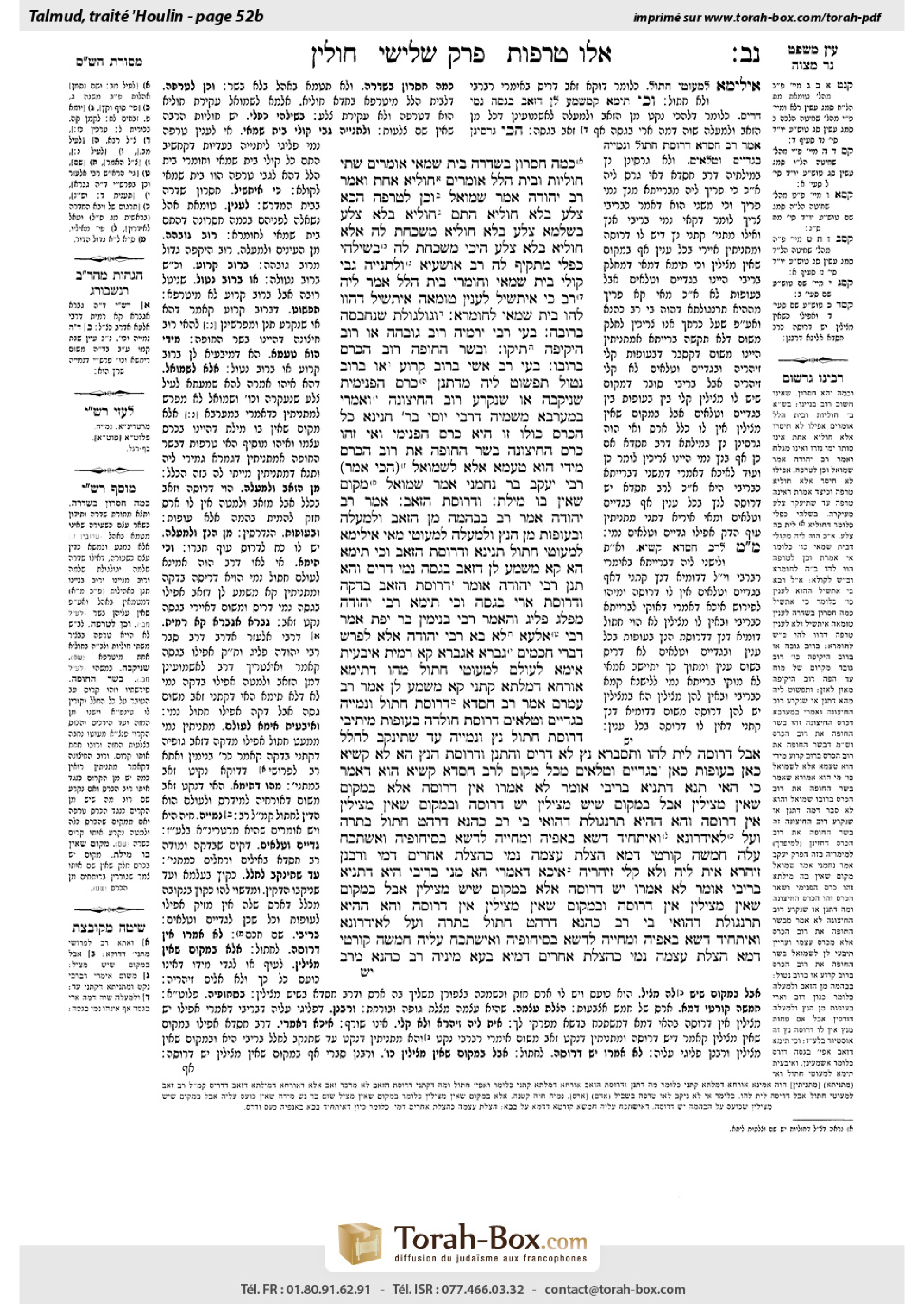
Chullin 52b: Talmud study for Daf Yomi
Study the Talmud for Daf Yomi with scanned pages, Hebrew text, English translations from Sefaria and AI-generated French translations.
Passage selection and English or AI-generated French translation are available where the scan has annotations. Daf Study is independent of Torah-Box and Sefaria.
Browse Chullin · חולין · All tractatesChullin 52b text and translations
This page of Chullin includes the Aramaic text, an English translation and an AI-generated French translation, alongside the scan above.
חולין נ״ב ב · Aramaic and Hebrew text
כַּמָּה חִסָּרוֹן בְּשִׁדְרָה? בֵּית שַׁמַּאי אוֹמְרִים: שְׁתֵּי חוּלְיוֹת, וּבֵית הִלֵּל אוֹמְרִים: חוּלְיָא אַחַת, וְאָמַר רַב יְהוּדָה אָמַר שְׁמוּאֵל: וְכֵן לִטְרֵפָה.
הָכָא – צֵלָע בְּלֹא חוּלְיָא, הָתָם – חוּלְיָא בְּלֹא צֵלָע.
בִּשְׁלָמָא צֵלָע בְּלֹא חוּלְיָא – מַשְׁכַּחַתְּ לַהּ, אֶלָּא חוּלְיָא בְּלֹא צֵלָע – הֵיכִי מַשְׁכַּחַתְּ לַהּ? בְּשִׁילְהֵי כַּפְלֵי.
מַתְקֵיף לַהּ רַב אוֹשַׁעְיָא: וְלִתְנְיַיהּ גַּבֵּי קוּלֵּי בֵּית שַׁמַּאי וְחוּמְרֵי בֵּית הִלֵּל? אֲמַר לֵיהּ רַב: כִּי אִיתְּשִׁיל – לְעִנְיַן טוּמְאָה אִיתְּשִׁיל, דְּהָווּ לְהוּ בֵּית שַׁמַּאי לְחוּמְרָא.
וְגוּלְגּוֹלֶת שֶׁנֶּחְבְּסָה בְּרוּבָּהּ. בָּעֵי רַבִּי יִרְמְיָה: רוֹב גּוֹבְהָהּ, אוֹ רוֹב הֶיקֵּיפָהּ? תֵּיקוּ.
וּבָשָׂר הַחוֹפֶה רוֹב הַכָּרֵס בְּרוּבּוֹ. בָּעֵי רַב אָשֵׁי: בְּרוֹב קָרוּעַ, אוֹ בְּרוֹב נָטוּל?
תִּפְשׁוֹט לֵיהּ מִדִּתְנַן: כָּרֵס הַפְּנִימִית שֶׁנִּיקְּבָה, אוֹ שֶׁנִּקְרַע רוֹב הַחִיצוֹנָה, וְאָמְרִי בְּמַעְרְבָא מִשְּׁמֵיהּ דְּרַבִּי יוֹסֵי בְּרַבִּי חֲנִינָא: כׇּל הַכָּרֵס כּוּלּוֹ זוֹ הִיא כָּרֵס הַפְּנִימִי, וְאֵי זֶהוּ כָּרֵס הַחִיצוֹנָה? בָּשָׂר הַחוֹפֶה אֶת רוֹב הַכָּרֵס.
מִידֵּי הוּא טַעְמָא, אֶלָּא לִשְׁמוּאֵל, הָכִי אָמַר רַבִּי יַעֲקֹב בַּר נַחְמָנִי אָמַר שְׁמוּאֵל: מָקוֹם שֶׁאֵין בּוֹ מֵילָת.
וּדְרוּסַת הַזְּאֵב. אָמַר רַב יְהוּדָה אָמַר רַב: בִּבְהֵמָה – מִן הַזְּאֵב וּלְמַעְלָה, וּבְעוֹפוֹת – מִן הַנֵּץ וּלְמַעְלָה.
לְמַעוֹטֵי מַאי? אִילֵּימָא לְמַעוֹטֵי חָתוּל – תְּנֵינָא: ״וּדְרוּסַת הַזְּאֵב״, וְכִי תֵּימָא הָא קָא מַשְׁמַע לַן דִּזְאֵב בְּגַסָּה נָמֵי דָּרֵיס – וְהָא תְּנַן: רַבִּי יְהוּדָה אוֹמֵר: דְּרוּסַת הַזְּאֵב בַּדַּקָּה, וּדְרוּסַת אֲרִי בַּגַּסָּה!
וְכִי תֵּימָא, רַבִּי יְהוּדָה מִפְלָג פְּלִיג, וְהָאָמַר רַבִּי בִּנְיָמִין בַּר יֶפֶת אָמַר רַבִּי אִלְעָא: לֹא בָּא רַבִּי יְהוּדָה אֶלָּא לְפָרֵשׁ דִּבְרֵי חֲכָמִים!
גַּבְרָא אַגַּבְרָא קָא רָמֵית? אִיבָּעֵית אֵימָא: לְעוֹלָם לְמַעוֹטֵי חָתוּל, מַהוּ דְּתֵימָא אוֹרְחָא דְּמִלְּתָא קָתָנֵי, קָא מַשְׁמַע לַן.
אָמַר רַב עַמְרָם אָמַר רַב חִסְדָּא: דְּרוּסַת חָתוּל וּנְמִיָּיה בִּגְדָיִים וּטְלָאִים, דְּרוּסַת חוּלְדָּה בְּעוֹפוֹת. מֵיתִיבִי: דְּרוּסַת חָתוּל, נֵץ וּנְמִיָּיה עַד שֶׁתִּינָּקֵב לֶחָלָל, אֲבָל דְּרוּסָה לֵית לְהוּ!
וְתִסְבְּרָא נֵץ לָא דָּרֵיס? וְהָתְנַן: וּדְרוּסַת הַנֵּץ! הָא לָא קַשְׁיָא: כָּאן בְּעוֹפוֹת, כָּאן בִּגְדָיִים וּטְלָאִים.
מִכׇּל מָקוֹם, לְרַב חִסְדָּא קַשְׁיָא, הוּא דְּאָמַר כִּי הַאי תַּנָּא, דְּתַנְיָא: בְּרִיבִּי אוֹמֵר: לֹא אָמְרוּ אֵין דְּרוּסָה אֶלָּא בְּמָקוֹם שֶׁאֵין מַצִּילִין, אֲבָל בִּמְקוֹם שֶׁיֵּשׁ מַצִּילִין – יֵשׁ דְּרוּסָה.
וּבִמְקוֹם שֶׁאֵין מַצִּילִין אֵין דְּרוּסָה? וְהָא הָהִיא (תרנגולת) [תַּרְנְגוֹלְתָּא] דַּהֲוַאי בֵּי רַב כָּהֲנָא, דִּרְהַט חָתוּל בָּתְרַהּ, וְעָל לְאִידְּרוֹנָא, וְאִיתְּחִיד דַּשָּׁא בְּאַפֵּיהּ, וּמַחְיֵיהּ לְדַשָּׁא בְּסִיחוּפֵיהּ, וְאִשְׁתְּכַח עֲלַהּ חַמְשָׁה קוּרְטֵי דְּמָא!
הַצָּלַת עַצְמָהּ נָמֵי כְּהַצָּלַת אֲחֵרִים דָּמֵי, וְרַבָּנַן – זִיהֲרָא אִית לֵיהּ, וְלָא קָלֵי זִיהֲרֵיהּ.
אִיכָּא דְאָמְרִי: הָא מַנִּי? בְּרִיבִּי הִיא, דְּתַנְיָא: בְּרִיבִּי אוֹמֵר: לֹא אָמְרוּ יֵשׁ דְּרוּסָה אֶלָּא בִּמְקוֹם שֶׁיֵּשׁ מַצִּילִין, אֲבָל בִּמְקוֹם שֶׁאֵין מַצִּילִין – אִין דְּרוּסָה.
וּבִמְקוֹם שֶׁאֵין מַצִּילִין אֵין דְּרוּסָה? וְהָא הָהִיא (תרנגולת) [תַּרְנְגוֹלְתָּא] דַּהֲוַאי בֵּי רַב כָּהֲנָא, דִּרְהַט חָתוּל בָּתְרַהּ וְעַל לְאִידְּרוֹנָא, וְאִיתְּחִיד דַּשָּׁא בְּאַפֵּיהּ, וּמַחְיֵיהּ לְדַשָּׁא בְּסִיחוּפֵיהּ, וְאִישְׁתְּכַח עֲלֵיהּ חֲמִשָּׁה קוּרְטֵי דְּמָא. הַצָּלַת עַצְמָהּ נָמֵי כְּהַצָּלַת אֲחֵרִים דָּמְיָא.
בְּעָא מִינֵּיהּ רַב כָּהֲנָא מֵרַב:
Chullin 52b · English translation
How much is considered a deficiency in the spine of a corpse so that it will not be considered a full corpse that would render one impure in a tent? Beit Shammai say: Two missing vertebrae, and Beit Hillel say: One vertebra. And Rav Yehuda says that Shmuel says: And just as Beit Shammai and Beit Hillel disagree with regard to ritual impurity, so too they disagree with regard to a tereifa, i.e., according to Beit Hillel an animal missing only one vertebra is a tereifa. Evidently, Shmuel holds that a missing vertebra renders the animal a tereifa, but a dislocated rib does not.
The Gemara responds: This is not difficult. Here, where Shmuel says that a rib ripped from its root renders the animal a tereifa, he is referring to a case where the rib was torn out without the vertebra. There, where he says that a missing vertebra renders the animal a tereifa according to Beit Hillel, he is referring to a case where the vertebra was missing without the rib being dislocated. But if the rib itself was ripped from its root, the animal is a tereifa.
The Gemara asks: Granted, with regard to a case where a rib was dislocated without the vertebra, you find this commonly. But how can you find a case of a missing vertebra without a dislocated rib? The Gemara responds: This can occur at the ends of the flanks, where there are vertebrae with no ribs attached to them.
Shmuel said that just as Beit Shammai and Beit Hillel disagree with regard to ritual impurity, so too they disagree with regard to a tereifa. Rav Oshaya objects to this statement: But if that is so, then the opinion of Beit Hillel is the more stringent one, as they hold that even one missing vertebra renders the animal a tereifa. Accordingly, let the tanna teach this dispute along with the list of leniencies of Beit Shammai and stringencies of Beit Hillel in tractate Eduyyot. Rav said to him: When the question was asked, it was asked with regard to the ritual impurity of a corpse. That is the source of the dispute between Beit Hillel and Beit Shammai, and on that matter, Beit Shammai constitute the stringent opinion. The parallel disagreement with regard to tereifot is not mentioned explicitly in any mishna or baraita, and it was therefore omitted from the list in tractate Eduyyot.
The Gemara returns to Shmuel’s statement: Or if the skull was crushed in its majority, the animal is a tereifa. Rabbi Yirmeya raises a dilemma: Is this referring to the majority of its height or the majority of its circumference? The Gemara responds: The dilemma shall stand unresolved.
Shmuel also said: Or if the flesh that envelops the majority of the rumen was damaged in its majority, the animal is a tereifa. Rav Ashi raises a dilemma: Is this referring even to a case where the majority of the length of the flesh was torn? Or is it referring only to a case where the majority of the flesh was removed, but if it was torn along the majority of its length the animal remains kosher?
The Gemara responds: Resolve the dilemma from that which we learned in the mishna: If the internal rumen was perforated or most of the external rumen was torn, the animal is a tereifa. And in the West, Eretz Yisrael, they said in the name of Rabbi Yosei, son of Rabbi Ḥanina: The entire rumen is the internal rumen. And if so, which is the external rumen? It is the flesh that envelops the majority of the rumen. Apparently, the animal is a tereifa even if the flesh is torn in its majority.
The Gemara rejects the proof: This explanation is meant only to clarify the statement of Shmuel, and Shmuel does not agree with the opinion of Rabbi Yosei, son of Rabbi Ḥanina, as this is what Rabbi Ya’akov bar Naḥmani said that Shmuel said: The case of: Most of the external rumen was torn, mentioned in the mishna, where the animal is a tereifa, is not referring to where the flesh enveloping the majority of the rumen was torn, but rather where the majority of the rumen itself was torn. The internal rumen is the place in the rumen that has no wool, i.e., downy projections on the inside of the rumen. Accordingly, one cannot prove anything about the statement of Shmuel based on an explanation of the mishna offered by Rabbi Yosei, son of Rabbi Ḥanina.
§ The mishna states: And an animal that was clawed by a wolf is a tereifa. Rav Yehuda says that Rav says: In the case of an animal, it is a tereifa if it was clawed by any predator from the size of a wolf and upward. And with regard to birds, they are tereifot if they were clawed by any predator from the size of a hawk and upward.
The Gemara asks: What does this statement of Rav, that an animal is a tereifa if it was clawed by a predator at least as large as a wolf, serve to exclude? If we say it serves to exclude a cat that clawed an animal, since it is smaller than a wolf, we already learned in the mishna: And an animal clawed by a wolf is a tereifa. One can infer from this that cats do not render an animal a tereifa. And if you would say: This mishna teaches us that a wolf can also effectively claw a large animal, e.g., cattle, but it may still be that a cat can render a small animal a tereifa, this cannot be; didn’t we learn in the mishna that Rabbi Yehuda says: If it was clawed by a wolf in the case of a small animal, or clawed by a lion in the case of a large animal, the animal is a tereifa?
And if you would say that Rabbi Yehuda disagrees with the Rabbis, and they hold that a wolf can also render large livestock tereifa by clawing, this too is impossible, as doesn’t Rabbi Binyamin bar Yefet say that Rabbi Ela says: The statement of Rabbi Yehuda in the mishna comes only to explain the statement of the Rabbis?
The Gemara responds: Are you setting the statement of one man against the statement of another man? Even if Rabbi Ela holds that Rabbi Yehuda comes only to explain the statement of the Rabbis, Rav may still hold that Rabbi Yehuda disagrees with the Rabbis. Or, if you wish, say instead: Actually, everyone agrees that a wolf can render only a small animal a tereifa through clawing. Nevertheless, the statement of Rav serves to exclude a cat from the ability to render even a small animal a tereifa. Lest you say that the mishna taught about a wolf only because this is the manner in which the matter typically occurs, but a cat may in fact render a small animal a tereifa, Rav teaches us that it is referring specifically to a wolf.
§ Rav Amram says that Rav Ḥisda says: If an animal was clawed by a cat or a mongoose, in the case of kids or lambs, which are very small, it is a tereifa. If it was clawed by a weasel in the case of birds, it is a tereifa. The Gemara raises an objection from a baraita: An animal clawed by a cat, hawk, or mongoose is not rendered a tereifa until one of its internal organs is perforated to its recesses. One may infer: But they, i.e., a cat, hawk, and mongoose, do not have the ability to render an animal a tereifa through the clawing itself.
The Gemara questions the inference: And can you understand that a hawk does not effectively claw an animal? But didn’t we learn in the mishna: And a small bird clawed by a hawk is rendered a tereifa? The Gemara responds: That is not difficult. Here, where the mishna states that a hawk can effectively claw, it is with regard to birds, while there, where the baraita states that a hawk does not effectively claw, it is with regard to kids and lambs.
The Gemara returns to its initial objection: In any case, the baraita poses a difficulty for Rav Ḥisda, who says that a cat may render kids and lambs tereifot through clawing. The Gemara responds: Rav Ḥisda states his opinion in accordance with the opinion of that tanna, as it is taught in a baraita: The Distinguished One says: They said that a kid is not effectively clawed by a cat only in a place where there are none present to save it. But in a place where there are bystanders trying to save the kid, it is effectively clawed, since the cat is angered and injects venom into the wound. Rav Ḥisda is referring specifically to the latter case.
The Gemara asks: And in a place where there are none to save the kid, is it not effectively clawed? But there was a certain hen that was in the house of Rav Kahana, which a cat pursued, and the cat entered after it into a small room, and the door shut in the cat’s face, and it struck the door with its paws in anger. And afterward, five drops of blood, i.e., venom, were found on the door. Apparently a cat is venomous even if no one is present to save its prey.
The Gemara responds: For a cat, saving itself is also considered like saving others. Since the cat felt threatened, it acted as it would if there had been someone present to defend the hen. The Gemara asks: And the Rabbis, who state in the baraita that a cat can never effectively claw a small animal, even when there are bystanders attempting to save its prey, how do they explain this incident? The Gemara responds: According to the Rabbis, a cat does have venom, but its venom does not burn enough to render the animal a tereifa.
There are those who state the details of this exchange differently: After raising an objection to the statement of Rav Ḥisda from the baraita that states that a cat cannot effectively claw kids and lambs, the Gemara responds: In accordance with whose opinion is this baraita? It is in accordance with the opinion of the Distinguished One, as it is taught in a baraita: The Distinguished One says: They said that a kid is effectively clawed by a cat only in a place where there are bystanders present to save it. But in a place where there are none present to save the kid, it is not effectively clawed. The baraita, then, discusses a case where there are none present to save it. Rav Ḥisda agrees with the Rabbis that a cat can effectively claw an animal even when there are none present to save it.
The Gemara asks: But in a place where there are none present to save the kid, is it not effectively clawed? But there was a certain hen that was in the house of Rav Kahana, which a cat pursued, and the cat entered after it into a small room, and the door shut in the cat’s face, and it struck the door with its paws in anger. And afterward, five drops of blood, i.e., venom, were found on the door. The Gemara responds: For a cat, saving itself is also considered like saving others.
The Gemara relates that Rav Kahana asked Rav:
Chullin 52b · Traduction française (IA)
Combien de vertèbres manquantes dans la colonne vertébrale d'un cadavre suffit-il pour que ce cadavre ne soit pas considéré comme complet et ne rende pas impur dans une tente ? Beit Shammai disent : Deux vertèbres manquantes, et Beit Hillel disent : Une vertèbre. Et Rav Yehuda dit que Shmuel dit : Et comme Beit Shammai et Beit Hillel s'opposent concernant l'impureté rituelle, de même ils s'opposent concernant un tereifa, c'est-à-dire, selon Beit Hillel, un animal manquant d'une seule vertèbre est un tereifa. Évidemment, Shmuel considère que la perte d'une vertèbre rend l'animal un tereifa, mais la dislocation d'une côte ne le fait pas.
La Guemara répond : Ce n'est pas difficile. Ici, où Shmuel dit qu'une côte arrachée à sa racine rend l'animal un tereifa, il s'agit d'un cas où la côte a été arrachée sans la vertèbre. Là, où il dit que la perte d'une vertèbre rend l'animal un tereifa selon Beit Hillel, il s'agit d'un cas où la vertèbre était absente sans que la côte ne soit disloquée. Mais si la côte elle-même a été arrachée à sa racine, l'animal est un tereifa.
La Guemara pose la question : Cela est évident dans le cas où une côte était disloquée sans la vertèbre, mais comment pouvez-vous trouver un cas de vertèbre manquante sans côte disloquée ? La Guemara répond : Cela peut se produire aux extrémités des flancs, où il y a des vertèbres sans côte attachée.
Shmuel a dit que comme Beit Shammai et Beit Hillel s'opposent concernant l'impureté rituelle, de même ils s'opposent concernant un tereifa. Rav Oshaya s'oppose à cette déclaration : Mais si c'est ainsi, alors l'opinion de Beit Hillel est la plus stricte, car ils considèrent que même une vertèbre manquante rend l'animal un tereifa. Ainsi, le tanna devrait enseigner ce débat avec la liste des leniencies de Beit Shammai et des stricteurs de Beit Hillel dans le traité Eduyyot. Rav dit à lui : Lorsque la question a été posée, elle était posée concernant l'impureté rituelle d'un cadavre. C'est la source du débat entre Beit Hillel et Beit Shammai, et sur ce point, Beit Shammai constitue l'opinion stricte. Le débat parallèle concernant les tereifot n'est pas mentionné explicitement dans aucun mitsva ou baraïta, et il a donc été omis de la liste dans le traité Eduyyot.
La Guemara revient à la déclaration de Shmuel : Ou si la tête était écrasée dans sa majorité, l'animal est un tereifa. Rabbi Yirmeya soulève un dilemme : Ce qui est mentionné, est-ce la majorité de sa hauteur ou la majorité de son circonférence ? La Guemara répond : Ce dilemme restera sans solution.
Shmuel a aussi dit : Ou si la chair qui enveloppe la majorité du rumen était endommagée dans sa majorité, l'animal est un tereifa. Rav Ashi soulève un dilemme : Ce qui est mentionné, est-ce même dans le cas où la majorité de la longueur de la chair a été déchirée ? Ou est-ce uniquement dans le cas où la majorité de la chair a été retirée, mais si elle a été déchirée le long de la majorité de sa longueur, l'animal reste kosher ?
La Guemara répond : Résolvez ce dilemme à partir de ce que nous avons appris dans la Michna : Si le rumen interne était percé ou que la majorité du rumen externe était déchirée, l'animal est un tereifa. Et dans l'Ouest, en Eretz Yisrael, ils disent en nom de Rabbi Yosei, fils de Rabbi Ḥanina : Le rumen entier est le rumen interne. Et si c'est ainsi, quel est le rumen externe ? C'est la chair qui enveloppe la majorité du rumen. Apparemment, l'animal est un tereifa même si la chair est déchirée dans sa majorité.
La Guemara rejette cette preuve : Cette explication est destinée uniquement à clarifier la déclaration de Shmuel, et Shmuel ne s'accorde pas avec l'opinion de Rabbi Yosei, fils de Rabbi Ḥanina, car c'est ce que Rabbi Ya'akov bar Naḥmani a dit que Shmuel a dit : Le cas de : La majorité du rumen externe a été déchirée, mentionné dans la Michna, où l'animal est un tereifa, ne fait pas référence à un cas où la chair enveloppant la majorité du rumen a été déchirée, mais plutôt à un cas où la majorité du rumen lui-même a été déchirée. Le rumen interne est la partie du rumen qui n'a pas de poils, c'est-à-dire des protubérances veloutées à l'intérieur du rumen. Ainsi, on ne peut pas prouver quoi que ce soit concernant la déclaration de Shmuel à partir d'une explication de la Michna offerte par Rabbi Yosei, fils de Rabbi Ḥanina.
§ La Michna stipule : Et un animal mordu par un loup est un tereifa. Rav Yehuda dit que Rav dit : Dans le cas d'un animal, il est un tereifa s'il a été mordu par tout prédateur de la taille d'un loup ou plus. Et concernant les oiseaux, ils sont tereifot s'ils ont été mordus par tout prédateur de la taille d'un aigle ou plus.
La Guemara pose la question : Quel est l'objectif de cette déclaration de Rav, que l'animal est un tereifa s'il a été mordu par un prédateur de la taille d'un loup ou plus grand ? S'il s'agit d'exclure un chat qui a mordu un animal, car il est plus petit qu'un loup, nous avons déjà appris dans la Michna : Et un animal mordu par un loup est un tereifa. On peut en déduire que les chats ne rendent pas un animal tereifa. Et si vous dites : Cette Michna enseigne que le loup peut aussi mordre un grand animal, par exemple, les bêtes, mais il peut encore être que le chat puisse rendre un petit animal tereifa, cela n'est pas possible ; n'avons-nous pas appris dans la Michna que Rabbi Yehuda dit : Si l'animal a été mordu par un loup dans le cas d'un petit animal, ou mordu par un lion dans le cas d'un grand animal, l'animal est un tereifa ?
Et si vous dites que Rabbi Yehuda s'oppose aux Rabbins, et qu'ils considèrent que le loup peut rendre les grandes bêtes tereifas en les mordant, cela est impossible, car n'est-ce pas que Rabbi Binyamin bar Yefet dit que Rabbi Ela dit : La déclaration de Rabbi Yehuda dans la Michna ne vise qu'à expliquer la déclaration des Rabbins ?
La Guemara répond : Est-ce que vous opposez l'affirmation d'un homme à celle d'un autre homme ? Même si Rabbi Ela considère que Rabbi Yéhuda vient seulement expliquer l'affirmation des Rabbins, Rav peut tout de même penser que Rabbi Yéhuda s'oppose aux Rabbins. Ou, si vous préférez, dites plutôt : En réalité, tout le monde convient qu'un loup ne peut rendre qu'un petit animal térifa par ses griffes. Cependant, l'affirmation de Rav sert à exclure le chat de la capacité à rendre même un petit animal térifa. De peur que vous disiez que la mitsva parlait du loup uniquement parce que c'est la manière dont cela arrive habituellement, mais un chat pourrait en fait rendre un petit animal térifa, Rav nous apprend que c'est spécifiquement au loup qu'il fait référence.
§ Rav Amram dit que Rav Ḥisda dit : Si un animal a été griffé par un chat ou un mongoose, dans le cas des agneaux ou des moutons, qui sont très petits, il est térifa. Si l'animal a été griffé par un furet dans le cas des oiseaux, il est térifa. La Guemara soulève un objet à partir d'une baraïta : Un animal griffé par un chat, un faucon ou un mongoose n'est pas rendu térifa jusqu'à ce qu'un de ses organes internes soit perforé jusqu'à ses recoins. On peut en déduire : Mais ils, c'est-à-dire le chat, le faucon et le mongoose, n'ont pas la capacité de rendre un animal térifa par la simple griffure.
La Guemara questionne cette déduction : Et pouvez-vous comprendre que le faucon ne griffe pas efficacement un animal ? Mais n'avons-nous pas appris dans la mitsva : Et un petit oiseau griffé par un faucon est rendu térifa ? La Guemara répond : Ce n'est pas difficile. Ici, où la mitsva dit que le faucon peut griffer efficacement, c'est en ce qui concerne les oiseaux, tandis que là, où la baraïta dit que le faucon ne griffe pas efficacement, c'est en ce qui concerne les agneaux et les moutons.
La Guemara reprend son objection initiale : En tout cas, la baraïta pose un problème pour Rav Ḥisda, qui affirme qu'un chat peut rendre les agneaux et les moutons térifas par griffure. La Guemara répond : Rav Ḥisda exprime son opinion conformément à celle du tanna, comme il est enseigné dans une baraïta : Le Distingué dit : Ils dirent qu'un agneau n'est pas griffé efficacement par un chat qu'en un lieu où il n'y a personne pour le sauver. Mais en un lieu où il y a des spectateurs qui essaient de sauver l'agneau, il est griffé efficacement, car le chat est en colère et injecte du venin dans la plaie. Rav Ḥisda fait référence spécifiquement à ce dernier cas.
La Guemara demande : Et en un lieu où il n'y a personne pour sauver l'agneau, n'est-il pas griffé efficacement ? Mais il y avait une poule qui était chez Rav Kahana, que poursuivait un chat, et le chat entraîna après elle dans une petite pièce, et la porte se ferma sur le visage du chat, et il frappa la porte avec ses pattes en colère. Et après cela, cinq gouttes de sang, c'est-à-dire du venin, furent trouvées sur la porte. Apparemment, le chat est venimeux même si personne n'est présent pour sauver sa proie.
La Guemara répond : Pour un chat, sauver soi-même est aussi considéré comme sauver les autres. Puisque le chat se sentait menacé, il agissait comme s'il y avait eu quelqu'un présent pour défendre la poule. La Guemara demande : Et les Rabbins, qui disent dans la baraïta que le chat ne peut jamais griffer efficacement un petit animal, même lorsqu'il y a des spectateurs qui essaient de sauver sa proie, comment expliquent-ils cet incident ? La Guemara répond : Selon les Rabbins, le chat a bien du venin, mais ce venin ne brûle pas suffisamment pour rendre l'animal térifa.
Certains affirment que les détails de ce débat sont différents : Après avoir soulevé une objection contre l'assertion de Rav Ḥisda tirée de la baraïta qui stipule qu'un chat ne peut pas griffer efficacement les agneaux et les moutons, la Guemara répond : Selon l'opinion de qui est cette baraïta ? C'est selon l'opinion du Distingué, comme il est enseigné dans une autre baraïta : Le Distingué dit : Ils ont affirmé qu'un agneau est griffé efficacement par un chat uniquement dans un lieu où il y a des spectateurs présents pour le sauver. Mais dans un lieu où il n'y a personne pour sauver l'agneau, il n'est pas griffé efficacement. La baraïta, alors, discute d'un cas où il n'y a personne pour le sauver. Rav Ḥisda est d'accord avec les Rabbins que le chat peut griffer efficacement un animal même lorsqu'il n'y a personne pour le sauver.
La Guemara demande : Mais dans un lieu où il n'y a personne pour sauver l'agneau, n'est-il pas griffé efficacement ? Mais il y avait une poule qui était chez Rav Kahana, que poursuivait un chat, et le chat entraîna après elle dans une petite pièce, et la porte se ferma sur le visage du chat, et il frappa la porte avec ses pattes en colère. Et après cela, cinq gouttes de sang, c'est-à-dire du venin, furent trouvées sur la porte. La Guemara répond : Pour un chat, sauver soi-même est aussi considéré comme sauver les autres.
La Guemara rapporte que Rav Kahana demanda à Rav :
Traduction française générée par IA à partir de l’édition anglaise de Sefaria. Vérifie toujours un passage avec le texte source.
Text from Sefaria: William Davidson Edition - Vocalized Aramaic (unknown); William Davidson Edition - English (CC BY NC).