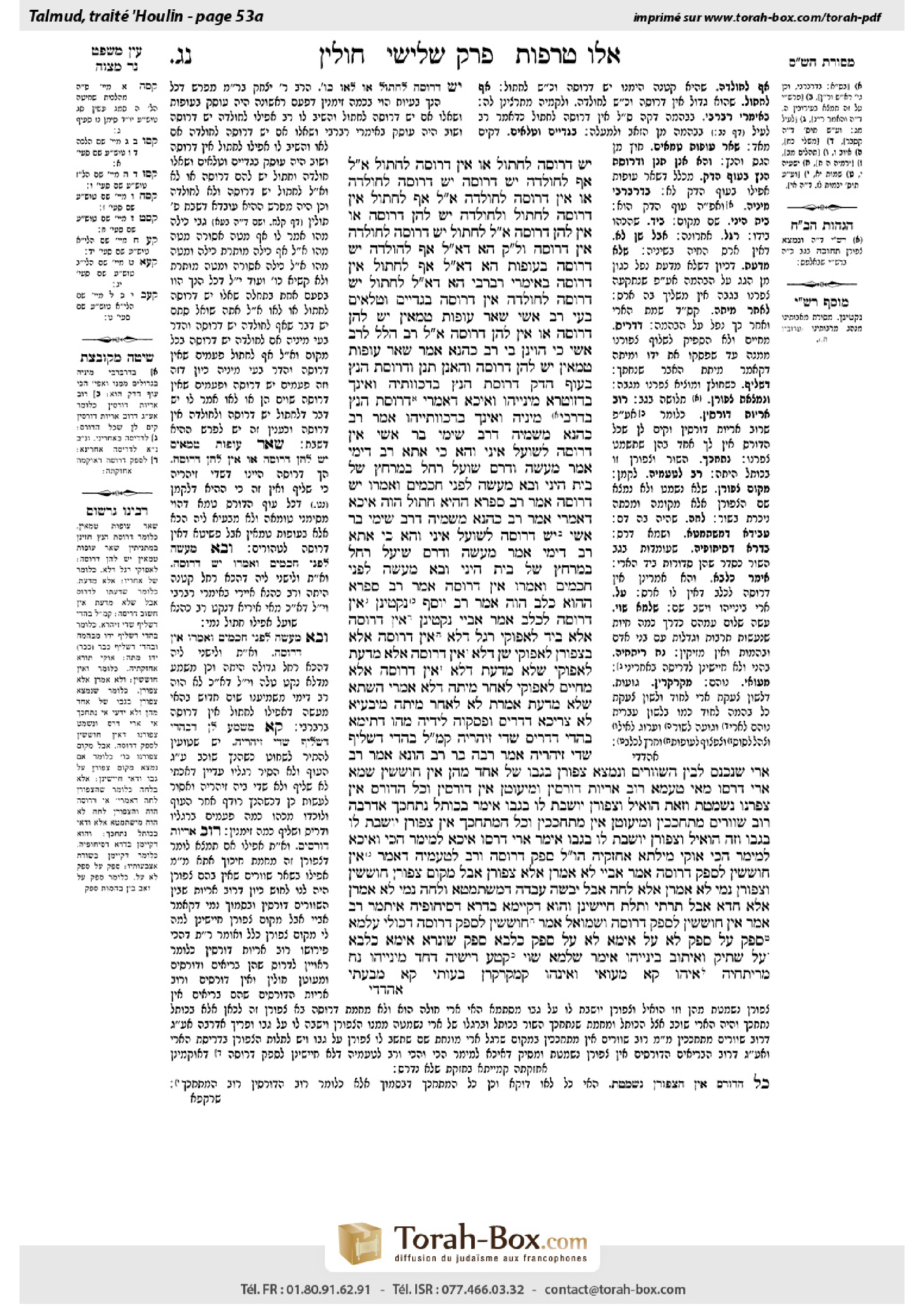
Chullin 53a: Talmud study for Daf Yomi
Study the Talmud for Daf Yomi with scanned pages, Hebrew text, English translations from Sefaria and AI-generated French translations.
Passage selection and English or AI-generated French translation are available where the scan has annotations. Daf Study is independent of Torah-Box and Sefaria.
Browse Chullin · חולין · All tractatesChullin 53a text and translations
This page of Chullin includes the Aramaic text, an English translation and an AI-generated French translation, alongside the scan above.
חולין נ״ג א · Aramaic and Hebrew text
יֵשׁ דְּרוּסָה לְחָתוּל אוֹ אֵין דְּרוּסָה לְחָתוּל? אֲמַר לֵיהּ: אַף לְחוּלְדָּה יֵשׁ דְּרוּסָה. יֵשׁ דְּרוּסָה לְחוּלְדָּה אוֹ אֵין דְּרוּסָה לְחוּלְדָּה? אֲמַר לֵיהּ: אַף לְחָתוּל אֵין דְּרוּסָה.
לְחָתוּל וּלְחוּלְדָּה, יֵשׁ לָהֶן דְּרוּסָה אוֹ אֵין לָהֶן דְּרוּסָה? אֲמַר לֵיהּ: לְחָתוּל יֵשׁ דְּרוּסָה, לְחוּלְדָּה אֵין דְּרוּסָה.
וְלָא קַשְׁיָא: הָא דַּאֲמַר לֵיהּ ״אַף לְחוּלְדָּה יֵשׁ דְּרוּסָה״ – בְּעוֹפוֹת, הָא דַּאֲמַר לֵיהּ ״אַף לְחָתוּל אֵין דְּרוּסָה״ – בְּאִימְּרֵי רַבְרְבֵי, הָא דַּאֲמַר לֵיהּ ״לְחָתוּל יֵשׁ דְּרוּסָה, לְחוּלְדָּה אֵין דְּרוּסָה״ – בִּגְדָיִים וּטְלָאִים.
בָּעֵי רַב אָשֵׁי: שְׁאָר עוֹפוֹת טְמֵאִין, יֵשׁ לָהֶן דְּרוּסָה אוֹ אֵין לָהֶן דְּרוּסָה? אֲמַר לֵיהּ רַב הִלֵּל לְרַב אָשֵׁי: כִּי הֲוֵינַן בֵּי רַב כָּהֲנָא, אֲמַר: שְׁאָר עוֹפוֹת טְמֵאִין יֵשׁ לָהֶן דְּרוּסָה.
וְהָאֲנַן תְּנַן: ״וּדְרוּסַת הַנֵּץ בְּעוֹף הַדַּק״! דְּרוּסַת הָנֵץ בְּדִכְוָותֵיהּ, וְאִינָךְ בִּדְזוּטְרָא מִינַּיְיהוּ. וְאִיכָּא דְּאָמְרִי: דְּרוּסַת הַנֵּץ בִּדְרַבִּי מִינֵּיהּ, וְאִינָךְ בְּדִכְוָותַיְיהוּ.
אָמַר רַב כָּהֲנָא מִשְּׁמֵיהּ דְּרַב שִׁימִי בַּר אָשֵׁי: אֵין דְּרוּסָה לְשׁוּעָל. אִינִי? וְהָא כִּי אֲתָא רַב דִּימִי אָמַר: מַעֲשֵׂה וְדָרַס שׁוּעָל רָחֵל בַּמֶּרְחָץ שֶׁל בֵּית הִינֵי, וּבָא מַעֲשֶׂה לִפְנֵי חֲכָמִים, וְאָמְרוּ: יֵשׁ דְּרוּסָה! אָמַר רַב סָפְרָא: הָהִיא חָתוּל הֲוָה.
אִיכָּא דְּאָמְרִי, אָמַר רַב כָּהֲנָא מִשְּׁמֵיהּ דְּרַב שִׁימִי בַּר אָשֵׁי: יֵשׁ דְּרוּסָה לְשׁוּעָל. אִינִי? וְהָא כִּי אֲתָא רַב דִּימִי אָמַר: מַעֲשֶׂה וְדָרַס שׁוּעָל רָחֵל בַּמֶּרְחָץ שֶׁל בֵּית הִינֵי, וּבָא מַעֲשֶׂה לִפְנֵי חֲכָמִים, וְאָמְרוּ: אֵין דְּרוּסָה! אָמַר רַב סָפְרָא: הָהוּא כֶּלֶב הֲוָה. אָמַר רַב יוֹסֵף: נָקְטִינַן אֵין דְּרוּסָה לְכֶלֶב.
אָמַר אַבָּיֵי: נָקְטִינַן, אֵין דְּרוּסָה אֶלָּא בַּיָּד, לְאַפּוֹקֵי רֶגֶל דְּלָא. אֵין דְּרוּסָה אֶלָּא בְּצִפּוֹרֶן, לְאַפּוֹקֵי שֵׁן דְּלָא. אֵין דְּרוּסָה אֶלָּא מִדַּעַת, לְאַפּוֹקֵי שֶׁלֹּא מִדַּעַת דְּלָא. אֵין דְּרוּסָה אֶלָּא מֵחַיִּים, לְאַפּוֹקֵי לְאַחַר מִיתָה דְּלָא.
אָמְרִי: הַשְׁתָּא שֶׁלֹּא מִדַּעַת אָמְרַתְּ לָא, לְאַחַר מִיתָה מִיבַּעְיָא? לָא צְרִיכָא, דְּדָרֵיס וּפַסְקוּהָ לִידֵיהּ. מַהוּ דְּתֵימָא: בַּהֲדֵי דְּדָרֵיס שָׁדֵי זִיהֲרֵיהּ, קָא מַשְׁמַע לַן: בַּהֲדֵי דְּשָׁלֵיף שָׁדֵי זִיהֲרֵיהּ.
אָמַר רַבָּה בַּר רַב הוּנָא אָמַר רַב: אֲרִי שֶׁנִּכְנַס לְבֵין הַשְּׁוָורִים, וְנִמְצָא צִפּוֹרֶן בְּגַבּוֹ שֶׁל אֶחָד מֵהֶן – אֵין חוֹשְׁשִׁין שֶׁמָּא אֲרִי דְּרָסוֹ. מַאי טַעְמָא? רוֹב אֲרָיוֹת דּוֹרְסִין וּמִיעוּטָן אֵין דּוֹרְסִין, וְכׇל הַדּוֹרֵס – אֵין צִפׇּרְנוֹ נִשְׁמֶטֶת, וְזֹאת, הוֹאִיל וְצִפּוֹרֶן יוֹשֶׁבֶת לוֹ בְּגַבּוֹ – אֵימַר בַּכּוֹתֶל נִתְחַכֵּךְ.
אַדְּרַבָּה, רוֹב שְׁוָורִים מִתְחַכְּכִין, וּמִיעוּטָן אֵין מִתְחַכְּכִין, וְכׇל הַמִּתְחַכֵּךְ – אֵין צִפּוֹרֶן יוֹשֶׁבֶת לוֹ בְּגַבּוֹ, וְזֶה, הוֹאִיל וְצִפּוֹרֶן יוֹשֶׁבֶת לוֹ בְּגַבּוֹ, אֵימַר אֲרִי דְּרָסוֹ!
אִיכָּא לְמֵימַר הָכִי, וְאִיכָּא לְמֵימַר הָכִי – אוֹקֵי (מִילְּתָא) [תּוֹרָא] אַחֶזְקֵיהּ, הָוֵה לֵיהּ סְפֵק דְּרוּסָה; וְרַב לְטַעְמֵיהּ, דְּאָמַר: אֵין חוֹשְׁשִׁין לִסְפֵק דְּרוּסָה.
אָמַר אַבָּיֵי: לָא אֲמַרַן אֶלָּא צִפּוֹרֶן, אֲבָל מְקוֹם צִפּוֹרֶן – חוֹשְׁשִׁין, וְצִפּוֹרֶן נָמֵי לָא אֲמַרַן אֶלָּא לַחָה, אֲבָל יְבֵשָׁה – עָבְדָה דְּמִשְׁתַּמְטָא.
וְלַחָה נָמֵי לָא אֲמַרַן, אֶלָּא חֲדָא, אֲבָל תַּרְתֵּי וּתְלָת – חָיְישִׁינַן, וְהוּא דְּקָיְימָא בְּדָרָא דְּסִיחוּפֵיהּ.
אִיתְּמַר: רַב אָמַר: אֵין חוֹשְׁשִׁין לִסְפֵק דְּרוּסָה, וּשְׁמוּאֵל אָמַר: חוֹשְׁשִׁין לִסְפֵק דְּרוּסָה.
דְּכוּלֵּי עָלְמָא, סָפֵק עָל, סָפֵק לָא עָל – אֵימָא לָא עָל. סְפֵק כַּלְבָּא, סְפֵק שׁוּנָרָא – אֵימָא כַּלְבָּא. עָל, שְׁתֵיק וְיָתֵיב בֵּינַיְיהוּ – אֵימַר שְׁלָמָא שַׁוִּי. קְטַע רֵישֵׁיהּ דְּחַד מִינַּיְיהוּ – נָח מֵרִיתְחֵיהּ. אִיהוּ קָא מְעַוֵּאי וְאִינְהוּ קָמְקַרְקְרָן – בַּעוֹתֵי קָא מְבַעֲתִי
Chullin 53a · English translation
Does a cat render an animal a tereifa through clawing, or does a cat not render it a tereifa through clawing? Rav said to him: Even a weasel, which is smaller than a cat, does render an animal a tereifa through clawing. Rav Kahana also asked him: Does a weasel render an animal a tereifa through clawing, or does a weasel not render it a tereifa through clawing? Rav said to him: Even a cat does not render an animal a tereifa through clawing.
Rav Kahana also asked him: With regard to a cat and a weasel, do they render an animal a tereifa through clawing, or do they not render it a tereifa through clawing? Rav said to him: A cat does render an animal a tereifa through clawing, but a weasel does not render it a tereifa through clawing.
The Gemara clarifies: And the apparent contradiction between these responses is not difficult. That which Rav said to him: Even a weasel does render an animal a tereifa through clawing, was stated about a case of clawed birds. That which he said to him: Even a cat does not render an animal a tereifa through clawing, was stated about a case of adult sheep. That which Rav said to him: A cat does render an animal a tereifa through clawing, but a weasel does not render it a tereifa through clawing, was stated about a case of kids and lambs.
§ The mishna states that a small bird clawed by a hawk is a tereifa. Rav Ashi raises a dilemma: With regard to other non-kosher birds beside a hawk, do they render a bird a tereifa through clawing, or do they not render it a tereifa through clawing? Rav Hillel said to Rav Ashi: When we were in the study hall of Rav Kahana, he said: Other non-kosher birds do render a bird a tereifa through clawing.
The Gemara asks: But didn’t we learn in the mishna: Or if it was clawed by a hawk in the case of a small bird, it is a tereifa? Apparently, only a hawk renders a small bird a tereifa through clawing. The Gemara responds: The mishna means that a small bird clawed by a hawk is rendered a tereifa even in a case where it is as large as the hawk. But these other non-kosher birds can render a small bird a tereifa only in a case where it is smaller than them. And there are those who say: A small bird clawed by a hawk is rendered a tereifa even in a case where it is larger than the hawk. But these other non-kosher birds can render a small bird a tereifa only in a case where it is, at most, as large as them.
§ Rav Kahana said in the name of Rav Shimi bar Ashi: A fox does not render an animal a tereifa through clawing. The Gemara asks: Is that so? But when Rav Dimi came from Eretz Yisrael to Babylonia he said: There was an incident in which a fox clawed a ewe in the bathhouse of Beit Hini, and the incident came before the Sages, and they said: This is a case of clawing. Rav Safra said in response: In that case the predator was a cat, not a fox.
There are those who say the above exchange differently: Rav Kahana said in the name of Rav Shimi bar Ashi: A fox does render an animal a tereifa through clawing. The Gemara asks: Is that so? But when Rav Dimi came from Eretz Yisrael to Babylonia he said: There was an incident in which a fox clawed a ewe in the bathhouse of Beit Hini, and the incident came before the Sages, and they said: This is not a case of clawing. Rav Safra said in response: In that case the predator was a dog, not a fox. And Rav Yosef said: We have a tradition that a dog does not render an animal a tereifa through clawing.
§ With regard to the definition of clawing that renders an animal a tereifa, Abaye said: We have a tradition: Clawing is only with the foreleg, to the exclusion of clawing with the hind leg, which does not render the animal a tereifa. Additionally, clawing is only with the claw, to the exclusion of savaging with the tooth, which does not render the animal a tereifa, because the teeth contain no venom. And clawing is only through an intentional act, to the exclusion of an unintentional act, which does not render the animal a tereifa, e.g., if the predator accidentally fell on the prey with its claws outstretched. And clawing is only while the predator is alive, to the exclusion of a case where it clawed an animal after death, which does not render the animal a tereifa.
The Sages say: Now that you said that an unintentional act of clawing does not render an animal a tereifa, is it necessary to say that clawing after death is ineffective? The Gemara responds: No, it is necessary to teach this halakha for a case where the predator clawed while still alive, and they cut off its hand with its claws still inside the prey’s flesh. Lest you say: It injects its venom while it claws, Abaye teaches us that it injects its venom while it withdraws its claws. Accordingly, where the venom has yet to be injected before its death, i.e., before its hand is severed, the animal is kosher.
§ Rabba bar Rav Huna says that Rav says: If a lion entered among the oxen, and afterward a claw was found stuck in the back of one of the oxen, one need not be concerned that perhaps the lion clawed it. What is the reason for this? Even though a majority of lions claw their prey and only a minority of them do not claw, still, it is known with regard to any lion that claws that its claw is not ripped out in the process. And therefore, with regard to this ox, since a claw sits in its back, say that it rubbed against a wall that had a claw embedded in it.
The Gemara objects: On the contrary, say that even though a majority of oxen rub against the wall and only a minority do not rub, still, it is known with regard to any ox that rubs that a claw does not sit in its back. And therefore, with regard to this ox, since a claw sits in its back, say that the lion clawed it.
The Gemara responds: One can say this, and one can say that. Therefore, establish the matter according to its presumptive status, in which case the ox is not a tereifa. Accordingly, the ox is permitted because this case is one of uncertainty as to whether the animal was clawed, and Rav conforms to his standard line of reasoning, as he says: One need not be concerned in a case of uncertainty as to whether an animal was clawed.
Abaye said: We said that one need not be concerned that the lion clawed the ox only when the claw was found in its back, since it is known that a claw is not ripped out during clawing. But if only the spot of a claw was found, i.e., a perforation, one must be concerned. And even if the claw was found in its back, we said that one need not be concerned only when it was moist, since this indicates it was well connected to the flesh. Accordingly, if the lion had clawed the ox, this claw would not have been ripped out. But if the claw was dry, one must be concerned, because it happens that such a claw is ripped out during clawing.
And with regard to a moist claw as well, we said that one need not be concerned only when one claw was found in its back. But if there were two or three claws embedded in its back, we must be concerned, because multiple claws were not likely to be embedded in the wall. And this is the halakha only where they are situated in a row as they are in the paw of a lion.
§ It was stated: Rav says: One need not be concerned in a case of uncertainty as to whether an animal was clawed. And Shmuel says: One must be concerned in a case of uncertainty as to whether an animal was clawed, and the animal must be inspected.
The Gemara explains: Everyone agrees that in a case where it is uncertain whether a predator entered the pen or coop and uncertain whether it did not enter, I will say that it did not enter. Furthermore, if it is known that an animal entered but it is uncertain whether it was a dog and uncertain whether it was a cat, I will say that it was a dog, which cannot render an animal a tereifa through clawing. And even if a predator entered, but it was quiet and sat among the animals, I will say it made peace with them, as though it were tame, and did not claw them. And if it decapitated one of them, I will say that its anger subsided afterward, and it did not claw other animals. And if it was roaring and they were clucking, I will say that they are only frightening
Chullin 53a · Traduction française (IA)
Un chat rend-il un animal tereifa par griffage, ou ne le rend-il pas par griffage ? Rav dit à lui : Même un rat-fauve, qui est plus petit qu'un chat, rend un animal tereifa par griffage. Rav Kahana a aussi demandé : Un rat-fauve rend-il un animal tereifa par griffage, ou ne le rend-il pas par griffage ? Rav dit à lui : Même un chat ne rend pas un animal tereifa par griffage.
Rav Kahana a aussi demandé : Concernant un chat et un rat-fauve, rendent-ils un animal tereifa par griffage, ou ne les rendent-ils pas par griffage ? Rav dit à lui : Un chat rend un animal tereifa par griffage, mais un rat-fauve ne le rend pas par griffage.
La Guemara clarifie : Et la contradiction apparente entre ces réponses n'est pas difficile. Ce que Rav a dit à lui : Même un rat-fauve rend un animal tereifa par griffage, était dit dans le cas d'oiseaux griffés. Ce que Rav a dit à lui : Même un chat ne rend pas un animal tereifa par griffage, était dit dans le cas de brebis adultes. Ce que Rav a dit à lui : Un chat rend un animal tereifa par griffage, mais un rat-fauve ne le rend pas par griffage, était dit dans le cas de petits agneaux et de moutons.
§ La Michna stipule qu'un petit oiseau griffé par un aigle est tereifa. Rav Ashi soulève un dilemme : Concernant d'autres oiseaux non-kosher en dehors de l'aigle, rendent-ils un oiseau tereifa par griffage, ou ne les rendent-ils pas par griffage ? Rav Hillel a dit à Rav Ashi : Quand nous étions dans la salle de étude de Rav Kahana, il a dit : D'autres oiseaux non-kosher rendent un oiseau tereifa par griffage.
La Guemara demande : Mais n'avons-nous pas appris dans la Michna : Ou si c'était griffé par un aigle dans le cas d'un petit oiseau, il est tereifa ? Apparemment, seul l'aigle rend un petit oiseau tereifa par griffage. La Guemara répond : La Michna signifie qu'un petit oiseau griffé par un aigle est rendu tereifa même dans le cas où il est aussi grand que l'aigle. Mais ces autres oiseaux non-kosher peuvent rendre un petit oiseau tereifa uniquement dans le cas où il est plus petit qu'eux. Et certains disent : Un petit oiseau griffé par un aigle est rendu tereifa même dans le cas où il est plus grand que l'aigle. Mais ces autres oiseaux non-kosher peuvent rendre un petit oiseau tereifa uniquement dans le cas où il est, au plus, aussi grand qu'eux.
§ Rav Kahana a dit au nom de Rav Shimi bar Ashi : Un renard ne rend pas un animal tereifa par griffage. La Guemara demande : Est-ce ainsi ? Mais quand Rav Dimi est venu d'Israël vers Babylone, il a dit : Il y avait un incident où un renard avait griffé une brebis dans la salle de bain de Beit Hini, et l'incident est venu devant les Sages, et ils ont dit : C'est un cas de griffage. Rav Safra a répondu : Dans ce cas, le prédateur était un chat, pas un renard.
Certains disent que l'échange ci-dessus est différent : Rav Kahana a dit au nom de Rav Shimi bar Ashi : Un renard rend un animal tereifa par griffage. La Guemara demande : Est-ce ainsi ? Mais quand Rav Dimi est venu d'Israël vers Babylone, il a dit : Il y avait un incident où un renard avait griffé une brebis dans la salle de bain de Beit Hini, et l'incident est venu devant les Sages, et ils ont dit : Ce n'est pas un cas de griffage. Rav Safra a répondu : Dans ce cas, le prédateur était un chien, pas un renard. Et Rav Yosef a dit : Nous avons une tradition que le chien ne rend pas un animal tereifa par griffage.
§ Concernant la définition du griffage qui rend un animal tereifa, Abaye a dit : Nous avons une tradition : Le griffage est seulement avec la patte avant, excluant le griffage avec la patte arrière, qui ne rend pas l'animal tereifa. De plus, le griffage est seulement avec la griffe, excluant le déchiquetage avec les dents, qui ne rend pas l'animal tereifa, car les dents n'ont pas de venin. Et le griffage est seulement par un acte intentionnel, excluant un acte non intentionnel, qui ne rend pas l'animal tereifa, par exemple, si le prédateur tombe accidentellement sur la proie avec ses griffes tendues. Et le griffage est seulement pendant que le prédateur est vivant, excluant le cas où il a griffé un animal après sa mort, qui ne rend pas l'animal tereifa.
Les Sages disent : Maintenant que vous dites que l'acte non intentionnel de griffage ne rend pas l'animal tereifa, est-il nécessaire de dire que le griffage après la mort est inefficace ? La Guemara répond : Non, il est nécessaire d'enseigner cette halakha dans le cas où le prédateur a griffé alors qu'il était vivant, et ils ont coupé sa main avec ses griffes encore dans la chair de la proie. De peur que vous disiez : Il injecte son venin alors qu'il griffe, Abaye enseigne que l'injecte son venin alors qu'il retire ses griffes. Ainsi, où le venin n'a pas encore été injecté avant sa mort, c'est-à-dire avant que sa main ne soit coupée, l'animal est kosher.
§ Rabba bar Rav Huna dit que Rav dit : Si un lion entre parmi les taureaux, et ensuite une griffe est trouvée coincée dans le dos d'un des taureaux, on ne doit pas s'inquiéter que le lion l'ait griffé. Quelle est la raison de cela ? Même si la majorité des lions griffent leur proie et seulement une minorité ne le fait pas, toutefois, il est connu concernant tout lion qui griffe que sa griffe n'est pas arrachée pendant le processus. Et donc, concernant ce taureau, puisque une griffe est coincée dans son dos, disons qu'il s'est frotté contre un mur qui avait une griffe encastrée dedans.
La Guemara s'oppose : Au contraire, disons que même si la majorité des taureaux se frottent contre le mur et seulement une minorité ne le fait pas, toutefois, il est connu concernant tout taureau qui se frotte que une griffe ne se trouve pas dans son dos. Et donc, concernant ce taureau, puisque une griffe est coincée dans son dos, disons que le lion l'a griffé.
La Guemara répond : On peut dire cela, et on peut dire cela. Par conséquent, établissez la question selon son statut présomptif, dans lequel cas l'ox n'est pas un tereifa. Ainsi, l'ox est permis, car cette situation est une incertitude quant à savoir si l'animal avait été griffé, et Rav suit sa ligne de raisonnement habituelle, car il dit : On ne doit pas s'inquiéter dans le cas d'une incertitude quant à savoir si un animal avait été griffé.
Abaye a dit : Nous avons dit que l'on ne doit pas s'inquiéter que le lion ait griffé l'ox que lorsque la griffe a été trouvée sur son dos, car il est connu que la griffe n'est pas arrachée pendant la griffure. Mais si seule la marque d'une griffe a été trouvée, c'est-à-dire une perforation, on doit s'inquiéter. Et même si la griffe a été trouvée sur son dos, nous avons dit que l'on ne doit pas s'inquiéter que ce soit seulement lorsque celle-ci était humide, car cela indique qu'elle était bien connectée à la chair. Ainsi, si le lion avait griffé l'ox, cette griffe n'aurait pas été arrachée. Mais si la griffe était sèche, on doit s'inquiéter, car il arrive que de telle griffe soit arrachée pendant la griffure.
Et concernant une griffe humide également, nous avons dit que l'on ne doit pas s'inquiéter que ce soit seulement lorsque l'une des griffes a été trouvée sur son dos. Mais si deux ou trois griffes étaient encastrées sur son dos, on doit s'inquiéter, car il est peu probable qu'un nombre aussi élevé de griffes soit encastré dans le mur. Et c'est la halakha uniquement là où elles sont alignées comme dans la patte d'un lion.
§ On a dit : Rav dit : On ne doit pas s'inquiéter dans le cas d'une incertitude quant à savoir si un animal avait été griffé. Et Shmuel dit : On doit s'inquiéter dans le cas d'une incertitude quant à savoir si un animal avait été griffé, et l'animal doit être inspecté.
La Guemara explique : Tout le monde convient que dans le cas où il est incertain si un prédateur est entré dans l'étable ou la poule, et incertain s'il n'y est pas entré, je dirai qu'il n'y est pas entré. De plus, si on sait qu'un animal est entré, mais qu'il est incertain s'il s'agissait d'un chien ou d'un chat, je dirai qu'il s'agissait d'un chien, qui ne peut rendre un animal tereifa par griffure. Et même si un prédateur est entré, mais qu'il était calme et s'est mêlé aux animaux, je dirai qu'il a fait la paix avec eux, comme s'il était tamé, et n'a pas griffé les autres. Et si il a décapité l'un d'eux, je dirai que sa colère s'est calmée après, et qu'il n'a pas griffé d'autres animaux. Et si il hurlait et qu'ils criaient, je dirai qu'ils sont seulement effrayants
Traduction française générée par IA à partir de l’édition anglaise de Sefaria. Vérifie toujours un passage avec le texte source.
Text from Sefaria: William Davidson Edition - Vocalized Aramaic (unknown); William Davidson Edition - English (CC BY NC).