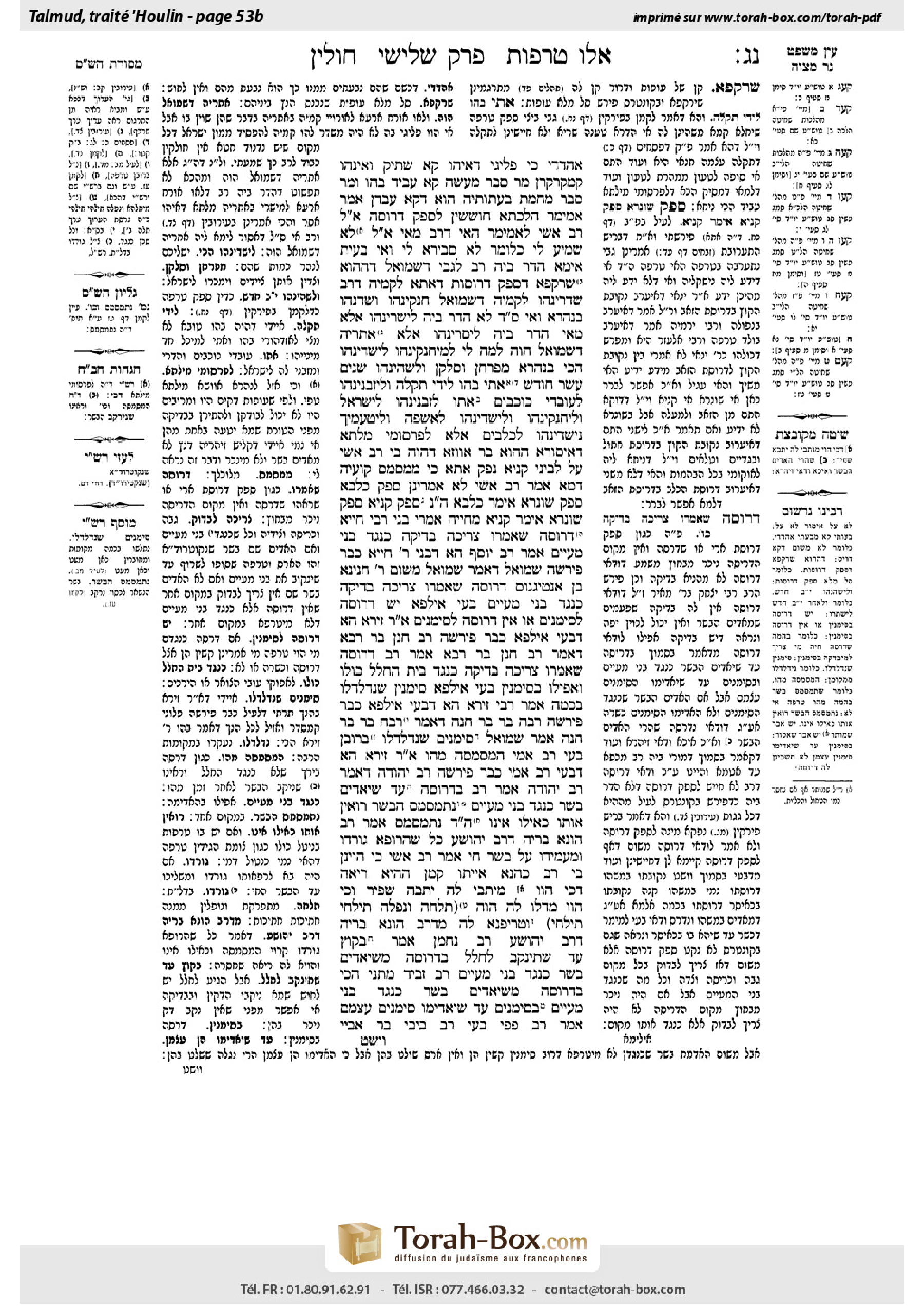
Chullin 53b: Talmud study for Daf Yomi
Study the Talmud for Daf Yomi with scanned pages, Hebrew text, English translations from Sefaria and AI-generated French translations.
Passage selection and English or AI-generated French translation are available where the scan has annotations. Daf Study is independent of Torah-Box and Sefaria.
Browse Chullin · חולין · All tractatesChullin 53b text and translations
This page of Chullin includes the Aramaic text, an English translation and an AI-generated French translation, alongside the scan above.
חולין נ״ג ב · Aramaic and Hebrew text
אַהֲדָדֵי. כִּי פְּלִיגִי דְּאִיהוּ קָא שָׁתֵיק וְאִינְהוּ קָמְקַרְקְרָן: מָר סָבַר מַעֲשֶׂה קָא עָבֵיד בְּהוּ, וּמָר סָבַר מֵחֲמַת בִּעֲתוּתֵיהּ הוּא דְּקָא עָבְדָן.
אָמַר אַמֵּימָר: הִלְכְתָא חוֹשְׁשִׁין לִסְפֵק דְּרוּסָה. אֲמַר לֵיהּ רַב אָשֵׁי לְאַמֵּימָר: הַאי דְּרַב מַאי? אֲמַר לֵיהּ: לָא שְׁמִיעַ לִי, כְּלוֹמַר, לָא סְבִירָא לִי.
וְאִי בָּעֵית אֵימָא: הֲדַר בֵּיהּ רַב לְגַבֵּי דִּשְׁמוּאֵל, דְּהָהוּא שַׁרְקָפָא דִּסְפֵק דְּרוּסוֹת, דַּאֲתָא לְקַמֵּיהּ דְּרַב, שַׁדְּרִינְהוּ לְקַמֵּיהּ דִּשְׁמוּאֵל, חַנְקִינְהוּ וּשְׁדָנְהוּ בְּנַהֲרָא. וְאִי סָלְקָא דַּעְתָּךְ לָא הֲדַר בֵּיהּ – לִישְׁרִינְהוּ?
אֶלָּא מַאי הֲדַר בֵּיהּ? לֵיסְרִינְהוּ! אֶלָּא, אַתְרֵיהּ דִּשְׁמוּאֵל הֲוָה.
לְמָה לִּי לְמִיחְנְקִינְהוּ? לִישְׁדִּינְהוּ הָכִי בְּנַהֲרָא! מְפָרְחָן וְסָלְקָן.
וּלְשַׁהִינְהוּ שְׁנֵים עָשָׂר חוֹדֶשׁ? אָתֵי בְּהוּ לִידֵי תַקָּלָה. וְלִיזַבְּנִינְהוּ לְגוֹיִם? אָתוּ לְזַבּוֹנִינְהוּ לְיִשְׂרָאֵל.
וְלִיחְנְקִינְהוּ וְלִישְׁדִּינְהוּ לְאַשְׁפָּה? וְלִיטַעְמָיךְ, נִישְׁדִּינְהוּ לִכְלָבִים! אֶלָּא, לְפַרְסוֹמֵי מִלְּתָא דְּאִיסּוּרָא.
הָהוּא בַּר אֲוָוזָא דַּהֲוָה בֵּי רַב אָשֵׁי, עָל לְבֵינֵי קְנַיָּא, נְפַק אֲתָא כִּי מְמַסְמַס קוֹעֵיהּ דְּמָא. אָמַר רַב אָשֵׁי: לָא אָמְרִינַן סְפֵק כַּלְבָּא סְפֵק שׁוּנָרָא – אֵימַר כַּלְבָּא? הָכָא נָמֵי, סְפֵק קַנְיָא סְפֵק שׁוּנָרָא – אֵימַר קַנְיָא מַחְיֵיהּ.
אָמְרִי בְּנֵי רַבִּי חִיָּיא: דְּרוּסָה שֶׁאָמְרוּ – צְרִיכָה בְּדִיקָה כְּנֶגֶד בְּנֵי מֵעַיִים.
אָמַר רַב יוֹסֵף: הָא דִּבְנֵי רַבִּי חִיָּיא – כְּבָר פֵּירְשַׁהּ שְׁמוּאֵל, דְּאָמַר שְׁמוּאֵל מִשּׁוּם רַבִּי חֲנִינָא בֶּן אַנְטִיגְנוֹס: דְּרוּסָה שֶׁאָמְרוּ – צְרִיכָה בְּדִיקָה כְּנֶגֶד בְּנֵי מֵעַיִים.
בָּעֵי אִילְפָא: יֵשׁ דְּרוּסָה לְסִימָנִים אוֹ אֵין דְּרוּסָה לְסִימָנִים? אָמַר רַבִּי זֵירָא: הָא דְּבָעֵי אִילְפָא – כְּבָר פֵּירְשַׁהּ רַב חָנָן בַּר רָבָא, דְּאָמַר רַב חָנָן בַּר רָבָא אָמַר רַב: דְּרוּסָה שֶׁאָמְרוּ צְרִיכָה בְּדִיקָה כְּנֶגֶד בֵּית הֶחָלָל כּוּלּוֹ, וַאֲפִילּוּ בְּסִימָנִין.
בָּעֵי אִילְפָא: סִימָנִין שֶׁנִּדַּלְדְּלוּ, בְּכַמָּה? אָמַר רַבִּי זֵירָא: הָא דְּבָעֵי אִילְפָא – כְּבָר פֵּירְשַׁהּ רַבָּה בַּר בַּר חָנָה, דְּאָמַר רַבָּה בַּר בַּר חָנָה אָמַר שְׁמוּאֵל: סִימָנִים שֶׁנִּדַּלְדְּלוּ בְּרוּבָּן.
בָּעֵי רַב אַמֵּי: הֲמַסְמָסָה מַהוּ? אָמַר רַבִּי זֵירָא: הָא דְּבָעֵי רַב אַמֵּי – כְּבָר פֵּירְשַׁהּ רַב יְהוּדָה, דְּאָמַר רַב יְהוּדָה אָמַר רַב: בִּדְרוּסָה, עַד שֶׁיַּאֲדִים בָּשָׂר כְּנֶגֶד בְּנֵי מֵעַיִים; נִתְמַסְמֵס הַבָּשָׂר – רוֹאִין אוֹתוֹ כְּאִילּוּ אֵינוֹ.
הֵיכִי דָּמֵי נִתְמַסְמֵס? אָמַר רַב הוּנָא בְּרֵיהּ דְּרַב יְהוֹשֻׁעַ: כֹּל שֶׁהָרוֹפֵא גּוֹרְדוֹ וּמַעֲמִידוֹ עַל בָּשָׂר חַי. אָמַר רַב אָשֵׁי: כִּי הֲוֵינַן בֵּי רַב כָּהֲנָא, אַיְיתוֹ קַמַּן הָהִיא רֵיאָה, דְּכִי הֲווֹ מוֹתְבִי לַהּ – יָתְבָה שַׁפִּיר, וְכִי הֲווֹ מַדְלוּ לַהּ – הֲוָה תָּלְחָה וְנָפְלָה תִּילְחֵי תִּילְחֵי, וְטָרֵיפְנָא לַהּ מִדְּרַב הוּנָא בְּרֵיהּ דְּרַב יְהוֹשֻׁעַ.
רַב נַחְמָן אָמַר: בְּקוֹץ – עַד שֶׁתִּינָּקֵב לֶחָלָל, בִּדְרוּסָה – מִשֶּׁיַּאֲדִים בָּשָׂר כְּנֶגֶד בְּנֵי מֵעַיִים. רַב זְבִיד מַתְנֵי הָכִי: בִּדְרוּסָה – מִשֶּׁיַּאֲדִים בָּשָׂר כְּנֶגֶד בְּנֵי מֵעַיִים, בְּסִימָנִים – עַד שֶׁיַּאֲדִימוּ סִימָנִים עַצְמָם.
אָמַר רַב פַּפִּי, בָּעֵי רַב בִּיבִי בַּר אַבָּיֵי:
Chullin 53b · English translation
each other, and one need not be concerned. They disagree when the lion is quiet and the birds are clucking. One Sage, Shmuel, holds: They are clucking because it is acting upon them, i.e., clawing them, and one Sage, Rav, holds that they are doing this out of fear of the predator, but it is not necessarily clawing them.
Ameimar said: The halakha is that one must be concerned in a case of uncertainty as to whether an animal was clawed. Rav Ashi said to Ameimar: What about this statement of Rav that one need not be concerned? Ameimar said to him: I did not hear that statement; that is to say, I do not hold in accordance with it.
Or if you wish, say instead that Rav retracted his statement and conceded to Shmuel that one must be concerned in a case of uncertainty. As there was a certain basket of birds concerning which there was uncertainty as to whether they had been clawed by a hawk that entered among them, which came before Rav. Rav sent them before Shmuel to issue a ruling, and Shmuel strangled them and threw them in the river. And if it enters your mind that Rav did not retract his statement, then let him permit them for consumption. Why did he send them to Shmuel?
The Gemara rejects this: Rather, what will you say, that Rav really did retract? If so, let him prohibit them for consumption without sending them to Shmuel. Rather, he sent the birds to Shmuel because it was Shmuel’s place, and although Rav disagreed with Shmuel, it would be improper to issue a contradictory ruling.
The Gemara asks: Why do I need Shmuel to strangle the birds? Let him simply throw them into the river as is. The Gemara responds: Shmuel was concerned lest they fly and leave the river and eventually end up in the possession of an unwitting Jew.
The Gemara objects: But let him delay killing them for twelve months. If they survive it will prove that they are not tereifot, and they will be permitted. The Gemara responds: Shmuel was concerned lest people encounter a stumbling block, as they might forget that these birds are prohibited and eat them before twelve months have passed. The Gemara asks: But let him sell them to gentiles so that they will not be a stumbling block. The Gemara responds: Shmuel was concerned that perhaps the gentiles will come to sell them back to Jews.
The Gemara objects: But let him strangle them and throw them into the garbage. Why did Shmuel throw them into the river? The Gemara responds: And according to your reasoning, we should throw them to the dogs, as at least then they will come to some use. Rather, Shmuel threw them into the river, a public place, in order to publicize the matter of the prohibition.
The Gemara relates that there was a certain duck that was in the house of Rav Ashi. The duck entered between the reeds, and it came out with its throat stained with blood. Rav Ashi said: Do we not say: If it is uncertain whether the predator was a dog and uncertain whether it was a cat, I will say that it was a dog, which cannot claw an animal effectively? Here, too, since it is uncertain whether the duck was injured by a reed and uncertain whether it was injured by a cat, I will say that a reed struck it, and the duck is not a tereifa.
§ The sons of Rabbi Ḥiyya, Yehuda and Ḥizkiyya, said: A clawed animal, about which the Sages said one must be concerned, requires inspection of the flesh adjacent to the intestines. If the flesh surrounding the intestines reddened, the animal is a tereifa, because the venom will eventually penetrate the body cavity and perforate the intestines themselves.
Rav Yosef said: This statement of the sons of Rabbi Ḥiyya was already explained by Shmuel, as Shmuel says in the name of Rabbi Ḥanina ben Antigonus: A clawed animal, about which they said one must be concerned, requires inspection adjacent to the intestines.
Ilfa raises a dilemma: Is there clawing with regard to the simanim, or is there no clawing with regard to the simanim? Does the venom penetrate the simanim as it does the intestines? Rabbi Zeira said: This dilemma that Ilfa raises was already explained by Rav Ḥanan bar Rava, as Rav Ḥanan bar Rava says that Rav says: A clawed animal, about which they said one must be concerned, requires inspection of the flesh adjacent to the entire body cavity, and even in the area of the simanim.
Ilfa raises another dilemma: With regard to simanim that were detached, how much detachment renders the animal a tereifa? Rabbi Zeira said: This dilemma that Ilfa raises was already explained by Rabba bar bar Ḥana, as Rabba bar bar Ḥana says that Shmuel says: With regard to simanim that were detached, if they were detached in their majority the animal is a tereifa.
Rav Ami raises a dilemma: What is the halakha with regard to an animal that was clawed in an area not surrounding the body cavity, such as the legs, and rot was found in the flesh of that area? Rabbi Zeira said: This dilemma that Rav Ami raises was already explained by Rav Yehuda, as Rav Yehuda says that Rav says: With regard to a clawed animal, the injury does not render it a tereifa unless the flesh adjacent to the intestine reddens; but if the flesh rotted, one views the rotten area as if it does not exist. If the animal would be a tereifa when missing this flesh, it is also a tereifa if the flesh rotted.
The Gemara asks: What is considered rotten flesh? Rav Huna, son of Rav Yehoshua, said: It is any flesh in such a state that the doctor scrapes it off and leaves the animal with its raw flesh exposed so that it will heal. Rav Ashi said: When we were in the study hall of Rav Kahana they brought before us a certain lung that, when they would set it down, would sit well, but when they would pick it up it would disintegrate and fall into pieces. And we deemed it a tereifa based on the statement of Rav Huna, son of Rav Yehoshua, that one views rotten flesh as if it does not exist. Since the animal would be a tereifa if missing the lung (see 42a), it is also a tereifa if the lung is rotten.
Rav Naḥman said: If an animal was pierced by a thorn, it is not a tereifa until it is perforated to the cavity of the body. But in the case of a clawed animal, once the flesh adjacent to the intestines reddens, it is a tereifa. Rav Zevid would teach the halakha in this manner: In the case of a clawed animal, once the flesh adjacent to the intestines reddens it is a tereifa; but if it was clawed in the simanim, it is not a tereifa unless the simanim themselves redden. If only the flesh around them reddens, the animal is kosher, since the venom may not penetrate to the simanim themselves.
Rav Pappi said: Rav Beivai bar Abaye raises a dilemma:
Chullin 53b · Traduction française (IA)
ils se regardent mutuellement, et l'un n'a pas besoin de s'inquiéter. Ils s'entendent lorsque le lion est calme et que les oiseaux clouent. Un Sage, Shmuel, affirme : Ils clouent parce qu'ils sont attaqués, c'est-à-dire qu'ils sont griffés, et un autre Sage, Rav, affirme qu'ils agissent ainsi par peur du prédateur, mais ce n'est pas nécessairement qu'ils soient griffés.
Ameimar a dit : La halakha est que l'on doit s'inquiéter dans le cas d'une incertitude quant à savoir si un animal a été griffé. Rav Ashi a dit à Ameimar : Et ce propos de Rav selon lequel l'on n'a pas besoin de s'inquiéter ? Ameimar a répondu à lui : Je n'ai pas entendu cette déclaration ; c'est-à-dire que je ne la suit pas.
Ou, si vous le souhaitez, dites plutôt que Rav a rétracté sa déclaration et a admis devant Shmuel que l'on doit s'inquiéter dans le cas d'une incertitude. Car il existait une certaine corbeille d'oiseaux concernant lesquels il y avait une incertitude quant à savoir s'ils avaient été griffés par un aigle qui était entré parmi eux, qui avait été soumise à Rav. Rav les a envoyés devant Shmuel pour obtenir un avis, et Shmuel les a étranglés et jetés dans le fleuve. Et si vous pensez que Rav n'a pas rétracté sa déclaration, alors laissez-le permettre leur consommation. Pourquoi a-t-il envoyé les oiseaux devant Shmuel ?
La Guemara rejette cela : Plutôt, que direz-vous, que Rav a vraiment rétracté ? Si c'est le cas, laissez-le interdire leur consommation sans les envoyer devant Shmuel. Plutôt, il a envoyé les oiseaux devant Shmuel car c'était la place de Shmuel, et bien que Rav divergeât avec Shmuel, il serait inapproprié d'élaborer un avis contraire.
La Guemara pose la question : Pourquoi ai-je besoin de Shmuel pour étrangler les oiseaux ? Laissez-le simplement les jeter dans le fleuve comme c'est fait. La Guemara répond : Shmuel avait peur qu'ils volent et quittent le fleuve et finissent un jour entre les mains d'un Juif ignorant.
La Guemara s'oppose à cela : Mais laissez-le attendre avant de les tuer pendant douze mois. S'ils survivent, cela prouvera qu'ils ne sont pas tereifot et ils seront permis. La Guemara répond : Shmuel avait peur que les gens ne tombent dans un piège, car ils pourraient oublier que ces oiseaux sont interdits et les manger avant que les douze mois ne soient passés. La Guemara pose la question : Mais laissez-le les vendre aux non-Juifs afin qu'ils ne soient pas un piège. La Guemara répond : Shmuel avait peur que les non-Juifs ne viennent à les revendre aux Juifs.
La Guemara s'oppose à cela : Mais laissez-le les étouffer et les jeter dans la poubelle. Pourquoi Shmuel a-t-il jeté les oiseaux dans le fleuve ? La Guemara répond : Selon votre raisonnement, nous devrions les jeter aux chiens, car au moins cela leur permettrait d'avoir une utilité. Plutôt, Shmuel a jeté les oiseaux dans le fleuve, un lieu public, afin de faire connaître la prohibition.
La Guemara rapporte qu'il y avait un certain canard chez Rav Ashi. Le canard est entré entre les roseaux et est sorti avec le cou taché de sang. Rav Ashi a dit : Ne disons-nous pas : Si on est incertain quant à savoir si le prédateur était un chien et incertain quant à savoir s'il était un chat, je dirai qu'il s'agit d'un chien, qui ne peut pas griffer efficacement un animal ? Ici aussi, puisque l'on est incertain quant à savoir si le canard a été blessé par un roseau et incertain quant à savoir s'il a été blessé par un chat, je dirai qu'un roseau l'a frappé, et le canard n'est pas tereifa.
§ Les fils de Rabbi Ḥiyya, Yehuda et Ḥizkiyya, ont dit : Un animal griffé, à propos duquel les Sages ont dit qu'il faut s'inquiéter, nécessite l'examen de la chair adjacent à l'intestin. Si la chair entourant l'intestin s'est teintée de rouge, l'animal est tereifa, car le venin pénètre finalement dans la cavité corporelle et perfore les intestins eux-mêmes.
Rav Yosef a dit : Cette déclaration des fils de Rabbi Ḥiyya avait déjà été expliquée par Shmuel, car Shmuel dit au nom de Rabbi Ḥanina ben Antigonus : Un animal griffé, à propos duquel on dit qu'il faut s'inquiéter, nécessite l'examen de la chair adjacent à l'intestin.
Ilfa soulève un dilemme : Y a-t-il un griffage concernant les simanim, ou n'y a-t-il pas ? Le venin pénètre-t-il dans les simanim comme dans les intestins ? Rabbi Zeira a dit : Ce dilemme que soulève Ilfa avait déjà été expliqué par Rav Ḥanan bar Rava, car Rav Ḥanan bar Rava dit que Rav dit : Un animal griffé, à propos duquel on dit qu'il faut s'inquiéter, nécessite l'examen de la chair adjacent à la totalité de la cavité corporelle, et même dans la zone des simanim.
Ilfa soulève un autre dilemme : Concernant les simanim détachés, jusqu'à quel point de détachement l'animal devient-il tereifa ? Rabbi Zeira a dit : Ce dilemme que soulève Ilfa avait déjà été expliqué par Rabba bar bar Ḥana, car Rabba bar bar Ḥana dit que Shmuel dit : Concernant les simanim détachés, si ils sont détachés à leur majorité, l'animal est tereifa.
Rav Ami soulève un dilemme : Quelle est la halakha concernant un animal griffé dans une zone non entourant la cavité corporelle, comme les pattes, et si on a trouvé de la pourriture dans la chair de cette zone ? Rabbi Zeira a dit : Ce dilemme que soulève Rav Ami avait déjà été expliqué par Rav Yehuda, car Rav Yehuda dit que Rav dit : Concernant un animal griffé, la blessure ne le rend tereifa que si la chair adjacent à l'intestin s'est teintée de rouge ; mais si la chair a pourri, on considère la zone pourrie comme si elle n'existait pas. Si l'animal serait tereifa en manquant cette chair, il est aussi tereifa si la chair a pourri.
La Guemara pose la question : Qu'est-ce qui est considéré comme de la viande pourrie ? Rav Huna, fils de Rav Yéhoshua, dit : C'est toute viande qui est dans un état tel que le médecin la gratte et laisse l'animal avec sa viande crue exposée afin qu'elle guérisse. Rav Ashi dit : Quand nous étions dans la salle de étude de Rav Kahana, on nous présenta un certain poumon qui, quand on le posait, était bien, mais quand on le soulevait, il se désintégrait et tombait en morceaux. Et nous l'avons considéré comme un téréifé selon la déclaration de Rav Huna, fils de Rav Yéhoshua, qui dit qu'on considère la viande pourrie comme si elle n'existait pas. Puisque l'animal serait un téréifé s'il manquait le poumon (voir 42a), il est également un téréifé si le poumon est pourri.
Rav Naḥman dit : Si un animal a été percé par un épine, il n'est pas un téréifé jusqu'à ce qu'il soit percé jusqu'au vide corporel. Mais dans le cas d'un animal à ongles, dès que la chair adjacent aux intestines rougit, il est un téréifé. Rav Zevid enseignait la halakha ainsi : Dans le cas d'un animal à ongles, dès que la chair adjacent aux intestines rougit, il est un téréifé ; mais si l'on a percé les simanim, il n'est pas un téréifé à moins que les simanim eux-mêmes ne rougissent. Si seulement la chair autour d'eux rougit, l'animal est acceptable, car le venin ne peut pas pénétrer jusqu'aux simanim eux-mêmes.
Rav Pappi dit : Rav Béivai bar Abaye pose un dilemme :
Traduction française générée par IA à partir de l’édition anglaise de Sefaria. Vérifie toujours un passage avec le texte source.
Text from Sefaria: William Davidson Edition - Vocalized Aramaic (unknown); William Davidson Edition - English (CC BY NC).