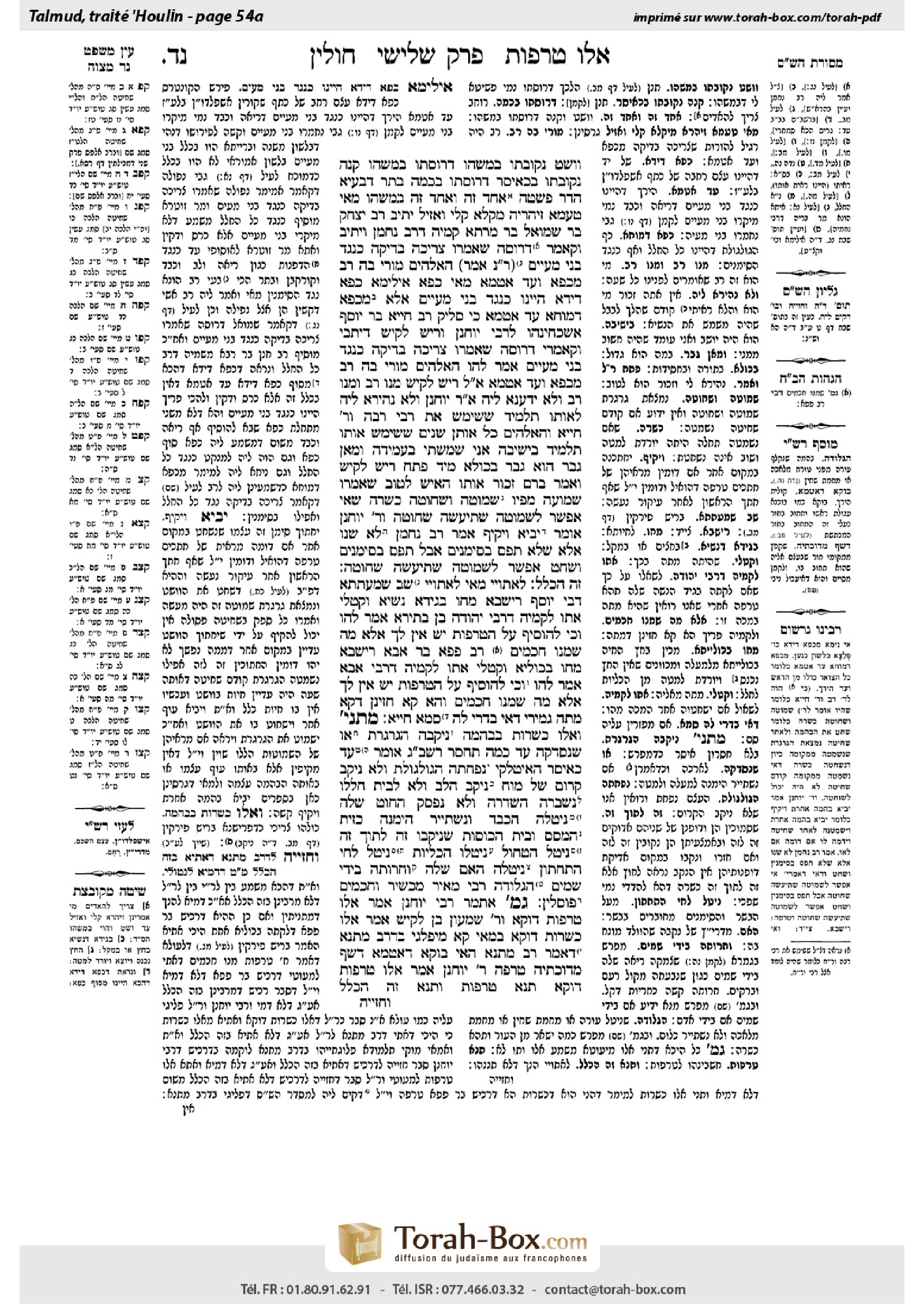
Chullin 54a: Talmud study for Daf Yomi
Study the Talmud for Daf Yomi with scanned pages, Hebrew text, English translations from Sefaria and AI-generated French translations.
Passage selection and English or AI-generated French translation are available where the scan has annotations. Daf Study is independent of Torah-Box and Sefaria.
Browse Chullin · חולין · All tractatesChullin 54a text and translations
This page of Chullin includes the Aramaic text, an English translation and an AI-generated French translation, alongside the scan above.
חולין נ״ד א · Aramaic and Hebrew text
וֶושֶׁט נְקוּבָתוֹ בְּמַשֶּׁהוּ, דְּרוּסָתוֹ בְּמַשֶּׁהוּ. קָנֶה נְקוּבָתוֹ בִּכְאִיסָּר, דְּרוּסָתוֹ בְּכַמָּה? בָּתַר דְּבַעְיָא הֲדַר פַּשְׁטַהּ: אֶחָד זֶה וְאֶחָד זֶה בְּמַשֶּׁהוּ. מַאי טַעְמָא? זִיהֲרֵיהּ מִקְלָא קָלֵי וְאָזֵיל.
יָתֵיב רַב יִצְחָק בַּר שְׁמוּאֵל בַּר מָרְתָּא קַמֵּיהּ דְּרַב נַחְמָן, וְיָתֵיב וְקָאָמַר: דְּרוּסָה שֶׁאָמְרוּ – צְרִיכָה בְּדִיקָה כְּנֶגֶד בְּנֵי מֵעַיִים. רַב נַחְמָן אָמַר: הָאֱלֹהִים! מוֹרֵי בַּהּ רַב מִכַּפָּא וְעַד אַטְמָא.
מַאי כַּפָּא? אִילֵּימָא כַּפָּא דִּידָא – הַיְינוּ כְּנֶגֶד בְּנֵי מֵעַיִים, אֶלָּא מִכַּפָּא דְּמוֹחָא עַד אַטְמָא.
כִּי סְלֵיק רַב חִיָּיא בַּר יוֹסֵף, אַשְׁכְּחִינְהוּ לְרַבִּי יוֹחָנָן וְרֵישׁ לָקִישׁ דְּיָתְבִי וְקָאָמְרִי: דְּרוּסָה שֶׁאָמְרוּ – צְרִיכָה בְּדִיקָה כְּנֶגֶד בְּנֵי מֵעַיִים. אֲמַר לְהוּ: הָאֱלֹהִים! מוֹרֵי בַּהּ רַב מִכַּפָּא וְעַד אַטְמָא. אֲמַר לֵיהּ רֵישׁ לָקִישׁ: מַנּוּ רַב וּמַנּוּ רַב? וְלָא יָדַעְנָא לֵיהּ!
אָמַר רַבִּי יוֹחָנָן: וְלָא נְהִירָא לֵיהּ לְאוֹתוֹ תַּלְמִיד שֶׁשִּׁימֵּשׁ אֶת רַבִּי רַבָּה, וְרַבִּי חִיָּיא? וְהָאֱלֹהִים! כׇּל אוֹתָן שָׁנִים שֶׁשִּׁימֵּשׁ אוֹתוֹ תַּלְמִיד בִּישִׁיבָה, אֲנִי שִׁמַּשְׁתִּי בַּעֲמִידָה, וּמַאן גְּבַר? הוּא גְּבַר בְּכוֹלָּא.
מִיָּד פָּתַח רֵישׁ לָקִישׁ וַאֲמַר: בְּרַם זָכוּר אוֹתוֹ הָאִישׁ לַטּוֹב, שֶׁאָמְרוּ שְׁמוּעָה מִפִּיו: שְׁמוּטָה וּשְׁחוּטָה – כְּשֵׁרָה, שֶׁאִי אֶפְשָׁר לַשְּׁמוּטָה שֶׁתֵּיעָשֶׂה שְׁחוּטָה.
וְרַבִּי יוֹחָנָן אוֹמֵר: יָבִיא וְיַקִּיף.
אָמַר רַב נַחְמָן: לֹא שָׁנוּ אֶלָּא שֶׁלֹּא תָּפַס בְּסִימָנִים, אֲבָל תָּפַס בְּסִימָנִים וְשָׁחַט – אֶפְשָׁר לַשְּׁמוּטָה שֶׁתֵּיעָשֶׂה שְׁחוּטָה.
זֶה הַכְּלָל, לְאֵתוֹיֵי מַאי? לְאֵתוֹיֵי שַׁב שְׁמַעְתָּתָא.
דְּבֵי יוֹסֵף רִישְׁבָּא מָחוּ בְּגִידָא נַשְׁיָא וְקָטְלִי, אֲתוֹ לְקַמֵּיהּ דְּרַבִּי יְהוּדָה בֶּן בְּתֵירָא, אֲמַר לְהוּ: וְכִי לְהוֹסִיף עַל הַטְּרֵפוֹת יֵשׁ? אֵין לְךָ אֶלָּא מַה שֶּׁמָּנוּ חֲכָמִים!
רַב פָּפָּא בַּר אַבָּא רִישְׁבָּא, מָחוּ בְּכוּלְיָא וְקָטְלִי. אֲתוֹ לְקַמֵּיהּ דְּרַבִּי אַבָּא, אֲמַר לְהוּ: וְכִי לְהוֹסִיף עַל הַטְּרֵפוֹת יֵשׁ? אֵין לְךָ אֶלָּא מַה שֶּׁמָּנוּ חֲכָמִים!
וְהָא קָא חָזֵינַן דְּקָא מֵתָה! גְּמִירִי דְּאִי בָּדְרִי לַהּ סַמָּא, חַיָּיא.
מַתְנִי׳ וְאֵלּוּ כְּשֵׁרוֹת בַּבְּהֵמָה, נִיקְּבָה הַגַּרְגֶּרֶת אוֹ שֶׁנִּסְדְּקָה. עַד כַּמָּה תֶּחְסַר? רַבָּן שִׁמְעוֹן בֶּן גַּמְלִיאֵל אוֹמֵר: עַד כְּאִיסָּר הָאִיטַלְקִי. נִפְחֲתָה הַגּוּלְגּוֹלֶת וְלֹא נִיקַּב קְרוּם שֶׁל מוֹחַ, נִיקַּב הַלֵּב וְלֹא לְבֵית חֲלָלוֹ, נִשְׁבְּרָה הַשִּׁדְרָה וְלֹא נִפְסַק הַחוּט שֶׁלָּהּ, נִיטְּלָה הַכָּבֵד וְנִשְׁתַּיֵּיר הֵימֶנָּה כְּזַיִת.
הֶמְסֵס וּבֵית הַכּוֹסוֹת, שֶׁנִּיקְּבוּ זֶה לְתוֹךְ זֶה. נִיטַּל הַטְּחוֹל, נִיטְּלוּ הַכְּלָיוֹת, נִיטַּל לֶחִי הַתַּחְתּוֹן, נִיטְּלָה הָאֵם שֶׁלָּהּ, וַחֲרוּתָה בִּידֵי שָׁמַיִם. הַגְּלוּדָה – רַבִּי מֵאִיר מַכְשִׁיר, וַחֲכָמִים פּוֹסְלִין.
גְּמָ׳ אִתְּמַר: רַבִּי יוֹחָנָן אָמַר: ״אֵלּוּ טְרֵפוֹת״ דַּוְקָא, וְרַבִּי שִׁמְעוֹן בֶּן לָקִישׁ אָמַר: ״אֵלּוּ כְּשֵׁרוֹת״ דַּוְקָא.
בְּמַאי קָא מִיפַּלְגִי? בִּדְרַב מַתְנָא, דְּאָמַר רַב מַתְנָא: הַאי בּוּקָא דְּאַטְמָא דְּשָׁף מִדּוּכְתֵּיהּ – טְרֵפָה. רַבִּי יוֹחָנָן אָמַר: ״אֵלּוּ טְרֵפוֹת״ דַּוְקָא, תְּנָא טְרֵפוֹת, וּתְנָא ״זֶה הַכְּלָל״,
Chullin 54a · English translation
If the gullet is perforated in any amount, the animal is a tereifa, as taught in the mishna (42a). Therefore, if the gullet is clawed and any amount of its flesh reddens, the animal is a tereifa as well. But a perforation of the windpipe renders the animal a tereifa only where it is the size of an issar. If clawed, what amount of its flesh must redden in order to render it a tereifa? After he raised the dilemma he then resolved it: Both this and that render the animal a tereifa if any amount of its flesh reddened. What is the reason for this? It is because its venom burns continuously around the circumference of the hole and widens it.
The Gemara relates: Rav Yitzḥak bar Shmuel bar Marta sat before Rav Naḥman, and he was sitting and saying: A clawed animal, about which the Sages said one must be concerned, requires inspection adjacent to the intestines to see that the flesh has not reddened. Rav Naḥman said to him: By God! Rav would teach that it must be inspected over its entire body, from the flesh around the hollow to that of the thigh.
The Gemara asks: What is the hollow? If we say that it is the hollow of the foreleg, i.e., its shoulder, then the area between it and the thigh is the same as the area adjacent to the intestines, and Rav Naḥman has said nothing new. Rather, Rav Naḥman referred to the area from the hollow of the brain, i.e., the skull, to the thigh.
The Gemara relates that when Rav Ḥiyya bar Yosef went up from Babylonia to Eretz Yisrael, he found that Rabbi Yoḥanan and Reish Lakish were sitting and saying: A clawed animal, about which they said one must be concerned, requires inspection adjacent to the intestines. Rav Ḥiyya bar Yosef said to them: By God! Rav would teach that it must be inspected from the flesh around the hollow to that of the thigh. Reish Lakish said to him: Who is this Rav, and who is this Rav? I do not know who he is.
Rabbi Yoḥanan said to him: But don’t you remember that student who served the great Rabbi Yehuda HaNasi and Rabbi Ḥiyya and studied under them? But by God! All those years that this student served in the yeshiva, he was held to be one of the most important students and was allowed to sit during study, while I held a lower status and served while standing up. And who was greater? He was greater in all things, in Torah and piety.
Immediately, Reish Lakish began to speak and said: Indeed [beram], that man, Rav, is remembered for the good, as they said this halakha in his name: If an animal’s windpipe is dislocated from the throat, and it has already been slaughtered, and it is uncertain whether it was dislocated before or after slaughter, the animal is kosher, as it is impossible for an animal with a dislocated windpipe to be slaughtered. A dislocated windpipe would have slipped away from the knife, and therefore the animal must have been slaughtered while it was still attached.
And Rabbi Yoḥanan says: This is not certain; rather, one should bring the windpipe, make a new slit in it, and compare the two slits. If they are similar, then the first slit by the slaughtering knife was also made after the windpipe was dislocated, and the animal is a tereifa. If they are different, then the slaughter preceded the dislocation of the windpipe and the animal is kosher.
Rav Naḥman said: The Sages taught that it is impossible to slaughter a dislocated windpipe only in cases where he did not grip the simanim during slaughter. But if he gripped the simanim and slaughtered the animal, then it is possible for an animal with a dislocated windpipe to be slaughtered, since it will not slip away from the knife.
§ The mishna states: This is the principle: Any animal that was injured such that an animal in a similar condition could not live for an extended period is a tereifa. The Gemara asks: What case does this principle add that was not previously mentioned? The Gemara responds: It was stated to add seven halakhot of tereifot taught by amora’im and not listed in the mishna. These cases are enumerated on 42b.
The Gemara recounts: The men of the house of Yosef the hunter would strike the sciatic nerve of an animal with an arrow and kill it that way. In other words, the animal would die from that wound. They came before Rabbi Yehuda ben Beteira to ask if an animal with an injured sciatic nerve is a tereifa, which is relevant if the animal was slaughtered before it died. Rabbi Yehuda ben Beteira said to them: And is it possible to add to the list of tereifot? You have only what the Sages counted, and the Sages mentioned no such tereifa.
Likewise, the men of Rav Pappa bar Abba the hunter would strike an animal in the kidney with an arrow and kill it that way. They came before Rabbi Abba to ask if such an animal is a tereifa. Rabbi Abba said to them: And is it possible to add to the list of tereifot? You have only what the Sages counted.
The Gemara objects: But we see that they die. Isn’t this an indication that the animal is a tereifa? The Gemara responds: It is learned as a tradition that in all these cases, if one were to scatter medicine on the wound, the animal would live. An animal is not considered a tereifa unless it cannot be healed.
MISHNA: And these, despite their condition, are kosher in an animal: If its windpipe was perforated or cracked lengthwise. How much can the windpipe be missing and still be kosher? Rabban Shimon ben Gamliel says: Until the perforation is the same size as the Italian issar. If the skull was fractured but the membrane of the brain was not perforated, it is kosher. If the heart was perforated and the perforation did not reach its chamber, or if the spinal column was broken but its cord was not cut, or if the liver was removed and an olive-bulk of it remained, it is kosher.
Additionally, it is kosher if the omasum or the reticulum was perforated one into the other. If the spleen was removed, or the kidneys were removed, or if its lower jaw was removed, or if its womb was removed, or if its lung shriveled by the hand of Heaven, the animal is kosher. In the case of an animal whose hide was removed, Rabbi Meir deems it kosher, and the Rabbis deem it a tereifa and unfit for consumption.
GEMARA: The mishna begins: And these are kosher, while the previous mishna begins: These are tereifot. With regard to this, it was stated that Rabbi Yoḥanan says: The tanna intended the phrase: These are tereifot, specifically, teaching that an animal is kosher in another case. The list of kosher cases here is therefore not exhaustive. And Rabbi Shimon ben Lakish says that the tanna intended the phrase: These are kosher, specifically, teaching that an animal is a tereifa in another case. The list of tereifot at the beginning of the chapter is therefore not exhaustive.
The Gemara explains: With regard to what case do they disagree? They disagree with regard to the statement of Rav Mattana, as Rav Mattana says: This head of the femur that was completely dislocated renders the animal a tereifa. According to Rabbi Yoḥanan, who says that the phrase: These are tereifot, is meant specifically, the tanna taught the list of tereifot and taught afterward: This is the principle, to add cases that were not stated explicitly;
Chullin 54a · Traduction française (IA)
Si le gosier est percé d'une quantité quelconque, l'animal est un tereifa, comme enseigné dans la Michna (42a). Ainsi, si le gosier est égraté et que toute quantité de sa chair rougit, l'animal est également un tereifa. Mais une perforation du larynx rend l'animal tereifa uniquement si la taille est celle d'un issar. Si l'animal est égraté, quelle quantité de chair doit rougir pour que l'animal soit tereifa ? Après qu'il ait soulevé ce problème, il l'a résolu ainsi : à la fois cette situation et celle-ci rendent l'animal tereifa si toute quantité de sa chair rougit. Quelle est la raison de cela ? C'est parce que son venin brûle continuellement autour du trou et l'élargit.
La Guemara rapporte : Rav Yitzḥak bar Shmuel bar Marta était assis devant Rav Naḥman, et il était assis en disant : Un animal égraté, à propos duquel les Sages ont dit qu'on doit en avoir peur, nécessite une inspection près des intestins pour vérifier que la chair n'a pas rougi. Rav Naḥman a dit à lui : Par le Seigneur ! Rav enseignait que l'animal doit être inspecté sur tout son corps, de la chair autour du vide jusqu'à celle de la cuisse.
La Guemara pose la question : Quel est ce vide ? Si nous disons qu'il s'agit du vide du cou, c'est-à-dire de l'épaule, alors la zone entre celui-ci et la cuisse est la même que la zone près des intestins, et Rav Naḥman n'a rien dit de nouveau. Plutôt, Rav Naḥman faisait référence à la zone allant du vide du cerveau, c'est-à-dire du crâne, jusqu'à la cuisse.
La Guemara rapporte que lorsqu'Rav Ḥiyya bar Yosef est monté de Babylone vers la Terre d'Israël, il a trouvé que Rabbi Yoḥanan et Reish Lakish étaient assis en disant : Un animal égraté, à propos duquel ils ont dit qu'on doit en avoir peur, nécessite une inspection près des intestins. Rav Ḥiyya bar Yosef a dit à eux : Par le Seigneur ! Rav enseignait que l'animal doit être inspecté de la chair autour du vide jusqu'à celle de la cuisse. Reish Lakish a dit à lui : Qui est ce Rav, et qui est ce Rav ? Je ne le connais pas.
Rabbi Yoḥanan a dit à lui : N'êtes-vous pas en mesure de vous souvenir de ce disciple qui servait le grand Rabbi Yehuda HaNasi et Rabbi Ḥiyya et étudiait sous leur tutelle ? Mais par le Seigneur ! Tous ces années que ce disciple a passé dans la yeshiva, il était considéré comme l'un des étudiants les plus importants et était autorisé à s'asseoir pendant les études, tandis que je tenais un statut inférieur et servais debout. Et qui était le plus grand ? Il était plus grand en tout, en Torah et en piété.
Immédiatement, Reish Lakish a commencé à parler et a dit : En effet [beram], cette personne, Rav, est reconnue pour le bien, car ils ont dit cette halakha en son nom : Si le larynx d'un animal est délogeé du cou, et qu'il a déjà été sacrifié, et si on ne sait pas s'il a été délogeé avant ou après la sacrifice, l'animal est acceptable, car il est impossible qu'un animal avec un larynx délogeé soit sacrifié. Un larynx délogeé aurait glissé hors du couteau, et donc l'animal a dû être sacrifié alors qu'il était encore attaché.
Et Rabbi Yoḥanan dit : Ce n'est pas certain ; plutôt, on doit présenter le larynx, faire un nouveau fendage et comparer les deux fendages. Si ils sont semblables, alors le premier fendage fait par le couteau de sacrifice a également été fait après que le larynx ait été délogeé, et l'animal est un tereifa. Si ils sont différents, alors la boucherie a précédé la déloge du larynx et l'animal est acceptable.
Rav Naḥman dit : Les Sages ont enseigné que l'on ne peut boucher un larynx délogeé que dans les cas où l'on n'a pas tenu les simanim lors de la boucherie. Mais si l'on a tenu les simanim et bouché l'animal, alors il est possible que l'animal avec un larynx délogeé soit bouché, car il ne glissera pas hors du couteau.
§ La mitsna stipule : C'est le principe : Tout animal blessé de sorte qu'un animal dans une condition similaire ne pourrait pas vivre pendant une longue période est un tereifa. La Guemara pose la question : Quel cas ce principe ajoute-t-il qui n'avait pas été mentionné auparavant ? La Guemara répond : C'était dit pour ajouter sept halakhot de tereifot enseignés par les amora’im et non listés dans la mitsna. Ces cas sont énumérés sur 42b.
La Guemara rapporte : Les hommes de la maison de Yosef le chasseur frappaient le nerf sciatique d'un animal avec une flèche et le tua ainsi. En d'autres termes, l'animal mourait de cette blessure. Ils se sont présentés devant Rabbi Yehuda ben Beteira pour demander si un animal avec un nerf sciatique blessé est un tereifa, ce qui est pertinent si l'animal a été sacrifié avant de mourir. Rabbi Yehuda ben Beteira a dit à eux : Et est-il possible d'ajouter à la liste des tereifot ? Vous avez seulement ce que les Sages ont compté, et les Sages n'ont mentionné aucun tel tereifa.
De même, les hommes de Rav Pappa bar Abba le chasseur frappaient un animal dans le rein avec une flèche et le tua ainsi. Ils se sont présentés devant Rabbi Abba pour demander si un tel animal est un tereifa. Rabbi Abba a dit à eux : Et est-il possible d'ajouter à la liste des tereifot ? Vous avez seulement ce que les Sages ont compté.
La Guemara s'oppose : Mais nous voyons qu'ils meurent. N'est-ce pas une indication que l'animal est un tereifa ? La Guemara répond : C'est appris comme une tradition que dans tous ces cas, si l'on répandait un remède sur la plaie, l'animal vivrait. Un animal n'est pas considéré comme un tereifa à moins qu'il ne puisse être guéri.
MICHNA : Et ces animaux, malgré leur condition, sont acceptables : Si leur larynx était percé ou fissuré longitudinalement. Quelle quantité peut manquer au larynx et être encore acceptable ? Rabban Shimon ben Gamliel dit : Jusqu'à ce que la perforation soit de la taille d'un issar italien. Si le crâne était fracturé mais la membrane du cerveau n'était pas percée, il est acceptable. Si le cœur était percé et la perforation n'avait pas atteint sa cavité, ou si la colonne vertébrale était brisée mais son fil n'était pas coupé, ou si le foie avait été retiré et une quantité d'olive restait, il est acceptable.
De plus, c'est aussi permis si l'omophage ou le réseau était percé l'un dans l'autre. Si le foie a été retiré, ou les reins, ou si la mâchoire inférieure a été enlevée, ou si le ventre a été retiré, ou si les poumons ont atrophié par la main du Ciel, l'animal est permis. Dans le cas d'un animal dont la peau a été retirée, le maître Moïr le considère comme permis, et les Sages le considèrent comme un tereifa et non comestible.
GUEMARA : La mitsva commence par : Et ces animaux sont permis, tandis que la mitsva précédente commence par : Ces animaux sont tereifot. En ce qui concerne cela, il a été dit que le maître Yochanan dit : Le tanna voulait dire par la phrase : Ces animaux sont tereifot, spécifiquement, enseignant que l'animal est permis dans un autre cas. La liste des cas permis ici n'est donc pas exhaustive. Et le maître Shim'on ben Lakish dit que le tanna voulait dire par la phrase : Ces animaux sont permis, spécifiquement, enseignant que l'animal est tereifa dans un autre cas. La liste des tereifot au début du chapitre n'est donc pas exhaustive.
La Guemara explique : À quel cas se réfèrent-ils ? Ils se réfèrent à la déclaration du maître Mattana, car le maître Mattana dit : Cette tête du fémur qui a été complètement délogeée rend l'animal tereifa. Selon le maître Yochanan, qui dit que la phrase : Ces animaux sont tereifot, est entendue spécifiquement, le tanna a enseigné la liste des tereifot et a ensuite enseigné : C'est le principe, pour ajouter des cas qui n'ont pas été mentionnés explicitement ;
Traduction française générée par IA à partir de l’édition anglaise de Sefaria. Vérifie toujours un passage avec le texte source.
Text from Sefaria: William Davidson Edition - Vocalized Aramaic (unknown); William Davidson Edition - English (CC BY NC).