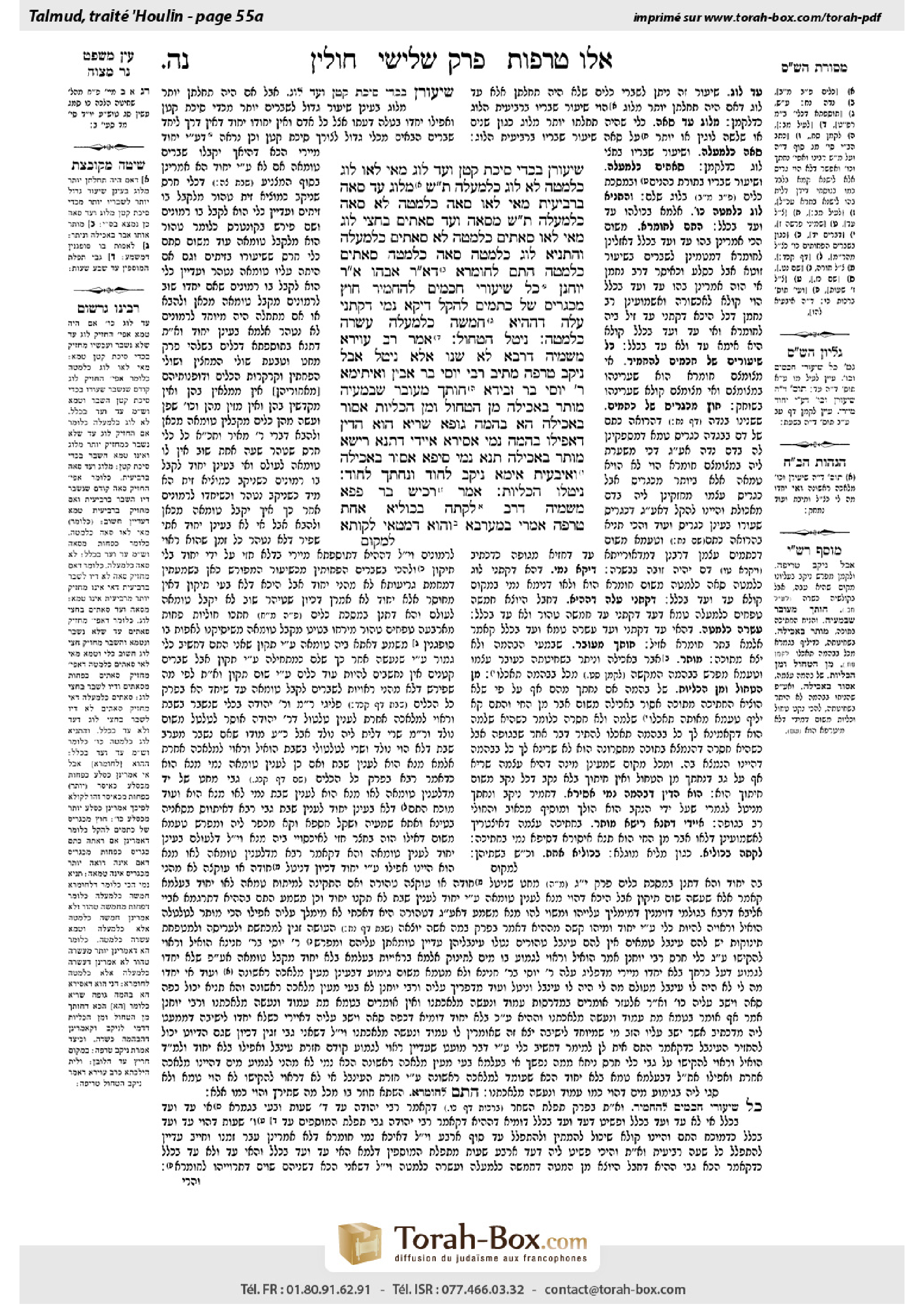
Chullin 55a: Talmud study for Daf Yomi
Study the Talmud for Daf Yomi with scanned pages, Hebrew text, English translations from Sefaria and AI-generated French translations.
Passage selection and English or AI-generated French translation are available where the scan has annotations. Daf Study is independent of Torah-Box and Sefaria.
Browse Chullin · חולין · All tractatesChullin 55a text and translations
This page of Chullin includes the Aramaic text, an English translation and an AI-generated French translation, alongside the scan above.
חולין נ״ה א · Aramaic and Hebrew text
שִׁיעוּרָן בִּכְדֵי סִיכַת קָטָן וְעַד לוֹג. מַאי לָאו לוֹג כִּלְמַטָּה? לֹא, לוֹג כִּלְמַעְלָה.
תָּא שְׁמַע: מִלּוֹג עַד סְאָה – בִּרְבִיעִית, מַאי לָאו סְאָה כִּלְמַטָּה? לָא, סְאָה כִּלְמַעְלָה.
תָּא שְׁמַע: מִסְּאָה וְעַד סָאתַיִם – בַּחֲצִי לוֹג, מַאי לָאו סָאתַיִם כִּלְמַטָּה? לָא, סָאתַיִם כִּלְמַעְלָה.
וְהָתַנְיָא: לוֹג – כִּלְמַטָּה, סְאָה – כִּלְמַטָּה, סָאתַיִם – כִּלְמַטָּה.
הָתָם לְחוּמְרָא, דְּאָמַר רַבִּי אֲבָהוּ אָמַר רַבִּי יוֹחָנָן: כׇּל שִׁיעוּרֵי חֲכָמִים לְהַחְמִיר, חוּץ מִכִּגְרִיס שֶׁל כְּתָמִים לְהָקֵל.
דַּיְקָא נָמֵי, דְּקָתָנֵי עֲלַהּ דְּהַהִיא: חֲמִשָּׁה – כִּלְמַעְלָה, עֲשָׂרָה – כִּלְמַטָּה.
נִיטַּל הַטְּחוֹל, אָמַר רַב עַוִּירָא מִשְּׁמֵיהּ דְּרָבָא: לֹא שָׁנוּ אֶלָּא נִיטַּל, אֲבָל נִיקַּב – טְרֵפָה.
מֵתִיב רַבִּי יוֹסֵי בַּר אָבִין, וְאִיתֵּימָא רַבִּי יוֹסֵי בַּר זְבִידָא: חוֹתֵךְ מֵעוּבָּר שֶׁבְּמֵעֶיהָ – מוּתָּר בַּאֲכִילָה, מִן הַטְּחוֹל וּמִן הַכְּלָיוֹת – אָסוּר בַּאֲכִילָה. הָא בְּהֵמָה גּוּפַהּ שַׁרְיָא!
הוּא הַדִּין דַּאֲפִילּוּ בְּהֵמָה נָמֵי אֲסִירָא, אַיְּידֵי דִּתְנָא רֵישָׁא ״מוּתָּר בַּאֲכִילָה״, תְּנָא נָמֵי סֵיפָא ״אָסוּר בַּאֲכִילָה״. וְאִיבָּעֵית אֵימָא: נִיקַּב לְחוֹד, וְנֶחְתַּךְ לְחוּד.
נִיטְּלוּ הַכְּלָיוֹת. אָמַר רָכִישׁ בַּר פָּפָּא מִשְּׁמֵיהּ דְּרַב: לָקְתָה בְּכוּלְיָא אַחַת – טְרֵפָה. אָמְרִי בְּמַעְרְבָא: וְהוּא דִּמְטַאי לָקוּתָא
Chullin 55a · English translation
their measure in order to be susceptible to ritual impurity is that they can hold enough oil with which to anoint a small child. If they cannot hold this amount, they are considered useless and are not susceptible to impurity. And this measure applies only to vessels that held up to a log when they were whole; if they had originally held more, they must hold more when broken in order to be susceptible to impurity. What, is it not teaching that if it originally held exactly one log it is treated as though it had held below that amount? If so, the term: Up to, means up to and including. The Gemara responds: No, if it held exactly one log it is treated as though it held above that amount, and if broken it must be capable of holding a greater measure in order to be susceptible to impurity.
The Gemara suggests: Come and hear proof from the continuation of the same mishna: If the vessel originally held from a log up to a se’a, its broken-off base or sides must hold a quarter-log in order to be susceptible to impurity. What, is it not teaching that if it originally held exactly a se’a it is treated as though it had held below that amount? The Gemara responds: No, if it held exactly a se’a it is treated as though it had held above that amount, and its base or sides must hold a greater measure in order to be susceptible to impurity.
The Gemara suggests: Come and hear proof from the continuation of the same mishna: If the vessel had originally held from a se’a up to two se’a, its broken-off base or sides must hold half a log to be susceptible to impurity. What, is it not teaching that if it had originally held exactly two se’a it is treated as if though it had held below that amount? The Gemara responds: No, if it had held exactly two se’a it is treated as though it had held above that amount.
The Gemara asks: How can one explain the mishna in this manner? But isn’t it taught explicitly in a baraita: If the vessel had originally held exactly a log it is treated as though it had held below that amount; if it had held exactly a se’a it is treated as though it had held below that amount; if it had held exactly two se’a it is treated as though it had held below that amount? Evidently, the term: Up to, means up to and including the given measure, in contradiction to Rav Naḥman’s opinion that it means up to and not including the measure.
The Gemara responds: The term: Up to, is always interpreted in the more stringent manner. Accordingly, there, with regard to the impurity of vessels, the term: Up to, is interpreted as up to and including in order to rule stringently, since the vessel is then more easily susceptible to impurity. As Rabbi Abbahu says that Rabbi Yoḥanan says: All measures of the Sages must be interpreted stringently, except for the measure of a groat as a standard for stains of blood found on a woman’s clothing, which is interpreted leniently. Even if the stain is exactly the size of a groat, the woman remains pure. Here, it is more stringent to interpret the phrase: Up to, as up to and including, because an animal is then more susceptible to being rendered a tereifa.
The Gemara notes: The language is also precise, i.e., it is evident that the phrase: Up to, is always interpreted stringently, as the mishna (Kelim 19:2) states that if a rope extending from a rope bed is of any length up to five handbreadths, it is not susceptible to ritual impurity, but if it is of any length from five up to ten handbreadths, it is susceptible. And a baraita teaches with regard to that mishna: If the rope was exactly five handbreadths long, it is treated as though its length were above that; if the rope was exactly ten handbreadths long, it is treated as though its length were below that. In both cases, the measure is interpreted stringently.
§ The mishna states: If the spleen was removed the animal remains kosher. Rav Avira says in the name of Rava: The Sages taught that it is kosher only when the spleen was removed, but if it was perforated, it is a tereifa.
Rabbi Yosei bar Avin, and some say Rabbi Yosei bar Zevida, raises an objection from a mishna in the next chapter (68a): If, prior to slaughtering an animal, one severs pieces from a fetus that is in the womb and leaves those pieces in the womb, their consumption is permitted by virtue of the slaughter of the mother animal (see 69a). By contrast, if one severs pieces of the spleen or of the kidneys of an animal and then slaughters it, then even if those pieces are left inside the animal their consumption is prohibited, because an organ severed from a living being is not permitted by the subsequent slaughter of the animal. One can infer from the mishna that the animal itself is permitted even when part of the spleen was severed. Evidently, such an animal is not a tereifa.
The Gemara responds: The same is true of the animal, and even the animal is prohibited. But since the mishna taught in the first clause, with regard to the parts of the fetus: Their consumption is permitted, it taught in the last clause with regard to the parts of the spleen: Their consumption is prohibited, to contrast between them. Or, if you wish, say instead that a perforated spleen is a discrete case, in which the animal is a tereifa, and a cut spleen is a discrete case, in which the animal is not.
§ The mishna states: If the kidneys were removed the animal remains kosher. Rakhish bar Pappa said in the name of Rav: If an animal was diseased in even one kidney, the animal is a tereifa. In the West, Eretz Yisrael, they say: And this applies only in a case where the disease reached
Chullin 55a · Traduction française (IA)
Leur mesure, afin d'être susceptible de souillure rituelle, est qu'ils peuvent contenir assez d'huile pour animer un petit enfant. Si ils ne peuvent pas contenir cette quantité, ils sont considérés comme inutiles et ne sont pas susceptibles de souillure. Et cette mesure s'applique uniquement aux récipients qui, lorsqu'ils étaient entiers, pouvaient contenir jusqu'à un log ; si ils avaient initialement contenu plus, ils doivent contenir plus lorsqu'ils sont brisés pour être susceptibles de souillure. Qu'est-ce que cela ne montre pas que si ils avaient initialement contenu exactement un log, ils sont traités comme s'ils avaient contenu en dessous de cette quantité ? Si tel est le cas, le terme : Jusqu'à, signifie jusqu'au seuil inclusif. La Guemara répond : Non, si ils avaient contenu exactement un log, ils sont traités comme s'ils avaient contenu au-delà de cette quantité, et si brisés, ils doivent être capables de contenir une mesure supérieure pour être susceptibles de souillure.
La Guemara suggère : Viens écouter la preuve à partir de la continuation de la même Michna : Si le récipient avait initialement contenu entre un log et une se'a, sa base ou ses côtés brisés doivent contenir un quart de log pour être susceptible de souillure. Qu'est-ce que cela ne montre pas que si il avait initialement contenu exactement une se'a, il est traité comme s'il avait contenu en dessous de cette quantité ? La Guemara répond : Non, si il avait contenu exactement une se'a, il est traité comme s'il avait contenu au-delà de cette quantité, et sa base ou ses côtés doivent contenir une mesure supérieure pour être susceptible de souillure.
La Guemara suggère : Viens écouter la preuve à partir de la continuation de la même Michna : Si le récipient avait initialement contenu entre une se'a et deux se'a, sa base ou ses côtés brisés doivent contenir demi-log pour être susceptible de souillure. Qu'est-ce que cela ne montre pas que si il avait initialement contenu exactement deux se'a, il est traité comme s'il avait contenu en dessous de cette quantité ? La Guemara répond : Non, si il avait contenu exactement deux se'a, il est traité comme s'il avait contenu au-delà de cette quantité.
La Guemara pose la question : Comment peut-on expliquer la Michna ainsi ? Mais n'est-il pas enseigné explicitement dans une baraïta : Si le récipient avait initialement contenu exactement un log, il est traité comme s'il avait contenu en dessous de cette quantité ; si le récipient avait contenu exactement une se'a, il est traité comme s'il avait contenu en dessous de cette quantité ; si le récipient avait contenu exactement deux se'a, il est traité comme s'il avait contenu en dessous de cette quantité ? Évidemment, le terme : Jusqu'à, signifie jusqu'au seuil inclusif, en contradiction avec l'opinion de Rav Naḥman qui considère que cela signifie jusqu'au seuil exclu.
La Guemara répond : Le terme : Jusqu'à, est toujours interprété dans le sens le plus strict. Ainsi, concernant la souillure des récipients, le terme : Jusqu'à, est interprété comme jusqu'au seuil inclusif afin de rendre la règle plus stricte, car le récipient est alors plus facilement susceptible de souillure. Comme Rabbi Abbahu dit que Rabbi Yoḥanan dit : Toutes les mesures des Sages doivent être interprétées de manière stricte, sauf la mesure d'un gros comme norme pour les taches de sang trouvées sur les vêtements d'une femme, qui est interprétée de manière clémente. Même si la tache est exactement la taille d'un gros, la femme reste pure. Ici, il est plus stricte d'interpréter le terme : Jusqu'à, comme jusqu'au seuil inclusif, car l'animal est alors plus susceptible d'être rendu tereifa.
La Guemara note : Le langage est aussi précis, c'est-à-dire il est évident que le terme : Jusqu'à, est toujours interprété de manière stricte, comme la Michna (Kelim 19:2) stipule que si une corde prolongeant un lit de corde est de toute longueur jusqu'à cinq paumes, elle n'est pas susceptible de souillure rituelle, mais si elle est de toute longueur de cinq à dix paumes, elle est susceptible. Et une baraïta enseigne concernant cette Michna : Si la corde était exactement de cinq paumes de long, elle est traitée comme si sa longueur était au-delà de celle-ci ; si la corde était exactement de dix paumes de long, elle est traitée comme si sa longueur était en dessous de celle-ci. Dans les deux cas, la mesure est interprétée de manière stricte.
§ La Michna stipule : Si le foie a été retiré, l'animal reste kasher. Rav Avira dit en nom de Rava : Les Sages ont enseigné qu'il est kasher uniquement lorsque le foie a été retiré, mais si celui-ci a été perforé, il est tereifa.
Rabbi Yosei bar Avin, et certains disent Rabbi Yosei bar Zevida, émet une objection à partir d'une Michna du chapitre suivant (68a) : Si, avant d'abattre un animal, on coupe des morceaux d'un fœtus qui est dans l'utérus et on laisse ces morceaux dans l'utérus, leur consommation est permise grâce à l'abattage de l'animal mère (voir 69a). À l'inverse, si on coupe des morceaux du foie ou des reins d'un animal et ensuite on l'abat, alors même si ces morceaux restent à l'intérieur de l'animal, leur consommation est interdite, car un organe coupé d'un être vivant n'est pas permis par l'abattage ultérieur de l'animal. On peut en déduire de la Michna que l'animal lui-même est permis même lorsque partie du foie a été coupée. Évidemment, un tel animal n'est pas tereifa.
La Guemara répond : C'est pareil pour l'animal, et même l'animal est interdit. Mais puisque la Michna a enseigné dans la première clause, concernant les parties du fœtus : Leur consommation est permise, elle a enseigné dans la dernière clause concernant les parties du rein : Leur consommation est interdite, pour contraster entre elles. Ou, si vous préférez, dites plutôt qu'un rein perforé est un cas distinct, dans lequel l'animal est tereifa, et un rein coupé est un cas distinct, dans lequel l'animal n'est pas.
§ La Michna stipule : Si les reins ont été retirés, l'animal reste kasher. Rakhish bar Pappa dit en nom de Rav : Si un animal était malade même dans un rein, l'animal est tereifa. Dans l'Ouest, Eretz Yisrael, ils disent : Et cela s'applique uniquement dans un cas où la maladie a atteint
Traduction française générée par IA à partir de l’édition anglaise de Sefaria. Vérifie toujours un passage avec le texte source.
Text from Sefaria: William Davidson Edition - Vocalized Aramaic (unknown); William Davidson Edition - English (CC BY NC).