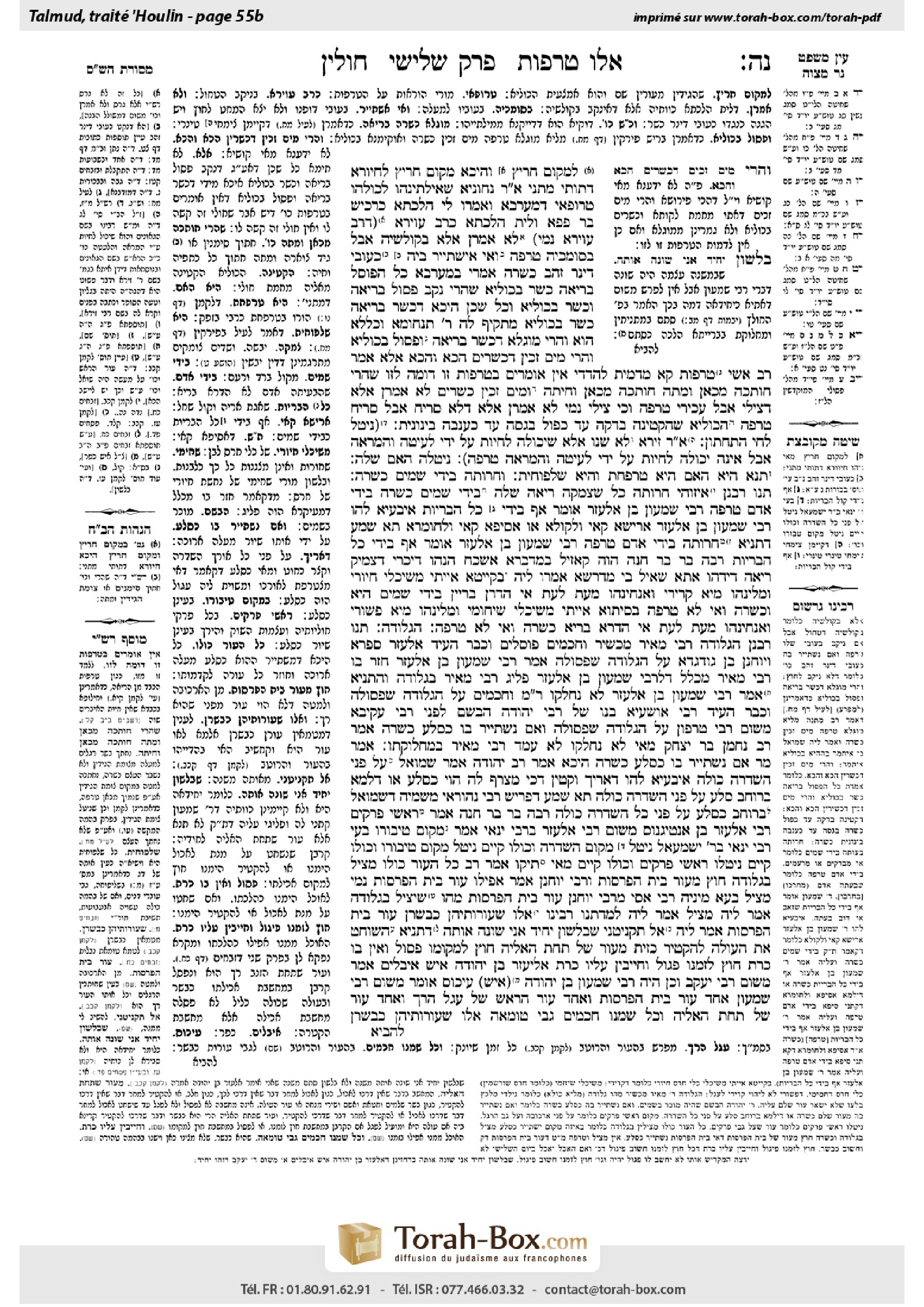
Chullin 55b: Talmud study for Daf Yomi
Study the Talmud for Daf Yomi with scanned pages, Hebrew text, English translations from Sefaria and AI-generated French translations.
Passage selection and English or AI-generated French translation are available where the scan has annotations. Daf Study is independent of Torah-Box and Sefaria.
Browse Chullin · חולין · All tractatesChullin 55b text and translations
This page of Chullin includes the Aramaic text, an English translation and an AI-generated French translation, alongside the scan above.
חולין נ״ה ב · Aramaic and Hebrew text
לִמְקוֹם חָרִיץ. וְהֵיכָא מְקוֹם חָרִיץ? לְחִיוָּרָא דְּתוּתֵי מׇתְנֵי. אָמַר רַב נְחוּנְיָא: שְׁאֵילְתִּינְהוּ לְכוּלְּהוּ טָרוֹפָאֵי דְּמַעְרְבָא, וְאָמְרִי לִי הִלְכְתָא כְּרָכִישׁ בַּר פָּפָּא, וְלֵית הִלְכְתָא כְּרַב עַוִּירָא.
דְּרַב עַוִּירָא נָמֵי לָא אֲמַרַן, אֶלָּא בְּקוּלְשֵׁיהּ, אֲבָל בְּסוּמְכֵיהּ – טְרֵפָה, וְאִי אִישְׁתְּיַיר בֵּיהּ כְּעוֹבִי דִּינַר זָהָב – כְּשֵׁרָה.
אָמְרִי בְּמַעְרְבָא: כׇּל הַפּוֹסֵל בָּרֵיאָה – כָּשֵׁר בַּכּוּלְיָא, שֶׁהֲרֵי נֶקֶב פָּסוּל בָּרֵיאָה, וְכָשֵׁר בַּכּוּלְיָא, וְכׇל שֶׁכֵּן הֵיכָא דְּכָשֵׁר בָּרֵיאָה – כָּשֵׁר בַּכּוּלְיָא.
מַתְקֵיף לַהּ רַבִּי תַּנְחוּמָא: וּכְלָלָא הוּא? הֲרֵי מוּגְלָא, דְּכָשֵׁר בָּרֵיאָה וּפָסוּל בַּכּוּלְיָא! וַהֲרֵי מַיִם זַכִּין, דִּכְשֵׁרִים הָכָא וְהָכָא, אֶלָּא אָמַר רַב אָשֵׁי: טְרֵפוֹת קָא מְדַמֵּית לַהֲדָדֵי? אֵין אוֹמְרִים בִּטְרֵפוֹת זוֹ דּוֹמָה לָזוֹ, שֶׁהֲרֵי חוֹתְכָהּ מִכָּאן וָמֵתָה, חוֹתְכָהּ מִכָּאן וְחָיְתָה.
וּמַיִם זַכִּין כְּשֵׁרִים, לָא אֲמַרַן אֶלָּא דְּצִילִּי, אֲבָל עֲכִירִי – טְרֵפָה. וְכִי צִילִּי נָמֵי לָא אֲמַרַן אֶלָּא דְּלָא סְרִיחַ, אֲבָל סְרִיחַ – טְרֵפָה.
הַכּוּלְיָא שֶׁהִקְטִינָה, בַּדַּקָּה – עַד כְּפוֹל, בַּגַּסָּה – עַד כַּעֲנָבָה בֵּינוֹנִית.
נִיטַּל לֶחִי הַתַּחְתּוֹן, אָמַר רַבִּי זֵירָא: לֹא שָׁנוּ אֶלָּא שֶׁיְּכוֹלָה לִחְיוֹת עַל יְדֵי לְעִיטָה וְהַמְרָאָה, אֲבָל אֵינָהּ יְכוֹלָה לִחְיוֹת עַל יְדֵי לְעִיטָה וְהַמְרָאָה – טְרֵפָה.
נִיטְּלָה הָאֵם שֶׁלָּהּ, תָּנָא: הִיא הָאֵם, הִיא טַרְפַּחַת, וְהִיא שַׁלְפּוּחִית.
וַחֲרוּתָה בִּידֵי שָׁמַיִם – כְּשֵׁרָה. תָּנוּ רַבָּנַן: אֵיזוֹהִי חֲרוּתָה? כֹּל שֶׁצָּמְקָה רֵיאָה שֶׁלָּהּ. בִּידֵי שָׁמַיִם – כְּשֵׁרָה, בִּידֵי אָדָם – טְרֵפָה. רַבִּי שִׁמְעוֹן בֶּן אֶלְעָזָר אוֹמֵר: אַף בִּידֵי כׇּל הַבְּרִיּוֹת.
אִיבַּעְיָא לְהוּ: רַבִּי שִׁמְעוֹן בֶּן אֶלְעָזָר אַרֵישָׁא קָאֵי וּלְקוּלָּא, אוֹ אַסֵּיפָא קָאֵי וּלְחוּמְרָא?
תָּא שְׁמַע, דְּתַנְיָא: חֲרוּתָה בִּידֵי אָדָם – טְרֵפָה, רַבִּי שִׁמְעוֹן בֶּן אֶלְעָזָר אוֹמֵר: אַף בִּידֵי כׇּל הַבְּרִיּוֹת.
רַבָּה בַּר בַּר חָנָה הֲוָה קָאָזֵיל בְּמַדְבְּרָא, אַשְׁכַּח הָנְהוּ דִּיכְרֵי דִּצְמִיק רֵיאָה דִּידְהוּ. אֲתָא שְׁאֵיל בֵּי מִדְרְשָׁא, אֲמַרוּ לֵיהּ: בְּקַיְיטָא – אַיְיתִי מְשִׁיכְלֵי חִיוָּרֵי, וּמַלִּינְהוּ מַיָּא קָרִירֵי, וְאַנְּחִינְהוּ מֵעֵת לְעֵת. אִי הָדְרָן בָּרְיָין – בִּידֵי שָׁמַיִם הִיא וּכְשֵׁרָה, וְאִי לָא – טְרֵפָה. בְּסִיתְוָא – אַיְיתִי מְשִׁיכְלֵי שִׁיחוּמֵי, וּמַלִּינְהוּ מַיָּא פָּשׁוֹרֵי, וְאַנְּחִינְהוּ מֵעֵת לְעֵת. אִי הָדְרָא בָּרְיָא – כְּשֵׁרָה, וְאִי לָא – טְרֵפָה.
הַגְּלוּדָה: תָּנוּ רַבָּנַן: הַגְּלוּדָה – רַבִּי מֵאִיר מַכְשִׁיר וַחֲכָמִים פּוֹסְלִים, וּכְבָר הֵעִיד אֶלְעָזָר סָפְרָא וְיוֹחָנָן בֶּן גּוּדְגְּדָא עַל הַגְּלוּדָה שֶׁפְּסוּלָה. אָמַר רַבִּי שִׁמְעוֹן בֶּן אֶלְעָזָר: חָזַר בּוֹ רַבִּי מֵאִיר.
מִכְּלָל דִּלְרַבִּי שִׁמְעוֹן בֶּן אֶלְעָזָר פְּלִיג רַבִּי מֵאִיר בִּגְלוּדָה? וְהָתַנְיָא: אָמַר רַבִּי שִׁמְעוֹן בֶּן אֶלְעָזָר: לֹא נֶחְלְקוּ רַבִּי מֵאִיר וַחֲכָמִים עַל הַגְּלוּדָה שֶׁפְּסוּלָה, וּכְבָר הֵעִיד רַבִּי אוֹשַׁעְיָא בְּנוֹ שֶׁל רַבִּי יְהוּדָה הַבַּשָּׂם לִפְנֵי רַבִּי עֲקִיבָא מִשּׁוּם רַבִּי טַרְפוֹן עַל הַגְּלוּדָה שֶׁפְּסוּלָה, וְאִם נִשְׁתַּיֵּיר בּוֹ כְּסֶלַע – כְּשֵׁרָה. אָמַר רַב נַחְמָן בַּר יִצְחָק: מַאי ״לֹא נֶחְלְקוּ״? לֹא עָמַד רַבִּי מֵאִיר בְּמַחֲלוֹקְתּוֹ.
אָמַר מָר: אִם נִשְׁתַּיֵּיר בּוֹ כְּסֶלַע – כְּשֵׁרָה. הֵיכָא? אָמַר רַב יְהוּדָה אָמַר שְׁמוּאֵל: עַל פְּנֵי הַשִּׁדְרָה כּוּלָּהּ.
אִיבַּעְיָא לְהוּ: דַּאֲרִיךְ וְקַטִּין, דְּכִי מְצָרֵף לַהּ הָוֵי כְּסֶלַע, אוֹ דִלְמָא בְּרוֹחַב סֶלַע עַל פְּנֵי הַשִּׁדְרָה כּוּלָּהּ? תָּא שְׁמַע, דְּפָרֵישׁ רַבִּי נְהוֹרַאי מִשְּׁמֵיהּ דִּשְׁמוּאֵל: בְּרוֹחַב כְּסֶלַע עַל פְּנֵי כׇּל הַשִּׁדְרָה כּוּלָּהּ.
רַבָּה בַּר בַּר חָנָה אָמַר: רָאשֵׁי פְרָקִים. רַבִּי אֶלְעָזָר בֶּן אַנְטִיגְנוֹס מִשּׁוּם רַבִּי אֶלְעָזָר בְּרַבִּי יַנַּאי אָמַר: מְקוֹם טִיבּוּרוֹ.
בָּעֵי רַבִּי יַנַּאי בְּרַבִּי יִשְׁמָעֵאל: נִיטַּל מְקוֹם הַשִּׁדְרָה וְכוּלּוֹ קַיָּים, נִיטַּל מְקוֹם טִיבּוּרוֹ וְכוּלּוֹ קַיָּים, נִיטְּלוּ רָאשֵׁי פְרָקִים וְכוּלּוֹ קַיָּים, מַאי? תֵּיקוּ.
אָמַר רַב: כׇּל הָעוֹר כּוּלּוֹ מַצִּיל בִּגְלוּדָה, חוּץ מֵעוֹר בֵּית הַפְּרָסוֹת, וְרַבִּי יוֹחָנָן אָמַר: אֲפִילּוּ עוֹר בֵּית הַפְּרָסוֹת נָמֵי מַצִּיל.
בְּעָא מִינֵּיהּ רַבִּי אַסִּי מֵרַבִּי יוֹחָנָן: עוֹר בֵּית הַפְּרָסוֹת מַהוּ שֶׁיַּצִּיל בִּגְלוּדָה? אֲמַר לֵיהּ: מַצִּיל. אֲמַר לֵיהּ, לִמַּדְתָּנוּ רַבֵּינוּ: אֵלּוּ שֶׁעוֹרוֹתֵיהֶן כִּבְשָׂרָן – עוֹר בֵּית הַפְּרָסוֹת! אֲמַר לֵיהּ: אַל תַּקְנִיטֵנִי, שֶׁבִּלְשׁוֹן יָחִיד אֲנִי שׁוֹנֶה אוֹתָהּ.
דְּתַנְיָא: הַשּׁוֹחֵט אֶת הָעוֹלָה לְהַקְטִיר כְּזַיִת מֵעוֹר שֶׁל תַּחַת הָאַלְיָה חוּץ לִמְקוֹמוֹ – פָּסוּל, וְאֵין בּוֹ כָּרֵת; חוּץ לִזְמַנּוֹ – פִּגּוּל, וְחַיָּיבִין עָלָיו כָּרֵת.
אֱלִיעֶזֶר בֶּן יְהוּדָה אִישׁ אֶיבְלַיִם אָמַר מִשּׁוּם רַבִּי יַעֲקֹב, וְכֵן הָיָה רַבִּי שִׁמְעוֹן בֶּן יְהוּדָה אִישׁ [כְּפַר] עִיכּוּס אוֹמֵר מִשּׁוּם רַבִּי שִׁמְעוֹן: אֶחָד עוֹר בֵּית הַפְּרָסוֹת, וְאֶחָד עוֹר הָרֹאשׁ שֶׁל עֵגֶל הָרַךְ, וְאֶחָד עוֹר שֶׁל תַּחַת הָאַלְיָה, וְכֹל שֶׁמָּנוּ חֲכָמִים גַּבֵּי טוּמְאָה אֵלּוּ שֶׁעוֹרוֹתֵיהֶן כִּבְשָׂרָן,
Chullin 55b · English translation
the location of the crevice. And where is the location of the crevice? This is a reference to the white matter under the loins. Rav Neḥunya said: I asked all the authorities on tereifot of the West, and they said to me: The halakha is in accordance with the opinion of Rakhish bar Pappa in the name of Rav that a diseased kidney renders an animal a tereifa, but the halakha is not in accordance with the opinion of Rav Avira that a perforated spleen renders the animal a tereifa.
The Gemara adds: And even with regard to the opinion of Rav Avira, we said that the halakha is not in accordance with his opinion only if the spleen was perforated in its narrow, lower end, but if it was perforated in its thick, upper end, the animal is a tereifa. And even if it was perforated in its thick end, if it was not perforated completely and a layer of the spleen as thick as a gold dinar remains intact, the animal is kosher.
§ They say in the West, Eretz Yisrael: Any injury that renders an animal unfit for consumption when occurring in the lung is kosher when occurring in the kidney. For example, a perforation renders an animal unfit when occurring in the lung (see 42a), but the animal is kosher if it occurs in the kidney. And it follows that all the more so, where an animal is kosher despite an injury in the lung, it will remain kosher despite a similar injury in the kidney.
Rabbi Tanḥuma objects to this: And is this an established principle? But what about a case of pus, where the animal is kosher if it occurs in the lung and unfit for consumption if it occurs in the kidney? And what about clear fluid, which is kosher both here and there, i.e., whether occurring in the lungs or the kidney? Rather, Rav Ashi said: Are you comparing tereifot to one another? One cannot say with regard to tereifot: This is similar to that, as one cuts an animal from here, in one place, and it dies, while one cuts it from there, in another place, and it lives. Certain injuries may compromise the kidney but not the lung, or vice versa.
The Gemara notes: And with regard to clear fluid found in the lungs or kidney, which is kosher, we said so only in a case where the fluid was unclouded, but if it was clouded, the animal is a tereifa. And even when the fluid was unclouded, we said the animal is kosher only if the fluid is not fetid, but if it is fetid, the animal is a tereifa.
The Gemara continues to discuss cases of tereifot due to the kidneys: With regard to a kidney that shrank, in small animals, such as sheep, the animal is a tereifa if it shrank until the size of a bean; in large animals, such as cattle, the animal is a tereifa if it shrank until the size of an intermediate-sized grape.
§ The mishna states: If the animal’s lower jaw was removed, it remains kosher. With regard to this, Rabbi Zeira says: The Sages taught this only when the animal is able to live by placing food in its mouth or stuffing it down its throat. But if it cannot live by placing or stuffing food into it, it is a tereifa.
§ The mishna states: If its womb [em] was removed, the animal remains kosher. A Sage taught: The em is synonymous with the tarpaḥat, and it is synonymous with the shalpuḥit.
§ The mishna states: Or if its lung shriveled [ḥaruta] by the hand of Heaven, the animal is kosher. The Sages taught in a baraita: Which is a ḥaruta? It is any animal whose lung shriveled. If this occurred by the hand of Heaven, e.g., if the lung shriveled from fright of thunder and lightning, the animal is kosher. But if it happened by the hands of a person who frightened it, e.g., if it witnessed another animal being slaughtered, it is a tereifa. Rabbi Shimon ben Elazar says: Even if the lung shriveled by the hands of any creature, e.g., if it was frightened by a lion’s roar.
A dilemma was raised before the Sages: Is the statement of Rabbi Shimon ben Elazar referring to the first clause of the baraita, in which case the statement is a leniency, and even the roar of a lion is considered by the hand of Heaven? Or perhaps it is referring to the latter clause, and the statement is a stringency, and a lung shriveled by the hand of any creature renders the animal a tereifa?
The Gemara suggests: Come and hear a proof, as it is taught in the above baraita: A lung that was shriveled by the hands of a person renders the animal a tereifa. Rabbi Shimon ben Elazar says: Even by the hands of any creature. Evidently, Rabbi Shimon ben Elazar is referring to the latter clause.
The Gemara recounts: Rabba bar bar Ḥana was walking in the desert, and he found certain rams whose lungs were shriveled. He came and asked in the study hall how one can determine the cause of the shriveling. The Sages said to him: In the summer, bring white vessels and fill them with cold water and set the lungs in them for a twenty-four-hour period. If they go back to appearing healthy, i.e., if they expand, one knows that it was by the hand of Heaven and the animals are kosher; but if they do not expand, the animals are tereifa. In the winter, bring dark vessels and fill them with tepid water, and set the lungs in them for a twenty-four-hour period. If they go back to appearing healthy, they are kosher; but if not, they are tereifa.
§ The mishna states: In the case of an animal whose hide was removed, Rabbi Meir deems it kosher, and the Rabbis deem it a tereifa. With regard to this, the Sages taught: In the case of an animal whose hide was removed, Rabbi Meir deems it kosher, and the Rabbis deem it a tereifa and unfit for consumption. And Elazar the scribe and Yoḥanan ben Gudgeda already testified before the Sages with regard to an animal whose hide was removed that it is unfit for consumption. Rabbi Shimon ben Elazar said: Rabbi Meir retracted his statement.
The Gemara objects: By inference, one may conclude that according to Rabbi Shimon ben Elazar, Rabbi Meir initially disagreed with regard to an animal whose hide was removed. But isn’t it taught in a baraita: Rabbi Shimon ben Elazar said: Rabbi Meir and the Sages did not disagree with regard to an animal whose hide was removed, and all agree that it is unfit for consumption. And Rabbi Oshaya, son of Rabbi Yehuda the spice merchant, already testified before Rabbi Akiva in the name of Rabbi Tarfon with regard to an animal whose hide was removed that it is unfit for consumption. And if a piece of hide the same size as a sela remained intact, the animal is kosher. The Gemara explains the objection: The phrase: Did not disagree, indicates that Rabbi Meir never disagreed with the Sages. Rav Naḥman bar Yitzḥak said: What is the meaning of the phrase: Did not disagree? It means that Rabbi Meir did not stand firm in his disagreement and retracted.
The Gemara analyzes the baraita: The Master said: If a piece of hide the same size as a sela remained intact in the animal, it is kosher. The Gemara asks: Where must this piece of hide be? Rav Yehuda said that Shmuel said: The piece of hide must be along the entire spine.
A dilemma was raised before the Sages: Does Shmuel mean that it is kosher if a long and thin strip of hide remains along the spine, such that when one combines its area, it will constitute the same size as a sela? Or perhaps it is kosher only if the remaining hide is the width of a sela along the entire spine? The Gemara responds: Come and hear proof from that which Rabbi Nehorai explained in the name of Shmuel: It must be the width of a sela along the entire spine.
Rabba bar bar Ḥana says: There must be a piece of hide the size of a sela on the tips of all segments of the spine and on the tips of the femur and tibia. Rabbi Elazar ben Antigonus says in the name of Rabbi Elazar, son of Rabbi Yannai: The piece of hide must be the width of a sela at the place of its navel.
Rabbi Yannai, son of Rabbi Yishmael, raises a dilemma: If all the hide covering the place of the spine was removed, but all of the remaining hide was intact, or if the hide covering the place of its navel was removed but all of the remaining hide was intact, or if the hide covering all the tips of the segments were removed but all of the remaining hide was intact, what is the halakha? The Gemara responds: The dilemma shall stand unresolved.
Rav says: Any portion of the hide that is the size of a sela saves an animal whose hide was removed from becoming a tereifa, except for the hide of the hooves, which is not considered hide. And Rabbi Yoḥanan says: Even the hide of the hooves saves it.
The Gemara recounts: Rabbi Asi asked Rabbi Yoḥanan: With regard to the hide of the hooves, what is the halakha? Does it save an animal whose hide was removed if a piece of it the size of a sela remains? Rabbi Yoḥanan said to him: It saves the animal. Rabbi Asi said to him: But didn’t you teach us, our teacher, the following mishna (122a): These are the entities whose hide is like their flesh in terms of halakhic status, in that it transmits ritual impurity…the skin of a head of a young calf, and the hide of the hooves? Evidently, the hide of the hooves is considered like flesh and not true skin. Rabbi Yoḥanan said to him: Do not trouble me by invoking that mishna, as I teach it in the singular. Only according to one Sage, Rabbi Shimon, is the hide of the hooves not true skin; according to the Rabbis, it is considered true skin.
As it is taught in a baraita: One who slaughters a burnt offering with intent to burn an olive-bulk of the hide beneath the tail outside its designated area, i.e., outside the Temple courtyard, renders the offering unfit, but there is no liability for excision from the World-to-Come [karet] for one who partakes of the offering. If he had intent to burn it beyond its designated time, then it is rendered piggul, and one is liable to receive karet for partaking of it. This halakha usually applies to an offering’s flesh but not its hide. Since the hide beneath the tail is soft, it is treated like part of the flesh. This is the opinion of the Rabbis.
Eliezer ben Yehuda of Evlayim said in the name of Rabbi Ya’akov, and so says Rabbi Shimon ben Yehuda of Ikos in the name of Rabbi Shimon: Whether the hide of the hooves, or the hide of the head of a young calf, or the hide beneath the tail, or any hide that the Sages listed with regard to ritual impurity under the heading: These are the entities whose hide is like their flesh in terms of halakhic status,
Chullin 55b · Traduction française (IA)
la localisation de la fente. Et où est la localisation de la fente ? Cela fait référence à la matière blanche sous les reins. Rav Néhunya a dit : J'ai interrogé tous les autorités sur les téréifot du West, et ils m'ont dit : La halakha suit l'opinion de Rakhish bar Pappa en nom de Rav selon laquelle un rein malade rend l'animal téréif, mais la halakha ne suit pas l'opinion de Rav Avira selon laquelle un foie perforé rend l'animal téréif.
La Guemara ajoute : Et même concernant l'opinion de Rav Avira, nous avons dit que la halakha ne suit pas son opinion uniquement si le foie était perforé à son extrémité étroite et inférieure, mais si le foie était perforé à son extrémité épaisse et supérieure, l'animal est téréif. Et même si le foie était perforé à son extrémité épaisse, si la perforation n'était pas totale et qu'une couche du foie épaisse comme un dinar d'or restait intacte, l'animal est propre.
§ Ils disent au West, en Terre d'Israël : Tout dommage qui rend un animal inacceptable lorsqu'il se produit dans les poumons est acceptable lorsqu'il se produit dans le rein. Par exemple, une perforation rend un animal inacceptable lorsqu'elle se produit dans les poumons (voir 42a), mais l'animal est acceptable s'il se produit dans le rein. Et cela implique que, d'autant plus, si un animal est acceptable malgré un dommage dans les poumons, il restera acceptable malgré un dommage similaire dans le rein.
Rabbi Tanḥuma s'oppose à cela : Et est-ce un principe établi ? Mais que dire d'un cas de pus, où l'animal est acceptable s'il se trouve dans les poumons et inacceptable s'il se trouve dans le rein ? Et que dire d'un liquide clair, qui est acceptable à la fois dans les poumons et dans le rein, c'est-à-dire qu'il se trouve soit dans les poumons soit dans le rein ? Plutôt, Rav Ashi a dit : Est-ce que vous comparez les téréifot les unes aux autres ? On ne peut pas dire concernant les téréifot : cela est semblable à cela, car on découpe un animal d'ici, dans une place, et il meurt, tandis qu'on le découpe d'ailleurs, dans une autre place, et il vit. Certains dommages peuvent compromettre le rein mais pas les poumons, ou inversement.
La Guemara note : Et concernant le liquide clair trouvé dans les poumons ou le rein, qui est acceptable, nous avons dit cela uniquement dans le cas où le liquide était clair, mais si le liquide était trouble, l'animal est téréif. Et même lorsque le liquide était clair, nous avons dit que l'animal est acceptable uniquement si le liquide n'était pas fétide, mais si le liquide était fétide, l'animal est téréif.
La Guemara continue à discuter des cas de téréifot en raison des reins : Concernant un rein qui s'est rétréci, chez les petits animaux, tels que les moutons, l'animal est téréif si le rein s'est rétréci jusqu'à la taille d'un haricot ; chez les grands animaux, tels que les bovins, l'animal est téréif si le rein s'est rétréci jusqu'à la taille d'un raisin de taille moyenne.
§ La michna stipule : Si la mâchoire inférieure de l'animal a été retirée, il reste acceptable. Concernant cela, Rabbi Zéira dit : Les Sages ont enseigné cela uniquement lorsque l'animal peut vivre en plaçant de la nourriture dans sa bouche ou en la lui faisant descendre par la gorge. Mais si l'animal ne peut pas vivre en plaçant ou en lui donnant de la nourriture, il est téréif.
§ La michna stipule : Si son utérus [em] a été retiré, l'animal reste acceptable. Un Sage a enseigné : L'em est synonyme de la tarpaḥat, et il est synonyme de la shalpuḥit.
§ La michna stipule : Ou si son poumon s'est rétréci [ḥaruta] par la main du Ciel, l'animal est acceptable. Les Sages ont enseigné dans une baraïta : Quel est un ḥaruta ? C'est tout animal dont le poumon s'est rétréci. Si cela s'est produit par la main du Ciel, c'est-à-dire si le poumon s'est rétréci à cause de la peur de la foudre et de la tonnerre, l'animal est acceptable. Mais si cela s'est produit par les mains d'une personne qui l'a effrayé, c'est-à-dire s'il a vu un autre animal être sacrifié, il est téréif. Rabbi Shimon ben Elazar dit : Même si le poumon s'est rétréci par la main de toute créature, c'est-à-dire s'il a été effrayé par le rugissement d'un lion.
Un dilemme a été soulevé devant les Sages : La déclaration de Rabbi Shimon ben Elazar fait-elle référence à la première clause de la baraïta, dans ce cas la déclaration est une leniency, et même le rugissement d'un lion est considéré comme par la main du Ciel ? Ou peut-être fait-elle référence à la seconde clause, et la déclaration est une stringence, et un poumon rétréci par la main de toute créature rend l'animal téréif ?
La Guemara suggère : Venez et entendez une preuve, car cela est enseigné dans la baraïta ci-dessus : Un poumon qui s'est rétréci par les mains d'une personne rend l'animal téréif. Rabbi Shimon ben Elazar dit : Même par la main de toute créature. Évidemment, Rabbi Shimon ben Elazar fait référence à la seconde clause.
La Guemara rapporte : Rabba bar bar Ḥana marchait dans le désert, et il a trouvé certains moutons dont les poumons s'étaient rétrécis. Il est venu et a demandé dans la salle de étude comment on peut déterminer la cause du rétrécissement. Les Sages lui ont dit : L'été, apportez des récipients blancs et remplissez-les d'eau froide et placez les poumons dedans pendant vingt-quatre heures. Si ils reviennent à l'apparence saine, c'est-à-dire s'ils s'élargissent, on sait qu'il s'est produit par la main du Ciel et les animaux sont acceptables ; mais si ils ne s'élargissent pas, les animaux sont téréifs. L'hiver, apportez des récipients sombres et remplissez-les d'eau tiède, et placez les poumons dedans pendant vingt-quatre heures. Si ils reviennent à l'apparence saine, ils sont acceptables ; mais si non, ils sont téréifs.
§ La michna stipule : Dans le cas d'un animal dont la peau a été retirée, Rabbi Meir considère qu'il est kasher, et les Rabbins considèrent qu'il est téréif. Concernant cela, les Sages ont enseigné : Dans le cas d'un animal dont la peau a été retirée, Rabbi Meir considère qu'il est kasher, et les Rabbins considèrent qu'il est téréif et inacceptable à la consommation. Et Elazar l'écrivain et Yoḥanan ben Gudgeda ont déjà témoigné devant les Sages concernant un animal dont la peau avait été retirée qu'il était inacceptable à la consommation. Rabbi Shimon ben Elazar a dit : Rabbi Meir a rétracté son déclaration.
La Guemara s'oppose : On peut en déduire par l'inférence que selon Rabbi Shimon ben Elazar, Rabbi Meir avait initialement une divergence d'opinion concernant un animal dont la peau avait été retirée. Mais n'est-ce pas enseigné dans une baraïta : Rabbi Shimon ben Elazar a dit : Rabbi Meir et les Sages n'ont pas eu de divergence d'opinion concernant un animal dont la peau avait été retirée, et tous s'accordent sur le fait qu'il est impropre à la consommation. Et Rabbi Oshaya, fils de Rabbi Yéhuda le marchand de condiments, a déjà témoigné devant Rabbi Akiva au nom de Rabbi Tarfon concernant un animal dont la peau avait été retirée qu'il est impropre à la consommation. Et si une pièce de peau de la taille d'un sela restait intacte, l'animal est propre. La Guemara explique l'objection : La phrase : n'ont pas eu de divergence d'opinion, indique que Rabbi Meir n'a jamais eu de divergence d'opinion avec les Sages. Rav Naḥman bar Yitzḥak a dit : Quelle est la signification de la phrase : n'ont pas eu de divergence d'opinion ? Cela signifie que Rabbi Meir n'a pas tenu ferme dans son opposition et a rétracté.
La Guemara analyse la baraïta : Le Maître a dit : Si une pièce de peau de la taille d'un sela restait intacte dans l'animal, il est propre. La Guemara pose la question : Où doit se trouver cette pièce de peau ? Rav Yéhuda a dit que Shmuel a dit : La pièce de peau doit être le long de toute la colonne vertébrale.
Un dilemme a été soulevé devant les Sages : Signifie-t-il que Shmuel considère comme propre un animal dont une bande longue et fine de peau reste le long de la colonne vertébrale, telle que lorsqu'on combine sa surface, elle constitue la même taille qu'un sela ? Ou bien est-ce propre uniquement si la peau restante est de la largeur d'un sela le long de toute la colonne vertébrale ? La Guemara répond : Venez écouter la preuve que Rabbi Néhorai a expliqué au nom de Shmuel : Il doit être de la largeur d'un sela le long de toute la colonne vertébrale.
Rabba bar bar Ḥana dit : Il doit y avoir une pièce de peau de la taille d'un sela sur les extrémités de tous les segments de la colonne vertébrale et sur les extrémités des fémurs et des tibias. Rabbi Elazar ben Antigonus dit au nom de Rabbi Elazar, fils de Rabbi Yannai : La pièce de peau doit être de la largeur d'un sela au niveau de son nombril.
Rabbi Yannai, fils de Rabbi Yishmael, soulève un dilemme : Si toute la peau recouvrant la colonne vertébrale avait été retirée, mais toute la peau restante était intacte, ou si la peau recouvrant le nombril avait été retirée mais toute la peau restante était intacte, ou si la peau recouvrant toutes les extrémités des segments avait été retirée mais toute la peau restante était intacte, quelle est la halakha ? La Guemara répond : Ce dilemme restera sans solution.
Rav dit : Toute portion de peau ayant la taille d'un sela sauve un animal dont la peau a été retirée de devenir un tereifa, sauf la peau des sabots, qui n'est pas considérée comme de la peau. Et Rabbi Yoḥanan dit : Même la peau des sabots sauve l'animal.
La Guemara rapporte : Rabbi Asi a interrogé Rabbi Yoḥanan : Concernant la peau des sabots, quelle est la halakha ? Sauve-t-elle un animal dont la peau a été retirée si une pièce de cette taille reste ? Rabbi Yoḥanan lui a répondu : Elle sauve l'animal. Rabbi Asi lui a dit : Mais n'avez-vous pas enseigné, notre maître, la suivante mitsva (122a) : Ces sont les entités dont la peau est comme leur chair en termes de statut halakhique, car elle transmet l'impureté rituelle... la peau de la tête d'un veau jeune, et la peau des sabots ? Évidemment, la peau des sabots est considérée comme de la chair et non comme une vraie peau. Rabbi Yoḥanan lui a dit : Ne m'embarrassez pas en invoquant cette mitsva, car je l'enseigne au singulier. Seul selon un Sage, Rabbi Shimon, la peau des sabots n'est pas une vraie peau ; selon les Rabbins, elle est considérée comme une vraie peau.
Il est enseigné dans une baraïta : Celui qui immole un holocauste avec l'intention de brûler une quantité d'olive de la peau sous la queue en dehors de son lieu désigné, c'est-à-dire en dehors du cour de l'Autel, rend l'offrande impropre, mais il n'y a pas de responsabilité d'excision du monde à venir [karet] pour celui qui consomme l'offrande. Si l'intention était de brûler au-delà du temps désigné, alors l'offrande est piggul, et l'on est responsable de recevoir karet pour en avoir consommé. Cette halakha s'applique généralement à la chair de l'offrande mais pas à sa peau. Puisque la peau sous la queue est molle, elle est traitée comme faisant partie de la chair. C'est l'opinion des Rabbins.
Eliezer ben Yéhuda d'Evlayim a dit au nom de Rabbi Ya'akov, et ainsi dit Rabbi Shimon ben Yéhuda d'Ikos au nom de Rabbi Shimon : Quelle que soit la peau des sabots, ou la peau de la tête d'un veau jeune, ou la peau sous la queue, ou toute peau que les Sages ont listé concernant l'impureté rituelle sous l'entête : Ces sont les entités dont la peau est comme leur chair en termes de statut halakhique,
Traduction française générée par IA à partir de l’édition anglaise de Sefaria. Vérifie toujours un passage avec le texte source.
Text from Sefaria: William Davidson Edition - Vocalized Aramaic (unknown); William Davidson Edition - English (CC BY NC).