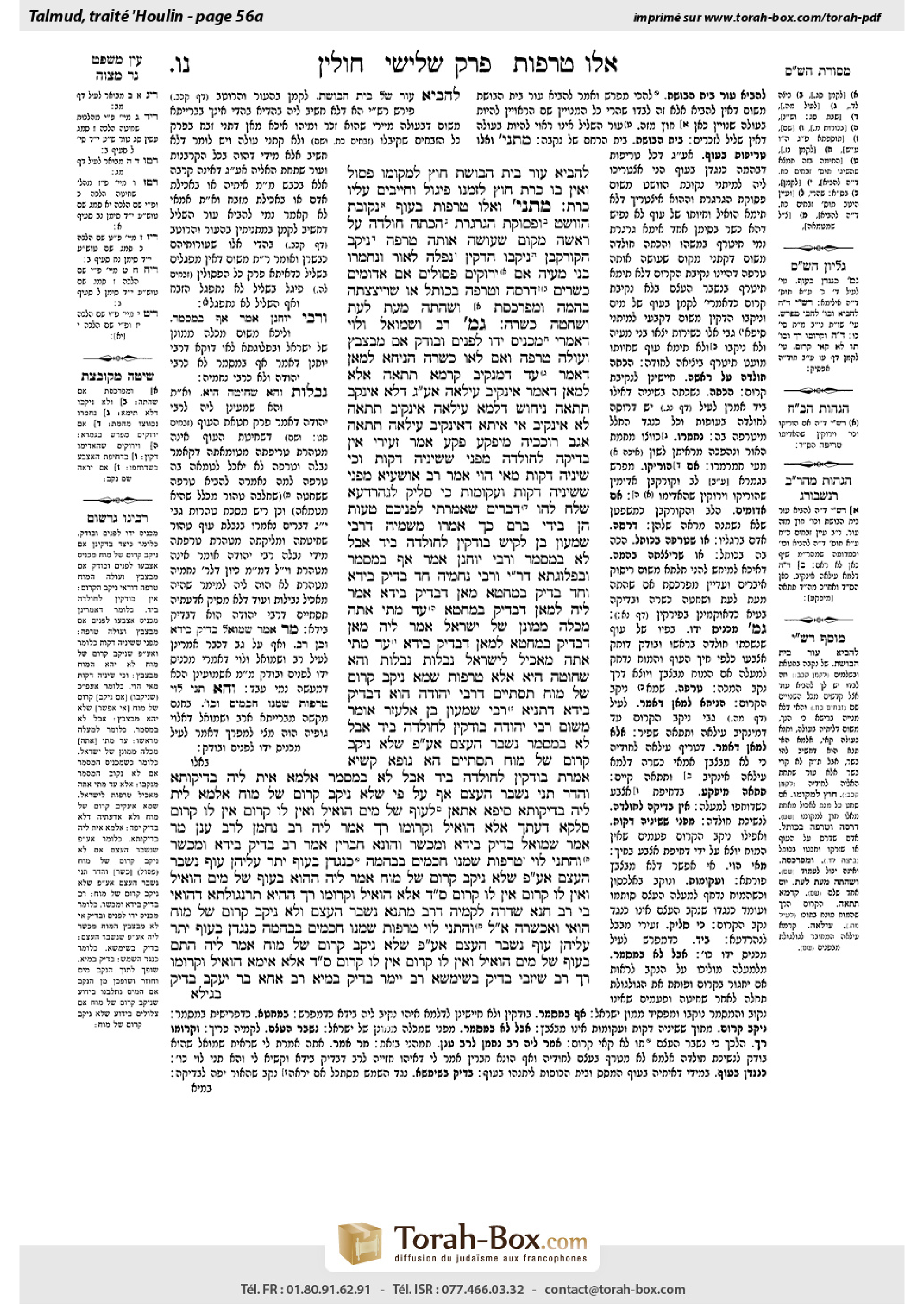
Chullin 56a: Talmud study for Daf Yomi
Study the Talmud for Daf Yomi with scanned pages, Hebrew text, English translations from Sefaria and AI-generated French translations.
Passage selection and English or AI-generated French translation are available where the scan has annotations. Daf Study is independent of Torah-Box and Sefaria.
Browse Chullin · חולין · All tractatesChullin 56a text and translations
This page of Chullin includes the Aramaic text, an English translation and an AI-generated French translation, alongside the scan above.
חולין נ״ו א · Aramaic and Hebrew text
לְהָבִיא עוֹר בֵּית הַבּוֹשֶׁת חוּץ לִמְקוֹמוֹ פָּסוּל וְאֵין בּוֹ כָּרֵת, חוּץ לִזְמַנּוֹ פִּיגּוּל וְחַיָּיבִים עָלָיו כָּרֵת.
מַתְנִי׳ וְאֵלּוּ טְרֵפוֹת בָּעוֹף: נְקוּבַת הַוֶּושֶׁט, וּפְסוּקַת הַגַּרְגֶּרֶת, הִכְּתָה חוּלְדָּה עַל רֹאשָׁהּ מָקוֹם שֶׁעוֹשֶׂה אוֹתָהּ טְרֵפָה, נִיקַּב הַקּוּרְקְבָן, נִיקְּבוּ הַדַּקִּין, נָפְלָה לָאוּר וְנֶחְמְרוּ בְּנֵי מֵעֶיהָ, אִם יְרוּקִּים – פְּסוּלִים, אִם אֲדוּמִּים – כְּשֵׁרִים. דְּרָסָהּ וּטְרָפָהּ בַּכּוֹתֶל אוֹ שֶׁרִיצְּצַתָּה בְּהֵמָה וּמְפַרְכֶּסֶת, וְשָׁהֲתָה מֵעֵת לְעֵת וּשְׁחָטָהּ – כְּשֵׁרָה.
גְּמָ׳ רַב וּשְׁמוּאֵל וְלֵוִי דְּאָמְרִי: מַכְנִיס יָדוֹ לִפְנִים וּבוֹדֵק, אִם מְבַצְבֵּץ וְעוֹלֶה – טְרֵפָה, וְאִם לָאו – כְּשֵׁרָה.
הָנִיחָא לְמַאן דְּאָמַר עַד דְּמִנְּקִיב קְרָמָא תַּתָּאָה, אֶלָּא לְמַאן דְּאָמַר אִינְּקִיב עִילָּאָה אַף עַל גַּב דְּלָא אִינְּקִיב תַּתָּאָה, נֵיחוּשׁ דִּלְמָא עִילָּאָה אִינְּקִיב תַּתָּאָה לָא אִינְּקִיב? אִי אִיתָא דְּאִינְּקִיב עִילָּאָה, תַּתָּאָה אַגַּב רוּכְּכֵיהּ מִיפְקָע פָּקַע.
אָמַר זְעֵירִי: אֵין בְּדִיקָה לְחוּלְדָּה, מִפְּנֵי שֶׁשִּׁינֶּיהָ דַּקּוֹת. וְכִי שִׁינֶּיהָ דַּקּוֹת מַאי הָוֵי? אָמַר רַב אוֹשַׁעְיָא: מִפְּנֵי שֶׁשִּׁינֶּיהָ דַּקּוֹת וַעֲקוּמּוֹת.
כִּי סְלֵיק לִנְהַרְדְּעָא, שְׁלַח לְהוּ: דְּבָרִים שֶׁאָמַרְתִּי לִפְנֵיכֶם טָעוּת הֵן בְּיָדִי, בְּרַם כָּךְ אָמְרוּ מִשְּׁמֵיהּ דְּרַבִּי שִׁמְעוֹן בֶּן לָקִישׁ: בּוֹדְקִין לְחוּלְדָּה בַּיָּד, אֲבָל לֹא בְּמַסְמֵר, וְרַבִּי יוֹחָנָן אָמַר: אַף בְּמַסְמֵר.
וּבִפְלוּגְתָּא דְּרַבִּי יְהוּדָה וְרַבִּי נְחֶמְיָה, חַד בָּדֵיק בִּידָא, וְחַד בָּדֵיק בְּמַחְטָא. מַאן דְּבָדֵיק בִּידָא אָמַר לֵיהּ לְמַאן דְּבָדֵיק בְּמַחְטָא: עַד מָתַי אַתָּה מְכַלֶּה מָמוֹנָן שֶׁל יִשְׂרָאֵל? אָמַר לֵיהּ מַאן דְּבָדֵיק בְּמַחְטָא לְמַאן דְּבָדֵיק בִּידָא: עַד מָתַי אַתָּה מַאֲכִיל לְיִשְׂרָאֵל נְבֵלוֹת?
נְבֵלוֹת? וְהָא שְׁחוּטָה הִיא! אֶלָּא טְרֵפוֹת, שֶׁמָּא נִיקַּב קְרוּם שֶׁל מוֹחַ.
תִּסְתַּיֵּים דְּרַבִּי יְהוּדָה הוּא דְּבָדֵיק בִּידָא, דְּתַנְיָא: רַבִּי שִׁמְעוֹן בֶּן אֶלְעָזָר אוֹמֵר מִשּׁוּם רַבִּי יְהוּדָה: בּוֹדְקִין לְחוּלְדָּה בַּיָּד, אֲבָל לֹא בְּמַסְמֵר. נִשְׁבַּר הָעֶצֶם, אַף עַל פִּי שֶׁלֹּא נִיקַּב קְרוּם שֶׁל מוֹחַ – תִּסְתַּיֵּים.
הָא גוּפַאּ קַשְׁיָא, אָמְרַתְּ: בּוֹדְקִין לְחוּלְדָּה בַּיָּד אֲבָל לֹא בְּמַסְמֵר. אַלְמָא אִית לֵיהּ בְּדִיקוּתָא, וַהֲדַר תָּנֵי: נִשְׁבַּר הָעֶצֶם אַף עַל פִּי שֶׁלֹּא נִיקַּב קְרוּם שֶׁל מוֹחַ. אַלְמָא לֵית לֵיהּ בְּדִיקוּתָא! סֵיפָא אֲתָאן לְעוֹף שֶׁל מַיִם, הוֹאִיל וְאֵין לוֹ קְרוּם. אֵין לוֹ קְרוּם סָלְקָא דַּעְתָּךְ? אֶלָּא, הוֹאִיל וּקְרוּמוֹ רַךְ.
אֲמַר לֵיהּ רַב נַחְמָן לְרַב עָנָן: מָר אָמַר שְׁמוּאֵל בָּדֵיק בִּידָא וּמַכְשַׁר, וְהוּנָא חַבְרִין אָמַר רַב בָּדֵיק בִּידָא וּמַכְשַׁר. וְהָתָנֵי לֵוִי: טְרֵפוֹת שֶׁמָּנוּ חֲכָמִים בִּבְהֵמָה – כְּנֶגְדָּן בָּעוֹף, יָתֵר עֲלֵיהֶן עוֹף – נִשְׁבַּר הָעֶצֶם אַף עַל פִּי שֶׁלֹּא נִיקַּב קְרוּם שֶׁל מוֹחַ? אֲמַר לֵיהּ: הָהוּא בְּעוֹף שֶׁל מַיִם, הוֹאִיל וְאֵין לוֹ קְרוּם. אֵין לוֹ קְרוּם סָלְקָא דַּעְתָּךְ? אֶלָּא, הוֹאִיל וּקְרוּמוֹ רַךְ.
הָהִיא תַּרְנְגוֹלְתָּא דַּהֲוַאי בֵּי רַב חָנָא, שַׁדְּרַהּ לְקַמֵּיהּ דְּרַב מַתְנָא. נִשְׁבַּר הָעֶצֶם וְלֹא נִיקַּב קְרוּם שֶׁל מוֹחַ הֲוַאי, וְאַכְשְׁרַהּ. אֲמַר לֵיהּ: וְהָתָנֵי לֵוִי: טְרֵפוֹת שֶׁמָּנוּ חֲכָמִים בִּבְהֵמָה כְּנֶגְדָּן בָּעוֹף, יָתֵר עֲלֵיהֶן עוֹף – נִשְׁבַּר הָעֶצֶם אַף עַל פִּי שֶׁלֹּא נִיקַּב קְרוּם שֶׁל מוֹחַ! אֲמַר לֵיהּ: הָתָם בְּעוֹף שֶׁל מַיִם, הוֹאִיל וְאֵין לוֹ קְרוּם. אֵין לוֹ קְרוּם סָלְקָא דַּעְתָּךְ? אֶלָּא אֵימָא: הוֹאִיל וּקְרוּמוֹ רַךְ.
רַב שֵׁיזְבִי בָּדֵיק בְּשִׁימְשָׁא, רַב יֵימַר בָּדֵיק בְּמַיָּא, רַב אַחָא בַּר יַעֲקֹב בָּדֵיק
Chullin 56a · English translation
including the hide of the vulva, the halakha is the same: If one performs the sacrificial rites with intent to burn one of them outside its designated area, the offering is unfit, but there is no liability for karet for one who partakes of the offering. If he had intent to burn it beyond its designated time, this renders it piggul, and one is liable to receive karet for eating it. This baraita indicates that only Rabbi Shimon holds that the hide of the hooves is treated like its flesh, and that the Sages disagree, as Rabbi Yoḥanan stated.
MISHNA: And these are tereifot in a bird: One with a perforated gullet, or with a cut windpipe that was cut across its width; or if a weasel struck the bird on its head in a place that renders it a tereifa, as one must be concerned that the membrane of the brain was perforated; or if the gizzard was perforated; or if the small intestines were perforated. In a case where a bird fell into the fire and its innards were singed [neḥmeru], if they turned green they are unfit, and the bird is a tereifa, but if they are red the bird is kosher. If a person trampled the bird, or slammed it against a wall, or if an animal crushed it and it is twitching, it is a tereifa because its limbs were shattered. But if the bird lasted for a twenty-four-hour period, and then one slaughtered it, it is kosher.
GEMARA: The mishna states: If a weasel struck the bird on its head in a place that renders it a tereifa, one must be concerned that the membrane of the brain was perforated. Rav and Shmuel and Levi say: How does one inspect the membrane? After slaughter, one inserts his hand into the mouth of the bird and pushes the nerve tissue with his finger and inspects it. If the nerve tissue emerges and rises out through the hole in the skull, the animal is a tereifa, because this proves that the membrane has been perforated, allowing the nerve tissue through. And if not, the animal is kosher.
The Gemara asks: This works out well according to the one who says (45a) that an animal is not a tereifa unless the inner membrane is perforated as well. But according to the one who says that the animal is rendered a tereifa if the outer membrane was perforated, even if the inner membrane was not perforated, how can one rely on this inspection? Let us be concerned that perhaps the outer membrane was perforated but the inner membrane was not perforated, in which case the animal is a tereifa even if the nerve tissue does not emerge through the hole. The Gemara responds: If it is the case that the outer membrane was perforated, the inner membrane will inevitably burst due to its fragility, allowing the nerve tissue to emerge. If it does not emerge, it is certain that the outer membrane is intact as well.
Ze’eiri says: There is no effective inspection for a bird bitten on the head by a weasel, because the weasel’s teeth are so thin that even if they perforate the membrane, the nerve tissue will not emerge through the perforations. The Gemara asks: And if its teeth are thin, what of it? Certainly a small amount will emerge through the perforation. Rav Oshaya said: There is no inspection because its teeth are fine and crooked. The hole in the skull does not overlap the perforation in the membrane, and nothing will be able to escape.
The Gemara recounts: When Ze’eiri went up to Neharde’a, he sent a message to the Sages: The matters that I stated before you are an error on my part. In fact, they said this in the name of Rabbi Shimon ben Lakish: One inspects a bird bitten on the head by a weasel with one’s hand, pressing against the nerve tissue to see if it emerges through the hole, but not with a nail. One may not inspect it by dragging the tip of a nail over the surface of the membrane to see if it catches on a perforation, since the nail itself may perforate the membrane. And Rabbi Yoḥanan says: One may even inspect it with a nail.
The Gemara notes: And this disagreement is also reflected in the dispute of Rabbi Yehuda and Rabbi Neḥemya, wherein one inspected the bird by hand, and one inspected it with a needle. The one who inspected it by hand said to the one who inspected it with a needle: Until when will you waste the money of the Jewish people by causing them to discard kosher meat? Sometimes the needle itself will perforate a membrane that was initially whole. The one who inspected it with a needle said to the one who inspected it by hand: Until when will you feed carcasses to the Jewish people, as you permit for consumption a bird that might well be forbidden?
The Gemara asks: Carcasses? But this is a slaughtered animal; even if it is forbidden, it is a tereifa, not a carcass. Rather, he must have said: Until when will you feed tereifot to the Jewish people; perhaps the membrane of the brain was perforated. Inspection by hand is not reliable, since the teeth of the weasel are thin and crooked and the nerve tissue may not escape even if the membrane is perforated.
The Gemara notes: It may be concluded that it is Rabbi Yehuda who inspected it by hand, as it is taught in a baraita: Rabbi Shimon ben Elazar says in the name of Rabbi Yehuda that one may inspect a bird bitten on the head by a weasel with one’s hand, but not with a nail. The baraita continues: If the bone of the skull was broken, even if the membrane of the brain was not perforated, the animal is a tereifa. The Gemara affirms: Indeed, it may be concluded that Rabbi Yehuda permits inspection only by hand.
The Gemara objects: This itself is difficult. You said in the baraita: One may inspect a bird injured by a weasel with one’s hand, but not with a nail; apparently, it has an option of inspection. But you then teach: If the bone of the skull was broken, even if the membrane of the brain was not perforated, the animal is a tereifa; apparently it has no inspection, because inspecting for a perforation would be pointless. The Gemara responds: In the latter clause, we come to discuss a water bird, which cannot be inspected, since it has no membrane. The Gemara clarifies: Can it enter your mind that it has no membrane? One can see that it does. Rather, the response is: Since its membrane is fragile, it must have ruptured when the skull was broken.
Similarly, the Gemara relates that Rav Naḥman said to Rav Anan: The Master says that Shmuel inspects a bird bitten on the head by a weasel with his hand and deems it kosher if the membrane is not perforated, and our colleague Rav Huna also says that Rav inspects it by hand and deems it kosher. But doesn’t Levi teach: Those tereifot that the Sages enumerated in an animal apply likewise in a bird, and in addition to those, a bird is a tereifa if the bone of the skull was broken, even if the membrane of the brain was not perforated? If so, how can a bird be permitted through inspection? Rav Anan said to him: That baraita is referring to a water bird, which cannot be inspected since it has no membrane. The Gemara clarifies: Can it enter your mind that it has no membrane? Rather, the response is: Since its membrane is fragile.
Similarly, the Gemara relates: There was a certain hen that was in the house of Rav Ḥana whose skull was injured. He sent it before Rav Mattana, who inspected it and found that the bone of the skull was broken but the membrane of the brain was not perforated, and he deemed it kosher. Rav Ḥana said to Rav Mattana: But doesn’t Levi teach: Those tereifot that the Sages enumerated in an animal hold likewise in a bird, and in addition to those, a bird is a tereifa if the bone of the skull was broken, even if the membrane of the brain was not perforated? Rav Mattana said to him: That baraita is referring to a water bird, which cannot be inspected since it has no membrane. The Gemara clarifies: Can it enter your mind that it has no membrane? Rather, say that his response was: Since its membrane is fragile.
The Gemara notes that Rav Sheizvi would inspect the membrane of the brain by the light of the sun. Rav Yeimar would inspect it by pouring water into the skull through the hole, to see if it emerges mixed with nerve tissue. Rav Aḥa bar Ya’akov would inspect it
Chullin 56a · Traduction française (IA)
y compris la peau des coussolats, la halakha est la même : Si l'on effectue les rites sacrificiels avec l'intention de brûler l'un d'eux en dehors de son lieu désigné, l'offrande est inadaptée, mais il n'y a pas de responsabilité de karet pour celui qui consomme l'offrande. Si l'intention était de brûler au-delà de la période désignée, cela rend l'offrande piggul, et l'on est tenu responsable de karet pour en consommer. Cette baraïta indique que seul Rabbi Shimon considère que la peau des sabots est traitée comme sa chair, et que les Sages s'opposent à cela, comme l'a dit Rabbi Yoḥanan.
MICHNA : Et ces sont des tereifot dans un oiseau : Celui dont le gosier est percé, ou dont la trachée a été coupée transversalement ; ou si un rat-fauve a frappé l'oiseau à la tête dans un endroit qui le rend tereifa, car on doit s'inquiéter que la membrane du cerveau ait été percée ; ou si le gourgeon était percé ; ou si les intestins étaient percés. Dans le cas où un oiseau tombe dans le feu et que ses viscères sont brûlés [neḥmeru], si ils deviennent verts, ils sont inadaptés et l'oiseau est tereifa, mais si ils sont rouges, l'oiseau est propre. Si une personne écrase l'oiseau, ou le frappe contre un mur, ou si un animal l'écrase et qu'il tremble, il est tereifa car ses membres sont brisés. Mais si l'oiseau a survécu pendant une période de vingt-quatre heures, et qu'on le sacrifie alors, il est propre.
GUEMARA : La mishna dit : Si un rat-fauve a frappé l'oiseau à la tête dans un endroit qui le rend tereifa, on doit s'inquiéter que la membrane du cerveau ait été percée. Rav et Shmuel et Levi disent : Comment inspecte-t-on la membrane ? Après la bête, on insère sa main dans la bouche de l'oiseau et on pousse la tige nerveuse avec son doigt et on l'inspecte. Si la tige nerveuse sort et monte à travers l'ouverture du crâne, l'animal est tereifa, car cela prouve que la membrane a été percée, permettant à la tige nerveuse de passer. Et si non, l'animal est propre.
La Guemara pose la question : Cela fonctionne bien selon celui qui dit (45a) qu'un animal n'est pas tereifa à moins que la membrane interne ne soit également percée. Mais selon celui qui dit qu'un animal est rendu tereifa si la membrane externe a été percée, même si la membrane interne n'a pas été percée, comment peut-on compter sur cette inspection ? Laissons-nous inquiéter que peut-être la membrane externe ait été percée mais la membrane interne n'ait pas été percée, dans ce cas l'animal est tereifa même si la tige nerveuse ne sort pas à travers l'ouverture. La Guemara répond : Si c'est le cas que la membrane externe ait été percée, la membrane interne éclatera nécessairement à cause de sa fragilité, permettant à la tige nerveuse de sortir. Si elle ne sort pas, on est certain que la membrane externe est intacte également.
Ze’eiri dit : Il n'y a pas d'inspection efficace pour un oiseau mordu à la tête par un rat-fauve, car les dents du rat-fauve sont si fines que même si elles perforent la membrane, la tige nerveuse ne sortira pas à travers les perforations. La Guemara pose la question : Et si ses dents sont fines, qu'est-ce que cela change ? Certainement une petite quantité sortira à travers la perforation. Rav Oshaya dit : Il n'y a pas d'inspection car ses dents sont fines et crochées. L'ouverture du crâne ne recouvre pas la perforation de la membrane, et rien ne pourra s'échapper.
La Guemara rapporte : Quand Ze’eiri est monté à Neharde’a, il a envoyé un message aux Sages : Les choses que j'ai dites avant vous sont une erreur de ma part. En fait, cela a été dit au nom de Rabbi Shimon ben Lakish : On inspecte un oiseau mordu à la tête par un rat-fauve avec la main, en pressant la tige nerveuse pour voir si elle sort à travers l'ouverture, mais pas avec un ongle. On ne peut pas inspecter en traînant l'extrémité d'un ongle sur la surface de la membrane pour voir si elle s'arrête sur une perforation, car l'ongle lui-même pourrait percer la membrane. Et Rabbi Yoḥanan dit : On peut même inspecter avec un ongle.
La Guemara note : Et ce désaccord est également reflété dans le débat entre Rabbi Yehuda et Rabbi Neḥemya, où l'un inspectait l'oiseau avec la main et l'autre avec une aiguille. Celui qui inspectait avec la main a dit à celui qui inspectait avec l'aiguille : Jusqu'à quand gaspillerez-vous l'argent du peuple juif en faisant en sorte qu'ils jettent des viandes kasher ? Parfois l'aiguille elle-même percerait une membrane qui était initialement intacte. Celui qui inspectait avec l'aiguille a dit à celui qui inspectait avec la main : Jusqu'à quand nourrissez-vous des cadavres au peuple juif, car vous permettez la consommation d'un oiseau qui pourrait bien être interdit ?
La Guemara pose la question : Des cadavres ? Mais c'est un animal sacrifié ; même s'il est interdit, c'est un tereifa, pas un cadavre. Plutôt, il a dû dire : Jusqu'à quand nourrissez-vous des tereifot au peuple juif ; peut-être la membrane du cerveau a-t-elle été perfore. L'inspection avec la main n'est pas fiable, car les dents du rat-fauve sont fines et crochées et la tige nerveuse pourrait ne pas s'échapper même si la membrane est perfore.
La Guemara note : On peut conclure que c'est Rabbi Yehuda qui inspecte avec la main, car cela est enseigné dans une baraïta : Rabbi Shimon ben Elazar dit au nom de Rabbi Yehuda que l'on peut inspecter un oiseau mordu à la tête par un rat-fauve avec la main, mais pas avec un ongle. La baraïta continue : Si l'os du crâne était brisé, même si la membrane du cerveau n'était pas perfore, l'animal est tereifa. La Guemara affirme : En effet, on peut conclure que Rabbi Yehuda permet l'inspection uniquement avec la main.
La Guemara s'oppose : Cela même est difficile. Vous avez dit dans la baraïta : On peut inspecter un oiseau blessé par un rat-fauve avec la main, mais pas avec un ongle ; apparemment, il y a une option d'inspection. Mais vous enseignez ensuite : Si l'os du crâne était brisé, même si la membrane du cerveau n'était pas perfore, l'animal est tereifa ; apparemment, il n'y a pas d'inspection, car inspecter pour une perforation serait inutile. La Guemara répond : Dans la clause suivante, nous discutons d'un oiseau aquatique, qui ne peut pas être inspecté, car il n'a pas de membrane. La Guemara clarifie : Pourriez-vous penser qu'il n'a pas de membrane ? On peut voir qu'il en a. Plutôt, la réponse est : Puisque sa membrane est fragile, elle doit avoir éclaté lorsque le crâne a été brisé.
De même, la Guemara rapporte que Rav Naḥman a dit à Rav Anan : Le Maître dit que Shmuel examine un oiseau mordu à la tête par un raton laveur avec la main et le déclare propre si la membrane n'est pas percée, et notre collègue Rav Huna dit aussi que Rav l'examine avec la main et le déclare propre. Mais ne dit-il pas Levi : Ceux des tereifot que les Sages ont énumérés dans un animal s'appliquent également à un oiseau, et en outre, un oiseau est tereifa si l'os du crâne est brisé, même si la membrane du cerveau n'est pas percée ? Si c'est ainsi, comment un oiseau peut-il être permis par l'examen ? Rav Anan lui a répondu : Ce baraïta fait référence à un oiseau aquatique, qui ne peut être examiné car il n'a pas de membrane. La Guemara précise : Est-ce que cela entre dans votre esprit qu'il n'ait pas de membrane ? Plutôt, la réponse est : Parce que sa membrane est fragile.
De même, la Guemara rapporte : Il y avait un poulet qui était chez Rav Ḥana dont le crâne était blessé. Il l'a envoyé devant Rav Mattana, qui l'a examiné et a trouvé que l'os du crâne était brisé mais que la membrane du cerveau n'était pas percée, et l'a déclaré propre. Rav Ḥana a dit à Rav Mattana : Mais ne dit pas Levi : Ceux des tereifot que les Sages ont énumérés dans un animal s'appliquent également à un oiseau, et en outre, un oiseau est tereifa si l'os du crâne est brisé, même si la membrane du cerveau n'est pas percée ? Rav Mattana lui a répondu : Ce baraïta fait référence à un oiseau aquatique, qui ne peut être examiné car il n'a pas de membrane. La Guemara précise : Est-ce que cela entre dans votre esprit qu'il n'ait pas de membrane ? Plutôt, disons que sa réponse était : Parce que sa membrane est fragile.
La Guemara note que Rav Sheizvi examinait la membrane du cerveau à la lumière du soleil. Rav Yeimar l'examinait en versant de l'eau dans le crâne par le trou, pour voir si elle sortait mélangée avec des tissus nerveux. Rav Aḥa bar Ya’akov l'examinait également.
Traduction française générée par IA à partir de l’édition anglaise de Sefaria. Vérifie toujours un passage avec le texte source.
Text from Sefaria: William Davidson Edition - Vocalized Aramaic (unknown); William Davidson Edition - English (CC BY NC).