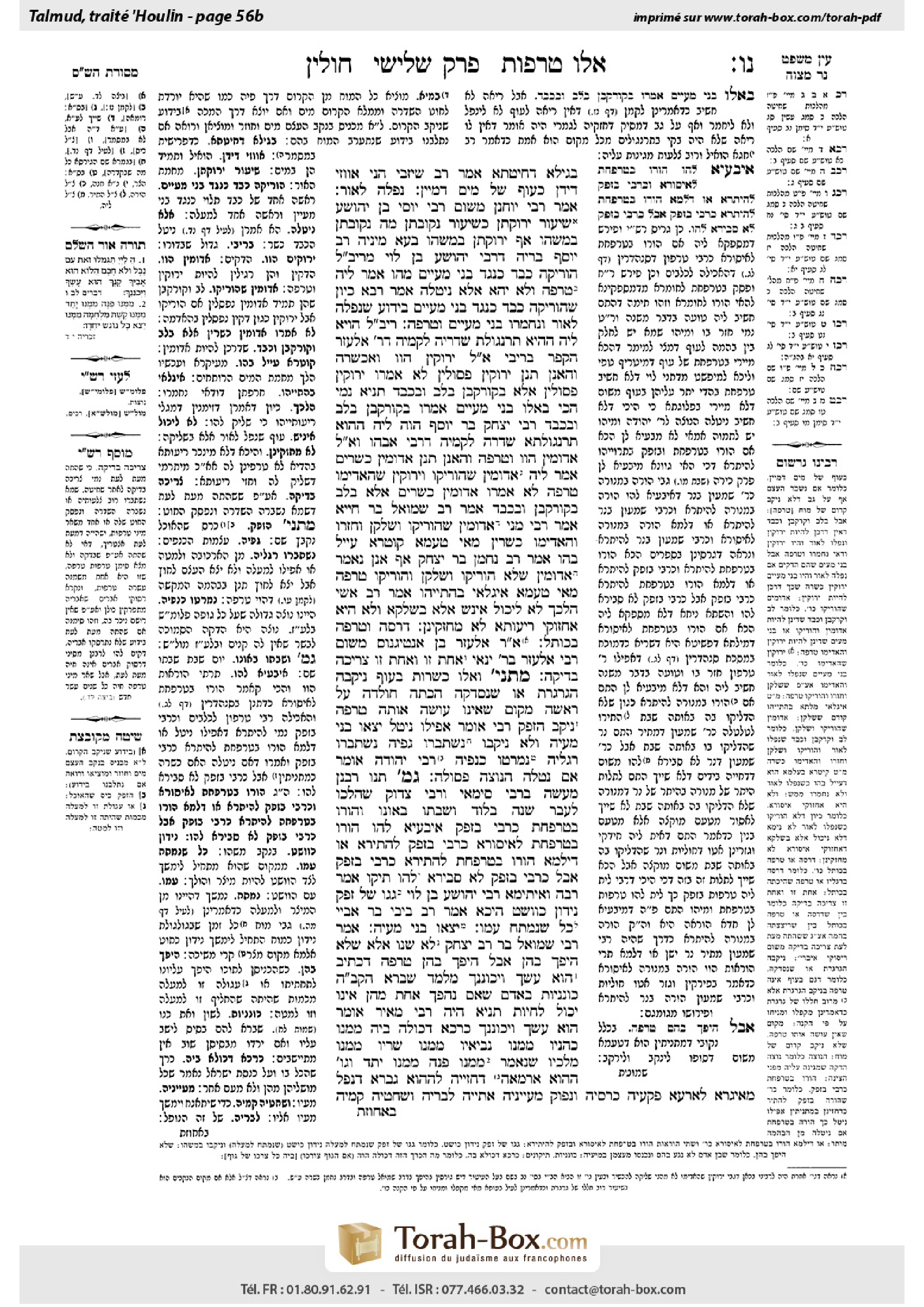
Chullin 56b: Talmud study for Daf Yomi
Study the Talmud for Daf Yomi with scanned pages, Hebrew text, English translations from Sefaria and AI-generated French translations.
Passage selection and English or AI-generated French translation are available where the scan has annotations. Daf Study is independent of Torah-Box and Sefaria.
Browse Chullin · חולין · All tractatesChullin 56b text and translations
This page of Chullin includes the Aramaic text, an English translation and an AI-generated French translation, alongside the scan above.
חולין נ״ו ב · Aramaic and Hebrew text
בְּגִילָא דְּחִיטְּתָא.
אָמַר רַב שֵׁיזְבִי: הָנֵי אֲוָוזֵי דִּידַן כְּעוֹף שֶׁל מַיִם דָּמְיָין.
נָפְלָה לָאוּר, אָמַר רַבִּי יוֹחָנָן מִשּׁוּם רַבִּי יוֹסֵי בֶּן יְהוֹשֻׁעַ: שִׁיעוּר יְרוּקָּתָן כְּשִׁיעוּר נְקוּבָתָן, מָה נְקוּבָתָן בְּמַשֶּׁהוּ – אַף יְרוּקָּתָן בְּמַשֶּׁהוּ.
בְּעָא מִינֵּיהּ רַב יוֹסֵף בְּרֵיהּ דְּרַבִּי יְהוֹשֻׁעַ בֶּן לֵוִי מֵרַבִּי יְהוֹשֻׁעַ בֶּן לֵוִי: הוֹרִיקָה כָּבֵד כְּנֶגֶד בְּנֵי מֵעַיִים מַהוּ? אֲמַר לֵיהּ: טְרֵפָה. וְלֹא יְהֵא אֶלָּא נִיטְּלָה! אָמַר רָבָא: כֵּיוָן שֶׁהוֹרִיקָה כָּבֵד כְּנֶגֶד בְּנֵי מֵעַיִים – בְּיָדוּעַ שֶׁנָּפְלָה לָאוּר, וְנֶחְמְרוּ בְּנֵי מֵעַיִים, וּטְרֵפָה.
רַבִּי יְהוֹשֻׁעַ בֶּן לֵוִי הַוְיָא לֵיהּ הָהִיא תַּרְנְגוֹלְתָּא, שַׁדְּרֵיהּ לְקַמֵּיהּ דְּרַבִּי אֶלְעָזָר הַקַּפָּר בְּרִיבִּי, אֲמַר לֵיהּ: יְרוּקִּין הֲווֹ, וְאַכְשְׁרַהּ. וְהָאֲנַן תְּנַן: ״יְרוּקִּין פְּסוּלִין״! לֹא אָמְרוּ ״יְרוּקִּין פְּסוּלִין״ אֶלָּא בַּקּוּרְקְבָן, בַּלֵּב וּבַכָּבֵד. תַּנְיָא נָמֵי הָכִי: בְּאֵלּוּ בְּנֵי מֵעַיִים אָמְרוּ – בַּקּוּרְקְבָן, בַּלֵּב וּבַכָּבֵד.
רַבִּי יִצְחָק בַּר יוֹסֵף הֲוָה לֵיהּ הָהִוא תַּרְנְגוֹלְתָּא, שַׁדְּרַהּ לְקַמֵּיהּ דְּרַבִּי אֲבָהוּ, וַאֲמַר לֵיהּ: אֲדוּמִּין הֲווֹ וּטְרֵפָה. וְהָאֲנַן תְּנַן: ״אֲדוּמִּין כְּשֵׁרִים״! אֲמַר לֵיהּ: אֲדוּמִּין שֶׁהוֹרִיקוּ וִירוּקִּין שֶׁהֶאֱדִימוּ – טְרֵפָה, לֹא אָמְרוּ ״אֲדוּמִּין כְּשֵׁרִים״ אֶלָּא בַּלֵּב בַּקּוּרְקְבָן וּבַכָּבֵד.
אָמַר רַב שְׁמוּאֵל בַּר חִיָּיא אָמַר רַבִּי מָנִי: אֲדוּמִּין שֶׁהוֹרִיקוּ וּשְׁלָקָן וְחָזְרוּ וְהֶאֱדִימוּ – כְּשֵׁרִין, מַאי טַעְמָא? קוּטְרָא עָיֵיל בְּהוּ. אָמַר רַב נַחְמָן בַּר יִצְחָק: אַף אָנוּ נֹאמַר, אֲדוּמִּין שֶׁלֹּא הוֹרִיקוּ וּשְׁלָקָן וְהוֹרִיקוּ – טְרֵפָה, מַאי טַעְמָא? אִיגַּלַּאי בַּהְתַּיְיהוּ. אָמַר רַב אָשֵׁי: הִלְכָּךְ לָא לֵיכוֹל אִינָשׁ אֶלָּא בְּשִׁלְקָא. וְלָא הִיא, אַחְזוֹקֵי רֵיעוּתָא לָא מַחְזְקִינַן.
דְּרָסָהּ וּטְרָפָהּ בַּכּוֹתֶל. אָמַר רַבִּי אֶלְעָזָר בֶּן אַנְטִיגְנוֹס מִשּׁוּם רַבִּי אֶלְעָזָר בְּרַבִּי יַנַּאי: אַחַת זוֹ וְאַחַת זוֹ צְרִיכָה בְּדִיקָה.
מַתְנִי׳ וְאֵלּוּ כְּשֵׁרוֹת בָּעוֹף: נִיקְּבָה הַגַּרְגֶּרֶת, אוֹ שֶׁנִּסְדְּקָה, הִכְּתָה חוּלְדָּה עַל רֹאשָׁהּ מָקוֹם שֶׁאֵינוֹ עוֹשֶׂה אוֹתָהּ טְרֵפָה, נִיקַּב הַזֶּפֶק, רַבִּי אוֹמֵר: אֲפִילּוּ נִיטַּל, יָצְאוּ בְּנֵי מֵעֶיהָ וְלֹא נִיקְּבוּ, נִשְׁתַּבְּרוּ גַּפֶּיהָ, נִשְׁתַּבְּרוּ רַגְלֶיהָ, נִמְרְטוּ כְּנָפֶיהָ, רַבִּי יְהוּדָה אוֹמֵר: אִם נִטְּלָה הַנּוֹצָה פְּסוּלָה.
גְּמָ׳ תָּנוּ רַבָּנַן: מַעֲשֶׂה בְּרַבִּי סִימַאי וְרַבִּי צָדוֹק שֶׁהָלְכוּ לְעַבֵּר שָׁנָה בְּלוֹד, וְשָׁבְתוּ בְּאוֹנוֹ, וְהוֹרוּ בְּטַרְפַּחַת כְּרַבִּי בְּזֶפֶק.
אִיבַּעְיָא לְהוּ: הוֹרוּ בְּטַרְפַּחַת לְאִיסּוּרָא, כְּרַבִּי בְּזֶפֶק לְהֶתֵּירָא? אוֹ דִילְמָא: הוֹרוּ בְּטַרְפַּחַת לְהֶתֵּירָא כְּרַבִּי בְּזֶפֶק, אֲבָל כְּרַבִּי בְּזֶפֶק לָא סְבִירָא לְהוּ? תֵּיקוּ.
אָמַר רַבָּה, וְאִיתֵּימָא רַבִּי יְהוֹשֻׁעַ בֶּן לֵוִי: גַּגּוֹ שֶׁל זֶפֶק נִידּוֹן כְּוֶושֶׁט. הֵיכָא? אָמַר רַב בִּיבִי בַּר אַבָּיֵי: כֹּל שֶׁנִּמְתָּח עִמּוֹ.
יָצְאוּ בְּנֵי מֵעֶיהָ, אָמַר רַבִּי שְׁמוּאֵל בַּר רַב יִצְחָק: לֹא שָׁנוּ אֶלָּא שֶׁלֹּא הִיפֵּךְ בָּהֶן, אֲבָל הִיפֵּךְ בָּהֶן – טְרֵפָה, דִּכְתִיב: ״הוּא עָשְׂךָ וַיְכֹנְנֶךָ״, מְלַמֵּד שֶׁבָּרָא הַקָּדוֹשׁ בָּרוּךְ הוּא כּוֹנָנִיּוֹת בָּאָדָם, שֶׁאִם נֶהְפָּךְ (אַחַת) [אֶחָד] מֵהֶן – אֵינוֹ יָכוֹל לִחְיוֹת.
תַּנְיָא, הָיָה רַבִּי מֵאִיר אוֹמֵר: ״הוּא עָשְׂךָ וַיְכֹנְנֶךָ״ – כַּרְכָא דְּכוֹלָּה בֵּיהּ, מִמֶּנּוּ כֹּהֲנָיו, מִמֶּנּוּ נְבִיאָיו, מִמֶּנּוּ שָׂרָיו, מִמֶּנּוּ מְלָכָיו, שֶׁנֶּאֱמַר: ״מִמֶּנּוּ פִנָּה מִמֶּנּוּ יָתֵד וְגוֹ׳״.
הָהוּא רוֹמָאָה דְּחַזְיֵיהּ לְהָהוּא גַּבְרָא דִּנְפַל מֵאִיגָּרָא לְאַרְעָא, פְּקַעיה כְּרֵסֵיהּ וּנְפוּק מַעְיָינֵיהּ, אַתְיֵיהּ לִבְרֵיהּ וְשַׁחְטֵיהּ קַמֵּיהּ
Chullin 56b · English translation
by dragging a wheat straw over the membrane to see if it would catch on a perforation.
Rav Sheizvi said: Our geese are considered like water birds. If the skull of a goose is broken, even if the membrane is not perforated, it is a tereifa.
§ The mishna states: In a case where a bird fell into the fire and its innards were singed, if they turned green the bird is a tereifa; if they are red the bird is kosher. Rabbi Yoḥanan says in the name of Rabbi Yosei ben Yehoshua: The measure of their turning green is like the measure of their perforation. Just as their perforation in any amount renders them a tereifa, so too their turning green in any amount renders them a tereifa.
Rav Yosef, son of Rabbi Yehoshua ben Levi, asked Rabbi Yehoshua ben Levi: If a liver turned green on the side facing the intestines, what is the halakha? Rabbi Yehoshua ben Levi said to him: The bird is a tereifa. Rav Yosef said to him: But this halakha should be no more stringent than that of a case where the liver was removed and an olive-bulk remained (see 54a), in which case the bird is kosher. Therefore, as long as an olive-bulk remains red, the bird should be kosher. Rava said: Since the liver turned green facing the intestines, it is certain that the bird fell into the fire and the intestines themselves were singed, and this is why the animal is a tereifa, not because of the liver per se.
The Gemara recounts: Rabbi Yehoshua ben Levi had a certain hen that fell into the fire. After it was slaughtered, he sent it before the distinguished Rabbi Elazar HaKappar and said to him: Its innards were green, and Rabbi Elazar HaKappar deemed it kosher. Rabbi Yehoshua ben Levi asked: But didn’t we learn in the mishna: If they turned green they are unfit? Rabbi Elazar HaKappar said to him: The Sages said that if they turned green they are unfit only with regard to the gizzard, the heart, and the liver, which are naturally red. Other innards of a hen, such as the intestines, are naturally green, and a green appearance in them does not render the hen a tereifa. The Gemara notes: This is also taught in a baraita: Concerning which innards did they say that a green appearance renders the bird a tereifa? Only concerning the gizzard, the heart, and the liver.
The Gemara recounts: Rabbi Yitzḥak bar Yosef had a certain hen that fell into the fire. After it was slaughtered, he sent it before Rabbi Abbahu and said to him: Its innards were red, and Rabbi Elazar HaKappar deemed it a tereifa. Rabbi Yitzḥak bar Yosef asked: But didn’t we learn in the mishna: If they are red, the bird is kosher? Rabbi Elazar HaKappar said to him: Red innards that turned green and green innards that turned red render the animal a tereifa. The Sages said in the mishna that red innards are kosher only with regard to the heart, the gizzard, and the liver, because these organs are naturally red. Organs that are naturally green, however, render the bird a tereifa if they have turned red.
Rav Shmuel bar Ḥiyya says that Rabbi Mani says: If red organs turned green, and one boiled them and they turned red again, they are kosher. What is the reason? This proves that they were not burned; rather, smoke entered them and changed their color temporarily. Rav Naḥman bar Yitzḥak said: We, too, will say: If red organs did not turn green, and one boiled them and they then turned green, the animal is a tereifa. What is the reason? Their shame was revealed, i.e., it is evident that they were in fact burned. Rav Ashi said: Therefore, even if a bird’s innards remain red after it fell in a fire, a person may eat it only if it is boiled, to be certain that the innards will not turn green. The Gemara rejects this: But that is not so, since we do not presume the existence of a flaw without evidence.
§ The mishna states: If a person trampled the bird, or slammed it against a wall, or if an animal crushed it, and it lasted twenty-four hours, and then one slaughtered it, it is kosher. Rabbi Elazar ben Antigonus says in the name of Rabbi Elazar, son of Rabbi Yannai: Both this and that, i.e., all of the above cases, require inspection after slaughter, to ascertain that there is no injury that would itself render the animal a tereifa.
MISHNA: And these are kosher among birds: If a bird’s windpipe was perforated or cracked lengthwise; or if a weasel struck the bird on its head in a place that does not render it a tereifa; or if the crop was perforated. Rabbi Yehuda HaNasi says: It is kosher even if the crop was removed. If the bird’s intestines emerged from the abdominal wall but were not perforated, or if its wings were broken, or if its legs were broken, or if the feathers on its wings were plucked, the bird is kosher. Rabbi Yehuda says: If the down covering its body was removed, it is a tereifa and unfit for consumption.
GEMARA: The Sages taught in a baraita: There was an incident involving Rabbi Simai and Rabbi Tzadok, who went to intercalate the year in Lod, and they spent Shabbat in the town of Ono. And they ruled with regard to an animal whose womb was removed, in accordance with the opinion of Rabbi Yehuda HaNasi in the mishna with regard to the crop.
A dilemma was raised before the Sages: What is the meaning of the baraita? Is it referring to two different rulings, i.e., that they ruled with regard to the womb to prohibit it, and they also ruled in accordance with the opinion of Rabbi Yehuda HaNasi with regard to the crop to permit it? Or perhaps it is referring to only one ruling, and it means that they ruled with regard to the womb to permit it, in accordance with the opinion of Rabbi Yehuda HaNasi with regard to the crop, but they do not hold in accordance with the opinion of Rabbi Yehuda HaNasi with regard to the crop itself. The Gemara concludes: The dilemma shall stand unresolved.
Rabba says, and some say it was Rabbi Yehoshua ben Levi who says: The roof of the crop is treated like the gullet, i.e., it renders the bird a tereifa if perforated in any amount. The Gemara asks: Where is the roof of the crop? Rav Beivai bar Abaye said: It is any part of the crop that stretches with the gullet.
§ The mishna states: If the bird’s intestines emerged from the stomach wall but were not perforated, the bird is kosher. Rabbi Shmuel bar Rav Yitzḥak says: The Sages taught this halakha only in a case where one did not jumble them, but returned them to the stomach in their proper order. But if he jumbled them, the bird is a tereifa, as it is written: “Has He not made you, and established you?” (Deuteronomy 32:6). The verse teaches that the Holy One, Blessed be He, created established locations for each organ in a person, so that if one of them is switched he cannot live. The same applies to other creatures.
It is taught in a baraita: Rabbi Meir would say that the verse: “Has He not made you, and established you?” teaches that the Jewish people is a city with everything in it. Out of it come its priests, out of it come its prophets, out of it come its chiefs, out of it come its kings, as it is stated: “Out of them shall come forth the cornerstone, out of them the stake, out of them the battle bow, out of them every master together” (Zechariah 10:4).
The Gemara recounts an incident involving a certain Roman who saw a certain man fall from the roof to the ground, and his stomach ruptured and his intestines emerged. The Roman brought the man’s son and slaughtered him before his father’s eyes
Chullin 56b · Traduction française (IA)
en traînant un petit foin de blé sur la membrane pour voir si cela s'accrochait à une perforation.
Rav Sheizvi a dit : Nos canards sont considérés comme des oiseaux aquatiques. Si la tête d'un canard est brisée, même si la membrane n'est pas perforée, il s'agit d'un tereifa.
§ La mitsva stipule : Dans le cas où un oiseau tombe dans le feu et que ses viscères sont brûlés, si ceux-ci deviennent verts, l'oiseau est un tereifa ; si ils restent rouges, l'oiseau est propre. Rabbi Yoḥanan cite Rabbi Yosei ben Yehoshua : La mesure de leur virage vers le vert est comme la mesure de leur perforation. Aussi longtemps que leur perforation, même en quantité minime, rend l'oiseau un tereifa, de même leur virage vers le vert, même en quantité minime, rend l'oiseau un tereifa.
Rav Yosef, fils de Rabbi Yehoshua ben Levi, demanda à Rabbi Yehoshua ben Levi : Si le foie est devenu vert du côté tourné vers les intestins, quelle est la halakha ? Rabbi Yehoshua ben Levi répondit à lui : L'oiseau est un tereifa. Rav Yosef dit à lui : Mais cette halakha ne devrait pas être plus stricte que celle du cas où le foie avait été retiré et qu'il restait une quantité d'olive (voir 54a), dans lequel cas l'oiseau est propre. Ainsi, tant que la quantité d'olive reste rouge, l'oiseau devrait être propre. Rava dit : Puisque le foie est devenu vert du côté tourné vers les intestins, il est certain que l'oiseau est tombé dans le feu et que les intestines eux-mêmes ont été brûlés, et c'est pourquoi l'animal est un tereifa, pas à cause du foie lui-même.
La Guemara rapporte : Rabbi Yehoshua ben Levi avait un poulet qui était tombé dans le feu. Après qu'il avait été sacrifié, il l'a envoyé devant le sage Rabbi Elazar HaKappar et lui a dit : Ses viscères étaient verts, et Rabbi Elazar HaKappar a jugé qu'il était propre. Rabbi Yehoshua ben Levi demanda : Mais n'avons-nous pas appris dans la mitsna : Si ils sont devenus verts, ils sont impurs ? Rabbi Elazar HaKappar répondit à lui : Les Sages ont dit que si ils sont devenus verts, ils sont impurs uniquement concernant le gourgeon, le cœur et le foie, qui sont naturellement rouges. Les autres viscères d'un poulet, tels que les intestines, sont naturellement verts, et un aspect vert chez ceux-ci ne rend pas le poulet un tereifa. La Guemara note : Cela est également enseigné dans une baraïta : Concernant quels viscères ont-ils dit que l'aspect vert rend l'oiseau un tereifa ? Seulement concernant le gourgeon, le cœur et le foie.
La Guemara rapporte : Rabbi Yitzḥak bar Yosef avait une poule qui était tombée dans le feu. Après qu'elle avait été sacrifiée, il l'a envoyée devant Rabbi Abbahu et lui a dit : Ses viscères étaient rouges, et Rabbi Elazar HaKappar a jugé qu'elle était un tereifa. Rabbi Yitzḥak bar Yosef a demandé : Mais n'avons-nous pas appris dans la mitsva : Si elles sont rouges, l'oiseau est propre ? Rabbi Elazar HaKappar a répondu à lui : Les viscères verts qui sont devenus rouges et les viscères rouges qui sont devenus verts rendent l'animal un tereifa. Les Sages ont dit dans la mitsva que les viscères rouges sont propres uniquement concernant le cœur, le gourgeon et le foie, car ces organes sont naturellement rouges. Les organes qui sont naturellement verts, cependant, rendent l'oiseau un tereifa si ils sont devenus rouges.
Rav Shmuel bar Ḥiyya dit que Rabbi Mani dit : Si des organes rouges sont devenus verts, et qu'on les a cuits et qu'ils sont devenus rouges à nouveau, ils sont propres. Quelle est la raison ? Cela prouve qu'ils n'ont pas été brûlés ; plutôt, de la fumée est entrée dans eux et a changé leur couleur temporairement. Rav Naḥman bar Yitzḥak a dit : Nous aussi, nous dirons : Si des organes rouges n'ont pas devenus verts, et qu'on les a cuits et qu'ils sont devenus verts, l'animal est un tereifa. Quelle est la raison ? Leur honte a été révélée, c'est-à-dire il est évident qu'ils ont été effectivement brûlés. Rav Ashi a dit : Ainsi, même si les viscères d'un oiseau restent rouges après qu'il est tombé dans un feu, une personne peut le manger seulement si on le fait bouillir, pour être certain que les viscères ne deviendront pas verts. La Guemara rejette cela : Mais cela n'est pas ainsi, car nous ne supposons pas l'existence d'une imperfection sans preuve.
§ La mitsva stipule : Si une personne a foulé l'oiseau, ou l'a frappé contre un mur, ou si un animal l'a écrasé, et s'il a duré vingt-quatre heures, et ensuite on l'a sacrifié, il est propre. Rabbi Elazar ben Antigonus dit au nom de Rabbi Elazar, fils de Rabbi Yannai : Les deux et l'autre, c'est-à-dire toutes les cas mentionnés ci-dessus, nécessitent une inspection après la sacrifice, pour déterminer s'il y a une blessure qui rendrait l'animal un tereifa.
MICHNA : Et ces-ci sont permis parmi les oiseaux : Si le gourgeon d'un oiseau était perforé ou fissuré longitudinalement ; ou si un rat-fauve avait frappé l'oiseau à la tête dans un endroit qui ne le rend pas un tereifa ; ou si le crop était perforé. Rabbi Yehuda HaNasi dit : Il est permis même si le crop avait été retiré. Si les intestins de l'oiseau sortaient du mur abdominal mais n'étaient pas perforés, ou si ses ailes étaient brisées, ou si ses pattes étaient brisées, ou si les plumes de ses ailes avaient été arrachées, l'oiseau est permis. Rabbi Yehuda dit : Si la fourrure qui recouvrait son corps avait été retirée, il est un tereifa et non permis à la consommation.
GUEMARA : Les Sages ont enseigné dans une baraïta : Il y avait un incident impliquant Rabbi Simai et Rabbi Tzadok, qui sont allés intercaler l'année à Lod, et ils ont passé le Shabbat dans la ville d'Ono. Et ils ont rendu un jugement concernant un animal dont l'utérus avait été retiré, conformément à l'opinion de Rabbi Yehuda HaNasi dans la mitsna concernant le crop.
Un dilemme a été soulevé devant les Sages : Quelle est la signification de la baraïta ? Est-ce qu'elle fait référence à deux décisions différentes, c'est-à-dire qu'ils ont rendu un jugement concernant l'utérus pour l'interdire, et qu'ils ont également rendu un jugement conformément à l'opinion de Rabbi Yehuda HaNasi concernant le crop pour le permettre ? Ou peut-être fait-elle référence à une seule décision, et elle signifie qu'ils ont rendu un jugement concernant l'utérus pour le permettre, conformément à l'opinion de Rabbi Yehuda HaNasi concernant le crop, mais ils ne suivent pas l'opinion de Rabbi Yehuda HaNasi concernant le crop lui-même. La Guemara conclut : Ce dilemme restera sans solution.
Rabba dit, et certains disent que c'est Rabbi Yéhoshua ben Lévi qui a dit : Le toit du crop est traité comme le gosier, c'est-à-dire qu'il rend l'oiseau téréif si on le perce en quelque quantité que ce soit. La Guemara demande : Où est le toit du crop ? Rav Béva bar Abaye dit : C'est toute partie du crop qui s'étire avec le gosier.
§ La Misha enseigne : Si les intestins de l'oiseau sont sortis du mur du ventre mais ne sont pas percés, l'oiseau est propre. Rabbi Shmuel bar Rav Yitzhak dit : Les Sages ont enseigné cette halakha uniquement dans le cas où l'on n'a pas mélangé les intestins, mais les a remis dans le ventre dans l'ordre correct. Mais si l'on a mélangé les intestins, l'oiseau est téréif, car il est écrit : « N'a-t-il pas fait toi, et établi toi ? » (Deutéronome 32:6). La verset enseigne que l'Éternel, béni soit Son Nom, a créé des lieux définis pour chaque organe dans un homme, de sorte que si l'un d'eux est changé, il ne peut pas vivre. La même chose s'applique aux autres créatures.
Il est enseigné dans une baraïta : Rabbi Méri disait que la verset : « N'a-t-il pas fait toi, et établi toi ? » enseigne que le peuple d'Israël est une ville avec tout ce qu'elle contient. D'elle sortent ses prêtres, d'elle sortent ses prophètes, d'elle sortent ses chefs, d'elle sortent ses rois, comme il est dit : « D'elle sortira le fondement de la pierre, d'elle le pieu, d'elle l'arc de guerre, d'elle chaque maître ensemble » (Zacharie 10:4).
La Guemara rapporte un incident concernant un certain Romain qui a vu un certain homme tomber du toit au sol, et son ventre s'est percé et ses intestins sont sortis. Le Romain a amené le fils de l'homme et l'a sacrifié devant les yeux de son père.
Traduction française générée par IA à partir de l’édition anglaise de Sefaria. Vérifie toujours un passage avec le texte source.
Text from Sefaria: William Davidson Edition - Vocalized Aramaic (unknown); William Davidson Edition - English (CC BY NC).