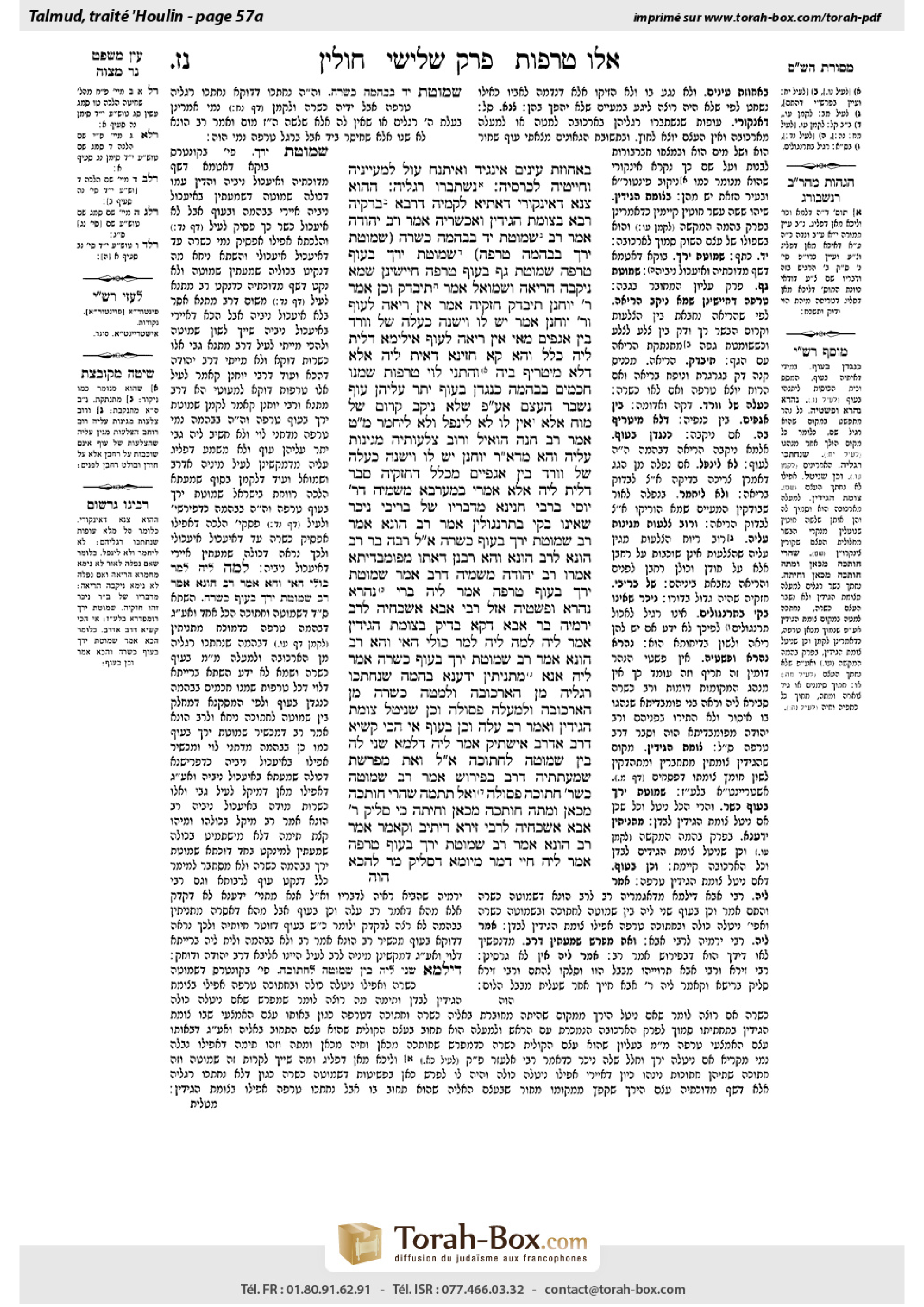
Chullin 57a: Talmud study for Daf Yomi
Study the Talmud for Daf Yomi with scanned pages, Hebrew text, English translations from Sefaria and AI-generated French translations.
Passage selection and English or AI-generated French translation are available where the scan has annotations. Daf Study is independent of Torah-Box and Sefaria.
Browse Chullin · חולין · All tractatesChullin 57a text and translations
This page of Chullin includes the Aramaic text, an English translation and an AI-generated French translation, alongside the scan above.
חולין נ״ז א · Aramaic and Hebrew text
בַּאֲחוּזַּת עֵינַיִם, אִינְּגִיד וְאִיתְּנַח, עוּל (למעייניה) [מַעְיָינֵיהּ] וְחַיְּיטֵיהּ לִכְרֵסֵיהּ.
נִשְׁתַּבְּרוּ רַגְלֶיהָ. הַהוּא צַנָּא דְּאִינְקוֹרֵי דַּאֲתַאי לְקַמֵּיהּ דְּרָבָא, בַּדְקֵיהּ רָבָא בְּצוֹמֶת הַגִּידִין, וְאַכְשְׁרֵיהּ.
אָמַר רַב יְהוּדָה אָמַר רַב: שְׁמוּטַת יָד בַּבְּהֵמָה – כְּשֵׁרָה, שְׁמוּטַת יָרֵךְ בַּבְּהֵמָה – טְרֵפָה, שְׁמוּטַת יָרֵךְ בָּעוֹף – טְרֵפָה, שְׁמוּטַת גַּף בָּעוֹף – טְרֵפָה, חָיְישִׁינַן שֶׁמָּא נִיקְּבָה הָרֵיאָה. וּשְׁמוּאֵל אָמַר: תִּיבָּדֵק, וְכֵן אָמַר רַבִּי יוֹחָנָן: תִּיבָּדֵק.
חִזְקִיָּה אָמַר: אֵין רֵיאָה לָעוֹף, וְרַבִּי יוֹחָנָן אָמַר: יֵשׁ לוֹ וְיֶשְׁנָהּ כְּעָלֶה שֶׁל וֶורֶד בֵּין אֲגַפַּיִם. מַאי ״אֵין רֵיאָה לָעוֹף״? אִילֵּימָא דְּלֵית לֵיהּ כְּלָל – וְהָא קָא חָזֵינַן דְּאִית לֵיהּ! אֶלָּא דְּלָא מִיטְּרִיף בֵּיהּ, וְהָתָנֵי לֵוִי: טְרֵפוֹת שֶׁמָּנוּ חֲכָמִים בַּבְּהֵמָה – כְּנֶגְדָּן בָּעוֹף, יָתֵר עֲלֵיהֶן עוֹף נִשְׁבַּר הָעֶצֶם אַף עַל פִּי שֶׁלֹּא נִיקַּב קְרוּם שֶׁל מוֹחַ!
אֶלָּא, אֵין לוֹ לֹא לִינָּפֵל וְלֹא לֵיחָמֵר. מַאי טַעְמָא? אָמַר רַב חָנָה: הוֹאִיל וְרוֹב צַלְעוֹתֶיהָ מְגִינּוֹת עָלֶיהָ.
וְהָא מִדְּאָמַר רַבִּי יוֹחָנָן: יֵשׁ לוֹ, וְיֶשְׁנָהּ כְּעָלֶה שֶׁל וֶורֶד בֵּין אֲגַפַּיִים – מִכְּלָל דְּחִזְקִיָּה סָבַר דְּלֵית לֵיהּ! אֶלָּא אָמְרִי בְּמַעְרְבָא מִשְּׁמֵיהּ דְּרַבִּי יוֹסֵי בְּרַבִּי חֲנִינָא: מִדְּבָרָיו שֶׁל בְּרִיבִּי נִיכָּר שֶׁאֵינוֹ בָּקִי בְּתַרְנְגוֹלִין.
אָמַר רַב הוּנָא אָמַר רַב: שְׁמוּטַת יָרֵךְ בָּעוֹף כְּשֵׁרָה. אֲמַר לֵיהּ רַבָּה בַּר רַב הוּנָא לְרַב הוּנָא: וְהָא רַבָּנַן דַּאֲתוֹ מִפּוּמְבְּדִיתָא אֲמַרוּ רַב יְהוּדָה מִשְּׁמֵיהּ דְּרַב אָמַר: שְׁמוּטַת יָרֵךְ בָּעוֹף טְרֵפָה! אֲמַר לֵיהּ: בְּרִי, נַהֲרָא נַהֲרָא וּפְשָׁטֵיהּ.
אֲזַל רַבִּי אַבָּא, אַשְׁכְּחֵיהּ לְרַב יִרְמְיָה בַּר אַבָּא דְּקָא בָּדֵיק בְּצוֹמֶת הַגִּידִין. אֲמַר לֵיהּ: לְמָה לֵיהּ לְמָר כּוּלֵּי הַאי? וְהָא רַב הוּנָא אָמַר רַב: שְׁמוּטַת יָרֵךְ בָּעוֹף כְּשֵׁרָה! אֲמַר לֵיהּ: אֲנָא מַתְנִיתִין יָדַעְנָא: בְּהֵמָה שֶׁנֶּחְתְּכוּ רַגְלֶיהָ מִן הָאַרְכּוּבָּה וּלְמַטָּה כְּשֵׁרָה, מִן הָאַרְכּוּבָּה וּלְמַעְלָה פְּסוּלָה, וְכֵן שֶׁנִּיטַּל צוֹמֶת הַגִּידִין, וְאָמַר רַב עֲלַהּ: וְכֵן בָּעוֹף.
אִי הָכִי, קַשְׁיָא דְּרַב אַדְּרַב! אִישְׁתִּיק. אֲמַר לֵיהּ: דִּלְמָא שָׁנֵי לֵיהּ בֵּין שְׁמוּטָה לַחֲתוּכָה? אֲמַר לֵיהּ: וְאַתְּ מְפָרְשַׁתְּ שְׁמַעְתָּתֵיהּ דְּרַב? בְּפֵירוּשׁ אָמַר רַב: שְׁמוּטָה – כְּשֵׁרָה, חֲתוּכָה – פְּסוּלָה. וְאַל תִּתְמַהּ, שֶׁהֲרֵי חוֹתְכָהּ מִכָּאן וָמֵתָה, חוֹתְכָהּ מִכָּאן וְחָיְתָה.
כִּי סְלֵיק רַבִּי אַבָּא, אַשְׁכְּחֵיהּ לְרַבִּי זֵירָא דְּיָתֵיב וְקָאָמַר: אָמַר רַב הוּנָא אָמַר רַב: שְׁמוּטַת יָרֵךְ בָּעוֹף טְרֵפָה. אֲמַר לֵיהּ: חַיֵּי דְּמָר, מִיּוֹמָא דִּסְלֵיק מָר לְהָכָא
Chullin 57a · English translation
deceptively, i.e., he only pretended to kill the son. The father fainted and went limp. By this movement, his intestines entered his stomach, and the Roman sewed up his stomach, and he recovered.
§ The mishna states: If its legs were broken, the bird remains kosher. The Gemara relates that there was a certain basket of birds with broken legs that came before Rava. Rava inspected each bird at the convergence of sinews in the thigh, and when he found that all its sinews were intact, he deemed it kosher.
Rav Yehuda says that Rav says: A dislocated foreleg in an animal is kosher. A dislocated femur in an animal renders it a tereifa. A dislocated femur in a bird renders it a tereifa. A dislocated wing in a bird renders it a tereifa, because we must be concerned that perhaps the lung was perforated. The lung is located near the wing’s attachment to the body, and part of the lung may have been torn out with the wing. And Shmuel says: The lung should be inspected, and if no damage is found, the bird is kosher. And so says Rabbi Yoḥanan: It should be inspected.
Ḥizkiyya, son of Rabbi Ḥiyya, says: A bird has no lungs. And Rabbi Yoḥanan says: A bird does have lungs, and they are like a rose petal in appearance, thin and red, between the wings. The Gemara asks: What does Ḥizkiyya mean when he says that a bird has no lungs? If we say that it has no lungs at all, that is problematic, as don’t we see that it does have lungs? Rather, say that he means that the bird is not rendered a tereifa by them if they are perforated. But this, too, is problematic, as doesn’t Levi teach: Those tereifot that the Sages enumerated in an animal hold likewise in a bird, and in addition to those, a bird is a tereifa if the bone of the skull was broken, even if the membrane of the brain was not perforated? If so, a perforated lung in a bird, as in an animal, renders it a tereifa.
Rather, say that Ḥizkiyya means that a bird’s lung has no halakha of falling and no halakha of singeing. If a bird falls, one need not inspect the lungs for damage as he must other organs (see 51b), and if it falls in a fire, one need not inspect the lungs for a change in color as he must other organs (see 56b). What is the reason for this? Rav Ḥana said: Since a majority of the bird’s ribs protect the lungs, one need not be concerned that the lung was damaged.
The Gemara asks: But from the fact that Rabbi Yoḥanan says in response: A bird does have lungs, and they are like a rose petal between the wings, by inference one must conclude that Ḥizkiyya maintains that it has no lungs at all. Rather, one must say as they say in the West, Eretz Yisrael, in the name of Rabbi Yosei, son of Rabbi Ḥanina: From the statement of the Distinguished, i.e., Ḥizkiyya, it is apparent that he is unfamiliar with chickens.
§ Rav Huna said that Rav said: A dislocated femur in a bird is kosher. Rabba bar Rav Huna said to Rav Huna: But the Rabbis that came from Pumbedita said that Rav Yehuda says in the name of Rav: A dislocated femur in a bird renders it a tereifa. Rav Huna said to him: My son, each river and its course, i.e., different communities observe different customs. Although Rav himself held that such a bird is kosher, he ruled for those living in Pumbedita that such a bird is a tereifa, in accordance with their own custom.
The Gemara recounts: Rabbi Abba went and found Rav Yirmeya bar Abba inspecting birds at the convergence of sinews in the thigh. Rabbi Abba said to him: Why must Master do all this? But doesn’t Rav Huna say that Rav says: A dislocated femur in a bird is kosher? If a bird is kosher even when the whole thigh has been removed, all the more so it should be kosher when only the convergence of sinews has been removed. Rav Yirmeya bar Abba said to him: I know the mishna (76a): With regard to an animal whose hind legs were severed, if they were severed from the leg joint and below, it is kosher; from the leg joint and above, it is a tereifa and unfit for consumption. And likewise an animal whose convergence of sinews in the thigh was removed is a tereifa. And Rav said about this: And likewise with regard to a bird.
Rabbi Abba responded: If so, this statement of Rav, that a bird whose convergence of sinews was removed is a tereifa, poses a difficulty for that statement of Rav, that a bird with a dislocated femur is kosher. Rav Yirmeya bar Abba was silent and did not respond. Rabbi Abba said to him: Perhaps there is a difference for Rav between a dislocated femur and a severed femur, and while the former does not render a bird a tereifa, the latter does. Rav Yirmeya bar Abba said to him: And are you interpreting Rav’s halakhot based on your own reasoning? Rav said explicitly: A dislocated femur is kosher, while a severed femur renders the animal unfit for consumption. And do not be confounded by this distinction, as one cuts an animal from here, in one place, and it dies, but one cuts it from there, in another place, and it lives.
The Gemara recounts: When Rabbi Abba went up from Babylonia to Eretz Yisrael, he found Rabbi Zeira sitting and saying: Rav Huna said that Rav said that a dislocated femur in a bird renders it a tereifa. Rabbi Abba said to him: By Master’s life, since the day that Master came up to here, Eretz Yisrael,
Chullin 57a · Traduction française (IA)
de façon trompeuse, c'est-à-dire qu'il n'avait que l'air de tuer le fils. Le père perdit connaissance et s'affaissa. Par ce mouvement, ses intestins entrèrent dans son estomac, et le Romain sutura son estomac, et il guérît.
§ La Michna dit : Si ses pattes sont cassées, l'oiseau reste propre. La Guemara rapporte qu'il y avait un certain panier d'oiseaux avec des pattes cassées qui vint devant Rava. Rava examina chaque oiseau au point de convergence des nerfs dans la cuisse, et lorsqu'il trouva que tous ses nerfs étaient intacts, il considéra qu'il était propre.
Rav Yéhouda dit que Rav dit : Une cuisse démise chez un animal est propre. Une fémur démis chez un animal le rend téréif. Une fémur démis chez un oiseau le rend téréif. Une aile démise chez un oiseau le rend téréif, car nous devons avoir peur que le poumon ait été perforé. Le poumon est situé près de l'attache de l'aile au corps, et une partie du poumon pourrait avoir été arrachée avec l'aile. Et Shmuel dit : Le poumon doit être inspecté, et si aucun dommage n'est trouvé, l'oiseau est propre. Et ainsi dit Rabbi Yoḥanan : Il doit être inspecté.
Ḥizkiyya, fils de Rabbi Ḥiyya, dit : L'oiseau n'a pas de poumons. Et Rabbi Yoḥanan dit : L'oiseau a des poumons, et ils sont comme une pétale de rose, fins et rouges, entre les ailes. La Guemara pose la question : De quoi Ḥizkiyya veut-il dire quand il dit que l'oiseau n'a pas de poumons ? Si nous disons qu'il n'a pas de poumons du tout, cela est problématique, car ne voyons-nous pas qu'il en a ? Plutôt, disons qu'il veut dire que l'oiseau n'est pas rendu téréif par eux s'ils sont perforés. Mais cela aussi est problématique, car ne dit pas Levi : Ceux des téréifot que les Sages ont énumérés chez un animal s'appliquent également chez un oiseau, et en plus de ceux-ci, un oiseau est téréif si l'os du crâne était brisé, même si la membrane du cerveau n'était pas perforée ? Si tel est le cas, un poumon perforé chez un oiseau, comme chez un animal, le rend téréif.
Plutôt, disons que Ḥizkiyya veut dire que le poumon de l'oiseau n'a pas de halakha de chute et n'a pas de halakha de brûlure. Si l'oiseau tombe, on n'a pas besoin d'inspecter les poumons pour des dommages, comme on le doit pour d'autres organes (voir 51b), et si il tombe dans un feu, on n'a pas besoin d'inspecter les poumons pour un changement de couleur, comme on le doit pour d'autres organes (voir 56b). Quelle est la raison de cela ? Rav Ḥana dit : Puisque la plupart des côtes de l'oiseau protègent les poumons, on n'a pas besoin de s'inquiéter que le poumon ait été endommagé.
La Guemara pose la question : Mais à partir du fait que Rabbi Yoḥanan dit en réponse : L'oiseau a des poumons, et ils sont comme une pétale de rose entre les ailes, on doit en conclure que Ḥizkiyya maintient qu'il n'en a pas du tout. Plutôt, on doit dire comme on dit en Occident, en Eretz Yisrael, en nom de Rabbi Yosei, fils de Rabbi Ḥanina : À partir de la déclaration du Distingué, c'est-à-dire Ḥizkiyya, il est évident qu'il est ignorant des poulets.
§ Rav Huna dit que Rav dit : Une fémur démise chez un oiseau est propre. Rabba bar Rav Huna dit à Rav Huna : Mais les Rabbins qui sont venus de Pumbedita dirent que Rav Yéhuda dit en nom de Rav : Une fémur démise chez un oiseau le rend téréif. Rav Huna dit à lui : Mon fils, chaque fleuve et son cours, c'est-à-dire différentes communautés observent différentes coutumes. Bien que Rav lui-même ait maintenu que tel oiseau est propre, il a jugé pour ceux qui habitent à Pumbedita que tel oiseau est téréif, conformément à leur propre coutume.
La Guemara rapporte : Rabbi Abba alla et trouva Rav Yirmeya bar Abba qui inspectait les oiseaux au point de convergence des nerfs dans la cuisse. Rabbi Abba dit à lui : Pourquoi doit le Maître faire tout cela ? Mais ne dit pas Rav Huna que Rav dit : Une fémur démise chez un oiseau est propre ? Si un oiseau est propre même quand toute la cuisse a été retirée, encore plus il devrait être propre quand seulement le point de convergence des nerfs a été retiré. Rav Yirmeya bar Abba dit à lui : Je sais la Michna (76a) : Concernant un animal dont les pattes arrière ont été tranchées, si elles ont été tranchées à la jointure de la patte et en dessous, il est propre ; à la jointure de la patte et au-dessus, il est téréif et non consommable. Et de même un animal dont le point de convergence des nerfs dans la cuisse a été retiré est téréif. Et Rav dit à ce sujet : Et de même concernant un oiseau.
Rabbi Abba répondit : Si tel est le cas, cette déclaration de Rav, que l'oiseau dont la convergence des nerfs a été retirée est téréif, pose un problème pour cette déclaration de Rav, que l'oiseau avec une fémur démise est propre. Rav Yirmeya bar Abba resta silencieux et ne répondit pas. Rabbi Abba dit à lui : Peut-être y a-t-il une différence pour Rav entre une fémur démise et une fémur tranchée, et bien que la première ne rende pas l'oiseau téréif, la seconde le fait. Rav Yirmeya bar Abba dit à lui : Et est-ce que vous interprétez les halakhot de Rav selon votre propre raisonnement ? Rav a dit explicitement : Une fémur démise est propre, tandis qu'une fémur tranchée rend l'animal inacceptable à la consommation. Et ne soyez pas confus par cette distinction, car on coupe un animal d'ici, dans un endroit, et il meurt, mais on le coupe d'ailleurs, dans un autre endroit, et il vit.
La Guemara rapporte : Quand Rabbi Abba monta de Babylone vers Eretz Yisrael, il trouva Rabbi Zeira assis et disant : Rav Huna dit que Rav a dit que une fémur démise chez un oiseau le rend téréif. Rabbi Abba dit à lui : Par la vie du Maître, depuis le jour où le Maître est venu ici, Eretz Yisrael,
Traduction française générée par IA à partir de l’édition anglaise de Sefaria. Vérifie toujours un passage avec le texte source.
Text from Sefaria: William Davidson Edition - Vocalized Aramaic (unknown); William Davidson Edition - English (CC BY NC).