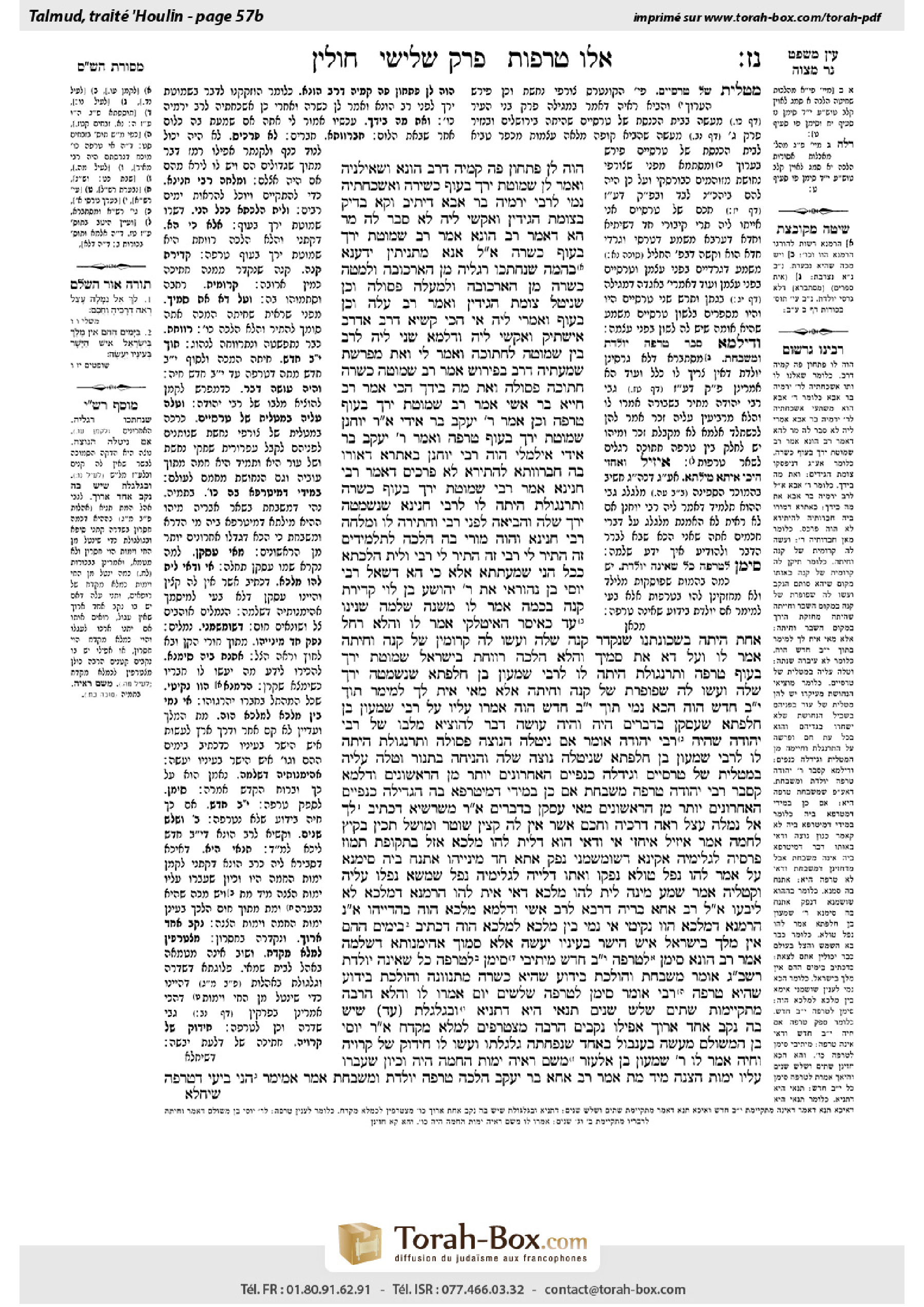
Chullin 57b: Talmud study for Daf Yomi
Study the Talmud for Daf Yomi with scanned pages, Hebrew text, English translations from Sefaria and AI-generated French translations.
Passage selection and English or AI-generated French translation are available where the scan has annotations. Daf Study is independent of Torah-Box and Sefaria.
Browse Chullin · חולין · All tractatesChullin 57b text and translations
This page of Chullin includes the Aramaic text, an English translation and an AI-generated French translation, alongside the scan above.
חולין נ״ז ב · Aramaic and Hebrew text
הֲוָה לַן פִּתְחוֹן פֶּה קַמֵּיהּ דְּרַב הוּנָא וּשְׁאֵילְנֵיהּ, וַאֲמַר לַן: שְׁמוּטַת יָרֵךְ בָּעוֹף כְּשֵׁירָה.
וְאַשְׁכַּחְתֵּיהּ נָמֵי לְרַבִּי יִרְמְיָה בַּר אַבָּא דְּיָתֵיב וְקָא בָדֵיק בְּצוֹמֵת הַגִּידִין, וְאַקְשִׁי לֵיהּ: לָא סָבַר לַהּ מָר הָא דְּאָמַר רַב הוּנָא אָמַר רַב: שְׁמוּטַת יָרֵךְ בָּעוֹף כְּשֵׁרָה? אָמַר לִי: אֲנָא מַתְנִיתִין יָדַעְנָא: בְּהֵמָה שֶׁנֶּחְתְּכוּ רַגְלֶיהָ, מִן הָאַרְכּוּבָּה וּלְמִטָּה – כְּשֵׁרָה, מִן הָאַרְכּוּבָּה וּלְמַעְלָה – פְּסוּלָה, וְכֵן שֶׁנִּיטַּל צוֹמֶת הַגִּידִין, וְאָמַר רַב עֲלַהּ: וְכֵן בָּעוֹף.
וַאֲמַרִי לֵיהּ: אִי הָכִי, קַשְׁיָא דְּרַב אַדְּרַב! אִישְׁתִּיק, וְאַקְשַׁי לֵיהּ: וְדִלְמָא שָׁנֵי לֵיהּ לְרַב בֵּין שְׁמוּטָה לַחֲתוּכָה? וְאָמַר לִי: וְאַתְּ מְפָרְשַׁתְּ שְׁמַעְתֵּיהּ דְּרַב? בְּפֵירוּשׁ אָמַר רַב: שְׁמוּטָה – כְּשֵׁרָה, חֲתוּכָה – פְּסוּלָה.
וְאַתְּ, מָה בִּידָךְ? הָכִי אָמַר רַב חִיָּיא בַּר אָשֵׁי אָמַר רַב: שְׁמוּטַת יָרֵךְ בָּעוֹף טְרֵפָה, וְכֵן אָמַר רַבִּי יַעֲקֹב בַּר אִידִי אָמַר רַבִּי יוֹחָנָן: שְׁמוּטַת יָרֵךְ בָּעוֹף טְרֵפָה.
וְאָמַר רַבִּי יַעֲקֹב בַּר אִידִי: אִילְמָלֵי הֲוָה רַבִּי יוֹחָנָן בְּאַתְרָא דְּאוֹרוֹ בַּהּ חַבְרָוָותָא לְהֶתֵּירָא, לָא פַּרְכֵּיס. דְּאָמַר רַבִּי חֲנִינָא אָמַר רַבִּי: שְׁמוּטַת יָרֵךְ בָּעוֹף כְּשֵׁרָה. וְתַרְנְגוֹלֶת הָיְתָה לוֹ לְרַבִּי חֲנִינָא שֶׁנִּשְׁמְטָה יָרֵךְ שֶׁלָּהּ, וֶהֱבִיאָהּ לִפְנֵי רַבִּי וְהִתִּירָהּ לוֹ, וּמְלָחָהּ רַבִּי חֲנִינָא, וַהֲוָה מוֹרֵי בַּהּ הֲלָכָה לַתַּלְמִידִים: זֶה הִתִּיר לִי רַבִּי, זֶה הִתִּיר לִי רַבִּי.
וְלֵית הִלְכְתָא כְּכׇל הָנֵי שְׁמַעְתָּתָא, אֶלָּא כִּי הָא דִּשְׁאֵל רַבִּי יוֹסֵי בֶּן נְהוֹרַאי אֶת רַבִּי יְהוֹשֻׁעַ בֶּן לֵוִי: קְדִירַת קָנֶה בְּכַמָּה? אָמַר לוֹ: מִשְׁנָה שְׁלֵמָה שָׁנִינוּ, עַד כְּאִיסָּר הָאִיטַלְקִי. אָמַר לוֹ: וַהֲלֹא רָחֵל אַחַת הָיְתָה בִּשְׁכוּנָתֵנוּ שֶׁנִּקְדַּר קָנֶה שֶׁלָּהּ, וְעָשׂוּ לָהּ קְרוּמִין שֶׁל קָנֶה וְחָיְתָה!
אָמַר לוֹ: וְעַל דָּא אַתְּ סָמֵיךְ? וַהֲלֹא הֲלָכָה רוֹוַחַת בְּיִשְׂרָאֵל: שְׁמוּטַת יָרֵךְ בָּעוֹף טְרֵפָה, וְתַרְנְגוֹלֶת הָיְתָה לוֹ לְרַבִּי שִׁמְעוֹן בֶּן חֲלַפְתָּא שֶׁנִּשְׁמְטָה יָרֵךְ שֶׁלָּהּ, וְעָשׂוּ לָהּ שְׁפוֹפֶרֶת שֶׁל קָנֶה וְחָיְתָה! אֶלָּא מַאי אִית לָךְ לְמֵימַר: תּוֹךְ שְׁנֵים עָשָׂר חֹדֶשׁ הֲוָה, הָכָא נָמֵי תּוֹךְ שְׁנֵים עָשָׂר חֹדֶשׁ הֲוָה.
אָמְרוּ עָלָיו עַל רַבִּי שִׁמְעוֹן בֶּן חֲלַפְתָּא שֶׁעַסְקָן בִּדְבָרִים הָיָה, וְהָיָה עוֹשֶׂה דָּבָר לְהוֹצִיא מִלִּבּוֹ שֶׁל רַבִּי יְהוּדָה, שֶׁהָיָה רַבִּי יְהוּדָה אוֹמֵר: אִם נִיטְּלָה הַנּוֹצָה פְּסוּלָה. וְתַרְנְגוֹלֶת הָיְתָה לוֹ לְרַבִּי שִׁמְעוֹן בֶּן חֲלַפְתָּא שֶׁנִּיטְּלָה נוֹצָה שֶׁלָּהּ, וְהִנִּיחָה בַּתַּנּוּר, וְטָלָה עָלֶיהָ בְּמַטְלִית שֶׁל טַרְסִיִּים, וְגִידְּלָה כְּנָפַיִים הָאַחֲרוֹנִים יוֹתֵר מִן הָרִאשׁוֹנִים.
וְדִלְמָא קָסָבַר רַבִּי יְהוּדָה טְרֵפָה מַשְׁבַּחַת? אִם כֵּן, בְּמִידֵּי דְּמִיטַּרְפָא בַּהּ – הִגְדִּילָה כְּנָפַיִים הָאַחֲרוֹנִים יוֹתֵר מִן הָרִאשׁוֹנִים?!
מַאי עַסְקָן בִּדְבָרִים? אָמַר רַב מְשַׁרְשְׁיָא, דִּכְתִיב: ״לֵךְ אֶל נְמָלָה עָצֵל רְאֵה דְרָכֶיהָ וַחֲכָם, אֲשֶׁר אֵין לָהּ קָצִין שֹׁטֵר וּמֹשֵׁל, תָּכִין בַּקַּיִץ לַחְמָהּ״. אָמַר: אֵיזִיל אִיחְזֵי אִי וַדַּאי הוּא דְּלֵית לְהוּ מַלְכָּא!
אֲזַל בִּתְקוּפַת תַּמּוּז, פַּרְסֵיהּ לִגְלִימֵיהּ אַקִּינָּא דְּשׁוּמְשְׁמָנֵי. נְפַק אֲתָא חַד מִינַּיְיהוּ, אַתְנַח בֵּיהּ סִימָנָא. עָל, אֲמַר לְהוּ: ״נְפַל טוּלָּא״. נְפַקוּ וַאֲתוֹ, דַּלְיֵיהּ לִגְלִימֵיהּ, נְפַל שִׁמְשָׁא. נְפַלוּ עֲלֵיהּ וְקַטְלֵיהּ. אֲמַר: שְׁמַע מִינַּהּ לֵית לְהוּ מַלְכָּא, דְּאִי אִית לְהוּ הַרְמָנָא דְּמַלְכָּא לָא לִיבְעוֹ.
אֲמַר לֵיהּ רַב אַחָא בְּרֵיהּ דְּרָבָא לְרַב אָשֵׁי: וְדִלְמָא מַלְכָּא הֲוָה בַּהֲדַיְיהוּ? אִי נָמֵי, הַרְמָנָא דְּמַלְכָּא הֲווֹ נְקִיטִי? אִי נָמֵי בֵּין מַלְכָּא לְמַלְכָּא הֲוָה, דִּכְתִיב: ״בַּיָּמִים הָהֵם אֵין מֶלֶךְ בְּיִשְׂרָאֵל אִישׁ הַיָּשָׁר בְּעֵינָיו יַעֲשֶׂה״? אֶלָּא, סְמוֹךְ אַהֵימָנוּתָא דִּשְׁלֹמֹה.
אָמַר רַב הוּנָא: סִימָן לִטְרֵפָה – שְׁנֵים עָשָׂר חֹדֶשׁ. מֵיתִיבִי: סִימָן לִטְרֵפָה – כֹּל שֶׁאֵינָהּ יוֹלֶדֶת. רַבָּן שִׁמְעוֹן בֶּן גַּמְלִיאֵל אוֹמֵר: מַשְׁבַּחַת וְהוֹלֶכֶת – בְּיָדוּעַ שֶׁהִיא כְּשֵׁרָה, מִתְנַוְּונָה וְהוֹלֶכֶת – בְּיָדוּעַ שֶׁהִיא טְרֵפָה. רַבִּי אוֹמֵר: סִימָן לִטְרֵפָה – שְׁלֹשִׁים יוֹם. אָמְרוּ לוֹ: וַהֲלֹא הַרְבֵּה מִתְקַיְּימוֹת שְׁתַּיִם שָׁלֹשׁ שָׁנִים!
תַּנָּאֵי הִיא, דְּתַנְיָא: וּבַגֻּלְגֹּלֶת, עַד שֶׁיֵּשׁ בָּהּ נֶקֶב אֶחָד אָרוֹךְ, אֲפִילּוּ נְקָבִים הַרְבֵּה מִצְטָרְפִים לִמְלֹא מַקְדֵּחַ. אָמַר רַבִּי יוֹסֵי בֶּן הַמְשׁוּלָּם: מַעֲשֶׂה בְּעִנְבּוּל, בְּאֶחָד שֶׁנִּפְחֲתָה גֻּלְגׇּלְתּוֹ, וְעָשׂוּ לוֹ חִידּוּק שֶׁל קֵרוּיָה וְחָיָה. אָמַר לוֹ רַבִּי שִׁמְעוֹן בֶּן אֶלְעָזָר: מִשָּׁם רְאָיָה? יְמוֹת הַחַמָּה הָיָה, וְכֵיוָן שֶׁעָבְרוּ עָלָיו יְמוֹת הַצִּנָּה מִיָּד מֵת.
אָמַר רַב אַחָא בַּר יַעֲקֹב, הֲלָכָה: טְרֵפָה יוֹלֶדֶת וּמַשְׁבַּחַת. אָמַר אַמֵּימָר: הָנֵי בֵּיעֵי דִּטְרֵפָה
Chullin 57b · English translation
we had the opportunity to speak with Rav Huna, and we asked him about this matter, and he said to us: A dislocated femur in a bird is kosher.
And I also found Rabbi Yirmeya bar Abba sitting and inspecting birds at the convergence of sinews in the thigh. And I posed a difficulty to him: Doesn’t Master maintain in accordance with this statement that Rav Huna says that Rav says: A dislocated femur in a bird is kosher? Rabbi Yirmeya bar Abba said to me: I know the mishna (76a): With regard to an animal whose hind legs were severed, if they were severed from the leg joint and below, it is kosher; from the leg joint and above, it is a tereifa and unfit for consumption. And likewise an animal whose convergence of sinews in the thigh was removed is a tereifa. And Rav said about this: And likewise with regard to a bird.
And I said to him: If so, this statement of Rav poses a difficulty for that statement of Rav. Rabbi Yirmeya bar Abba was silent. And I challenged him: But perhaps there is a difference for Rav between a dislocated femur and a severed one. And he said to me: And are you interpreting Rav’s halakha based on your own reasoning? Rav said explicitly: A dislocated femur is kosher, while a severed femur renders the animal unfit for consumption.
Rabbi Abba then asked Rabbi Zeira: And as for you, what is in your hand? What have you heard with regard to this halakha? Rabbi Zeira said to him: This is what Rav Ḥiyya bar Ashi says that Rav says: A dislocated femur in a bird renders it a tereifa. And so said Rabbi Ya’akov bar Idi that Rabbi Yoḥanan said: A dislocated femur in a bird renders it a tereifa.
And with regard to this, Rabbi Ya’akov bar Idi said: If Rabbi Yoḥanan had been in the place where the assembly ruled to permit such a bird, he would not have stirred. In other words, he would not have contested their ruling, because they were the greatest Sages of the previous generation. As Rabbi Ḥanina says that Rabbi Yehuda HaNasi says: A dislocated femur in a bird is kosher. And Rabbi Ḥanina had a hen whose femur was dislocated, and he brought it before Rabbi Yehuda HaNasi, and Rabbi Yehuda HaNasi permitted it to him, and Rabbi Ḥanina salted the hen to preserve it. And he would teach the students the halakha with it, as he would show them the preserved body of the hen and say: Rabbi Yehuda HaNasi permitted this to me, Rabbi Yehuda HaNasi permitted this to me.
The Gemara concludes: But the halakha is not in accordance with any of these statements. Rather, it is in accordance with that which Rabbi Yosei ben Nehorai asked Rabbi Yehoshua ben Levi: In what amount must a windpipe be punctured to render the animal a tereifa? Rabbi Yehoshua ben Levi said to him: We learned a full mishna (54a): Until the perforation is the same size as the Italian issar. Rabbi Yosei ben Nehorai said to him: But wasn’t there a certain ewe in our neighborhood whose windpipe was punctured in a greater amount, and they made a seal for the windpipe out of the shell of a reed and it lived?
Rabbi Yehoshua ben Levi said to him: And do you rely on this incident as evidence? But isn’t it a widespread halakha among the Jewish people that a dislocated femur in a bird renders it a tereifa? And still, Rabbi Shimon ben Ḥalafta had a hen whose femur was dislocated, and they made it a support out of the tube of a reed and it lived. Rather, what have you to say about this case? It must have occurred within twelve months of the dislocation, and afterward the hen died, since no tereifa can live more than twelve months. Here, too, in the case of the punctured windpipe, the episode occurred within twelve months of the injury and the ewe later died.
§ They said about Rabbi Shimon ben Ḥalafta that he was a researcher of various matters, and he would act to counter the opinion of Rabbi Yehuda, as Rabbi Yehuda would say: If the down covering a bird’s body was removed, it is a tereifa and unfit for consumption, as stated in the mishna. And Rabbi Shimon ben Ḥalafta had a hen whose down was removed, and he placed it in an oven, a warm place, and he covered it with a Coppersmiths’ [tarsiyyim] apron, and its new, i.e., rehabilitated, wings grew even more feathers than the original wings.
The Gemara asks: But how does this counter Rabbi Yehuda’s opinion? Perhaps Rabbi Yehuda holds that a tereifa can live and that its health can even improve beyond its previous state. The Gemara responds: Even if this is so, would Rabbi Yehuda say so with regard to the very thing with which it was rendered a tereifa, as is the case here, where it grew new wings with more feathers than the original wings?
The Gemara asks: From what episode did Rabbi Shimon ben Ḥalafta earn the title: Researcher of matters? Rav Mesharshiyya said: He saw that it is written: “Go to the ant, you sluggard; consider her ways, and be wise; which having no chief, overseer, or ruler, provides her bread in the summer” (Proverbs 6:6–8). Rabbi Shimon ben Ḥalafta said: I will go and see if it is correct that they have no king.
He went in the season of Tammuz, i.e., summer. Knowing that ants avoid intense heat, he spread his cloak over an ant hole to provide shade. One of the ants came out and saw the shade. Rabbi Shimon placed a distinguishing mark on the ant. It went into the hole and said to the other ants: Shade has fallen. They all came out to work. Rabbi Shimon lifted up his cloak, and the sun fell on them. They all fell upon the first ant and killed it. He said: One may learn from their actions that they have no king; as, if they had a king, would they not need the king’s edict [harmana] to execute their fellow ant?
Rav Aḥa, son of Rava, said to Rav Ashi: But perhaps the king was with them at the time and gave them permission. Or perhaps they already possessed the king’s edict giving them license to kill the ant. Or perhaps it was an interregnum between kings, as it is written: “In those days there was no king in Israel; every man did that which was right in his own eyes” (Judges 17:6). Rather, rely on the credibility of Solomon, the author of Proverbs, that ants have no king.
§ Rav Huna says: The sign of a tereifa is twelve months. If it is uncertain whether an animal is a tereifa, one may wait twelve months; if the animal survives, it is kosher. The Gemara raises an objection from a baraita: The sign of a tereifa is any animal that cannot give birth. Rabban Shimon ben Gamliel says: If its health improves continuously, it is certainly kosher; if its health deteriorates continuously, it is certainly a tereifa. Rabbi Yehuda HaNasi says: The sign of a tereifa is any animal that does not survive thirty days. The Sages said to him: But don’t many animals that are certainly tereifot survive two or three years? None of the opinions cited in the baraita accord with Rav Huna’s statement.
The Gemara responds: The matter is a dispute between tanna’im, as it is taught in a baraita: And in a skull that contains one long hole, or even if it has many holes, the areas of the holes join together to constitute the size of a drill hole, and they render the animal a tereifa. Rabbi Yosei ben HaMeshullam said: There was an incident in a place called Inbul involving one whose skull was missing a piece, and they made for him a patch out of the shell of a gourd, and he survived. Therefore, an animal with a missing piece of skull cannot be a tereifa. Rabbi Shimon ben Elazar said to him: Can you bring proof from there? It was summer then, and once winter came upon him he died immediately. Rabbi Shimon ben Elazar holds that an animal is a tereifa if it does not survive through summer and winter, i.e., one year. Rav Huna’s statement accords with this opinion.
Rav Aḥa bar Ya’akov says: The halakha is that a tereifa can give birth and its health can even improve. If the animal appears to recover or gives birth, this does not prove it is not a tereifa. Ameimar says: With regard to these eggs of a tereifa bird,
Chullin 57b · Traduction française (IA)
Nous avons eu l'occasion de parler avec Rav Huna, et nous lui avons posé une question à ce sujet, et il nous a répondu : Un fémur disloqué chez un oiseau est acceptable.
Et j'ai également trouvé Rabbi Yirmeya bar Abba assis et examinant des oiseaux au point de convergence des nerfs dans la cuisse. Et j'ai posé une difficulté à lui : N'est-ce pas que le Maître maintient, selon cette déclaration, que Rav Huna dit que Rav dit : Un fémur disloqué chez un oiseau est acceptable ? Rabbi Yirmeya bar Abba m'a répondu : Je sais la mitsva (76a) : Concernant un animal dont les jambes arrière ont été tranchées, si elles ont été tranchées au niveau du genou et en dessous, elle est acceptable ; si elles ont été tranchées au niveau du genou et au-dessus, elle est tereifa et non consommable. De même, un animal dont le point de convergence des nerfs dans la cuisse a été retiré est tereifa. Et Rav a dit à ce sujet : De même pour un oiseau.
Et j'ai dit à lui : Si c'est ainsi, cette déclaration de Rav pose une difficulté pour cette déclaration de Rav. Rabbi Yirmeya bar Abba a gardé le silence. Et j'ai défendu mon point : Mais peut-être y a-t-il une différence pour Rav entre un fémur disloqué et un fémur tranché. Et il m'a répondu : Et est-ce que vous interprétez la halakha de Rav selon votre propre raisonnement ? Rav a dit explicitement : Un fémur disloqué est acceptable, tandis qu'un fémur tranché rend l'animal non consommable.
Rabbi Abba demanda ensuite à Rabbi Zeira : Et concernant vous, qu'avez-vous en main ? Qu'avez-vous entendu à ce sujet de cette halakha ? Rabbi Zeira répondit : C'est ce que Rav Ḥiyya bar Ashi dit que Rav dit : Un fémur disloqué chez un oiseau le rend tereifa. Et ainsi a dit Rabbi Ya’akov bar Idi que Rabbi Yoḥanan dit : Un fémur disloqué chez un oiseau le rend tereifa.
Et concernant cela, Rabbi Ya’akov bar Idi dit : Si Rabbi Yoḥanan avait été à l'endroit où l'assemblée avait décidé de permettre un tel oiseau, il n'aurait pas contesté leur décision. En d'autres termes, il n'aurait pas contesté leur décision, car ils étaient les plus grands Sages de la génération précédente. Comme Rabbi Ḥanina dit que Rabbi Yehuda HaNasi dit : Un fémur disloqué chez un oiseau est acceptable. Et Rabbi Ḥanina avait une poule dont le fémur était disloqué, et il l'a présentée devant Rabbi Yehuda HaNasi, et Rabbi Yehuda HaNasi l'a permis à Rabbi Ḥanina, et Rabbi Ḥanina a salé la poule pour la conserver. Et il enseignait à ses élèves la halakha avec elle, en montrant à ses élèves le corps conservé de la poule et en disant : Rabbi Yehuda HaNasi m'a permis cela, Rabbi Yehuda HaNasi m'a permis cela.
La Guemara conclut : Mais la halakha ne suit aucune de ces déclarations. Elle suit plutôt celle que Rabbi Yosei ben Nehorai a posée à Rabbi Yehoshua ben Levi : Dans quelle mesure doit-on percer la trachée pour rendre l'animal tereifa ? Rabbi Yehoshua ben Levi lui répondit : Nous avons appris une mitsva complète (54a) : Jusqu'à ce que la perforation soit de la taille d'un Italian issar. Rabbi Yosei ben Nehorai lui dit : Mais n'y avait-il pas une certaine brebis dans notre quartier dont la trachée avait été perçée dans une mesure plus grande, et ils avaient fait un selle pour la trachée à partir de la coquille d'un roseau et elle avait survécu ?
Rabbi Yehoshua ben Levi lui a dit : Et est-ce que vous vous appuyez sur cet incident comme preuve ? Mais n'est-ce pas une halakha courante parmi le peuple juif que un fémur disloqué chez un oiseau le rend tereifa ? Et pourtant, Rabbi Shimon ben Ḥalafta avait une poule dont le fémur était disloqué, et ils avaient fait un support à partir du tube d'un roseau et elle avait survécu. Plutôt, que dites-vous à ce sujet ? Il doit avoir eu lieu dans les douze mois suivant la dislocation, et après cela la poule est morte, car aucun tereifa ne peut vivre plus de douze mois. Ici aussi, dans le cas de la trachée perçée, l'incident s'est produit dans les douze mois suivant la blessure et la brebis est morte plus tard.
§ On disait de Rabbi Shimon ben Ḥalafta qu'il était un chercheur de diverses choses, et il agissait pour contredire l'opinion de Rabbi Yehuda, comme Rabbi Yehuda disait : Si la couverture de plumes d'un oiseau est retirée, il est tereifa et non consommable, comme mentionné dans la mitsna. Et Rabbi Shimon ben Ḥalafta avait une poule dont la couverture de plumes avait été retirée, et il l'a placée dans un four, un lieu chaud, et il l'a couverte avec un manteau des ciseleurs [tarsiyyim], et ses ailes réparées ont même poussé plus de plumes que les ailes originales.
La Guemara pose la question : Mais comment cela contredit-il l'opinion de Rabbi Yehuda ? Peut-être que Rabbi Yehuda maintient que un tereifa peut vivre et que sa santé peut même s'améliorer au-delà de son état précédent. La Guemara répond : Même si c'est ainsi, serait-ce que Rabbi Yehuda dirait cela concernant la chose même avec laquelle il a été rendu tereifa, comme c'est le cas ici, où il a poussé des ailes nouvelles avec plus de plumes que les ailes originales ?
La Guemara pose la question : D'après quel épisode Rabbi Shimon ben Ḥalafta a-t-il mérité le titre : Chercheur de questions ? Rav Mesharshiyya a dit : Il a vu que cela est écrit : « Va vers l'ara, tu paresseux ; considère ses manières, et sois sage ; qui n'a pas de chef, de chef d'œuvre, ou de roi, elle prépare son pain en été » (Proverbes 6:6–8). Rabbi Shimon ben Ḥalafta a dit : Je vais y aller et voir si c'est correct qu'ils n'aient pas de roi.
Il est allé en Tammuz, c'est-à-dire en été. Sachant que les fourmis évitent la chaleur intense, il a étendu son manteau sur un trou de fourmi pour lui fournir de l'ombre. Une des fourmis est sortie et a vu l'ombre. Rabbi Shimon a marqué la fourmi. Elle est entrée dans le trou et a dit aux autres fourmis : L'ombre est tombée. Elles sont toutes sorties travailler. Rabbi Shimon a levé son manteau, et le soleil est tombé sur elles. Elles sont toutes tombées sur la première fourmi et l'ont tuée. Il a dit : On peut apprendre de leurs actions qu'ils n'ont pas de roi ; car, si ils avaient un roi, ne devraient-ils pas avoir besoin de l'édit [harmana] du roi pour exécuter leur fourmi ?
Rav Aḥa, fils de Rava, dit à Rav Ashi : Mais peut-être que le roi était présent lorsqu'ils agissaient et leur avait donné la permission. Ou peut-être qu'ils disposaient déjà d'un édit royal leur permettant de tuer la fourmi. Ou peut-être qu'il s'agissait d'une période interrégnaire entre deux rois, comme il est écrit : « Dans ces jours-là, il n'y avait pas de roi en Israël ; chacun faisait ce qui lui semblait juste » (Juges 17:6). Il faut plutôt se fier à la crédibilité de Salomon, auteur des Proverbes, qui affirme que les fourmis n'ont pas de roi.
§ Rav Huna dit : Le signe d'un téréif est un an. Si l'on est不确定 si un animal est téréif, on peut attendre un an ; si l'animal survit, il est propre. La Guemara émet un objet d'objection à partir d'une baraïta : Le signe d'un téréif est tout animal qui ne peut pas accoucher. Rabban Shimon ben Gamliel dit : Si sa santé s'améliore continuellement, il est certainement propre ; si sa santé s'aggrave continuellement, il est certainement téréif. Rabbi Yehuda HaNasi dit : Le signe d'un téréif est tout animal qui ne survit pas trente jours. Les Sages lui dirent : Mais ne sont-ce pas nombreux les animaux qui sont certainement téréif qui survivent deux ou trois ans ? Aucun des opinions citées dans la baraïta ne correspond à l'affirmation de Rav Huna.
La Guemara répond : La question est un débat entre les tannaïm, comme il est enseigné dans une baraïta : Et dans un crâne qui contient un seul trou long, ou même s'il a plusieurs trous, les zones des trous se joignent pour constituer la taille d'un trou de perceuse, et ils rendent l'animal téréif. Rabbi Yosei ben HaMeshullam dit : Il y avait un cas dans un lieu appelé Inbul concernant un homme dont le crâne manquait une pièce, et ils lui firent un pansement avec la coquille d'un citron, et il survécut. Par conséquent, un animal dont le crâne manque une pièce ne peut pas être téréif. Rabbi Shimon ben Elazar lui dit : Peux-tu en tirer une preuve ? Il faisait alors l'été, et une fois que l'hiver vint, il mourut immédiatement. Rabbi Shimon ben Elazar considère que l'animal est téréif s'il ne survit pas l'été et l'hiver, c'est-à-dire un an. L'affirmation de Rav Huna correspond à cet avis.
Rav Aḥa bar Ya’akov dit : La halakha est que le téréif peut accoucher et sa santé peut même s'améliorer. Si l'animal semble se rétablir ou accoucher, cela ne prouve pas qu'il n'est pas téréif. Ameimar dit : En ce qui concerne les œufs d'un oiseau téréif,
Traduction française générée par IA à partir de l’édition anglaise de Sefaria. Vérifie toujours un passage avec le texte source.
Text from Sefaria: William Davidson Edition - Vocalized Aramaic (unknown); William Davidson Edition - English (CC BY NC).