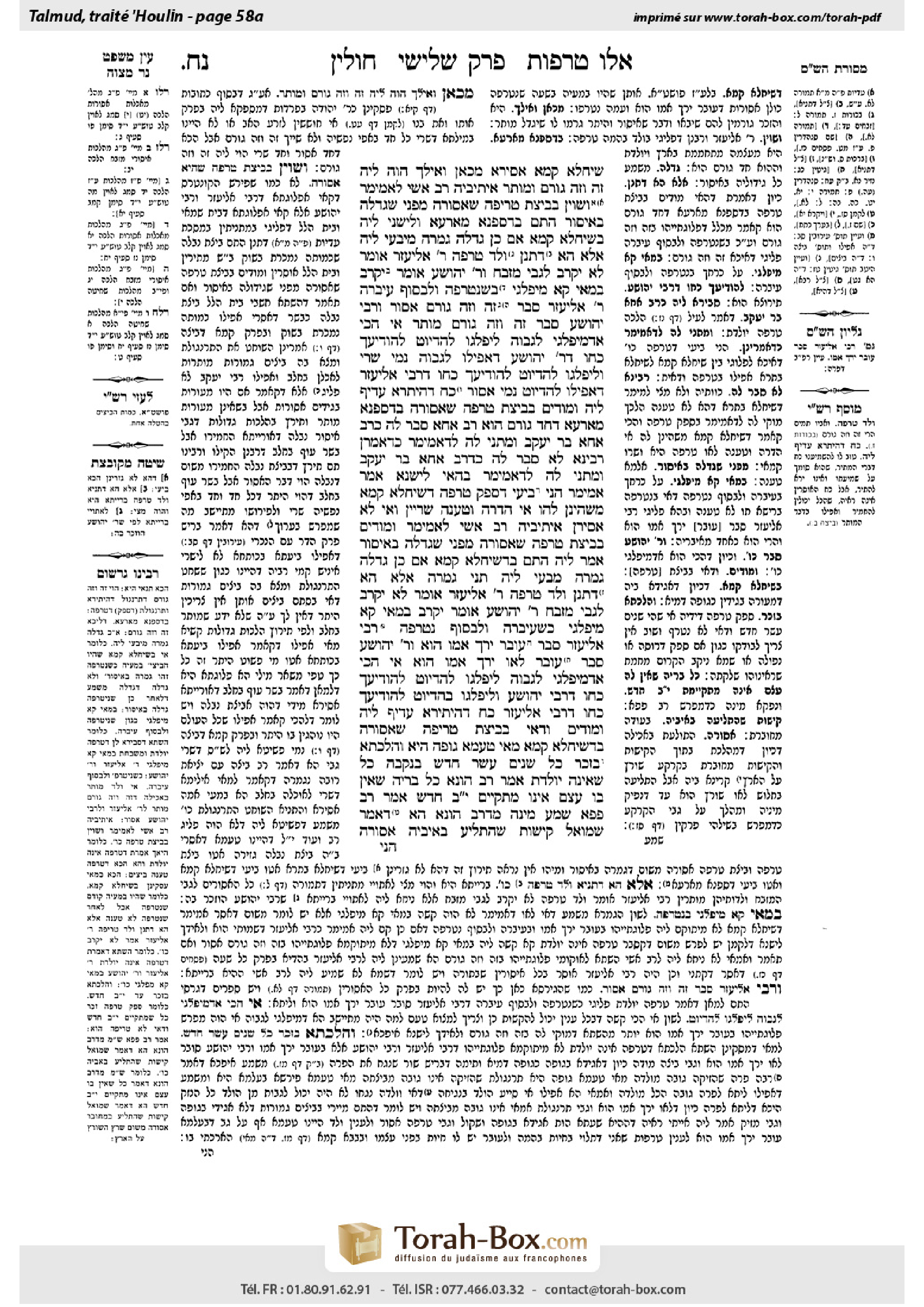
Chullin 58a: Talmud study for Daf Yomi
Study the Talmud for Daf Yomi with scanned pages, Hebrew text, English translations from Sefaria and AI-generated French translations.
Passage selection and English or AI-generated French translation are available where the scan has annotations. Daf Study is independent of Torah-Box and Sefaria.
Browse Chullin · חולין · All tractatesChullin 58a text and translations
This page of Chullin includes the Aramaic text, an English translation and an AI-generated French translation, alongside the scan above.
חולין נ״ח א · Aramaic and Hebrew text
שִׁיחְלָא קַמָּא אֲסִירָא, מִכָּאן וְאֵילָךְ – הָוֵה לֵיהּ זֶה וָזֶה גּוֹרֵם, וּמוּתָּר.
אֵיתִיבֵיהּ רַב אָשֵׁי לְאַמֵּימָר: וְשָׁוִין בְּבֵיצַת טְרֵיפָה שֶׁאֲסוּרָה, מִפְּנֵי שֶׁגָּדְלָה בְּאִיסּוּר! הָתָם בִּדְסָפְנָא מֵאַרְעָא.
וְלִישַׁנֵּי לֵיהּ בְּשִׁיחְלָא קַמָּא? אִם כֵּן, ״גָּדְלָה״? ״גָּמְרָה״ מִיבְּעֵי לֵיהּ.
אֶלָּא, הָא דִּתְנַן: וְלַד טְרֵפָה, רַבִּי אֱלִיעֶזֶר אוֹמֵר: לֹא יִקְרַב לְגַבֵּי מִזְבֵּחַ, וְרַבִּי יְהוֹשֻׁעַ אוֹמֵר: יִקְרַב. בְּמַאי קָא מִיפַּלְגִי? בְּשֶׁנִּטְרְפָה וּלְבַסּוֹף עִיבְּרָה, רַבִּי אֱלִיעֶזֶר סָבַר: זֶה וָזֶה גּוֹרֵם אָסוּר, וְרַבִּי יְהוֹשֻׁעַ סָבַר: זֶה וָזֶה גּוֹרֵם מוּתָּר. אִי הָכִי, אַדְּמִיפַּלְגִי לְגָבוֹהַּ, לִיפַּלְגוּ לְהֶדְיוֹט?
לְהוֹדִיעֲךָ כֹּחוֹ דְּרַבִּי יְהוֹשֻׁעַ, דַּאֲפִילּוּ לְגָבוֹהַּ נָמֵי שָׁרֵי.
וְלִיפַּלְגוּ לְהֶדְיוֹט, לְהוֹדִיעֲךָ כֹּחוֹ דְּרַבִּי אֱלִיעֶזֶר, דַּאֲפִילּוּ לְהֶדְיוֹט נָמֵי אָסַור! כֹּחַ דְּהֶיתֵּרָא עֲדִיף לֵיהּ.
וּמוֹדִים בְּבֵיצַת טְרֵפָה שֶׁאֲסוּרָה, בִּדְסָפְנָא מֵאַרְעָא, דְּחַד גּוֹרֵם הוּא.
רַב אַחָא סָבַר לַהּ כְּרַב אַחָא בַּר יַעֲקֹב, וּמַתְנֵי לַהּ לִדְאַמֵּימָר כְּדַאֲמַרַן.
רָבִינָא לָא סָבַר לַהּ כִּדְרַב אַחָא בַּר יַעֲקֹב, וּמַתְנֵי לַהּ לִדְאַמֵּימָר בְּהַאי לִישָּׁנָא: אָמַר אַמֵּימָר: הָנֵי בֵּיעֵי דִּסְפֵק טְרֵפָה, דְּשִׁיחְלָא קַמָּא מְשַׁהֵינַן לְהוּ, אִי הָדְרָה וְטָעֲנָה – שַׁרְיָין, וְאִי לָא – אֲסִירָן.
אֵיתִיבֵיהּ רַב אָשֵׁי לְאַמֵּימָר: וּמוֹדִים בְּבֵיצַת טְרֵפָה שֶׁאֲסוּרָה, מִפְּנֵי שֶׁגָּדְלָה בְּאִיסּוּר. אֲמַר לֵיהּ: הָתָם בִּדְשִׁיחְלָא קַמָּא. אִם כֵּן, ״גָּדְלָה״? ״גָּמְרָה״ מִבְּעֵי לֵיהּ! תְּנִי: גָּמְרָה.
אֶלָּא, הָא דִּתְנַן: וְלַד טְרֵפָה, ר׳ אֱלִיעֶזֶר אוֹמֵר: לֹא יִקְרַב לְגַבֵּי מִזְבֵּחַ, ר׳ יְהוֹשֻׁעַ אוֹמֵר: יִקְרַב, בְּמַאי קָא מִיפַּלְגִי? כְּשֶׁעִיבְּרָה וּלְבַסּוֹף נִטְרְפָה, רַבִּי אֱלִיעֶזֶר סָבַר: עוּבָּר יֶרֶךְ אִמּוֹ הוּא, וְרַבִּי יְהוֹשֻׁעַ סָבַר: עוּבָּר לָאו יֶרֶךְ אִמּוֹ הוּא. אִי הָכִי, אַדְּמִיפַּלְגִי לְגָבוֹהַּ, לִיפַּלְגוּ לְהֶדְיוֹט!
לְהוֹדִיעֲךָ כֹּחוֹ דְּרַבִּי יְהוֹשֻׁעַ. וְלִיפַּלְגוּ בְּהֶדְיוֹט לְהוֹדִיעֲךָ כֹּחוֹ דְּרַבִּי אֱלִיעֶזֶר? כֹּחַ דְּהֶיתֵּירָא עֲדִיף לֵיהּ.
וּמוֹדִים וַדַּאי בְּבֵיצַת טְרֵיפָה שֶׁאֲסוּרָה, בִּדְשִׁיחְלָא קַמָּא, מַאי טַעְמָא? גּוּפַהּ הִיא.
וְהִלְכְתָא בְּזָכָר – כׇּל שְׁנֵים עָשָׂר חֹדֶשׁ, בִּנְקֵבָה – כֹּל שֶׁאֵינָהּ יוֹלֶדֶת.
אָמַר רַב הוּנָא: כֹּל (בְּרִיָּה) שֶׁאֵין בּוֹ עֶצֶם אֵינוֹ מִתְקַיֵּים שְׁנֵים עָשָׂר חֹדֶשׁ. אָמַר רַב פָּפָּא: שְׁמַע מִינַּהּ מִדְּרַב הוּנָא, הָא דְּאָמַר שְׁמוּאֵל: קִישּׁוּת (שהתליע) [שֶׁהִתְלִיעָה] בְּאִיבֶּיהָ אֲסוּרָה.
Chullin 58a · English translation
the first clutch [shiḥala] of eggs that were in its body at the time it was rendered a tereifa is prohibited for consumption, because these eggs are considered part of the bird and were therefore rendered tereifa along with it. But as for any egg fertilized from this point forward, it is a case where both this and that cause it, i.e., a tereifa female and a kosher male, and as a rule, when permitted and prohibited causes operate together, the joint result is permitted.
Rav Ashi raised an objection to Ameimar from a mishna (Eduyyot 5:1): And all agree with regard to the egg of a tereifa bird that it is prohibited for consumption, because it grew in a state of prohibition. Evidently, even eggs created after the bird was rendered a tereifa are prohibited. Ameimar said to him: There, the mishna is dealing with a bird that is heated by the earth, i.e., that was not fertilized by a male, and the female tereifa is therefore the sole source of the egg.
The Gemara objects: And let Ameimar answer differently, that the mishna is dealing with the first clutch of eggs, which were part of the mother’s body when it became a tereifa. The Gemara responds: If this was so, why does the mishna state: Because it grew in a state of prohibition? The mishna should have stated: Because it was finished in a state of prohibition.
The Gemara objects: But if the offspring in the womb of an animal becomes a tereifa along with it, then that which we learned in a baraita is difficult: With regard to the offspring of a tereifa, Rabbi Eliezer says that it shall not be sacrificed on the altar, and Rabbi Yehoshua says that it may be sacrificed. With regard to what case do they disagree? It must be with regard to a case where the mother animal was rendered a tereifa and afterward became pregnant from a kosher male, and Rabbi Eliezer holds: In a case where this and that cause it, it is prohibited, and Rabbi Yehoshua holds: In a case where this and that cause it, it is permitted. But if so, rather than disputing whether it is permitted to sacrifice such offspring to the Most High, let them disagree concerning the more basic issue of whether the offspring is permitted to an ordinary person for consumption.
The Gemara responds: The dispute addresses the question of whether it is permitted to sacrifice the animal as an offering in order to convey to you the far-reaching nature of the lenient opinion of Rabbi Yehoshua, that such an animal is permitted even as an offering to the Most High.
The Gemara challenges: But let them disagree concerning whether the animal is permitted to an ordinary person in order to convey to you the far-reaching nature of the stringent opinion of Rabbi Eliezer, that such an animal is prohibited even to an ordinary person. The Gemara responds: It is preferable for the tanna to emphasize the power of leniency.
The Gemara concludes: Since Rabbi Eliezer and Rabbi Yehoshua disagree with regard to an offspring brought about by two causes, it follows that when the mishna states: And they concede with regard to the egg of a tereifa bird that it is prohibited for consumption, this is referring to a bird that is heated by the earth and was not fertilized by a male, so that there is only one cause, the tereifa mother bird.
The Gemara notes: Rav Aḥa holds in accordance with the opinion of Rav Aḥa bar Ya’akov, who said at the end of the previous amud that a tereifa animal can be capable of giving birth, and similarly a tereifa bird can be capable of laying eggs as well, and he therefore teaches the statement of Ameimar as we have said, that any egg fertilized after the bird became a tereifa is permitted.
But Ravina does not hold in accordance with the opinion of Rav Aḥa bar Ya’akov. Rather, he holds that a tereifa cannot produce eggs or give birth. And he therefore teaches the statement of Ameimar in this formulation: Ameimar said that with regard to these eggs of a bird concerning which it is uncertain whether it is a tereifa, the halakha is as follows: We leave aside the first clutch of eggs. If the bird produces eggs again, the first eggs are permitted for consumption, because the bird is certainly not a tereifa. And if not, they are prohibited, because they were considered part of the bird when it was rendered a tereifa.
Rav Ashi raised an objection to Ameimar from a mishna (Eduyyot 5:1): And they concede with regard to the egg of a tereifa bird that it is prohibited for consumption, because it grew in a state of prohibition. Evidently, a tereifa bird can produce eggs. Ameimar said to him: The mishna there deals with the first clutch of eggs, which existed before the bird became a tereifa. Rav Ashi asks: If so, why does the mishna state: Because it grew in a state of prohibition? The mishna should have stated: Because it was finished in a state of prohibition. Ameimar responded: Teach an emended version of the mishna: Because it was finished in a state of prohibition.
Rav Ashi asks: But if a tereifa cannot become pregnant, that which we learned in a baraita is difficult: With regard to the offspring of a tereifa, Rabbi Eliezer says that it shall not be sacrificed on the altar, and Rabbi Yehoshua says that it may be sacrificed. With regard to what case do they disagree? It must be with regard to a case where the mother animal became pregnant and only afterward was rendered a tereifa. Rabbi Eliezer holds that a fetus is considered like the thigh of its mother and is rendered a tereifa as part of its body, and Rabbi Yehoshua holds that a fetus is not considered like the thigh of its mother. The Gemara objects: But if so, rather than disputing whether it is permitted to sacrifice such offspring to the Most High, let them dispute the more basic issue of whether the offspring is permitted to an ordinary person for consumption.
The Gemara responds: The mishna discusses the question of whether it is permitted to sacrifice the animal as an offering in order to convey to you the far-reaching nature of the lenient opinion of Rabbi Yehoshua that such an animal is permitted even as an offering to the Most High. The Gemara suggests: But let them dispute whether the animal is permitted to an ordinary person, in order to convey to you the far-reaching nature of the stringent opinion of Rabbi Eliezer that such an animal is prohibited even to an ordinary person. The Gemara responds: It is preferable for the tanna to emphasize the power of leniency.
The Gemara concludes: According to this explanation, when the mishna states: And they certainly concede with regard to the egg of a tereifa bird that it is prohibited for consumption, it is dealing with the first clutch of eggs in the bird’s oviduct at the time it becomes a tereifa. Even Rabbi Yehoshua, who holds that the fetus of an animal is not considered like the thigh of its mother, concedes that a bird’s egg is rendered a tereifa along with it. What is the reason for this? Rabbi Yehoshua holds that an egg is a true part of its body.
The Gemara rules: And with regard to an animal concerning which it is uncertain whether it is a tereifa, the halakha is: In the case of a male, it is prohibited for an entire twelve-month period. After that point, the animal is certainly kosher. In the case of a female, any animal that does not give birth is prohibited. Once it has, it is certainly kosher.
§ Rav Huna says: Any creature that has no bones cannot last twelve months. Rav Pappa said: One may learn from Rav Huna’s statement about that which Shmuel says: If a serpent melon became infested by worms while attached to the ground [be’ibbeha], the worm is prohibited for consumption, in accordance with the verse: “And every swarming thing that swarms upon the earth is a detestable thing; it shall not be eaten” (Leviticus 11:41).
Chullin 58a · Traduction française (IA)
la première couvée d'œufs qui se trouvait dans son corps au moment où elle est devenue tereifa est interdite à la consommation, car ces œufs sont considérés comme faisant partie du volatile et ont donc été rendus tereifa avec lui. Mais concernant tout œuf fécondé à partir de ce moment, c'est un cas où à la fois cette cause et celle-ci l'entraînent, c'est-à-dire une femelle tereifa et un mâle kasher, et en général, lorsque des causes permises et interdites agissent ensemble, le résultat conjoint est permis.
Rav Ashi a soulevé une objection contre Ameimar à partir d'une mitsna (Eduyyot 5:1) : Et tous s'accordent sur l'œuf d'un volatile tereifa, car il est interdit à la consommation, car il a grandi dans un état d'interdiction. Évidemment, même les œufs créés après que le volatile est devenu tereifa sont interdits. Ameimar a répondu à lui : Là, la mitsna traite d'un volatile chauffé par la terre, c'est-à-dire qui n'a pas été fécondé par un mâle, et la femelle tereifa est donc la seule source de l'œuf.
Le Guemara s'oppose : Et laissez Ameimar répondre différemment, que la mitsna traite de la première couvée d'œufs, qui faisaient partie du corps de la mère au moment où elle est devenue tereifa. Le Guemara répond : Si c'était le cas, pourquoi la mitsna dit-elle : car il a grandi dans un état d'interdiction ? La mitsna aurait dû dire : car il a été achevé dans un état d'interdiction.
Le Guemara s'oppose : Mais si les descendants dans le ventre d'un animal deviennent tereifa avec lui, alors ce que nous avons appris dans une baraïta est difficile : Concernant les descendants d'un tereifa, Rabbi Eliezer dit qu'ils ne doivent pas être sacrifiés sur l'autel, et Rabbi Yehoshua dit qu'ils peuvent être sacrifiés. Concernant quel cas se déroule leur débat ? Il doit être concernant un cas où l'animal mère était devenu tereifa et après avoir été enceinte d'un mâle kasher, et Rabbi Eliezer dit : Dans un cas où ces causes-là l'entraînent, il est interdit, et Rabbi Yehoshua dit : Dans un cas où ces causes-là l'entraînent, il est permis. Mais si c'est ainsi, plutôt que de discuter si il est permis de sacrifier de tels descendants à l'Éternel, qu'ils débattent plutôt de la question plus fondamentale de savoir si le descendant est permis à un homme ordinaire pour la consommation.
Le Guemara répond : Le débat porte sur la question de savoir si il est permis de sacrifier l'animal comme offrande afin de vous faire comprendre la portée de l'opinion leniente de Rabbi Yehoshua, que cet animal est permis même comme offrande à l'Éternel.
Le Guemara soulève un défi : Mais qu'ils débattent concernant si l'animal est permis à un homme ordinaire afin de vous faire comprendre la portée de l'opinion stricte de Rabbi Eliezer, que cet animal est interdit même à un homme ordinaire. Le Guemara répond : Il est préférable que le tanna mette en avant la puissance de la lenienc.
Le Guemara conclut : Puisque Rabbi Eliezer et Rabbi Yehoshua s'opposent concernant un descendant issu de deux causes, il en découle que lorsque la mitsna dit : Et ils reconnaissent concernant l'œuf d'un volatile tereifa qu'il est interdit à la consommation, cela fait référence à un volatile chauffé par la terre et qui n'a pas été fécondé par un mâle, de sorte qu'il n'y a qu'une seule cause, la femelle tereifa.
Le Guemara note : Rav Aḥa suit l'opinion de Rav Aḥa bar Ya’akov, qui a dit à la fin de l'amud précédent qu'un animal tereifa peut être capable de donner naissance, et de même un volatile tereifa peut être capable de pondre des œufs, et il enseigne donc la déclaration d'Ameimar telle que nous l'avons dite, que tout œuf fécondé après que le volatile est devenu tereifa est permis.
Mais Ravina ne suit pas l'opinion de Rav Aḥa bar Ya’akov. Il considère plutôt qu'un tereifa ne peut pas produire d'œufs ou donner naissance. Et il enseigne donc la déclaration d'Ameimar sous cette formulation : Ameimar dit que concernant ces œufs d'un volatile dont on ne sait pas s'il est tereifa, la halakha est la suivante : On met de côté la première couvée d'œufs. Si le volatile produit des œufs à nouveau, les premiers œufs sont permis à la consommation, car le volatile n'est certainement pas un tereifa. Et si non, ils sont interdits, car ils étaient considérés comme faisant partie du volatile au moment où il est devenu tereifa.
Rav Ashi souleva une objection contre Ameimar à partir d'une mitsna (Eduyyot 5:1) : Et ils reconnaissent concernant l'œuf d'un volatile tereifa qu'il est interdit à la consommation, car il a grandi dans un état d'interdiction. Évidemment, un volatile tereifa peut produire des œufs. Ameimar répondit à lui : La mitsna là traite de la première couvée d'œufs, qui existait avant que le volatile ne devienne tereifa. Rav Ashi demande : Si c'est ainsi, pourquoi la mitsna dit-elle : car il a grandi dans un état d'interdiction ? La mitsna aurait dû dire : car il a été achevé dans un état d'interdiction. Ameimar répondit : Enseigne une version corrigée de la mitsna : car il a été achevé dans un état d'interdiction.
Rav Ashi demande : Mais si un tereifa ne peut pas devenir enceinte, ce que nous avons appris dans une baraïta est difficile : Concernant les descendants d'un tereifa, Rabbi Eliezer dit qu'ils ne doivent pas être sacrifiés sur l'autel, et Rabbi Yehoshua dit qu'ils peuvent être sacrifiés. Concernant quel cas se déroule leur débat ? Il doit être concernant un cas où l'animal mère est devenue enceinte et n'a été rendue tereifa qu'ensuite. Rabbi Eliezer considère que le fœtus est considéré comme le cuisse de sa mère et est rendu tereifa comme partie de son corps, et Rabbi Yehoshua considère que le fœtus n'est pas considéré comme le cuisse de sa mère. La Guemara s'oppose : Mais si c'est ainsi, plutôt que de discuter si il est permis de sacrifier de tels descendants à l'Éternel, qu'ils débattent plutôt de la question plus fondamentale de savoir si le descendant est permis à un homme ordinaire pour la consommation.
La Guemara répond : La Michna discute de la question de savoir si l'animal peut être sacrifié en tant qu'offrande afin de vous faire comprendre la portée du point de vue leniante du Rabbi Yéhoshua, selon lequel cet animal est permis même en tant qu'offrande au Très-Haut. La Guemara suggère : Mais qu'ils disputent si l'animal est permis à un homme ordinaire, afin de vous faire comprendre la portée du point de vue strict du Rabbi Éliezer, selon lequel cet animal est interdit même à un homme ordinaire. La Guemara répond : Il est préférable que le tanna mette en avant la puissance de la leniante.
La Guemara conclut : Selon cette explication, lorsque la Michna dit : Et ils reconnaissent certainement concernant l'œuf d'un oiseau téréif que cela est interdit à la consommation, elle parle du premier lot d'œufs dans l'oviducte de l'oiseau au moment où il devient téréif. Même le Rabbi Yéhoshua, qui considère que le fœtus d'un animal n'est pas considéré comme la cuisse de sa mère, reconnaît que l'œuf d'un oiseau est rendu téréif avec lui. Quelle est la raison de cela ? Le Rabbi Yéhoshua considère que l'œuf est une partie véritable de son corps.
La Guemara déclare : Et concernant un animal dont on ne sait pas s'il est téréif, la halakha est : Dans le cas d'un mâle, il est interdit pendant une période d'un an. Après cela, l'animal est certainement propre. Dans le cas d'une femelle, tout animal qui ne donne pas naissance est interdit. Une fois qu'il a donné naissance, il est certainement propre.
§ Rav Huna dit : Tout créature qui n'a pas d'os ne peut pas durer douze mois. Rav Pappa dit : On peut apprendre de la déclaration de Rav Huna concernant ce que Shmuel dit : Si un melon de serpent est infesté de vers pendant qu'il est attaché au sol [be'ibbeha], les vers sont interdits à la consommation, conformément à la parole : « Et toute créature qui rampait sur la terre est une chose abominable ; elle ne doit pas être mangée » (Lévitique 11:41).
Traduction française générée par IA à partir de l’édition anglaise de Sefaria. Vérifie toujours un passage avec le texte source.
Text from Sefaria: William Davidson Edition - Vocalized Aramaic (unknown); William Davidson Edition - English (CC BY NC).