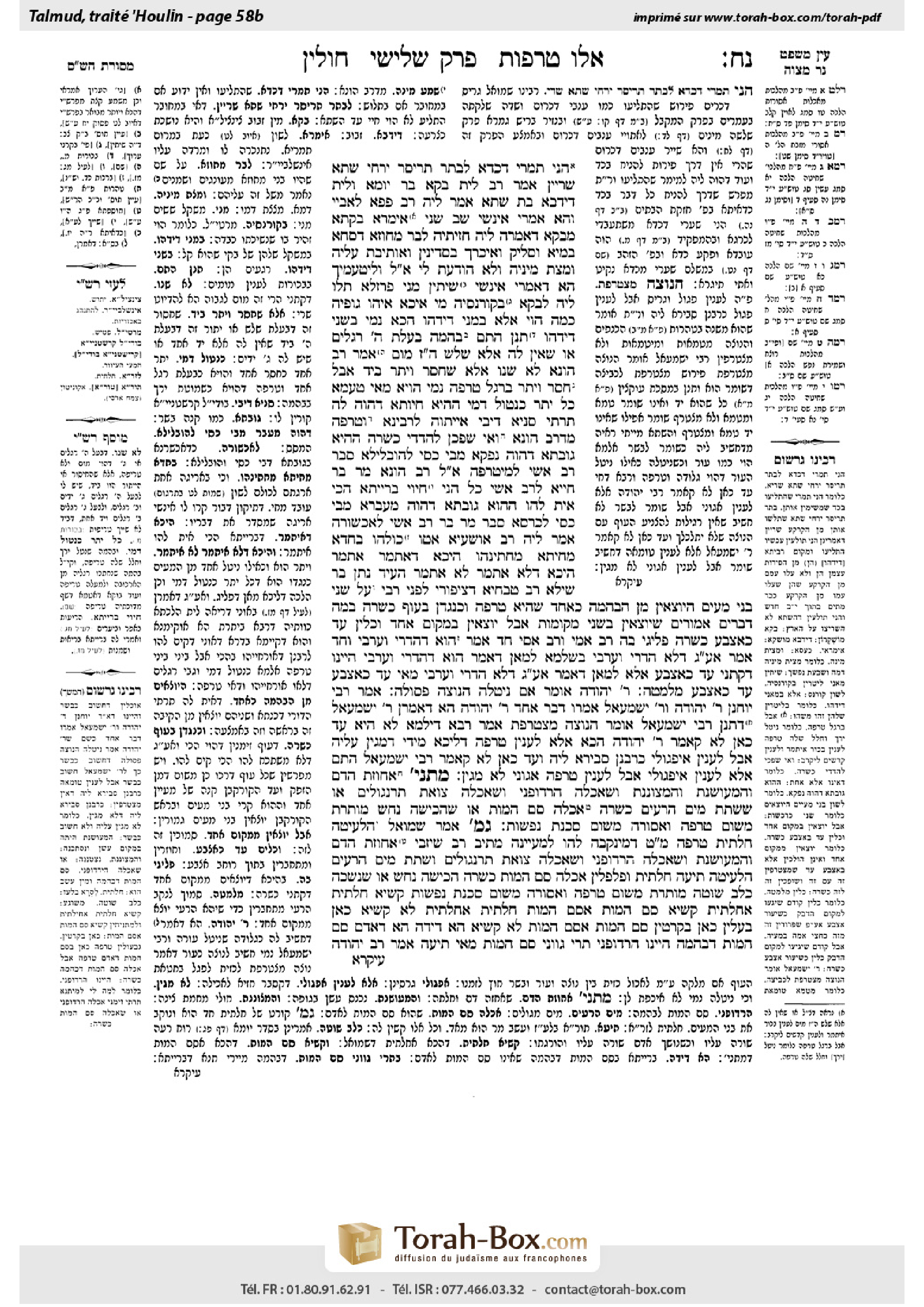
Chullin 58b: Talmud study for Daf Yomi
Study the Talmud for Daf Yomi with scanned pages, Hebrew text, English translations from Sefaria and AI-generated French translations.
Passage selection and English or AI-generated French translation are available where the scan has annotations. Daf Study is independent of Torah-Box and Sefaria.
Browse Chullin · חולין · All tractatesChullin 58b text and translations
This page of Chullin includes the Aramaic text, an English translation and an AI-generated French translation, alongside the scan above.
חולין נ״ח ב · Aramaic and Hebrew text
הָנֵי תַּמְרֵי דְּכַדָּא לְבָתַר תְּרֵיסַר יַרְחֵי שַׁתָּא שַׁרְיָין.
אָמַר רַב: לֵית בָּקָא בַּר יוֹמָא, וְלֵית דִּידְבָא בַּת שַׁתָּא.
אֲמַר לֵיהּ רַב פָּפָּא לְאַבָּיֵי, וְהָא אָמְרִי אִינָשֵׁי: שַׁב שְׁנֵי אִימְּרַאי בָּקְתָּא מִבָּקָא. דְּאָמְרָה לֵיהּ: חֲזִיתֵיהּ לְבַר מָחוֹזָא דִּסְחָא בְּמַיָּא, וּסְלֵיק וְאִיכְּרֵךְ בִּסְדִינִין, וְאִיתֵּיבְתְּ עֲלֵיהּ וּמְצֵת מִינֵּיהּ, וְלָא הוֹדַעְתְּ לִי. אֲמַר לֵיהּ: וְלִיטַעְמָיךְ, הָא דְּאָמְרִי אִינָשֵׁי ״שִׁיתִּין מָנֵי פַּרְזְלָא תְּלוּ לֵיהּ לְבָקָא בְּקוּרְנָסֵיהּ״, מִי אִיכָּא? אִיהוּ גּוּפֵיהּ כַּמָּה הָוֵי? אֶלָּא בְּמָנֵי דִּידְהוּ, הָכָא נָמֵי בִּשְׁנֵי דִּידְהוּ.
תְּנַן הָתָם: בְּהֵמָה בַּעֲלַת חָמֵשׁ רַגְלַיִם, אוֹ שֶׁאֵין לָהּ אֶלָּא שָׁלֹשׁ – הֲרֵי זֶה מוּם. אָמַר רַב הוּנָא: לֹא שָׁנוּ אֶלָּא שֶׁחָסֵר וְיָתֵר בַּיָּד, אֲבָל חָסֵר וְיָתֵר בָּרֶגֶל – טְרֵפָה נָמֵי הָוְיָא. מַאי טַעְמָא? כׇּל יָתֵר כְּנָטוּל דָּמֵי.
הָהִיא חֵיוְתָא דַּהֲוָה לַהּ תַּרְתֵּי סַנְיָא דֵּיבֵי, אַיְיתוּהָ לְרָבִינָא, וְטַרְפַהּ מִדְּרַב הוּנָא. וְאִי שָׁפְכָן לַהֲדָדֵי – כְּשֵׁרָה.
הָהִיא גּוּבְתָּא דַּהֲוָה נָפְקָא מִבֵּי כָסֵי לְהוּבְלִילָא, סָבַר רַב אָשֵׁי לְמִיטְרְפַהּ. אֲמַר לֵיהּ רַב הוּנָא מָר בַּר חִיָּיא לְרַב אָשֵׁי: כֹּל הָנֵי חֵיוֵי בָּרָיָיתָא הָכִי אִית לְהוּ.
הָהוּא גּוּבְתָּא דַּהֲוָה מְעַבְּרָא מִבֵּי כָסֵי לִכְרֵסָא, סְבַר מָר בַּר רַב אָשֵׁי לְאַכְשׁוֹרַהּ. אֲמַר לֵיהּ רַב אוֹשַׁעְיָא: אַטּוּ כּוּלְּהוּ בַּחֲדָא מְחִיתָא מַחֵתִינְהוּ? הֵיכָא דְּאִתְּמַר – אִתְּמַר, הֵיכָא דְּלָא אִתְּמַר – לָא אִתְּמַר.
הֵעִיד נָתָן בַּר שֵׁילָא רַב טַבָּחַיָּא דְּצִיפּוֹרִי לִפְנֵי רַבִּי, עַל שְׁנֵי בְּנֵי מֵעַיִם הַיּוֹצְאִין מִן הַבְּהֵמָה כְּאֶחָד, שֶׁהִיא טְרֵפָה, וּכְנֶגְדָּן בָּעוֹף – כְּשֵׁרָה. בַּמֶּה דְּבָרִים אֲמוּרִים? שֶׁיּוֹצְאִין בִּשְׁנֵי מְקוֹמוֹת, אֲבָל יוֹצְאִין בְּמָקוֹם אֶחָד, וְכָלִין עַד כְּאֶצְבַּע – כְּשֵׁרָה.
פְּלִיגִי בַּהּ רַב אַמֵּי וְרַב אַסִּי, חַד אָמַר: הוּא דְּהָדְרִי וְעָרְבִי, וְחַד אָמַר: אַף עַל גַּב דְּלָא הָדְרִי וְעָרְבִי.
בִּשְׁלָמָא לְמַאן דְּאָמַר הוּא דְּהָדְרִי וְעָרְבִי, הַיְינוּ דְּקָתָנֵי ״עַד כְּאֶצְבַּע״, אֶלָּא לְמַאן דְּאָמַר אַף עַל גַּב דְּלָא הָדְרִי וְעָרְבִי, מַאי ״עַד כְּאֶצְבַּע״? עַד כְּאֶצְבַּע מִלְּמַטָּה.
רַבִּי יְהוּדָה אוֹמֵר: אִם נִיטְּלָה הַנּוֹצָה – פְּסוּלָה. אָמַר רַבִּי יוֹחָנָן: רַבִּי יְהוּדָה וְרַבִּי יִשְׁמָעֵאל אָמְרוּ דָּבָר אֶחָד. רַבִּי יְהוּדָה – הָא דַּאֲמַרַן, רַבִּי יִשְׁמָעֵאל – דִּתְנַן: רַבִּי יִשְׁמָעֵאל אוֹמֵר: הַנּוֹצָה מִצְטָרֶפֶת.
אָמַר רָבָא: דִּילְמָא לָא הִיא, עַד כָּאן לָא קָאָמַר רַבִּי יְהוּדָה הָכָא אֶלָּא לְעִנְיַן טְרֵפָה, דְּלֵיכָּא מִידֵּי דְּמַגֵּין עֲלֵיהּ, אֲבָל לְעִנְיַן אִיפַּגּוֹלֵי – כְּרַבָּנַן סְבִירָא לֵיהּ, וְעַד כָּאן לָא קָאָמַר רַבִּי יִשְׁמָעֵאל הָתָם אֶלָּא לְעִנְיַן אִיפַּגּוֹלֵי, אֲבָל לְעִנְיַן טְרֵפָה – אַגּוֹנֵי לָא מַגֵּין.
מַתְנִי׳ אֲחוּזַת הַדָּם, וְהַמְעוּשֶּׁנֶת, וְהַמְצוּנֶּנֶת, וְשֶׁאָכְלָה הַרְדּוּפְנֵי, וְשֶׁאָכְלָה צוֹאַת תַּרְנְגוֹלִים, אוֹ שֶׁשָּׁתָת מַיִם הָרָעִים – כְּשֵׁרָה. אָכְלָה סַם הַמָּוֶת, אוֹ שֶׁהִכִּישָׁהּ נָחָשׁ – מוּתֶּרֶת מִשּׁוּם טְרֵפָה, וַאֲסוּרָה מִשּׁוּם סַכָּנַת נְפָשׁוֹת.
גְּמָ׳ אָמַר שְׁמוּאֵל: הִלְעִיטָהּ חִלְתִּית – טְרֵפָה, מַאי טַעְמָא? דִּמְינַקְּבָה לְהוּ לְמַעְיָינַהּ.
מֵתִיב רַב שֵׁיזְבִי: אֲחוּזַת הַדָּם, וְהַמְעוּשֶּׁנֶת, וְשֶׁאָכְלָה הַרְדּוּפְנֵי, וְשֶׁאָכְלָה צוֹאַת תַּרְנְגוֹלִים, וְשָׁתָת מַיִם הָרָעִים, הִלְעִיטָהּ תִּיעָה, חִלְתִּית וּפִלְפְּלִין, אָכְלָה סַם הַמָּוֶת – כְּשֵׁרָה. הִכִּישָׁהּ נָחָשׁ, אוֹ שֶׁנְּשָׁכָהּ כֶּלֶב שׁוֹטֶה – מוּתֶּרֶת מִשּׁוּם טְרֵפָה, וַאֲסוּרָה מִשּׁוּם סַכָּנַת נְפָשׁוֹת. קַשְׁיָא חִלְתִּית אַחִלְתִּית, קַשְׁיָא סַם הַמָּוֶת אַסַּם הַמָּוֶת!
חִלְתִּית אַחִלְתִּית לָא קַשְׁיָא: כָּאן בְּעָלִין, כָּאן בִּקְרָטִין. סַם הַמָּוֶת אַסַּם הַמָּוֶת לָא קַשְׁיָא: הָא דִּידַהּ, הָא דְּאָדָם. סַם הַמָּוֶת דִּבְהֵמָה הַיְינוּ הַרְדּוּפְנֵי? תְּרֵי גַּוְונֵי סַם הַמָּוֶת.
מַאי תִּיעָה? אָמַר רַב יְהוּדָה:
Chullin 58b · English translation
These dates stored in a jar are permitted after remaining there for twelve months of the year. Since worms have no bones, they cannot last twelve months. Consequently, any worms found in the dates must have hatched after they were picked and are therefore permitted.
Rav says: There is no one-day-old mosquito, since all mosquitoes die before they have lived a day. And there is no one-year-old fly.
Rav Pappa said to Abaye: But isn’t there the adage that people say that the female mosquito revolted against the male mosquito seven years, since she said to him: I saw a townsman swimming in the water, and he came out and wrapped himself in sheets, and you sat on him and sucked blood from him, and you did not inform me? Apparently, some boneless creatures can survive at least seven years. Abaye said to him: And according to your reasoning, what about that adage that people say: Six thousand iron dinars hang in a mosquito’s mallet, i.e., its bite is powerful? Is there really such a thing? How much does the mosquito itself weigh? Rather, the saying must be referring to hundreds of their own dinars, i.e., the mosquitoes’ coins. Here, too, the adage is referring to their own years, not human years.
§ We learned in a mishna elsewhere (Bekhorot 40a): With regard to an animal with five legs, or one that has only three, this is a blemish, and the animal may not be brought as an offering. Rav Huna said: They taught this halakha only in a case where the animal was missing or had an additional foreleg. But if it was missing or had an additional hind leg, it is also a tereifa. What is the reason? It is that any extra limb is considered like a removed limb. An animal whose foreleg was removed is kosher, but if its hind leg was removed it is a tereifa; the same applies if it had an extra leg.
The Gemara recounts the case of a certain animal that had two ceca. They brought it to Ravina, and he deemed it a tereifa based on the statement of Rav Huna that an extra limb is like a missing limb. Since an animal missing a cecum is a tereifa, an animal with an extra cecum is likewise a tereifa. The Gemara adds: But if they empty into each other, such that food can move freely between them, the animal is kosher, because they are considered one organ.
The Gemara recounts the case of a certain tube that exited from the reticulum into the omasum. Rav Ashi thought to deem the animal a tereifa. Rav Huna Mar bar Ḥiyya said to Rav Ashi: All animals that dwell outside have tubes like this, and one need not be concerned.
The Gemara recounts the case of a certain tube that passed from the reticulum to the rumen. Mar bar Rav Ashi thought to deem the animal kosher, as in the above case. Rav Oshaya said to him: Is that to say all such cases are woven in one weave? Where it was stated that such an organ is normal, it was stated; where it was not stated, it was not stated. This animal is a tereifa.
Natan bar Sheila, head of the butchers of Tzippori, testified before Rabbi Yehuda HaNasi about two intestines that exit the abomasum of the animal as one, that this renders the animal a tereifa. But if this phenomenon occurs likewise in a bird, it is kosher, because it is common in birds. In what case is this statement said, i.e., that two intestines render an animal a tereifa? It is said in a case where they exit at two different points. But if they exit at one point, adjacent to each other, and they end, i.e., they merge into one intestine, within a fingerbreadth, the animal is kosher.
Rav Ami and Rav Asi disagree with regard to this halakha. One says: It is kosher when the two intestines exit at one point only in a case where they subsequently merge into one intestine; and one says: It is kosher even if they do not subsequently merge.
The Gemara asks: Granted, according to the one who says that it is kosher only in a case where they subsequently merge, this explanation is consistent with that which the baraita teaches: Within a fingerbreadth. That is, the two intestines must merge within a fingerbreadth for the animal to be kosher. But according to the one who says: It is kosher even if they do not subsequently merge, what is the meaning of the phrase: And they end within a fingerbreadth? The Gemara responds: It means within a fingerbreadth below. As long as the intestines merge before the final fingerbreadth near the anus, the animal is kosher.
§ The mishna states: Rabbi Yehuda says: If the down covering its body was removed, it is a tereifa and unfit for consumption, like an animal whose hide was removed. With regard to this, Rabbi Yoḥanan says: Rabbi Yehuda and Rabbi Yishmael said the same thing. Rabbi Yehuda said that which we said here, that the removal of the feathers is like removal of the hide. Rabbi Yishmael agrees, as we learned in a baraita: Rabbi Yishmael says: The down joins the flesh to constitute an olive-bulk for purposes of piggul. If a priest pinches the nape of the neck of a bird with intent to consume a combined olive-bulk of its meat and its down beyond the permitted time, the offering is rendered piggul. Evidently, both Rabbi Yehuda and Rabbi Yishmael agree that the down of a bird is considered like the hide of an animal.
Rava said: Perhaps it is not so, and they disagree. Perhaps Rabbi Yehuda says that the down is like the hide of an animal here only with regard to a tereifa, since when the down is removed, there is nothing that protects the bird, and its life is in danger; but with regard to piggul, he holds in accordance with the opinion of the Rabbis that the down is not treated like the hide of an animal, because piggul applies only if one had intent to consume an item that is normally consumed. And perhaps Rabbi Yishmael says so there only with regard to piggul, since he holds that the down is in fact fit for consumption; but with regard to a tereifa, he holds that the down does not protect the bird, and its removal does not endanger it.
MISHNA: With regard to an animal that is congested with excess blood, or that was smoked, i.e., that suffered from smoke inhalation, or that was chilled and subsequently became sick, or that ate oleander, which is poisonous, or that ate the excrement of chickens, or that drank foul water, although in all these cases the animal is in danger, it is kosher. By contrast, if the animal ate deadly poison, or if a snake bit the animal, with regard to the prohibition of tereifa, consumption of the animal would be permitted, but it is prohibited due to the threat to one’s life if he eats it.
GEMARA: Shmuel says: If one fed an animal asafoetida, a very sharp plant, it is a tereifa. What is the reason? Since it perforates its intestines.
Rav Sheizvi raises an objection from a baraita: An animal that is congested with excess blood, or that suffered from smoke inhalation, or that ate poisonous oleander, or that ate the excrement of roosters, or that drank foul water, or if one fed it tia, asafoetida, or peppers, or if it ate deadly poison, it is kosher. But if a snake bit the animal, or if a mad dog bit it, with regard to the prohibition of tereifa its consumption is permitted, but it is nevertheless prohibited due to the threat to one’s life. The statement of the baraita concerning an animal that was fed asafoetida poses a difficulty to Shmuel’s statement that asafoetida renders the animal a tereifa, and the statement concerning deadly poison poses a difficulty to the mishna’s statement that deadly poison renders the animal prohibited due to the threat to one’s life.
The Gemara responds: The apparent contradiction between one statement about asafoetida and the other statement about asafoetida is not difficult. Here, the baraita is referring to a case where the animal ate asafoetida leaves, which are less dangerous. There, Shmuel is referring to a case where the animal ate slivers of asafoetida, which are very sharp. Likewise, the apparent contradiction between one statement about deadly poison and the other statement about deadly poison is not difficult. This statement of the baraita that it is permitted is referring to a case where the animal consumed poison that is deadly only to itself. That statement of the mishna that it is prohibited is referring to a case where it consumed poison deadly to a person. The Gemara asks: Poison deadly to an animal is the same as oleander; why should the baraita mention both? The Gemara responds: The tanna is referring to two types of deadly poison.
The above baraita teaches that if an animal was fed tia, it is kosher. The Gemara asks: What is tia? Rav Yehuda said:
Chullin 58b · Traduction française (IA)
Ces figues conservées dans un récipient sont permises après avoir été laissées pendant douze mois de l'année. Puisque les vers n'ont pas d'os, ils ne peuvent pas survivre douze mois. Par conséquent, tout ver trouvé dans les figues doit avoir éclos après leur récolte et est donc permis.
Rav dit : Il n'existe pas de moustique d'un jour, puisque tous les moustiques meurent avant d'avoir vécu un jour. Et il n'existe pas de mouche d'un an.
Rav Pappa dit à Abaye : Mais n'est-ce pas l'adage que les gens disent que la femelle moustique s'est révoltée contre le mâle moustique sept ans, puisqu'elle lui a dit : J'ai vu un habitant nager dans l'eau, et il est sorti et s'est enveloppé de draps, et toi tu as été assis sur lui et as sucré son sang, et tu n'as pas informé ? Apparemment, certains animaux sans os peuvent survivre au moins sept ans. Abaye dit à lui : Et selon votre raisonnement, que dire de l'adage que les gens disent : Six mille dinars d'acier pendent dans le marteau d'un moustique, c'est-à-dire que son mordillement est puissant ? Y a-t-il vraiment une telle chose ? Combien pèse le moustique lui-même ? Plutôt, cette expression doit se référer à des centaines de leurs propres dinars, c'est-à-dire les pièces des moustiques. Ici aussi, l'adage se réfère à leurs propres années, pas aux années humaines.
§ Nous avons appris dans une mitsva ailleurs (Bekhorot 40a) : Concernant un animal à cinq pattes, ou un animal qui en a seulement trois, c'est une imperfection, et l'animal ne peut pas être offert en sacrifice. Rav Huna dit : Ils ont enseigné cette halakha uniquement dans le cas où l'animal manquait une patte ou avait une patte supplémentaire sur l'avant. Mais si l'animal manquait une patte ou avait une patte supplémentaire sur l'arrière, il est également un tereifa. Quelle est la raison ? C'est que toute patte supplémentaire est considérée comme une patte retirée. Un animal dont la patte avant a été retirée est acceptable, mais si sa patte arrière a été retirée, il est un tereifa ; la même chose s'applique si l'animal avait une patte supplémentaire.
La Guemara rapporte le cas d'un animal qui avait deux ceca. Ils l'ont apporté à Ravina, et il l'a considéré comme un tereifa en se basant sur l'affirmation de Rav Huna que toute patte supplémentaire est comme une patte retirée. Puisque un animal dont le cecum est retiré est un tereifa, un animal avec un cecum supplémentaire est également un tereifa. La Guemara ajoute : Mais si les ceca se vident mutuellement, de sorte que la nourriture puisse circuler librement entre eux, l'animal est acceptable, car ils sont considérés comme un seul organe.
La Guemara rapporte le cas d'un certain tube qui sortait du reticulum vers l'omasum. Rav Ashi avait l'intention de considérer l'animal comme un tereifa. Rav Huna Mar bar Ḥiyya dit à Rav Ashi : Tous les animaux qui habitent à l'extérieur ont ce genre de tubes, et on ne doit pas s'en inquiéter.
La Guemara rapporte le cas d'un certain tube qui passait du reticulum vers le rumen. Mar bar Rav Ashi avait l'intention de considérer l'animal comme acceptable, comme dans le cas précédent. Rav Oshaya lui répondit : Est-ce que cela signifie que tous les cas sont tissés dans un seul tissu ? Lorsqu'il a été dit que cet organe est normal, il a été dit ; lorsqu'il n'a pas été dit, il n'a pas été dit. Cet animal est un tereifa.
Natan bar Sheila, chef des bouchers de Tzippori, a témoigné devant Rabbi Yehuda HaNasi sur deux intestins qui sortent de l'abomasum de l'animal comme un seul, ce qui rend l'animal un tereifa. Mais si ce phénomène se produit également chez un oiseau, il est acceptable, car c'est commun chez les oiseaux. Dans quel cas cette déclaration est-elle faite, c'est-à-dire que deux intestins rendent un animal un tereifa ? Elle est faite dans le cas où ils sortent à deux points différents. Mais si ils sortent à un seul point, adjacents les uns aux autres, et s'ils se terminent, c'est-à-dire s'ils se fusionnent en un seul intestin, dans un doigt, l'animal est acceptable.
Rav Ami et Rav Asi divergent sur cette halakha. L'un dit : C'est acceptable lorsque les deux intestins sortent à un seul point, à condition qu'ils se fusionnent ensuite en un seul intestin ; et l'autre dit : C'est acceptable même s'ils ne se fusionnent pas ensuite.
La Guemara pose la question : D'accord, selon celui qui dit qu'il est acceptable uniquement dans le cas où ils se fusionnent ensuite, cette explication est cohérente avec ce que la baraïta enseigne : À l'intérieur d'un doigt. C'est-à-dire que les deux intestins doivent se fusionner à l'intérieur d'un doigt pour que l'animal soit acceptable. Mais selon celui qui dit : Il est acceptable même s'ils ne se fusionnent pas ensuite, quelle est la signification de la phrase : Et ils se terminent à l'intérieur d'un doigt ? La Guemara répond : Cela signifie à l'intérieur d'un doigt en dessous. Tant que les intestins se fusionnent avant le dernier doigt près de l'anus, l'animal est acceptable.
§ La mitsna stipule : Rabbi Yehuda dit : Si la plume qui recouvre son corps a été retirée, c'est un tereifa et inacceptable, comme un animal dont la peau a été retirée. À ce sujet, Rabbi Yoḥanan dit : Rabbi Yehuda et Rabbi Yishmael ont dit la même chose. Rabbi Yehuda a dit ce que nous avons dit ici, à savoir que le retrait des plumes est comme le retrait de la peau. Rabbi Yishmael est d'accord, comme nous l'avons appris dans une baraïta : Rabbi Yishmael dit : La plume s'unit à la chair pour constituer une quantité d'olive pour les piggul. Si un prêtre serre le cou d'un oiseau avec l'intention de consommer une quantité combinée d'olive de sa chair et de sa plume au-delà du temps permis, l'offrande est rendue piggul. Évidemment, Rabbi Yehuda et Rabbi Yishmael sont d'accord sur le fait que la plume d'un oiseau est considérée comme la peau d'un animal.
Rava dit : Peut-être ce n'est pas ainsi, et ils divergent. Peut-être Rabbi Yehuda dit que la plume est comme la peau d'un animal ici uniquement concernant un tereifa, puisque lorsque la plume est retirée, il n'y a rien qui protège l'oiseau, et sa vie est en danger ; mais concernant le piggul, il suit l'opinion des Rabbins que la plume n'est pas traitée comme la peau d'un animal, car le piggul s'applique uniquement si l'on avait l'intention de consommer un objet normalement consommé. Et peut-être Rabbi Yishmael dit cela là uniquement concernant le piggul, puisqu'il considère que la plume est effectivement comestible ; mais concernant un tereifa, il considère que la plume ne protège pas l'oiseau, et son retrait ne le met pas en danger.
MICHNA : Concernant un animal congestionné de sang en excès, ou qui a été fumé, c'est-à-dire qui a souffert d'inhalation de fumée, ou qui a été refroidi puis est devenu malade, ou qui a mangé de l'oleander, qui est toxique, ou qui a mangé les déjections de poules, ou qui a bu de l'eau impure, bien que dans tous ces cas l'animal soit en danger, il est considéré comme propre. En revanche, si l'animal a mangé un poison mortel, ou si un serpent l'a mordu, concernant l'interdiction de tereifa, la consommation de l'animal est permise, mais elle est interdite en raison du danger pour la vie si l'on en mange.
GUEMARA : Shmuel dit : Si l'on nourrit un animal d'asafoétida, une plante très piquante, il devient tereifa. Pourquoi ? Parce qu'elle perfore ses intestins.
Rav Sheizvi émet un doute à partir d'une baraïta : Un animal congestionné de sang en excès, ou qui a souffert d'inhalation de fumée, ou qui a mangé de l'oleander toxique, ou qui a mangé les déjections de poules, ou qui a bu de l'eau impure, ou si l'on nourrit l'animal d'asafoétida, de piments ou de tia, ou s'il a mangé un poison mortel, il est considéré comme propre. Mais si un serpent l'a mordu, ou si un chien fou l'a mordu, concernant l'interdiction de tereifa, sa consommation est permise, mais elle est interdite en raison du danger pour la vie. L'affirmation de la baraïta concernant un animal nourri d'asafoétida pose un problème pour l'affirmation de Shmuel selon laquelle l'asafoétida rend l'animal tereifa, et l'affirmation concernant le poison mortel pose un problème pour l'affirmation de la mishna selon laquelle le poison mortel rend l'animal interdit en raison du danger pour la vie.
La Guemara répond : La contradiction apparente entre l'affirmation concernant l'asafoétida et l'autre affirmation concernant l'asafoétida n'est pas difficile. Ici, la baraïta fait référence à un cas où l'animal a mangé des feuilles d'asafoétida, qui sont moins dangereuses. Là, Shmuel fait référence à un cas où l'animal a mangé des copeaux d'asafoétida, qui sont très tranchants. De même, la contradiction apparente entre l'affirmation concernant le poison mortel et l'autre affirmation concernant le poison mortel n'est pas difficile. Cette affirmation de la baraïta selon laquelle la consommation est permise fait référence à un cas où l'animal a ingéré un poison mortel uniquement pour lui-même. Cette affirmation de la mishna selon laquelle la consommation est interdite fait référence à un cas où l'animal a ingéré un poison mortel pour une personne. La Guemara demande : Le poison mortel pour un animal est le même que l'oleander ; pourquoi la baraïta mentionne-t-elle les deux ? La Guemara répond : Le tanna fait référence à deux types de poison mortel.
La baraïta ci-dessus enseigne que si un animal a été nourri de tia, il est considéré comme propre. La Guemara demande : Qu'est-ce que le tia ? Rav Yehuda a dit :
Traduction française générée par IA à partir de l’édition anglaise de Sefaria. Vérifie toujours un passage avec le texte source.
Text from Sefaria: William Davidson Edition - Vocalized Aramaic (unknown); William Davidson Edition - English (CC BY NC).