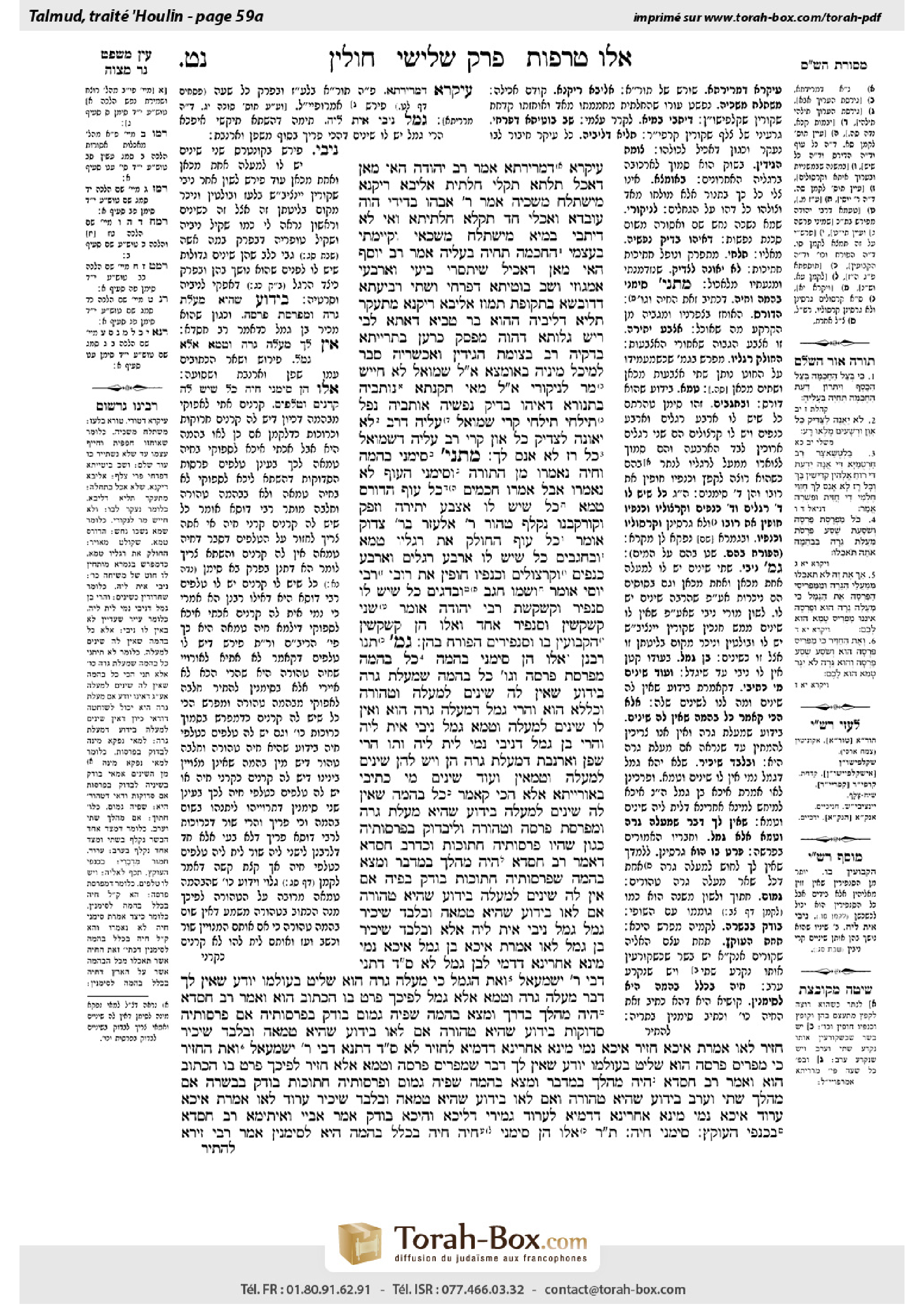
Chullin 59a: Talmud study for Daf Yomi
Study the Talmud for Daf Yomi with scanned pages, Hebrew text, English translations from Sefaria and AI-generated French translations.
Passage selection and English or AI-generated French translation are available where the scan has annotations. Daf Study is independent of Torah-Box and Sefaria.
Browse Chullin · חולין · All tractatesChullin 59a text and translations
This page of Chullin includes the Aramaic text, an English translation and an AI-generated French translation, alongside the scan above.
חולין נ״ט א · Aramaic and Hebrew text
עִיקָּרָא דְּמָרִירְתָּא.
אָמַר רַב יְהוּדָה: הַאי מַאן דַּאֲכַל תְּלָתָא תִּקְלֵי חִלְתִּית אַלִּיבָּא רֵיקָנָא – מִישְׁתְּלַח מַשְׁכֵיהּ. אָמַר רַבִּי אֲבָהוּ: בְּדִידִי הֲוָה עוֹבָדָא, וַאֲכַלִי חַד תִּקְלָא חִלְתִּיתָא, וְאִי לָא דִּיתַבִי בְּמַיָּא – מִישְׁתְּלַח מַשְׁכַאי, וְקִיַּימְתִּי בְּעַצְמִי ״הַחׇכְמָה תְּחַיֶּה בְעָלֶיהָ״.
אָמַר רַב יוֹסֵף: הַאי מַאן דְּאָכֵיל שִׁיתַּסְרֵי בֵּיעֵי, וְאַרְבְּעֵי אַמְגּוֹזֵי, וְשַׁב בּוּטְיָתָא דְּפִרְחֵי, וְשָׁתֵי רְבִיעֵתָא דְּדוּבְשָׁא בִּתְקוּפַת תַּמּוּז, אַלִּיבָּא רֵיקָנָא – מִתְעֲקַר תַּלְיָא דְּלִיבֵּיהּ.
הָהוּא בַּר טַבְיָא דַּאֲתָא לְבֵי רֵישׁ גָּלוּתָא, דַּהֲוָה (מפסק) [מְפַסְּקָן] כַּרְעִן בָּתְרָיָיתָא, בַּדְקֵיהּ רַב בְּצוֹמֶת הַגִּידִין וְאַכְשְׁרֵיהּ. סְבַר לְמֵיכַל מִינֵּיהּ בְּאוּמְצָא, אֲמַר לֵיהּ שְׁמוּאֵל: לָא חָיֵישׁ מָר לְנִיקּוּרֵי?
אֲמַר לֵיהּ: מַאי תַּקַּנְתָּא? נוֹתְבֵיהּ בְּתַנּוּרָא דְּאִיהוּ בָּדֵיק נַפְשֵׁיהּ. אוֹתְבֵיהּ, נְפַל תִּילְחֵי תִּילְחֵי. קָרֵי שְׁמוּאֵל עֲלֵיהּ דְּרַב: ״לֹא יְאֻנֶּה לַצַּדִּיק כׇּל אָוֶן״. קָרֵי רַב עֲלֵיהּ דִּשְׁמוּאֵל: ״כׇּל רָז לָא אָנֵס לָךְ״.
מַתְנִי׳ סִימָנֵי בְּהֵמָה וְחַיָּה נֶאֶמְרוּ מִן הַתּוֹרָה, וְסִימָנֵי הָעוֹף לֹא נֶאֶמְרוּ, אֲבָל אָמְרוּ חֲכָמִים: כׇּל עוֹף הַדּוֹרֵס – טָמֵא, כֹּל שֶׁיֵּשׁ לוֹ אֶצְבַּע יְתֵירָה וְזֶפֶק וְקוּרְקְבָנוֹ נִקְלָף – טָהוֹר. רַבִּי אֶלְעָזָר בְּרַבִּי צָדוֹק אוֹמֵר: כׇּל עוֹף הַחוֹלֵק אֶת רַגְלָיו – טָמֵא.
וּבַחֲגָבִים, כֹּל שֶׁיֵּשׁ לוֹ אַרְבַּע רַגְלַיִם, וְאַרְבַּע כְּנָפַיִם, וְקַרְצוּלַּיִם, וּכְנָפָיו חוֹפִין אֶת רוּבּוֹ. רַבִּי יוֹסֵי אוֹמֵר: וּשְׁמוֹ חָגָב. וּבַדָּגִים, כֹּל שֶׁיֵּשׁ לוֹ סְנַפִּיר וְקַשְׁקֶשֶׁת. רַבִּי יְהוּדָה אוֹמֵר: שְׁנֵי קַשְׂקַשִּׂין וּסְנַפִּיר אֶחָד. וְאֵלּוּ הֵן קַשְׂקַשִּׂין – הַקְּבוּעִין בּוֹ, וּסְנַפִּירִים – הַפּוֹרֵחַ בָּהֶן.
גְּמָ׳ תָּנוּ רַבָּנַן: אֵלּוּ הֵן סִימָנֵי בְּהֵמָה – ״כׇּל בְּהֵמָה מַפְרֶסֶת פַּרְסָה וְגוֹ׳״, כׇּל בְּהֵמָה שֶׁמַּעֲלַת גֵּרָה – בְּיָדוּעַ שֶׁאֵין לָהּ שִׁינַּיִם לְמַעְלָה, וּטְהוֹרָה.
וּכְלָלָא הוּא? וַהֲרֵי גָּמָל, דְּמַעֲלֵה גֵרָה הוּא, וְאֵין לוֹ שִׁינַּיִם לְמַעְלָה, וְטָמֵא! גָּמָל נִיבֵי אִית לֵיהּ.
וַהֲרֵי בֶּן גָּמָל, דְּנִיבֵי נָמֵי לֵית לֵיהּ, וְתוּ, הֲרֵי שָׁפָן וְאַרְנֶבֶת דְּמַעֲלַת גֵּרָה הֵן וְיֵשׁ לָהֶן שִׁינַּיִם לְמַעְלָה, וּטְמֵאִין! וְעוֹד, שִׁינַּיִם מִי כְּתִיבִי בְּאוֹרָיְיתָא? אֶלָּא הָכִי קָאָמַר: כׇּל בְּהֵמָה שֶׁאֵין לָהּ שִׁינַּיִם לְמַעְלָה – בְּיָדוּעַ שֶׁהִיא מַעֲלַת גֵּרָה וּמַפְרֶסֶת פַּרְסָה, וּטְהוֹרָה.
וְלִיבְדּוֹק בְּפַרְסוֹתֶיהָ! כְּגוֹן שֶׁהָיוּ פַּרְסוֹתֶיהָ חֲתוּכוֹת, וְכִדְרַב חִסְדָּא, דְּאָמַר רַב חִסְדָּא: הָיָה מְהַלֵּךְ בַּמִּדְבָּר וּמָצָא בְּהֵמָה שֶׁפַּרְסוֹתֶיהָ חֲתוּכוֹת – בּוֹדֵק בְּפִיהָ, אִם אֵין לָהּ שִׁינַּיִם לְמַעְלָה – בְּיָדוּעַ שֶׁהִיא טְהוֹרָה, אִם לָאו – בְּיָדוּעַ שֶׁהִיא טְמֵאָה, וּבִלְבַד שֶׁיַּכִּיר גָּמָל. גָּמָל נִיבֵי אִית לֵיהּ! אֶלָּא, וּבִלְבַד שֶׁיַּכִּיר בֶּן גָּמָל.
לָאו אָמְרַתְּ אִיכָּא בֶּן גָּמָל? אִיכָּא נָמֵי מִינָא אַחֲרִינָא דְּדָמֵי לְבֶן גָּמָל! לָא סָלְקָא דַּעְתָּךְ, דְּתָנֵי דְּבֵי רַבִּי יִשְׁמָעֵאל: ״וְאֶת הַגָּמָל כִּי מַעֲלֵה גֵרָה הוּא״, שַׁלִּיט בְּעוֹלָמוֹ יוֹדֵעַ שֶׁאֵין לְךָ דָּבָר מַעֲלֵה גֵרָה וְטָמֵא אֶלָּא גָּמָל, לְפִיכָךְ פָּרַט בּוֹ הַכָּתוּב ״הוּא״.
וְאָמַר רַב חִסְדָּא: הָיָה מְהַלֵּךְ בַּדֶּרֶךְ וּמָצָא בְּהֵמָה שֶׁפִּיהָ גָּמוּם, בּוֹדֵק בְּפַרְסוֹתֶיהָ: אִם פַּרְסוֹתֶיהָ סְדוּקוֹת – בְּיָדוּעַ שֶׁהִיא טְהוֹרָה, אִם לָאו – בְּיָדוּעַ שֶׁהִיא טְמֵאָה, וּבִלְבַד שֶׁיַּכִּיר חֲזִיר.
לָאו אָמְרַתְּ אִיכָּא חֲזִיר? אִיכָּא נָמֵי מִינָא אַחֲרִינָא דְּדָמְיָא לַחֲזִיר! לָא סָלְקָא דַּעְתָּךְ, דְּתָנָא דְּבֵי רַבִּי יִשְׁמָעֵאל: ״וְאֶת הַחֲזִיר כִּי מַפְרִיס פַּרְסָה הוּא״ – שַׁלִּיט בְּעוֹלָמוֹ יוֹדֵעַ שֶׁאֵין לְךָ דָּבָר שֶׁמַּפְרִיס פַּרְסָה וְטָמֵא אֶלָּא חֲזִיר, לְפִיכָךְ פָּרַט בּוֹ הַכָּתוּב ״הוּא״.
וְאָמַר רַב חִסְדָּא: הָיָה מְהַלֵּךְ בַּמִּדְבָּר, וּמָצָא בְּהֵמָה שֶׁפִּיהָ גָּמוּם וּפַרְסוֹתֶיהָ חֲתוּכוֹת – בּוֹדֵק בִּבְשָׂרָהּ, אִם מְהַלֵּךְ שְׁתִי וָעֵרֶב – בְּיָדוּעַ שֶׁהִיא טְהוֹרָה, וְאִם לָאו – בְּיָדוּעַ שֶׁהִיא טְמֵאָה, וּבִלְבַד שֶׁיַּכִּיר עַרְוָד.
לָאו אָמְרַתְּ אִיכָּא עַרְוָד? אִיכָּא נָמֵי מִינָא אַחֲרִינָא דְּדָמֵיא לְעַרְוָד! גְּמִירִי דְּלֵיכָּא. וְהֵיכָא בּוֹדֵק? אָמַר אַבָּיֵי, וְאִיתֵּימָא רַב חִסְדָּא: בְּכַנְפֵי הָעוֹקֶץ.
סִימָנֵי חַיָּה. תָּנוּ רַבָּנַן: אֵלּוּ הֵן סִימָנֵי חַיָּה. חַיָּה בִּכְלַל בְּהֵמָה הִיא לְסִימָנִין! אָמַר רַבִּי זֵירָא:
Chullin 59a · English translation
It is the root of a bitter vegetable.
Rav Yehuda says: This individual who eats the weight of three shekel of asafoetida on an empty heart, i.e., stomach, his skin sheds due to the fever he contracts. Rabbi Abbahu said: There was an incident in which I was involved, wherein I ate the weight of one shekel of asafoetida, and had I not immediately sat in water to cool off, my skin would have shed. And I thereby fulfilled with regard to myself that which the verse states: “Wisdom preserves the life of him that has it” (Ecclesiastes 7:12).
Rav Yosef says: This individual who eats sixteen eggs and forty nuts and seven fruits of the caper bush, and he drinks a quarter-log of honey in the season of Tammuz, i.e., summer, all on an empty heart, i.e., stomach, his heartstrings are uprooted.
§ The mishna states that if an animal is bitten by a poisonous snake, it is not a tereifa, but it is nevertheless prohibited for consumption due to the hazard it poses. The Gemara recounts the case of a certain young deer that was brought to the house of the Exilarch after slaughter whose hind legs had been cut. Rav inspected it at the convergence of sinews in the thigh and found them intact, and he deemed it kosher. He thought to eat it rare, i.e., lightly roasted. Shmuel said to him: Is the Master not concerned for the possibility that it may have a snakebite?
Rav said to him: What is the rectification for such an uncertainty? Shmuel said to him: We shall set it in a hot oven, as it will then inspect itself. Shmuel set it in the oven on a spit, and the meat fell off the bone bit by bit, a sign that a snake had bitten the young deer. Shmuel recited about Rav the verse: “There shall no mischief befall the righteous” (Proverbs 12:21), since he was saved due to his righteousness. Rav recited about Shmuel the verse: “And no secret causes you trouble” (Daniel 4:6), since he was learned even with regard to such matters.
MISHNA: The signs that indicate that a domesticated animal and an undomesticated animal are kosher were stated in the Torah, and the signs of a kosher bird were not explicitly stated. But the Sages stated certain signs in a bird: Any bird that claws its prey and eats it is non-kosher. Any bird that has an extra digit behind the leg slightly elevated above the other digits, and a crop, which is a sack alongside the gullet in which food is stored prior to digestion, and for which the yellowish membrane inside its gizzard can be peeled, is kosher. Rabbi Elazar, son of Rabbi Tzadok, says: Any bird that splits the digits of its feet when standing on a string, placing two digits on one side of the string and two on the other, is non-kosher.
And with regard to grasshoppers, whose signs were also not stated in the Torah, the Sages stated: Any grasshopper that has four legs, and four wings, and two additional jumping legs, and whose wings cover most of its body, is kosher. Rabbi Yosei says: And this applies only if the name of its species is grasshopper. And with regard to fish, the signs are explicitly stated in the Torah: Any fish that has a fin and a scale is kosher; Rabbi Yehuda says: Two scales and one fin. And these are scales: Those that are fixed to its body; and fins are those with which the fish swims.
GEMARA: The mishna states that the signs of a kosher domesticated animal are stated in the Torah. With regard to this, the Sages taught in a baraita: These are the signs of a kosher domesticated animal: “Whatsoever parts the hoof, and is wholly cloven-footed, and chews the cud, among the animals, that may you eat” (Leviticus 11:3). Any animal that chews the cud certainly has no upper front teeth, i.e., incisors, and is kosher.
The Gemara asks: And is this an established principle? But isn’t there a camel, which chews the cud, and has no upper front teeth, and it is still non-kosher (see Leviticus 11:4)? The Gemara responds: A camel has cuspid-like upper incisors, one on each side.
The Gemara asks: But isn’t there a young camel, which does not even have cuspid-like upper incisors and is still non-kosher? And furthermore, aren’t there the hyrax and the hare, which chew the cud, and yet they have upper front teeth, and are non-kosher? And furthermore, one might ask: Are teeth written in the Torah with regard to the kosher status of an animal? Rather, this is what the tanna is saying: Any animal that does not have upper front teeth certainly chews the cud and parts the hoof and is kosher.
The Gemara asks: But why should one inspect the teeth? Let him simply inspect whether the hooves are cloven. The Gemara responds: One inspects the teeth in a case where its hooves were cut and one cannot tell whether they are cloven. And this is in accordance with the statement of Rav Ḥisda, as Rav Ḥisda says: If one was walking in the wilderness, and he found an animal whose hooves were cut, he may inspect its mouth. If it has no upper front teeth, it is certainly kosher; if that is not the case, it is certainly non-kosher, provided that he recognizes that this animal is not a camel, which is non-kosher even though it has no upper incisors. The Gemara asks: Why must one recognize that this is not a camel? A camel has cuspid-like upper incisors. Rather, say: Provided that one recognizes that it is not a young camel, which has no cuspid-like upper incisors.
The Gemara asks: How can one rely only on an inspection of the mouth? Did you not say that there is a young camel, which has no upper incisors but is still non-kosher? If so, perhaps there is also another species that is similar to a young camel and is non-kosher despite having no upper incisors. The Gemara responds that this possibility should not enter your mind, as the school of Rabbi Yishmael taught: The verse states: “The camel, because it chews the cud but parts not the hoof, it is unclean” (Leviticus 11:4). The Ruler of His world knows that nothing other than the camel chews the cud and is still non-kosher. Therefore, the verse singles it out with the word “it,” i.e., it and no other.
And Rav Ḥisda says: If one was walking on the road, and he found an animal whose mouth was mutilated, he may inspect its hooves. If its hooves are cloven, it is certainly kosher. If not, it is certainly non-kosher. This applies provided that he recognizes that it is not a pig, which is non-kosher even though it has cloven hooves.
The Gemara asks: But didn’t you say that there is a pig, which has cloven hooves but is still non-kosher? If so, perhaps there is also another species that is similar to a pig. The Gemara responds that this possibility should not enter your mind, as the school of Rabbi Yishmael taught: The verse states: “And the pig, because it parts the hoof, and is cloven-footed, but chews not the cud, it is unclean” (Leviticus 11:7). The Ruler of His world knows that nothing other than the pig parts the hoof and is still non-kosher. Therefore, the verse singles it out with the word “it.”
And Rav Ḥisda says: If one was walking in the wilderness, and he found an animal whose mouth was mutilated and whose hooves were cut, he may inspect its flesh. If it runs like warp and woof, i.e., part of it stretches vertically and part of it horizontally, it is certainly kosher; and if not, it is certainly non-kosher, provided that one recognizes that this animal is not a wild donkey, which is non-kosher even though its flesh runs like warp and woof.
The Gemara asks: Didn’t you say that there is a wild donkey, whose flesh runs like warp and woof but who is still non-kosher? If so, perhaps there is also another species that is similar to a wild donkey. The Gemara responds: It is learned as a tradition that there are no similar species. The Gemara asks: And where does one inspect the flesh? Abaye said, and some say that Rav Ḥisda said: At the edges of the tailbone, on the upper thighs.
§ The mishna states: The signs of an undomesticated animal were stated in the Torah. With regard to this, the Sages taught in a baraita: These are the signs of an undomesticated animal. The Gemara interjects: Why does one need signs for an undomesticated animal? An undomesticated animal [ḥayya] is included in the category of a domesticated animal [behema] with regard to signs, as the verse states: “These are the living things [ḥayya] which you may eat among all the animals [behema] that are on the earth. Whatsoever parts the hoof” (Leviticus 11:2–3). Rabbi Zeira said:
Chullin 59a · Traduction française (IA)
C'est la racine d'une plante amère.
Rav Yehuda dit : Ce individu qui mange la quantité de trois sicles d'asafoètida sur un cœur vide, c'est-à-dire un estomac vide, sa peau se décolle à cause de la fièvre qu'il contracte. Rabbi Abbahu a dit : Il y avait un incident dans lequel j'étais impliqué, où j'ai mangé la quantité d'un sicle d'asafoètida, et si je n'avais pas immédiatement pris un bain pour me rafraîchir, ma peau aurait se décolle. Et ainsi j'ai accompli, à mon sujet, ce que la Parashia dit : « La sagesse préserve la vie de celui qui l'a » (Ecclésiaste 7:12).
Rav Yosef dit : Ce individu qui mange seize œufs et quarante noix et sept fruits de buis, et qui boit un quart de log de miel pendant la saison de Tammouz, c'est-à-dire l'été, tous sur un cœur vide, c'est-à-dire un estomac vide, ses cordes du cœur sont arrachées.
§ La MICHNA dit que si un animal est mordu par un serpent venimeux, il n'est pas un tereifa, mais il est tout de même interdit de le consommer en raison du danger qu'il représente. La GUEMARA raconte le cas d'un petit cerf qui a été apporté chez le prince exilé après avoir été sacrifié, dont les pattes arrière avaient été coupées. Rav l'a inspecté au point de convergence des nerfs dans la cuisse et a trouvé qu'elles étaient intactes, et il l'a déclaré kasher. Il pensait à le manger cru, c'est-à-dire légèrement grillé. Shmuel lui a dit : Le Maître n'est-il pas inquiet de la possibilité qu'il ait été mordu par un serpent ?
Rav a dit à lui : Quelle est la solution à cette incertitude ? Shmuel lui a dit : Nous allons le mettre dans un four chaud, car alors il se vérifiera lui-même. Shmuel l'a mis dans le four sur une broche, et la viande est tombée un peu à la fois sur les os, un signe qu'un serpent avait mordu le petit cerf. Shmuel a récité à propos de Rav la Parashia : « Il n'arrivera aucun malheur au juste » (Proverbes 12:21), car il a été sauvé grâce à sa justesse. Rav a récité à propos de Shmuel la Parashia : « Et aucun secret ne t'ennuiera » (Daniel 4:6), car il était savant même sur de tels sujets.
MICHNA : Les signes qui indiquent qu'un animal domestique et un animal sauvage sont kasher ont été énoncés dans la Torah, et les signes d'un oiseau kasher n'ont pas été explicitement énoncés. Mais les Sages ont énoncé certains signes concernant un oiseau : Tout oiseau qui déchire sa proie et la mange est non-kasher. Tout oiseau qui a un doigt supplémentaire derrière la patte légèrement élevé par rapport aux autres doigts, et un sac, qui est un sac à côté du gosier où la nourriture est stockée avant la digestion, et pour lequel la membrane jaunâtre à l'intérieur de son gésier peut être décollée, est kasher. Rabbi Elazar, fils de Rabbi Tzadok, dit : Tout oiseau qui sépare les doigts de ses pieds lorsqu'il est debout sur une corde, plaçant deux doigts d'un côté de la corde et deux sur l'autre, est non-kasher.
Et concernant les sauterelles, dont les signes n'ont pas été énoncés dans la Torah, les Sages ont déclaré : toute sauterelle ayant quatre pattes, quatre ailes, deux pattes supplémentaires pour sauter, et dont les ailes recouvrent la plupart de son corps, est kasher. Rabbi Yosei dit : et cela s'applique uniquement si le nom de sa espèce est sauterelle. Et concernant les poissons, les signes sont explicitement énoncés dans la Torah : tout poisson ayant une nageoire et une écaille est kasher ; Rabbi Yehuda dit : deux écailles et une nageoire. Et ces sont des écailles : celles qui sont fixées à son corps ; et les nageoires sont celles avec lesquelles le poisson nage.
GUEMARA : La MICHNA indique que les signes d'un animal domestique kasher sont énoncés dans la Torah. À ce sujet, les Sages ont enseigné dans une baraïta : ces sont les signes d'un animal domestique kasher : « Tout ce qui partage le sabot, et est entièrement cloisonné, et mâche l'herbe, parmi les animaux, que tu mangeras » (Lévitique 11:3). Tout animal qui mâche l'herbe a certainement des dents de devant supérieures, c'est-à-dire des incisives, et est kasher.
La GUEMARA demande : et c'est un principe établi ? Mais n'y a-t-il pas un chameau, qui mâche l'herbe, et qui n'a pas de dents de devant supérieures, et qui est encore non-kasher (voir Lévitique 11:4) ? La GUEMARA répond : le chameau a des dents de devant supérieures en forme de cuspide, une sur chaque côté.
La Guemara demande : Mais n'y a-t-il pas un jeune chameau, qui n'a même pas de dents de devant supérieures en forme de cuspide et qui est encore non-kosher ? Et de plus, n'y a-t-il pas le hyrax et la biche, qui mâchent l'herbe, et qui ont des dents de devant supérieures, et sont non-kosher ? Et de plus, on pourrait demander : Les dents sont-elles écrites dans la Torah concernant le statut kasher d'un animal ? Plutôt, c'est ce que dit le tanna : Tout animal qui n'a pas de dents de devant supérieures est certainement kasher, mâche l'herbe et partage le sabot.
La Guemara demande : Mais pourquoi inspecter les dents ? Laissons-le simplement inspecter si les sabots sont cloisonnés. La Guemara répond : On inspecte les dents dans le cas où ses sabots ont été coupés et qu'on ne peut pas savoir s'ils sont cloisonnés. Et cela est selon la déclaration de Rav Ḥisda, car Rav Ḥisda dit : Si l'on marchait dans le désert, et qu'on trouvait un animal dont les sabots avaient été coupés, on pouvait inspecter sa bouche. Si il n'a pas de dents de devant supérieures, il est certainement kasher ; si ce n'est pas le cas, il est certainement non-kasher, à condition qu'on reconnaisse que cet animal n'est pas un chameau, qui est non-kasher même s'il n'a pas de dents de devant supérieures. La Guemara demande : Pourquoi doit-on reconnaître que ce n'est pas un chameau ? Le chameau a des dents de devant supérieures en forme de cuspide. Plutôt, disons : À condition qu'on reconnaisse qu'il n'est pas un jeune chameau, qui n'a pas de dents de devant supérieures en forme de cuspide.
La Guemara demande : Comment peut-on se fier uniquement à l'inspection de la bouche ? N'as-tu pas dit que le jeune chameau, qui n'a pas de dents de devant supérieures, est encore non-kosher ? Si c'est le cas, peut-être existe-t-il aussi une autre espèce similaire au jeune chameau et non-kosher malgré l'absence de dents de devant supérieures. La Guemara répond que cette possibilité ne doit pas entrer dans votre esprit, car l'école de Rabbi Yishmael a enseigné : La Parashia dit : « Le chameau, car il mâche l'herbe mais ne partage pas le sabot, il est impur » (Lévitique 11:4). Le Roi du monde sait que rien d'autre que le chameau mâche l'herbe et est encore non-kosher. Par conséquent, la Parashia le distingue avec le mot « il », c'est-à-dire lui et aucun autre.
Et Rav Ḥisda dit : Si l'on marchait sur la route, et qu'on trouvait un animal dont la bouche était mutilée, on pouvait examiner ses sabots. Si ses sabots sont cloisonnés, il est certainement permis. Si non, il est certainement interdit. Cela s'applique à la condition qu'on reconnaisse qu'il ne s'agit pas d'un porc, qui est interdit même s'il a des sabots cloisonnés.
La Guemara demande : Mais n'avez-vous pas dit qu'il existe un porc, qui a des sabots cloisonnés mais qui est encore interdit ? Si c'est le cas, peut-être existe-t-il aussi une autre espèce semblable au porc. La Guemara répond que cette possibilité ne doit pas entrer en votre esprit, car la maison de Rabbi Yishmael enseignait : La Parole dit : « Et le porc, car il part le sabot et est cloisonné, mais ne mâche pas le goutte, il est impur » (Lévitique 11:7). Le Maître du monde sait que rien d'autre que le porc ne part le sabot et n'est pas permis. Par conséquent, la Parole le distingue avec le mot « il ».
Et Rav Ḥisda dit : Si l'on marchait dans le désert, et qu'on trouvait un animal dont la bouche était mutilée et dont les sabots étaient coupés, on pouvait examiner sa chair. Si elle s'étire comme un tissu de tapisserie, c'est-à-dire que partie s'étire verticalement et partie horizontalement, il est certainement permis ; et si non, il est certainement interdit, à la condition qu'on reconnaisse que cet animal n'est pas un âne sauvage, qui est interdit même si sa chair s'étire comme un tissu de tapisserie.
La Guemara demande : N'avez-vous pas dit qu'il existe un âne sauvage, dont la chair est tissée comme un tissu de tapisserie mais qui est encore interdite ? Si c'est le cas, peut-être existe-t-il aussi une autre espèce semblable à l'âne sauvage. La Guemara répond : C'est appris comme une tradition que rien d'autre n'est semblable. La Guemara demande : Et où inspecte-t-on la chair ? Abaye dit, et certains disent que Rav Ḥisda dit : Sur les bords de la queue, sur les cuisses supérieures.
§ La mitsva dit : Les signes d'un animal sauvage ont été énoncés dans la Torah. En ce qui concerne cela, les Sages enseignèrent dans une baraïta : Ces sont les signes d'un animal sauvage. La Guemara interrompt : Pourquoi a-t-on besoin de signes pour un animal sauvage ? L'animal sauvage [ḥayya] est inclus dans la catégorie d'un animal domestique [behema] en ce qui concerne les signes, car la Parole dit : « Ces sont les animaux [ḥayya] que vous pouvez manger parmi tous les animaux [behema] qui sont sur la terre. Ce qui part le sabot » (Lévitique 11:2–3). Rabbi Zeira dit :
Traduction française générée par IA à partir de l’édition anglaise de Sefaria. Vérifie toujours un passage avec le texte source.
Text from Sefaria: William Davidson Edition - Vocalized Aramaic (unknown); William Davidson Edition - English (CC BY NC).