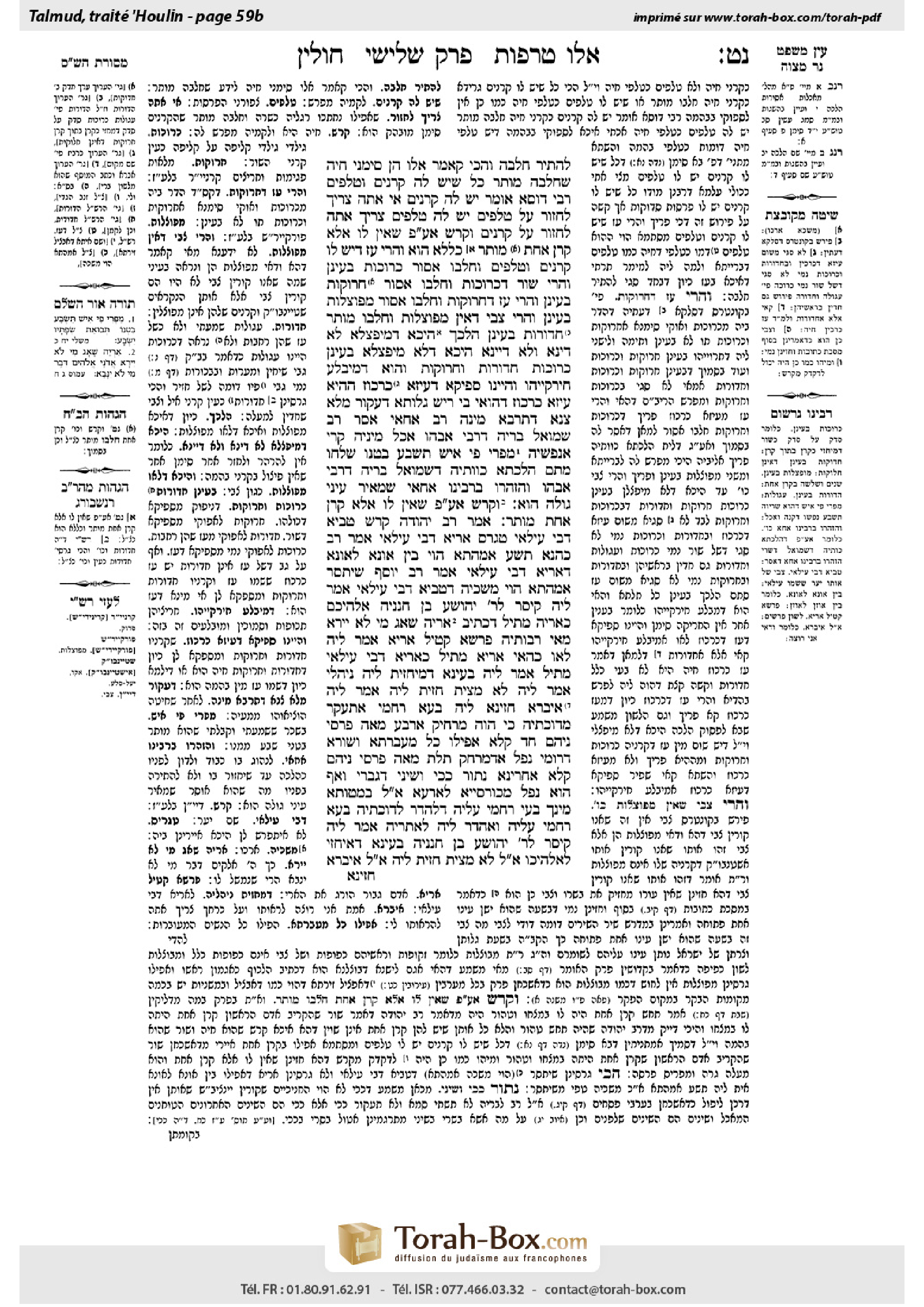
Chullin 59b: Talmud study for Daf Yomi
Study the Talmud for Daf Yomi with scanned pages, Hebrew text, English translations from Sefaria and AI-generated French translations.
Passage selection and English or AI-generated French translation are available where the scan has annotations. Daf Study is independent of Torah-Box and Sefaria.
Browse Chullin · חולין · All tractatesChullin 59b text and translations
This page of Chullin includes the Aramaic text, an English translation and an AI-generated French translation, alongside the scan above.
חולין נ״ט ב · Aramaic and Hebrew text
לְהַתִּיר חֶלְבָּהּ, וְהָכִי קָאָמַר: אֵלּוּ הֵן סִימָנֵי חַיָּה שֶׁחֶלְבָּהּ מוּתָּר – כֹּל שֶׁיֵּשׁ לָהּ קַרְנַיִם וּטְלָפַיִם.
רַבִּי דּוֹסָא אוֹמֵר: יֵשׁ לָהּ קַרְנַיִם – אִי אַתָּה צָרִיךְ לַחֲזוֹר עַל טְלָפַיִם, יֵשׁ לָהּ טְלָפַיִם – צָרִיךְ אַתָּה לַחֲזוֹר עַל קַרְנַיִם, וְקֶרֶשׁ, אַף עַל פִּי שֶׁאֵין לוֹ אֶלָּא קֶרֶן אַחַת – מוּתָּר.
כְּלָלָא הוּא? וַהֲרֵי עֵז, דְּיֵשׁ לוֹ קַרְנַיִם וּטְלָפַיִם, וְחֶלְבּוֹ אָסוּר! כְּרוּכוֹת בָּעֵינַן. וַהֲרֵי שׁוֹר, דִּכְרוּכוֹת, וְחֶלְבּוֹ אָסוּר! חֲרוּקוֹת בָּעֵינַן.
וַהֲרֵי עֵז, דַּחֲרוּקוֹת, וְחֶלְבּוֹ אָסוּר? מְפוּצָּלוֹת בָּעֵינַן! וַהֲרֵי צְבִי, דְּאֵין מְפוּצָּלוֹת, וְחֶלְבּוֹ מוּתָּר? חֲדוּרוֹת בָּעֵינַן.
הִלְכָּךְ, הֵיכָא דְּמִיפַּצְלָא – לָא דִּינָא וְלָא דַּיָּינָא; הֵיכָא דְּלָא מִיפַּצְלָא – בָּעֵינַן כְּרוּכוֹת, חֲדוּרוֹת, וַחֲרוּקוֹת, וְהוּא דְּמִיבְּלַע חִירְקַיְיהוּ.
וְהַיְינוּ סְפֵיקָא דְּעִיזָּא כַּרְכּוּז. הָהִיא עִיזָּא כַּרְכּוּז דַּהֲוַאי בֵּי רֵישׁ גָּלוּתָא, דַּעֲקוּר מְלָא צַנָּא דְּתַרְבָּא מִינַּהּ. רַב אַחַאי אָסַר, רַב שְׁמוּאֵל בְּרֵיהּ דְּרַבִּי אֲבָהוּ אֲכַל מִינֵּיהּ, קָרֵי אַנַּפְשֵׁיהּ: ״מִפְּרִי פִי אִישׁ תִּשְׂבַּע בִּטְנוֹ״.
שְׁלַחוּ מִתָּם: הִלְכְתָא כְּוָותֵיהּ דִּשְׁמוּאֵל בְּרֵיהּ דְּרַבִּי אֲבָהוּ, וְהִזָּהֲרוּ בְּרַבֵּינוּ אַחַאי, שֶׁמֵּאִיר עֵינֵי גּוֹלָה הוּא.
וְקֶרֶשׁ, אַף עַל פִּי שֶׁאֵין לוֹ אֶלָּא קֶרֶן אַחַת, מוּתָּר. אָמַר רַב יְהוּדָה: קֶרֶשׁ טַבְיָא דְּבֵי עִילַּאי, טִגְרִיס אַרְיָא דְּבֵי עִילַּאי. אָמַר רַב כָּהֲנָא: תְּשַׁע אַמְּהָתָא הָוֵי בֵּין אוּנָּא לְאוּנָּא דְּאַרְיָא דְּבֵי עִילַּאי. אָמַר רַב יוֹסֵף: שִׁיתְּסַר אַמְּהָתָא הָוֵי מַשְׁכֵיהּ דְּטַבְיָא דְּבֵי עִילַּאי.
אֲמַר לֵיהּ קֵיסָר לְרַבִּי יְהוֹשֻׁעַ בֶּן חֲנַנְיָה: אֱלֹהֵיכֶם כְּאַרְיָה מְתִיל, דִּכְתִיב ״אַרְיֵה שָׁאָג מִי לֹא יִירָא״, מַאי רְבוּתֵיהּ? פָּרָשָׁא קָטֵיל אַרְיָא! אֲמַר לֵיהּ: לָאו כְּהַאי אַרְיָא מְתִיל, כְּאַרְיָא דְּבֵי עִילַּאי מְתִיל. אֲמַר לֵיהּ: בָּעֵינָא דְּמַיחֲזֵית לֵיהּ נִיהֲלִי. אֲמַר לֵיהּ: לָא מָצֵית חָזֵית לֵיהּ. אֲמַר לֵיהּ: אִיבְרָא, חָזֵינָא לֵיהּ! בְּעָא רַחֲמֵי, אִתְעֲקַר מִדּוּכְתֵּיהּ,
כִּי הֲוָה מְרַחַיק אַרְבַּע מְאָה פַּרְסֵי, נַיהֵם חַד קָלָא, אַפִּילוּ כֹּל מְעַבְּרָתָא, וְשׁוּרָא דְּרוֹמִי נְפַל. אַדִּמְרַחַק תְּלָת מְאָה פַּרְסֵי, נַיהֵם קָלָא אַחֲרִינָא, נְתוּר כַּכֵּי וְשִׁינֵּי דְּגַבְרֵי, וְאַף הוּא נְפַל מִכּוּרְסְיָיא לְאַרְעָא. אֲמַר לֵיהּ: בְּמָטוּתָא מִינָּךְ, בְּעֵי רַחֲמֵי עֲלֵיהּ דְּלֶהְדַּר לְדוּכְתֵּיהּ. בְּעָא רַחֲמֵי עֲלֵיהּ, וְאַהְדַּר לֵיהּ לְאַתְרֵיהּ.
אֲמַר לֵיהּ קֵיסָר לְרַבִּי יְהוֹשֻׁעַ בֶּן חֲנַנְיָה: בָּעֵינָא דְּאִיחְזֵי לֵאלָהַיְכוּ. אֲמַר לֵיהּ: לָא מָצֵית חָזֵית לֵיהּ. אֲמַר לֵיהּ: אִיבְרָא
Chullin 59b · English translation
The signs are given to permit its forbidden fat, i.e., to deem the animal undomesticated. Fat that is forbidden for consumption in domesticated animals is permitted in undomesticated animals. And this is what the tanna is saying: These are the signs of a kosher undomesticated animal, so that one will know that its fat is permitted: Any animal that has horns and cloven hooves is an undomesticated animal.
Rabbi Dosa says: If it has horns, it is certainly a kosher undomesticated animal, and you need not search for cloven hooves. But if it has cloven hooves, you must still search for horns. And with regard to the animal called a keresh, even though it has only one horn, its fat is permitted for consumption.
The Gemara asks: Is this an established principle? But isn’t there a goat, which has horns and cloven hooves, and still its fat is forbidden, as it is a domesticated animal? The Gemara responds: We require horns that are layered to designate a kosher animal as undomesticated; a goat’s horns are not layered. The Gemara asks: But isn’t there a bull, which has layered horns, and still its fat is forbidden since it is domesticated? The Gemara responds: We require horns that are grooved; a bull’s horns are not grooved.
The Gemara persists: But isn’t there a goat, which has grooved horns, and still its fat is forbidden? The Gemara responds: We require horns that are branched; a goat’s horns are not branched. The Gemara asks: But isn’t there a gazelle [tzevi], whose horns are not branched, and still its fat is permitted? The Gemara responds: We require horns that are rounded and not broad like those of a sheep.
The Gemara concludes: Therefore, where an animal’s horns are branched, there is neither judgment nor judge, and the animal is without a doubt undomesticated. Where they are not branched, we require that they be layered, rounded, and grooved. And it must be grooved in a pattern such that its grooves are absorbed into one another.
And this is the uncertainty that arose concerning the karkoz goat, i.e., whether it is considered a domesticated animal. As there was a certain karkoz goat that was in the house of the Exilarch, from which they removed a full basket of fat after slaughtering it. Rav Aḥai deemed the fat forbidden, because he considered it a domesticated animal. But Rav Shmuel, son of Rabbi Abbahu, ate of it. He read the verse about himself: “A man’s belly shall be filled with the fruit of his mouth” (Proverbs 18:20). In other words, due to his learning, he knew it was permitted to eat the fat of the karkoz goat.
The Sages sent a message from there, Eretz Yisrael: The halakha is in accordance with the opinion of Rav Shmuel, son of Rabbi Abbahu, that a karkoz goat is an undomesticated animal and its fat is permitted; but nevertheless, be mindful of the honor of our teacher Aḥai who deems it forbidden, and do not partake of the fat in his presence, as he enlightens the eyes of the exile.
§ The baraita states: And with regard to the animal called a keresh, even though it has only one horn, its fat is permitted for consumption. Rav Yehuda says: The keresh is the gazelle that is native to the area of Bei Ila’ei. The tagras mentioned by the Sages is the lion of Bei Ila’ei. Rav Kahana says: There are nine cubits between the ears of the lion of Bei Ila’ei. Rav Yosef says: The length of the gazelle of Bei Ila’ei is sixteen cubits.
The Gemara recounts: The Roman emperor said to Rabbi Yehoshua ben Ḥananya: Your God is compared to a lion, as it is written: “The lion has roared, who will not fear” (Amos 3:8). But if so, what is His greatness? A cavalryman can kill a lion. Rabbi Yehoshua said to him: God is not compared to that lion which a cavalryman can kill. Rather, God is compared to the lion of Bei Ila’ei. The emperor said to him: I ask that you show it to me. Rabbi Yehoshua said to him: You cannot see it. The emperor said to him: Truly, I wish to see it. Rabbi Yehoshua prayed for mercy, and the lion of Bei Ila’ei set off from its place of origin toward Rome.
When it was four hundred parasangs away from Rome, it roared once, and all the pregnant women miscarried, and the wall of Rome fell. When it was three hundred parasangs away, it roared another time, and all the men’s front and back teeth fell out from fear. And even he, the emperor, fell from his throne to the ground. The emperor said to Rabbi Yehoshua: I beg you, pray for mercy with regard to it, that it should go back to the place from which it came. Rabbi Yehoshua prayed for mercy with regard to it, and it returned to the place from which it came.
§ The Gemara recounts: The emperor said to Rabbi Yehoshua ben Ḥananya: I wish to see your God. Rabbi Yehoshua said to him: You cannot see Him. The emperor said to him: Truly,
Chullin 59b · Traduction française (IA)
Les signes sont donnés afin de permettre la graisse interdite, c'est-à-dire pour considérer l'animal comme sauvage. La graisse interdite pour la consommation dans les animaux domestiques est permise dans les animaux sauvages. Et c'est ce que dit le tanna : Ces sont les signes d'un animal sauvage et propre, afin que l'on sache que sa graisse est permise : Tout animal qui a des cornes et des pieds à cloisons est un animal sauvage.
Rabbi Dosa dit : Si l'animal a des cornes, il est certainement un animal sauvage et propre, et l'on n'a pas besoin de chercher des pieds à cloisons. Mais si l'animal a des pieds à cloisons, il faut encore chercher des cornes. Et concernant l'animal appelé keresh, même s'il n'a qu'une seule corne, sa graisse est permise à la consommation.
Le Guemara demande : Ce n'est-ce pas un principe établi ? Mais n'y a-t-il pas un bouc, qui a des cornes et des pieds à cloisons, et dont la graisse est interdite, car il est un animal domestique ? Le Guemara répond : Nous exigeons des cornes couchées pour désigner un animal propre comme sauvage ; les cornes du bouc ne sont pas couchées. Le Guemara demande : Mais n'y a-t-il pas un taureau, qui a des cornes couchées, et dont la graisse est interdite car il est domestique ? Le Guemara répond : Nous exigeons des cornes en sillons ; les cornes du taureau ne sont pas en sillons.
Le Guemara persiste : Mais n'y a-t-il pas un bouc, qui a des cornes en sillons, et dont la graisse est interdite ? Le Guemara répond : Nous exigeons des cornes ramifiées ; les cornes du bouc ne sont pas ramifiées. Le Guemara demande : Mais n'y a-t-il pas un gazelle [tzevi], dont les cornes ne sont pas ramifiées, et dont la graisse est permise ? Le Guemara répond : Nous exigeons des cornes arrondies et non larges comme celles du mouton.
Le Guemara conclut : Ainsi, lorsque les cornes d'un animal sont ramifiées, il n'y a ni jugement ni juge, et l'animal est certainement sauvage. Lorsqu'elles ne sont pas ramifiées, nous exigeons qu'elles soient couchées, arrondies et en sillons. Et ces sillons doivent être tels qu'ils s'entrelacent les uns aux autres.
Et c'est cette incertitude qui a surgi concernant le bouc karkoz, c'est-à-dire si l'on considère qu'il est un animal domestique. Car il existait un certain bouc karkoz dans la maison de l'Exilarch, d'où on avait retiré une panse de graisse après avoir sacrifié l'animal. Rav Aḥai considérait la graisse comme interdite, car il la considérait comme un animal domestique. Mais Rav Shmuel, fils de Rabbi Abbahu, l'avait mangée. Il avait lu la parole concernant lui-même : « Le ventre d'un homme sera rempli de la fruit de sa bouche » (Proverbes 18:20). En d'autres termes, grâce à son étude, il savait qu'il était permis de manger la graisse du bouc karkoz.
Les Sages ont envoyé un message d'Eretz Yisrael : La halakha suit l'opinion de Rav Shmuel, fils de Rabbi Abbahu, qui considère le bouc karkoz comme un animal sauvage et dont la graisse est permise ; mais toutefois, soyez attentifs à l'honneur de notre maître Aḥai qui considère cette graisse comme interdite, et ne consommez pas la graisse en sa présence, car il éclaire les yeux de l'exil.
§ La baraïta dit : Et concernant l'animal appelé keresh, même s'il a qu'une seule corne, sa graisse est permise à la consommation. Rav Yehuda dit : Le keresh est le gazelle originaire de la région de Bei Ila’ei. Le tagras mentionné par les Sages est le lion de Bei Ila’ei. Rav Kahana dit : Il y a neuf coudées entre les oreilles du lion de Bei Ila’ei. Rav Yosef dit : La longueur du gazelle de Bei Ila’ei est seize coudées.
Le Guemara rapporte : L'empereur romain dit à Rabbi Yehoshua ben Ḥananya : Votre Dieu est comparé à un lion, car il est écrit : « Le lion a rugi, qui ne craindra pas » (Amos 3:8). Mais si c'est ainsi, quelle est sa grandeur ? Un cavalier peut tuer un lion. Rabbi Yehoshua dit à lui : Dieu n'est pas comparé à ce lion que peut tuer un cavalier. Plutôt, Dieu est comparé au lion de Bei Ila’ei. L'empereur dit à lui : Je te demande de me le montrer. Rabbi Yehoshua dit à lui : Tu ne peux pas le voir. L'empereur dit à lui : Vraiment, je veux le voir. Rabbi Yehoshua pria pour la miséricorde, et le lion de Bei Ila’ei partit de son lieu d'origine vers Rome.
Quand il était à quatre cents parasangs de Rome, il rugit une fois, et toutes les femmes enceintes eurent des avortements, et le mur de Rome s'effondra. Quand il était à trois cents parasangs de Rome, il rugit une autre fois, et toutes les dents de devant et de derrière des hommes tombèrent à cause de la peur. Même l'empereur lui-même tomba de son trône au sol. L'empereur dit à Rabbi Yehoshua : Je t'implore, prie pour la miséricorde concernant lui, afin qu'il retourne au lieu d'où il est venu. Rabbi Yehoshua pria pour la miséricorde concernant lui, et il retourna au lieu d'où il était venu.
§ Le Guemara rapporte : L'empereur dit à Rabbi Yehoshua ben Ḥananya : Je veux voir votre Dieu. Rabbi Yehoshua dit à lui : Tu ne peux pas le voir. L'empereur dit à lui : Vraiment,
Traduction française générée par IA à partir de l’édition anglaise de Sefaria. Vérifie toujours un passage avec le texte source.
Text from Sefaria: William Davidson Edition - Vocalized Aramaic (unknown); William Davidson Edition - English (CC BY NC).