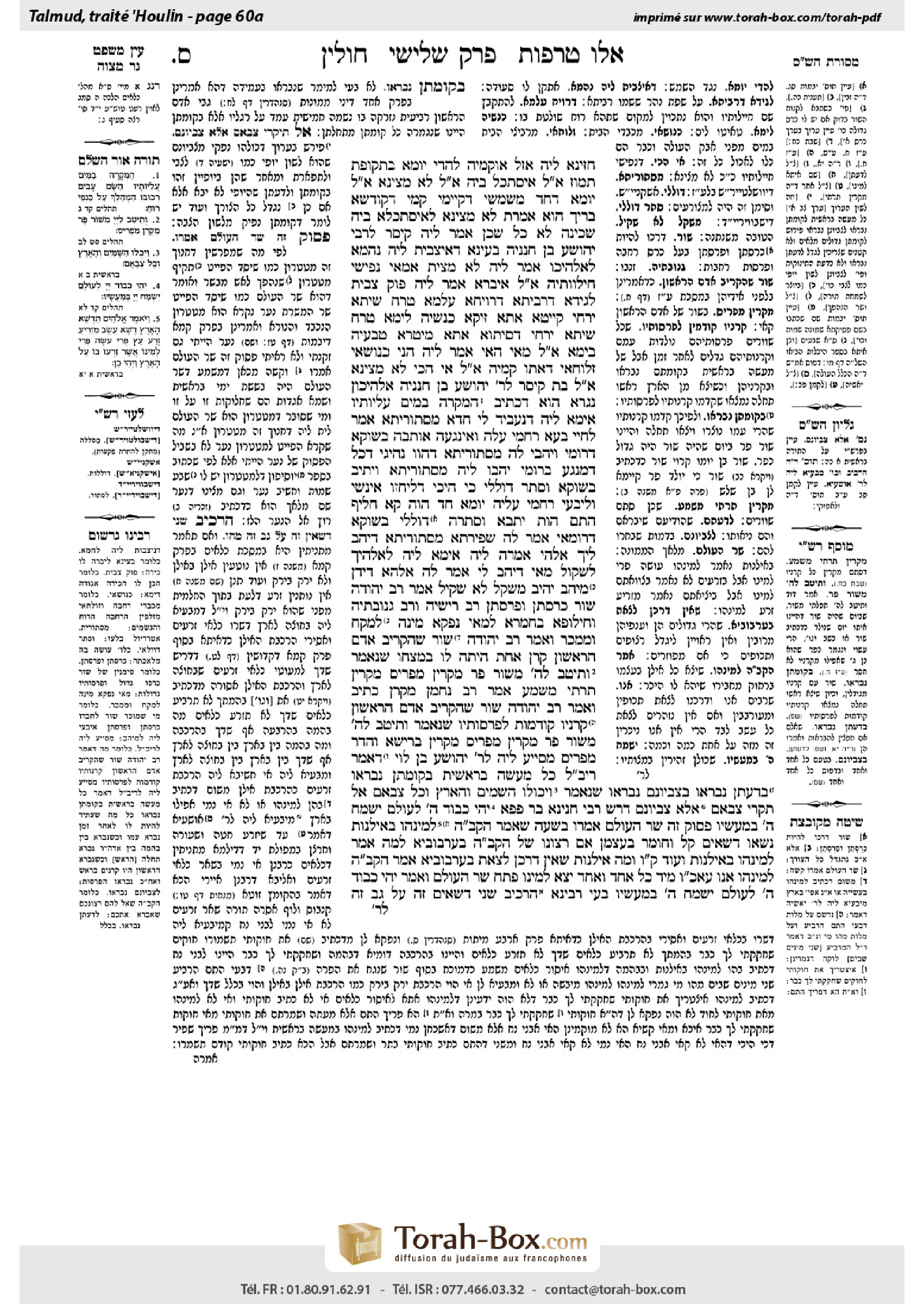
Chullin 60a: Talmud study for Daf Yomi
Study the Talmud for Daf Yomi with scanned pages, Hebrew text, English translations from Sefaria and AI-generated French translations.
Passage selection and English or AI-generated French translation are available where the scan has annotations. Daf Study is independent of Torah-Box and Sefaria.
Browse Chullin · חולין · All tractatesChullin 60a text and translations
This page of Chullin includes the Aramaic text, an English translation and an AI-generated French translation, alongside the scan above.
חולין ס׳ א · Aramaic and Hebrew text
חָזֵינָא לֵיהּ. אֲזַל אוֹקְמֵיהּ לַהֲדֵי יוֹמָא בִּתְקוּפַת תַּמּוּז, אֲמַר לֵיהּ: אִיסְתַּכַּל בֵּיהּ. אֲמַר לֵיהּ: לָא מָצֵינָא. אֲמַר לֵיהּ: יוֹמָא, דְּחַד מִשַּׁמָּשֵׁי דְּקָיְימִי קַמֵּי דְּקוּדְשָׁא בְּרִיךְ הוּא אָמְרַתְּ לָא מָצֵינָא לְאִיסְתַּכָּלָא בֵּיהּ, שְׁכִינָה לֹא כׇּל שֶׁכֵּן.
אֲמַר לֵיהּ קֵיסָר לְרַבִּי יְהוֹשֻׁעַ בֶּן חֲנַנְיָה: בָּעֵינָא דְּאִיצְבֵּית לֵיהּ נַהֲמָא לֵאלָהַיְכוּ. אֲמַר לֵיהּ: לָא מָצֵית. אַמַּאי? נְפִישִׁי חֵילְוָותֵיהּ. אֲמַר לֵיהּ: אִיבְרָא. אֲמַר לֵיהּ: פּוֹק צְבֵית לְגֻידָּא דִּרְבִיתָא, דִּרְוִיחַ עָלְמָא. טְרַח שִׁיתָּא יַרְחֵי קַיְיטָא, אֲתָא זִיקָא כַּנְשֵׁיהּ לְיַמָּא.
טְרַח שִׁיתָּא יַרְחֵי דְּסִיתְוָא, אֲתָא מִיטְרָא טַבְּעֵיהּ בְּיַמָּא. אֲמַר לֵיהּ: מַאי הַאי? אֲמַר לֵיהּ: הָנֵי כָּנוֹשָׁאֵי זָלוֹחָאֵי דְּאָתוּ קַמֵּיהּ. אֲמַר לֵיהּ: אִי הָכִי לָא מָצֵינָא.
אֲמַרָה לֵיהּ בַּת קֵיסָר לְרַבִּי יְהוֹשֻׁעַ בֶּן חֲנַנְיָה: אֱלָהֵיכוֹן נַגָּרָא הוּא, דִּכְתִיב ״הַמְקָרֶה בַמַּיִם עֲלִיּוֹתָיו״. אֵימָא לֵיהּ דְּנֶעְבֵּיד לִי חֲדָא מַסְתּוּרִיתָא. אֲמַר: לְחַיֵּי, בְּעָא רַחֲמֵי עֲלַהּ וְאִינַּגְעָה. אוֹתְבַהּ בְּשׁוּקָא דְּרוֹמִי וְיָהֲבִי לַהּ מַסְתּוּרִיתָא, דַּהֲווֹ נְהִיגִי דְּכֹל דִּמְנַגַּע בְּרוֹמִי יָהֲבוּ לֵיהּ מַסְתּוּרִיתָא, וְיָתֵיב בְּשׁוּקָא וְסָתַר דּוּלְלֵי, כִּי הֵיכִי דְּלִיחְזוֹ אִינָשֵׁי וְלִיבְעֵי רַחֲמֵי עֲלֵיהּ.
יוֹמָא חַד הֲוָה קָא חָלֵיף הָתָם, הֲוָת יָתְבָא וְסָתְרָה דּוּלְלֵי בְּשׁוּקָא דְּרוֹמָאֵי, אֲמַר לַהּ: שַׁפִּירְתָּא מַסְתּוּרִיתָא דִּיהַב לִיךְ אֱלָהַי. אֲמַרָה לֵיהּ: אֵימָא לֵיהּ לֵאלָהָיךְ לִשְׁקוֹל מַאי דִּיהַב לִי. אָמַר לָהּ: אֱלָהָא דִּידַן מֵיהָב יָהֵיב, מִשְׁקָל לָא שָׁקֵיל.
אָמַר רַב יְהוּדָה: שׁוֹר כְּרַסְתָּן וּפַרְסְתָן, רַב רֵישֵׁיהּ וְרַב גְּנוּבְתֵּיהּ, וְחִילּוּפָא בַּחֲמָרָא. לְמַאי נָפְקָא מִינַּהּ? לְמִקָּח וּמִמְכָּר.
וְאָמַר רַב יְהוּדָה: שׁוֹר שֶׁהִקְרִיב אָדָם הָרִאשׁוֹן, קֶרֶן אַחַת הָיְתָה לוֹ בְּמִצְחוֹ, שֶׁנֶּאֱמַר: ״וְתִיטַב לַה׳ מִשּׁוֹר פָּר מַקְרִין מַפְרִיס״ – מַקְרִין תַּרְתֵּי מַשְׁמַע! אָמַר רַב נַחְמָן: ״מַקְרָן״ כְּתִיב.
וְאָמַר רַב יְהוּדָה: שׁוֹר שֶׁהִקְרִיב אָדָם הָרִאשׁוֹן, קַרְנָיו קוֹדְמוֹת לְפַרְסוֹתָיו, שֶׁנֶּאֱמַר: ״וְתִיטַב לַה׳ מִשּׁוֹר פָּר מַקְרִין מַפְרִיס״ – מַקְרִין בְּרֵישָׁא, וַהֲדַר מַפְרִיס.
מְסַיַּיע לֵיהּ לְרַבִּי יְהוֹשֻׁעַ בֶּן לֵוִי, דְּאָמַר רַבִּי יְהוֹשֻׁעַ בֶּן לֵוִי: כׇּל מַעֲשֵׂה בְרֵאשִׁית בְּקוֹמָתָן נִבְרְאוּ, בְּדַעְתָּן נִבְרְאוּ, בְּצִבְיוֹנָם נִבְרְאוּ, שֶׁנֶּאֱמַר ״וַיְכֻלּוּ הַשָּׁמַיִם וְהָאָרֶץ וְכׇל צְבָאָם״, אַל תִּקְרֵי ״צְבָאָם״ אֶלָּא ״צִבְיוֹנָם״.
דָּרֵשׁ רַבִּי חֲנִינָא בַּר פָּפָּא: ״יְהִי כְבוֹד ה׳ לְעוֹלָם יִשְׂמַח ה׳ בְּמַעֲשָׂיו״, פָּסוּק זֶה שַׂר הָעוֹלָם אֲמָרוֹ, בְּשָׁעָה שֶׁאָמַר הַקָּדוֹשׁ בָּרוּךְ הוּא ״לְמִינֵהוּ״ בָּאִילָנוֹת, נָשְׂאוּ דְּשָׁאִים קַל וָחוֹמֶר בְּעַצְמָן:
אִם רְצוֹנוֹ שֶׁל הַקָּדוֹשׁ בָּרוּךְ הוּא בְּעִרְבּוּבְיָא, לָמָּה אָמַר ״לְמִינֵהוּ״ בָּאִילָנוֹת? וְעוֹד קַל וָחוֹמֶר: וּמָה אִילָנוֹת שֶׁאֵין דַּרְכָּן לָצֵאת בְּעִרְבּוּבְיָא, אָמַר הַקָּדוֹשׁ בָּרוּךְ הוּא ״לְמִינֵהוּ״ – אָנוּ עַל אַחַת כַּמָּה וְכַמָּה!
מִיָּד כׇּל אֶחָד וְאֶחָד יָצָא לְמִינוֹ, פָּתַח שַׂר הָעוֹלָם וְאָמַר: ״יְהִי כְבוֹד ה׳ לְעוֹלָם יִשְׂמַח ה׳ בְּמַעֲשָׂיו״.
בָּעֵי רָבִינָא: הִרְכִּיב שְׁנֵי דְּשָׁאִים זֶה עַל גַּב זֶה
Chullin 60a · English translation
I wish to see Him. Rabbi Yehoshua went and stood the emperor facing the sun in the season of Tammuz, i.e., summer. Rabbi Yehoshua said to him: Look at it. The emperor said to him: I cannot. Rabbi Yehoshua said to him: Now, if with regard to the sun, which is only one of the servants that stand before the Holy One, Blessed be He, you say: I cannot look at it, is it not all the more so with regard to the Divine Presence?
§ The Gemara recounts: The Roman emperor said to Rabbi Yehoshua ben Ḥananya: I desire to arrange bread, i.e., a meal, for your God. Rabbi Yehoshua said to him: You cannot. The emperor asked him: Why? Rabbi Yehoshua said to him: His hosts are too great. The emperor said to him: Truly, I wish to do it. Rabbi Yehoshua said to him: Go out and arrange a meal on the shore of the great sea [dirvita], where there is a wide open space. The emperor worked all the six months of summer to accomplish this. A wind came and swept it all into the sea.
The emperor worked to arrange another meal all the six months of winter. Rain came and sank it all in the sea. The emperor said to Rabbi Yehoshua: What is this? Rabbi Yehoshua said to him: These are only the sweepers and floor washers that wait on Him, and they alone have eaten everything. The emperor said to him: If so, I cannot arrange a meal before Him.
§ The Gemara recounts: The daughter of the Roman emperor said to Rabbi Yehoshua ben Ḥananya: Your God is a carpenter, as it is written: “Who lays the beams of His upper chambers in the waters” (Psalms 104:3). Tell Him to make for me a distaff, a simple tool used in spinning. Rabbi Yehoshua ben Ḥananya said: Very well. He prayed for mercy for her and she was stricken with leprosy. She sat in the Roman market, and they gave her a distaff, since it was their custom to give a distaff to anyone stricken with leprosy in Rome, and the leper would sit in the market and untangle bunches of wool, so that people would see and pray for mercy on him.
One day Rabbi Yehoshua ben Ḥananya was passing there, and he saw that she was sitting and untangling bunches of wool in the Roman market. Rabbi Yehoshua ben Ḥananya said to her: Is the distaff my God gave you pleasing? She said to him: Tell your God to take back what He has given me. Rabbi Yehoshua ben Ḥananya said to her: Our God gives, but does not take.
§ Rav Yehuda says: A bull has a large paunch and large hooves. Its head is large, and its tail is large. And the opposite is true for a donkey. The Gemara explains: What is the practical difference that results from such a statement? It is relevant for purposes of buying and selling. One who agrees to sell a bull must provide the buyer with one that fits this description, and the opposite for a donkey.
And Rav Yehuda says: The bull that Adam, the first man, sacrificed as a thanks offering for his life being spared had a single horn on its forehead, as it is stated: “And it shall please the Lord better than a bullock that has horns [makrin] and hoofs” (Psalms 69:32). The Gemara comments: On the contrary, the word makrin indicates two horns. Rav Naḥman said: Although it is vocalized in the plural, makran is written in the verse, without the letter yod, to indicate that it had only a single horn.
And Rav Yehuda says: With regard to the bull that Adam, the first man, sacrificed, its horns preceded its hooves. It was not born of a cow, but rose fully formed out of the earth such that its head emerged first, as it is stated: “And it shall please the Lord better than a bullock that has horns and hoofs.” The phrase “has horns” comes first, and only afterward the word “hoofs.”
And this supports the statement of Rabbi Yehoshua ben Levi, as Rabbi Yehoshua ben Levi says: All items created during the acts of Creation were created with their full stature, immediately fit to bear fruit; they were created with their full mental capacities; they were created with their full form. As it is stated: “And the heaven and the earth were finished, and all the host of them” (Genesis 2:1). Do not read it as: “The host of them [tzeva’am]”; rather, read it as: Their form [tzivyonam].
§ Rabbi Ḥanina bar Pappa taught: “May the glory of the Lord endure forever; let the Lord rejoice in His works” (Psalms 104:31). This verse was stated by the minister of the world, i.e., the angel charged with overseeing the world. When the Holy One, Blessed be He, said: “Let the earth put forth grass, herb yielding seed, and fruit tree bearing fruit after its kind” (Genesis 1:11), the grasses drew an a fortiori inference with regard to themselves.
They reasoned: If the Holy One, Blessed be He, wishes the mixing of species, why did he say: After its kind, with regard to the trees? And furthermore, let us draw an a fortiori inference: If with regard to trees, which do not naturally grow mixed, as they are large and distinct from one another, the Holy One, Blessed be He, said: “After its kind,” all the more so with regard to us, since grass naturally grows mixed.
Immediately, every kind of grass emerged after its kind, as it is stated: “And the earth brought forth grass, herb yielding seed after its kind” (Genesis 1:12). The minister of the world began to speak and said: “May the glory of the Lord endure forever; let the Lord rejoice in His works,” who do His will even when not explicitly instructed.
With regard to the above description, Ravina raises a dilemma: If one grafted two species of grass onto one another, as is done with trees,
Chullin 60a · Traduction française (IA)
Je veux le voir. Le Rabbi Yéhoshua est allé se poster face au soleil, devant l'empereur, en l'été, c'est-à-dire en Tammouz. Le Rabbi Yéhoshua a dit à l'empereur : Regarde-le. L'empereur a dit à lui : Je ne peux pas. Le Rabbi Yéhoshua a dit à l'empereur : Maintenant, si avec regard au soleil, qui est seulement l'un des serviteurs qui se tiennent devant le Saint des Saints, béni soit-Il, tu dis : Je ne peux pas le regarder, n'est-ce pas encore plus vrai avec regard à la Divine Présence ?
§ La Guemara rapporte : L'empereur romain a dit au Rabbi Yéhoshua ben Hananyah : Je désire organiser un repas, c'est-à-dire un banquet, pour votre Dieu. Le Rabbi Yéhoshua a dit à lui : Tu ne peux pas. L'empereur a demandé : Pourquoi ? Le Rabbi Yéhoshua a dit : Ses hôtes sont trop nombreux. L'empereur a dit : Vraiment, je désire le faire. Le Rabbi Yéhoshua a dit : Sortez et organisez un banquet sur la côte de la grande mer [dirvita], là où il y a un espace ouvert. L'empereur a travaillé les six mois de l'été pour accomplir cela. Un vent est venu et a emporté tout cela dans la mer.
L'empereur a travaillé pour organiser un autre banquet pendant les six mois de l'hiver. La pluie est venue et a fait couler tout cela dans la mer. L'empereur a dit au Rabbi Yéhoshua : Qu'est-ce que c'est ? Le Rabbi Yéhoshua a dit : Ce sont seulement les balayeurs et les nettoyeurs de sol qui servent Lui, et ce sont eux seuls qui ont mangé tout cela. L'empereur a dit : Si c'est ainsi, je ne peux pas organiser un banquet devant Lui.
§ La Guemara rapporte : La fille de l'empereur romain a dit au Rabbi Yéhoshua ben Hananyah : Votre Dieu est un charpentier, car il est écrit : « Qui pose les poutres de ses chambres supérieures dans les eaux » (Psaumes 104:3). Dites-Lui de me faire un distaff, un outil simple utilisé pour tisser. Le Rabbi Yéhoshua ben Hananyah a dit : Très bien. Il a prié pour la miséricorde envers elle et elle a été touchée de la maladie de la lèpre. Elle a été assise au marché romain, et on lui a donné un distaff, car c'était leur coutume à Rome de donner un distaff à toute personne touchée de la lèpre, et la lèpre serait assise au marché et dénouerait des bouquets de laine, afin que les gens voient et priesnt pour sa miséricorde.
Un jour, le Rabbi Yéhoshua ben Hananyah passait là, et il a vu qu'elle était assise et dénouait des bouquets de laine au marché romain. Le Rabbi Yéhoshua ben Hananyah a dit à elle : Est-ce que le distaff que Dieu t'a donné te plaît ? Elle a dit à lui : Dites à votre Dieu de reprendre ce qu'il a donné. Le Rabbi Yéhoshua ben Hananyah a dit à elle : Notre Dieu donne, mais ne reprend pas.
§ Rav Yéhuda dit : Un taureau a un ventre grand et des sabots grands. Sa tête est grande, et sa queue est grande. Et l'inverse est vrai pour un âne. La Guemara explique : Quelle est la différence pratique qui résulte de telle déclaration ? C'est pertinent pour les raisons d'acheter et de vendre. Celui qui s'accorde à vendre un taureau doit fournir au acheteur un qui correspond à cette description, et l'inverse pour un âne.
Et Rav Yéhuda dit : Le taureau que Adam, le premier homme, a sacrifié comme offrande de remerciement pour sa vie préservée avait un seul cornet sur son front, comme il est dit : « Et cela plaira à l'Éternel mieux qu'un taureau qui a des cornes [makrin] et des sabots » (Psaumes 69:32). La Guemara commente : Au contraire, le mot makrin indique deux cornes. Rav Naḥman a dit : Bien qu'il soit vocalisé au pluriel, makran est écrit dans la verset sans la lettre yod, pour indiquer qu'il avait seulement un cornet.
Et Rav Yéhuda dit : Concernant le taureau que Adam, le premier homme, a sacrifié, ses cornes précédaient ses sabots. Il n'était pas né d'une vache, mais s'est formé entièrement de la terre de telle sorte que sa tête est sortie en premier, comme il est dit : « Et cela plaira à l'Éternel mieux qu'un taureau qui a des cornes et des sabots ». La phrase « a des cornes » vient d'abord, et seulement ensuite le mot « des sabots ».
Et cela soutient la déclaration du Rabbi Yéhoshua ben Levi, comme le Rabbi Yéhoshua ben Levi dit : Tous les objets créés pendant les actes de la Création ont été créés avec leur stature complète, immédiatement prêts à porter des fruits ; ils ont été créés avec leurs capacités mentales complètes ; ils ont été créés avec leur forme complète. Comme il est dit : « Et le ciel et la terre furent achevés, et toute l'armée de ceux-ci » (Genèse 2:1). Ne le lis pas comme : « L'armée de ceux-ci [tzeva’am] » ; plutôt, le lis comme : Leur forme [tzivyonam].
§ Rabbi Ḥanina bar Pappa enseigna : « Que la gloire de l'Éternel endure éternellement ; que l'Éternel se réjouisse de Ses œuvres » (Psaumes 104:31). Cette parole a été dite par le ministre du monde, c'est-à-dire l'ange chargé de surveiller le monde. Lorsque l'Éternel Saint, béni soit-Il, a dit : « Que la terre produise de l'herbe, des plantes qui donnent des semences, et des arbres fruitiers qui portent des fruits selon leur espèce » (Genèse 1:11), les herbes ont tiré une déduction a fortiori concernant elles-mêmes.
Ils ont raisonné : Si l'Éternel Saint, béni soit-Il, désire le mélange des espèces, pourquoi a-t-il dit : « Selon leur espèce », concernant les arbres ? Et de plus, permettons-nous de tirer une déduction a fortiori : Si concernant les arbres, qui ne grandissent naturellement mélangés, car ils sont grands et distincts les uns des autres, l'Éternel Saint, béni soit-Il, a dit : « Selon leur espèce », encore plus encore concernant nous, car l'herbe grandit naturellement mélangée.
Immédiatement, toute espèce d'herbe est sortie selon son espèce, comme il est dit : « Et la terre produisit de l'herbe, des plantes qui donnent des semences selon leur espèce » (Genèse 1:12). Le ministre du monde a commencé à parler et a dit : « Que la gloire de l'Éternel endure éternellement ; que l'Éternel se réjouisse de Ses œuvres », qui fait Sa volonté même lorsqu'il n'est pas explicitement instruit.
Concernant la description ci-dessus, Ravina soulève un dilemme : Si l'on greffe deux espèces de plantes herbacées l'une sur l'autre, comme on le fait avec les arbres,
Traduction française générée par IA à partir de l’édition anglaise de Sefaria. Vérifie toujours un passage avec le texte source.
Text from Sefaria: William Davidson Edition - Vocalized Aramaic (unknown); William Davidson Edition - English (CC BY NC).