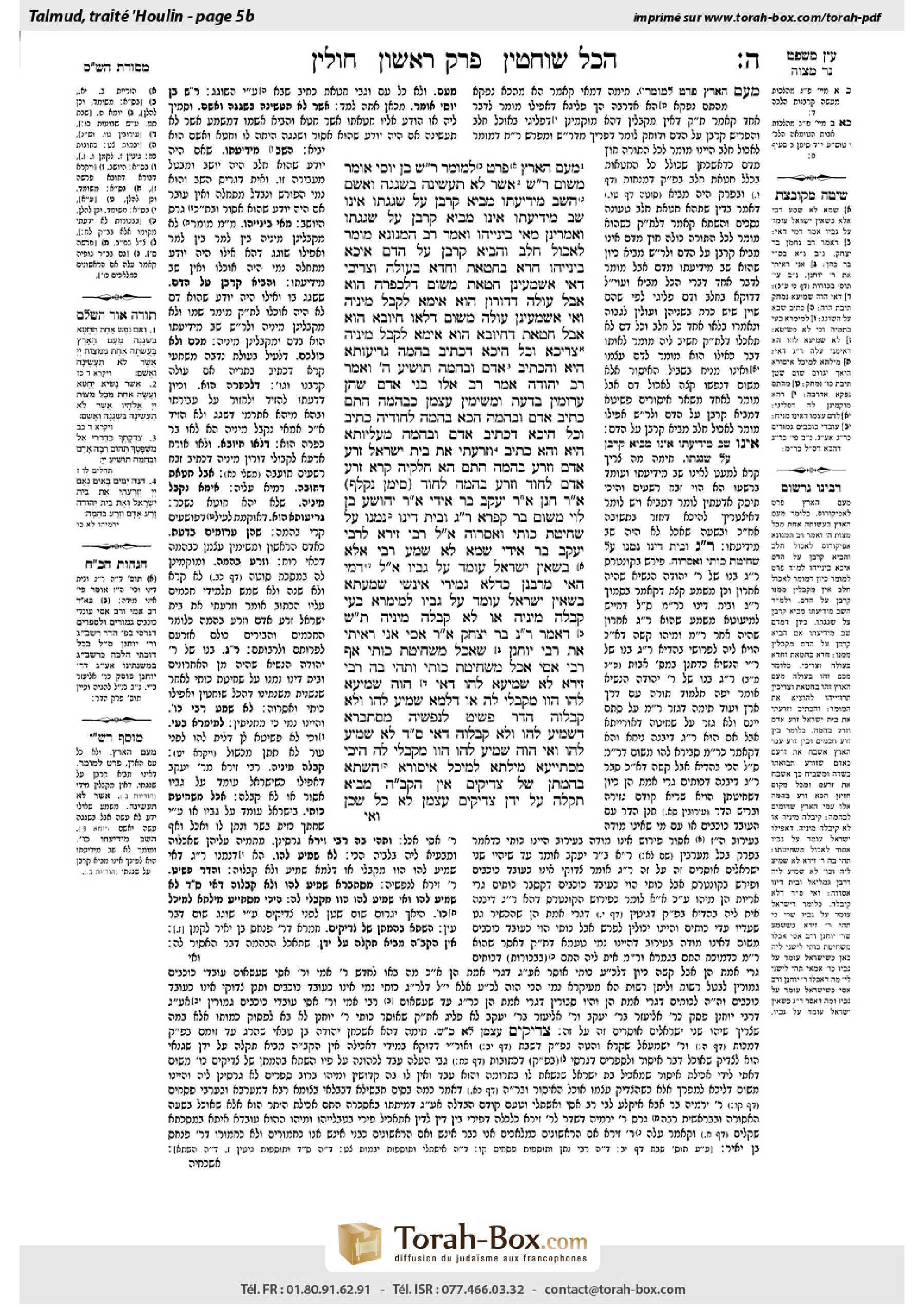
Chullin 5b: Talmud study for Daf Yomi
Study the Talmud for Daf Yomi with scanned pages, Hebrew text, English translations from Sefaria and AI-generated French translations.
Passage selection and English or AI-generated French translation are available where the scan has annotations. Daf Study is independent of Torah-Box and Sefaria.
Browse Chullin · חולין · All tractatesChullin 5b text and translations
This page of Chullin includes the Aramaic text, an English translation and an AI-generated French translation, alongside the scan above.
חולין ה׳ ב · Aramaic and Hebrew text
״מֵעַם הָאָרֶץ״ – פְּרָט לִמְשׁוּמָּד.
רַבִּי שִׁמְעוֹן בֶּן יוֹסֵי אוֹמֵר מִשּׁוּם רַבִּי שִׁמְעוֹן: ״אֲשֶׁר לֹא תֵּעָשֶׂינָה בִּשְׁגָגָה וְאָשֵׁם״, הַשָּׁב מִידִיעָתוֹ – מֵבִיא קׇרְבָּן עַל שִׁגְגָתוֹ, אֵינוֹ שָׁב מִידִיעָתוֹ – אֵינוֹ מֵבִיא קׇרְבָּן עַל שִׁגְגָתוֹ.
וְאָמְרִינַן: מַאי בֵּינַיְיהוּ? וְאָמַר רַב הַמְנוּנָא: מְשׁוּמָּד לֶאֱכוֹל חֵלֶב וְהֵבִיא קׇרְבָּן עַל הַדָּם אִיכָּא בֵּינַיְיהוּ.
חֲדָא בְּחַטָּאת, וַחֲדָא בְּעוֹלָה, וּצְרִיכִי, דְּאִי אַשְׁמְעִינַן חַטָּאת – מִשּׁוּם דִּלְכַפָּרָה הוּא, אֲבָל עוֹלָה דְּדוֹרוֹן הוּא – אֵימָא לְקַבֵּל מִינֵּיהּ. וְאִי אַשְׁמְעִינַן עוֹלָה – מִשּׁוּם דְּלָאו חִיּוּבָא הוּא, אֲבָל חַטָּאת דְּחִיּוּבָא הוּא – אֵימָא לְקַבֵּל מִינֵּיהּ, צְרִיכָא.
וְכׇל הֵיכָא דִּכְתִיב בְּהֵמָה, גְּרִיעוּתָא הִיא? וְהָכְתִיב ״אָדָם וּבְהֵמָה תוֹשִׁיעַ ה׳״, וְאָמַר רַב יְהוּדָה אָמַר רַב: אֵלּוּ בְּנֵי אָדָם שֶׁהֵן עֲרוּמִין בְּדַעַת, וּמְשִׂימִין עַצְמָן כִּבְהֵמָה! הָתָם כְּתִיב ״אָדָם וּבְהֵמָה״, הָכָא בְּהֵמָה לְחוּדֵּיהּ כְּתִיב.
וְכׇל הֵיכָא דִּכְתִיב ״אָדָם וּבְהֵמָה״ מְעַלְּיוּתָא הִיא? וְהָא כְּתִיב: ״וְזָרַעְתִּי אֶת בֵּית יִשְׂרָאֵל זֶרַע אָדָם וְזֶרַע בְּהֵמָה״! הָתָם, הָא חַלְּקֵיהּ קְרָא, ״זֶרַע אָדָם״ לְחוֹד וְ״זֶרַע בְּהֵמָה״ לְחוֹד.
(סִימָן: נִקְלָ״ף.)
אָמַר רַבִּי חָנָן אָמַר רַבִּי יַעֲקֹב בַּר אִידֵּי אָמַר רַבִּי יְהוֹשֻׁעַ בֶּן לֵוִי מִשּׁוּם בַּר קַפָּרָא: רַבָּן גַּמְלִיאֵל וּבֵית דִּינוֹ נִמְנוּ עַל שְׁחִיטַת כּוּתִי וַאֲסָרוּהָ. אֲמַר לֵיהּ רַבִּי זֵירָא לְרַבִּי יַעֲקֹב בַּר אִידִי: שֶׁמָּא לֹא שָׁמַע רַבִּי אֶלָּא בְּשֶׁאֵין יִשְׂרָאֵל עוֹמֵד עַל גַּבָּיו? אֲמַר לֵיהּ: דָּמֵי הַאי מֵרַבָּנַן כִּדְלָא גְּמִירִי אִינָשֵׁי שְׁמַעְתָּא, בְּשֶׁאֵין יִשְׂרָאֵל עוֹמֵד עַל גַּבָּיו לְמֵימְרָא בָּעֵי?
קַבְּלַהּ מִינֵּיהּ אוֹ לָא קַבְּלַהּ מִינֵּיהּ? תָּא שְׁמַע, דְּאָמַר רַב נַחְמָן בַּר יִצְחָק אָמַר רַבִּי אַסִּי: אֲנִי רָאִיתִי אֶת רַבִּי יוֹחָנָן שֶׁאָכַל מִשְּׁחִיטַת כּוּתִי, אַף רַבִּי אַסִּי אָכַל מִשְּׁחִיטַת כּוּתִי. וְתָהֵי בַּהּ רַבִּי זֵירָא: לָא שְׁמִיעָא לְהוּ, דְּאִי הֲוָה שְׁמִיעָא לְהוּ הֲווֹ מְקַבְּלִי לֵהּ, אוֹ דִלְמָא שְׁמִיעַ לְהוּ וְלָא קַבְּלוּהָ?
הֲדַר פָּשֵׁיט לְנַפְשֵׁיהּ: מִסְתַּבְּרָא דִּשְׁמִיעַ לְהוּ וְלָא קַבְּלוּהָ, דְּאִי סָלְקָא דַעְתָּךְ לָא שְׁמִיעַ לְהוּ, וְאִי הֲוָה שְׁמִיעַ לְהוּ הֲווֹ מְקַבְּלִי לֵהּ, הֵיכִי מִסְתַּיְּיעָא מִילְּתָא לְמֵיכַל אִיסּוּרָא? הַשְׁתָּא בְּהֶמְתָּן שֶׁל צַדִּיקִים אֵין הַקָּדוֹשׁ בָּרוּךְ הוּא מֵבִיא תַּקָּלָה עַל יָדָן, צַדִּיקִים עַצְמָן לֹא כׇּל שֶׁכֵּן!
Chullin 5b · English translation
“And if any one of the common people sins unwittingly…and he shall bring his offering” (Leviticus 4:27–28), from which it is inferred in a baraita: “Of the common people,” indicating: But not all of the common people. This serves to exclude a transgressor, from whom a sin offering is not accepted.
Rabbi Shimon ben Yosei says in the name of Rabbi Shimon that the verse states: “And does unwittingly one of the things…that may not be done, and he becomes guilty, or if his sin that he sinned became known to him” (Leviticus 4:22–23). From the words “become known to him” it is inferred: One who repents due to his awareness that he performed a transgression, as had he known that the action is prohibited he would not have performed it, brings an offering for his unwitting transgression in order to achieve atonement. But one who does not repent due to his awareness that he sinned, e.g., a transgressor who would have sinned even had he been aware that the act is prohibited, does not bring an offering for his unwitting action.
And we say: What is the difference between their two opinions? And Rav Hamnuna said: The difference is in the case of a transgressor with regard to eating the forbidden fat of a domesticated animal and he brought an offering for unwittingly consuming blood is the difference between them. According to the first tanna he may not bring an offering, as he is a transgressor. According to Rabbi Shimon, since he repented for unwittingly consuming blood, due to his awareness that he sinned, he brings a sin offering for that unwitting sin. In any event, this baraita apparently contradicts the previously cited baraita with regard to the source for the halakha that one does not accept an offering from a transgressor.
The Gemara answers: One source teaches with regard to the sin offering of a transgressor that it is not accepted, and one source teaches with regard to the burnt offering of a transgressor that it is not accepted. And both sources are necessary, as, if the Torah had taught us this halakha only with regard to a sin offering, one might have thought that it is not accepted due to the fact that it is for atonement, and as a transgressor he is undeserving of atonement, but with regard to a burnt offering, which is merely a gift [dedoron], say that one ought to accept it from him. And if the Torah had taught us this halakha only with regard to a burnt offering, one might have thought that it is not accepted due to the fact that it is not an obligation, but with regard to a sin offering, which is an obligation, say that one ought to accept it from him. Therefore, both sources are necessary.
§ In the previous baraita the Sages derived from the phrase “from the animal” that people who are similar to an animal are included among those from whom offerings are accepted. The Gemara seeks to understand the meaning of the phrase: Similar to an animal, and asks: And everywhere that the word animal is written and interpreted as referring to a person, does it indicate a deficiency? But isn’t it written: “Man and animal You preserve, Lord” (Psalms 36:7), and Rav Yehuda says that Rav says: These are people who are clever in terms of their intellect, like people, and despite their intelligence they comport themselves humbly and self-effacingly, like an animal. The Gemara answers: There it is written “man and animal.” Here, the word “animal” alone is written.
The Gemara asks: And everywhere that the terms “man” and “animal” are written together, does it indicate a virtue? But isn’t it written: “And I will sow the house of Israel and the house of Judah with the seed of man and with the seed of animal” (Jeremiah 31:26), and the Sages interpreted the phrase “seed of animal” as a reference to ignorant, inferior people. The Gemara answers: There, doesn’t the verse separate man and animal? The seed of man is discrete and the seed of animal is discrete.
§ The Gemara revisits the matter of slaughter by a Samaritan and cites a mnemonic for the names of the Sages that follow: Nun, for Ḥanan; kuf, for Ya’akov; lamed, for ben Levi; and peh, for bar Kappara.
§ Rabbi Ḥanan says that Rabbi Ya’akov bar Idi says that Rabbi Yehoshua ben Levi says in the name of bar Kappara: The opinions of Rabban Gamliel and his court were counted with regard to the status of the slaughter of a Samaritan, and they prohibited it. Rabbi Zeira said to Rabbi Ya’akov bar Idi: Perhaps my teacher heard that halakha only in a case where a Jew is not standing over him. Rabbi Ya’akov bar Idi said to Rabbi Zeira: This one of the Sages seems like one of the people who have not studied halakha. When a Jew is not standing over the Samaritan is it necessary to say that it is prohibited to eat from what he slaughters?
The Gemara asks: Did Rabbi Zeira accept that response from Rabbi Ya’akov bar Idi or did he not accept it from him? Come and hear a proof to resolve that dilemma from that which Rav Naḥman bar Yitzḥak says that Rabbi Asi says: I saw that Rabbi Yoḥanan ate from the slaughter of a Samaritan. And Rabbi Asi too ate from the slaughter of a Samaritan. And Rabbi Zeira wondered about it, whether perhaps they did not hear the halakha that it is prohibited to eat from the slaughter of a Samaritan but had they heard it they would have accepted it, or perhaps they heard the halakha but did not accept it.
Rabbi Zeira then resolved the matter for himself. It stands to reason that they heard it and did not accept it. As, if it enters your mind that they did not hear it, but that had they heard it they would have accepted it, how did the matter eventuate, leading these Sages to eat forbidden food? Now consider: If even through the animals of the righteous, the Holy One, Blessed be He, does not generate mishaps, then is it not all the more so true that the righteous themselves would not experience mishaps?
Chullin 5b · Traduction française (IA)
«Et si l'un des gens du peuple péche involontairement… et il apportera son offrande» (Lévitique 4,27-28), d'où on déduit une baraïta : «Du peuple», ce qui signifie : mais pas tous du peuple. Cela sert à exclure un transgresseur, duquel un sacrifice expiatoire n'est pas accepté.
Rabbi Shimon ben Yosei dit au nom de Rabbi Shimon que la parole dit : «Et si involontairement l'un des choses… qui ne doit pas être fait, et il devient coupable, ou si son péché qu'il a commis est devenu connu à lui» (Lévitique 4,22-23). D'après les mots «devenu connu à lui», on déduit : celui qui se repente à cause de sa conscience qu'il a commis un péché, comme s'il avait su que l'action était interdite, il ne l'aurait pas faite, apporte une offrande pour son péché involontaire afin d'obtenir la rédemption. Celui qui ne se repente pas à cause de sa conscience qu'il a péché, par exemple, un transgresseur qui aurait commis le péché même s'il avait su que l'action était interdite, n'apporte pas une offrande pour son action involontaire.
Et nous disons : quelle est la différence entre leurs deux opinions ? Et Rav Hamnuna dit : la différence est dans le cas d'un transgresseur concernant la consommation de la graisse interdite d'un animal domestique et il apporta une offrande pour la consommation involontaire du sang, c'est la différence entre eux. Selon le premier tanna, il ne peut pas apporter une offrande, car il est un transgresseur. Selon Rabbi Shimon, puisqu'il s'est repenti pour la consommation involontaire du sang, à cause de sa conscience qu'il a péché, il apporte un sacrifice expiatoire pour ce péché involontaire. En tout cas, cette baraïta semble contredire la baraïta précédemment citée concernant la source de la halakha selon laquelle on ne accepte pas une offrande d'un transgresseur.
La Guemara répond : une source enseigne concernant l'offrande expiatoire d'un transgresseur qu'elle n'est pas acceptée, et une autre source enseigne concernant l'holocauste d'un transgresseur qu'elle n'est pas acceptée. Et les deux sources sont nécessaires, car, si la Torah nous avait enseigné cette halakha uniquement concernant l'offrande expiatoire, on aurait pu penser qu'elle n'est pas acceptée en raison du fait qu'elle est pour l'atoneur, et que le transgresseur n'est pas digne d'atoneur, mais concernant l'holocauste, qui est simplement un don [dedoron], on dirait qu'on devrait l'accepter de lui. Et si la Torah nous avait enseigné cette halakha uniquement concernant l'holocauste, on aurait pu penser qu'elle n'est pas acceptée en raison du fait qu'elle n'est pas une obligation, mais concernant l'offrande expiatoire, qui est une obligation, on dirait qu'on devrait l'accepter de lui. Ainsi, les deux sources sont nécessaires.
§ Dans la baraïta précédente, les Sages déduisent de la phrase «de l'animal» que les gens semblables à un animal sont inclus parmi ceux desquels les offrandes sont acceptées. La Guemara cherche à comprendre le sens de la phrase : semblable à un animal, et demande : Et partout où le mot «animal» est écrit et interprété comme désignant une personne, cela indique-t-il un défaut ? Mais n'est-il pas écrit : «L'homme et l'animal que tu préserves, Seigneur» (Psa 36,7), et Rav Yehuda dit que Rav dit : Ce sont des gens qui sont intelligents en termes d'intelligence, comme les gens, et malgré leur intelligence ils se comportent humblement et modestement, comme un animal. La Guemara répond : là, il est écrit «homme et animal». Ici, le mot «animal» seul est écrit.
La Guemara demande : Et partout où les termes «homme» et «animal» sont écrits ensemble, cela indique-t-il une vertu ? Mais n'est-il pas écrit : «Et je semerai la maison d'Israël et la maison de Juda avec la semence d'homme et avec la semence d'animal» (Jérémie 31,26), et les Sages interprètent la phrase «semence d'animal» comme faisant référence à des gens ignorants, inférieurs. La Guemara répond : là, n'est-ce pas que la parole sépare l'homme et l'animal ? La semence d'homme est distincte et la semence d'animal est distincte.
§ La Guemara reprend la question de la décapitation par un Samaritain et cite un mnémonique pour les noms des Sages qui suivent : Nun, pour Ḥanan ; kuf, pour Ya’akov ; lamed, pour ben Levi ; et peh, pour bar Kappara.
§ Rabbi Ḥanan dit que Rabbi Ya’akov bar Idi dit que Rabbi Yehoshua ben Levi dit au nom de bar Kappara : Les opinions de Rabban Gamliel et de son tribunal étaient comptées concernant le statut de la décapitation d'un Samaritain, et elles l'interdisaient. Rabbi Zeira dit à Rabbi Ya’akov bar Idi : Peut-être que mon maître a entendu cette halakha uniquement dans un cas où un Juif n'est pas debout au-dessus de lui. Rabbi Ya’akov bar Idi dit à Rabbi Zeira : Ce Sage semble être l'un de ceux qui n'ont pas étudié la halakha. Quand un Juif n'est pas debout au-dessus du Samaritain, est-il nécessaire de dire qu'il est interdit de manger de ce qu'il décapite ?
La Guemara demande : Rabbi Zeira a-t-il accepté cette réponse de Rabbi Ya’akov bar Idi ou non ? Venez entendre une preuve pour résoudre ce dilemme à partir de ce que Rav Naḥman bar Yitzḥak dit que Rabbi Asi dit : J’ai vu que Rabbi Yoḥanan mangeait de la viande d’un Samaritain sacrifié. Et Rabbi Asi aussi mangeait de la viande d’un Samaritain sacrifié. Et Rabbi Zeira s’est interrogé sur cela, si peut-être ils n’avaient pas entendu la halakha selon laquelle il est interdit de manger de la viande d’un Samaritain sacrifié mais s’ils l’avaient entendue, ils l’auraient acceptée, ou peut-être qu’ils avaient entendu la halakha mais ne l’avaient pas acceptée.
Rabbi Zeira a ensuite résolu la question par lui-même. Il est raisonnable qu’ils l’ont entendue et ne l’ont pas acceptée. Car, si l’idée vous vient qu’ils n’avaient pas entendu, mais qu’ils l’auraient acceptée s’ils l’avaient entendue, comment est-il arrivé que ces Sages mangent de la nourriture interdite ? Maintenant considérez : si même par les bêtes des justes, le Saint, le Très Haut, ne génère pas de malheurs, alors n’est-ce pas encore plus vrai que les justes eux-mêmes ne connaîtraient pas de malheurs ?
Traduction française générée par IA à partir de l’édition anglaise de Sefaria. Vérifie toujours un passage avec le texte source.
Text from Sefaria: William Davidson Edition - Vocalized Aramaic (unknown); William Davidson Edition - English (CC BY NC).