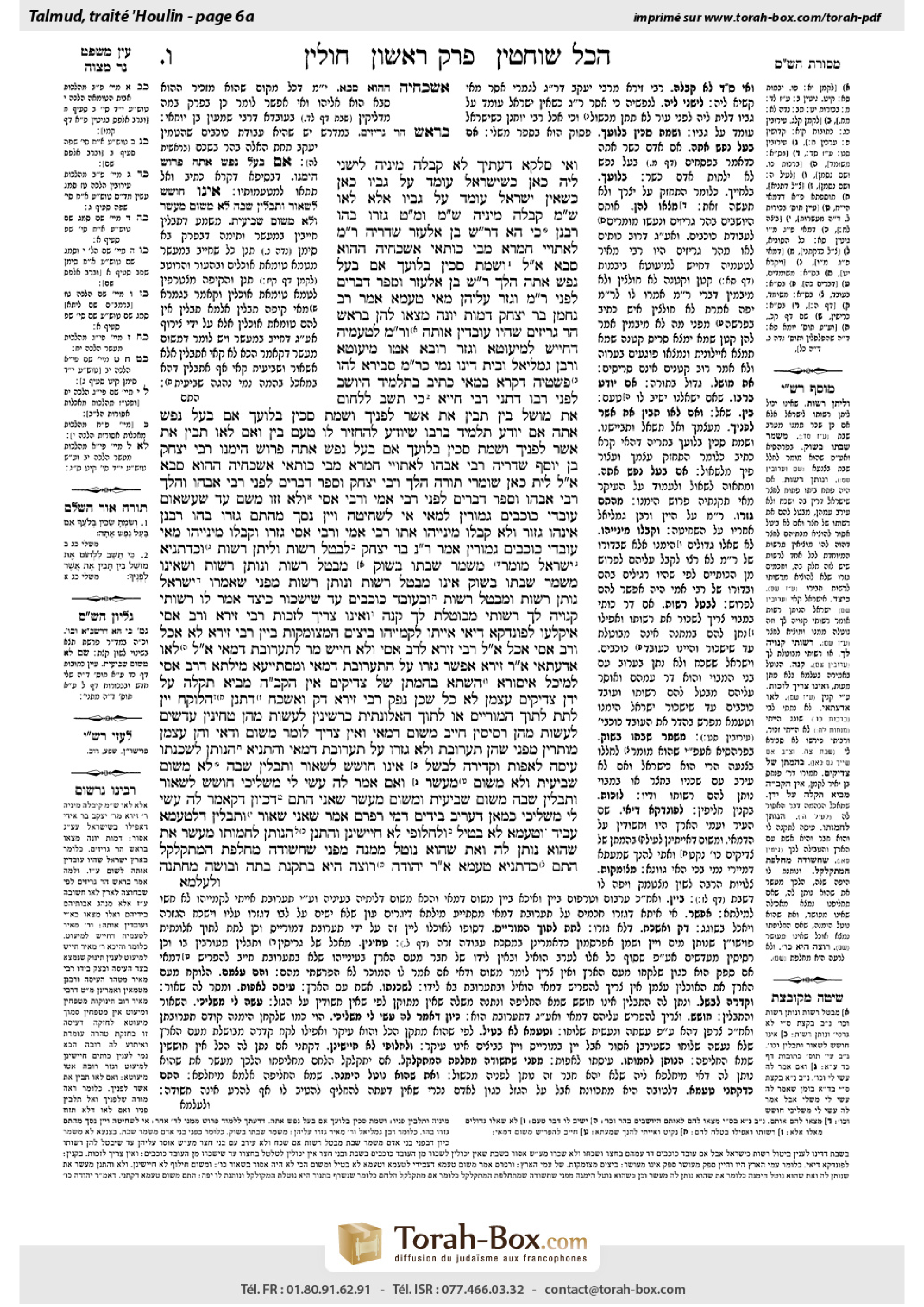
Chullin 6a: Talmud study for Daf Yomi
Study the Talmud for Daf Yomi with scanned pages, Hebrew text, English translations from Sefaria and AI-generated French translations.
Passage selection and English or AI-generated French translation are available where the scan has annotations. Daf Study is independent of Torah-Box and Sefaria.
Browse Chullin · חולין · All tractatesChullin 6a text and translations
This page of Chullin includes the Aramaic text, an English translation and an AI-generated French translation, alongside the scan above.
חולין ו׳ א · Aramaic and Hebrew text
וְאִי סָלְקָא דַּעְתָּיךְ לָא קַבְּלַהּ מִינֵּיהּ, לִישַׁנֵּי לֵיהּ: כָּאן כְּשֶׁיִּשְׂרָאֵל עוֹמֵד עַל גַּבָּיו, כָּאן כְּשֶׁאֵין יִשְׂרָאֵל עוֹמֵד עַל גַּבָּיו? אֶלָּא לָאו שְׁמַע מִינַּהּ קַבְּלַהּ מִינֵּיהּ, שְׁמַע מִינַּהּ.
וּמַאי טַעְמָא גְּזַרוּ בְּהוּ רַבָּנַן? כִּי הָא דְּרַבִּי שִׁמְעוֹן בֶּן אֶלְעָזָר, שַׁדְּרֵיהּ רַבִּי מֵאִיר לְאֵתוֹיֵי חַמְרָא מִבֵּי כוּתָאֵי, אַשְׁכְּחֵיהּ הָהוּא סָבָא, אֲמַר לֵיהּ: ״וְשַׂמְתָּ סַכִּין בְּלֹעֶךָ אִם בַּעַל נֶפֶשׁ אָתָּה״, הָלַךְ רַבִּי שִׁמְעוֹן בֶּן אֶלְעָזָר וְסִפֵּר דְּבָרִים לִפְנֵי רַבִּי מֵאִיר, וְגָזַר עֲלֵיהֶן.
מַאי טַעְמָא? אָמַר רַב נַחְמָן בַּר יִצְחָק: דְּמוּת יוֹנָה מָצְאוּ לָהֶן בְּרֹאשׁ הַר גְּרִיזִים, שֶׁהָיוּ עוֹבְדִין אוֹתָהּ. וְרַבִּי מֵאִיר לְטַעְמֵיהּ, דְּחָיֵישׁ לְמִיעוּטָא, וְגָזַר רוּבָּא אַטּוּ מִיעוּטָא. וְרַבָּן גַּמְלִיאֵל וּבֵית דִּינוֹ נָמֵי כְּרַבִּי מֵאִיר סְבִירָא לְהוּ.
פְּשָׁטֵיהּ דִּקְרָא בְּמַאי כְּתִיב? בְּתַלְמִיד הַיּוֹשֵׁב לִפְנֵי רַבּוֹ, דְּתָנֵי רַבִּי חִיָּיא: ״כִּי תֵשֵׁב לִלְחוֹם אֶת מוֹשֵׁל בִּין תָּבִין אֶת אֲשֶׁר לְפָנֶיךָ וְשַׂמְתָּ סַכִּין בְּלֹעֶךָ אִם בַּעַל נֶפֶשׁ אָתָּה״.
אִם יוֹדֵעַ תַּלְמִיד בְּרַבּוֹ שֶׁיּוֹדֵעַ לְהַחֲזִיר לוֹ טַעַם – ״בִּין״, וְאִם לָאו – ״תָּבִין אֶת אֲשֶׁר לְפָנֶיךָ וְשַׂמְתָּ סַכִּין בְּלֹעֶךָ״, ״אִם בַּעַל נֶפֶשׁ אָתָּה״ – פְּרוֹשׁ הֵימֶנּוּ.
רַבִּי יִצְחָק בֶּן יוֹסֵף שַׁדְּרֵיהּ רַבִּי אֲבָהוּ לְאֵתוֹיֵי חַמְרָא מִבֵּי כוּתָאֵי, אַשְׁכְּחֵיהּ הָהוּא סָבָא, אֲמַר לֵיהּ: לֵית כָּאן שׁוֹמְרֵי תוֹרָה. הָלַךְ רַבִּי יִצְחָק וְסִפֵּר דְּבָרִים לִפְנֵי רַבִּי אֲבָהוּ, וְהָלַךְ רַבִּי אֲבָהוּ וְסִפֵּר דְּבָרִים לִפְנֵי רַבִּי אַמֵּי וְרַבִּי אַסִּי, וְלֹא זָזוּ מִשָּׁם עַד שֶׁעֲשָׂאוּם גּוֹיִם גְּמוּרִין.
לְמַאי? אִי לִשְׁחִיטָה וְיֵין נֶסֶךְ, מֵהָתָם גְּזַרוּ בְּהוּ רַבָּנַן! אִינְהוּ גְּזוּר וְלָא קַבִּלוּ מִינַּיְיהוּ, אֲתוֹ רַבִּי אַמֵּי וְרַבִּי אַסִּי גְּזַרוּ וְקַבִּלוּ מִינַּיְיהוּ.
מַאי גּוֹיִם גְּמוּרִין? אָמַר רַב נַחְמָן בַּר יִצְחָק: לְבַטֵּל רְשׁוּת וְלִיתֵּן רְשׁוּת.
וְכִדְתַנְיָא: יִשְׂרָאֵל מְשׁוּמָּד מְשַׁמֵּר שַׁבַּתּוֹ בַּשּׁוּק, מְבַטֵּל רְשׁוּת וְנוֹתֵן רְשׁוּת, וְשֶׁאֵינוֹ מְשַׁמֵּר שַׁבַּתּוֹ בַּשּׁוּק, אֵינוֹ מְבַטֵּל רְשׁוּת וְנוֹתֵן רְשׁוּת.
מִפְּנֵי שֶׁאָמְרוּ: יִשְׂרָאֵל נוֹתֵן רְשׁוּת וּמְבַטֵּל רְשׁוּת, וּבְגוֹי עַד שֶׁיִּשְׂכּוֹר.
כֵּיצַד? אָמַר לוֹ: ״רְשׁוּתִי קְנוּיָה לָךְ״ ״רְשׁוּתִי מְבוּטֶּלֶת לָךְ״ – קָנָה, וְאֵינוֹ צָרִיךְ לִזְכּוֹת.
רַבִּי זֵירָא וְרַב אַסִּי אִיקְּלַעוּ לְפוּנְדְּקָא דְּיָאֵי, אַיְיתוֹ לְקַמַּיְיהוּ בֵּיצִים הַמְצוּמָּקוֹת בְּיַיִן. רַבִּי זֵירָא לָא אֲכַל, וְרַב אַסִּי אֲכַל. אֲמַר לֵיהּ רַבִּי זֵירָא לְרַב אַסִּי: וְלָא חָיֵישׁ מָר לְתַעֲרוֹבֶת דְּמַאי? אֲמַר לֵיהּ: לָאו אַדַּעְתַּאי.
אָמַר רַבִּי זֵירָא: אֶפְשָׁר גָּזְרוּ עַל הַתַּעֲרוֹבֶת דְּמַאי, וּמִסְתַּיְּיעָא מִילְּתָא דְּרַב אַסִּי לְמֵיכַל אִיסּוּרָא? הַשְׁתָּא בְּהֶמְתָּן שֶׁל צַדִּיקִים אֵין הַקָּדוֹשׁ בָּרוּךְ הוּא מֵבִיא תַּקָּלָה עַל יָדָן, צַדִּיקִים עַצְמָן לֹא כׇּל שֶׁכֵּן?
נְפַק רַבִּי זֵירָא דַּק וְאַשְׁכַּח, דִּתְנַן: הַלּוֹקֵחַ יַיִן לָתֵת לְתוֹךְ הַמּוּרְיָיס אוֹ לְתוֹךְ הָאֲלוּנְתִּית, כַּרְשִׁינִין לַעֲשׂוֹת מֵהֶן טְחִינִין, עֲדָשִׁים לַעֲשׂוֹת מֵהֶן רְסִיסִין – חַיָּיב מִשּׁוּם דְּמַאי, וְאֵין צָרִיךְ לוֹמַר מִשּׁוּם וַדַּאי.
וְהֵן עַצְמָן מוּתָּרִין, מִפְּנֵי שֶׁהֵן תַּעֲרוֹבֶת.
וְלֹא גָּזְרוּ עַל תַּעֲרוֹבֶת דְּמַאי? וְהָתַנְיָא: הַנּוֹתֵן לִשְׁכֶנְתּוֹ עִיסָּה לֶאֱפוֹת, וּקְדֵירָה לְבַשֵּׁל – אֵינוֹ חוֹשֵׁשׁ לִשְׂאוֹר וְתַבְלִין שֶׁבָּהּ, לֹא מִשּׁוּם שְׁבִיעִית וְלֹא מִשּׁוּם מַעֲשֵׂר.
וְאִם אָמַר לָהּ: ״עֲשִׂי לִי מִשֶּׁלִּיכִי״, חוֹשֵׁשׁ לִשְׂאוֹר וְתַבְלִין שֶׁבָּהּ מִשּׁוּם שְׁבִיעִית וּמִשּׁוּם מַעֲשֵׂר.
שָׁאנֵי הָתָם, דְּכֵיוָן דְּקָאָמַר לַהּ ״עֲשִׂי לִי מִשֶּׁלִּיכִי״, כְּמַאן דְּעָרֵיב בְּיָדַיִם דְּמֵי. רַפְרָם אָמַר: שָׁאנֵי שְׂאוֹר וְתַבְלִין, דִּלְטַעְמָא עֲבִיד, וְטַעְמָא לָא בָּטֵיל.
וּלְחַלּוֹפֵי לָא חָיְישִׁינַן? וְהָתְנַן: הַנּוֹתֵן לַחֲמוֹתוֹ – מְעַשֵּׂר אֵת שֶׁהוּא נוֹתֵן לָהּ וְאֵת שֶׁהוּא נוֹטֵל מִמֶּנָּה, מִפְּנֵי שֶׁחֲשׁוּדָהּ מַחְלֶפֶת הַמִּתְקַלְקֵל! הָתָם כִּדְתַנְיָא טַעְמָא, אָמַר רַבִּי יְהוּדָה: רוֹצֶה הִיא בְּתַקָּנַת בִּתָּהּ וּבוֹשָׁה מֵחֲתָנָהּ.
Chullin 6a · English translation
And if it enters your mind that Rabbi Zeira did not accept from Rabbi Ya’akov bar Idi that Rabban Gamliel prohibited eating from the slaughter of a Samaritan even when a Jew was standing over him, let Rabbi Zeira resolve the matter for himself in a different manner: Here, where Rabbi Yoḥanan ate from the slaughter of a Samaritan, it was when a Jew was standing over him; there, where Rabban Gamliel prohibited eating from the slaughter of a Samaritan, it was when a Jew was not standing over him. Rather, must one not conclude from it that Rabbi Zeira accepted the response from Rabbi Ya’akov bar Idi. The Gemara affirms: Indeed, learn this from it.
§ The Gemara asks: And what is the reason that the Sages, Rabban Gamliel and his court, issued a decree rendering it prohibited to eat from the slaughter of Samaritans? The Gemara answers: It is like that case involving Rabbi Shimon ben Elazar, in which Rabbi Meir dispatched him to bring wine from the area of the Samaritans. A certain elder found him and said to him: “And put a knife to your throat, if you are a man given to appetite” (Proverbs 23:2),as a warning to distance himself from them and not to drink their wine, because they were not reliable. Rabbi Shimon ben Elazar went and related those matters before Rabbi Meir, and Rabbi Meir issued a decree against them.
What is the reason that the Samaritans are deemed unreliable? Rav Naḥman bar Yitzḥak said: At the peak of Mount Gerizim they found the image of a dove, which the Samaritan residents of Mount Gerizim would worship; and Rabbi Meir issued the decree according to his line of reasoning that he takes the minority into consideration, and therefore, despite the fact that the majority of Samaritans did not live on Mount Gerizim, he issued a decree rendering meat slaughtered by the majority forbidden due to the minority that worshipped that idol. And Rabban Gamliel and his court also hold in accordance with the opinion of Rabbi Meir.
The Gemara asks: As to the plain meaning of that verse: “And put a knife to your throat, if you are a man given to appetite,” with regard to what matter is it written? The Gemara answers: It is written with regard to a student who is sitting before his teacher, as he must consider his words carefully. As Rabbi Ḥiyya teaches a baraita interpreting the verses: “When you sit to eat with a ruler, consider well [bin tavin] him that is before you; and put a knife to your throat, if you are a man given to appetite” (Proverbs 23:1–2).
The tanna explains the verse: If a student knows about his teacher that he knows to respond to him with a reasoned answer, seek wisdom [bin] from him. And if the student believes that the teacher is not capable of doing so, understand [tavin] who is sitting before you, and put a knife to your throat and refrain from embarrassing him with questions that he cannot answer. And if you are a man given to appetite and you seek an answer to your question, distance yourself from him.
Rabbi Abbahu dispatched Rabbi Yitzḥak ben Yosef to bring wine from the area of the Samaritans. A certain elder found him and said to him: The people here are not keepers of the Torah. Rabbi Yitzḥak went and related the matters before Rabbi Abbahu, and Rabbi Abbahu went and related the matters before Rabbi Ami and Rabbi Asi, and they did not move from there until they rendered the Samaritans full-fledged gentiles.
The Gemara asks: For what matters did those Sages render them full-fledged gentiles? If it was to prohibit eating from their slaughter and to render their wine as wine used for a libation in idol worship, these prohibitions were issued previously. From there, from the generations of Rabbi Meir and Rabban Gamliel, the Sages issued a decree prohibiting them. The Gemara answers: They issued a decree, and the people did not accept it from them. Rabbi Ami and Rabbi Asi came and issued a decree, and the people accepted it from them.
The Gemara asks: What is the meaning of full-fledged gentiles? Rav Naḥman bar Yitzḥak said: It means that the halakhic status of a Samaritan is like that of a gentile with regard to renouncing his domain in a jointly-owned courtyard on Shabbat and to transferring his domain in the courtyard to residents of that courtyard.
And this is as it is taught in a baraita: With regard to a Jewish transgressor who nevertheless observes his Shabbat in the marketplace, i.e., in public, if he failed to establish a joining of houses in a courtyard before Shabbat, his halakhic status is that of an observant Jew, and he may renounce his domain in the courtyard and transfer his domain in the courtyard. But a transgressor who does not observe his Shabbat in the marketplace may neither renounce his domain in the courtyard nor transfer his domain in the courtyard.
This is because the Sages said: Only a Jew may verbally transfer rights in his domain or renounce his rights in his domain, but with regard to a gentile, the other residents cannot establish a joining of courtyards unless the residents of the courtyard lease his domain from him. The halakhic status of one who publicly desecrates Shabbat is that of a gentile.
How does a Jew transfer or renounce his domain? If a Jew says to his neighbor: My domain is transferred to you or my domain is renounced to you, his neighbor has acquired his domain, and it is not necessary for him to grant it to his neighbor by means of one of the standard modes of acquisition.
§ The Gemara revisits the statement that the righteous would not experience mishaps. Rabbi Zeira and Rav Asi happened to come to the inn of the town of Ya’ei. In the inn, they brought before these Sages eggs that shriveled after being cooked in wine. Rabbi Zeira did not eat the eggs, and Rav Asi ate them. Rabbi Zeira said to Rav Asi: And is the Master not concerned about the possibility that the dish is a mixture containing wine that is doubtfully tithed produce [demai]? Rav Asi said to him: It did not enter my mind.
Rabbi Zeira said to himself: Is it possible that the Sages issued a decree on a mixture containing demai and the matter eventuated that Rav Asi ate forbidden food? Now, since even with regard to the animals of the righteous, the Holy One, Blessed be He, does not generate mishaps through them, is it not all the more so true that the righteous themselves would not experience mishaps?
Rabbi Zeira emerged, analyzed, and found that no mishap was generated through Rav Asi, as we learned in a baraita (Tosefta, Demai 1:24): In the case of one who purchases wine to place into fish gravy [hamorayes] or into aluntit, a beverage in which wine is mixed, or one who purchases vetch to prepare grist from it, or lentils to prepare groats from it, if it is uncertain whether what he purchased is tithed, e.g., he bought it from one who is unreliable with regard to tithes [am ha’aretz], one is obligated to tithe it, due to the fact that it is demai. And needless to say, if it is certain that what he purchased is not tithed, he is obligated to tithe it due to the fact that it is certain that it is untithed produce.
And they themselves, the gravy, aluntit, grist, and groats that one purchased from an am ha’aretz, are permitted, because they are a mixture. Since only one element of the mixture must be tithed, the food is permitted.
The Gemara asks: And is it so that the Sages did not issue a decree on a mixture containing demai? But isn’t it taught in a baraita: With regard to one who gives his neighbor, who is an am ha’aretz, dough to bake and gives her leaven for the dough to rise, or gives her a pot of food and the spices to cook in it, he need not be concerned about the leaven and the spices that are in the dough and the pot respectively, that perhaps she replaced them with her own, neither with regard to the possibility that they are Sabbatical Year produce nor with regard to the possibility that tithe was not separated.
And if he says to her: Prepare the dough or the food for me with your own leaven and spices, he must be concerned about the leaven and the spices that are in the dough and the pot respectively, with regard to the possibility that they are Sabbatical Year produce and with regard to the possibility that tithe was not separated, even though it is a mixture containing demai.
The Gemara answers: It is different there, as, since he said to her: Prepare the dough or the food for me from your own, it is like one who mixed it by direct action. Rafram said: Leaven and spices are different, as each of them is made for the purpose of adding taste to the mixture, and taste is not nullified in a mixture.
The Gemara asks: And are we not concerned about replacement of the ingredients that he gave his neighbor with her own? But didn’t we learn in a mishna (Demai 3:6): One who gives dough to his mother-in-law, who is suspect with regard to tithing, so that she will prepare it for him, must tithe everything that he gives her and everything that he takes back from her. This is because she is suspected of replacing an ingredient that spoils. The Gemara answers: There, the reason is like it is taught explicitly in that mishna, that Rabbi Yehuda said: The mother-in-law desires her daughter’s well-being and wants to ensure that she eats quality food, and is reticent to tell her son-in-law that she replaced the ingredients that spoiled.
Chullin 6a · Traduction française (IA)
Et si cela entre dans votre tête que le Rabbi Zeira n’a pas accepté de Rabbi Ya’akov bar Idi que Rabban Gamliel interdisait de manger de la viande sacrifiée par un Samaritain même lorsqu’un Juif était présent, faites résoudre la question par le Rabbi Zeira lui-même d’une autre manière : ici, où le Rabbi Yoḥanan a mangé de la viande sacrifiée par un Samaritain, c’était lorsqu’un Juif était présent ; là, où Rabban Gamliel interdisait de manger de la viande sacrifiée par un Samaritain, c’était lorsqu’un Juif n’était pas présent. Plutôt, ne devons-nous pas conclure que le Rabbi Zeira a accepté la réponse du Rabbi Ya’akov bar Idi ? La Guemara affirme : En effet, apprenez cela de cela.
§ La Guemara demande : Et quelle est la raison que les Sages, Rabban Gamliel et son tribunal, ont émis un décret interdisant de manger de la viande sacrifiée par des Samaritains ? La Guemara répond : C’est comme le cas du Rabbi Shimon ben Elazar, dans lequel le Rabbi Meir l’a envoyé chercher du vin dans la région des Samaritains. Un certain vieillard l’a trouvé et lui a dit : « Et posez un couteau sur votre gorge, si vous êtes un homme de faim » (Proverbes 23:2), comme avertissement pour le distancer et ne pas boire leur vin, car ils n’étaient pas fiables. Le Rabbi Shimon ben Elazar est allé rapporter ces choses au Rabbi Meir, et le Rabbi Meir a émis un décret contre eux.
Quelle est la raison que les Samaritains sont considérés comme peu fiables ? Rav Naḥman bar Yitzḥak a dit : Sur le sommet de Gerizim, ils ont trouvé l’image d’un pigeon, que les habitants samaritains de Gerizim adoraient ; et le Rabbi Meir a émis le décret selon sa ligne de raisonnement qui prend en compte la minorité, et donc, malgré le fait que la majorité des Samaritains ne vivait pas sur Gerizim, il a émis un décret interdisant la viande sacrifiée par la majorité en raison de la minorité qui adorait cet idole. Et Rabban Gamliel et son tribunal aussi tiennent compte de l’opinion du Rabbi Meir.
La Guemara demande : En ce qui concerne la signification littérale de cette verset : « Et posez un couteau sur votre gorge, si vous êtes un homme de faim », à quel sujet est-il écrit ? La Guemara répond : Il est écrit concernant un élève qui est assis devant son maître, car il doit considérer ses paroles avec soin. Comme Rabbi Ḥiyya enseigne une baraïta interprétant les versets : « Quand tu t’assieds pour manger avec un prince, considère bien [bin tavin] celui qui est devant toi ; et posez un couteau sur votre gorge, si vous êtes un homme de faim » (Proverbes 23:1–2).
Le tanna explique le verset : Si un élève sait que son maître sait répondre à ses questions avec une réponse raisonnée, cherche la sagesse [bin] auprès de lui. Et si l’élève croit que le maître n’est pas capable de le faire, comprend [tavin] celui qui est assis devant toi, et pose un couteau sur ta gorge et évite de le mettre en situation de questions qu’il ne peut répondre. Et si tu es un homme de faim et tu cherches une réponse à ta question, éloigne-toi de lui.
Le Rabbi Abbahu a envoyé le Rabbi Yitzḥak ben Yosef chercher du vin dans la région des Samaritains. Un certain vieillard l’a trouvé et lui a dit : Les gens ici ne sont pas gardiens de la Torah. Le Rabbi Yitzḥak est allé rapporter les choses au Rabbi Abbahu, et le Rabbi Abbahu est allé rapporter les choses au Rabbi Ami et au Rabbi Asi, et ils ne se sont pas éloignés de là jusqu’à ce qu’ils déclarent les Samaritains comme des gentils complets.
La Guemara demande : Pour quelles raisons ces Sages ont-ils rendu ces gens des gentils complets ? Si c’était pour interdire de manger de leur viande et de considérer leur vin comme du vin utilisé pour un sacrifice idolâtre, ces interdits avaient déjà été émis précédemment. D’où, depuis les générations du Rabbi Meir et de Rabban Gamliel, les Sages ont émis un décret interdisant cela. La Guemara répond : Ils ont émis un décret, mais le peuple ne l’a pas accepté d’eux. Le Rabbi Ami et le Rabbi Asi sont venus et ont émis un décret, et le peuple l’a accepté d’eux.
La Guemara demande : Quelle est la signification de gentils complets ? Rav Naḥman bar Yitzḥak a dit : Cela signifie que le statut halakhique d’un Samaritain est comme celui d’un gentil concernant la renonciation à son domaine dans un jardin partagé le sabbat et la transmission de son domaine dans le jardin aux habitants de ce jardin.
Et cela est enseigné dans une baraïta : Concernant un transgresseur juif qui observe néanmoins le sabbat en public, c’est-à-dire dans le marché, si celui-ci n’a pas établi la jonction des maisons dans un jardin avant le sabbat, son statut halakhique est celui d’un juif observant, et il peut renoncer à son domaine dans le jardin et transmettre son domaine dans le jardin. Mais un transgresseur qui ne respecte pas son sabbat en public ne peut ni renoncer à son domaine dans le jardin ni transmettre son domaine dans le jardin.
C’est parce que les Sages ont dit : Seul un Juif peut transmettre verbalement les droits sur son domaine ou renoncer à ses droits sur son domaine, mais concernant un gentil, les autres habitants ne peuvent établir la jonction des jardins à moins que les habitants du jardin ne lui louent son domaine. Le statut halakhique d’un qui profane le sabbat en public est celui d’un gentil.
Comment un Juif transmet-il ou renonce-t-il à son domaine ? Si un Juif dit à son voisin : Mon domaine est transféré à toi ou mon domaine est renoncé à toi, son voisin acquiert son domaine, et il n’est pas nécessaire qu’il le lui donne par l’un des modes standards d’acquisition.
§ La Guemara reprend la déclaration que les justes ne connaissent pas de malheurs. Rabbi Zeira et Rav Asi sont tombés par hasard dans l’auberge de la ville de Ya’ei. Dans l’auberge, ils ont présenté devant ces Sages des œufs qui avaient séché après avoir été cuits dans du vin. Rabbi Zeira n’a pas mangé les œufs, et Rav Asi les a mangés. Rabbi Zeira a dit à Rav Asi : Et le Maître n’est-il pas inquiet de la possibilité que le plat soit un mélange contenant du vin dont la titrée est douteuse [demai] ? Rav Asi a dit à lui : Ce n’est pas venu à mon esprit.
Rabbi Zeira se dit à lui-même : Est-il possible que les Sages aient émis un décret concernant un mélange contenant demai et que la chose ait abouti à ce que Rav Asi ait mangé de la nourriture interdite ? Maintenant, puisque même concernant les animaux des justes, le Saint, le Bienheureux, ne génère pas d'ennuis à travers eux, n'est-il pas encore plus vrai que les justes eux-mêmes ne connaîtraient pas d'ennuis ?
Rabbi Zeira sortit, analysa et trouva qu'aucun ennuis n'avait été généré concernant Rav Asi, comme nous l'avons appris dans une baraïta (Tosefta, Demai 1:24) : Dans le cas d'une personne qui achète du vin pour le mettre dans un bouillon de poisson [hamorayes] ou dans un aluntit, boisson dans laquelle du vin est mélangé, ou qui achète des vetches pour en faire du farine, ou des lentilles pour en faire des grogs, si on ne sait pas si ce qu'il a acheté est tithé, c'est-à-dire s'il l'a acheté chez une personne peu fiable concernant les tithes [am ha’aretz], on est tenu de le titrer, en raison du fait qu'il s'agit de demai. Et encore moins, si on sait avec certitude que ce qu'il a acheté n'est pas tithé, on est tenu de le titrer en raison du fait qu'il s'agit de produit non tithé.
Et ceux-là mêmes, le bouillon, l'aluntit, la farine et les grogs que l'on a achetés chez un am ha’aretz, sont permis, car ils sont un mélange. Puisque seul un élément du mélange doit être tithé, la nourriture est permise.
La Guemara demande : Et est-ce que les Sages n'ont pas émis un décret concernant un mélange contenant demai ? Mais n'est-il pas enseigné dans une baraïta : Concernant celui qui donne à son voisin, qui est un am ha’aretz, de la pâte à faire cuire et lui donne du levain pour que la pâte monte, ou qui lui donne un pot de nourriture et les épices pour cuire dedans, il n'a pas à craindre que le levain et les épices qui sont dans la pâte et le pot respectivement aient été remplacés par ceux de la voisin, ni concernant la possibilité qu'ils soient des produits de l'année sabbatique, ni concernant la possibilité que les tithes n'aient pas été séparées.
Et s'il dit à elle : Prépare la pâte ou la nourriture pour moi avec tes propres levains et épices, il faut craindre que les levains et les épices qui sont dans la pâte et le pot respectivement aient été remplacés par ceux de la voisin, concernant la possibilité qu'ils soient des produits de l'année sabbatique et concernant la possibilité que les tithes n'aient pas été séparées, même si c'est un mélange contenant demai.
La Guemara répond : C'est différent là, car, puisque il a dit à elle : Prépare la pâte ou la nourriture pour moi à partir de tes propres, c'est comme si l'on avait mélangé directement. Rafram dit : Le levain et les épices sont différents, car chacun d'eux est fait pour ajouter du goût au mélange, et le goût ne se perd pas dans un mélange.
La Guemara demande : Et ne sommes-nous pas préoccupés par le fait que les ingrédients qu'il a donnés à son voisin aient été remplacés par les siens ? Mais n'avons-nous pas appris dans une mitsva (Demai 3:6) : Celui qui donne de la pâte à sa belle-mère, qui est suspecte concernant les tithes, afin qu'elle le prépare pour lui, doit titrer tout ce qu'il lui donne et tout ce qu'il récupère de chez elle. C'est parce qu'elle est suspecte de remplacer un ingrédient qui se gâte. La Guemara répond : Là, la raison est comme celle qui est explicitement enseignée dans cette mitsva, que Rabbi Yehuda a dit : La belle-mère désire le bien-être de sa fille et veut s'assurer qu'elle mange de la nourriture de qualité, et est réticente à dire à son gendre qu'elle a remplacé les ingrédients qui se gâtent.
Traduction française générée par IA à partir de l’édition anglaise de Sefaria. Vérifie toujours un passage avec le texte source.
Text from Sefaria: William Davidson Edition - Vocalized Aramaic (unknown); William Davidson Edition - English (CC BY NC).