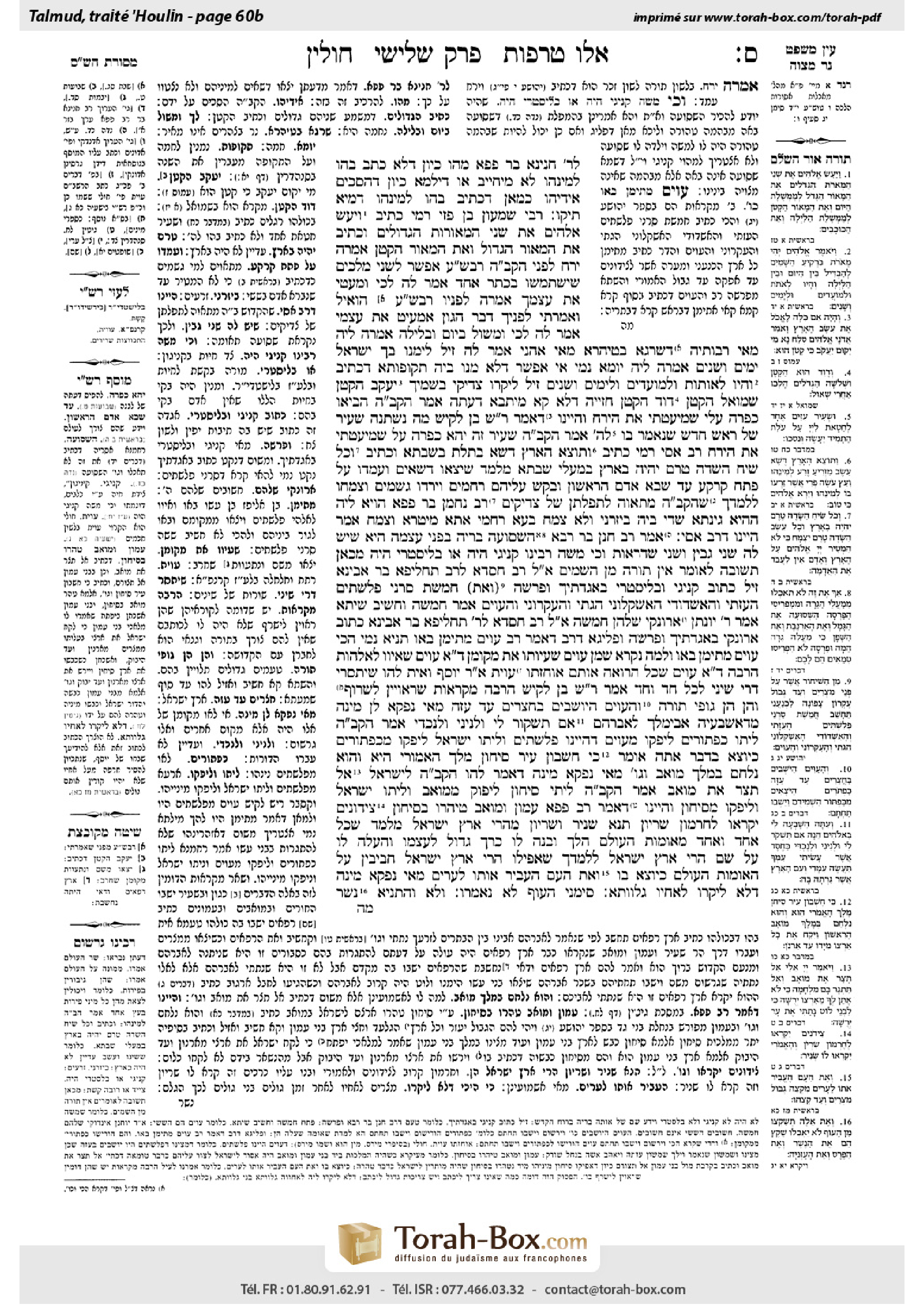
Chullin 60b: Talmud study for Daf Yomi
Study the Talmud for Daf Yomi with scanned pages, Hebrew text, English translations from Sefaria and AI-generated French translations.
Passage selection and English or AI-generated French translation are available where the scan has annotations. Daf Study is independent of Torah-Box and Sefaria.
Browse Chullin · חולין · All tractatesChullin 60b text and translations
This page of Chullin includes the Aramaic text, an English translation and an AI-generated French translation, alongside the scan above.
חולין ס׳ ב · Aramaic and Hebrew text
לְרַבִּי חֲנִינָא בַּר פָּפָּא מַהוּ? כֵּיוָן דְּלָא כְּתַב בְּהוּ ״לְמִינֵהוּ״ לָא מִיחַיַּיב, אוֹ דִילְמָא כֵּיוָן דְּהִסְכִּים אַיְּדַיְהוּ – כְּמַאן דִּכְתִיב בְּהוּ ״לְמִינֵהוּ״ דָּמְיָא? תֵּיקוּ.
רַבִּי שִׁמְעוֹן בֶּן פַּזִּי רָמֵי: כְּתִיב ״וַיַּעַשׂ אֱלֹהִים אֶת שְׁנֵי הַמְּאֹרֹת הַגְּדֹלִים״, וּכְתִיב ״אֶת הַמָּאוֹר הַגָּדוֹל וְאֶת הַמָּאוֹר הַקָּטֹן״. אָמְרָה יָרֵחַ לִפְנֵי הַקָּדוֹשׁ בָּרוּךְ הוּא: רִבּוֹנוֹ שֶׁל עוֹלָם, אֶפְשָׁר לִשְׁנֵי מְלָכִים שֶׁיִּשְׁתַּמְּשׁוּ בְּכֶתֶר אֶחָד? אָמַר לָהּ: לְכִי וּמַעֲטִי אֶת עַצְמֵךְ.
אָמְרָה לְפָנָיו: רִבּוֹנוֹ שֶׁל עוֹלָם, הוֹאִיל וְאָמַרְתִּי לְפָנֶיךָ דָּבָר הָגוּן, אַמְעִיט אֶת עַצְמִי?! אָמַר לָהּ: לְכִי וּמְשׁוֹל בַּיּוֹם וּבַלַּיְלָה. אֲמַרָה לֵיהּ: מַאי רְבוּתֵיהּ? דִּשְׁרָגָא בְּטִיהֲרָא מַאי אַהֲנִי? אֲמַר לַהּ: זִיל לִימְנוֹ בָּךְ יִשְׂרָאֵל יָמִים וְשָׁנִים. אָמְרָה לֵיהּ: יוֹמָא נָמֵי אִי אֶפְשָׁר דְּלָא מָנוּ בֵּיהּ תְּקוּפָתָא, דִּכְתִיב ״וְהָיוּ לְאֹתֹת וּלְמוֹעֲדִים וּלְיָמִים וְשָׁנִים״. זִיל לִיקְרוֹ צַדִּיקֵי בִּשְׁמִיךְ: ״יַעֲקֹב הַקָּטָן״, ״שְׁמוּאֵל הַקָּטָן״, ״דָּוִד הַקָּטָן״.
חַזְיַיהּ דְּלָא קָא מִיַּתְּבָא דַּעְתַּהּ, אָמַר הַקָּדוֹשׁ בָּרוּךְ הוּא: הָבִיאוּ כַּפָּרָה עָלַי שֶׁמִּיעַטְתִּי אֶת הַיָּרֵחַ! וְהַיְינוּ דְּאָמַר רַבִּי שִׁמְעוֹן בֶּן לָקִישׁ: מָה נִשְׁתַּנָּה שָׂעִיר שֶׁל רֹאשׁ חֹדֶשׁ שֶׁנֶּאֱמַר בּוֹ ״לַה׳״? אָמַר הַקָּדוֹשׁ בָּרוּךְ הוּא: שָׂעִיר זֶה יְהֵא כַּפָּרָה עַל שֶׁמִּיעַטְתִּי אֶת הַיָּרֵחַ.
רַב אַסִּי רָמֵי, כְּתִיב: ״וַתּוֹצֵא הָאָרֶץ דֶּשֶׁא״ (בתלת) [בִּתְלָתָא] בְּשַׁבָּא, וּכְתִיב: ״וְכׇל שִׂיחַ הַשָּׂדֶה טֶרֶם יִהְיֶה בָאָרֶץ״ בְּמַעֲלֵי שַׁבְּתָא, מְלַמֵּד שֶׁיָּצְאוּ דְּשָׁאִים וְעָמְדוּ עַל פֶּתַח קַרְקַע, עַד שֶׁבָּא אָדָם הָרִאשׁוֹן וּבִקֵּשׁ עֲלֵיהֶם רַחֲמִים, וְיָרְדוּ גְּשָׁמִים וְצָמְחוּ, לְלַמֶּדְךָ שֶׁהַקָּדוֹשׁ בָּרוּךְ הוּא מִתְאַוֶּה לִתְפִלָּתָן שֶׁל צַדִּיקִים.
רַב נַחְמָן בַּר פָּפָּא הַוְיָא לֵיהּ הָהִיא גִּינְּתָא, שְׁדִי בַּיהּ בִּיזְרָנֵי וְלָא צְמַח. בְּעָא רַחֲמֵי, אֲתָא מִיטְרָא וּצְמַח. אֲמַר: הַיְינוּ דְּרַב אַסִּי.
אָמַר רַב חָנָן בַּר רָבָא: ״הַשְּׁסוּעָה״ בְּרִיָּה בִּפְנֵי עַצְמָהּ הִיא, שֶׁיֵּשׁ לָהּ שְׁנֵי גַּבִּין וּשְׁנֵי שִׁדְרָאוֹת. וְכִי מֹשֶׁה רַבֵּינוּ קְנִיגִי הָיָה אוֹ בַּלִּיסְטָרִי הָיָה? מִכָּאן תְּשׁוּבָה לָאוֹמֵר אֵין תּוֹרָה מִן הַשָּׁמַיִם.
אֲמַר לֵיהּ רַב חִסְדָּא לְרַב תַּחְלִיפָא בַּר אֲבִינָא: זִיל כְּתוֹב ״קְנִיגִי וּבַלִּיסְטָרִי״ בְּאַגַּדְתָּיךְ, וּפָרְשַׁהּ.
״וְאֶת חֲמֵשֶׁת סַרְנֵי פְלִשְׁתִּים הָעַזָּתִי וְהָאַשְׁדּוֹדִי הָאֶשְׁקְלוֹנִי הַגִּתִּי וְהָעֶקְרוֹנִי וְהָעַוִּים״, אָמַר חַמְשָׁה וְחָשֵׁיב שִׁיתָּא! אָמַר רַבִּי יוֹנָתָן: אֲרוּנְקֵי שֶׁלָּהֶן חֲמִשָּׁה. אֲמַר לֵיהּ רַב חִסְדָּא לְרַב תַּחְלִיפָא בַּר אֲבִינָא: כְּתוֹב ״אֲרוּנְקֵי״ בְּאַגַּדְתָּיךְ וּפָרְשַׁהּ. וּפְלִיגָא דְּרַב, דְּאָמַר רַב: עַוִּים מִתֵּימָן בָּאוּ.
תַּנְיָא נָמֵי הָכִי: עַוִּים מִתֵּימָן בָּאוּ, וְלָמָּה נִקְרָא שְׁמָן עַוִּים? שֶׁעִיוְּתוּ אֶת מְקוֹמָן. דָּבָר אַחֵר: עַוִּים, שֶׁאִיוּוּ לֶאֱלֹהוֹת הַרְבֵּה. דָּבָר אַחֵר: עַוִּים, שֶׁכׇּל הָרוֹאֶה אוֹתָם אוֹחַזְתּוֹ עֲוִית. אָמַר רַב יוֹסֵף: וְאִית לְהוּ שִׁיתַּסְרֵי דָּרֵי שִׁינֵּי לְכׇל חַד וְחַד.
אָמַר רַבִּי שִׁמְעוֹן בֶּן לָקִישׁ: הַרְבֵּה מִקְרָאוֹת שֶׁרְאוּיִין לִשְׂרוֹף כְּסִפְרֵי מִינִין, וְהֵן הֵן גּוּפֵי תוֹרָה. ״וְהָעַוִּים הַיֹּשְׁבִים בַּחֲצֵרִים עַד עַזָּה״ – מַאי נָפְקָא לַן מִינַּהּ?
מִדְּאַשְׁבְּעֵיהּ אֲבִימֶלֶךְ לְאַבְרָהָם ״אִם תִּשְׁקֹר לִי וּלְנִינִי וּלְנֶכְדִּי״, אָמַר הַקָּדוֹשׁ בָּרוּךְ הוּא: לֵיתוֹ כַּפְתּוֹרִים לִיפְּקוּ מֵעַוִּים, דְּהַיְינוּ פְּלִשְׁתִּים, וְלֵיתוֹ יִשְׂרָאֵל לִיפְּקוּ מִכַּפְתּוֹרִים.
כְּיוֹצֵא בַּדָּבָר אַתָּה אוֹמֵר: ״כִּי חֶשְׁבּוֹן עִיר סִיחֹן מֶלֶךְ הָאֱמֹרִי הִוא וְהוּא נִלְחַם בְּמֶלֶךְ מוֹאָב וְגוֹ׳״. מַאי נָפְקָא מִינַּהּ? דַּאֲמַר לְהוּ הַקָּדוֹשׁ בָּרוּךְ הוּא לְיִשְׂרָאֵל: ״אַל תָּצַר אֶת מוֹאָב״. אָמַר הַקָּדוֹשׁ בָּרוּךְ הוּא: לֵיתֵי סִיחוֹן לִיפּוֹק מִמּוֹאָב, וְלֵיתוֹ יִשְׂרָאֵל וְלִיפְּקוּ מִסִּיחוֹן. וְהַיְינוּ דְּאָמַר רַב פָּפָּא: עַמּוֹן וּמוֹאָב טִיהֲרוּ בְּסִיחוֹן.
״צִידֹנִים יִקְרְאוּ לְחֶרְמוֹן שִׂרְיֹן״, תָּנָא: שְׂנִיר וְשִׂרְיוֹן מֵהָרֵי אֶרֶץ יִשְׂרָאֵל, מְלַמֵּד שֶׁכׇּל אֶחָד וְאֶחָד מֵאוּמוֹת הָעוֹלָם הָלַךְ וּבָנָה לוֹ כְּרַךְ גָּדוֹל לְעַצְמוֹ, וְהֶעֱלָה לוֹ עַל שֵׁם הָרֵי אֶרֶץ יִשְׂרָאֵל, לְלַמֶּדְךָ שֶׁאֲפִילּוּ הָרֵי אֶרֶץ יִשְׂרָאֵל חֲבִיבִין עַל אוּמוֹת הָעוֹלָם.
כַּיּוֹצֵא בּוֹ: ״וְאֶת הָעָם הֶעֱבִיר אֹתוֹ לֶעָרִים״, מַאי נָפְקָא מִינַּהּ? דְּלָא לִיקְרוֹ לְאֶחָיו גָּלְוָותָא.
סִימָנֵי הָעוֹף לֹא נֶאֶמְרוּ, וְלָא? וְהָתַנְיָא: ״נֶשֶׁר״,
Chullin 60b · English translation
what is the halakha according to Rabbi Ḥanina bar Pappa? Shall one say that since the phrase “after its kind” is not written as a mitzva with regard to them, one is not liable for transgressing the prohibition against mixing diverse kinds? Or perhaps, since God agreed with them after the fact, as the verse states: “Let the Lord rejoice in His works,” it is as if the mitzva “after its kind” is written with regard to them. The Gemara responds: The dilemma shall stand unresolved.
§ Rabbi Shimon ben Pazi raises a contradiction between two verses. It is written: “And God made the two great lights” (Genesis 1:16), and it is also written in the same verse: “The greater light to rule the day, and the lesser light to rule the night,” indicating that only one was great. Rabbi Shimon ben Pazi explains: When God first created the sun and the moon, they were equally bright. Then, the moon said before the Holy One, Blessed be He: Master of the Universe, is it possible for two kings to serve with one crown? One of us must be subservient to the other. God therefore said to her, i.e., the moon: If so, go and diminish yourself.
She said before Him: Master of the Universe, since I said a correct observation before You, must I diminish myself? God said to her: As compensation, go and rule both during the day along with the sun and during the night. She said to Him: What is the greatness of shining alongside the sun? What use is a candle in the middle of the day? God said to her: Go; let the Jewish people count the days and years with you, and this will be your greatness. She said to Him: But the Jewish people will count with the sun as well, as it is impossible that they will not count seasons with it, as it is written: “And let them be for signs, and for seasons, and for days and years” (Genesis 1:14). God said to her: Go; let righteous men be named after you. Just as you are called the lesser [hakatan] light, there will be Ya’akov HaKatan, i.e., Jacob our forefather (see Amos 7:2), Shmuel HaKatan the tanna, and David HaKatan, i.e., King David (see I Samuel 17:14).
God saw that the moon was not comforted. The Holy One, Blessed be He, said: Bring atonement for me, since I diminished the moon. The Gemara notes: And this is what Rabbi Shimon ben Lakish says: What is different about the goat offering of the New Moon, that it is stated with regard to it: “For the Lord” (Numbers 28:15)? The Holy One, Blessed be He, said: This goat shall be an atonement for Me for having diminished the size of the moon.
§ Rav Asi raises a contradiction between two verses. It is written: “And the earth brought forth grass” (Genesis 1:12), on the third day of the week of Creation. And it is also written: “No shrub of the field was yet in the earth” (Genesis 2:5), on Shabbat eve, the sixth day of Creation, immediately before Adam was created. Rav Asi explains: This teaches that the grasses emerged on the third day and stood at the opening of the ground, but they did not grow until Adam, the first man, came and prayed for mercy upon them, and rain came, and they sprouted. And this is meant to teach you that the Holy One, Blessed be He, desires the prayers of the righteous.
The Gemara recounts: Rav Naḥman bar Pappa had a certain garden. He planted seeds but they did not sprout. He prayed for mercy, and rain came, and they sprouted. He said: This is what is meant by the statement of Rav Asi, that the Holy One, Blessed be He, desires the prayers of the righteous.
§ In one of the passages discussing kosher and non-kosher animals, the Torah states: “Nevertheless, these you shall not eat of them that only chew the cud, or of them that have split hooves that are cloven [hashesua]: The camel, and the hare, and the hyrax” (Deuteronomy 14:7). Rav Ḥanan bar Rava said: “Hashesua” is not a redundant description of the split hooves but a distinct creature, which has two backs and two spines and therefore looks like an entirely cloven animal. One might ask: But was Moses our teacher a hunter, or was he an archer, who was familiar with the most exotic animals? Rather, from here there is a refutation to those who say that the Torah is not from Heaven, since Moses could not have known of the existence of such an animal save by divine revelation.
Rav Ḥisda said to Rav Taḥlifa bar Avina: Go write this statement about the hunter [kinnigi] and the archer [ballisteri] in your book of aggada, and explain those two words, since some are unfamiliar with them.
The Gemara relates another statement. The verse states: “The five lords of the Philistines: The Gazite, and the Ashdodite, the Ashkelonite, the Gittite, and the Ekronite; also the Avvim” (Joshua 13:3). The verse is difficult, since it first said there are five lords of the Philistines, but it then lists six. Rabbi Yonatan said: There were in fact six lords, but the greatest of them were only five. Rav Ḥisda said to Rav Taḥlifa bar Avina: Write this statement about the greatest [arunekei] in your book of aggada, and explain that word. The Gemara notes: And this statement disagrees with the opinion of Rav, as Rav says: The Avvim were not Philistines; rather, they came from Teiman.
This is also taught in a baraita: The Avvim came from Teiman. And why were they called Avvim and not Teimanim? Because they corrupted [ivvetu] and destroyed their place of origin when they left. Alternatively, they were called Avvim since they desired [ivvu] many deities. Alternatively, they were called Avvim since they were so fearsome that all who saw them were seized by convulsions [avit]. Rav Yosef said: And each one of them has sixteen rows of teeth.
The Gemara cites another statement related to the Avvim: Rabbi Shimon ben Lakish says: There are many verses that are seemingly fit to be burned as books of the heretics, since they appear redundant or frivolous, and yet they are themselves the essence of Torah. For example, the verse states: “And the Avvim, that dwelt in villages as far as Gaza, the Caphtorim, that came forth out of Caphtor, destroyed them, and dwelt in their stead” (Deuteronomy 2:23). What practical difference does this make for us?
The verse teaches the following: Since Abimelech, king of the Philistines, administered an oath to Abraham: “That you will not deal falsely with me, nor with my son, nor with my grandson” (Genesis 21:23), the Jewish people were prohibited from conquering the land of the Philistines until four generations had passed. Therefore, the Holy One, Blessed be He, said: Let the Caphtorim come and remove the land from the Avvim, who are the same as the Philistines, and let Israel come and remove it from the Caphtorim, circumventing the prohibition.
Similarly, you say with regard to another apparently unnecessary verse, describing a city that the Israelites conquered: “For Heshbon was the city of Sihon, the king of the Amorites, who had fought against the former king of Moab, and taken all his land out of his hand” (Numbers 21:26). What is the practical difference in knowing this information? It teaches that since the Holy One, Blessed be He, said to Israel: “Be not at enmity with Moab” (Deuteronomy 2:9), the Jewish people were prohibited from conquering the land of Moab. Therefore, the Holy One, Blessed be He, said: Let Sihon come and remove the land from Moab, and let Israel come and remove it from Sihon. The Gemara notes: And this is what Rav Pappa says: The lands of Ammon and Moab were purified by Sihon, i.e., rendered permitted for conquest.
The Gemara cites another seemingly superfluous verse, describing Mount Hermon: “Which Hermon the Sidonians call Sirion, and the Amorites call it Senir” (Deuteronomy 3:9). A Sage taught: Senir and Sirion are mountains of Eretz Yisrael. The verse teaches that every one of the nations of the world went and built itself a great city on Mount Hermon, and named it after one of the mountains of Eretz Yisrael, teaching you that even the mountains of Eretz Yisrael are beloved by the nations of the world.
Similarly, a difficult verse describes Joseph’s treatment of the Egyptians: “And as for the people, he removed them city by city” (Genesis 47:21). What is the practical difference of this information? It teaches Joseph’s love for his brothers, as he transferred the entire Egyptian population so that they would not call his brothers exiles.
§ The mishna states: The signs of the kosher bird were not explicitly stated in the Torah. The Gemara asks: And is it true that they were not stated in the Torah? But isn’t it taught in a baraita: “The nesher” (Leviticus 11:13) is a non-kosher bird.
Chullin 60b · Traduction française (IA)
Quel est la halakha selon Rabbi Ḥanina bar Pappa ? Faut-il dire que puisque la formule « selon son espèce » n'est pas écrite comme une mitsva concernant eux, on n'est pas tenu responsable de transgresser l'interdiction de mélanger des espèces différentes ? Ou bien, puisque Dieu a accepté leur accord après coup, comme le dit la parole : « Que l'Éternel se réjouisse de ses œuvres », cela équivaut à ce que la mitsva « selon son espèce » soit écrite concernant eux. La Guemara répond : ce dilemme restera sans solution.
§ Rabbi Shimon ben Pazi soulève une contradiction entre deux versets. Il est écrit : « Et Dieu fit les deux grands lumières » (Genèse 1:16), et il est également écrit dans le même verset : « La lumière grande pour dominer le jour, et la lumière petite pour dominer la nuit », indiquant que seul l'un était grand. Rabbi Shimon ben Pazi explique : lorsque Dieu a créé d'abord le soleil et la lune, ils étaient également brillants. Puis, la lune s'est adressée au Saint des Saints : Maître du Monde, est-il possible que deux rois servent avec une seule couronne ? L'un d'entre nous doit être soumis à l'autre. Dieu a donc dit à elle, c'est-à-dire à la lune : Si c'est ainsi, va et diminue-toi.
Elle s'est adressée à Lui : Maître du Monde, puisque j'ai dit une observation correcte devant Toi, dois-je me diminuer ? Dieu a dit à elle : En compensation, va et domine à la fois pendant le jour avec le soleil et pendant la nuit. Elle a dit à Lui : Quelle est la grandeur de briller à côté du soleil ? Quel usage est une bougie au milieu du jour ? Dieu a dit à elle : Va ; que le peuple juif compte les jours et les années avec toi, et cela sera ta grandeur. Elle a dit à Lui : Mais le peuple juif comptera aussi avec le soleil, car il est impossible qu'ils ne comptent pas les saisons avec lui, comme il est écrit : « Et qu'ils soient des signes, et des saisons, et des jours et des années » (Genèse 1:14). Dieu a dit à elle : Va ; que des justes soient nommés après toi. Comme tu es appelée la lumière petite [hakatan], il y aura Ya’akov HaKatan, c'est-à-dire Jacob notre patriarche (voir Amos 7:2), Shmuel HaKatan le tanna, et David HaKatan, c'est-à-dire le roi David (voir I Samuel 17:14).
Dieu a vu que la lune n'était pas rassurée. Le Saint, le Bienheureux, a dit : Apporte-moi une atonement, car j'ai diminué la lune. La Guemara note : Et c'est ce que dit Rabbi Shimon ben Lakish : Qu'est-ce qui est différent dans l'offrande de l'agneau du Nouvel Mois, que cela est dit à son sujet : « Pour l'Éternel » (Nombres 28:15) ? Le Saint, le Bienheureux, a dit : Cet agneau sera une atonement pour Moi pour avoir diminué la taille de la lune.
§ Rav Asi soulève une contradiction entre deux versets. Il est écrit : « Et la terre produisit de l'herbe » (Genèse 1:12), le troisième jour de la semaine de la Création. Et il est également écrit : « Aucun arbrisseau du champ n'était encore sur la terre » (Genèse 2:5), la veille du Shabbat, le sixième jour de la Création, immédiatement avant que l'homme ne soit créé. Rav Asi explique : cela enseigne que les herbes sont apparues le troisième jour et se tenaient à l'ouverture de la terre, mais elles n'ont pas grandi jusqu'à ce que l'homme, le premier homme, vienne prier pour leur miséricorde, et la pluie vint, et elles poussèrent. Et cela est destiné à t'enseigner que le Saint, le Bienheureux, désire les prières des justes.
La Guemara rapporte : Rav Naḥman bar Pappa avait un certain jardin. Il a planté des graines mais elles n'ont pas germé. Il a prié pour la miséricorde, et la pluie est venue, et elles ont germé. Il a dit : C'est ce que signifie la déclaration de Rav Asi, que le Saint, le Bienheureux, désire les prières des justes.
§ Dans l'un des passages discutant des animaux kasher et non kasher, la Torah dit : « Cependant, vous ne mangerez pas de ceux qui ruminent ou de ceux qui ont des pieds cloisonnés [hashesua] : le chameau, le lapin, et le hyrax » (Deutéronome 14:7). Rav Ḥanan bar Rava a dit : « Hashesua » n'est pas une description redondante des pieds cloisonnés mais un animal distinct, qui a deux dos et deux vertèbres et donc ressemble à un animal entièrement cloisonné. On pourrait demander : Mais était Moses notre maître un chasseur, ou était-il un archer, qui connaissait les animaux les plus exotiques ? Plutôt, d'ici il y a une réfutation à ceux qui disent que la Torah ne vient pas du Ciel, car Moses ne pouvait pas connaître l'existence de cet animal sans révélation divine.
Rav Ḥisda a dit à Rav Taḥlifa bar Avina : Écris cette déclaration concernant le chasseur [kinnigi] et l'archer [ballisteri] dans ton livre d'aggada, et explique ces deux mots, car certains ne les connaissent pas.
La Guemara rapporte une autre déclaration. Le verset dit : « Les cinq seigneurs des Philistins : le Gazite, et l'Ashdodite, l'Ashkélonite, le Gittite, et l'Ekronite ; aussi les Avvim » (Josué 13:3). Le verset est difficile, car il dit d'abord qu'il y a cinq seigneurs des Philistins, mais il liste ensuite six. Rabbi Yonatan a dit : Il y avait en effet six seigneurs, mais les plus grands d'entre eux étaient seulement cinq. Rav Ḥisda a dit à Rav Taḥlifa bar Avina : Écris cette déclaration concernant les plus grands [arunekei] dans ton livre d'aggada, et explique ce mot. La Guemara note : Et cette déclaration contredit l'opinion de Rav, car Rav dit : Les Avvim n'étaient pas des Philistins ; plutôt, ils venaient de Téiman.
Cela est également enseigné dans une baraïta : Les Avvim venaient de Téiman. Et pourquoi étaient-ils appelés Avvim et non Téimanim ? Parce qu'ils ont corrompu [ivvetu] et détruit leur lieu d'origine lorsqu'ils sont partis. Alternativement, ils étaient appelés Avvim parce qu'ils désiraient [ivvu] de nombreux dieux. Alternativement, ils étaient appelés Avvim parce qu'ils étaient si redoutables que tous ceux qui les voyaient étaient pris de convulsions [avit]. Rav Yosef a dit : Et chacun d'eux a seize rangées de dents.
La Guemara cite une autre déclaration concernant les Avvim : Rabbi Shimon ben Lakish dit : Il y a beaucoup de versets qui semblent adaptés à être brûlés comme des livres des hérétiques, car ils paraissent redondants ou frivoles, et pourtant ils sont eux-mêmes l'essence de la Torah. Par exemple, le verset dit : « Et les Avvim, qui habitaient dans les villages jusqu'à Gaza, les Caphtorim, qui sont sortis de Caphtor, les ont détruits, et ils ont habité à leur place » (Deutéronome 2:23). Quelle différence pratique cela fait-il pour nous ?
La parabole enseigne ce qui suit : puisque Abimelech, roi des Philistins, avait prêté serment à Abraham : « Que tu ne trompes pas moi, ni mon fils, ni mon petit-fils » (Genèse 21:23), le peuple juif était interdit de conquérir la terre des Philistins jusqu'à ce que quatre générations aient passé. Ainsi, le Saint, le Très Haut, a dit : Fais venir les Caphtorim et qu'ils enlèvent la terre des Avvim, qui sont les mêmes que les Philistins, et fais venir Israël et qu'il enlève la terre des Caphtorim, contournant ainsi l'interdiction.
De même, vous dites concernant une autre parabole qui semble inutile, décrivant une ville que les Israélites avaient conquise : « Heshbon était la ville de Sihon, roi des Amoréens, qui avait combattu contre le roi précédent de Moab et avait pris toute sa terre de ses mains » (Nombres 21:26). Quel est le sens pratique de cette information ? Elle enseigne que puisque le Saint, le Très Haut, avait dit à Israël : « Soyez en paix avec Moab » (Deutéronome 2:9), le peuple juif était interdit de conquérir la terre de Moab. Ainsi, le Saint, le Très Haut, a dit : Fais venir Sihon et qu'il enlève la terre de Moab, et fais venir Israël et qu'il enlève la terre de Sihon. La Guemara note : et c'est ce que dit Rav Pappa : les terres d'Ammon et de Moab ont été purifiées par Sihon, c'est-à-dire rendues permises à la conquête.
La Guemara cite une autre parabole qui semble superflue, décrivant le mont Hermon : « Qui est appelé Sirion par les Sidoniens, et Senir par les Amoréens » (Deutéronome 3:9). Un Sage a enseigné : Senir et Sirion sont des montagnes de la Terre d'Israël. La parabole enseigne que chaque nation du monde a construit une grande ville sur le mont Hermon et l'a nommée d'après l'une des montagnes de la Terre d'Israël, enseignant ainsi que même les montagnes de la Terre d'Israël sont chères aux nations du monde.
De même, un verset difficile décrit le traitement de Joseph envers les Égyptiens : « Et quant au peuple, il les éloigna ville par ville » (Genèse 47:21). Quel est le sens pratique de cette information ? Elle enseigne l'amour de Joseph pour ses frères, car il a transféré toute la population égyptienne afin qu'ils ne désignent pas ses frères comme des exilés.
§ La mitsva dit : les signes des oiseaux kasher n'étaient pas explicitement mentionnés dans la Torah. La Guemara demande : Et est-ce vrai que ces signes n'étaient pas mentionnés dans la Torah ? Mais n'est-il pas enseigné dans une baraïta : « Le nesher » (Lévitique 11:13) est un oiseau non kasher.
Traduction française générée par IA à partir de l’édition anglaise de Sefaria. Vérifie toujours un passage avec le texte source.
Text from Sefaria: William Davidson Edition - Vocalized Aramaic (unknown); William Davidson Edition - English (CC BY NC).