Chullin 61a: Talmud study for Daf Yomi
Study the Talmud for Daf Yomi with scanned pages, Hebrew text, English translations from Sefaria and AI-generated French translations.
Passage selection and English or AI-generated French translation are available where the scan has annotations. Daf Study is independent of Torah-Box and Sefaria.
Browse Chullin · חולין · All tractatesChullin 61a text and translations
This page of Chullin includes the Aramaic text, an English translation and an AI-generated French translation, alongside the scan above.
חולין ס״א א · Aramaic and Hebrew text
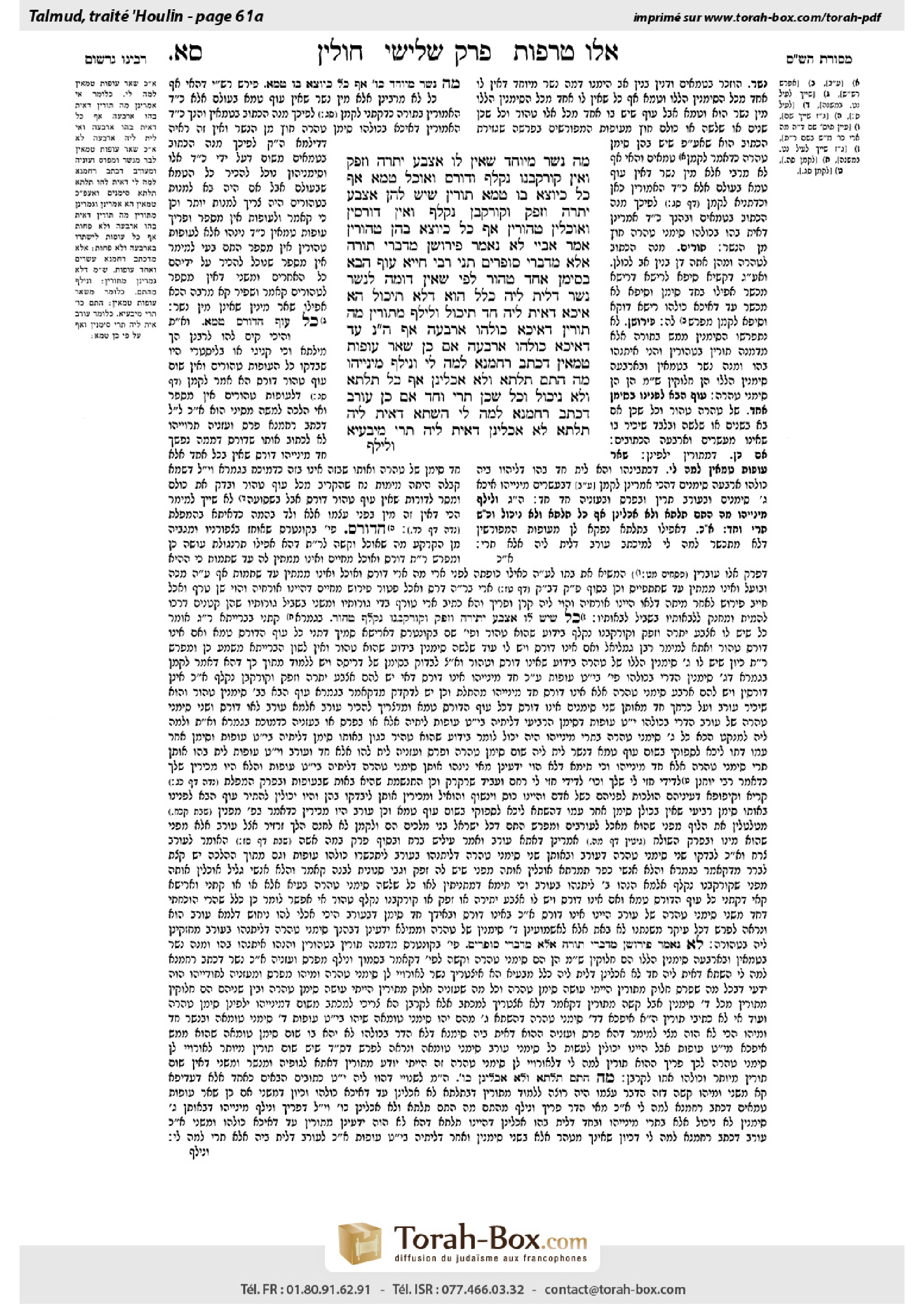
מָה נֶשֶׁר מְיוּחָד שֶׁאֵין לוֹ אֶצְבַּע יְתֵרָה וְזֶפֶק וְאֵין קוּרְקְבָנוֹ נִקְלָף וְדוֹרֵס וְאוֹכֵל – טָמֵא, אַף כׇּל כַּיּוֹצֵא בּוֹ – טָמֵא. תּוֹרִין שֶׁיֵּשׁ לָהֶן אֶצְבַּע יְתֵרָה וְזֶפֶק וְקוּרְקְבָן נִקְלָף וְאֵין דּוֹרְסִין וְאוֹכְלִין – טְהוֹרִין, אַף כׇּל כַּיּוֹצֵא בָּהֶן – טְהוֹרִין. אָמַר אַבָּיֵי: לֹא נֶאֱמַר פֵּירוּשָׁן מִדִּבְרֵי תוֹרָה אֶלָּא מִדִּבְרֵי סוֹפְרִים.
תָּנֵי רַבִּי חִיָּיא: עוֹף הַבָּא בְּסִימָן אֶחָד טָהוֹר, לְפִי שֶׁאֵין דּוֹמֶה לְנֶשֶׁר. נֶשֶׁר דְּלֵית לֵיהּ כְּלָל – הוּא דְּלָא תֵּיכוֹל, הָא אִיכָּא דְּאִית לֵיהּ חַד – תֵּיכוֹל.
וְלֵילַף מִתּוֹרִין: מָה תּוֹרִין דְּאִיכָּא כּוּלְּהוּ אַרְבְּעָה, אַף הָכָא נָמֵי עַד דְּאִיכָּא כּוּלְּהוּ אַרְבְּעָה?
אִם כֵּן, שְׁאָר עוֹפוֹת טְמֵאִין דִּכְתַב רַחֲמָנָא לְמָה לִי?
וְנֵילַף מִינַּיְיהוּ: מָה הָתָם תְּלָתָא וְלָא אָכְלִינַן, אַף כֹּל תְּלָתָא וְלָא נֵיכוֹל, וְכׇל שֶׁכֵּן תְּרֵי וְחַד?
אִם כֵּן, עוֹרֵב, דִּכְתַב רַחֲמָנָא, לְמָה לִי? הַשְׁתָּא דְּאִית לֵיהּ תְּלָתָא לָא אָכְלִינַן, דְּאִית לֵיהּ תְּרֵי מִיבַּעְיָא?
Chullin 61a · English translation
Just as a nesher is unique in that it has no extra digit or crop, and its gizzard cannot be peeled, and it claws its prey and eats it, and it is non-kosher, so too, all like birds with these four signs are non-kosher. And just as doves and pigeons, which have an extra digit and a crop, and whose gizzard can be peeled, and do not claw their food and eat it, are kosher, as they are fit for sacrifice on the altar (see Leviticus 1:14), so too, all like birds with these four signs are kosher. If so, why does the mishna state that the signs were not stated in the Torah? Abaye said: The mishna means that the explanation of the signs of a kosher bird was not stated in the Torah. Rather, one learns it from the statements of the Sages, i.e., the baraita.
Rabbi Ḥiyya teaches: A bird that comes before a person with one sign of a kosher bird, and which is not listed in the Torah as non-kosher, is kosher, since it is unlike a nesher. The verse did not need to state that the nesher is non-kosher, since one could have inferred this from the list of other non-kosher birds. Rather, the verse mentions the nesher specifically to indicate that it is only a bird like a nesher, which has none of the signs of a kosher bird, that you shall not eat. But if there is a bird that has even one of the signs, you may eat it.
The Gemara asks: But why learn specifically from the case of a nesher? Let one derive the opposite from the case of doves: Just as doves, which the Torah mentions explicitly as kosher, have all four signs, so too here, no other bird is kosher unless it has all four signs.
The Gemara responds: If it is so that one learns from the case of a dove, why do I need the rest of the non-kosher birds that the Merciful One wrote? Since none of them has all four signs of a kosher bird, their non-kosher status could simply be inferred from the case of a dove. Rather, since the Torah states explicitly that they are non-kosher, it follows that one does not learn from the case of a dove.
The Gemara objects: But let us derive instead from them, i.e., the rest of the non-kosher birds, which each have only three signs, the following: Just as there, those birds have three of the signs of a kosher bird mentioned in the mishna, and we still do not eat them, so too, all other birds that have three signs should have the same halakhic status, and we will not eat them. And all the more so should this apply to a bird that has only two signs or one.
The Gemara responds: If so, why do I need the crow that the Merciful One wrote among the non-kosher birds? Now that it is established that we do not eat any bird that has three signs, is it necessary to mention the crow, which has only two? Rather, those birds explicitly listed as non-kosher are prohibited, and all other birds with any number of signs are kosher.
Chullin 61a · Traduction française (IA)
Comme le nesher est unique dans le fait qu'il n'a pas de doigt supplémentaire ni de crop, et que son gourdin ne peut être déplumé, et qu'il déchire sa proie et la mange, et qu'il est non-kosher, de même, tous les oiseaux ayant ces quatre signes sont non-kosher. Et comme les colombes et les pigeons, qui ont un doigt supplémentaire et un crop, et dont le gourdin peut être déplumé, et qui ne déchirent pas leur nourriture et ne la mangent pas, sont kosher, car ils sont propres à l'offrande sur l'autel (cf. Lévitique 1:14), de même, tous les oiseaux ayant ces quatre signes sont kosher. Si c'est ainsi, pourquoi la Michna dit-elle que les signes n'étaient pas mentionnés dans la Torah ? Abaye dit : La Michna signifie que l'explication des signes d'un oiseau kosher n'était pas mentionnée dans la Torah. Plutôt, on l'apprend à partir des paroles des Sages, c'est-à-dire de la baraïta.
Rabbi Ḥiyya enseigne : Un oiseau qui vient devant une personne avec un seul signe d'un oiseau kosher, et qui n'est pas mentionné dans la Torah comme non-kosher, est kosher, car il est différent du nesher. La parole n'avait pas besoin de préciser que le nesher est non-kosher, car on pouvait en déduire cela à partir de la liste des autres oiseaux non-kosher. Plutôt, la parole mentionne spécifiquement le nesher pour indiquer qu'il s'agit d'un oiseau semblable au nesher, qui n'a aucun des signes d'un oiseau kosher, que l'on ne doit pas manger. Mais si un oiseau a même un seul de ces signes, on peut le manger.
La Guemara pose la question : Mais pourquoi apprendre spécifiquement du cas du nesher ? Laissons-nous apprendre l'inverse du cas des colombes : Comme les colombes, qui sont explicitement mentionnées dans la Torah comme kosher, ont tous les quatre signes, de même ici, aucun autre oiseau n'est kosher à moins d'avoir tous les quatre signes.
La Guemara répond : Si c'est ainsi que l'on apprend du cas des colombes, pourquoi ai-je besoin des autres oiseaux non-kosher mentionnés par le Merciueux ? Puisque aucun d'eux n'a tous les quatre signes d'un oiseau kosher, leur statut de non-kosher pourrait simplement être déduit du cas des colombes. Plutôt, puisque la Torah précise explicitement qu'ils sont non-kosher, il en découle que l'on ne peut pas apprendre du cas des colombes.
La Guemara s'oppose : Mais apprenons plutôt d'eux, c'est-à-dire des autres oiseaux non-kosher, qui ont chacun trois signes : Comme là-bas, ces oiseaux ont trois des signes d'un oiseau kosher mentionnés dans la Michna, et nous ne les mangeons pas, de même, tous les autres oiseaux ayant trois signes devraient avoir le même statut halakhique, et nous ne les mangeons pas. Et encore plus encore devrait cela s'appliquer à un oiseau ayant seulement deux signes ou un seul.
La Guemara répond : Si c'est ainsi, pourquoi ai-je besoin du corbeau mentionné par le Merciueux parmi les oiseaux non-kosher ? Maintenant que cela est établi que nous ne mangeons aucun oiseau ayant trois signes, est-il nécessaire de mentionner le corbeau, qui en a seulement deux ? Plutôt, ces oiseaux explicitement mentionnés comme non-kosher sont interdits, et tous les autres oiseaux ayant un nombre quelconque de signes sont kosher.
Traduction française générée par IA à partir de l’édition anglaise de Sefaria. Vérifie toujours un passage avec le texte source.
Text from Sefaria: William Davidson Edition - Vocalized Aramaic (unknown); William Davidson Edition - English (CC BY NC).