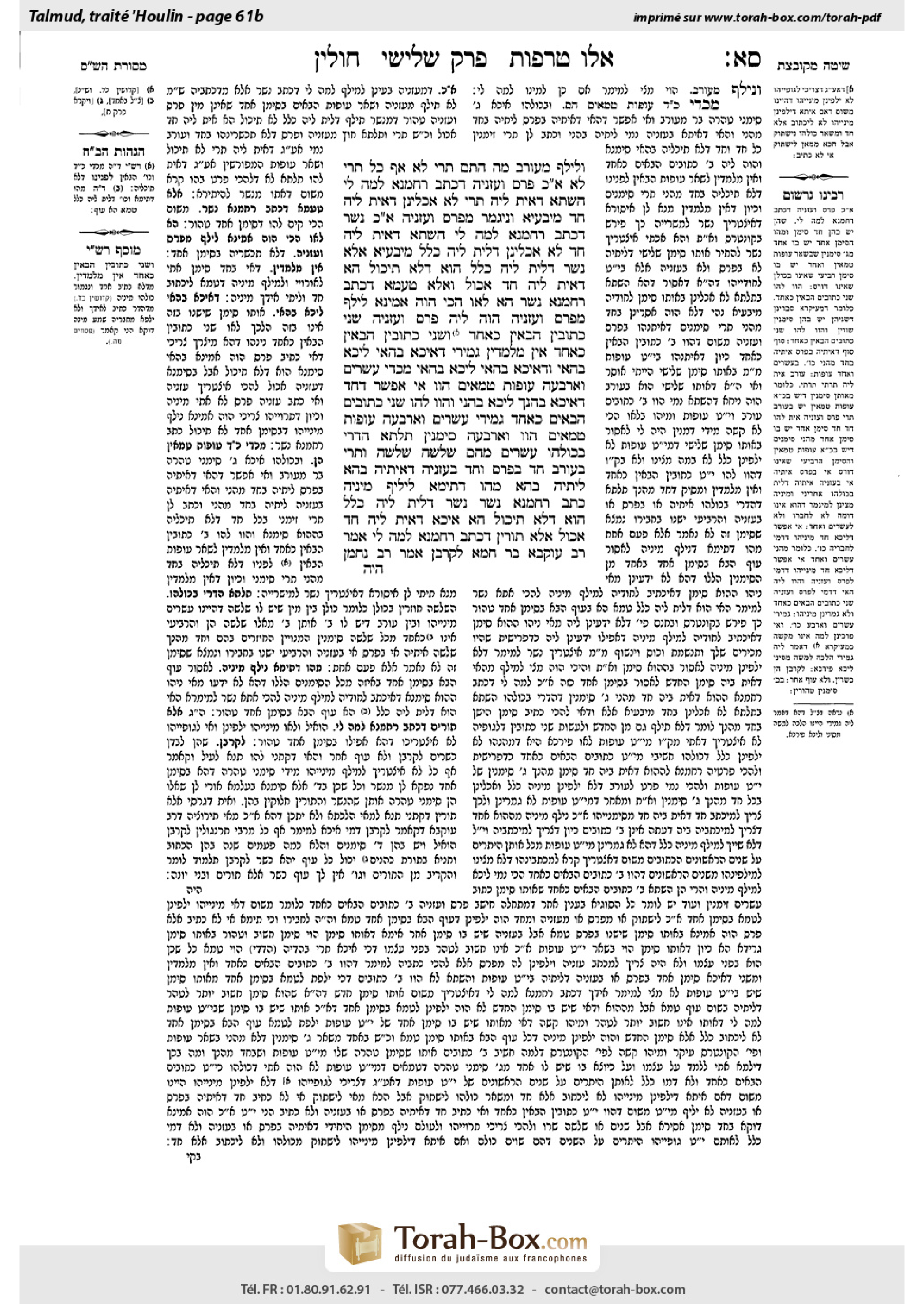
Chullin 61b: Talmud study for Daf Yomi
Study the Talmud for Daf Yomi with scanned pages, Hebrew text, English translations from Sefaria and AI-generated French translations.
Passage selection and English or AI-generated French translation are available where the scan has annotations. Daf Study is independent of Torah-Box and Sefaria.
Browse Chullin · חולין · All tractatesChullin 61b text and translations
This page of Chullin includes the Aramaic text, an English translation and an AI-generated French translation, alongside the scan above.
חולין ס״א ב · Aramaic and Hebrew text
וְלֵילַף מֵעוֹרֵב: מָה הָתָם תְּרֵי לָא, אַף כֹּל תְּרֵי לָא? אִם כֵּן, פֶּרֶס וְעׇזְנִיָּה דִּכְתַב רַחֲמָנָא לְמָה לִי? הַשְׁתָּא דְּאִית לֵיהּ תְּרֵי לָא אָכְלִינַן, דְּאִית לֵיהּ חַד מִיבַּעְיָא!
וְנִיגְמַר מִפֶּרֶס וְעׇזְנִיָּה? אִם כֵּן, נֶשֶׁר דִּכְתַב רַחֲמָנָא לְמָה לִי? הַשְׁתָּא דְּאִית לֵיהּ חַד לָא אָכְלִינַן, דְּלֵית לֵיהּ כְּלָל מִיבַּעְיָא! אֶלָּא נֶשֶׁר דְּלֵית לֵיהּ כְּלָל – הוּא דְּלָא תֵּיכוֹל, הָא דְּאִית לֵיהּ חַד – אֱכוֹל.
וְאֶלָּא, טַעְמָא דִּכְתַב רַחֲמָנָא נֶשֶׁר, הָא לָאו הָכִי הֲוָה אָמֵינָא: לֵילַף מִפֶּרֶס וְעׇזְנִיָּה? הָוֵה לֵיהּ פֶּרֶס וְעׇזְנִיָּה שְׁנֵי כְתוּבִין הַבָּאִין כְּאֶחָד, וּשְׁנֵי כְּתוּבִין הַבָּאִין כְּאֶחָד אֵין מְלַמְּדִין.
גְּמִירִי, דְּאִיכָּא בְּהַאי לֵיכָּא בְּהַאי, וּדְאִיכָּא בְּהַאי לֵיכָּא בְּהַאי.
מִכְּדֵי עֶשְׂרִים וְאַרְבָּעָה עוֹפוֹת טְמֵאִים הָווּ, אִי אֶפְשָׁר דְּחַד דְּאִיכָּא בְּהָנָךְ לֵיכָּא בְּהָנֵי, וְהָווּ לְהוּ שְׁנֵי כְּתוּבִים הַבָּאִים כְּאֶחָד.
גְּמִירִי: עֶשְׂרִים וְאַרְבָּעָה עוֹפוֹת טְמֵאִים הָווּ, וְאַרְבָּעָה סִימָנִין. תְּלָתָא הָדְרִי בְּכוּלְּהוּ, עֶשְׂרִים מֵהֶם שְׁלֹשָׁה שְׁלֹשָׁה, וּתְרֵי בְּעוֹרֵב, חַד בְּפֶרֶס וְחַד בְּעׇזְנִיָּה, דְּאִיתֵיהּ בְּהָא לֵיתֵיהּ בְּהָא. מַהוּ דְּתֵימָא לֵילַיף מִינֵּיהּ – כְּתַב רַחֲמָנָא ״נֶשֶׁר״, נֶשֶׁר דְּלֵית לֵיהּ כְּלָל הוּא דְּלָא תֵּיכוֹל, הָא אִיכָּא דְּאִית לֵיהּ חַד – אֱכוֹל.
אֶלָּא, תּוֹרִין דִּכְתַב רַחֲמָנָא לְמָה לִי? אָמַר רַב עוּקְבָא בַּר חָמָא: לְקׇרְבָּן. אָמַר רַב נַחְמָן:
Chullin 61b · English translation
The Gemara objects: But one should derive instead from a crow: Just as there, a bird with two signs is not kosher, so too any other bird that has only two signs is not kosher. The Gemara responds: If so, why do I need the peres and the ozniyya that the Merciful One wrote among the non-kosher birds? Now that it is established that we do not eat any bird that has two signs, is it necessary to mention these birds, which have only one? Rather, even birds that have only one sign are kosher, save those mentioned explicitly in the Torah as non-kosher.
The Gemara objects: But let us learn instead from the peres and ozniyya themselves that all other birds with only one sign are non-kosher. The Gemara responds: If so, why do I need the nesher that the Merciful One wrote? Now that it is established that we do not eat any bird that has one sign, is it necessary to mention the nesher, which has none? Rather, the Torah mentions the nesher to indicate that it is a nesher, which has none of the signs of a kosher bird, that you shall not eat. But if you find any bird that has even one of the signs, you may eat it.
The Gemara objects: But if so, the reason for eating birds with even one sign is only that the Merciful One wrote: “Nesher.” One can infer, then, that if not for this, I would say: Derive from the peres and ozniyya that any bird with one sign is non-kosher. But that cannot be, since the peres and ozniyya are two verses that come as one, i.e., that teach the same matter, and as a rule, two verses that come as one do not teach a principle.
The Gemara responds: It is learned as a tradition that the sign present in this, the peres, is absent in that, the ozniyya, and that which is present in that is absent in this. Accordingly, this is not a case of two verses that come as one, since each case would teach only that any other bird with only its respective sign is non-kosher. Consequently, it would have been possible to derive from them that any bird with only one sign is non-kosher. The verse therefore states: “Nesher,” to indicate otherwise.
The Gemara persists: Now, there are twenty-four non-kosher birds mentioned in the verses. It is impossible that the one sign present in these, the peres and ozniyya, respectively, is absent in all those other birds. Consequently, the mentioning of the peres, ozniyya, and the other birds constitutes two verses that come as one. If so, one could not have derived from the cases of the peres and ozniyya that a bird with one sign is not kosher, and the inclusion of the nesher is unnecessary.
The Gemara responds: It is learned as a tradition that there are twenty-four non-kosher birds, and four signs of a kosher bird. The same three signs can be found in all of them, with the exception of either the peres or the ozniyya. Twenty of them have all three signs, and two of those signs can be found in a crow. One sign is found in a peres and one in an ozniyya, and the sign present in this is absent in that, i.e., one of them has the fourth sign, which is absent from the other twenty-three non-kosher birds. Lest you say: Derive from it that any other bird with only that sign is non-kosher, the Merciful One wrote about the nesher to indicate: It is a nesher, which has none of the signs of a kosher bird, that you shall not eat. But if there is any bird that has even one of the signs, you may eat it.
The Gemara asks: But if one learns from nesher that a bird with even one sign is kosher, why do I need the doves that the Merciful One wrote are kosher, which have all four? Rav Ukva bar Ḥama said: The dove was not mentioned to teach that it is kosher, but rather to teach that it is the only bird fit to be sacrificed as an offering. Rav Naḥman says:
Chullin 61b · Traduction française (IA)
La Guemara s'oppose : Mais on devrait plutôt tirer une conclusion à partir du corbeau : Tout comme là-bas, un oiseau ayant deux signes n'est pas acceptable, de même tout autre oiseau ayant seulement deux signes n'est pas acceptable. La Guemara répond : Si c'est ainsi, pourquoi ai-je besoin des peres et des ozniyya que l'Éternel a inscrit parmi les oiseaux non acceptables ? Maintenant que l'on établit que l'on ne mange aucun oiseau ayant deux signes, est-il nécessaire de mentionner ces oiseaux, qui n'ont qu'un seul ? Plutôt, même les oiseaux ayant un seul signe sont acceptables, sauf ceux mentionnés explicitement dans la Torah comme non acceptables.
La Guemara s'oppose : Mais apprenons plutôt à partir des peres et des ozniyya eux-mêmes que tous les autres oiseaux ayant un seul signe sont non acceptables. La Guemara répond : Si c'est ainsi, pourquoi ai-je besoin du nesher que l'Éternel a inscrit ? Maintenant que l'on établit que l'on ne mange aucun oiseau ayant un seul signe, est-il nécessaire de mentionner le nesher, qui en a aucun ? Plutôt, la Torah mentionne le nesher pour indiquer qu'il s'agit d'un nesher, qui n'a aucun des signes d'un oiseau acceptable, que l'on ne doit pas manger. Mais si l'on trouve un oiseau ayant même un seul de ces signes, on peut le manger.
La Guemara s'oppose : Mais si c'est ainsi, la raison d'accepter les oiseaux ayant même un seul signe est seulement que l'Éternel a dit : « Nesher ». On pourrait en déduire alors que, sans cela, je dirais : Tirez une conclusion à partir des peres et des ozniyya que tout oiseau ayant un seul signe est non acceptable. Mais cela ne peut pas être, car les peres et les ozniyya sont deux versets qui s'expriment ensemble, c'est-à-dire qui enseignent la même chose, et, en général, deux versets s'exprimant ensemble ne transmettent pas un principe.
La Guemara répond : On l'apprend comme une tradition que le signe présent dans celui-ci, le peres, est absent dans celui-là, l'ozniyya, et que ce qui est présent dans celui-là est absent dans celui-ci. Ainsi, cela n'est pas un cas de deux versets s'exprimant ensemble, car chaque cas enseignerait seulement que tout autre oiseau ayant seulement son propre signe est non acceptable. Par conséquent, on aurait pu en déduire à partir d'eux que tout oiseau ayant seulement un signe est non acceptable. Le verset dit donc : « Nesher », pour indiquer le contraire.
La Guemara persiste : Maintenant, il y a vingt-quatre oiseaux non acceptables mentionnés dans les versets. Il est impossible que le signe présent dans ceux-ci, le peres et l'ozniyya, soit absent dans tous les autres oiseaux. Par conséquent, la mention des peres, de l'ozniyya et des autres oiseaux constitue deux versets s'exprimant ensemble. Si c'est ainsi, on ne pourrait pas en déduire à partir des cas des peres et de l'ozniyya que tout oiseau ayant un seul signe est non acceptable, et l'inclusion du nesher n'est pas nécessaire.
La Guemara répond : On l'apprend comme une tradition qu'il y a vingt-quatre oiseaux non acceptables, et quatre signes d'un oiseau acceptable. Les mêmes trois signes peuvent être trouvés dans tous d'entre eux, sauf soit le peres soit l'ozniyya. Vingt d'entre eux ont les trois signes, et deux de ces signes peuvent être trouvés dans un corbeau. Un signe est trouvé dans un peres et un dans un ozniyya, et le signe présent dans celui-ci est absent dans celui-là, c'est-à-dire que l'un d'eux a le quatrième signe, absent des vingt-trois autres oiseaux non acceptables. Pour éviter que l'on dise : En déduire que tout autre oiseau ayant seulement ce signe est non acceptable, l'Éternel a mentionné le nesher pour indiquer : C'est un nesher, qui n'a aucun des signes d'un oiseau acceptable, que l'on ne doit pas manger. Mais si l'on trouve un oiseau ayant même un seul de ces signes, on peut le manger.
La Guemara demande : Mais si l'on apprend du nesher que tout oiseau ayant même un seul signe est acceptable, pourquoi ai-je besoin des colombes que l'Éternel a mentionnées comme acceptables, qui ont tous les quatre signes ? Rav Ukva bar Ḥama dit : La colombe n'a pas été mentionnée pour enseigner qu'elle est acceptable, mais plutôt pour enseigner qu'elle est l'unique oiseau adapté à être sacrifié en offrande. Rav Naḥman dit :
Traduction française générée par IA à partir de l’édition anglaise de Sefaria. Vérifie toujours un passage avec le texte source.
Text from Sefaria: William Davidson Edition - Vocalized Aramaic (unknown); William Davidson Edition - English (CC BY NC).