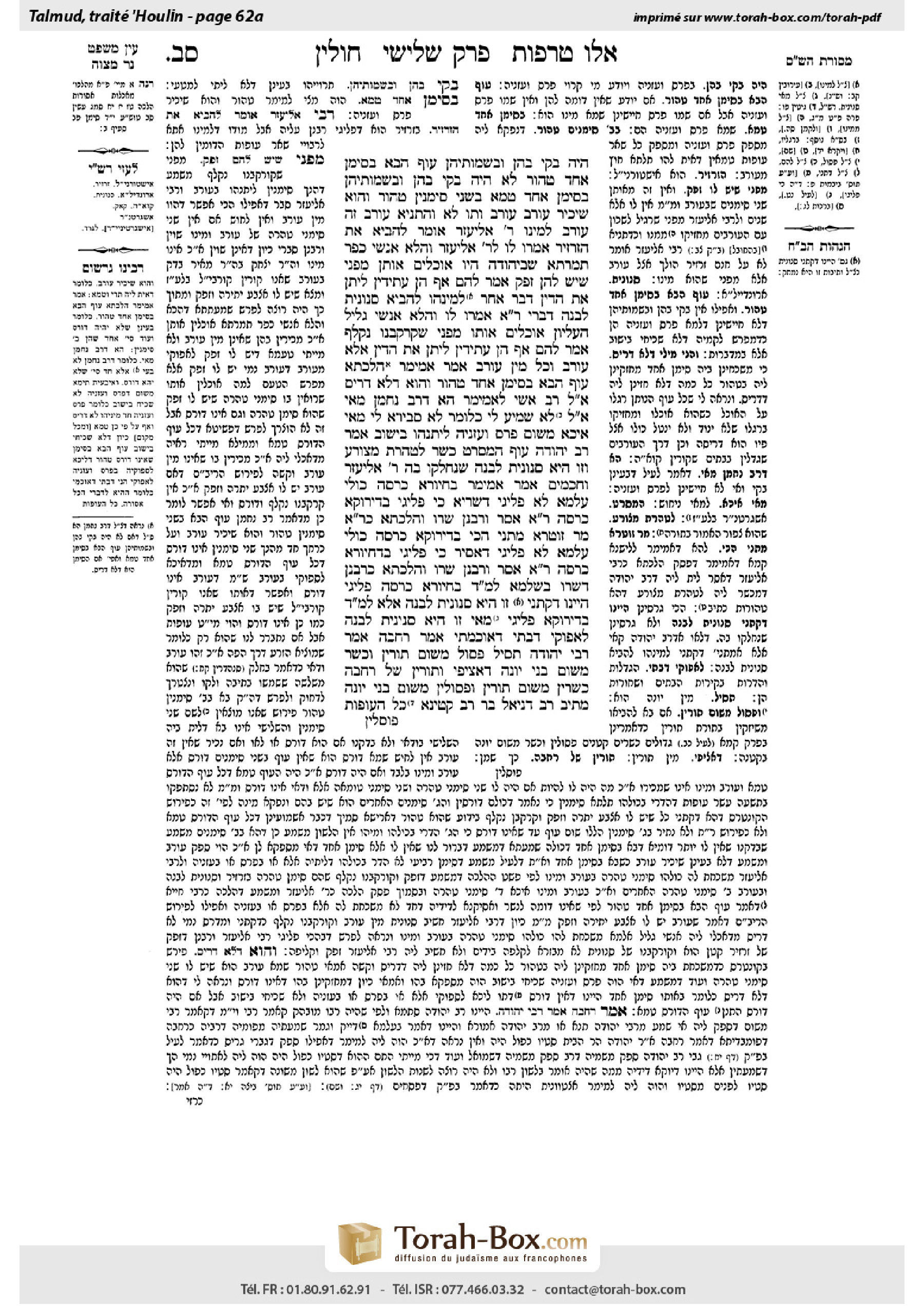
Chullin 62a: Talmud study for Daf Yomi
Study the Talmud for Daf Yomi with scanned pages, Hebrew text, English translations from Sefaria and AI-generated French translations.
Passage selection and English or AI-generated French translation are available where the scan has annotations. Daf Study is independent of Torah-Box and Sefaria.
Browse Chullin · חולין · All tractatesChullin 62a text and translations
This page of Chullin includes the Aramaic text, an English translation and an AI-generated French translation, alongside the scan above.
חולין ס״ב א · Aramaic and Hebrew text
הָיָה בָּקִי בָּהֶן וּבִשְׁמוֹתֵיהֶן – עוֹף הַבָּא בְּסִימָן אֶחָד טָהוֹר, לֹא הָיָה בָּקִי בָּהֶן וּבִשְׁמוֹתֵיהֶן – בְּסִימָן אֶחָד טָמֵא, בִּשְׁנֵי סִימָנִין טָהוֹר, וְהוּא שֶׁיַּכִּיר עוֹרֵב.
עוֹרֵב וְתוּ לָא? וְהָתַנְיָא: ״עוֹרֵב״ – זֶה עוֹרֵב, ״לְמִינוֹ״ – רַבִּי אֱלִיעֶזֶר אוֹמֵר: לְהָבִיא אֶת הַזַּרְזִיר. אָמְרוּ לוֹ לְרַבִּי אֱלִיעֶזֶר: וַהֲלֹא אַנְשֵׁי כְּפַר תְּמַרְתָּא שֶׁבִּיהוּדָה הָיוּ אוֹכְלִים אוֹתָן מִפְּנֵי שֶׁיֵּשׁ לָהֶן זֶפֶק! אָמַר לָהֶם: אַף הֵן עֲתִידִין לִיתֵּן אֶת הַדִּין.
דָּבָר אַחֵר: ״לְמִינֵהוּ״ לְהָבִיא סְנוּנִית לְבָנָה, דִּבְרֵי רַבִּי אֱלִיעֶזֶר. אָמְרוּ לוֹ: וַהֲלֹא אַנְשֵׁי גָּלִיל הָעֶלְיוֹן אוֹכְלִים אוֹתוֹ, מִפְּנֵי שֶׁקֻּרְקְבָנוֹ נִקְלָף! אָמַר לָהֶם: אַף הֵן עֲתִידִין לִיתֵּן אֶת הַדִּין. אֶלָּא עוֹרֵב וְכׇל מִין עוֹרֵב.
אָמַר אַמֵּימָר: הִלְכְתָא, עוֹף הַבָּא בְּסִימָן אֶחָד – טָהוֹר, וְהוּא דְּלָא דָּרֵיס. אֲמַר לֵיהּ רַב אָשֵׁי לְאַמֵּימָר: הָא דְּרַב נַחְמָן מַאי? אֲמַר לֵיהּ: לָא שְׁמִיעַ לִי, כְּלוֹמַר לָא סְבִירָא לִי. מַאי אִיכָּא? מִשּׁוּם פֶּרֶס וְעׇזְנִיָּה? לֵיתַנְהוּ בַּיִּשּׁוּב.
אָמַר רַב יְהוּדָה: עוֹף הַמְסָרֵט – כָּשֵׁר לְטׇהֳרַת מְצוֹרָע, וְזוֹ הִיא סְנוּנִית לְבָנָה שֶׁנֶּחְלְקוּ בָּהּ רַבִּי אֱלִיעֶזֶר וַחֲכָמִים.
אָמַר אַמֵּימָר: בְּחִיוָּרָא כְּרֵסַהּ – כּוּלֵּי עָלְמָא לָא פְּלִיגִי דְּשַׁרְיָא, כִּי פְּלִיגִי – בְּדִירוּקָּא כְּרֵסַהּ, רַבִּי אֱלִיעֶזֶר אָסַר וְרַבָּנַן שָׁרוּ, וְהִלְכְתָא כְּרַבִּי אֱלִיעֶזֶר.
מָר זוּטְרָא מַתְנֵי הָכִי: בְּדִירוּקָּא כְּרֵסַהּ, כּוּלֵּי עָלְמָא לָא פְּלִיגִי דַּאֲסִיר. כִּי פְּלִיגִי בִּדְחִיוָּרָא כְּרֵסַהּ, רַבִּי אֱלִיעֶזֶר אָסַר וְרַבָּנַן שָׁרוּ, וְהִלְכְתָא כְּרַבָּנַן דְּשָׁרוּ.
בִּשְׁלָמָא לְמַאן דְּאָמַר בְּחִיוָּרָא כְּרֵסַהּ פְּלִיגִי – הַיְינוּ דְּקָתָנֵי ״זוֹ הִיא סְנוּנִית לְבָנָה״, אֶלָּא לְמַאן דְּאָמַר בְּדִירוּקָּא פְּלִיגִי, מַאי ״זוֹ הִיא סְנוּנִית לְבָנָה״? לְאַפּוֹקֵי דְּבָתֵּי דְּאוּכַּמְתִּי.
אָמַר רַחֲבָה, אָמַר רַבִּי יְהוּדָה: תָּסִיל פָּסוּל מִשּׁוּם תּוֹרִין, וְכָשֵׁר מִשּׁוּם בְּנֵי יוֹנָה, דָּאצִיפִי וְתוֹרִין שֶׁל רְחָבָה כְּשֵׁרִין מִשּׁוּם תּוֹרִין, וּפְסוּלִין מִשּׁוּם בְּנֵי יוֹנָה. מֵתִיב רַב דָּנִיאֵל בַּר רַב קַטִּינָא: כָּל הָעוֹפוֹת
Chullin 62a · English translation
If one is familiar with the non-kosher birds and their names, any bird that comes before him with only one sign is kosher, since he can be sure that it is not the peres or ozniyya, which have only one sign. If he is not familiar with them and their names, any bird that he finds with one sign is non-kosher, since it may be the peres or ozniyya. But if he finds a bird with exactly two signs, it is kosher, provided that he can recognize a crow, since the crow is the only non-kosher bird with exactly two signs.
The Gemara asks: Must he recognize only the crow and nothing more? But isn’t it taught in a baraita: The verse states: “Every orev after its kinds” (Leviticus 11:15). With regard to the orev, this is the well-known crow; as for the phrase “after its kinds,” Rabbi Eliezer says: It is written to include the zarzir, another type of crow, to teach that it is non-kosher. The Sages said to Rabbi Eliezer: But wouldn’t the people of Kefar Temarta in Judea eat the zarzir, because it has a crop? Rabbi Eliezer said to them: They too will be judged in the future for their transgression.
Alternatively, the phrase “after its kinds” is written to include the white senunit and teach that it is non-kosher; this is the statement of Rabbi Eliezer. The Rabbis said to him: But don’t the people of the upper Galilee eat it, because its gizzard can be peeled? Rabbi Eliezer said to them: They too will be judged in the future for their transgression. In any event, the baraita indicates that other non-kosher birds exist that have two signs, like the crow. The Gemara responds: Rather, Rav Naḥman must have meant that one must be able to recognize the well-known crow and all other species of crow.
Ameimar said: The halakha is: Any bird that comes before a person with one sign is kosher, provided that it does not claw its food. Rav Ashi said to Ameimar: What about that which Rav Naḥman said, that if one finds a bird with exactly one sign, he may eat it only if he can identify all the non-kosher birds in the Torah, to be sure that it is not one of them? Ameimar said to him: I did not hear this statement; that is to say: I do not hold accordingly. What concern is there? Is one concerned because of the peres and ozniyya, which have only one sign? They are not found in settled areas, and one need not be concerned about them.
§ Rav Yehuda says: The bird known as the scratching bird is fit for use in the purification of a leper, i.e., it is kosher. Only kosher birds are fit for this rite, as the verse states: “Then shall the priest command to take for him that is to be purified two living pure birds” (Leviticus 14:4). And this is the white senunit about which Rabbi Eliezer and the Rabbis disagreed in the baraita.
Ameimar said: There are two kinds of white senunit. With regard to the senunit with a white belly, everyone agrees that it is permitted for consumption. They disagree when discussing the kind with a yellow belly. Rabbi Eliezer prohibits it, and the Rabbis permit it. And the halakha is in accordance with the opinion of Rabbi Eliezer.
Mar Zutra teaches the statement of Ameimar in this manner: With regard to the senunit with a yellow belly, everyone agrees that it is prohibited. They disagree when discussing the kind with a white belly. Rabbi Eliezer deems it prohibited, and the Rabbis deem it permitted. And the halakha is in accordance with the opinion of the Rabbis, who deem it permitted.
The Gemara asks: Granted, according to the one who says that they disagree with regard to the kind with a white belly, this explanation is consistent with that which Rav Yehuda teaches: This is the white senunit about which Rabbi Eliezer and the Rabbis disagreed. But according to the one who says that they disagree with regard to the kind with a yellow belly, what is the meaning of the phrase: This is the white senunit? The Gemara responds: The phrase: White senunit, is used only to exclude the house senunit, which is black.
§ Raḥava says that Rabbi Yehuda says: A young tasil, which is similar to a dove, is unfit for sacrifice as a dove, which is fit only when mature, but it is fit for sacrifice as a pigeon, which is fit only when immature. In other words, the tasil is considered a type of pigeon, not a dove. A mature datzifi bird, and mature doves of Reḥava, are fit as doves, but are unfit as pigeons, since they are types of doves. Rav Daniel bar Rav Ketina raises an objection from a mishna (Para 9:3): All birds
Chullin 62a · Traduction française (IA)
Si une personne connaît les oiseaux non-kosher et leurs noms, tout oiseau qui lui arrive avec un seul signe est kosher, car il peut être sûr qu'il ne s'agit pas du peres ou de l'ozniyya, qui ont un seul signe. Si elle ne connaît pas ces oiseaux et leurs noms, tout oiseau qu'elle trouve avec un seul signe est non-kosher, car il pourrait s'agir du peres ou de l'ozniyya. Mais si elle trouve un oiseau avec exactement deux signes, il est kosher, à condition qu'elle puisse reconnaître un corbeau, car le corbeau est le seul oiseau non-kosher avec exactement deux signes.
La Guemara pose la question : Faut-il reconnaître uniquement le corbeau et rien d'autre ? Mais n'est-il pas enseigné dans une baraïta : La Parole dit : « Tout orev selon son espèce » (Lévitique 11:15). En ce qui concerne l'orev, c'est le corbeau bien connu ; quant à la phrase « selon son espèce », le Rabbi Eliezer dit : elle est écrite pour inclure le zarzir, une autre espèce de corbeau, afin d'enseigner qu'il est non-kosher. Les Sages dirent au Rabbi Eliezer : Mais ne mangent pas les habitants de Kefar Temarta en Judée le zarzir, car il a un estomac ? Le Rabbi Eliezer répondit à eux : Ils seront jugés à l'avenir pour leur transgression.
Une autre interprétation est que la phrase « selon son espèce » est écrite pour inclure le senunit blanc et enseigner qu'il est non-kosher ; c'est l'opinion du Rabbi Eliezer. Les Sages dirent à lui : Mais ne mangent pas les habitants du Galil supérieur ce senunit, car son gourmandise peut être épluchée ? Le Rabbi Eliezer répondit à eux : Ils seront également jugés à l'avenir pour leur transgression. En tout cas, la baraïta indique que d'autres oiseaux non-kosher existent qui ont deux signes, comme le corbeau. La Guemara répond : Plutôt, Rav Naḥman doit avoir voulu dire qu'il faut être capable de reconnaître le corbeau bien connu et toutes les autres espèces de corbeaux.
Ameimar dit : La halakha est : Tout oiseau qui arrive devant une personne avec un seul signe est kosher, à condition qu'il ne gratte pas sa nourriture. Rav Ashi dit à Ameimar : Et celui que Rav Naḥman a dit, selon lequel si l'on trouve un oiseau avec exactement un seul signe, on peut le manger seulement si l'on peut identifier tous les oiseaux non-kosher de la Torah, afin d'être sûr qu'il n'en est pas un ? Ameimar dit à lui : Je n'ai pas entendu cette déclaration ; c'est-à-dire : Je ne l'adopte pas. Quel est le problème ? Est-on préoccupé à cause du peres et de l'ozniyya, qui ont un seul signe ? Ils ne sont pas trouvés dans les zones habitées, et on ne doit pas s'en préoccuper.
§ Rav Yehuda dit : L'oiseau connu sous le nom d'oiseau rasant est adapté à la purification d'un lépreux, c'est-à-dire qu'il est kosher. Seuls les oiseaux kosher sont adaptés à ce rite, car la Parole dit : « Puis le prêtre ordonnera de prendre pour lui qui est à purifier deux oiseaux vivants purs » (Lévitique 14:4). Et c'est le senunit blanc dont le Rabbi Eliezer et les Sages ont disputé dans la baraïta.
Ameimar dit : Il existe deux sortes de senunit blanc. En ce qui concerne le senunit avec un ventre blanc, tout le monde convient qu'il est permis à la consommation. Ils divergent lorsqu'ils discutent de la sorte avec un ventre jaune. Le Rabbi Eliezer l'interdit, et les Sages le permettent. Et la halakha suit l'opinion du Rabbi Eliezer.
Mar Zutra enseigne la déclaration d'Ameimar ainsi : En ce qui concerne le senunit avec un ventre jaune, tout le monde convient qu'il est interdit. Ils divergent lorsqu'ils discutent de la sorte avec un ventre blanc. Le Rabbi Eliezer le considère comme interdit, et les Sages le considèrent comme permis. Et la halakha suit l'opinion des Sages, qui le considèrent comme permis.
La Guemara pose la question : Admettons que celui qui dit qu'ils divergent en ce qui concerne la sorte avec un ventre blanc, cette explication est cohérente avec ce que Rav Yehuda enseigne : C'est le senunit blanc dont le Rabbi Eliezer et les Sages ont divergé. Mais selon celui qui dit qu'ils divergent en ce qui concerne la sorte avec un ventre jaune, quelle est la signification de la phrase : C'est le senunit blanc ? La Guemara répond : La phrase : senunit blanc, est utilisée uniquement pour exclure le senunit de maison, qui est noir.
§ Raḥava dit que Rabbi Yehuda dit : Un jeune tasil, qui ressemble à une colombe, est inadapté à la sacrifice comme une colombe, qui est adapté uniquement lorsqu'il est mûr, mais il est adapté à la sacrifice comme un pigeon, qui est adapté uniquement lorsqu'il est jeune. En d'autres termes, le tasil est considéré comme une espèce de pigeon, pas de colombe. Un oiseau mûr datzifi et des colombes mûres de Reḥava sont adaptés comme des colombes, mais inadaptés comme des pigeons, car ils sont des espèces de colombes. Rav Daniel bar Rav Ketina émet un objection à partir d'une mitsva (Para 9:3) : Tous les oiseaux
Traduction française générée par IA à partir de l’édition anglaise de Sefaria. Vérifie toujours un passage avec le texte source.
Text from Sefaria: William Davidson Edition - Vocalized Aramaic (unknown); William Davidson Edition - English (CC BY NC).