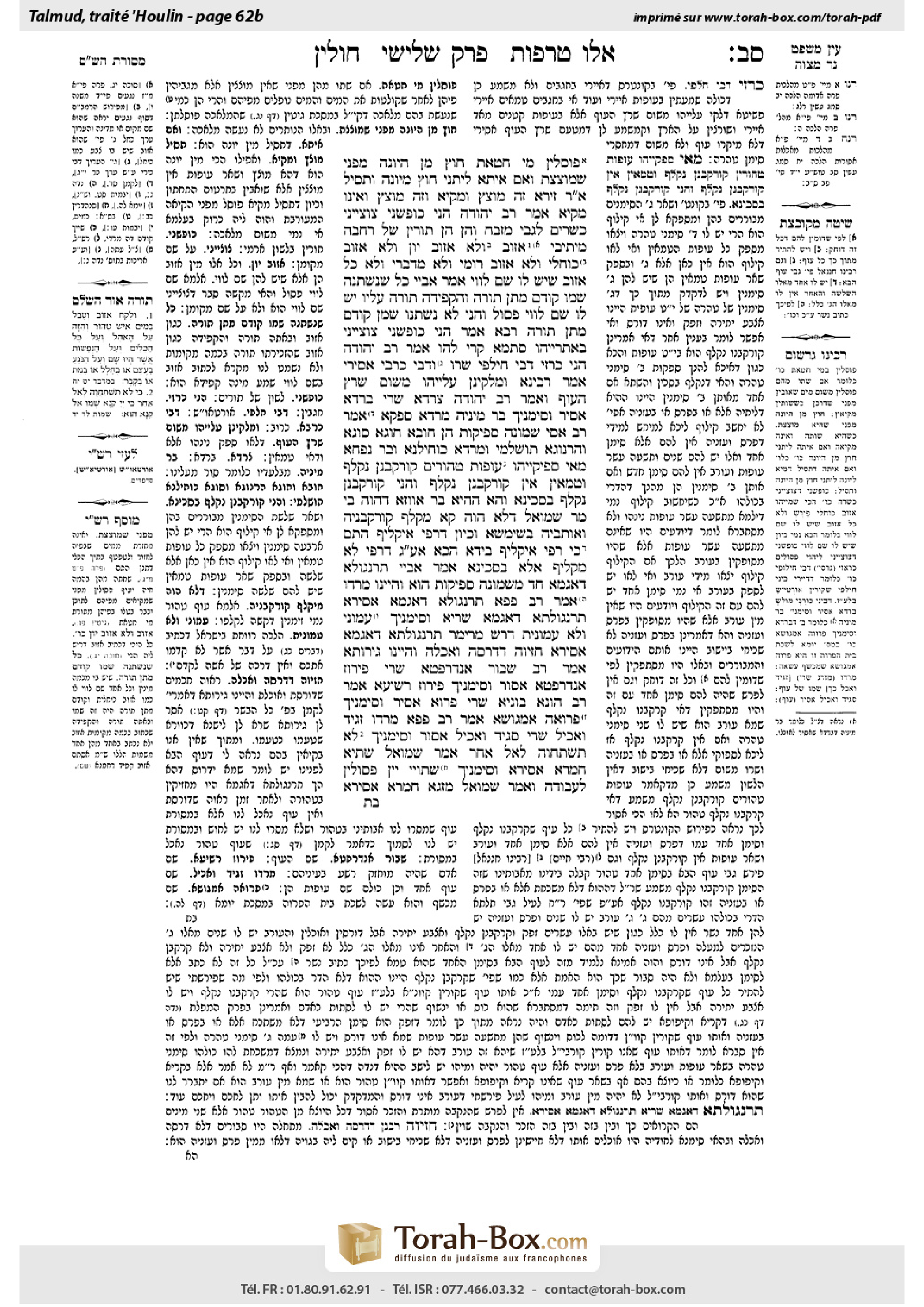
Chullin 62b: Talmud study for Daf Yomi
Study the Talmud for Daf Yomi with scanned pages, Hebrew text, English translations from Sefaria and AI-generated French translations.
Passage selection and English or AI-generated French translation are available where the scan has annotations. Daf Study is independent of Torah-Box and Sefaria.
Browse Chullin · חולין · All tractatesChullin 62b text and translations
This page of Chullin includes the Aramaic text, an English translation and an AI-generated French translation, alongside the scan above.
חולין ס״ב ב · Aramaic and Hebrew text
פּוֹסְלִין בְּמֵי חַטָּאת חוּץ מִן הַיּוֹנָה מִפְּנֵי שֶׁמּוֹצֶצֶת, וְאִם אִיתָא לִיתְנֵי חוּץ מִיּוֹנָה וְתָסִיל! אָמַר רַבִּי זֵירָא: זֶה מוֹצֵץ וּמֵקִיא, וְזֶה מוֹצֵץ וְאֵינוֹ מֵקִיא.
אָמַר רַב יְהוּדָה: הָנֵי כּוּפְשָׁנֵי צוּצְיָינֵי כְּשֵׁרִים לְגַבֵּי מִזְבֵּחַ, וְהֵן הֵן תּוֹרִין שֶׁל רְחָבָה. מֵיתִיבִי: ״אֵזוֹב״, וְלֹא אֵזוֹב יוֹן, וְלֹא אֵזוֹב כּוֹחֳלִי, וְלֹא אֵזוֹב רוֹמִי, וְלֹא מִדְבָּרִי, וְלֹא כׇּל אֵזוֹב שֶׁיֵּשׁ לוֹ שֵׁם לְוַוי.
אָמַר אַבָּיֵי: כֹּל שֶׁנִּשְׁתַּנָּה שְׁמוֹ קוֹדֶם מַתַּן תּוֹרָה, וְהִקְפִּידָה תּוֹרָה עָלָיו, יֵשׁ לוֹ שֵׁם לְוַוי – פָּסוּל. וְהָנֵי לֹא נִשְׁתַּנָּה שְׁמָן קוֹדֶם מַתַּן תּוֹרָה. רָבָא אָמַר: הָנֵי כּוּפְשָׁנֵי צוּצְיָינֵי, בְּאַתְרַיְיהוּ סְתָמָא קָרֵי לְהוּ.
אָמַר רַב יְהוּדָה: הָנֵי כְּרָזֵי דְּבֵי חִילְפֵי שָׁרוּ, וּדְבֵי כְּרָבֵי אֲסִירִי. אָמַר רָבִינָא: וּמַלְקִינַן עֲלַיְיהוּ מִשּׁוּם שֶׁרֶץ הָעוֹף. וְאָמַר רַב יְהוּדָה: צְרָדָא – שְׁרֵי, בַּרְדָּא – אֲסִיר, וְסִימָנָיךְ ״בַּר מִינֵּיהּ״, מַרְדָּא – סְפֵקָא.
אָמַר רַב אַסִּי: שְׁמוֹנָה סְפֵיקוֹת הֵן: חוֹבָא, חוּגָא, סוּגָא, וְהַרְנוּגָא, תּוּשְׁלְמִי, וּמַרְדָּא, כּוֹחִילְנָא, וּבַר נַפָּחָא. מַאי סְפֵיקַיְיהוּ? עוֹפוֹת טְהוֹרִים קוּרְקְבָנָן נִקְלָף, וּטְמֵאִין אֵין קוּרְקְבָנָן נִקְלָף, וְהָנֵי קוּרְקְבָנָן נִקְלָף בְּסַכִּינָא.
וְהָא הָהִיא בַּר אֲוָוזָא דַּהֲוָה בֵּי מָר שְׁמוּאֵל, דְּלָא הֲוָה קָא מִקְּלֵף קוּרְקְבָנֵיהּ, וְאוֹתְבֵיהּ בְּשִׁימְשָׁא, וְכֵיוָן דְּרָפֵי אִיקְּלֵיף! הָתָם, כִּי רָפֵי אִיקְּלֵיף בִּידָא. הָכָא, אַף עַל גַּב דְּרָפֵי, לָא מִקְּלֵיף אֶלָּא בְּסַכִּינָא.
אָמַר אַבָּיֵי: תַּרְנְגוֹלָא דְּאַגְמָא חַד מִשְּׁמוֹנָה סְפֵיקוֹת הוּא, וְהַיְינוּ מַרְדּוּ. אָמַר רַב פָּפָּא: תַּרְנְגוֹלָא דְּאַגְמָא אֲסִירָא, תַּרְנְגוֹלְתָּא דְּאַגְמָא שַׁרְיָא, וְסִימָנָיךְ – ״עַמּוֹנִי וְלֹא עַמּוֹנִית״. דְּרַשׁ מָרִימָר: תַּרְנְגוֹלְתָּא דְּאַגְמָא אֲסִירָא, חַזְיוּהָ דְּדָרְסָה וְאָכְלָה, וְהַיְינוּ גֵּירוּתָא.
אָמַר רַב: שַׁבּוּר אַנַדַּרְפַּטָּא – שְׁרֵי, פֵּירוּז אַנַדַּרְפַּטָּא – אֲסִיר, וְסִימָנָיךְ – פֵּירוּז רַשִּׁיעָא. אָמַר רַב הוּנָא: בּוּנְיָא – שְׁרֵי, פַּרְוָא – אֲסִיר, וְסִימָנָיךְ – פַּרְוָאָה אַמְגּוּשָׁא.
אָמַר רַב פָּפָּא: מַרְדּוּ זָגֵיד וְאָכֵיל – שְׁרֵי, סָגֵיד וְאָכֵיל – אֲסִיר, וְסִימָנָיךְ ״לֹא תִשְׁתַּחֲוֶה לְאֵל אַחֵר״. אָמַר שְׁמוּאֵל: שָׁתְיָא חַמְרָא – אֲסִירָא, וְסִימָנָיךְ ״שְׁתוּיֵי יַיִן פְּסוּלִין לַעֲבוֹדָה״. וְאָמַר שְׁמוּאֵל: מָזְגָא חַמְרָא – אֲסִירָא,
Chullin 62b · English translation
disqualify the water of purification, i.e., water in which ashes of the red heifer have been placed, by drinking from it. The water that entered the bird’s mouth is disqualified, and some of it drips back into the container, disqualifying the rest. This applies to all birds except for the pigeon, because it sips the water from the container and none falls back in from its mouth. But if it is so that the tasil is a type of pigeon, let the mishna teach: Except for the pigeon and the tasil. Rabbi Zeira said: Although the tasil is a type of pigeon and sips the water as well, this, the tasil, sips the water and spits part of it back, and therefore disqualifies the water of purification, and that, the pigeon, sips but does not spit.
Rav Yehuda says: The tzutzeyanei doves are fit for sacrifice on the altar, and they are the doves of Reḥava mentioned earlier. The Gemara raises an objection from a mishna (Nega’im 14:6): The Torah requires hyssop for the purification of a leper. It must be standard hyssop, and neither a hyssop of Greece, nor stibium hyssop, nor Roman hyssop, nor desert hyssop, nor any other kind of hyssop whose name is accompanied by a modifier. Likewise, tzutzeyanei doves should be unfit for sacrifice, because they have a modifier in their name.
Abaye said: Any item whose name was modified before the giving of the Torah, and concerning which the Torah was particular when naming it, is unfit if its name is accompanied by a modifier, since the language of the Torah was formulated to exclude it. But the name of these tzutzeyanei doves was not modified, i.e., the modifier tzutzeyanei was not applied to them, before the giving of the Torah. Even though it was applied to them later, they are still fit for sacrifice. Alternatively, Rava said: The tzutzeyanei doves are called simply doves in their place of habitation.
Similarly, Rav Yehuda says: These grasshoppers found among the shrubs are kosher and permitted for consumption. And those found among the cabbages are forbidden. Ravina said: And we flog those who eat them on their account, due to the prohibition: “And all winged swarming things are impure unto you” (Deuteronomy 14:19). And Rav Yehuda says: The bird called tzarda is permitted for consumption, and the barda is prohibited. And your mnemonic to remember which is which is this: Eat any bird except [bar] for it. As for the marda, it is uncertain whether it is kosher.
Rav Asi says: There are eight uncertain cases: The ḥuva, ḥuga, suga, and harnuga, tushelemi, and marda, kuḥilna, and bar nappaḥa. The Gemara explains: What is their uncertainty? The gizzard of kosher birds can be peeled, as mentioned in the mishna, and the gizzard of non-kosher birds cannot be peeled, but the gizzard of these birds can be peeled only with a knife.
The Gemara asks: But why should these not be kosher? Wasn’t there a certain duck in the house of Mar Shmuel whose gizzard could not be peeled, and they set the gizzard in the sun, and once it softened it could be peeled? The Gemara responds: There, when it softened it could be peeled by hand. Here, in these eight cases, even when it softened it could be peeled only with a knife.
Abaye says: The swamp rooster is one of the eight uncertain cases, and this is the mardu, i.e., the marda mentioned earlier. Rav Pappa says: The swamp rooster is forbidden, but the swamphen is permitted. And your mnemonic to remember this is the statement of the Sages with regard to the verse: “An Ammonite or a Moabite shall not enter into the assembly of the Lord” (Deuteronomy 23:4), that an Ammonite man is unfit to enter the assembly, but not an Ammonite woman. Mareimar taught: The swamphen is forbidden, because the Sages saw that it claws its prey and eats it. And this is the giruta, a non-kosher bird (see 109b).
Rav says: The bird called the shavor anderafta is permitted, but the piruz anderafta is forbidden. And your mnemonic to remember this is the known personality Piruz the Evil. Rav Huna says: The bird called the bunya is permitted. The parva is forbidden. And your mnemonic to remember this is the known personality Parva’a the Sorcerer.
Rav Pappa says: The bird known as the reclining and eating mardu is permitted, while the bowing and eating mardu is forbidden. And your mnemonic to remember this is the verse: “You shall bow down to no other god” (Exodus 34:14). Shmuel says: The bird called the wine drinker is forbidden. And your mnemonic to remember this is the halakha: Those who drank wine are unfit for service in the Temple. And Shmuel says: The bird called the wine pourer is forbidden.
Chullin 62b · Traduction française (IA)
Ce qui disqualifie l'eau de purification, c'est-à-dire l'eau dans laquelle on a mis les cendres de la vache rouge, est de boire dedans. L'eau qui entre dans la bouche de l'oiseau est disqualifiée, et une partie d'elle coule à nouveau dans le récipient, disqualifiant le reste. Cela s'applique à tous les oiseaux sauf le pigeon, car il boit l'eau du récipient et aucune ne revient de sa bouche. Mais si le tasil est un type de pigeon, la mitsva enseigne : à l'exception du pigeon et du tasil. Rabbi Zeira a dit : Bien que le tasil soit un type de pigeon et qu'il boive l'eau comme le pigeon, ce tasil boit l'eau et en recrache une partie, et donc disqualifie l'eau de purification, tandis que le pigeon boit sans recracher.
Rav Yehuda dit : Les tzutzeyanei doves sont propres pour l'offrande sur l'autel, et ce sont les doves de Reḥava mentionnés plus tôt. La Guemara soulève un objet contre une mitsva (Nega’im 14:6) : La Torah exige l'hyssop pour la purification du lépreux. Il doit être un hyssop standard, ni un hyssop de Grèce, ni un hyssop de stibium, ni un hyssop romain, ni un hyssop du désert, ni tout autre genre d'hyssop dont le nom est accompagné d'un modificateur. De même, les tzutzeyanei doves devraient être impropre pour l'offrande, car leur nom est accompagné d'un modificateur.
Abaye a dit : Tout objet dont le nom a été modifié avant la révélation de la Torah, et concernant lequel la Torah a été précise lors de son nommage, est impropre si son nom est accompagné d'un modificateur, car la langue de la Torah a été formulée pour l'exclure. Mais le nom de ces tzutzeyanei doves n'a pas été modifié, c'est-à-dire le modificateur tzutzeyanei n'a pas été appliqué à eux avant la révélation de la Torah. Même s'il a été appliqué à eux plus tard, ils restent propres pour l'offrande. Alternativement, Rava a dit : Les tzutzeyanei doves sont appelés simplement des moineaux dans leur lieu d'habitation.
De même, Rav Yehuda dit : Ces criquets trouvés parmi les buissons sont permis et autorisés à la consommation. Et ceux trouvés parmi les choux sont interdits. Ravina a dit : Et nous flagellons ceux qui les mangent à cause de l'interdiction : « Et tout ce qui vole et se déplace par le vol est impur pour vous » (Deutéronome 14:19). Et Rav Yehuda dit : L'oiseau appelé tzarda est permis à la consommation, et le barda est interdit. Et votre mnémotechnie pour se souvenir de laquelle est laquelle est celle-ci : mangez tout oiseau sauf [bar] pour lui. Quant au marda, il est incertain s'il est permis.
Rav Asi dit : Il y a huit cas incertains : le ḥuva, le ḥuga, le suga, et le harnuga, le tushelemi, et le marda, le kuḥilna, et le bar nappaḥa. La Guemara explique : Quelle est leur incertitude ? Le foie des oiseaux kasher peut être épluché, comme mentionné dans la mitsna, et le foie des oiseaux non kasher ne peut pas être épluché, mais le foie de ces oiseaux peut être épluché uniquement avec un couteau.
La Guemara demande : Mais pourquoi ces oiseaux ne devraient-ils pas être kasher ? N'y avait-il pas un certain canard dans la maison de Mar Shmuel dont le foie ne pouvait pas être épluché, et ils ont mis le foie au soleil, et une fois qu'il s'était ramollit, il pouvait être épluché ? La Guemara répond : Là, une fois qu'il s'était ramollit, il pouvait être épluché à la main. Ici, dans ces huit cas, même une fois qu'il s'était ramollit, il pouvait être épluché uniquement avec un couteau.
Abaye dit : Le rooster du marais est l'un des huit cas incertains, et c'est le mardu, c'est-à-dire le marda mentionné plus tôt. Rav Pappa dit : Le rooster du marais est interdit, mais le swamphen est permis. Et votre mnémotechnie pour se souvenir de cela est la déclaration des Sages concernant la parole : « Un Ammonite ou un Moabite ne doit pas entrer dans l'assemblée du Seigneur » (Deutéronome 23:4), qu'un homme d'Ammon est inapte à entrer dans l'assemblée, mais pas une femme d'Ammon. Mareimar a enseigné : Le swamphen est interdit, car les Sages ont vu qu'il déchire sa proie et la mange. Et c'est la giruta, un oiseau non kasher (voir 109b).
Rav dit : L'oiseau appelé shavor eterafta est permis, mais le piruz eterafta est interdit. Et votre mnémotechnie pour se souvenir de cela est la personnalité connue Piruz l'Évile. Rav Huna dit : L'oiseau appelé bunya est permis. Le parva est interdit. Et votre mnémotechnie pour se souvenir de cela est la personnalité connue Parva’a le Sorcier.
Rav Pappa dit : L'oiseau connu sous le nom de mardu qui s'allonge et mange est permis, tandis que le mardu qui s'incline et mange est interdit. Et votre mnémotechnie pour se souvenir de cela est la parole : « Vous ne devriez pas vous prosterner devant un autre dieu » (Exode 34:14). Shmuel dit : L'oiseau appelé buveur de vin est interdit. Et votre mnémotechnie pour se souvenir de cela est la halakha : ceux qui ont bu du vin sont inaptes au service dans le Temple. Et Shmuel dit : L'oiseau appelé verseur de vin est interdit.
Traduction française générée par IA à partir de l’édition anglaise de Sefaria. Vérifie toujours un passage avec le texte source.
Text from Sefaria: William Davidson Edition - Vocalized Aramaic (unknown); William Davidson Edition - English (CC BY NC).