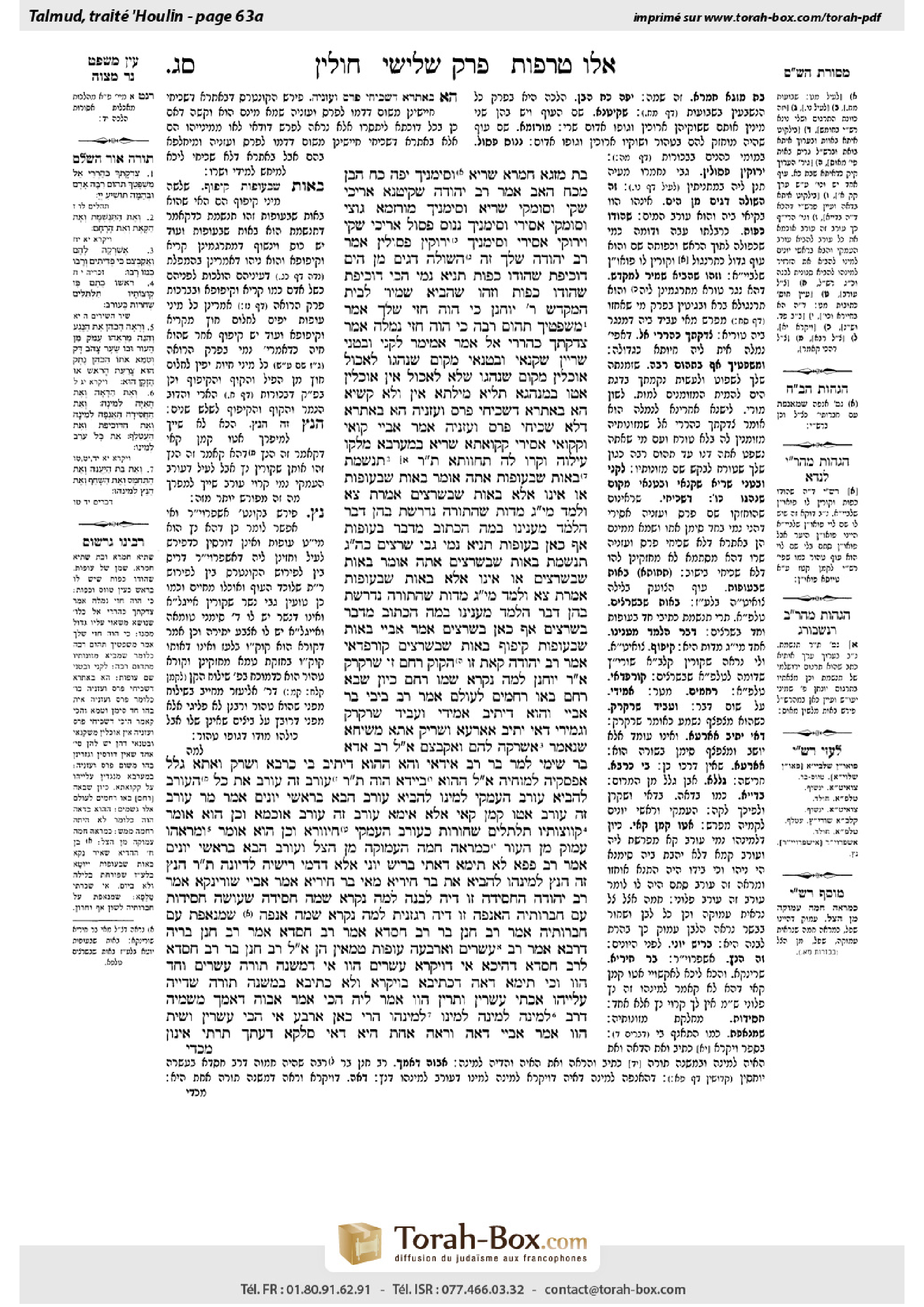
Chullin 63a: Talmud study for Daf Yomi
Study the Talmud for Daf Yomi with scanned pages, Hebrew text, English translations from Sefaria and AI-generated French translations.
Passage selection and English or AI-generated French translation are available where the scan has annotations. Daf Study is independent of Torah-Box and Sefaria.
Browse Chullin · חולין · All tractatesChullin 63a text and translations
This page of Chullin includes the Aramaic text, an English translation and an AI-generated French translation, alongside the scan above.
חולין ס״ג א · Aramaic and Hebrew text
בַּת מָזְגָא חַמְרָא – שַׁרְיָא, וְסִימָנָיךְ ״יָפֶה כֹּחַ הַבֵּן מִכֹּחַ הָאָב״.
אָמַר רַב יְהוּדָה: שְׁקִיטָנָא, אֲרִיכֵי שָׁקֵי וְסוּמָּקֵי – שַׁרְיָא, וְסִימָנָיךְ מוּרְזְמָא. גּוּצֵי וְסוּמָּקֵי – אֲסִירִי, וְסִימָנָיךְ ״נָנוּס פָּסוּל״. אֲרִיכֵי שָׁקֵי וִירוּקֵּי – אֲסִירִי, וְסִימָנָיךְ ״יְרוּקִּין פְּסוּלִין״.
אָמַר רַב יְהוּדָה: ״שָׁלָךְ״, זֶה הַשּׁוֹלֶה דָּגִים מִן הַיָּם. ״דּוּכִיפַת״, שֶׁהוֹדוֹ כָּפוּת. תַּנְיָא נָמֵי הָכִי: דּוּכִיפַת, שֶׁהוֹדוֹ כָּפוּת, וְזֶהוּ שֶׁהֵבִיא שָׁמִיר לְבֵית הַמִּקְדָּשׁ.
רַבִּי יוֹחָנָן, כִּי הֲוָה חָזֵי שָׁלָךְ, אָמַר: ״מִשְׁפָּטֶיךָ תְּהוֹם רַבָּה״. כִּי הֲוָה חָזֵי נְמָלָה, אָמַר: ״צִדְקָתְךָ כְּהַרְרֵי אֵל״.
אָמַר אַמֵּימָר: לַקְנִי וּבָטְנִי – שַׁרְיָין, שַׁקְנַאי וּבָטְנַאי – מְקוֹם שֶׁנָּהֲגוּ לֶאֱכוֹל אוֹכְלִין, מְקוֹם שֶׁנָּהֲגוּ שֶׁלֹּא לֶאֱכוֹל אֵין אוֹכְלִין. אַטּוּ בְּמִנְהֲגָא תַּלְיָא מִילְּתָא? אִין, וְלָא קַשְׁיָא: הָא בְּאַתְרָא דִּשְׁכִיחִי פֶּרֶס וְעׇזְנִיָּה, הָא בְּאַתְרָא דְּלָא שְׁכִיחִי פֶּרֶס וְעׇזְנִיָּה.
אָמַר אַבָּיֵי: קוּאֵי וְקָקוֹאֵי אֲסִירִי, קָקוֹאֲתָא שַׁרְיָא. בְּמַעְרְבָא מַלְקוּ עִילָּוַהּ, וְקָרוּ לַהּ תַּחְוָותָא.
תָּנוּ רַבָּנַן: ״תִּנְשֶׁמֶת״ בָּאוָת שֶׁבָּעוֹפוֹת. אַתָּה אוֹמֵר בָּאוָת שֶׁבָּעוֹפוֹת, אוֹ אֵינוֹ אֶלָּא בָּאוָת שֶׁבַּשְּׁרָצִים? אָמַרְתָּ: צֵא וּלְמַד מִשְּׁלֹשׁ עֶשְׂרֵה מִדּוֹת שֶׁהַתּוֹרָה נִדְרֶשֶׁת בָּהֶן, דָּבָר הַלָּמֵד מֵעִנְיָנוֹ. בְּמָה הַכָּתוּב מְדַבֵּר? בְּעוֹפוֹת, אַף כָּאן בְּעוֹפוֹת.
תַּנְיָא נָמֵי גַּבֵּי שְׁרָצִים כְּהַאי גַּוְונָא: ״תִּנְשֶׁמֶת״ בָּאוָת שֶׁבַּשְּׁרָצִים. אַתָּה אוֹמֵר בָּאוָת שֶׁבַּשְּׁרָצִים, אוֹ אֵינוֹ אֶלָּא בָּאוָת שֶׁבָּעוֹפוֹת? אָמַרְתָּ: צֵא וּלְמַד מִשְּׁלֹשׁ עֶשְׂרֵה מִדּוֹת שֶׁהַתּוֹרָה נִדְרֶשֶׁת בָּהֶן, דָּבָר הַלָּמֵד מֵעִנְיָנוֹ – בְּמָה הַכָּתוּב מְדַבֵּר? בִּשְׁרָצִים, אַף כָּאן בִּשְׁרָצִים.
אָמַר אַבָּיֵי: בָּאוָת שֶׁבָּעוֹפוֹת – קִיפוֹף, בָּאוָת שֶׁבַּשְּׁרָצִים – קוּרְפְּדַאי. אָמַר רַב יְהוּדָה: ״קָאָת״ – זוֹ הַקּוּק, ״רָחָם״ – זוֹ שְׁרַקְרַק.
אָמַר רַבִּי יוֹחָנָן: לָמָּה נִקְרָא שְׁמוֹ רָחָם? כֵּיוָן שֶׁבָּא רָחָם בָּאוּ רַחֲמִים לְעוֹלָם. אָמַר רַב בִּיבִי בַּר אַבָּיֵי: וְהוּא דְּיָתֵיב אַמִּידֵּי וְעָבֵיד ״שְׁרַקְרַק״, וּגְמִירִי דְּאִי יָתֵיב אַאַרְעָא וְשָׁרֵיק – אֲתָא מְשִׁיחָא, שֶׁנֶּאֱמַר: ״אֶשְׁרְקָה לָהֶם וַאֲקַבְּצֵם״.
אֲמַר לֵיהּ רַב אַדָּא בַּר שִׁימִי לְמָר בַּר רַב אִידַאי: וְהָא הָהוּא דְּיָתֵיב בֵּי כְרָבָא וּשְׁרַק, וַאֲתָא גָּלָל אַפְסְקֵיהּ לְמוֹחֵיהּ! אֲמַר לֵיהּ: הָהוּא בַּיָּידָא הֲוָה.
תָּנוּ רַבָּנַן: ״עוֹרֵב״ – זֶה עוֹרֵב, ״אֶת כׇּל עוֹרֵב״ – לְהָבִיא עוֹרֵב הָעִמְקִי, ״לְמִינוֹ״ – לְהָבִיא עוֹרֵב הָבֵא בְּרָאשֵׁי יוֹנִים.
אָמַר מָר: ״עוֹרֵב״ – זֶה עוֹרֵב. אַטּוּ קַמַּן קָאֵי? אֶלָּא אֵימָא: ״עוֹרֵב״ – זֶה עוֹרֵב אוּכָּמָא, וְכֵן הוּא אוֹמֵר: ״קְוֻצּוֹתָיו תַּלְתַּלִּים שְׁחֹרוֹת כָּעוֹרֵב״. הָעִמְקִי – חִיוָּורָא, וְכֵן הוּא אוֹמֵר: ״וּמַרְאֵהוּ עָמֹק מִן הָעוֹר״, כְּמַרְאֵה חַמָּה הָעֲמוּקָּה מִן הַצֵּל.
וְעוֹרֵב הַבָּא בְּרָאשֵׁי יוֹנִים, אָמַר רַב פָּפָּא: לָא תֵּימָא דְּאָתֵי בְּרֵישׁ יוֹנֵי, אֶלָּא דְּדָמֵי רֵישֵׁיהּ לִדְיוֹנָה.
תָּנוּ רַבָּנַן: ״הַנֵּץ״ – זֶה הַנֵּץ, ״לְמִינֵהוּ״ – לְהָבִיא אֶת בַּר חִירְיָא. מַאי בַּר חִירְיָא? אָמַר אַבָּיֵי: שׁוּרִינְקָא.
אָמַר רַב יְהוּדָה: ״הַחֲסִידָה״ – זוֹ דַּיָּה לְבָנָה. לָמָּה נִקְרָא שְׁמָהּ חֲסִידָה? שֶׁעוֹשָׂה חֲסִידוּת עִם חַבְרוֹתֶיהָ. ״הָאֲנָפָה״ – זוֹ דַּיָּה רַגְזָנִית. לָמָּה נִקְרָא שְׁמָהּ אֲנָפָה? שֶׁמְּנָאָפֶת עִם חַבְרוֹתֶיהָ.
אָמַר רַב חָנָן בַּר רַב חִסְדָּא אָמַר רַב חִסְדָּא אָמַר רַב חָנָן בְּרֵיהּ דְּרָבָא אָמַר רַב: עֶשְׂרִים וְאַרְבָּעָה עוֹפוֹת טְמֵאִין הֵן. אֲמַר לֵיהּ רַב חָנָן בַּר רַב חִסְדָּא לְרַב חִסְדָּא: דְּהֵיכָא? אִי דְּוַיִּקְרָא – עֶשְׂרִים הָווּ, אִי דְּמִשְׁנֵה תוֹרָה – עֶשְׂרִים וְחַד הָווּ, וְכִי תֵּימָא דָּאָה דִּכְתִיבָא בְּוַיִּקְרָא וְלָא כְּתִיבָא בְּמִשְׁנֵה תוֹרָה שִׁדְיַיהּ עֲלַיְיהוּ – אַכַּתִּי עֶשְׂרִין וּתְרֵין הָווּ!
אֲמַר לֵיהּ: הָכִי אָמַר אֲבוּהּ דְּאִמָּךְ מִשְּׁמֵיהּ דְּרַב: ״לְמִינָהּ״ ״לְמִינָהּ״ ״לְמִינוֹ״ ״לְמִינֵהוּ״ – הֲרֵי כָּאן אַרְבַּע. אִי הָכִי עֶשְׂרִין וְשֵׁית הָווּ? אָמַר אַבָּיֵי: דָּאָה וְרָאָה אַחַת הִיא, דְּאִי סָלְקָא דַּעְתָּךְ תַּרְתֵּי אִינּוּן,
Chullin 63a · English translation
But the bird called the little wine pourer is permitted. And your mnemonic to remember this is the idiom of the Sages: The power of the son is greater than the power of the father, i.e., the larger is forbidden while the smaller is permitted.
Rav Yehuda says: There are several types of shekitena. The long-shanked red ones are permitted. And your mnemonic to remember this is the murzema bird, which is similar in appearance and known to be kosher. The little red ones are forbidden, and your mnemonic for this is the halakha that a dwarf priest is unfit for Temple service. The long-shanked green, i.e., yellow, ones are forbidden, and your mnemonic for this is the mishna (56a): Innards that have turned green render an animal a tereifa and unfit for consumption.
Rav Yehuda says: As for the shalakh, listed as a non-kosher bird (see Leviticus 11:17), this is the bird that scoops [sholeh] fish out of the sea. The dukhifat (see Leviticus 11:19) is the bird whose comb seems bent [hodo kafut] due to its thickness. The Gemara notes: This is also taught in a baraita: The dukhifat is the bird whose comb seems bent, and this is the bird that brought the shamir to the Temple. As recounted in tractate Gittin (68b), King Solomon required a unique worm called the shamir to carve stones of the Temple, as the verse states: “There was neither hammer nor ax nor any tool of iron heard in the house, while it was in building” (I Kings 6:7).
The Gemara recounts: When Rabbi Yoḥanan would see a shalakh, he would say: “Your judgments are like the great deep” (Psalms 36:7), as God exacts retribution even upon the fish in the sea. When he would see an ant, he would say the first half of the same verse: “Your righteousness is like the mighty mountains,” as God provides sustenance for the tiny ant just as He does for the largest creatures.
Ameimar says: The laknei and batnei birds are permitted. As for the sakna’ei and batna’ei birds, in any place that it is customary to eat them, one may eat them; in any place that it is customary not to eat them, one may not eat them. The Gemara asks: Is that to say that the matter of whether it is permitted depends on custom? The Gemara responds: Yes, but it is not difficult: This place where they are forbidden is a place where the peres and ozniyya are found. Since they are similar to these birds, one must be concerned that people will confuse them, even though the sakna’ei and batna’ei are themselves kosher. That place where they are permitted is a place where the peres and ozniyya are not found.
Abaye says: The birds called kevai and kakvai are forbidden, but the kakvata is permitted. Still, in the West, Eretz Yisrael, they flog one who eats it on its account, and they call it taḥveta.
The Sages taught in a baraita: The tinshemet, listed in the Torah as non-kosher (see Leviticus 11:18), is the ba’ut among birds. One might ask: Do you say that it is the ba’ut among birds, or is it only the ba’ut among creeping animals? The tinshemet is also listed among the creeping animals (see Leviticus 11:30). Say: Go out and learn from the thirteen hermeneutical principles, of which one is: A matter derived from its context. What are the adjacent verses speaking about? They are speaking about birds. So too here, the word tinshemet is referring to birds.
The Gemara notes: It is also taught in a baraita in this way with regard to the tinshemet listed among the creeping animals: The tinshemet here is the ba’ut among creeping animals. One might ask: Do you say that it is the ba’ut among creeping animals, or it is only the ba’ut among birds? Say: Go out and learn from the thirteen hermeneutical principles, of which one is: A matter derived from its context. What are the adjacent verses speaking about? They are speaking about creeping animals. So too here, the word tinshemet is referring to creeping animals.
Abaye says: The ba’ut among birds is commonly called the kifof. The ba’ut among creeping animals is commonly called the kurpedai. Rav Yehuda says: As for the ka’at listed in the Torah as non-kosher (see Leviticus 11:18), this is the bird called a kuk. As for the raḥam, this is the sherakrak.
Rabbi Yoḥanan says: Why is it called the raḥam? Because when the raḥam comes to Eretz Yisrael, mercy [raḥamim] comes to the world, as it appears at the beginning of the rainy season. Rav Beivai bar Abaye said: And it is a sign of rain only when it sits on something and makes a sherakrak sound. And it is learned as a tradition that if it sits on the ground and hisses [veshareik], this is a sign that the Messiah is coming, as it is stated: “I will hiss [eshreka] for them, and gather them” (Zechariah 10:8).
Rav Adda bar Shimi said to Mar bar Rav Idai: But wasn’t there a certain raḥam that sat on a plowed field and hissed, and a stone came and broke its head? Mar bar Rav Idai said to him: That raḥam was a liar and was punished for prophesying falsely.
With regard to the verse: “Every orev after its kinds” (Leviticus 11:15), the Sages taught in a baraita: As for the orev, this is the crow. When the verse states: “Every orev,” this serves to include the valley crow as non-kosher. And the verse states: “After its kinds,” to include the crow that comes at the heads of pigeons.
The Gemara explains: The Master said: As for the orev, this is the crow. Is that to say that the particular crow stands before us, such that one immediately knows which one it is? Rather, say: As for the orev, this is the black crow, and so the verse states: “His locks are curled, and black as a crow” (Song of Songs 5:11). The Gemara continues to explain the baraita: The valley crow [ha’amaki] is the white crow. And so the verse states with regard to leprosy: “If the appearance thereof be deeper [amok] than the skin” (Leviticus 13:30), and the Sages explained: As the appearance of an area lit by the sun, which seems deeper than the shade, which appears to cover it. There is therefore an association between a valley and the color white.
And with regard to the crow that comes at the heads of pigeons, Rav Pappa said: Do not say that the baraita means that it comes at the head of pigeons, i.e., it dwells with them; rather, it means that this crow’s head resembles that of a pigeon.
With regard to the verse: “And the netz after its kinds” (Leviticus 11:16), the Sages taught: As for the netz, this is the hawk. The verse states: “After its kinds,” to include the bird called bar ḥireya. The Gemara asks: What is the bar ḥireya? Abaye said: It is the bird commonly called the shurineka.
With regard to the verse: “And the ḥasida, and the anafa after its kinds” (Leviticus 11:19), Rav Yehuda says: As for the ḥasida, this is the white dayya. And why is it called ḥasida? Since it performs charity [ḥasidut] for its fellows, giving them from its own food. As for the anafa, this is the irritable dayya. And why is it called anafa? Since it quarrels [mena’efet] with its fellows.
§ Rav Ḥanan bar Rav Ḥisda says that Rav Ḥisda says that Rav Ḥanan, son of Rava, says that Rav says: There are twenty-four non-kosher birds. Rav Ḥanan bar Rav Ḥisda said to Rav Ḥisda, his father: From where in the Torah is this number obtained? If you are referring to the list of Leviticus (11:13–19), there are only twenty birds listed there. If you are referring to the list of Deuteronomy (14:12–18), there are only twenty-one there. And if you would say: Add the da’a, which is written in Leviticus but is not written in Deuteronomy, to the others in Deuteronomy, still there are only twenty-two.
Rav Ḥisda said to him: This is what your mother’s father, Rav Ḥanan, son of Rava, said in the name of Rav: The phrases “after its kinds,” “after its kinds,” “after its kinds,” and “after its kinds,” that appear in each list indicate additional cases. Here, then, are four more. The Gemara objects: If so, there are twenty-six, not twenty-four. Abaye said: The da’a mentioned in Leviticus and the ra’a mentioned in Deuteronomy are one bird. As, if it enters your mind that they are two different birds,
Chullin 63a · Traduction française (IA)
Mais l'oiseau appelé le petit verseur de vin est permis. Et votre mnémonique pour vous souvenir de cela est l'idiome des Sages : La puissance du fils est supérieure à la puissance du père, c'est-à-dire que l'animal plus grand est interdit, tandis que l'animal plus petit est permis.
Rav Yehuda dit : Il existe plusieurs types de shekitena. Les oiseaux à longs jarrets rouges sont permis. Et votre mnémonique pour se souvenir de cela est l'oiseau murzema, qui ressemble à l'oiseau et est connu pour être kasher. Les petits rouges sont interdits, et votre mnémonique pour cela est la halakha selon laquelle un prêtre nain n'est pas digne de service dans le Temple. Les longs jarrets verts, c'est-à-dire jaunes, sont interdits, et votre mnémonique pour cela est la mishna (56a) : Les entrailles devenant vertes rendent un animal tereifa et non consommable.
Rav Yehuda dit : En ce qui concerne le shalakh, listé comme oiseau non kasher (voir Lévitique 11:17), c'est l'oiseau qui ramasse les poissons de la mer. Le dukhifat (voir Lévitique 11:19) est l'oiseau dont le bec semble courbé en raison de son épaisseur. La Guemara note : Cela est également enseigné dans une baraïta : Le dukhifat est l'oiseau dont le bec semble courbé, et c'est l'oiseau qui a apporté le shamir au Temple. Comme raconté dans le traité Gittin (68b), le roi Salomon exigeait un vers unique appelé le shamir pour tailler les pierres du Temple, car la Bible dit : « Il n'y avait ni marteau ni hache ni aucun outil d'acier entendu dans la maison, pendant qu'il était en construction » (I Rois 6:7).
La Guemara raconte : Lorsque le Rabbi Yoḥanan voyait un shalakh, il disait : « Vos jugements sont comme la grande mer » (Psaumes 36:7), car Dieu exige une rétribution même sur les poissons de la mer. Lorsqu'il voyait une fourmi, il disait la première moitié du même verset : « Votre justice est comme les montagnes puissantes », car Dieu fournit un aliment à la toute petite fourmi comme il le fait pour les plus grands créatures.
Ameimar dit : Les oiseaux appelés laknei et batnei sont permis. En ce qui concerne les sakna’ei et batna’ei, dans tout lieu où il est coutumier de les manger, on peut les manger ; dans tout lieu où il est coutumier de ne pas les manger, on ne peut pas les manger. La Guemara demande : Est-ce que cela signifie que la question de leur permis dépend de la coutume ? La Guemara répond : Oui, mais ce n'est pas difficile : Ce lieu où ils sont interdits est un lieu où les peres et ozniyya sont trouvés. Puisque ces oiseaux sont semblables à ces oiseaux, on doit avoir peur que les gens les confondent, même si les sakna’ei et batna’ei sont eux-mêmes kasher. Ce lieu où ils sont permis est un lieu où les peres et ozniyya ne sont pas trouvés.
Abaye dit : Les oiseaux appelés kevai et kakvai sont interdits, mais le kakvata est permis. Cependant, en Occident, en Eretz Yisrael, on flagelle celui qui les mange et on les appelle taḥveta.
Les Sages ont enseigné dans une baraïta : Le tinshemet, listé dans la Torah comme non kasher (voir Lévitique 11:18), est le ba’ut parmi les oiseaux. On pourrait demander : Dites-vous qu'il est le ba’ut parmi les oiseaux, ou est-ce seulement le ba’ut parmi les animaux rampants ? Le tinshemet est également listé parmi les animaux rampants (voir Lévitique 11:30). Dites : Sortez et apprenez des treize principes herméneutiques, dont l'un est : Une chose dérivée de son contexte. Quels versets adjacents parlent ? Ils parlent d'oiseaux. De même ici, le mot tinshemet fait référence aux oiseaux.
La Guemara note : Cela est également enseigné dans une baraïta concernant le tinshemet listé parmi les animaux rampants : Le tinshemet ici est le ba’ut parmi les animaux rampants. On pourrait demander : Dites-vous qu'il est le ba’ut parmi les animaux rampants, ou est-ce seulement le ba’ut parmi les oiseaux ? Dites : Sortez et apprenez des treize principes herméneutiques, dont l'un est : Une chose dérivée de son contexte. Quels versets adjacents parlent ? Ils parlent d'animaux rampants. De même ici, le mot tinshemet fait référence aux animaux rampants.
Abaye dit : Le ba’ut parmi les oiseaux est communément appelé le kifof. Le ba’ut parmi les animaux rampants est communément appelé le kurpedai. Rav Yehuda dit : En ce qui concerne le ka’at listé dans la Torah comme non kasher (voir Lévitique 11:18), c'est l'oiseau appelé un kuk. En ce qui concerne le raḥam, c'est le sherakrak.
Rabbi Yoḥanan dit : Pourquoi est-il appelé le raḥam ? Parce que lorsque le raḥam arrive en Eretz Yisrael, la miséricorde [raḥamim] arrive dans le monde, comme cela apparaît au début de la saison des pluies. Rav Beivai bar Abaye dit : Et c'est un signe de pluie seulement lorsqu'il s'assied sur quelque chose et produit un bruit sherakrak. Et cela est appris comme une tradition que si il s'assied sur le sol et produit un bruit [veshareik], cela est un signe que le Messie arrive, comme il est dit : « Je hisserai [eshreka] pour eux, et je les rassemblerai » (Zacharie 10:8).
Rav Adda bar Shimi a dit à Mar bar Rav Idai : Mais n'y avait-il pas un certain raḥam qui s'est assis sur un champ labouré et a produit un bruit, et une pierre est venue et a cassé sa tête ? Mar bar Rav Idai a dit à lui : Ce raḥam était un menteur et a été puni pour avoir prédit faux.
Concernant le verset : « Tout orev selon son espèce » (Lévitique 11:15), les Sages ont enseigné dans une baraïta : En ce qui concerne l'orev, c'est le corbeau. Lorsque le verset dit : « Tout orev », cela sert à inclure le corbeau de vallée comme non kasher. Et le verset dit : « Selon son espèce », pour inclure le corbeau qui vient à la tête des pigeons.
La Guemara explique : Le Maître dit : En ce qui concerne l'orev, c'est le corbeau. Est-ce que cela signifie que le corbeau particulier se trouve devant nous, tel que l'on sait immédiatement lequel il est ? Plutôt, dis : En ce qui concerne l'orev, c'est le corbeau noir, et ainsi le verset dit : « Ses cheveux sont bouclés, et noir comme un corbeau » (Chant des Chants 5:11). La Guemara continue d'expliquer la baraïta : Le corbeau de vallée [ha’amaki] est le corbeau blanc. Et ainsi le verset parle de la lèpre : « Si l'apparence est plus profonde [amok] que la peau » (Lévitique 13:30), et les Sages expliquent : Comme l'apparence d'une zone éclairée par le soleil, qui semble plus profonde que l'ombre, qui semble le couvrir. Il y a donc une association entre une vallée et la couleur blanche.
Et concernant le corbeau qui vient à la tête des pigeons, Rav Pappa a dit : N'entendez pas que la baraïta signifie qu'il vient à la tête des pigeons, c'est-à-dire qu'il vit avec eux ; plutôt, elle signifie que la tête de ce corbeau ressemble à celle d'un pigeon.
Concernant la parole : « Et le netz selon son espèce » (Lévitique 11:16), les Sages ont enseigné : Le netz est le faucon. La parole dit : « selon son espèce », pour inclure l'oiseau appelé bar ḥireya. La Guemara demande : Quel est le bar ḥireya ? Abaye a dit : C'est l'oiseau communément appelé shurineka.
Concernant la parole : « Et la ḥasida, et l'anafa selon son espèce » (Lévitique 11:19), Rav Yehuda dit : La ḥasida est le jourya blanc. Et pourquoi est-elle appelée ḥasida ? Parce qu'elle pratique la charité [ḥasidut] pour ses compagnons, en leur donnant de sa propre nourriture. Quant à l'anafa, c'est le jourya irritable. Et pourquoi est-elle appelée anafa ? Parce qu'elle se dispute [mena’efet] avec ses compagnons.
§ Rav Ḥanan bar Rav Ḥisda dit que Rav Ḥisda dit que Rav Ḥanan, fils de Rava, dit que Rav dit : Il y a vingt-quatre oiseaux non-kosher. Rav Ḥanan bar Rav Ḥisda a dit à Rav Ḥisda, son père : D'où dans la Torah ce nombre provient-il ? Si vous faites référence à la liste du Lévitique (11:13–19), il n'y a que vingt oiseaux listés là. Si vous faites référence à la liste du Deutéronome (14:12–18), il n'y a que vingt-et-un là. Et si vous dites : Ajoutez le da’a, qui est écrit dans le Lévitique mais pas dans le Deutéronome, aux autres du Deutéronome, il y a encore seulement vingt-deux.
Rav Ḥisda a dit à lui : C'est ce que votre père maternel, Rav Ḥanan, fils de Rava, a dit au nom de Rav : Les phrases « selon son espèce », « selon son espèce », « selon son espèce », et « selon son espèce », qui apparaissent dans chaque liste indiquent des cas supplémentaires. Ici, donc, il y a quatre de plus. La Guemara s'oppose : Si c'est ainsi, il y a vingt-six, pas vingt-quatre. Abaye a dit : Le da’a mentionné dans le Lévitique et le ra’a mentionné dans le Deutéronome sont un même oiseau. Car, si vous pensez qu'ils sont deux oiseaux différents,
Traduction française générée par IA à partir de l’édition anglaise de Sefaria. Vérifie toujours un passage avec le texte source.
Text from Sefaria: William Davidson Edition - Vocalized Aramaic (unknown); William Davidson Edition - English (CC BY NC).