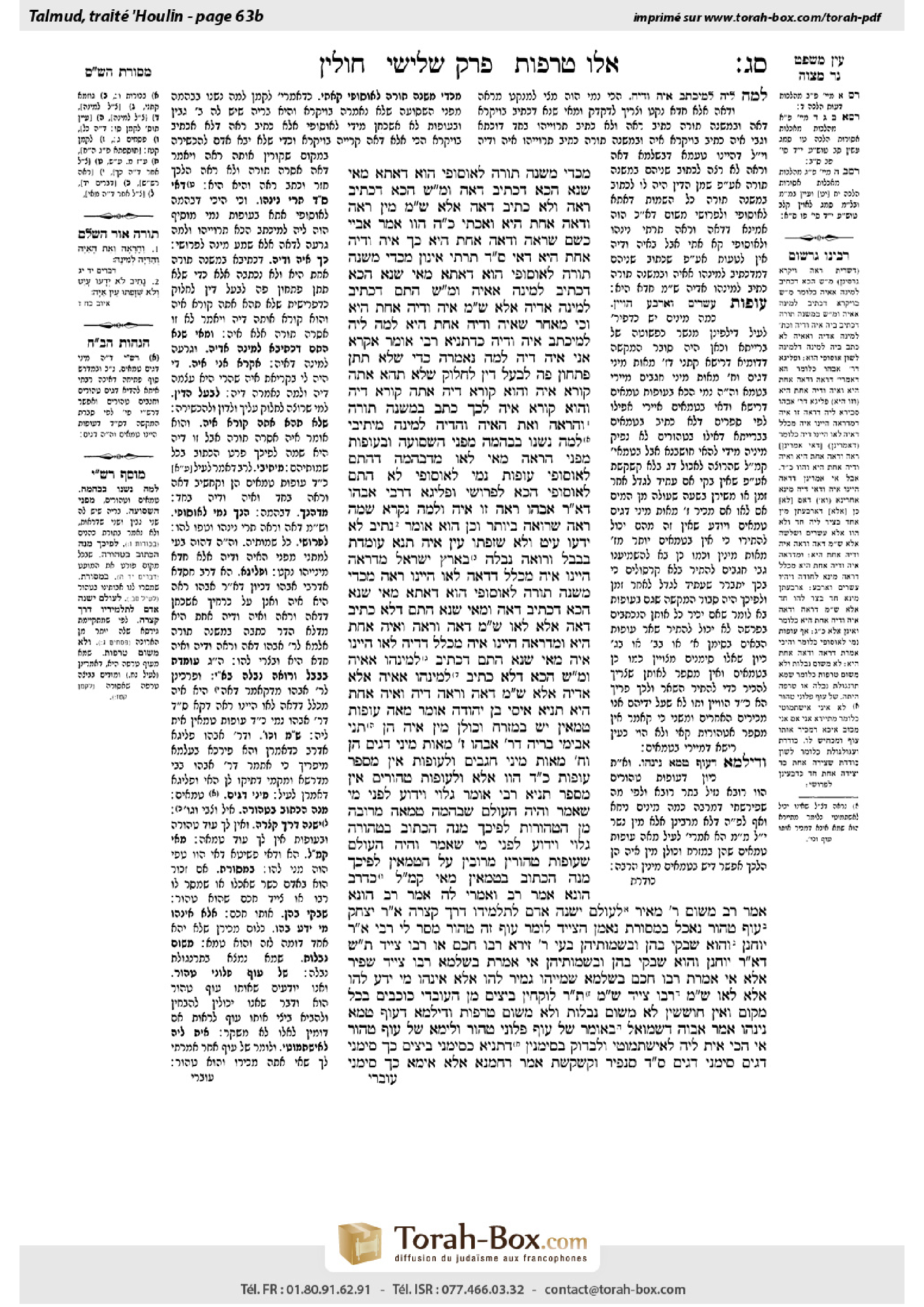
Chullin 63b: Talmud study for Daf Yomi
Study the Talmud for Daf Yomi with scanned pages, Hebrew text, English translations from Sefaria and AI-generated French translations.
Passage selection and English or AI-generated French translation are available where the scan has annotations. Daf Study is independent of Torah-Box and Sefaria.
Browse Chullin · חולין · All tractatesChullin 63b text and translations
This page of Chullin includes the Aramaic text, an English translation and an AI-generated French translation, alongside the scan above.
חולין ס״ג ב · Aramaic and Hebrew text
מִכְּדֵי מִשְׁנֵה תוֹרָה לְאוֹסוֹפֵי הוּא דַּאֲתָא, מַאי שְׁנָא הָכָא דִּכְתִיב ״דָּאָה״ וּמַאי שְׁנָא הָכָא דִּכְתִיב ״רָאָה״ וְלָא כְּתִיב ״דָּאָה״? אֶלָּא שְׁמַע מִינַּהּ מִין רָאָה וְדָאָה אַחַת הִיא.
וְאַכַּתִּי עֶשְׂרִין וְחַמְשָׁה הָווּ? אָמַר אַבָּיֵי: כְּשֵׁם שֶׁרָאָה וְדָאָה אַחַת הִיא, כָּךְ אַיָּה וְדַיָּה אַחַת הִיא. דְּאִי סָלְקָא דַּעְתָּךְ תַּרְתֵּי אִינּוּן, מִכְּדֵי מִשְׁנֵה תוֹרָה לְאוֹסוֹפֵי הוּא דַּאֲתָא, מַאי שְׁנָא הָכָא דִּכְתִיב ״לְמִינָהּ״ אַאַיָּה, וּמַאי שְׁנָא הָתָם דִּכְתִיב ״לְמִינָהּ״ אַדַּיָּה? אֶלָּא שְׁמַע מִינַּהּ: אַיָּה וְדַיָּה אַחַת הִיא.
וְכִי מֵאַחַר שֶׁאַיָּה וְדַיָּה אַחַת הִיא, לְמָה לֵיהּ לְמִיכְתַּב אַיָּה וְדַיָּה? כִּדְתַנְיָא, רַבִּי אוֹמֵר: אֶקְרָא אֲנִי אַיָּה, דַּיָּה לָמָּה נֶאֶמְרָה? כְּדֵי שֶׁלֹּא תִּתֵּן פִּתְחוֹן פֶּה לְבַעַל דִּין לַחְלוֹק, שֶׁלֹּא תְּהֵא אַתָּה קוֹרֵא אַיָּה וְהוּא קוֹרֵא דַּיָּה, אַתָּה קוֹרֵא דַּיָּה וְהוּא קוֹרֵא אַיָּה, לְכָךְ כָּתַב בְּמִשְׁנֵה תוֹרָה: ״וְהָרָאָה וְאֶת הָאַיָּה וְהַדַּיָּה לְמִינָהּ״.
מֵיתִיבִי: לָמָּה נִשְׁנוּ? בִּבְהֵמָה – מִפְּנֵי הַשְּׁסוּעָה, וּבָעוֹפוֹת – מִפְּנֵי הָרָאָה. מַאי לָאו, מִדִּבְהֵמָה דְּהָתָם לְאוֹסוֹפֵי, עוֹפוֹת נָמֵי לְאוֹסוֹפֵי? לָא, הָתָם לְאוֹסוֹפֵי, הָכָא לְפָרוֹשֵׁי.
וּפְלִיגָא דְּרַבִּי אֲבָהוּ, דְּאָמַר רַבִּי אֲבָהוּ: רָאָה זוֹ אַיָּה, וְלָמָּה נִקְרָא שְׁמָהּ רָאָה? שֶׁרוֹאָה בְּיוֹתֵר, וְכֵן הוּא אוֹמֵר: ״נָתִיב לֹא יְדָעוֹ עָיִט וְלֹא שְׁזָפַתּוּ עֵין אַיָּה״, תָּנָא: עוֹמֶדֶת בְּבָבֶל וְרוֹאָה נְבֵלָה בְּאֶרֶץ יִשְׂרָאֵל.
מִדְּרָאָה הַיְינוּ אַיָּה, מִכְּלָל דְּדָאָה לָאו הַיְינוּ רָאָה. מִכְּדֵי מִשְׁנֵה תוֹרָה לְאוֹסוֹפֵי הוּא דַּאֲתָא, מַאי שְׁנָא הָכָא דִּכְתִיב ״דָּאָה״, וּמַאי שְׁנָא הָתָם דְּלָא כְּתִיב ״דָּאָה״? אֶלָּא לָאו שְׁמַע מִינַּהּ דָּאָה וְרָאָה וְאַיָּה אַחַת הִיא.
וּמִדְּרָאָה הַיְינוּ אַיָּה, מִכְּלַל דְּדַיָּה לָאו הַיְינוּ אַיָּה. מַאי שְׁנָא הָתָם דִּכְתִיב ״לְמִינֵהוּ״ אַאַיָּה, וּמַאי שְׁנָא הָכָא דְּלָא כְּתִיב ״לְמִינֵהוּ״ אַאַיָּה אֶלָּא אַדַּיָּה? אֶלָּא שְׁמַע מִינַּהּ דָּאָה וְרָאָה דַּיָּה וְאַיָּה אַחַת הִיא.
תַּנְיָא, אִיסִי בֶּן יְהוּדָה אוֹמֵר: מֵאָה עוֹפוֹת טְמֵאִין יֵשׁ בַּמִּזְרָח, וְכוּלָּן מִין ״אַיָּה״ הֵן. תָּנֵי אֲבִימִי בְּרֵיהּ דְּרַבִּי אֲבָהוּ: שְׁבַע מֵאוֹת מִינֵי דָגִים הֵן, וּשְׁמוֹנֶה מֵאוֹת מִינֵי חֲגָבִים, וּלְעוֹפוֹת אֵין מִסְפָּר. עוֹפוֹת עֶשְׂרִין וְאַרְבָּעָה הָווּ! אֶלָּא: וּלְעוֹפוֹת טְהוֹרִים אֵין מִסְפָּר.
תַּנְיָא, רַבִּי אוֹמֵר: גָּלוּי וְיָדוּעַ לִפְנֵי מִי שֶׁאָמַר וְהָיָה הָעוֹלָם שֶׁבְּהֵמָה טְמֵאָה מְרוּבָּה מִן הַטְּהוֹרוֹת, לְפִיכָךְ מָנָה הַכָּתוּב בַּטְּהוֹרָה. גָּלוּי וְיָדוּעַ לִפְנֵי מִי שֶׁאָמַר וְהָיָה הָעוֹלָם שֶׁעוֹפוֹת טְהוֹרִין מְרוּבִּין עַל הַטְּמֵאִין, לְפִיכָךְ מָנָה הַכָּתוּב בַּטְּמֵאִין.
מַאי קָא מַשְׁמַע לַן? כִּדְרַב הוּנָא אָמַר רַב, וְאָמְרִי לַהּ אָמַר רַב הוּנָא אָמַר רַב מִשּׁוּם רַבִּי מֵאִיר: לְעוֹלָם יִשְׁנֶה אָדָם לְתַלְמִידוֹ דֶּרֶךְ קְצָרָה.
אָמַר רַבִּי יִצְחָק: עוֹף טָהוֹר נֶאֱכָל בְּמָסוֹרֶת, נֶאֱמָן הַצַּיָּיד לוֹמַר: עוֹף זֶה טָהוֹר, מָסַר לִי רַבִּי. אָמַר רַבִּי יוֹחָנָן: וְהוּא שֶׁבָּקִי בָּהֶן וּבִשְׁמוֹתֵיהֶן.
בָּעֵי רַבִּי זֵירָא: רַבּוֹ חָכָם, אוֹ רַבּוֹ צַיָּיד? תָּא שְׁמַע, דְּאָמַר רַבִּי יוֹחָנָן: וְהוּא שֶׁבָּקִי בָּהֶן וּבִשְׁמוֹתֵיהֶן. אִי אָמְרַתְּ בִּשְׁלָמָא רַבּוֹ צַיָּיד – שַׁפִּיר, אֶלָּא אִי אָמְרַתְּ רַבּוֹ חָכָם, בִּשְׁלָמָא שְׁמַיְיהוּ גְּמִיר לְהוּ, אֶלָּא אִינְהוּ מִי יָדַע לְהוּ? אֶלָּא לָאו שְׁמַע מִינַּהּ: רַבּוֹ צַיָּיד. שְׁמַע מִינַּהּ.
תָּנוּ רַבָּנַן: לוֹקְחִין בֵּיצִים מִן הַגּוֹיִם בְּכׇל מָקוֹם, וְאֵין חוֹשְׁשִׁין לֹא מִשּׁוּם נְבֵלוֹת וְלֹא מִשּׁוּם טְרֵפוֹת.
וְדִילְמָא דְּעוֹף טָמֵא נִינְהוּ? אָמַר אֲבוּהּ דִּשְׁמוּאֵל: בְּאוֹמֵר שֶׁל עוֹף פְּלוֹנִי טָהוֹר. וְלֵימָא שֶׁל עוֹף טָהוֹר? אִי הָכִי, אִית לֵיהּ לְאִישְׁתְּמוֹטֵי.
וְלִבְדּוֹק בְּסִימָנִין! דְּתַנְיָא: כְּסִימָנֵי בֵיצִים כָּךְ סִימָנֵי דָגִים. סִימָנֵי דָגִים סָלְקָא דַּעְתָּךְ? ״סְנַפִּיר וְקַשְׂקֶשֶׂת״ אָמַר רַחֲמָנָא! אֶלָּא אֵימָא: כָּךְ סִימָנֵי
Chullin 63b · English translation
one might ask: Since it is assumed that the list in Deuteronomy comes to add to the list in Leviticus, what is different here, in Leviticus, that it is written: “Da’a,” and what is different here, in Deuteronomy, that it is written: “Ra’a,” and da’a is not written? Rather, conclude from the presence of each on only one list that the ra’a and da’a are one species.
The Gemara objects: But still, there are twenty-five birds, not twenty-four. Abaye said: Just as the ra’a and da’a are one species, so too, the ayya and the dayya, the latter of which is mentioned only in Deuteronomy, are one species. As, if it enters your mind that they are two different species, one might ask: Since it is assumed that the list in Deuteronomy comes to add to the list in Leviticus, what is different here, in Leviticus, that it is written: “After its kinds,” about the ayya, prohibiting some other kind of ayya, and what is different there, in Deuteronomy, that it is written: “After its kinds,” about the dayya? Why is the ayya not mentioned? Rather, learn from the use of the same phrase with regard to the ayya and dayya that they are one species.
The Gemara asks: And now that the ayya and dayya are one species, why did the Torah need to write both ayya and dayya in Deuteronomy? The Gemara responds: As it is taught in a baraita that Rabbi Yehuda HaNasi says: Given that the two are one species, I will read ayya and know that it is forbidden. Why is dayya stated? It is so as not to give a claim to a litigant to disagree, and it should not occur that you call it an ayya and he calls it a dayya and eats it. Likewise, the Torah did not write only dayya so that it will not occur that you call it a dayya and he calls it an ayya and eats it. Therefore, the Torah writes in Deuteronomy: “And the ra’a, and the ayya, and the dayya after its kinds” (Deuteronomy 14:13). Consequently, both the list in Leviticus and that in Deuteronomy enumerate twenty-four birds, in accordance with the statement attributed to Rav.
The Gemara raises an objection from a baraita: Why is the list of non-kosher animals in Leviticus repeated? It is due to the necessity of adding the shesua (Deuteronomy 14:7), which was not listed in Leviticus. And the list of non-kosher birds is repeated due to the ra’a. What, is it not understood from the fact that the extra list of animals there, in Deuteronomy, is to add animals, that the list of birds is also repeated to add birds? The Gemara responds: No, there, i.e., with regard to animals, the list is repeated to add, but here, with regard to birds, it is repeated only to explain.
And the opinion that the da’a and ra’a are one species, and that the ayya and dayya are another species, differs from the opinion of Rabbi Abbahu, as Rabbi Abbahu says: The ra’a is the ayya. And why is it called the ra’a? Since it sees [ro’ah] most vividly. And so the verse states: “That path no bird of prey knows, neither has the eye of the ayya seen it” (Job 28:7). And a Sage taught: The ra’a can stand in Babylonia and see a carcass in Eretz Yisrael.
The Gemara discusses Rabbi Abbahu’s statement: Since the ra’a is the same as the ayya, by inference, one may conclude that the da’a is not the same as the ra’a; otherwise, there are not twenty-four non-kosher birds. But since it is assumed that the list in Deuteronomy comes to add to the list in Leviticus, what is different here, in Leviticus, that it is written: “Da’a,” and what is different there, in Deuteronomy, that da’a is not written? Rather, must one not conclude from the discrepancy that the two are the same? If so, one must conclude that according to Rabbi Abbahu, the da’a and ra’a and ayya are all one species.
And furthermore, from the fact that Rabbi Abbahu holds that the ra’a is the same as the ayya, by inference, one may conclude that the dayya is not the same as the ayya. But if so, one may ask again: What is different there, in Leviticus, that it is written: “After its kinds,” about the ayya, and what is different here, in Deuteronomy, that it is not written: “After its kinds,” about the ayya but about the dayya? Rather, the ayya and dayya must be one species. And one may learn from the combination of the two disputes that according to Rabbi Abbahu, the da’a and ra’a, dayya and ayya are all one species. Consequently, according to Rabbi Abbahu, there are only twenty-three non-kosher species.
§ With regard to the phrase: “The ayya after its kinds” (Leviticus 11:14), it is taught in a baraita that Isi ben Yehuda says: There are one hundred non-kosher birds in the East, and they are all species of ayya. Avimi, son of Rabbi Abbahu, taught: There are seven hundred types of non-kosher fish, and eight hundred types of non-kosher grasshopper, and there are countless birds. The Gemara protests: Are there countless non-kosher birds? But there are only twenty-four non-kosher birds mentioned in the Torah. Rather, Avimi must have meant: And there are countless kosher birds.
It is taught in a baraita: Rabbi Yehuda HaNasi says: It is revealed and known before the One Who spoke and the world came into being that the species of non-kosher animals are more numerous than the kosher ones. Therefore, the Torah lists the kosher animals, teaching that all the rest are non-kosher. On the other hand, it is revealed and known before the One Who spoke and the world came into being that the species of kosher birds are more numerous than the non-kosher ones. Therefore, the Torah lists the non-kosher birds.
The Gemara asks: What is this baraita teaching us? The Gemara responds: As Rav Huna says that Rav says, and some say that Rav Huna says that Rav says in the name of Rabbi Meir: A person should always teach his student in a concise manner, just as the Torah is concise in its language.
Rabbi Yitzḥak says: A kosher bird may be eaten on the strength of a tradition that it is kosher, without inspecting for the signs listed in the mishna. And the hunter is deemed credible to say: My teacher conveyed to me that this bird is kosher. Rabbi Yoḥanan said: And this is the halakha only when the teacher is familiar with the non-kosher birds and with their names.
Rabbi Zeira raises a dilemma: Was Rabbi Yoḥanan referring to the hunter’s teacher the Sage, or to his teacher the hunter, i.e., the one who taught him how to hunt? The Gemara responds: Come and hear proof from that which Rabbi Yoḥanan said: And this applies only when the teacher is familiar with them and with their names. Granted, if you say this is referring to his teacher the hunter, this works out well. But if you say it is referring to his teacher the Sage, granted, a Sage will know their names, since he has learned them, but does he recognize the birds themselves? Rather, must one not conclude from it that Rabbi Yoḥanan referred to his teacher the hunter? The Gemara concludes: Indeed, conclude from it that this is so.
§ The Sages taught in a baraita: One may buy eggs from the gentiles anywhere, and one need not be concerned, neither with regard to carcasses, i.e., that the egg may have been removed from a carcass of a bird and therefore forbidden, nor with regard to eggs from tereifot, because neither of these possibilities is likely.
The Gemara objects: But perhaps they are from a non-kosher bird. Shmuel’s father said: The baraita is referring to a case where the gentile says they are of such and such bird, which is known to be kosher. The Gemara challenges: But if the gentile is deemed credible, let him say only that they are of a kosher bird. Why does he need to name the species? The Gemara responds: If so, if he does not name the species, he has the opportunity to deflect scrutiny if he is dishonest; but if he names the species, one can bring other eggs of the same species to compare and validate the claim.
The Gemara asks: But why must one rely on the gentile? Let him inspect the eggs for signs, as it is taught in a baraita: Like the signs of kosher eggs, so too are the signs of fish. The Gemara interjects: Can it enter your mind that the baraita is referring to the signs of fish? The Merciful One states them explicitly in the Torah: “Fins and scales” (Leviticus 11:9). Rather, say: So too are the signs of
Chullin 63b · Traduction française (IA)
On pourrait demander : puisque l'on suppose que la liste du Deutéronome vient ajouter à celle du Lévitique, qu'est-ce qui diffère ici, dans le Lévitique, que l'on lit : « Da’a », et qu'est-ce qui diffère ici, dans le Deutéronome, que l'on lit : « Ra’a », et que « Da’a » n'est pas écrit ? Plutôt, concluez de la présence de chacun sur une seule liste que « Ra’a » et « Da’a » sont une seule espèce.
La Guemara s'oppose à cela : mais alors, il y a vingt-cinq oiseaux, pas vingt-quatre. Abaye dit : Tout comme « Ra’a » et « Da’a » sont une seule espèce, de même, l'ayya et la dayya, la dernière étant mentionnée uniquement dans le Deutéronome, sont une seule espèce. Car, si cela vous vient à l'esprit qu'il s'agit de deux espèces différentes, on pourrait demander : puisque l'on suppose que la liste du Deutéronome vient ajouter à celle du Lévitique, qu'est-ce qui diffère ici, dans le Lévitique, que l'on lit : « Après ses espèces », concernant l'ayya, interdisant une autre espèce d'ayya, et qu'est-ce qui diffère là, dans le Deutéronome, que l'on lit : « Après ses espèces », concernant la dayya ? Pourquoi l'ayya n'est-elle pas mentionnée ? Plutôt, apprenez de l'emploi du même phrasé concernant l'ayya et la dayya que ces deux sont une seule espèce.
La Guemara pose une question : et maintenant que l'ayya et la dayya sont une seule espèce, pourquoi la Torah a-t-elle besoin d'écrire à la fois ayya et dayya dans le Deutéronome ? La Guemara répond : Comme il est enseigné dans une baraïta que Rabbi Yéhuda HaNasi dit : Puisque les deux sont une seule espèce, je lirai ayya et je saurai qu'il est interdit. Pourquoi dayya est-il mentionné ? C'est afin de ne pas laisser un litigeur prétendre à un désaccord, et afin que cela ne se produise pas que vous l'appeliez ayya et lui dayya et qu'il l'eat. De même, la Torah n'a pas écrit que dayya seul afin que cela ne se produise pas que vous l'appeliez dayya et lui ayya et qu'il l'eat. Ainsi, la Torah écrit dans le Deutéronome : « Et le ra’a, et l'ayya, et la dayya après ses espèces » (Deutéronome 14:13). Par conséquent, à la fois la liste du Lévitique et celle du Deutéronome énumèrent vingt-quatre oiseaux, conformément à l'affirmation attribuée à Rav.
La Guemara soulève une objection à partir d'une baraïta : pourquoi la liste des animaux non-kosher dans le Lévitique est-elle répétée ? C'est à cause de la nécessité d'ajouter le shesua (Deutéronome 14:7), qui n'était pas listé dans le Lévitique. Et la liste des oiseaux non-kosher est répétée à cause du ra’a. Qu'est-ce que cela signifie ? N'est-ce pas compris du fait que la liste supplémentaire d'animaux là, dans le Deutéronome, est pour ajouter des animaux, que la liste des oiseaux est également répétée pour ajouter des oiseaux ? La Guemara répond : Non, là, c'est-à-dire concernant les animaux, la liste est répétée pour ajouter, mais ici, concernant les oiseaux, elle est répétée uniquement pour expliquer.
Et l'opinion selon laquelle le da’a et le ra’a sont une seule espèce, et que l'ayya et la dayya sont une autre espèce, diffère de l'opinion de Rabbi Abbahu, car Rabbi Abbahu dit : le ra’a est l'ayya. Et pourquoi est-il appelé ra’a ? Parce qu'il voit [ro’ah] le plus clairement. Et ainsi, la Sainte Écriture dit : « Ce chemin n'a pas été connu par un oiseau de proie, ni l'œil de l'ayya ne l'a vu » (Job 28:7). Et un Sage a enseigné : le ra’a peut se tenir en Babylonie et voir un cadavre en Terre d'Israël.
La Guemara discute de l'affirmation de Rabbi Abbahu : puisque le ra’a est le même que l'ayya, par déduction, on peut conclure que le da’a n'est pas le même que le ra’a ; autrement, il n'y aurait pas vingt-quatre oiseaux non-kosher. Mais puisque l'on suppose que la liste du Deutéronome vient ajouter à celle du Lévitique, qu'est-ce qui diffère ici, dans le Lévitique, que l'on lit : « Da’a », et qu'est-ce qui diffère là, dans le Deutéronome, que « Da’a » n'est pas écrit ? Plutôt, ne doit-on pas conclure de la différence que les deux sont les mêmes ? Si tel est le cas, on doit conclure que selon Rabbi Abbahu, le da’a et le ra’a et l'ayya sont tous une seule espèce.
Et de plus, du fait que Rabbi Abbahu maintient que le ra’a est le même que l'ayya, par déduction, on peut conclure que la dayya n'est pas le même que l'ayya. Mais si tel est le cas, on pourrait poser à nouveau une question : qu'est-ce qui diffère là, dans le Lévitique, que l'on lit : « Après ses espèces », concernant l'ayya, et qu'est-ce qui diffère ici, dans le Deutéronome, que l'on ne lit pas : « Après ses espèces », concernant l'ayya mais concernant la dayya ? Plutôt, l'ayya et la dayya doivent être une seule espèce. Et on peut apprendre de la combinaison des deux disputes que selon Rabbi Abbahu, le da’a et le ra’a, la dayya et l'ayya sont tous une seule espèce. Par conséquent, selon Rabbi Abbahu, il n'y a que vingt-trois espèces non-kosher.
§ Concernant la phrase : « L'ayya après ses espèces » (Lévitique 11:14), il est enseigné dans une baraïta que Isi ben Yéhuda dit : Il y a cent oiseaux non-kosher dans l'Est, et ils sont toutes des espèces d'ayya. Avimi, fils de Rabbi Abbahu, enseigna : Il y a sept cents types de poissons non-kosher, et huit cents types de sauterelles non-kosher, et il y a des oiseaux innombrables. La Guemara proteste : Y a-t-il des oiseaux non-kosher innombrables ? Mais il n'y a que vingt-quatre oiseaux non-kosher mentionnés dans la Torah. Plutôt, Avimi doit avoir voulu dire : et il y a des oiseaux kosher innombrables.
Il est enseigné dans une baraïta : Rabbi Yéhuda HaNasi dit : Il est révélé et connu devant celui qui a parlé et dont le monde est né que les espèces d'animaux non-kosher sont plus nombreuses que les espèces d'animaux kosher. Par conséquent, la Torah liste les animaux kosher, enseignant que toutes les autres sont non-kosher. D'un autre côté, il est révélé et connu devant celui qui a parlé et dont le monde est né que les espèces d'oiseaux kosher sont plus nombreuses que les espèces d'oiseaux non-kosher. Par conséquent, la Torah liste les oiseaux non-kosher.
La Guemara pose une question : Qu'est-ce que cette baraïta nous enseigne ? La Guemara répond : Comme Rav Huna dit que Rav a dit, et certains disent que Rav Huna dit que Rav a dit en nom de Rabbi Meir : une personne doit toujours enseigner à son élève de manière concise, tout comme la Torah est concise dans sa langue.
Rabbi Yitzhak dit : un oiseau kosher peut être mangé sur la base d'une tradition selon laquelle il est kosher, sans inspecter les signes mentionnés dans la mishna. Et le chasseur est considéré comme crédible pour dire : mon maître m'a transmis que cet oiseau est kosher. Rabbi Yoḥanan dit : et c'est la halakha uniquement lorsque le maître est familier avec les oiseaux non-kosher et leurs noms.
Rabbi Zéira soulève un dilemme : Rabbi Yoḥanan faisait-il référence au maître du chasseur, le Sage, ou à son maître, le chasseur, c'est-à-dire celui qui l'a appris à chasser ? La Guemara répond : Viens entendre la preuve que Rabbi Yoḥanan a donnée : cela s'applique uniquement lorsque le maître connaît les oiseaux et leurs noms. Bien sûr, si tu dis qu'il s'agit de son maître, le chasseur, cela s'explique bien. Mais si tu dis qu'il s'agit de son maître, le Sage, bien sûr, un Sage connaît les noms, puisqu'il les a appris, mais reconnaît-il les oiseaux eux-mêmes ? Plutôt, ne doit-on pas conclure de cela que Rabbi Yoḥanan faisait référence à son maître, le chasseur ? La Guemara conclut : En effet, conclure de cela que c'est ainsi.
§ Les Sages enseignent dans une baraïta : On peut acheter des œufs aux non-Juifs partout, et on n'a pas à s'inquiéter, ni en ce qui concerne les cadavres, c'est-à-dire que l'œuf puisse avoir été retiré d'un cadavre d'oiseau et donc interdit, ni en ce qui concerne les œufs de tereifot, car ces possibilités ne sont pas probables.
La Guemara s'oppose : Mais peut-être qu'ils proviennent d'un oiseau non-kosher. Le père de Shmuel dit : la baraïta fait référence à un cas où le non-Juif dit qu'ils sont des oiseaux tels et tels, qui sont connus pour être kosher. La Guemara conteste : Mais si le non-Juif est considéré comme crédible, qu'il dise simplement qu'ils sont des oiseaux kosher. Pourquoi a-t-il besoin de nommer l'espèce ? La Guemara répond : Si c'est ainsi, si il ne nomme pas l'espèce, il a l'opportunité de détourner l'attention s'il est menteur ; mais si il nomme l'espèce, on peut apporter d'autres œufs de la même espèce pour les comparer et valider l'affirmation.
La Guemara demande : Mais pourquoi doit-on se fier au non-Juif ? Laisse-le inspecter les œufs pour des signes, comme il est enseigné dans une baraïta : Comme les signes des œufs kasher, ainsi sont aussi les signes des poissons. La Guemara intercale : Peut-on penser que la baraïta fait référence aux signes des poissons ? L'Éternel dit clairement dans la Torah : « Ailes et écailles » (Lévitique 11:9). Plutôt, dis : Ainsi sont aussi les signes de
Traduction française générée par IA à partir de l’édition anglaise de Sefaria. Vérifie toujours un passage avec le texte source.
Text from Sefaria: William Davidson Edition - Vocalized Aramaic (unknown); William Davidson Edition - English (CC BY NC).