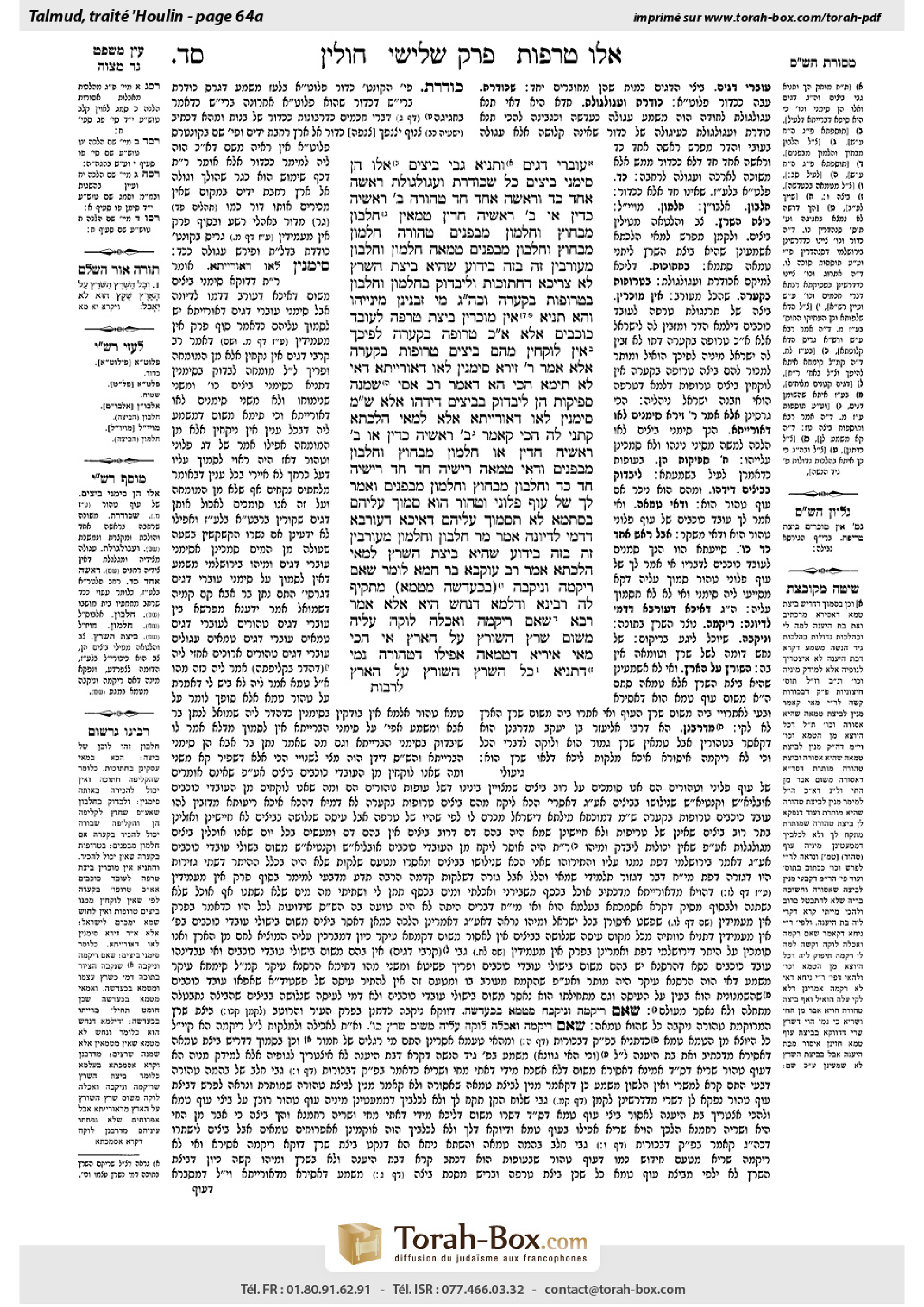
Chullin 64a: Talmud study for Daf Yomi
Study the Talmud for Daf Yomi with scanned pages, Hebrew text, English translations from Sefaria and AI-generated French translations.
Passage selection and English or AI-generated French translation are available where the scan has annotations. Daf Study is independent of Torah-Box and Sefaria.
Browse Chullin · חולין · All tractatesChullin 64a text and translations
This page of Chullin includes the Aramaic text, an English translation and an AI-generated French translation, alongside the scan above.
חולין ס״ד א · Aramaic and Hebrew text
עוּבְּרֵי דָּגִים.
וְתַנְיָא גַּבֵּי בֵיצִים: אֵלּוּ הֵן סִימָנֵי בֵיצִים – כָּל שֶׁכּוֹדֶרֶת וַעֲגוּלְגּוֹלֶת, רֹאשָׁהּ אֶחָד כַּד וְרֹאשָׁהּ אֶחָד חַד – טְהוֹרָה, שְׁנֵי רָאשֶׁיהָ כַּדִּין אוֹ שְׁנֵי רָאשֶׁיהָ חַדִּין – טְמֵאִין. חֶלְבּוֹן מִבַּחוּץ וְחֶלְמוֹן מִבִּפְנִים – טְהוֹרָה, חֶלְמוֹן מִבַּחוּץ וְחֶלְבּוֹן מִבְּפָנִים – טְמֵאָה, חֶלְמוֹן וְחֶלְבּוֹן מְעוֹרָבִין זֶה בָּזֶה – בְּיָדוּעַ שֶׁהִיא בֵּיצַת הַשֶּׁרֶץ.
לָא צְרִיכָא, דַּחֲתוּכוֹת. וְלִיבְדּוֹק בְּחֶלְמוֹן וְחֶלְבּוֹן? בִּטְרוּפוֹת בִּקְעָרָה.
וּכְהַאי גַּוְונָא מִי זָבְנִינַן מִינַּיְיהוּ? וְהָא תַּנְיָא: אֵין מוֹכְרִין בֵּיצַת טְרֵפָה לְגוֹי, אֶלָּא אִם כֵּן טְרוּפָה בִּקְעָרָה; לְפִיכָךְ אֵין לוֹקְחִין מֵהֶם בֵּיצִים טְרוּפוֹת בִּקְעָרָה.
אֶלָּא אָמַר רַבִּי זֵירָא: סִימָנִין לָאו דְּאוֹרָיְיתָא, דְּאִי לָא תֵּימָא הָכִי, הָא דְּאָמַר רַב אַסִּי: שְׁמֹנָה סְפֵיקוֹת הֵן – לִיבְדּוֹק בְּבֵיצִים דִּידְהוּ! אֶלָּא שְׁמַע מִינַּהּ: סִימָנִין לָאו דְּאוֹרָיְיתָא.
אֶלָּא לְמַאי הִלְכְתָא קָתָנֵי לַהּ? הָכִי קָאָמַר: שְׁנֵי רָאשֶׁיהָ כַּדִּין, אוֹ שְׁנֵי רָאשֶׁיהָ חַדִּין, אוֹ חֶלְמוֹן מִבַּחוּץ וְחֶלְבּוֹן מִבִּפְנִים – וַדַּאי טְמֵאָה. רֵישֵׁיהּ חַד חַד, רֵישֵׁיהּ חַד כַּד, וְחֶלְבּוֹן מִבַּחוּץ וְחֶלְמוֹן מִבִּפְנִים, וְאָמַר לָךְ שֶׁל עוֹף פְּלוֹנִי וְטָהוֹר הוּא – סְמוֹךְ עֲלֵיהּ. בִּסְתָמָא – לָא תִּסְמוֹךְ עֲלֵיהּ, דְּאִיכָּא דְּעוֹרְבָא דְּדָמֵי לִדְיוֹנָה.
אָמַר מָר: חֶלְבּוֹן וְחֶלְמוֹן מְעוֹרָבִין זֶה בָּזֶה – בְּיָדוּעַ שֶׁהִיא בֵּיצַת הַשֶּׁרֶץ. לְמַאי הִלְכְתָא? אָמַר רַב עוּקְבָא בַּר חָמָא: לוֹמַר שֶׁאִם רִיקְּמָה וְנִיקְּבָה בְּכַעֲדָשָׁה – מְטַמֵּא.
מַתְקֵיף לַהּ רָבִינָא: וְדִלְמָא דְּנָחָשׁ הִיא? אֶלָּא אָמַר רָבָא: שֶׁאִם רִיקְּמָה וְאָכְלָה – לוֹקֶה עָלֶיהָ מִשּׁוּם ״שֶׁרֶץ הַשֹּׁרֵץ עַל הָאָרֶץ״.
אִי הָכִי, מַאי אִירְיָא דִּטְמֵאָה? אֲפִילּוּ דִּטְהוֹרָה נָמֵי! דְּתַנְיָא: ״כׇּל הַשֶּׁרֶץ הַשֹּׁרֵץ עַל הָאָרֶץ״ –
Chullin 64a · English translation
fish embryos, i.e., fish eggs found in the fish’s innards.
The Gemara continues: And it is taught in a baraita about eggs that these are the signs of bird eggs: Any egg that narrows at the top and is rounded, so that one of its ends is rounded and the other one of its ends is pointed, is kosher. If both of its ends are rounded or both of its ends are pointed, they are non-kosher. If the albumen is on the outside and the yolk on the inside, it is kosher. If the yolk is on the outside and the albumen on the inside, it is non-kosher. If the yolk and albumen are mixed with each other, it is certainly the egg of a creeping animal. Therefore, if it is possible to recognize a kosher egg by these signs, there is no need to rely on the gentile.
The Gemara responds: No, it is necessary if the eggs have already been cut and one cannot know their original shape. The Gemara challenges: But let him inspect the yolk and the albumen, to see which is inside and which is outside. The Gemara responds: The baraita deals with a case where the eggs are mixed in a bowl, and it is impossible to discern this.
The Gemara counters: But in a case like this, where the eggs are mixed, may we buy eggs from them? Isn’t it taught in another baraita: One may sell the egg of a tereifa bird to a gentile only if it is mixed in a bowl; therefore, one may not buy eggs mixed in a bowl from them, because they may be from tereifot? If so, it cannot be that the baraita deals with a case where they are mixed, and one should be able to inspect the yolk and albumen.
Rather, Rabbi Zeira said: The signs of a kosher egg are not valid by Torah law. As, if you do not say so, one encounters difficulty with that which Rav Asi says: There are eight birds whose kosher status is uncertain. Why is there uncertainty? Let one inspect their eggs for the signs listed in the baraita to determine whether they are kosher. Rather, learn from it that the signs are not valid by Torah law and one may not rely on them.
The Gemara asks: But if one may not rely on these signs, with regard to what halakha is the baraita teaching them? The Gemara responds: This is what the baraita is saying: If both of its ends are rounded, or both its ends are pointed, or the yolk is on the outside and the albumen is on the inside, it is certainly non-kosher. But if one of its ends is pointed and one of its ends is rounded, and the albumen is on the outside and the yolk on the inside, and the gentile says to you that it is from such and such bird, and that bird is kosher, rely on the signs. But if he offers no specification of the type of bird, or if one simply finds eggs with these signs, do not rely on them, since there are crow’s eggs that resemble those of a pigeon.
The Gemara analyzes the baraita: The Master said: If the albumen and yolk are mixed with each other, it is certainly the egg of a creeping animal and not of a non-kosher bird. The Gemara asks: For what halakha is this information necessary? Either way, the egg is forbidden. Rav Ukva bar Ḥama said: The baraita means to say that if tissue of an embryo developed [rikema] inside it and it was perforated, and one touched it, it transmits ritual impurity provided that the embryo is at least the size of a lentil-bulk, because the carcass of a creeping animal of this size is a source of ritual impurity.
Ravina objects to this: But perhaps it is the egg of a snake, whose carcass does not transmit ritual impurity, even though the albumen and yolk of its eggs are mixed together. Rather, Rava said: The baraita does not teach about ritual impurity, but rather that if tissue of an embryo developed inside the egg and one ate it, he is flogged on its account, due to the prohibition: “And every swarming thing that swarms upon the earth is a detestable thing; it shall not be eaten” (Leviticus 11:41).
The Gemara asks: If so, why specifically mention the egg of a non-kosher creeping animal? The same would apply even for one who eats the embryo of a kosher bird as well. In either case, one is flogged, as it is taught in a baraita that the verse: “Every swarming thing that swarms upon the earth,”
Chullin 64a · Traduction française (IA)
des embryons de poissons, c'est-à-dire des œufs de poissons trouvés dans les entrailles du poisson.
La Guemara continue : Et il est enseigné dans une baraïta concernant les œufs que ces sont les signes des œufs d'oiseaux : tout œuf qui se rétrécit vers le haut et est arrondi, de sorte qu'un de ses extrémités est arrondie et l'autre est pointue, est acceptable. Si les deux extrémités sont arrondies ou si les deux sont pointues, ils sont non acceptables. Si la claire est à l'extérieur et le jaune à l'intérieur, il est acceptable. Si le jaune est à l'extérieur et la claire à l'intérieur, il est non acceptable. Si le jaune et la claire sont mélangés, c'est certainement l'œuf d'un animal rampant. Ainsi, si l'on peut reconnaître un œuf acceptable par ces signes, il n'est pas nécessaire de se fier aux non-Juifs.
La Guemara répond : Non, il est nécessaire si les œufs ont déjà été coupés et qu'on ne peut pas connaître leur forme originale. La Guemara conteste : Mais qu'il examine la claire et le jaune, pour voir lequel est à l'intérieur et lequel est à l'extérieur. La Guemara répond : La baraïta traite d'un cas où les œufs sont mélangés dans un bol et il est impossible de distinguer cela.
La Guemara réplique : Mais dans un cas comme celui-ci, où les œufs sont mélangés, peut-on acheter des œufs d'eux ? N'est-il pas enseigné dans une autre baraïta : On peut vendre l'œuf d'un oiseau téréif à un non-Juif uniquement s'il est mélangé dans un bol ; donc, on ne peut pas acheter des œufs mélangés dans un bol d'eux, car ils pourraient être d'oiseaux téréifs ? Si c'est ainsi, il ne peut pas être que la baraïta traite d'un cas où ils sont mélangés, et qu'on puisse inspecter la claire et le jaune.
Plutôt, Rabbi Zéira a dit : Les signes d'un œuf acceptable ne sont pas valides selon la Loi. Car, si l'on ne dit pas cela, on rencontre une difficulté avec ce que Rav Asi dit : Il y a huit oiseaux dont le statut acceptable est incertain. Pourquoi y a-t-il incertitude ? Qu'on examine leurs œufs pour les signes énumérés dans la baraïta afin de déterminer s'ils sont acceptables. Plutôt, apprendre de cela que les signes ne sont pas valides selon la Loi et qu'on ne peut pas s'y fier.
La Guemara demande : Mais si l'on ne peut pas s'appuyer sur ces signes, à quel halakha la baraïta les enseigne-t-elle ? La Guemara répond : C'est ce que la baraïta dit : Si les deux extrémités sont arrondies, ou si les deux extrémités sont pointues, ou si le jaune est à l'extérieur et la claire à l'intérieur, c'est certainement non acceptable. Mais si l'une des extrémités est pointue et l'autre arrondie, et que la claire est à l'extérieur et le jaune à l'intérieur, et que le non-Juif vous dit que c'est l'œuf d'un tel oiseau, et que cet oiseau est acceptable, s'y fier. Mais s'il ne précise pas le type d'oiseau, ou si l'on trouve simplement des œufs avec ces signes, ne pas s'y fier, car les œufs de corbeau ressemblent à ceux de moineau.
La Guemara analyse la baraïta : Le Maître a dit : Si la claire et le jaune sont mélangés, c'est certainement l'œuf d'un animal rampant et non d'un oiseau non acceptable. La Guemara demande : Pour quelle halakha cette information est-elle nécessaire ? Quoi qu'il en soit, l'œuf est interdit. Rav Ukva bar Ḥama a dit : La baraïta veut dire que si un tissu d'un embryon s'est développé à l'intérieur et qu'il a été perforé, et qu'on a touché, il transmet la souillure rituelle à condition que l'embryon soit de la taille d'un bol de lentilles, car le cadavre d'un animal rampant de cette taille est une source de souillure rituelle.
Ravina s'oppose à cela : Mais peut-être que c'est l'œuf d'un serpent, dont le cadavre ne transmet pas la souillure rituelle, même si la claire et le jaune de ses œufs sont mélangés. Plutôt, Rava a dit : La baraïta ne parle pas de la souillure rituelle, mais plutôt que si un tissu d'un embryon s'est développé à l'intérieur de l'œuf et qu'on l'a mangé, on est battu à cause de l'interdiction : « Et toute créature qui rampe sur la terre est une chose abominable ; elle ne doit pas être mangée » (Lévitique 11:41).
La Guemara demande : Si c'est ainsi, pourquoi spécifiquement mentionner l'œuf d'un animal rampant non acceptable ? La même chose s'appliquerait même à celui qui mange l'embryon d'un oiseau acceptable. Dans les deux cas, on est battu, comme il est enseigné dans une baraïta que la verset : « Toute créature qui rampe sur la terre »,
Traduction française générée par IA à partir de l’édition anglaise de Sefaria. Vérifie toujours un passage avec le texte source.
Text from Sefaria: William Davidson Edition - Vocalized Aramaic (unknown); William Davidson Edition - English (CC BY NC).