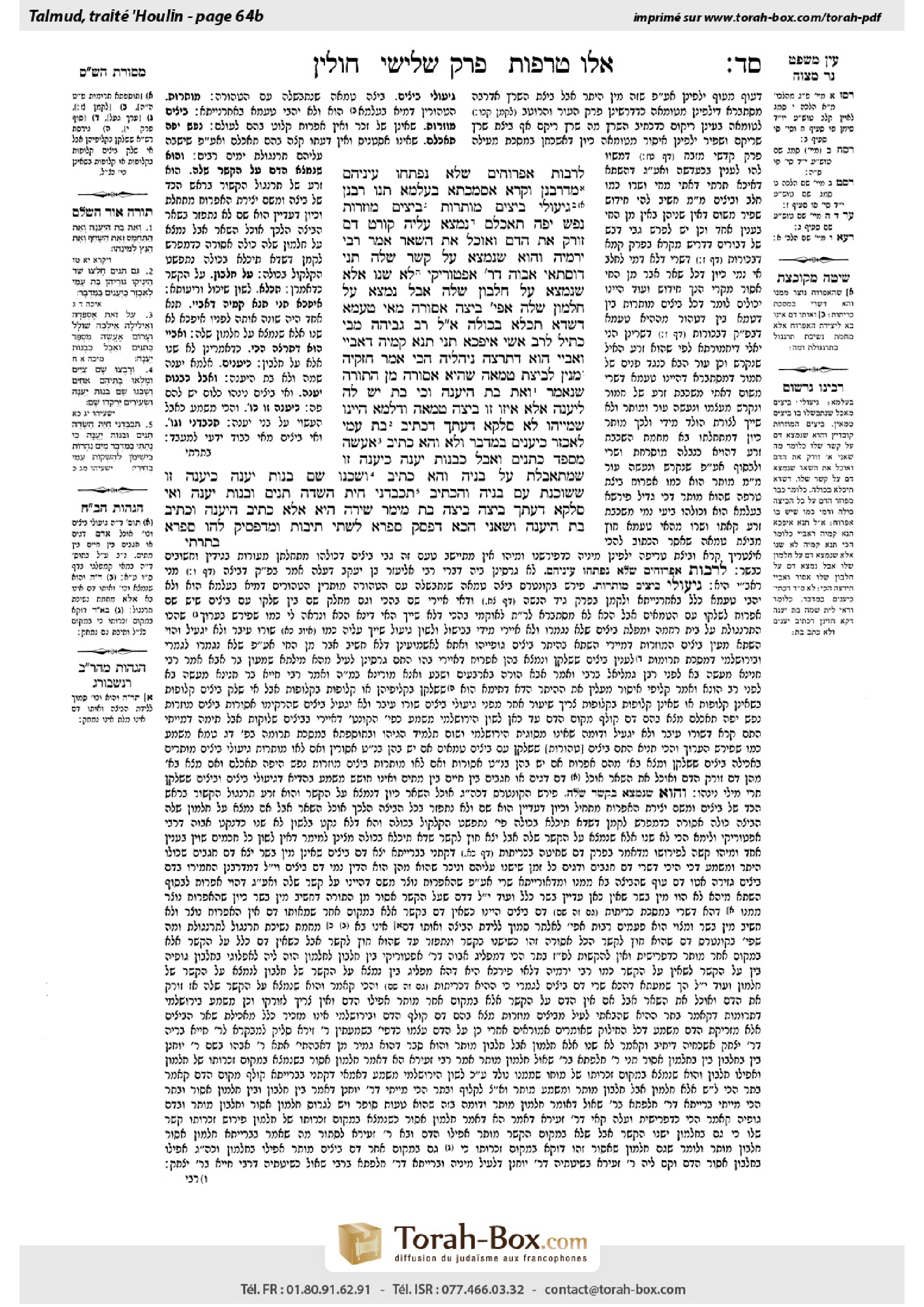
Chullin 64b: Talmud study for Daf Yomi
Study the Talmud for Daf Yomi with scanned pages, Hebrew text, English translations from Sefaria and AI-generated French translations.
Passage selection and English or AI-generated French translation are available where the scan has annotations. Daf Study is independent of Torah-Box and Sefaria.
Browse Chullin · חולין · All tractatesChullin 64b text and translations
This page of Chullin includes the Aramaic text, an English translation and an AI-generated French translation, alongside the scan above.
חולין ס״ד ב · Aramaic and Hebrew text
לְרַבּוֹת אֶפְרוֹחִים שֶׁלֹּא נִפְתְּחוּ עֵינֵיהֶם! מִדְּרַבָּנַן, וּקְרָא אַסְמַכְתָּא בְּעָלְמָא.
תָּנוּ רַבָּנַן: גִּיעוּלֵי בֵּיצִים מוּתָּרוֹת, בֵּיצִים מוּזָרוֹת – נֶפֶשׁ יָפָה תֹּאכְלֵם, נִמְצָא עָלֶיהָ קוֹרֶט דָּם – זוֹרֵק אֶת הַדָּם וְאוֹכֵל אֶת הַשְּׁאָר.
אָמַר רַבִּי יִרְמְיָה: וְהוּא שֶׁנִּמְצָא עַל קֶשֶׁר שֶׁלָּהּ. תָּנֵי דּוֹסְתַּאי אֲבוּהּ דְּרַבִּי אַפְטוֹרִיקִי: לֹא שָׁנוּ אֶלָּא שֶׁנִּמְצָא עַל חֶלְבּוֹן שֶׁלָּהּ, אֲבָל נִמְצָא עַל חֶלְמוֹן שֶׁלָּהּ – אֲפִילּוּ בֵּיצָה אֲסוּרָה. מַאי טַעְמָא? דִּשְׁדָא תִּכְלָא בְּכוּלַּהּ. אֲמַר לֵיהּ רַב גְּבִיהָה מִבֵּי כְתִיל לְרַב אָשֵׁי: אִיפְּכָא תָּנֵי תַּנָּא קַמֵּיהּ דְּאַבָּיֵי, וְאַבָּיֵי הוּא דְּתָרְצַהּ נִיהֲלֵיהּ הָכִי.
אָמַר חִזְקִיָּה: מִנַּיִן לְבֵיצַת טְמֵאָה שֶׁהִיא אֲסוּרָה מִן הַתּוֹרָה? שֶׁנֶּאֱמַר: ״וְאֶת בַּת הַיַּעֲנָה״, וְכִי בַּת יֵשׁ לָהּ לַיַּעֲנָה? אֶלָּא אֵיזוֹ – זוֹ בֵּיצָה טְמֵאָה. וְדִלְמָא הַיְינוּ שְׁמַיְיהוּ? לָא סָלְקָא דַּעְתָּךְ, דִּכְתִיב: ״בַּת עַמִּי לְאַכְזָר כַּיְעֵנִים בַּמִּדְבָּר״.
וְלָא? וְהָא כְּתִיב: ״אֶעֱשֶׂה מִסְפֵּד כַּתַּנִּים וְאֵבֶל כִּבְנוֹת יַעֲנָה״? כְּיַעֲנָה זוֹ שֶׁמִּתְאַבֶּלֶת עַל בָּנֶיהָ. וְהָא כְּתִיב: ״וְשָׁכְנוּ שָׁם בְּנוֹת יַעֲנָה״? כְּיַעֲנָה זוֹ שֶׁשּׁוֹכֶנֶת עִם בָּנֶיהָ.
וְהָכְתִיב: ״תְּכַבְּדֵנִי חַיַּת הַשָּׂדֶה תַּנִּים וּבְנוֹת יַעֲנָה״, וְאִי סָלְקָא דַעְתָּךְ בֵּיצָה, בֵּיצָה בַּת מֵימַר שִׁירָה הִיא? אֶלָּא, כְּתִיב ״הַיַּעֲנָה״, וּכְתִיב ״בַּת הַיַּעֲנָה״.
וְשָׁאנֵי הָכָא, דְּפָסֵק סָפְרָא לִשְׁתֵּי תֵּיבוֹת, וּמִדְּפָסֵיק לְהוּ סָפְרָא
Chullin 64b · English translation
serves to include chicks of pigeons whose eyes have not yet opened in the prohibition against consuming swarming things. The Gemara responds: This prohibition is by rabbinic law, and the verse cited is a mere support for it. One who eats the embryo of a kosher bird is not liable to receive lashes.
§ The Sages taught in a baraita: Kosher eggs that have been boiled with non-kosher eggs are permitted. Unfertilized eggs are permitted, and one of strong constitution may eat them, even if the hen has sat on them for a long period of time. If a drop [koret] of blood is found on it, one discards the blood, which is the first stage of an embryo’s development, and eats the rest.
Rabbi Yirmeya said: And this applies when the blood is found on its knot, i.e., the place in the albumen where the embryo begins to develop, since this proves that tissue has not developed elsewhere in the egg. And so taught Dostai, father of Rabbi Aptoriki: The Sages taught that one may eat the rest of the egg only when the blood is found on its albumen, i.e., the knot; but if it is found on its yolk, even the rest of the egg is forbidden. What is the reason for this? It is that the decay has spread through all of it. Rav Geviha from Bei Ketil said to Rav Ashi: A tanna taught the opposite before Abaye, that one may eat the rest of the egg only when the blood is found on its yolk, and it is Abaye that corrected it in this manner.
§ Ḥizkiyya says: From where is it derived that the egg of a non-kosher bird is prohibited by Torah law? As it is stated: “And the daughter [bat] of the ya’ana” (Leviticus 11:16). But does the ya’ana have a daughter whose forbidden status would be different from that of its mother? Both daughter and mother should be included in the same prohibition. Rather, which is this? This is a non-kosher egg. The Gemara challenges: But perhaps this is their name, i.e., the bird is called bat ya’ana. The Gemara responds: This should not enter your mind, as it is written: “The daughter of my people has become cruel, like the ye’enim in the wilderness” (Lamentations 4:3).
The Gemara persists: And is bat ya’ana not its name? But isn’t it written: “I will make a wailing like the jackals, and a mourning like the daughters [benot] of the ya’ana” (Micah 1:8)? The Gemara responds: The verse means: I will make mourning like this ya’ana that mourns for its children. The Gemara asks: But isn’t it written: “And benot ya’ana shall dwell there” (Isaiah 13:21)? The Gemara responds: Here too, the verse means: And they shall dwell there like this ya’ana that dwells with its children.
The Gemara asks: But isn’t it written: “The animals of the field shall honor Me, the jackals and the benot ya’ana” (Isaiah 43:20)? And if it enters your mind that the term bat ya’ana is referring to an egg, can an egg sing a song of praise to God? Rather, one must say: The ya’ana is written, and the bat ya’ana is also written, and both are acceptable names for this bird.
And still, the name here is different from those of other animals, in that the scribe splits it into two words: Bat ya’ana, even though it is one species. And from the fact that the scribe splits it
Chullin 64b · Traduction française (IA)
sert à inclure les poussins de pigeons dont les yeux n'ont pas encore ouvert dans l'interdiction de consommer les créatures rampantes. La Guemara répond : cette interdiction est d'origine rabbinique, et la versette citée est simplement un appui pour elle. Celui qui mange l'embryon d'un oiseau d'espèce permise n'est pas punissable par des fessées.
§ Les Sages enseignèrent dans une baraïta : les œufs d'espèce permise qui ont été cuits avec des œufs non permis sont permis. Les œufs non fécondés sont permis, et une personne de constitution robuste peut les manger, même si la poule les a couvés pendant une longue période. Si un point de sang [koret] est trouvé sur celui-ci, on jette le sang, qui est la première phase de développement de l'embryon, et on mange le reste.
Rabbi Yirmeya dit : et cela s'applique lorsque le sang est trouvé sur son nœud, c'est-à-dire la place dans la clarté où l'embryon commence à se développer, car cela prouve que le tissu n'a pas développé ailleurs dans l'œuf. C'est ainsi que Dostai, père de Rabbi Aptoriki, enseigna : les Sages enseignèrent que l'on peut manger le reste de l'œuf uniquement lorsque le sang est trouvé sur sa clarté, c'est-à-dire sur le nœud ; mais si le sang est trouvé sur son jaune, même le reste de l'œuf est interdit. Quelle est la raison de cela ? C'est que la pourriture s'est répandue dans tout l'œuf. Rav Geviha de Bei Ketil dit à Rav Ashi : un tanna enseigna l'opposé avant Abaye, que l'on peut manger le reste de l'œuf uniquement lorsque le sang est trouvé sur son jaune, et c'est Abaye qui l'a corrigé ainsi.
§ Ḥizkiyya dit : d'où est tiré le fait que l'œuf d'un oiseau non permis est interdit par la Torah ? Comme il est dit : « Et la fille [bat] de la ya’ana » (Lévitique 11:16). Mais la ya’ana a-t-elle une fille dont l'interdiction serait différente de celle de sa mère ? La fille et la mère devraient être incluses dans la même interdiction. Et c'est cela : c'est un œuf non permis. La Guemara conteste : mais peut-être que c'est leur nom, c'est-à-dire que l'oiseau s'appelle bat ya’ana. La Guemara répond : cela ne doit pas entrer dans votre esprit, car il est écrit : « La fille de mon peuple est devenue cruelle, comme les ye’enim dans le désert » (Lamentations 4:3).
La Guemara persiste : et n'est-ce pas le nom de bat ya’ana ? Mais n'est-il pas écrit : « Je ferai un gémissement comme les guépards, et une lamentation comme les filles [benot] de la ya’ana » (Micha 1:8) ? La Guemara répond : la versette signifie : je ferai une lamentation comme cette ya’ana qui pleure pour ses enfants. La Guemara demande : mais n'est-il pas écrit : « Et les filles [benot] de la ya’ana habiteront là » (Isaïe 13:21) ? La Guemara répond : ici aussi, la versette signifie : et elles habiteront là comme cette ya’ana qui habite avec ses enfants.
La Guemara demande : mais n'est-il pas écrit : « Les bêtes de la campagne honoreront Moi, les guépards et les filles [benot] de la ya’ana » (Isaïe 43:20) ? Et si vous pensez que le terme bat ya’ana fait référence à un œuf, peut un œuf chanter une chanson de louange à Dieu ? Plutôt, il faut dire : la ya’ana est écrite, et la bat ya’ana est aussi écrite, et les deux sont des noms acceptables pour cet oiseau.
Et pourtant, le nom ici est différent de ceux des autres animaux, car le scribe le divise en deux mots : Bat ya’ana, même s'il s'agit d'une seule espèce. Et du fait que le scribe le divise
Traduction française générée par IA à partir de l’édition anglaise de Sefaria. Vérifie toujours un passage avec le texte source.
Text from Sefaria: William Davidson Edition - Vocalized Aramaic (unknown); William Davidson Edition - English (CC BY NC).