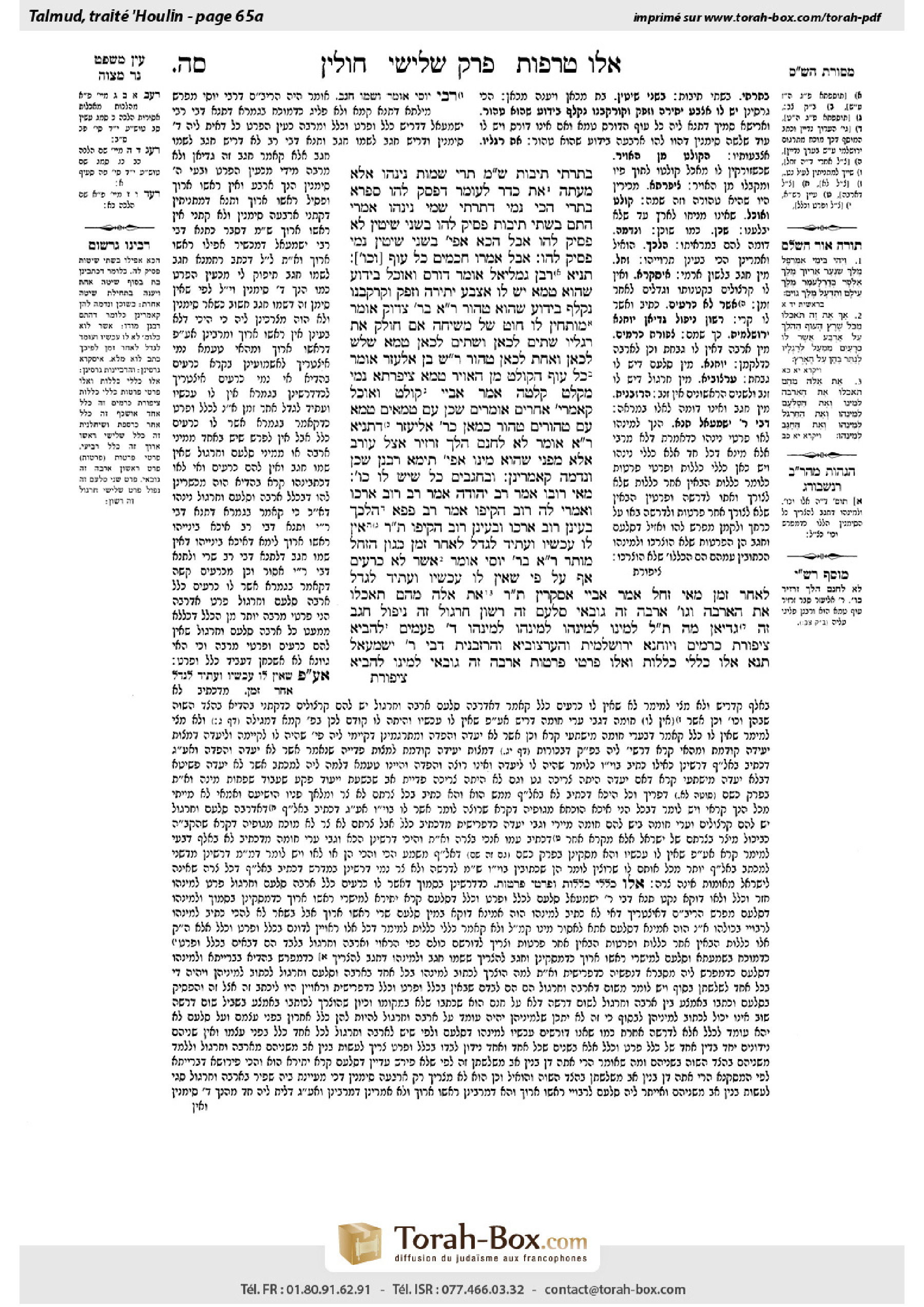
Chullin 65a: Talmud study for Daf Yomi
Study the Talmud for Daf Yomi with scanned pages, Hebrew text, English translations from Sefaria and AI-generated French translations.
Passage selection and English or AI-generated French translation are available where the scan has annotations. Daf Study is independent of Torah-Box and Sefaria.
Browse Chullin · חולין · All tractatesChullin 65a text and translations
This page of Chullin includes the Aramaic text, an English translation and an AI-generated French translation, alongside the scan above.
חולין ס״ה א · Aramaic and Hebrew text
בְּתַרְתֵּי תֵּיבוֹת, שְׁמַע מִינַּהּ תְּרֵי שֵׁמוֹת נִינְהוּ.
אֶלָּא מֵעַתָּה ״אֶת כְּדׇר לָעֹמֶר״ דְּפָסֵק לְהוּ סָפְרָא בִּתְרֵי, הָכִי נָמֵי דִּתְרֵי שְׁמֵי נִינְהוּ? אָמְרִי: הָתָם בִּשְׁתֵּי תֵּיבוֹת פָּסֵיק לְהוּ, בִּשְׁנֵי שִׁיטִין לָא פָּסֵיק לְהוּ, אֲבָל הָכָא אֲפִילּוּ בִּשְׁנֵי שִׁיטִין נָמֵי פָּסֵיק לְהוּ.
אֲבָל אָמְרוּ חֲכָמִים: כׇּל עוֹף. תַּנְיָא, רַבָּן גַּמְלִיאֵל אוֹמֵר: דּוֹרֵס וְאוֹכֵל – בְּיָדוּעַ שֶׁהוּא טָמֵא, יֵשׁ לוֹ אֶצְבַּע יְתֵירָה וְזֶפֶק וְקֻרְקְבָנוֹ נִקְלָף – בְּיָדוּעַ שֶׁהוּא טָהוֹר. רַבִּי אֶלְעָזָר בְּרַבִּי צָדוֹק אוֹמֵר: מוֹתְחִין לוֹ חוּט שֶׁל מְשִׁיחָה, אִם חוֹלֵק אֶת רַגְלָיו, שְׁתַּיִם לְכָאן וּשְׁתַּיִם לְכָאן – טָמֵא, שָׁלֹשׁ לְכָאן וְאַחַת לְכָאן – טָהוֹר. רַבִּי שִׁמְעוֹן בֶּן אֶלְעָזָר אוֹמֵר: כׇּל עוֹף הַקּוֹלֵט מִן הָאֲוִיר – טָמֵא.
צִיפַּרְתָּא נָמֵי מִקְלָט קָלְטָה! אָמַר אַבָּיֵי: ״קוֹלֵט וְאוֹכֵל״ קָאָמְרִי.
אֲחֵרִים אוֹמְרִים: שָׁכֵן עִם טְמֵאִים – טָמֵא, עִם טְהוֹרִים – טָהוֹר.
כְּמַאן? כְּרַבִּי אֱלִיעֶזֶר, דְּתַנְיָא: רַבִּי אֱלִיעֶזֶר אוֹמֵר: לֹא לְחִנָּם הָלַךְ זַרְזִיר אֵצֶל עוֹרֵב, אֶלָּא מִפְּנֵי שֶׁהוּא מִינוֹ. אֲפִילּוּ תֵּימָא רַבָּנַן, שָׁכֵן וְנִדְמֶה קָאָמְרִינַן.
וּבַחֲגָבִים, כֹּל שֶׁיֵּשׁ לוֹ כּוּ׳. מַאי רוּבּוֹ? אָמַר רַב יְהוּדָה אָמַר רַב: רוֹב אׇרְכּוֹ, וְאָמְרִי לַהּ: רוֹב הֶקֵּיפוֹ. אָמַר רַב פָּפָּא: הִלְכָּךְ בָּעֵינַן רוֹב אׇרְכּוֹ, וּבָעֵינַן רוֹב הֶקֵּיפוֹ.
תָּנוּ רַבָּנַן: אֵין לוֹ עַכְשָׁיו וְעָתִיד לְגַדֵּל לְאַחַר זְמַן, כְּגוֹן הַזַּחַל – מוּתָּר. רַבִּי אֶלְעָזָר בְּרַבִּי יוֹסֵי אוֹמֵר: ״אֲשֶׁר לֹא כְרָעַיִם״ – אַף עַל פִּי שֶׁאֵין לוֹ עַכְשָׁיו וְעָתִיד לְגַדֵּל לְאַחַר זְמַן. מַאי זַחַל? אָמַר אַבָּיֵי: אַסְקְרָא.
תָּנוּ רַבָּנַן: ״אֶת אֵלֶּה מֵהֶם תֹּאכֵלוּ אֶת הָאַרְבֶּה וְגוֹ׳״. אַרְבֶּה – זֶה גּוֹבַאי, סַלְעָם – זֶה רָשׁוֹן, חַרְגּוֹל – זֶה נִיפּוּל, חָגָב – זֶה נַדְיָאן. מָה תַּלְמוּד לוֹמַר ״לְמִינוֹ״ ״לְמִינֵהוּ״ ״לְמִינֵהוּ״ ״לְמִינֵהוּ״ אַרְבַּע פְּעָמִים? לְהָבִיא צִיפּוֹרֶת כְּרָמִים, וְיוֹחָנָא יְרוּשַׁלְמִית, וְהָעַרְצוּבְיָא, וְהָרַזְבָּנִית.
דְּבֵי רַבִּי יִשְׁמָעֵאל תָּנָא: אֵלּוּ כְּלָלֵי כְלָלוֹת, וְאֵלּוּ פְּרָטֵי פְרָטוֹת. ״אַרְבֶּה״ – זֶה ״גּוֹבַאי״, ״לְמִינוֹ״ לְהָבִיא
Chullin 65a · English translation
into two words, conclude from it that they are two names, prohibiting the egg as well.
The Gemara asks: If that is so, what about the name: “Chedorlaomer” (Genesis 14:4), which the scribe splits in two so that it appears as: Chedor Laomer? Is it also true there that they are two names? The verse is clearly referring to only one person. They say in response: There, with regard to Chedor Laomer, the scribe splits the name into two words, but he may not split it into two lines if the first half nears the end of one line. But here, he may split the name bat ya’ana even into two lines, indicating that they are completely separate.
§ The mishna states: But the Sages stated that any bird that claws its prey and eats it is non-kosher. It is taught in a baraita: Rabban Gamliel says: A bird that claws its prey and eats it is certainly non-kosher. If it has an extra digit and a crop, and its gizzard can be peeled, it is certainly kosher. Rabbi Elazar, son of Rabbi Tzadok, says: One stretches a line, and the bird perches on it. If it splits its feet on the line, with two digits here and two there, it is non-kosher. If it places three digits here and one there, it is possibly kosher. Rabbi Shimon ben Elazar says: Any bird that catches food out of the air is non-kosher.
The Gemara interjects: But the tziparta also catches food out of the air, and it is kosher. Abaye said: We say this only for a bird that both catches and eats its food in the air. The tziparta lands before eating what it has caught.
The baraita concludes: Others say: If a bird dwells with non-kosher birds, it is non-kosher; if it dwells with kosher birds, it is kosher.
The Gemara asks: In accordance with whose opinion is this last statement? Perhaps it is in accordance with the opinion of Rabbi Eliezer, as it is taught in a baraita: Rabbi Eliezer says: It was not for naught that the zarzir went to dwell with the crow, but because it is of the same species. The Gemara rejects this: You may even say that the opinion introduced with the words: Others say, is like that of the Rabbis, who disagree with Rabbi Eliezer and deem the zarzir kosher. The statement introduced with the words: Others say, is understood as follows: We say that a bird is non-kosher whenever it both dwells with a non-kosher bird and resembles it. The zarzir, though, does not resemble the crow.
§ The mishna states: And with regard to grasshoppers, any grasshopper that has four legs, and four wings, and two additional jumping legs, and whose wings cover most of its body, is kosher. The Gemara asks: What is considered most of its body? Rav Yehuda said that Rav said: Most of its length. And some say that he said: Most of its circumference. Rav Pappa said: Therefore, one must satisfy both versions of the statement. We require that the wings cover most of its length, and we also require that they cover most of its circumference.
The Sages taught in a baraita: A grasshopper that has no wings now but will grow them after a time, e.g., the zaḥal, is permitted. Rabbi Elazar, son of Rabbi Yosei, says: The verse states: “Yet these may you eat of all winged swarming things that go upon all fours, which have [lo] jointed legs above their feet, wherewith to leap upon the earth” (Leviticus 11:21). The word lo is written with the letter alef, meaning not, so that it can be understood as: Do not have jointed legs. This teaches that even though it has no jointed legs now but will grow them after a time, it is still kosher. The Gemara asks: What is the zaḥal? Abaye said: It is called askarin in Aramaic.
The Sages taught in a baraita that the verse states: “These of them you may eat: The arbeh after its kinds, and the solam after its kinds, and the ḥargol after its kinds, and the ḥagav after its kinds” (Leviticus 11:22). The arbeh is the insect known as the govai. The solam is the rashon. The ḥargol is the nippul. The ḥagav is the gadyan. Why must the verse state: “After its kinds,” “after its kinds,” “after its kinds,” and “after its kinds,” four times? It is to include four similar species: The vineyard bird, and the Jerusalem yoḥana, and the artzuveya, and the razbanit, which are also kosher.
The school of Rabbi Yishmael taught: These appearances of the phrase “after its kinds” in the verse are generalizations, and these species mentioned explicitly are details. The verse must be understood in light of the previous verse, which offers general signs of a kosher grasshopper. The two verses together are a generalization, and a detail, and a generalization, in the following manner: The first verse is a generalization, arbeh is a detail referring to the species govai, and the phrase “after its kinds” is another generalization. According to Rabbi Yishmael’s hermeneutical principles, the second generalization serves to include a case similar to the detail. In this case, the phrase “after its kinds” serves to include
Chullin 65a · Traduction française (IA)
en deux mots, on conclut qu'il s'agit de deux noms, interdisant également l'œuf.
La Guemara pose la question : Si c'est ainsi, que dire du nom « Chedorlaomer » (Genèse 14:4), que l'écrivain divise en deux mots pour qu'il apparaisse comme « Chedor Laomer » ? Est-ce aussi vrai là que ce sont deux noms ? La versette fait clairement référence à une seule personne. Ils répondent : Là, concernant « Chedor Laomer », l'écrivain divise le nom en deux mots, mais il ne peut pas le diviser en deux lignes si la première moitié est près de la fin d'une ligne. Ici, il peut diviser le nom « bat ya’ana » même en deux lignes, indiquant qu'ils sont complètement séparés.
§ La Michna stipule : Mais les Sages ont dit que tout oiseau qui déchire sa proie et la mange est non-kosher. Il est enseigné dans une baraïta : Rabban Gamliel dit : Un oiseau qui déchire sa proie et la mange est certainement non-kosher. S'il a un doigt supplémentaire et un estomac, et que son bec peut être écorché, il est certainement kosher. Rabbi Elazar, fils de Rabbi Tzadok, dit : On tend une ligne, et l'oiseau s'assoit dessus. Si ses pieds s'écartent sur la ligne, avec deux doigts ici et deux là, il est non-kosher. Si il place trois doigts ici et un là, il est peut-être kosher. Rabbi Shimon ben Elazar dit : Tout oiseau qui attrape sa nourriture de l'air est non-kosher.
La Guemara interrompt : Mais le tziparta aussi attrape sa nourriture de l'air, et il est kosher. Abaye dit : Nous disons cela uniquement pour un oiseau qui à la fois attrape et mange sa nourriture dans l'air. Le tziparta atterrit avant de manger ce qu'il a attrapé.
La baraïta conclut : D'autres disent : Si un oiseau vit avec des oiseaux non-kosher, il est non-kosher ; si il vit avec des oiseaux kosher, il est kosher.
La Guemara pose la question : Selon l'opinion de qui est cette dernière déclaration ? Peut-être selon celle de Rabbi Eliezer, comme il est enseigné dans une baraïta : Rabbi Eliezer dit : Ce n'était pas pour rien que le zarzir a vécu avec le corbeau, mais parce qu'il est de la même espèce. La Guemara rejette cela : On peut même dire que l'opinion introduite avec les mots « D'autres disent » est celle des Rabbins, qui s'opposent à Rabbi Eliezer et considèrent le zarzir comme kosher. La déclaration introduite avec les mots « D'autres disent » est entendue comme suit : Nous disons qu'un oiseau est non-kosher chaque fois qu'il vit avec un oiseau non-kosher et ressemble à celui-ci. Le zarzir, en revanche, ne ressemble pas au corbeau.
§ La Michna stipule : Et concernant les sauterelles, toute sauterelle qui a quatre pattes, quatre ailes, et deux pattes supplémentaires pour sauter, et dont les ailes recouvrent la plupart de son corps, est kasher. La Guemara pose la question : Qu'est-ce qui constitue la plupart de son corps ? Rav Yehuda dit que Rav a dit : La plupart de sa longueur. Et certains disent qu'il a dit : La plupart de sa circonférence. Rav Pappa dit : Par conséquent, on doit satisfaire les deux versions de l'affirmation. Nous exigeons que les ailes recouvrent la plupart de sa longueur, et nous exigeons également qu'elles recouvrent la plupart de sa circonférence.
Les Sages ont enseigné dans une baraïta : Une sauterelle qui n'a pas d'ailes maintenant mais en grandira plus tard, par exemple le zaḥal, est permise. Rabbi Elazar, fils de Rabbi Yosei, dit : La versette stipule : « Et ces-ci vous êtes permis de manger de tous les oiseaux volants qui se meuvent sur quatre pattes, qui ont [lo] des pattes articulées au-dessus de leurs pieds, avec lesquelles ils sautent sur la terre » (Lévitique 11:21). Le mot lo est écrit avec la lettre alef, signifiant non, afin qu'il puisse être compris comme : Ne pas avoir des pattes articulées. Cela enseigne que même s'il n'a pas de pattes articulées maintenant mais en en développera plus tard, il est encore kasher. La Guemara pose la question : Qu'est-ce que le zaḥal ? Abaye dit : C'est appelé askarin en araméen.
Les Sages ont enseigné dans une baraïta que la versette stipule : « Ces-ci vous êtes permis de manger : l'arbeh selon son espèce, et le solam selon son espèce, et le ḥargol selon son espèce, et le ḥagav selon son espèce » (Lévitique 11:22). L'arbeh est l'insecte connu sous le nom de govai. Le solam est le rashon. Le ḥargol est le nippul. Le ḥagav est le gadyan. Pourquoi la versette stipule-t-elle : « selon son espèce », « selon son espèce », « selon son espèce », et « selon son espèce », quatre fois ? C'est pour inclure quatre espèces similaires : l'oiseau de la vigne, et la yoḥana de Jérusalem, et l'artzuveya, et le razbanit, qui sont également kasher.
L'école de Rabbi Yishmael enseigna : Ces occurrences de la phrase « selon son espèce » dans la versette sont des généralisations, et ces espèces mentionnées explicitement sont des détails. La versette doit être comprise à la lumière de la versette précédente, qui offre des signes généraux d'une sauterelle kosher. Les deux versettes ensemble sont une généralisation, un détail, et une généralisation, dans le sens suivant : La première versette est une généralisation, l'arbeh est un détail faisant référence à l'espèce govai, et la phrase « selon son espèce » est une autre généralisation. Selon les principes herméneutiques de Rabbi Yishmael, la deuxième généralisation sert à inclure un cas similaire au détail. Dans ce cas, la phrase « selon son espèce » sert à inclure
Traduction française générée par IA à partir de l’édition anglaise de Sefaria. Vérifie toujours un passage avec le texte source.
Text from Sefaria: William Davidson Edition - Vocalized Aramaic (unknown); William Davidson Edition - English (CC BY NC).