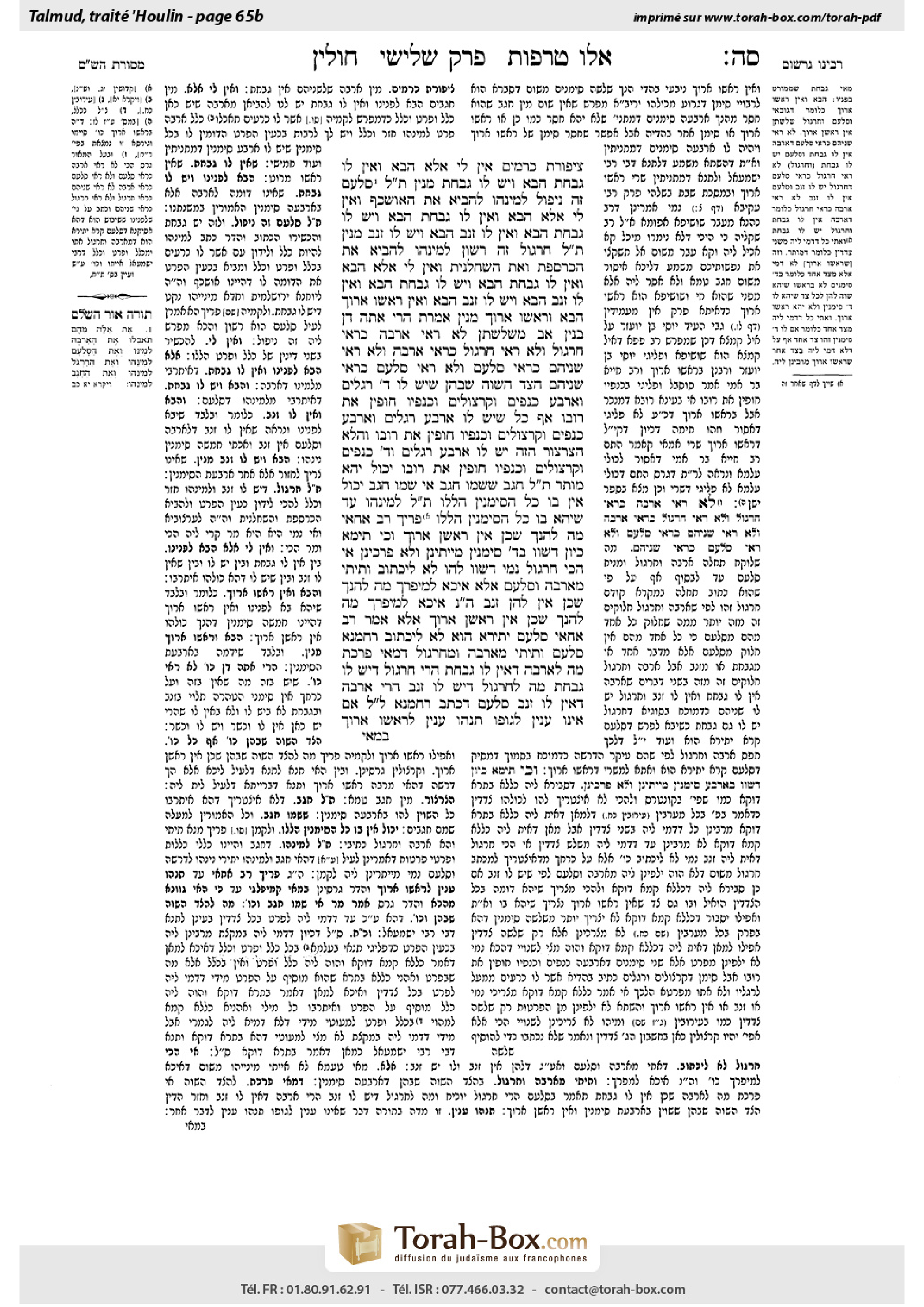
Chullin 65b: Talmud study for Daf Yomi
Study the Talmud for Daf Yomi with scanned pages, Hebrew text, English translations from Sefaria and AI-generated French translations.
Passage selection and English or AI-generated French translation are available where the scan has annotations. Daf Study is independent of Torah-Box and Sefaria.
Browse Chullin · חולין · All tractatesChullin 65b text and translations
This page of Chullin includes the Aramaic text, an English translation and an AI-generated French translation, alongside the scan above.
חולין ס״ה ב · Aramaic and Hebrew text
צִיפּוֹרֶת כְּרָמִים.
אֵין לִי אֶלָּא הַבָּא וְאֵין לוֹ גַּבַּחַת. הַבָּא וְיֵשׁ לוֹ גַּבַּחַת מִנַּיִן? תַּלְמוּד לוֹמַר ״סׇלְעָם״ – זֶה נִיפּוּל, ״לְמִינֵהוּ״ – לְהָבִיא אֶת הָאוּשְׁכָּף.
וְאֵין לִי אֶלָּא הַבָּא וְאֵין לוֹ גַּבַּחַת, הַבָּא וְיֵשׁ לוֹ גַּבַּחַת. הַבָּא וְאֵין לוֹ זָנָב, הַבָּא וְיֵשׁ לוֹ זָנָב מִנַּיִן? תַּלְמוּד לוֹמַר ״חַרְגֹּל״ – זֶה רָשׁוֹן, ״לְמִינֵהוּ״ – לְהָבִיא אֶת הַכַּרְסֶפֶת וְאֶת הַשַּׁחֲלָנִית.
וְאֵין לִי אֶלָּא הַבָּא וְאֵין לוֹ גַּבַּחַת, הַבָּא וְיֵשׁ לוֹ גַּבַּחַת; הַבָּא וְאֵין לוֹ זָנָב, הַבָּא וְיֵשׁ לוֹ זָנָב. הַבָּא וְאֵין רֹאשׁוֹ אָרוֹךְ, הַבָּא וְרֹאשׁוֹ אָרוֹךְ מִנַּיִן?
אָמַרְתָּ: הֲרֵי אַתָּה דָן בִּנְיַן אָב מִשְּׁלׇשְׁתָּן, לֹא רְאִי אַרְבֶּה כִּרְאִי חַרְגּוֹל, וְלֹא רְאִי חַרְגּוֹל כִּרְאִי אַרְבֶּה, וְלֹא רְאִי שְׁנֵיהֶם כִּרְאִי סׇלְעָם, וְלֹא רְאִי סׇלְעָם כִּרְאִי שְׁנֵיהֶם. הַצַּד הַשָּׁוֶה שֶׁבָּהֶן – שֶׁיֵּשׁ לוֹ אַרְבַּע רַגְלַיִם, וְאַרְבַּע כְּנָפַיִם, וְקַרְצוּלַּיִם, וּכְנָפָיו חוֹפִין אֶת רוּבּוֹ; אַף כֹּל שֶׁיֵּשׁ לוֹ אַרְבַּע רַגְלַיִם, וְאַרְבַּע כְּנָפַיִם, וְקַרְצוּלַּיִם, וּכְנָפָיו חוֹפִין אֶת רוּבּוֹ.
וַהֲלֹא הַצַּרְצוּר הַזֶּה יֵשׁ לוֹ אַרְבַּע רַגְלַיִם, וְאַרְבַּע כְּנָפַיִם, וְקַרְצוּלַּיִם, וּכְנָפָיו חוֹפִין אֶת רוּבּוֹ, יָכוֹל יְהֵא מוּתָּר? תַּלְמוּד לוֹמַר ״חָגָב״, שֶׁשְּׁמוֹ חָגָב.
אִי שְׁמוֹ חָגָב, יָכוֹל אֵין בּוֹ כׇּל הַסִּימָנִין הַלָּלוּ? תַּלְמוּד לוֹמַר ״לְמִינֵהוּ״ – עַד שֶׁיְּהֵא בּוֹ כׇּל הַסִּימָנִין הַלָּלוּ.
פָּרֵיךְ רַב אַחַאי: מָה לְהָנָךְ, שֶׁכֵּן אֵין רֹאשָׁן אָרוֹךְ? וְכִי תֵּימָא: כֵּיוָן דְּשָׁווּ בְּאַרְבַּע סִימָנִין מַיְיתִינַן וְלָא פָּרְכִינַן – אִי הָכִי, חַרְגּוֹל נָמֵי דְּשָׁווּ לְהוּ, לָא לִיכְתּוֹב וְתֵיתֵי מֵאַרְבֶּה וְסׇלְעָם!
אֶלָּא, אִיכָּא לְמִיפְרַךְ: מָה לְהָנָךְ שֶׁכֵּן אֵין לָהֶן זָנָב. הָכִי נָמֵי אִיכָּא לְמִיפְרַךְ: מָה לְהָנָךְ שֶׁכֵּן אֵין רֹאשָׁן אָרוֹךְ?
אֶלָּא אָמַר רַב אַחַאי: סׇלְעָם יַתִּירָא הוּא, לָא לִיכְתּוֹב רַחֲמָנָא ״סׇלְעָם״, וְתֵיתֵי מֵאַרְבֶּה וּמֵחַרְגּוֹל, דְּמַאי פָּרְכַתְּ? מָה לְאַרְבֶּה דְּאֵין לוֹ גַּבַּחַת – הֲרֵי חַרְגּוֹל דְּיֵשׁ לוֹ גַּבַּחַת, מָה לְחַרְגּוֹל דְּיֵשׁ לוֹ זָנָב – הֲרֵי אַרְבֶּה דְּאֵין לוֹ זָנָב, סׇלְעָם דִּכְתַב רַחֲמָנָא לְמָה לִי? אִם אֵינוֹ עִנְיָן לְגוּפוֹ – תְּנֵהוּ עִנְיָן לְרֹאשׁוֹ אָרוֹךְ.
Chullin 65b · English translation
the vineyard bird, which is similar to the arbeh in that its forehead is not smooth but has small hairs.
I have derived only that a species that comes before a person and does not have a smooth forehead is kosher. From where is it derived that even one that comes before a person and has a smooth forehead is kosher? The verse states: “Solam,” and this is the nippul, which has a smooth forehead. The phrase “after its kinds” that follows solam is another generalization, which serves to include a case similar to the detail, i.e., the ushkaf, which has a smooth forehead like the solam.
And I have derived only that a species that comes before a person and does not have a smooth forehead, like the arbeh, or one that comes before a person and has a smooth forehead, like the solam, or one that comes before a person and has no tail, is kosher, since none of the previously mentioned grasshoppers have a tail. From where is it derived that even one that comes before a person and has a tail is kosher? The verse states: “Ḥargol,” and this is the rashon, which has a tail. The phrase “after its kinds” that follows ḥargol is another generalization, and it serves to include the karsefet and the shaḥlanit, which also have tails.
And I have derived only that a species that comes before a person and does not have a smooth forehead, or that comes before a person and has a smooth forehead, or that comes and has no tail, or that comes and has a tail, or that comes and its head is not long, is kosher, since every grasshopper mentioned until this point does not have a long head. From where is it derived that even one that comes and its head is long is kosher?
You will say: You derive a paradigm from the three of them, as follows: The aspect [re’i] of the arbeh, which has neither smooth forehead nor tail, is not similar to the aspect of the ḥargol, which has both; and the aspect of the ḥargol is not similar to the aspect of the arbeh. And the aspect of neither of them is similar to the aspect of the solam, which has a smooth forehead but no tail, and the aspect of the solam is similar to neither of their aspects. The characteristic that renders them all kosher can only be an aspect common to all of them. Their common denominator is that each has four legs, and four wings, and jumping legs, and its wings cover most of its body. So too, any other species that has four legs, and four wings, and jumping legs, and its wings cover most of its body is kosher, even if its head is long.
One might ask: But doesn’t this tzartzur have four legs, and four wings, and jumping legs, and its wings cover most of its body? Consequently, one might have thought that it should be permitted. Therefore, the verse states: “Ḥagav,” to indicate that its name must be ḥagav. This includes all of the species previously mentioned, but not the tzartzur.
But if its name must be ḥagav, one might have thought that any ḥagav is kosher, even if it does not have all these signs. Therefore, the verse states: “After its kinds,” indicating that even if it is called a ḥagav it is not kosher unless it has all these signs. This concludes the baraita of the school of Rabbi Yishmael.
Rav Aḥai refutes the baraita: The four signs listed are not the sole common denominators between the arbeh, ḥargol, and solam. What is also unique about these grasshoppers in addition to these signs? They are unique in that their heads are not long. If so, grasshoppers with long heads might not be kosher. And if you would say: Since they share these four signs, we include all others with these four signs and we do not refute them, since the included species need not be identical in all their aspects, if so, the Torah should not even write the ḥargol, which shares these four signs with the arbeh and the solam, and let it be derived that the ḥargol is kosher by inference from the common denominators between the arbeh and solam.
Rather, it was necessary for the verse to write ḥargol because if it were omitted, its inclusion could be refuted as follows: What is unique about these, the arbeh and solam? They are unique in that they both have no tail. Since the ḥargol has a tail, its kosher status cannot be inferred from theirs. So too, the inclusion of grasshoppers with long heads can be refuted as follows: What is unique about these, the arbeh, ḥargol, and solam? They are unique in that their heads are not long. If so, grasshoppers with long heads might not be kosher.
Rather, Rav Aḥai said: One can derive that grasshoppers with long heads are kosher as follows: The solam mentioned in the verse is redundant. How so? Let the Merciful One not write solam, and instead let it be derived by inference from the common denominators between the arbeh and ḥargol, that they have four legs, four wings, jumping legs, and that their wings cover most of their body. As what can you say to refute this? If you say: What can be derived from the arbeh, which, unlike the solam, does not have a smooth forehead; one can respond: But there is the ḥargol, which has a smooth forehead. And if you say: What can be derived from the ḥargol, which, unlike the solam, has a tail, one can respond: But there is the arbeh, which has no tail. If so, why do I need the solam that the Merciful One wrote? Rather, if the solam is not necessary for the matter itself, apply it to the matter of a long-headed grasshopper, to teach that it is kosher.
Chullin 65b · Traduction française (IA)
l'oiseau du domaine, qui est semblable à l'arbeh, car son front n'est pas lisse mais présente de petites touffes.
J'ai déduit seulement que toute espèce qui vient avant une personne et dont le front n'est pas lisse est permise. D'où vient-on que même celle qui vient avant une personne et dont le front est lisse est permise ? La Sainte Écriture dit : « Solam », et c'est le nippul, dont le front est lisse. La phrase « selon son espèce » qui suit « solam » est une généralisation supplémentaire, qui sert à inclure un cas similaire au détail, c'est-à-dire l'ushkaf, dont le front est lisse comme celui de solam.
Et j'ai déduit seulement que toute espèce qui vient avant une personne et dont le front n'est pas lisse, comme l'arbeh, ou qui vient avant une personne et dont le front est lisse, comme le solam, ou qui vient avant une personne et n'a pas de queue, est permise, car aucun des grillons mentionnés jusqu'à présent n'a de queue. D'où vient-on que même celui qui vient avant une personne et qui a une queue est permis ? La Sainte Écriture dit : « Ḥargol », et c'est le rashon, qui a une queue. La phrase « selon son espèce » qui suit ḥargol est une autre généralisation, et elle sert à inclure le karsefet et le shaḥlanit, qui ont aussi une queue.
Et j'ai déduit que toute espèce qui vient avant une personne et dont le front n'est pas lisse, ou qui vient avant une personne et dont le front est lisse, ou qui vient et n'a pas de queue, ou qui vient et a une queue, ou qui vient et dont la tête n'est pas longue, est permise, car chaque grillon mentionné jusqu'à présent n'a pas une tête longue. D'où vient-on que même celui qui vient et dont la tête est longue est permis ?
Tu diras : Tu déduis un modèle à partir des trois d'entre eux, comme suit : L'aspect [re'î] de l'arbeh, qui n'a ni front lisse ni queue, n'est pas semblable à l'aspect du ḥargol, qui en a les deux ; et l'aspect du ḥargol n'est pas semblable à l'aspect de l'arbeh. Et l'aspect de ni l'un ni l'autre n'est semblable à l'aspect du solam, qui a un front lisse mais pas de queue, et l'aspect du solam n'est pas semblable à l'aspect de l'un ou de l'autre. Le caractère qui rend tous ces grillons permis ne peut être qu'un aspect commun à tous. Le point commun est que chacun a quatre pattes, quatre ailes, des pattes sautantes, et ses ailes recouvrent la plupart de son corps. De même, toute autre espèce qui a quatre pattes, quatre ailes, des pattes sautantes, et dont ses ailes recouvrent la plupart de son corps est permise, même si sa tête est longue.
On pourrait demander : Mais ce tzartzur a-t-il quatre pattes, quatre ailes, des pattes sautantes, et ses ailes recouvrent-elles la plupart de son corps ? Ainsi, on pourrait penser qu'il devrait être permis. Par conséquent, la Sainte Écriture dit : « Ḥagav », pour indiquer que son nom doit être ḥagav. Cela inclut toutes les espèces mentionnées précédemment, mais pas le tzartzur.
Mais si son nom doit être ḥagav, on pourrait penser que tout ḥagav est acceptable, même s'il n'a pas tous ces signes. Par conséquent, la Torah écrite dit : « selon son espèce », indiquant que même s'il est appelé ḥagav, il n'est pas acceptable à moins qu'il ait tous ces signes. Cela conclut la baraïta de la maison de Rabbi Yishmael.
Rav Aḥai réfute la baraïta : Les quatre signes mentionnés ne sont pas le seul point commun entre l'arbeh, le ḥargol et le solam. Quel est aussi ce qui est particulier à ces grillons en plus de ces signes ? Ils sont particuliers dans le fait que leurs têtes ne sont pas longues. Si c'est le cas, les grillons avec des têtes longues pourraient ne pas être acceptables. Et si tu dis : Puisque ils partagent ces quatre signes, nous incluons tous les autres avec ces quatre signes et nous ne les réfutons pas, car les espèces incluses n'ont pas besoin d'être identiques en tous leurs aspects, si c'est le cas, la Torah ne devrait pas même écrire le ḥargol, qui partage ces quatre signes avec l'arbeh et le solam, et laisser être déduit que le ḥargol est acceptable par inférence à partir du point commun entre l'arbeh et le solam.
Plutôt, il était nécessaire que la Torah écrite écrive ḥargol, car si elle était omise, son inclusion pourrait être réfutée comme suit : Qu'est-ce qui est particulier à ces, l'arbeh et le solam ? Ils sont particuliers dans le fait qu'ils n'ont pas de queue. Puisque le ḥargol a une queue, son statut d'acceptation ne pourrait pas être déduit à partir des leurs. De même, l'inclusion des grillons avec des têtes longues pourrait être réfutée comme suit : Qu'est-ce qui est particulier à ces, l'arbeh, le ḥargol et le solam ? Ils sont particuliers dans le fait que leurs têtes ne sont pas longues. Si c'est le cas, les grillons avec des têtes longues pourraient ne pas être acceptables.
Plutôt, Rav Aḥai dit : On peut déduire que les grillons à tête longue sont permis comme suit : Le solam mentionné dans la Sainte Écriture est redondant. Comment ? Fais en sorte que le Merciue ne l'écrive pas, et plutôt qu'il soit déduit par inférence à partir du point commun entre l'arbeh et le ḥargol, qu'ils ont quatre pattes, quatre ailes, des pattes sautantes, et que leurs ailes recouvrent la plupart de leur corps. Comment peux-tu réfuter cela ? Si tu dis : De quoi peut-on déduire à partir de l'arbeh, qui, contrairement au solam, n'a pas un front lisse ; on peut répondre : Mais il y a le ḥargol, qui a un front lisse. Et si tu dis : De quoi peut-on déduire à partir du ḥargol, qui, contrairement au solam, a une queue, on peut répondre : Mais il y a l'arbeh, qui n'a pas de queue. Si c'est le cas, pourquoi ai-je besoin du solam que le Merciue a écrit ? Plutôt, si le solam n'est pas nécessaire pour la matière elle-même, applique-le à la matière du grillon à tête longue, pour enseigner qu'il est permis.
Traduction française générée par IA à partir de l’édition anglaise de Sefaria. Vérifie toujours un passage avec le texte source.
Text from Sefaria: William Davidson Edition - Vocalized Aramaic (unknown); William Davidson Edition - English (CC BY NC).