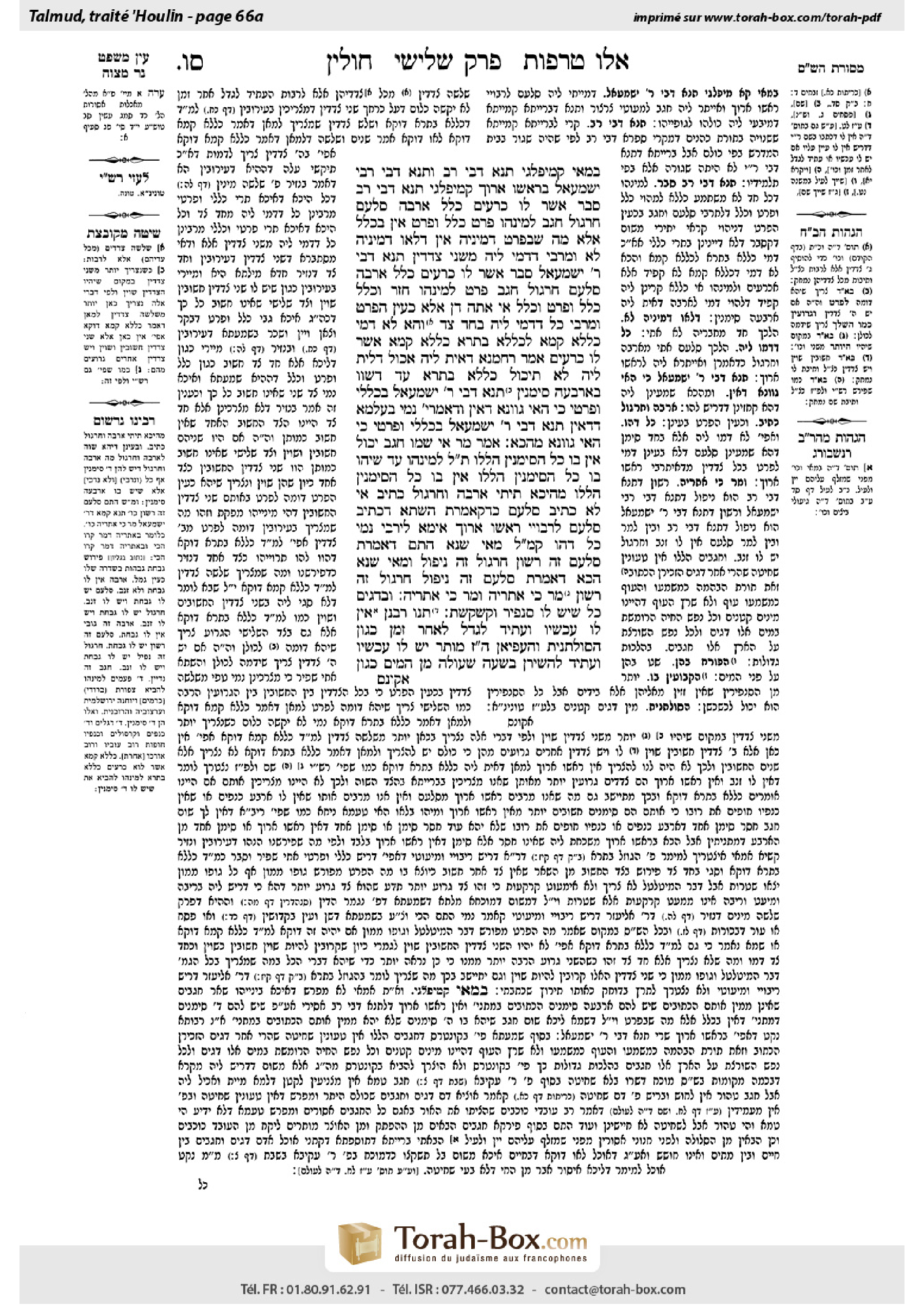
Chullin 66a: Talmud study for Daf Yomi
Study the Talmud for Daf Yomi with scanned pages, Hebrew text, English translations from Sefaria and AI-generated French translations.
Passage selection and English or AI-generated French translation are available where the scan has annotations. Daf Study is independent of Torah-Box and Sefaria.
Browse Chullin · חולין · All tractatesChullin 66a text and translations
This page of Chullin includes the Aramaic text, an English translation and an AI-generated French translation, alongside the scan above.
חולין ס״ו א · Aramaic and Hebrew text
בְּמַאי קָמִיפַּלְגִי תָּנָא דְּבֵי רַב וְתָנָא דְּבֵי רַבִּי יִשְׁמָעֵאל? בְּרֹאשׁוֹ אָרוֹךְ קָמִיפַּלְגִי.
תָּנָא דְּבֵי רַב סָבַר: ״אֲשֶׁר לוֹ כְּרָעַיִם״ – כָּלַל, ״אַרְבֶּה״ ״סׇלְעָם״ ״חַרְגֹּל״ ״חָגָב״ ״לְמִינֵהוּ״ – פָּרַט, כְּלָל וּפְרָט אֵין בַּכְּלָל אֶלָּא מַה שֶּׁבַּפְּרָט, דְּמִינֵיהּ – אִין, דְּלָאו (דמיניה) [מִינֵּיהּ] – לָא, וּמְרַבֵּי דְּדָמֵי לֵיהּ מִשְּׁנֵי צְדָדִין.
תָּנָא דְּבֵי רַבִּי יִשְׁמָעֵאל סָבַר: ״אֲשֶׁר לוֹ כְרָעַיִם״ – כָּלַל, ״אַרְבֶּה״ ״סׇלְעָם״ ״חַרְגֹּל״ ״חָגָב״ – פָּרַט, ״לְמִינֵהוּ״ – חָזַר וְכָלַל, כְּלָל וּפְרָט וּכְלָל – אִי אַתָּה דָן אֶלָּא כְעֵין הַפְּרָט, וּמְרַבֵּי כֹּל דְּדָמֵי לֵיהּ בְּחַד צַד.
וְהָא לָא דָּמֵי כְּלָלָא קַמָּא לִכְלָלָא בָּתְרָא? כְּלָלָא קַמָּא – ״אֲשֶׁר לוֹ כְרָעַיִם״ אָמַר רַחֲמָנָא, דְּאִית לֵיהּ אֱכוֹל, דְּלֵית לֵיהּ לָא תֵּיכוֹל. כְּלָלָא בָּתְרָא – עַד דְּשָׁווּ בְּאַרְבָּעָה סִימָנִין.
תָּנָא דְּבֵי רַבִּי יִשְׁמָעֵאל בִּכְלָלֵי וּפְרָטֵי כִּי הַאי גַוְונָא דָּאֵין, וּדְאָמְרִינַן נָמֵי בְּעָלְמָא דְּדָאֵין תָּנָא דְּבֵי רַבִּי יִשְׁמָעֵאל בִּכְלָלֵי וּפְרָטֵי כִּי הַאי גַוְונָא מֵהָכָא.
אָמַר מָר: אִי שְׁמוֹ ״חָגָב״, יָכוֹל אֵין בּוֹ כׇּל הַסִּימָנִין הַלָּלוּ? תַּלְמוּד לוֹמַר ״לְמִינֵהוּ״ – עַד שֶׁיְּהוּ בּוֹ כׇּל הַסִּימָנִין הַלָּלוּ. אֵין בּוֹ כׇּל הַסִּימָנִין הַלָּלוּ מֵהֵיכָא תֵּיתֵי? ״אַרְבֶּה״ וְ״חַרְגּוֹל״ כְּתִיב!
אִי לָא כְּתִיב ״סׇלְעָם״ – כִּדְקָאָמְרַתְּ, הַשְׁתָּא דִּכְתִיב ״סׇלְעָם״ – לְרַבּוֹיֵי רֹאשׁוֹ אָרוֹךְ, אֵימָא לִירַבֵּי נָמֵי כֹּל דְּהוּ – קָא מַשְׁמַע לַן.
מַאי שְׁנָא הָתָם דְּאָמְרַתְּ: ״סׇלְעָם״ – זֶה ״רָשׁוֹן״, ״חַרְגֹּל״ – זֶה ״נִיפּוּל״, וּמַאי שְׁנָא הָכָא דְּאָמְרַתְּ: ״סׇלְעָם״ – זֶה ״נִיפּוּל״, ״חַרְגֹּל״ – זֶה ״רָשׁוֹן״? מָר כִּי אַתְרֵיהּ וּמָר כִּי אַתְרֵיהּ.
וּבַדָּגִים כֹּל שֶׁיֵּשׁ לוֹ סְנַפִּיר וְקַשְׂקֶשֶׂת. תָּנוּ רַבָּנַן: אֵין לוֹ עַכְשָׁיו וְעָתִיד לְגַדֵּל לְאַחַר זְמַן, כְּגוֹן הַסּוּלְתָּנִית וְהָעַפְיָאן – הֲרֵי זֶה מוּתָּר. יֵשׁ לוֹ עַכְשָׁיו וְעָתִיד לְהַשִּׁירָן בְּשָׁעָה שֶׁעוֹלֶה מִן הַמַּיִם, כְּגוֹן
Chullin 66a · English translation
The Gemara asks: With regard to what do the tanna of the study hall, who taught the first baraita above, and the tanna of the school of Rabbi Yishmael disagree? They disagree with regard to a grasshopper whose head is long. According to the tanna of the study hall it is prohibited, and according to the tanna of the school of Rabbi Yishmael it is permitted.
The Gemara elaborates: The tanna of the study hall holds that the previous verse, permitting all species “which have jointed legs” (Leviticus 11:21), is a generalization. The species arbeh, solam, ḥargol, and ḥagav, and the phrase “after its kinds,” that appears after each, are a detail. As a rule, in any instance of a generalization and a detail, the generalization includes only that which is spelled out in the detail. Therefore, only grasshoppers of the same species as those detailed in the verse are kosher. Grasshoppers that are not of the same species as them are not kosher. And the phrase “after its kinds” amplifies the halakha to include grasshoppers that are similar to the named species in two aspects, i.e., that are very similar to them. Since all the named species have short heads, grasshoppers with long heads are forbidden.
By contrast, the tanna of the school of Rabbi Yishmael holds that the phrase “which have jointed legs” is a generalization. The species arbeh, solam, ḥargol, and ḥagav are a detail. And by the phrase “after its kinds” after each species, it then generalized again. In any instance of a generalization, and a detail, and a generalization, you may deduce that the verse is referring only to items similar to the detail. And the verse therefore amplifies the halakha to include any grasshopper that is similar to the named species in even one aspect, i.e., that has the four signs listed in the mishna, even if its head is long.
The Gemara asks: But how can this be considered a generalization, a detail, and a generalization? The first generalization is not similar to the latter generalization. In the first generalization, the Merciful One states: “Which have jointed legs,” indicating that you may eat a grasshopper that has jointed legs, but you may not eat one that does not have jointed legs, irrespective of any other sign. However, the latter generalization: “After its kinds,” indicates that no grasshopper is kosher unless it shares all four signs with the named species.
The Gemara responds: The tanna of the school of Rabbi Yishmael deduces from generalizations and details like this case, even if the generalizations are not similar to one another. The Gemara notes: And that which we also say generally, that the tanna of the school of Rabbi Yishmael deduces from generalizations and details like this case, is derived from here.
The Gemara analyzes the baraita of the school of Rabbi Yishmael: The Master said: If its name must be ḥagav, one might have thought that any ḥagav is kosher, even if it does not have all these four signs. Therefore, the verse states: “After its kinds,” indicating that it is not kosher unless it has all these signs. The Gemara asks: From where would this be derived, that a grasshopper is kosher even if it does not have all these signs? How could one entertain this possibility? Arbeh and ḥargol are written beforehand, indicating that all kosher grasshoppers must share the signs they both possess.
The Gemara responds: If solam had not been written as well, it would be as you said. But now that it is written: “Solam,” to include long-headed grasshoppers even though none of the named species have long heads, I will say: Let us also include any grasshopper that is called ḥagav. Therefore, the phrase “after its kinds” teaches us that this is not so.
The Gemara asks: What is different there, in the baraita of the study hall, that you say that the solam is the rashon, and the ḥargol is the nippul, and what is different here, in the baraita of the school of Rabbi Yishmael, that you say: The solam is the nippul, and the ḥargol is the rashon? The Gemara responds: This Sage refers to them in accordance with the custom of his locale and that Sage refers to them in accordance with the custom of his locale.
§ The mishna states: And with regard to fish, any fish that has a fin and a scale is kosher. The Sages taught in a baraita: If a fish does not have scales now but will grow them after a period of time, such as the sultanit and afyan fish, it is permitted. Likewise, if it has scales now but will shed them when it is caught and rises from the water, such as
Chullin 66a · Traduction française (IA)
La Guemara pose la question : À propos de quoi les tannaïm, l'un étant celui de la cour de étude qui a enseigné le premier baraïta ci-dessus, et l'autre celui de l'école de Rabbi Yishmael, sont-ils en désaccord ? Ils sont en désaccord concernant un sauterelle dont la tête est longue. Selon le tanna de la cour de étude, elle est interdite, et selon le tanna de l'école de Rabbi Yishmael, elle est permise.
La Guemara explique : Le tanna de la cour de étude considère que le verset précédent, qui permet tous les espèces « qui ont des pattes jointées » (Lévitique 11:21), est une généralisation. Les espèces arbeh, solam, ḥargol et ḥagav, ainsi que la phrase « selon leur espèce », qui suit chacune, sont des détails. En règle générale, dans tout cas d'une généralisation et d'un détail, la généralisation inclut uniquement ce qui est spécifié dans le détail. Ainsi, seules les sauterelles de la même espèce que celles détaillées dans le verset sont permises. Les sauterelles qui ne sont pas de la même espèce que celles-ci ne sont pas permises. Et la phrase « selon leur espèce » élargit la halakha pour inclure les sauterelles qui sont similaires aux espèces nommées sur deux aspects, c'est-à-dire très similaires à elles. Puisque toutes les espèces nommées ont des têtes courtes, les sauterelles avec des têtes longues sont interdites.
Par contraste, le tanna de l'école de Rabbi Yishmael considère que la phrase « qui ont des pattes jointées » est une généralisation. Les espèces arbeh, solam, ḥargol et ḥagav sont des détails. Et par la phrase « selon leur espèce » qui suit chaque espèce, il y a une généralisation à nouveau. Dans tout cas d'une généralisation, d'un détail et d'une généralisation, on peut déduire que le verset fait référence uniquement aux choses similaires au détail. Le verset élargit donc la halakha pour inclure toute sauterelle qui est similaire aux espèces nommées sur un seul aspect, c'est-à-dire qui possède les quatre signes listés dans la mitsna, même si sa tête est longue.
La Guemara pose la question : Mais comment peut-on considérer cela comme une généralisation, un détail et une généralisation ? La première généralisation n'est pas semblable à la seconde généralisation. Dans la première généralisation, l'Éternel dit : « Qui ont des pattes jointées », indiquant que l'on peut manger une sauterelle qui a des pattes jointées, mais qu'on ne peut pas manger celle qui n'en a pas, indépendamment de tout autre signe. Cependant, la seconde généralisation : « selon leur espèce », indique que aucune sauterelle n'est permise à moins qu'elle ne partage tous les quatre signes avec les espèces nommées.
La Guemara répond : Le tanna de l'école de Rabbi Yishmael déduit de généralisations et de détails comme dans ce cas, même si les généralisations ne sont pas semblables les unes aux autres. La Guemara note : Et ce que nous disons généralement, que le tanna de l'école de Rabbi Yishmael déduit de généralisations et de détails comme dans ce cas, est tiré d'ici.
La Guemara analyse la baraïta de l'école de Rabbi Yishmael : Le Maître dit : Si son nom doit être ḥagav, on pourrait penser que toute ḥagav est permise, même si elle ne possède pas tous ces quatre signes. Ainsi, le verset dit : « selon leur espèce », indiquant qu'elle n'est pas permise à moins qu'elle ne possède tous ces signes. La Guemara pose la question : D'où cette déduction, que la sauterelle est permise même si elle ne possède pas tous ces signes ? Comment pouvait-on envisager cette possibilité ? Arbeh et ḥargol sont écrits avant, indiquant que toutes les sauterelles permises doivent partager les signes qu'ils possèdent tous les deux.
La Guemara répond : Si solam n'avait pas été écrit également, ce serait comme vous le dites. Mais maintenant qu'il est écrit : « Solam », pour inclure les sauterelles à tête longue, même si aucune des espèces nommées n'en a, je dirai : Faisons aussi inclure toute sauterelle appelée ḥagav. Ainsi, la phrase « selon leur espèce » nous apprend que ce n'est pas ainsi.
La Guemara pose la question : Qu'est-ce qui diffère là, dans la baraïta de la cour de l'étude, que vous dites que solam est le rashon et ḥargol le nippul, et qu'est-ce qui diffère ici, dans la baraïta de l'école de Rabbi Yishmael, que vous dites : solam est le nippul et ḥargol le rashon ? La Guemara répond : Ce Sage les désigne selon la coutume de son lieu et ce Sage selon la coutume de son lieu.
§ La mitsna stipule : Et concernant les poissons, tout poisson qui a une nageoire et une écaille est permis. Les Sages ont enseigné dans une baraïta : Si un poisson n'a pas d'écailles maintenant mais en développera après un certain temps, comme les poissons sultanit et afyan, il est permis. De même, si il a des écailles maintenant mais en en perdra lorsqu'il est attrapé et monte à la surface de l'eau, comme
Traduction française générée par IA à partir de l’édition anglaise de Sefaria. Vérifie toujours un passage avec le texte source.
Text from Sefaria: William Davidson Edition - Vocalized Aramaic (unknown); William Davidson Edition - English (CC BY NC).